
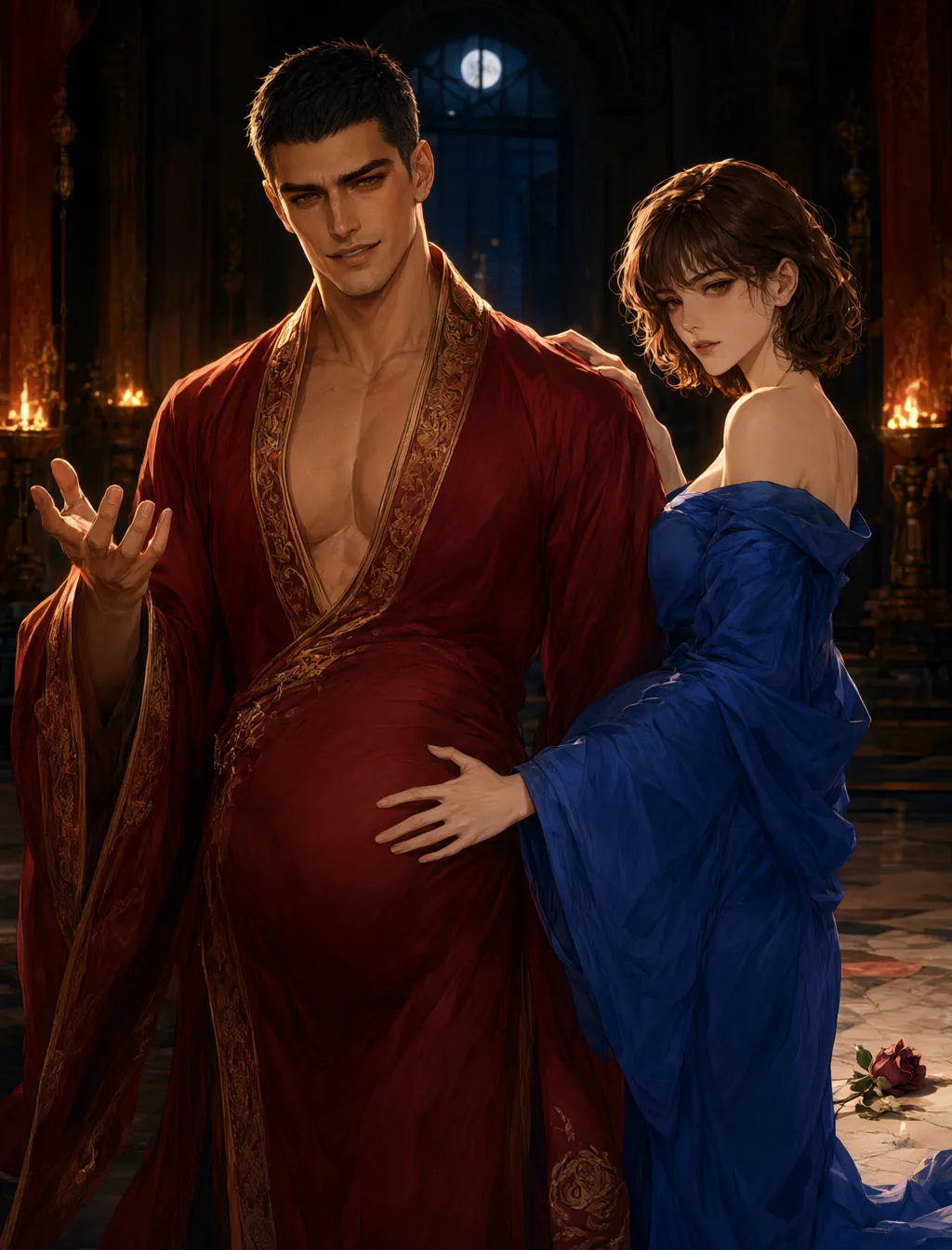
The main room had gone quiet in the way only late evening could make it—the fire low, the shadows long, the smell of woodsmoke settling into everything like a second skin. Phuwin stood at the basin near the hearth, his hands moving through the familiar work of folding towels, the white cloth soft against his fingers. He had wrapped a scarf over his hair, loose and practical, the way Clove had shown him, and the light cotton of his shirt hung thin against his shoulders.
He worked slowly. Everything was slow now, his body heavy with the weight of the child, his back aching in that dull, persistent way he had learned to ignore. The contractions had been coming and going for hours—small waves, distant things he could breathe through, could pretend were nothing. He had pretended before. He knew how to pretend.
His hands paused on a towel. Folded it again, though it was already folded. The motion was something to hold onto, something ordinary in a world that had stopped being ordinary days ago.
He thought of Pond.
Pond, asleep in the other room now, having finally let exhaustion take him after riding through the night. Pond, whose hand had found his in the doorway, whose voice had cracked when he said he was here, that he wasn't leaving. The words were still warm somewhere in Phuwin's chest, stubbornly alive despite everything.
And he thought of his daughters.
Imaria, with her serious eyes and her training scars, who had learned to carry the weight of the crown before she was old enough to understand it. Ovoale, whose laugh had filled every room she entered, whose wild curls had always escaped their braids no matter how tightly he wove them. Xiana, who watched the world with her father's intense stare and her mother's delicate bones, who had seen too much and said too little.
His hand drifted to his belly, pressing gently against the curve of it. The baby kicked—a small, insistent movement against his palm, as if she could feel the weight of his thoughts too.
"I know," he murmured, though he wasn't sure what he was answering. "I know."
The fire crackled. A log shifted, sending sparks up the chimney. Phuwin bent to gather another armful of towels into the basin, his movements careful, deliberate, the way he had learned to move in these final days—slowly, as if the child could sense his haste and punish him for it.
The scarf slipped.
It slid from his hair, catching on his ear, and he reached up to fix it, one hand still cradling the towels. The cloth was warm from the fire, and for a moment he stood there, half-bent, the weight of his belly pulling at his spine, the ache in his back sharpening into something that made his breath catch.
He straightened slowly. The ache eased. He told himself it was nothing.
He had told himself that before, too.
The memory came unbidden—the carriage, the blood pooling under his dress, the way the world had gone soft and distant while Clove's hands pressed against him, trying to hold in what was already leaving. He had felt that child leave him, had felt the life drain out of his own body along with it, and he had survived. He had survived because Clove had refused to let him go.
Phuwin closed his eyes. Breathed. The fire was warm on his face, and the baby was moving inside him, and he was still here, still standing, still folding towels in a house that smelled of herbs and safety.
The cramp came without warning.
It seized him low in his belly, a sharp, twisting pain that doubled him over before he could brace himself. The basin slipped from his hands, clattering against the packed-earth floor, towels spilling white against the dark wood. He gasped, one hand flying to the edge of the hearth, the other pressing hard against his belly as the pain rolled through him, deep and relentless.
"No," he breathed. "Not yet. Not—"
The contraction crested, held, and began to ease. Phuwin hung there, trembling, sweat already beading at his temples, his breath coming in short, ragged gasps. The baby shifted inside him, low and heavy, and he felt something give—a deep, internal release that he knew before he felt it.
Warmth flooded down his thighs.
His water broke, soaking the floor beneath him, pooling in the hollows of the packed earth. Phuwin stared down at it, his mind slow and distant, watching the liquid spread like something that belonged to someone else's body, someone else's life.
The second contraction hit before he could move.
It was stronger than the first, a wave that dragged him under, and he cried out—a sharp, broken sound that tore from his throat before he could stop it. His knees buckled. He caught himself on the hearth, fingers scraping against the rough stone, the heat of the fire searing his skin.
"Clove!"
The name came out as a scream, raw and desperate, echoing off the rough-hewn beams. The fire crackled. The shadows stretched. For a moment, there was nothing but the sound of his own breathing, harsh and uneven, and the wet stain spreading at his feet.
Then the door burst open.
Clove stood in the frame, her eyes wide, her hand still on the doorframe as if she had thrown it open without stopping to knock. Behind her, two maidens hovered, their faces pale in the firelight, their hands already reaching for cloth and water.
"Phuwin."
Clove's voice was steady, even as she crossed the room in three quick strides. Her hands found his shoulders, steadying him, and she looked down at the floor, at the water, at the towels scattered like white leaves. When she looked back at his face, her eyes were calm.
"You're in labor," she said. It wasn't a question.
Phuwin shook his head, though he didn't know why. Denial was a reflex, a habit worn smooth by years of pretending. "It's too early. It's—"
"It's time," Clove said gently. "The baby decides these things, not us."
Another contraction seized him, and he doubled over with a cry, his hands clutching Clove's arms, his nails digging into the fabric of her sleeves. She held him through it, her grip firm and unyielding, and when the wave passed, she was already guiding him toward the bed.
"Help me," she said to the maidens, and they moved, quick and silent, clearing the bed, spreading clean cloths, their hands efficient and practiced.
Phuwin let himself be led. He was shaking now, his whole body trembling with the force of the contractions, his hands cold despite the fire. The scarf had fallen completely from his hair, and his dark curls clung to his damp forehead, his brown eyes wide and dark.
"Pond," he managed, his voice thin. "I need—"
"I'll call him." Clove's hand pressed against his cheek, grounding him. "I'll call him right now. But I need you to breathe, Phuwin. Can you do that for me?"
He tried. He breathed, or tried to, the air coming in short, ragged pulls that didn't feel like enough. The baby moved inside him, a sharp, insistent kick against his ribs, and he gasped, his hand flying to his belly.
"She's coming," he whispered. "She's—"
"I know." Clove's voice was soft, but her eyes were already moving, already calculating. She looked at the maidens, at the bed, at the door. "Get the water hot. More cloths. Everything I showed you."
They scattered, and Clove turned to the small table by the bed, where a phone sat, old and heavy, its cord coiled like a sleeping snake. She picked it up, her fingers finding the numbers with practiced ease, and Phuwin watched her through the haze of pain, his breath catching as another contraction rolled through him.
The phone rang.
Once. Twice. The sound was distant, tinny, like it was coming from somewhere far away. Phuwin gripped the edge of the bed, his knuckles white, his teeth clenched against the wave building inside him.
Three rings. Four.
"Come on," Clove muttered, her hand tightening on the receiver. "Come on, come on—"
Five rings.
Then, a click. A voice, rough with sleep and alarm.
"Hello?"
Clove's shoulders dropped, relief flooding her face. "Pond. It's Clove." Her voice was steady, but there was something beneath it, something urgent and bright. "Phuwin is in labor. I need you, Pond."
There was a pause. A sharp intake of breath. Then the sound of movement, of someone already rising, already reaching for clothes.
"I'm coming." Pond's voice was rough, but it didn't waver. "I'm coming now."
"Be safe," Clove said. "The roads are—"
"I don't care about the roads."
The line went dead.
Clove set the phone down and turned back to Phuwin, her face soft, her hand finding his. He was shaking, his body arched against the bed, his breath coming in short, hard gasps as the contraction crested and held.
"He's coming," she said, her voice low and sure. "He's coming, Phuwin. You just have to hold on."
Phuwin nodded, or tried to, his eyes squeezed shut, his hand gripping hers so hard he could feel the bones of her fingers. The baby kicked again, sharp and insistent, and he cried out, the sound swallowed by the crackling of the fire and the distant, fading ring of the phone.
Somewhere, far away, he heard the maidens returning, heard the slosh of water, the rustle of cloth. But all he could feel was the pain, the relentless, rolling wave of it, and the small, stubborn kick of the life inside him, fighting to be born.
"She's coming," he gasped. "She's coming, she's—"
"I know." Clove's hand was on his forehead, cool and steady. "I know. And you're going to meet her, Phuwin. You're going to hold her in your arms."
Phuwin opened his eyes, and for a moment, the pain receded, just enough for him to see her—Clove, her face lit by the fire, her eyes bright with something that looked like hope.
"I'm scared," he whispered.
"I know," she said again. "But you're not alone."
The fire crackled. The shadows danced. And somewhere on the dark road, a horse was already galloping, carrying the emperor home.
Clove's thumb traced a slow circle on the back of his hand, a small, steady pressure that anchored him to the room. The firelight caught the silver in her hair, the lines around her eyes that deepened when she smiled, and for a breath, Phuwin let himself believe her. Believed that he was not alone, that the child inside him was not something to fear, that the dark road outside would deliver Pond to this door before the night was done.
The contraction released him slowly, like a wave pulling back from the shore, leaving him gasping on the bed, his body slick with sweat. The maidens had returned—he could hear them moving behind him, the soft rustle of cloth, the careful pour of water into a basin. Someone had draped a clean sheet over his legs, and the fabric was cool against his skin, a small mercy he hadn't asked for but received anyway.
Clove's hand found his forehead, brushing the damp curls from his eyes. "You're doing well," she said. "The baby is positioned well. I can feel her."
He wanted to laugh at that—doing well, as if his body were a ship navigating a storm it had no business surviving. But the laugh died in his throat, replaced by the low, building pressure of another wave, gathering somewhere deep and dark inside him.
"How long?" he managed. "How long until—"
"Until Pond gets here?" Clove's voice was gentle, but her eyes flicked to the window, where the night pressed black against the glass. "He'll ride fast. He always does."
Phuwin closed his eyes. He thought of Pond's hands—broad, calloused, the hands of a man who had signed treaties and held swords and still found the tenderness to cup his face in the doorway of this house. He thought of the way Pond had looked at him, red-eyed and travel-worn, as if Phuwin were a ghost he had been granted one more chance to hold.
"He shouldn't have come," Phuwin whispered, though the words felt wrong even as they left his mouth. "I left. I left him, and he—"
"He loves you." Clove said it simply, without judgment, as if it were a fact as plain as the fire in the hearth. "He rode through the night because he loves you. And he'll ride back with you, Phuwin. You and the baby."
The contraction crested before he could answer, and he bit down on his lip, tasting copper, his hand crushing Clove's fingers. The baby moved inside him, a sharp, insistent roll that made him cry out, the sound swallowed by the crackling of the fire and the murmur of the maidens' voices.
When the wave passed, he was trembling, his breath coming in shallow gasps. Clove pressed a cup of water to his lips, and he drank, the liquid cool against his raw throat. The room smelled of woodsmoke and herbs and something else now—something sharp and metallic that he recognized from the carriage, from the blood pooling under his dress, from the moment he had felt a child leave him for the last time.
"Clove." His voice was thin, barely a whisper. "What if—"
"No." She cut him off, firm but kind. "I'm not going to let you do this to yourself. Not now. Not when you're so close."
He wanted to argue. Wanted to tell her about the blood, the way it had soaked through his dress, the way the world had gone soft and distant while she pressed her hands against him, trying to hold in what was already leaving. But the words wouldn't come, tangled somewhere in his chest with the fear and the hope and the stubborn, relentless kick of the life inside him.
The fire popped, sending a shower of sparks up the chimney. One of the maidens crossed to the hearth, adding another log, and the flames leapt higher, casting long shadows across the packed-earth floor. Phuwin watched them dance, his hand pressed to his belly, feeling the baby shift and settle, as if she too were waiting for something.
Somewhere on the dark road, a horse was galloping. Somewhere in the night, a man was riding toward him, carrying the weight of an empire and the hope of a family. And here, in this small house that smelled of herbs and safety, Phuwin lay on a bed of clean cloths, his body shaking, his heart pounding, waiting for the next wave to take him under.