
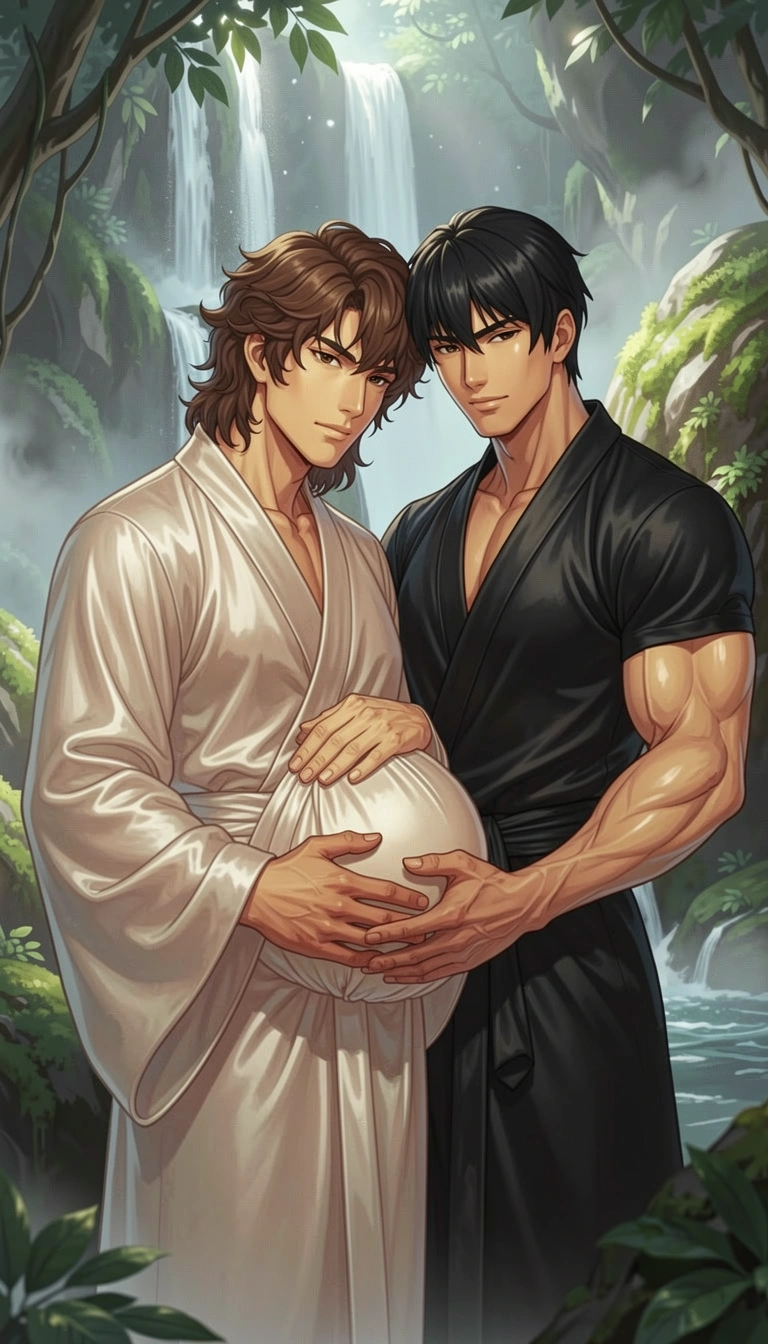
The twins slept in their cradle, Kael's tiny fist pressed against his cheek and Lirien's mouth slack, her chest rising and falling in the rhythm of the deeply contented. Phuwin watched them for a long moment, his hand resting on the cradle's edge, before the maid curtsied and lifted Aric from the bed. The baby fussed once, then settled against her shoulder, his dark hair already thick like Pond's.
"I'll have him fed and changed, Your Grace," the maid said, her voice soft. "Shall I bring him back after?"
Phuwin nodded, not trusting his voice. The door closed behind her, and the room became very still.
He stood at the cradle a moment longer, his fingers tracing the carved wood, then turned toward the bed. The ache in his legs was waiting for him—a deep, bone-level throb that started in his hips and ran down to his knees, the kind of pain that made standing feel like a bad decision. He took two steps, three, his hand finding the bedpost, and lowered himself onto the mattress. The silk sheets were cool against his palms, the pillows still dented from where he had lain that morning, and the exhale that left his mouth was more surrender than breath.
Every muscle in his body seemed to have a complaint. His lower back, his thighs, the tender ache where the healer had pressed and stitched. He eased himself onto his side, one arm cradling his stomach, the other stretched across the empty expanse of sheet beside him. The afternoon light had shifted to a deeper gold, slanting through the window in long beams that caught the dust motes floating in the still air.
The room was too quiet.
He heard the guards outside the door shift their weight, the soft scuff of boots on stone. One of them cleared his throat. Through the wall, distant and muffled, the palace hummed with life—servants moving, voices calling, the clatter of the kitchens. But here, in this bed, the silence had weight.
Phuwin stared at the empty space beside him. Pond's pillow still held the faintest curve, the indent of his head from the night before, when he had lain here with his hand on Phuwin's belly and murmured something about the morning. Then he had risen, dressed, kissed Phuwin's forehead, and walked out the door. That had been hours ago. The sun had made its full arc across the sky since then, and Phuwin had spent it in this bed, between these sheets, watching the light move and counting the minutes until someone came back.
He pressed his palm against Pond's pillow and let his fingers curl into the fabric. It was still cool. No warmth left.
Through the door, he heard the guard shift again, and when he lifted his eyes, he saw the shadow beneath the frame—the fair-haired guard who had escorted the healer this morning, whose gaze had lingered on Phuwin's throat, his hands, the curve of his waist. The one who stood a little too close when he opened doors, who watched a little too long when Phuwin walked past.
Phuwin turned his face toward the window, the ache in his legs sharpening as he shifted. He pulled the silk robe tighter around himself, the fabric sliding over his shoulders, and felt the weight of the guard's stare through the wood of the door. It was not the first time. It would not be the last. He had learned, years ago, to feel a gaze before he saw it—to sense when someone was looking at him not as Empress, but as a body. The fair-haired guard was not the worst offender. He did not leer. He simply watched, his eyes tracking the fall of Phuwin's robe, the pale skin of his collarbone, the faint red marks on his thighs that the sheets had not covered.
Phuwin closed his eyes. The ache in his legs throbbed. The silence pressed against his ears. And somewhere in the palace, three floors below, his husband was meeting with the council, signing papers, smiling at maids who brought him tea with their hips swaying.
He opened his eyes. The ceiling was white. The shadows had begun to lengthen.
He thought about staying here. About letting the silence win. About closing his eyes and waiting for sleep to take him somewhere else, somewhere quieter, where the ache in his legs meant nothing and the ache in his chest meant even less.
Then he thought about the fair-haired guard outside the door, who would probably watch him sleep through the crack if he left it open.
Phuwin twisted onto his back. The movement pulled at his stitches, and he hissed through his teeth, a sharp intake of breath that made his eyes water. He lay there, panting, staring at the ceiling, and felt the first flicker of something that was not quite anger, not quite sadness, but something in between. Something hot and tight and unreasonable.
He kicked his feet against the sheets. The fabric tangled around his ankles, and he kicked again, harder, until the robe rode up his thighs and the silk bunched beneath his knees. His hair—what was left of it, still growing back from the birth—fell across his face, and he blew at it, the breath making the strands flutter and then settle right back where they had been.
The pout came without thinking. It was his oldest weapon, honed over years of practice, perfected in moments like this: the lower lip thrust forward just so, the eyes wide and pleading, the whole expression calibrated to land somewhere between wounded and adorable. He had used it on Pond the first time they met, when Pond had refused to dance with him until Phuwin had looked up at him with those big brown eyes and said, very softly, Are you going to make me stand here alone? Pond had caved in less than a heartbeat. He had been caving ever since.
Phuwin pressed his lips together, held the pout for a moment, then let it drop. The room was still empty. There was no one here to see it.
He turned his head toward the bedside table. The phone sat there, black and polished, its cord curling behind the leg of the table. He stared at it. The phone stared back.
His hand moved before he had decided to reach. He picked up the receiver, pressed the button for Pond's office line, and held it to his ear.
The ring was loud in the quiet room. One. Two. Three.
No answer.
Phuwin let it ring again. Four. Five. The sound seemed to fill the room, bouncing off the walls, and he imagined it traveling down the corridor, down the stairs, through the heavy oak doors of the council chamber where Pond sat surrounded by advisors and maps and the serious faces of men who ran the empire. He imagined them all pausing at the sound, turning to look at the phone on the table, waiting for someone to pick it up.
Six. Seven.
No one did.
Phuwin hung up. The receiver clicked into its cradle with a sound that felt final. He stared at the phone, his jaw tight, and then he dialed again.
One. Two.
This time, he let it ring until it stopped on its own. The silence after was worse than the waiting.
He set the receiver down carefully, as if it might break, and lay back against the pillows. The pout had returned, unbidden, and he let it stay. There was no one to see it anyway.
He was already turning toward the window, already settling into the ache, when the door opened.
The sound was soft—just the click of the latch and the creak of old hinges—but Phuwin felt it in his chest. He did not turn. He kept his face toward the window, his profile to the door, and listened to the footsteps cross the room. Heavy. Measured. A stride he knew as well as his own heartbeat.
The bed dipped as Pond sat on the edge. The mattress tilted, rolling Phuwin slightly toward him, and the warmth of his body reached across the distance between them. He said nothing. He did not reach out. He simply sat, his hands resting on his thighs, and waited.
Phuwin kept his face turned. The sun was lower now, the gold deepening to amber, and the shadows stretched long across the floor. He could see Pond's reflection in the window glass—a dark shape against the light, the broad shoulders, the set of his jaw. He was watching Phuwin, waiting for him to speak, and the silence between them felt like a room of its own, full of furniture they had not yet learned to arrange.
Phuwin bit his lip. The pout wavered, and he bit harder, refusing to let it fall.
Pond exhaled slowly, a sound that was almost a sigh. "What's wrong?"
His voice was low, gentle, the voice he used when the girls woke from nightmares, when Phuwin was crying and would not tell him why. It was a voice that expected an answer, and the expectation made something hot twist in Phuwin's chest.
The words came out before he could stop them, sharp-edged and petulant, the tone of a child who had been left alone too long. "I'm irritated."
Pond did not move. "Irritated?"
Phuwin turned his head just enough to look at him, one eye visible over the curve of the pillow. "You mean to tell me you didn't miss me. Not even one bit."
The pout was in full force now. Phuwin let it deepen, let his lower lip push forward, let his eyes go wide and wounded. He had spent years perfecting this expression. It was, perhaps, the only weapon he had ever truly mastered.
Pond's eyebrows lifted. His mouth twitched, and Phuwin saw the smile threatening at the corner of his lips—the one he was trying to suppress, the one that always gave him away.
"I was in a council meeting—"
"For hours," Phuwin said. His voice rose, the heat building beneath his skin. "Hours, Pond. I sat here, aching, all day, in this bed, and you were—you were downstairs, floors away, talking to the council and the ministers and—" He paused. Drew a breath. "And the maids."
Pond's smile vanished. "The maids?"
"The cute ones," Phuwin said, and the words tasted petulant even to him, but he could not stop them. "With the braids. The ones who bring you tea and lean over your desk so you can see—" He gestured vaguely at his chest. "You know what they do. They all do it. Every single one of them, with their waists and their—their—"
"Phuwin."
"They think I don't see," Phuwin continued, his voice rising, the ache in his legs forgotten. "But I see. I was Empress before they were born. I know what a maid looks like when she's trying to catch the Emperor's eye."
Pond stared at him for a long moment. The smile was gone, replaced by something Phuwin could not quite read—something between surprise and amusement, with a thread of something deeper, something that made his stomach flip.
"Are you jealous?" Pond asked. The question was soft, almost wondering, as if he had never considered the possibility before.
Phuwin's face went hot. The word hit him like a slap, and his mouth opened and closed before the sound came out—high and sharp and in Thai, the word ripping out of him before he could cage it.
"MAI KHA! "
The shout echoed off the walls. The silence that followed was ringing and absolute.
Phuwin stared at Pond, his chest heaving, his hands gripping the sheets. The denial hung in the air between them, and even as he heard it, he knew how transparent it was. Mai. No. The no that meant yes, the no that meant how dare you see through me, the no that meant nothing at all.
Pond's face was unreadable. Then, slowly, his lips curved into something that was not quite a smile—something softer, quieter. He shifted on the bed, turning to face Phuwin fully, and when he spoke, his voice was low and warm. "You shouted at me."
"You deserved it," Phuwin muttered, but the fire in his voice had gone out. He looked away, his gaze finding the window, the fading light. "I sat here all day. The guard outside the door—he watches me. He watches me like—like I'm something to be looked at. And you were downstairs with those maids, and I was alone, and I—"
His voice broke. The words died in his throat, and he pressed his lips together, fighting the tremble in his chin. The pout had dissolved into something more vulnerable, something he had not intended to show.
Pond's hand found his. Fingers threading through his, warm and steady, the pressure light. "I was in the council chamber for three hours," he said. "With five ministers, a map of the northern territories, and a disagreement about grain taxes that nearly came to blows. There were no maids. There was no tea. There was only a very angry man from the eastern province who thinks he can grow wheat on rocky soil."
Phuwin did not look at him. "I don't care about the wheat."
"I know."
Pond lifted their joined hands and pressed a kiss to Phuwin's knuckles. The touch was soft, the brush of his lips warm against Phuwin's skin, and Phuwin felt something in his chest loosen—a knot he had not realized he was holding.
"I missed you," Pond said. His voice was simple, direct, with no artifice. "I was thinking about you the whole time. The way your hair falls across your face when you sleep. The sound you make when you stretch in the morning. The way you pout when you want something."
Phuwin's cheeks flushed. "I do not pout."
"You pout. You're pouting right now."
Phuwin pressed his lips together, but the smile was already breaking through, and he turned his face into the pillow to hide it. Pond tugged his hand, pulling him gently, and Phuwin let himself be drawn—rolling onto his back, the ache in his legs sharp but distant, his eyes meeting Pond's.
"You married me for a reason," Pond said, his thumb tracing circles on Phuwin's palm. "Do you remember what it was?"
Phuwin's breath caught. The question was not a question—it was a reminder, a thread back to the beginning, to the day they had stood before the altar and made promises that had seemed impossible. He remembered Pond's hands in his, the way they had trembled. He remembered the look in his eyes, the one that said you are my whole world without a single word spoken.
"Because I was beautiful," Phuwin said, his voice small, testing.
Pond shook his head. "There are beautiful people in every kingdom. I could have married any of them."
"Because I was smart."
"I need smart advisors, not a smart wife." Pond's eyes softened. "I married you because you were the only person who ever looked at me and saw someone worth staying for. Not the Emperor. Not the throne. Me."
Phuwin's throat tightened. The tears were sudden, hot, pressing behind his eyes, and he blinked them back, refusing to let them fall. "I still see you," he whispered. "Even when you're in council meetings for three hours."
"I know." Pond lifted his hand again, pressed another kiss to his fingers. "And you are more beautiful than every maid in every kingdom combined. You are more beautiful than the sunrise, and the sunset, and every star between them. I married you because the moment I saw you, I could not imagine a world where you were not mine."
Phuwin's face went crimson. The heat spread from his cheeks down his neck, and he ducked his head, hiding the smile that had broken through despite his best efforts. "You're being ridiculous."
"I'm being honest." Pond's voice was low, rough at the edges. "And if you want me to prove it, I will."
The air between them changed. Something shifted in the quality of the light, in the weight of the silence, and Phuwin felt the familiar electricity flicker in his chest—the pull, the heat, the ache that had nothing to do with his legs.
He looked up. Pond was watching him with dark eyes, his gaze heavy and focused, the way he looked before a battle, before a decision, before he took something he wanted.
"Prove it how?" Phuwin asked, and his voice came out breathless, a whisper he had not intended.
Pond did not answer with words. He leaned forward, his hand sliding from Phuwin's palm to his wrist, his arm, his shoulder—and then his mouth was on Phuwin's, warm and firm and tasting of the tea he had drunk hours ago. Phuwin's eyes fluttered closed. His hands found Pond's chest, gripping the fabric of his robe, and he pulled him closer, the ache in his legs forgotten, the silence in the room replaced by the sound of his own heartbeat.
The kiss deepened. Pond's tongue traced Phuwin's lower lip, and Phuwin opened for him, a soft sound escaping his throat. Pond's hand slid down his side, following the curve of his waist, his hip, the silk of his robe shifting beneath his palm. The touch was light, almost teasing, and Phuwin arched into it, his fingers twisting in the fabric of Pond's robe.
When Pond broke the kiss, Phuwin followed him, chasing his mouth, and Pond laughed—a low, warm sound that vibrated through Phuwin's chest. "Impatient," he murmured.
"You left me alone all day," Phuwin whispered back, his lips brushing Pond's. "You owe me."
Pond's eyes darkened. He kissed the corner of Phuwin's mouth, then his jaw, then the hollow of his throat, each touch sending sparks down Phuwin's spine. "What do I owe you?"
Phuwin bit his lip, the pout flickering back for a moment before he let it go, replaced by something hungrier. "Everything."
Pond smiled against his skin. "Then I will give you everything."