
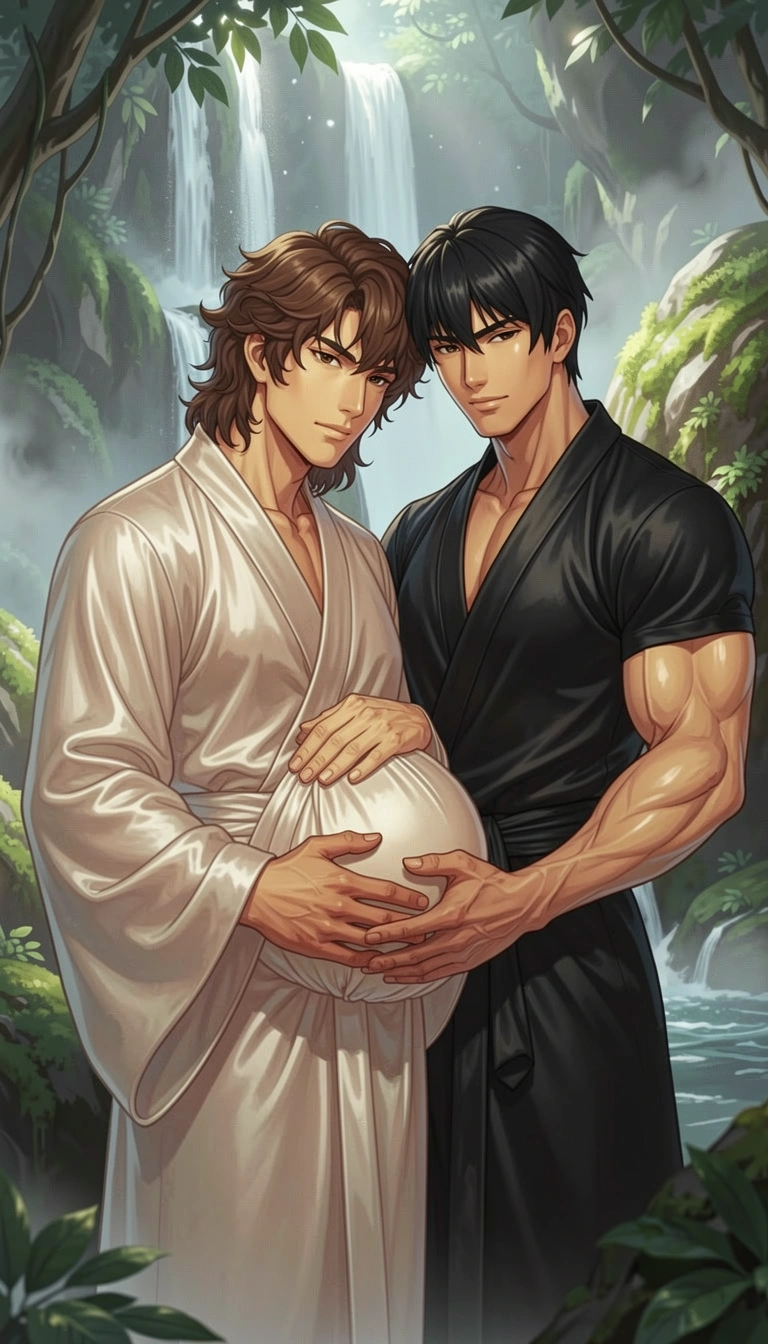
Phuwin's hand slid from Pond's, moving slowly, deliberately, toward the edge of the mattress. His fingers found the gap between the wooden frame and the feather-stuffed cushion—the loose slat he'd discovered years ago, when he needed a place to hide letters from his mother that arrived after her death. The paper was still there. Folded. Soft at the creases from fingers that had opened and closed it more times than he could count.
Pond's eyes followed the movement. His brow furrowed, the lines deepening the way they did when he sensed a shift in the room—when a councilor was about to deliver bad news, when a messenger arrived with a sealed scroll. "What is that?"
Phuwin didn't answer immediately. He pulled the paper out, held it between them. The candlelight caught the edge, casting a small shadow across his fingers. He could feel the weight of the words on the other side, words he had memorized in Star's careful reading: *I detected two heartbeats. I could not be certain. I could not be wrong.*
"The healer left this," Phuwin said. His voice was steady, but his hand trembled slightly—not from cold. "Hidden in her quarters, beneath a loose stone. Star found it the day after Aric was born."
Pond's expression shifted, a muscle in his jaw tightening. He reached for the paper, his fingers brushing Phuwin's as the note changed hands. The touch was brief, but Phuwin felt it—the warmth, the calluses from years of holding a sword and a scepter.
The paper rustled as Pond unfolded it. His eyes moved across the words, reading once, then again. The silence stretched. Aric made a soft sound in his crib, a tiny breath, and the candle flickered as if the room itself was holding its breath.
"Two heartbeats," Pond said, looking up. The words were flat, almost empty—as if they hadn't landed yet. "She detected two heartbeats."
"Yes."
"And she's gone. The healer. No one can find her."
"Yes."
Pond stared at the note, his thumb pressing against the paper's edge. "Why didn't you tell me?"
Phuwin closed his eyes. He had rehearsed this answer a hundred times, alone in the dark while Pond slept beside him, while Aric nursed in the gray dawn. But now, hearing the question aloud, all the rehearsed words crumbled. "I was afraid."
"Of what?"
"That you would hope," Phuwin said quietly. "That you would hope for something that might not exist. That I would have to watch that hope die. Again."
Pond's hand tightened on the note. The paper wrinkled, and he loosened his grip, smoothing it against his thigh. "The healer said she detected two. That means—"
"It means she was uncertain. She wrote that she could not be certain, could not be wrong. Her own words contradict each other." Phuwin's hand moved to his belly, a gesture he couldn't stop—pressing against the flat hollow where his pregnancy had been. "I don't know if there was a second child, Pond. I don't know if I lost it. I don't know if it's still inside me, somehow, waiting to be discovered. The healer vanished before she could explain. Before I could ask."
Pond set the note down on the bed between them. He stared at it, then at Phuwin, his dark eyes searching. "You've been carrying this alone. For days."
"Star has been helping. She's looking for a healer—someone we can trust. But she hasn't found anyone yet." Phuwin's voice cracked, just slightly, on the last word. "I didn't want to burden you when you had just met your son. When Imaria—" He stopped, shook his head. "There was never a right time."
"There is no right time for a secret like this," Pond said. "But there is a right thing to do. And that is to face it together." He reached for Phuwin's hand, wrapping his fingers around it—warm, steady, a grip that had held him through worse. "We find a healer. We find out what happened to the one who delivered Aric. And we find out if there is another child—inside you or gone."
"Gone." Phuwin repeated the word like it tasted strange. "If I lost it, I didn't know. The blood—during the birth—I thought it was just the trauma. I didn't feel anything else pass. I didn't feel—" He couldn't finish.
Pond pulled him closer, one hand on his shoulder, the other still holding Phuwin's. "We don't know yet. We act on what we know. The note says two heartbeats. Until we find a healer who can examine you, we hold onto that possibility."
Phuwin leaned into him, his head resting against Pond's chest. He could hear his husband's heartbeat—strong, steady, the same rhythm that had anchored him through every storm. "Star is in the eastern wing. She said she would come when I called."
"Then call her."
Phuwin pulled back, wiping his eyes with the back of his hand. "Now? It's late."
"The truth does not wait for morning," Pond said. He picked up the note again, reading it once more. "If there is a second child, your body deserves to be cared for. If there is not, your mind deserves to stop wondering." He looked at Phuwin, and his voice softened. "I will not let you carry this alone anymore."
Phuwin looked at the candle, the flame guttering in its pool of wax. He thought of the waterfall, of the way the water had always seemed to understand him better than any person. He thought of the name Lunara, still unspoken in the light, and of the son sleeping in his crib. "There's a communicator in the drawer," he said. "Star gave it to me. In case I needed her."
Pond stood, walked to the small table by the window, and opened the drawer. The device was small, silver, with a single button. He pressed it, held it to his ear. After a moment, he spoke. "Star. It's Pond. We need you in the bedchamber." He paused, listening. "Yes. Now."
He set the device down and turned back to Phuwin. "She's coming."
Phuwin nodded, his hand still resting on his belly. "We should dress."
Pond handed him a silk robe from the chair, then pulled on his own tunic. The movements were quiet, efficient, the rhythm of two people who knew each other's spaces. When Phuwin tied the belt of his robe, his fingers were steady now. The trembling had passed.
They waited. The candle burned lower. Aric stirred, and Phuwin went to the crib, lifting the baby into his arms. The warmth of the small body settled something in his chest. He pressed a kiss to Aric's forehead, breathing in the scent of milk and sleep.
Footsteps in the corridor. A soft knock.
"Come in," Pond said.
The door opened, and Star stepped inside, still in the gold and white dress from the ball, though it was rumpled now, the hem stained. Her hair had come loose from its pins, and there was a smudge of ink on her cheek—from handling old records in the healer's quarters, Phuwin guessed.
"You found the note," Star said. It wasn't a question. She looked at the paper in Pond's hand, then at Phuwin holding Aric. "I've been searching the healer's journals. There's nothing else. No mention of twins, no second examination. That note was the only thing she hid."
Pond held it up. "She wrote that she detected two heartbeats, but could not be certain."
"And she disappeared before anyone could question her." Star stepped closer, her eyes moving between them. "I've spoken to every healer in the capital. No one knows where she went. Her family says she left suddenly, said she had business in the outer provinces. But the outer provinces are a week's ride. She has no relatives there."
"She was afraid," Phuwin said softly. "Of what, I don't know. But she was afraid."
Star nodded. "I found a letter in her desk. Unsent. Addressed to someone in the northern territories. It said 'I cannot stay where my conscience is a crime.'" She paused. "Whatever she discovered, she did not trust the palace to keep her safe."
Pond's jaw tightened. "The palace is safe. I am safe."
"She didn't know that." Star's voice was gentle but firm. "She saw a healer who delivered a lie—that the baby was a boy when it was a girl. She saw the pressure on the Empress to bear a son. She may have thought her discovery would be another burden, another expectation."
Phuwin held Aric closer. "She was right. It is a burden. But it is mine to carry—not hers."
Pond moved to stand beside him, one hand resting on his shoulder. "We need a healer. Someone who can examine you properly. Star, can you bring one here—discreetly?"
"I have a name," Star said. "An old woman in the lower city. She delivered half the children in my village when I was young. She is known for her discretion and her skill. I can bring her tomorrow."
"Tomorrow," Phuwin repeated. "So soon."
"The longer we wait, the more the healer's trail grows cold," Star said. "And your body deserves answers."
Phuwin looked down at Aric, at the tiny fist curled against his chest. He thought of the possibility growing inside him—a second heartbeat he might have carried without knowing. Or a loss he had never mourned because he had never known to mourn it. "Tomorrow, then."
Pond squeezed his shoulder. "We will be with you."
Star nodded, then turned to leave. At the door, she paused. "I will return at first light with the healer. Sleep if you can." The door closed behind her, her footsteps fading down the corridor.
The room was quiet again. Phuwin laid Aric back in his crib, tucking the blanket around him. He stood there for a long moment, watching the baby breathe, the small rise and fall of his chest.
Pond came up behind him, wrapping his arms around Phuwin's waist, his chin resting on his shoulder. "We will face this together."
"And if there is no second child? If I lost it without knowing?"
"Then we grieve it together." Pond's voice was low, steady. "But we do not assume loss before we know truth."
Phuwin leaned back into him, feeling the solid warmth of his husband's body. The candle sputtered, then died, plunging the room into darkness broken only by the faint silver of moonlight through the window. In the dark, Phuwin reached back and found Pond's hand.
"I love you," he said.
"I know," Pond said. "And I love you. In this, and in everything."
They stood there, in the dark, holding each other, as the night pressed against the palace walls and the stars turned slowly overhead. Tomorrow would bring a stranger into their room, a woman with old hands and old eyes who would touch Phuwin's belly and tell them what the missing healer had hidden. Tonight, there was only this: the three of them—Pond, Phuwin, and Aric—and the paper with its impossible words lying on the bed.
Phuwin turned, pressed his forehead to Pond's chest, and let himself be held. The fear was still there, a cold stone in his stomach. But it was no longer alone. Pond's arms were around him, and that was enough, for now, to keep the stone from sinking.
They stayed like that for a long time, the silence settling around them like a second skin. Phuwin could feel the steady rhythm of Pond's heartbeat against his cheek, a counterpoint to his own racing pulse. The stone in his stomach had not dissolved, but it had settled—less sharp, less urgent, held in place by the arms around him.
After a while, Phuwin pulled back. His eyes had adjusted to the darkness now; he could see the outline of Pond's face, the gleam of his eyes in the moonlight. "The note," he said. "Where did you put it?"
"On the bedside table." Pond's hand found his in the dark. "Why?"
Phuwin didn't answer. He walked to the table, his bare feet silent on the cold stone floor, and picked up the paper. The creases were soft, the ink smudged in places from where his fingers had pressed too hard. He held it to the moonlight, reading the words one more time, as if they might rearrange themselves into something easier to understand.
"I keep thinking," Phuwin said, "that if I read it enough times, it will tell me more. That the words will expand, will explain themselves." He let out a breath, half-laugh, half-sigh. "But they don't. They just stay the same."
Pond moved closer, his hand settling on the small of Phuwin's back. "Words can only hold so much. The rest is what we do with them."
Phuwin folded the note carefully, precisely, the way he had folded it a hundred times before. He tucked it back into the gap beneath the mattress, his fingers lingering on the paper for a moment before he withdrew them. "I should sleep. Tomorrow will be long."
"You should sleep," Pond agreed. But neither of them moved toward the bed.
Phuwin walked to the window instead, his hand resting on the cold glass. The palace gardens stretched below, silver and black in the moonlight. He could see the fountain in the center, the water catching the light, and beyond it, the dark line of trees that marked the path to the waterfall. He thought of the cave, of the sound of water echoing off stone, of the way the world felt simpler there—just rock and water and the weight of his own breath.
"Do you remember," Phuwin said, "when we first came to this palace? Before the girls were born. Before the empire was what it is now."
Pond came to stand beside him, his reflection ghosting in the glass. "I remember. The halls were empty. The gardens were overgrown. You spent the first week pulling weeds."
A small smile touched Phuwin's lips. "I wanted it to be beautiful. For our children. For the children I hoped we would have."
"It is beautiful." Pond's hand found his on the windowsill, their fingers interlacing. "Because of you."
Phuwin leaned his head against Pond's shoulder. "I was so certain, back then. Certain that I would give you sons. Certain that I would be enough." His voice dropped. "I am still learning that being enough does not mean being perfect."
Pond turned, cupping Phuwin's face in his hands. His thumbs brushed the hollows beneath Phuwin's eyes, where shadows had settled like permanent guests. "You are enough, Phuwin. You were enough when you gave me three daughters. You were enough when you gave me a son. You will be enough tomorrow, whatever the healer finds."
Phuwin closed his eyes, letting himself be held in the warmth of Pond's palms. "And if there is another child? If I am carrying it still, without knowing?"
"Then we will welcome it." Pond's voice was firm, certain. "Another daughter. Another son. Another life to love."
"And if I am not?"
Pond was quiet for a moment. When he spoke, his voice was softer. "Then we will grieve the life we did not get to know. And we will hold the ones we have a little tighter."
Phuwin opened his eyes. In the dim light, Pond's face was all shadows and angles, but his eyes were clear—dark and steady and full of something that made Phuwin's chest ache. "I don't deserve you," Phuwin whispered.
"You deserve everything," Pond said. "And I will spend the rest of my life trying to give it to you."
Phuwin kissed him. Soft, slow, a press of lips that said more than words could carry. When he pulled back, his hand found Pond's chest, feeling the steady beat beneath his palm. "Come to bed."
Pond nodded. They walked to the bed together, and Phuwin lay down on his side, facing the crib where Aric slept. Pond lay behind him, his arm wrapping around Phuwin's waist, his chest warm against Phuwin's back. The position was familiar, practiced—the way they had slept through a thousand nights, through arguments and reconciliations, through pregnancies and births and the quiet terror of raising children in a world that demanded so much.
Phuwin stared at the crib. The moonlight fell across Aric's face, illuminating the soft curve of his cheek, the tiny fist pressed against his chin. He was so small. So fragile. And yet he carried the weight of an empire on his shoulders, a weight he did not yet know.
"Pond," Phuwin said, his voice barely a whisper.
"Mm?"
"If there is another child, and it is a girl—" He stopped, the words catching in his throat.
Pond's arm tightened around him. "Then she will be a princess. Like her sisters. Like Lunara would have been."
"And if it is a boy?"
"Then Aric will have a brother." Pond pressed a kiss to the back of Phuwin's neck. "And we will have two sons to raise, and four daughters to love, and a palace full of chaos and laughter and noise."
Phuwin let out a breath, something loosening in his chest. "Chaos and laughter and noise," he repeated. "That sounds like a good life."
"It is the only life I want," Pond said. "As long as you are in it."
Phuwin closed his eyes. The fear was still there, curled in his stomach like a sleeping animal. But it was quieter now, held at bay by the warmth of Pond's body, the steady rhythm of his breathing, the knowledge that tomorrow would come whether he was ready or not.
He let himself drift, not quite asleep but not quite awake, suspended in the gray space between. The last thing he heard before sleep took him was Aric's soft breathing, and the distant sound of wind moving through the palace gardens, carrying the promise of morning.