The bell above the door chimed, and Emma knew the weight of that tread before her brain caught up. The heavy set of boots, the slight drag of the left heel—she'd feel it in a crowd, in her sleep, in another life. Her fingers found a paint chip without looking, blue, the exact shade of his old truck, the one he'd driven them to the lake in that summer. She held it like evidence.
"Emma." His voice scraped something loose in her chest, something she'd packed carefully and thought she'd buried deep enough. Her throat closed. Her hand trembled against the metal shelf, the cool edge grounding her. She turned.
He was closer than she expected. Sawdust caught in his dark curls, a fleck on his jaw. Hazel eyes, more guarded than she remembered, the lines around them deeper. The expression cracked the second their gazes met—something raw and unguarded surfacing before he could lock it down. Her pulse slammed against her ribs. No. Her pulse was just her pulse, loud and insistent, filling her ears until the store's hum faded, the distant radio blurring into static.
"Lucas." Just his name. Her voice barely carried it. The syllable sat in the air between them, small and fragile. His jaw tightened. He didn't move. Neither did she.
Her thumb stroked the paint chip. Blue. She remembered the feel of his truck's bench seat, worn fabric, his elbow brushing hers. She remembered the way he'd looked at her before everything broke—like she was something he couldn't quite believe he got to have.
The fluorescent light buzzed. Somewhere in the back, a radio crackled. She couldn't process any of it. She smelled oil and sawdust and him—soap and sweat, familiar and not, the ache of it pressing against her ribs until she couldn't breathe.
He looked at the paint chip in her hand, then back at her face. Something flickered in his eyes—a question he didn't ask. His lips parted. Closed.
She should say something. Should fill the silence like the old Emma would have, filling every quiet with chatter, deflecting and laughing. The new Emma—the one who'd learned to be still—just stood there, letting the space between them do the talking.
He took a breath. Slow. Deliberate. The kind of breath a man takes before he says something he can't take back. "You're really here." Not a question. Like he'd been testing the fact for hours and still couldn't believe it.
She opened her mouth, closed it. The paint chip was warm against her skin now, slick with her own palm. "I'm really here." Her voice cracked. She didn't apologize for it.
He didn't step closer. But the air between them thinned, the distance vibrating with things unsaid. He just looked at her, like he was memorizing her all over again, like he'd forgotten how she fit into the world.
The hardware store hummed around them—fluorescent light, distant radio, the shuffle of someone in another aisle. All she heard was her own blood, loud and wanting, and the sound of him breathing.
He stepped closer. The scrape of his boots on the worn floorboards was the only sound in the aisle, deliberate and final. Emma's breath caught—not the shallow hitch of surprise, but the deeper pause of a held moment she didn't dare release. The distance between them compressed from six feet to four, then three, each inch loaded with years of silence.
Her fingers tightened on the paint chip. The edges bit into her palm. She heard her own blood again, a low rush behind her ears, and the subtle shift of his jacket as he closed the gap. He stopped when they were close enough that she could see the flecks of gold in his hazel eyes, the tiny scar above his left eyebrow she'd forgotten existed.
"You still do that," he said. His voice was lower than she remembered, rougher at the edges. "Hold things like they're going to disappear."
She looked down at the paint chip in her hand, blue and crumpled, her knuckles white. She forced her fingers to relax. "Old habit."
He didn't look at the paint. He looked at her face, his gaze tracking from her eyes to her mouth and back, like he was reading something she hadn't said. His hands stayed at his sides, but she saw his fingers curl slightly, a microscopic clench. Restraint, or the opposite.
"It's the wrong shade," he said. "That blue. It's too light."
"I know." She managed a small, broken laugh. "I grabbed it without looking. It was just—" She stopped. It was the color of your truck. "It doesn't matter."
"It matters." He said it quietly, almost to himself, and something in his eyes shifted—that guarded look cracking just a little more. "You always did that. Reached for something without thinking, then pretended it was an accident."
Emma's throat tightened. She wanted to deflect, to make a joke, to break the tension with her old nervous chatter. But the words wouldn't come. She just stood there, the paint chip warm and damp in her hand, his presence filling the space until she felt dizzy with it.
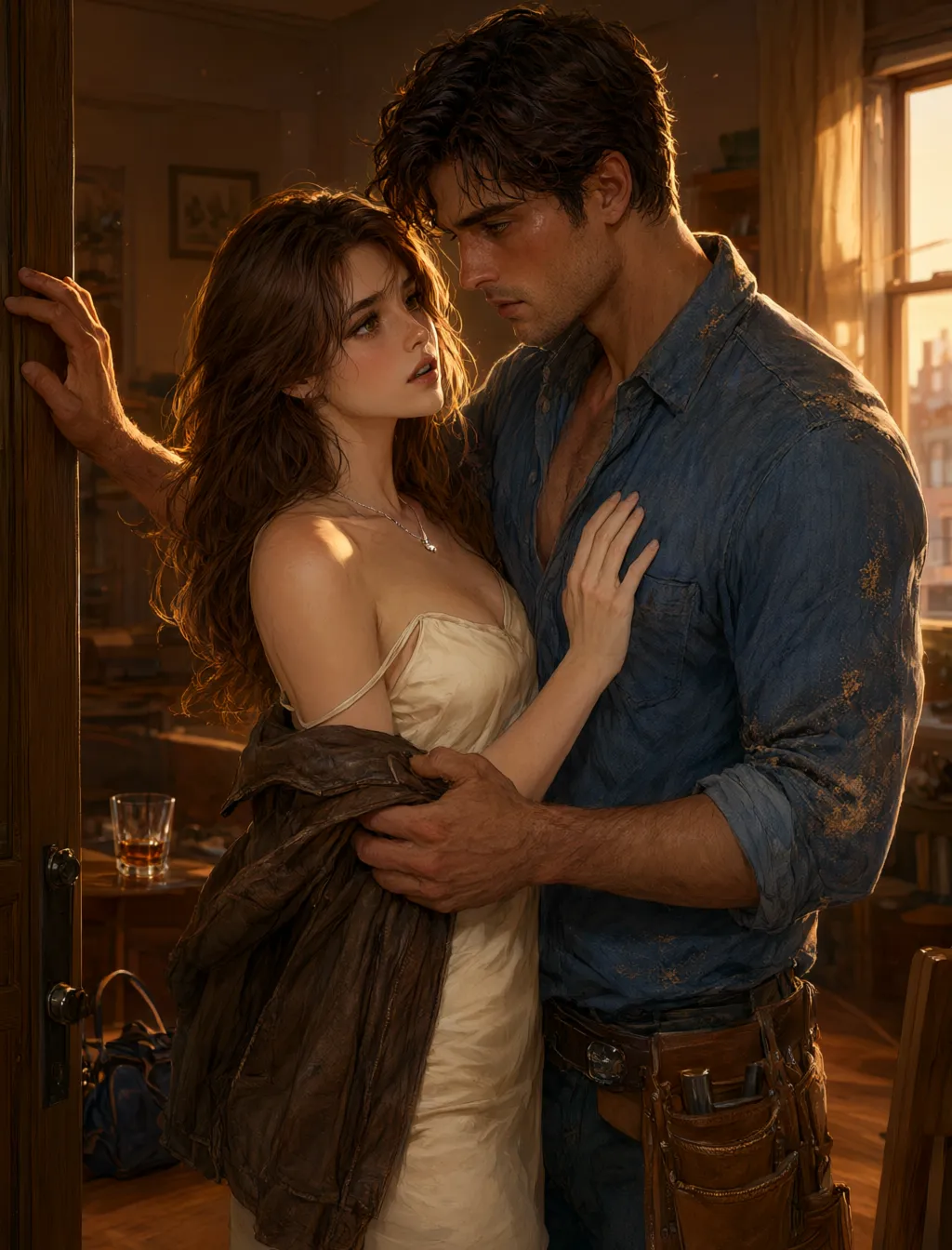
He took another half-step, the last of the distance collapsing. She could smell the sawdust in his curls now, the faint musk of his skin, and beneath it, something she remembered from years ago—the soap his mother used. His arm lifted, slow and deliberate, and his fingertips brushed her wrist, light as a question. "Emma," he said, and her name in his mouth was a prayer and a wound and a beginning she didn't know how to name.
Her breath stopped. His fingertips rested on her wrist—not grasping, not pulling, just there, the lightest pressure asking a question she'd been running from for years. The calluses on his hand scraped her skin, and she felt the roughness in her chest, deep and sharp.
She looked down. His hand was dark against her skin, the veins visible, the same hand that had held hers at sixteen on the dock, the same knuckles she'd traced with her thumb while he drove. The paint chip trembled between her fingers, blue and crumpled, the color of his truck, the color of memory.
"Emma." His voice was low, careful, like he was handling something fragile. "Look at me."
She did. Slowly. His hazel eyes were soft now, the guard dropped, and she saw the boy she'd known in the man in front of her—the same hunger, the same fear, the same desperate hope he was trying to hide. Her throat burned.
His hand moved. He didn't pull away. Instead, he turned his palm up, an invitation, his fingers open and waiting. The gesture was deliberate, each second stretching, giving her time to refuse. She could have pulled back. Should have. The smart thing, the safe thing, was to laugh and step away, to find her paint and leave.
Her hand moved on its own. The paint chip fell—blue fluttering to the worn floorboards—and her fingers found his. Cool metal shelf against her back, his warmth against her palm. He closed his grip slowly, gently, his thumb settling in the hollow of her wrist, right over her pulse.
He felt it. She knew he felt it, hammering against his skin. His jaw tightened, but his hand didn't. He held her like she was something precious, something he'd been afraid to touch for too long.
Neither spoke. The fluorescent light buzzed. The radio in the back crackled through a country song. None of it reached her. All she knew was the weight of his hand in hers, the way his thumb traced a slow, unthinking circle on her palm—a question, a promise, a beginning.
She squeezed. Just once. Just enough to say she was still here. His eyes closed for a second, and when they opened, something in them had shifted—something raw and unguarded, the same look he'd given her on the dock before everything broke.
"I missed your hands," she whispered. The words came out before she could stop them, thin and honest in the space between them.
His thumb stilled. Then he held her tighter, and she felt the tremor run through him—his whole body, a vibration she felt in her own bones. He didn't say anything. He didn't have to. His hand in hers said everything.
He moved. Not a step forward—his feet were already planted, the worn floorboards creaking under his weight—but a shift in his body, a lean that closed the last inches between them. The cool metal shelf pressed against her spine, and his chest brushed hers, the contact a static shock through her shirt. She felt every ridge of his ribs, the heat rising off his skin, the way his breath caught and held when they touched.
His hand was still wrapped around hers, but his other hand lifted. Slow. Deliberate. The calloused pads of his fingers found her jaw, tilting her face up, and she felt the tremor in his fingertips. He didn't pull her closer. He just held her there, his thumb tracing the line of her cheekbone, the gesture so familiar it hurt—he'd touched her like this before, in the dark of his truck, in the back of a crowded party, in every quiet moment that had ever mattered.
"Emma." Her name came out rough, scraped from somewhere deep. His eyes searched hers, flickering between them, and she saw the question he was afraid to ask, the one he'd been holding for years. His thumb paused at the corner of her mouth, and she felt her lips part without meaning to, a reflex older than thought.
She couldn't breathe. Couldn't think. The fluorescent light hummed overhead, and somewhere a customer laughed, distant and irrelevant. All she knew was the heat of his palm against her skin, the way the sawdust in his curls caught the light, the tiny muscle ticking in his jaw as he held himself back.
His gaze dropped. Down to her lips, then back up, the question raw in his eyes. He didn't move closer. He didn't pull away. He just stayed there, suspended, his thumb resting on the seam of her mouth, waiting for her to decide.
She should say something. Should tell him to stop, should laugh it off, should remind him of all the reasons this was a bad idea. But her body had already betrayed her—her free hand rising, her fingers finding the fabric of his shirt, fisting in the worn cotton over his chest. She felt his heart hammering beneath her knuckles, fast and desperate, a match for her own.
His breath stuttered. His forehead dropped to hers, his curls brushing her skin, and the proximity was too much—his warmth, his smell, the faint roughness of his jaw against her temple. She closed her eyes, and the world narrowed to the sound of him breathing, the weight of his hand on her face, the fabric bunched in her fist.
"Tell me to stop," he whispered. His voice cracked on the last word, and she felt the tremor in his whole body, a tension barely contained. "Tell me you don't want this, and I'll—" He didn't finish. Couldn't. His hand tightened on her jaw, not enough to hurt, just enough to ground himself.
She opened her eyes. His were closed, the lines of his face tight, as if he was bracing for a blow. And she saw it—the years of silence, the night that broke them, the distance he'd carried like a wound. She saw that he was terrified, that he'd been terrified since she walked into this store, that every step he'd taken toward her had cost him.
She didn't tell him to stop. She rose on her toes, just slightly, just enough to close the fraction of space between them, and pressed her lips to the corner of his mouth, soft and quick, a question of her own.