
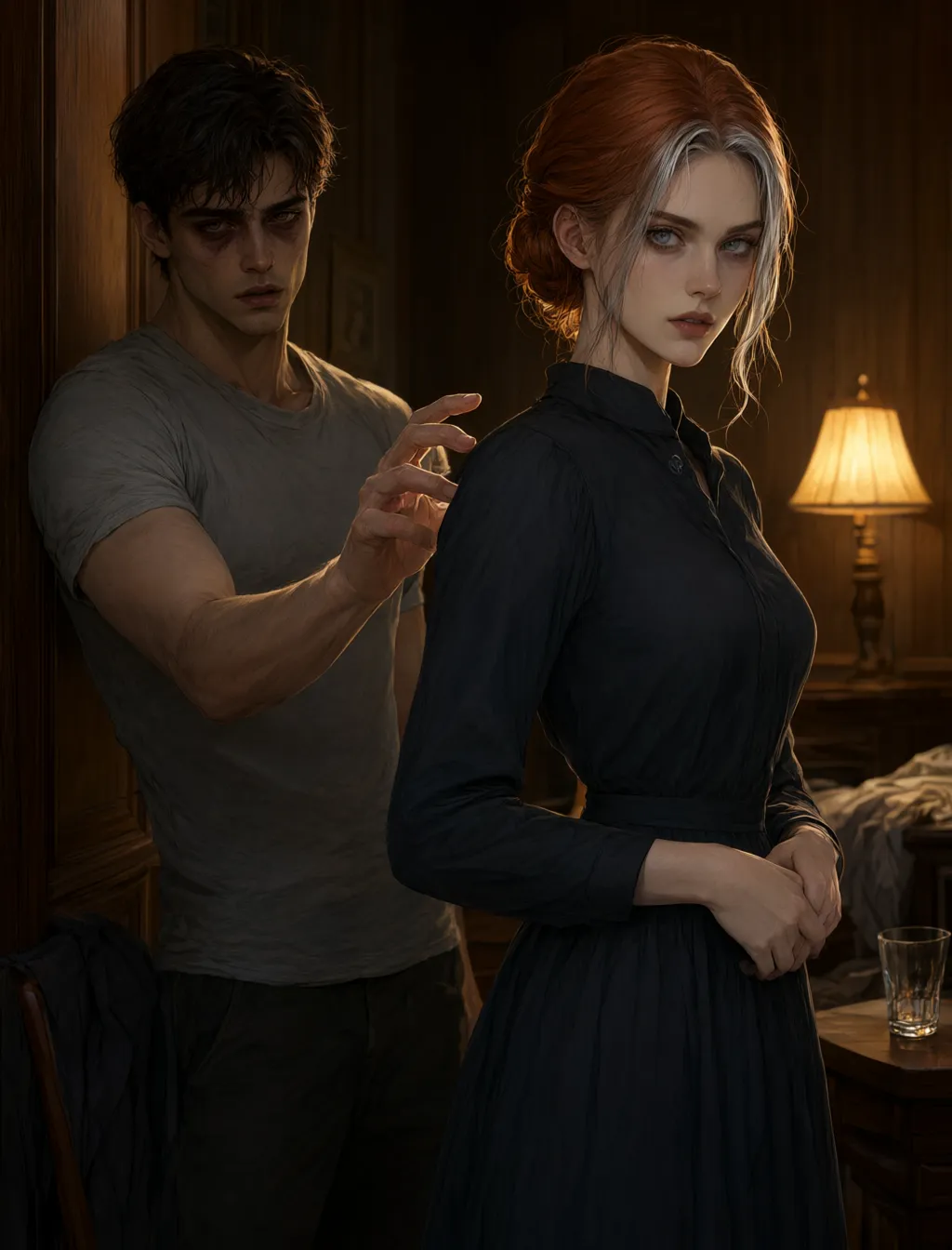
The flat of his thumb found the muscle high on his thigh, just below the hip, and pressed in until the ache sharpened into something clean. He knew the spot. Knew how much pressure it took before the bruise would bloom under his olive skin by morning — a dark thumbprint he'd trace later without thinking, proof he'd been here, in this body, on this bed, in this room that smelled like beeswax and someone else's silence.
Moonlight striped the Persian rug in four pale rectangles. He counted them. Counted the grain lines in the door across from him. Counted anything that wasn't the shape still burning under his thumb — not the key itself, which sat somewhere on Miriam's desk now, cold metal waiting, but the after-image of it. The oval head. The teeth. The weight his thumb had pressed into the desk without lifting.
She'd said his name like it meant something.
Not Lucas Vasquez from the file. Not the intake form with its boxes checked and its history reduced to bullet points. Just Lucas. Like she'd been waiting to say it. Like she'd known it would land somewhere behind his ribs and stay there.
His other hand stopped at his belt. The leather was warm from his body, the buckle familiar under his fingertips — a habit so old it predated memory, the automatic reach when the wanting got too loud. Feed it. That's what she'd said. No one taught you what to do with wanting except feed it.
His fingers curled around the buckle. Tight. The metal edge bit into his palm.
The fluorescent hum in the hallway seeped through the thin walls, a steady electric whine that had probably been there for years, long before this room was his, long before the last resident left whatever he'd left behind. Lucas didn't move. The hum filled the silence between his breaths, and his hand stayed clenched around the belt, and his thumb kept pressing into his thigh, and somewhere in the east wing a locked room waited with a silver key on a desk and a woman who folded her hands like she had all the time in the world.
He wanted to break something. Wanted to get up and pace the narrow strip of floor between the bed and the door, three steps each way, until his legs gave out. Wanted to find Miriam's office and ask her what the hell she expected him to do with wanting if he wasn't supposed to feed it.
Nothing. Yet.
Her voice again. Calm. Measured. The slightest curve at the corner of her mouth when she'd said it, like she already knew he'd leave the key, like she'd watched a hundred men sit in that same metal chair and touch that same silver key and make the same choice or not make it, and she'd catalogued every outcome in that ledger of hers without ever looking up.
Lucas released the belt. His hand fell to the mattress, open, empty. The ache in his thigh had settled into a dull heat, and the wanting was still there — it would always be there — but for now it was just pressure. Just a shape under his skin. Just the fluorescent hum and the moonlight and the weight of his own body on a bed that wasn't his, in a room that wasn't his, in a life he hadn't figured out how to want yet.
He didn't move for a long time.
Eventually his body decided for him. The ache in his thigh had gone numb, and the fluorescent hum had burrowed into his skull, and the wanting hadn't gone anywhere but it had stopped screaming long enough for his joints to unlock. He swung his legs off the bed. The Persian rug was rough under his bare feet, the wool worn thin in patches where other men had paced the same three steps between the bed and the door.
The door.
He'd locked it without thinking when he'd first entered—habit from years of cheap apartments and roommates who stole and dealers who didn't knock. The deadbolt was old brass, tarnished green at the edges, and the keyhole below it was the old-fashioned kind, the kind a key with teeth would fit. Not the silver one on Miriam's desk. A different key. One he didn't have.
His hand lifted before he told it to. The brass handle was cool against his palm, cooler than the belt buckle had been, and when he closed his fingers around it the metal warmed fast. His pulse beat in his thumb where he'd pressed it into his thigh, and he could feel that bruise forming now—a tender heat spreading under the skin, a shape that matched the key's head, if he thought about it. He tried not to think about it.
The handle gave a quarter-inch when he tested it. Just enough to feel the mechanism engage, the deadbolt holding firm, the door solid in its frame. Locked. He was locked in. Or locked out—he wasn't sure which, wasn't sure if the lock was keeping something away from him or keeping him away from something, and the thought was too close to Miriam's voice in his head for comfort.
He let the handle return. The latch clicked soft, a sound that probably carried down the hall, probably reached whatever room she slept in, if she slept. He imagined her hearing it. Imagined her pausing over that ledger, pen suspended, head tilting just slightly toward the west wing. There he is, she might think. Testing the door.
His fingers stayed on the brass. He could feel his own pulse in them now, a steady thud against the cool metal, and he realized he was holding his breath. Waiting. For what—a knock? Her voice through the wood? The deadbolt to turn from the outside? None of it came. Just the hum. Just the moonlight. Just his own hand on a door that wasn't going to open.
He pressed his forehead to the wood. It smelled like polish and dust and the faintest trace of cedar, and it was cooler than his skin, and for a long moment he just stood there, breathing into the grain, his hand still wrapped around the handle like it was the only thing keeping him upright.
She'd told him to go to his room. She'd told him he did well. She hadn't said what came next, or when, or whether the door would be locked from the outside in the morning or whether he'd be expected to present himself at some appointed hour with an answer to a question she hadn't asked yet.
His hand slid off the brass. The handle stayed where it was. The door stayed locked. And Lucas stayed on his side of it, in the dark, with the wanting still burning under his skin and nowhere to put it.
He didn't turn so much as let his body remember it could move. The forehead lifted off the wood. The hand dropped from the brass. The soles of his feet registered the worn wool of the rug again, the texture he'd forgotten while he'd been pressed against the door, and his calves ached from standing locked for so long. When he faced the room, the moonlight had shifted—just slightly, a thumb's width across the floor—and his own shadow stretched long and thin across the bed.
That's when he saw it.
The bruise sat high on his thigh, dark against the olive skin below the hem of his gray boxer briefs. He'd felt it forming while he'd been at the door, a dull heat radiating outward from the pressure point, but he hadn't looked. Hadn't wanted to. Now, in the pale light, it was impossible to miss—a mottled purple crescent, the size of his thumbprint, with a secondary mark above it that caught the moonlight differently. A small oval. The exact shape of a key's head.
His thumb had pressed the silver key into the desk without lifting it, and now his thumb had pressed that same shape into his own flesh. The teeth of the key weren't there—just the oval, and beneath it the bruise's edge where his nail had dug in, a half-moon of darker pigment. He stared at it. His hand drifted down without permission, fingers hovering over the mark, not quite touching. The skin around it was warm. He could feel the heat radiating up toward his palm.
Miriam's key shape.
The thought landed somewhere in his chest and stayed there. Not the key itself—that was still on her desk, cold metal waiting for someone who could be trusted with it—but the ghost of it. The after-image. The thing he'd refused and carried anyway, written into his skin by his own hand, a bruise that would last days. He'd catalogued his bruises before. Track marks, mostly. The yellowing remnants of fists he'd walked into. Never one like this. Never one he'd given himself as proof he'd said no.
He pressed the mark. Just once. The ache sharpened, then dulled into something almost satisfying, and his breath left him in a slow exhale through his nose. She'd told him wanting wasn't the problem. She'd told him no one taught him what to do with it except feed it. This bruise was the first thing he'd ever done with wanting that wasn't feeding. This bruise was the shape of a key he hadn't picked up.
Lucas dropped his hand. He didn't touch it again. The fluorescent hum in the hallway had become part of the room's silence, no longer a distraction but a presence, and somewhere in the east wing a locked room waited, and somewhere between here and there was a woman who'd folded her hands and said his name like she meant it. The wanting was still there. It would be there in the morning, and the morning after, and probably every morning until he learned what she was trying to teach him.
He sat on the edge of the bed. The mattress dipped under his weight, the sheets still cool from his absence, and the bruise throbbed in time with his pulse. There, it said. You're still here. In this body. In this room. You didn't break anything. You didn't open the door.
Outside, the estate sat in a darkness so complete it swallowed the moon's reach beyond the windowpane. Lucas pulled the sheet up to his waist and lay back, his head finding the pillow's thin center, and through the dusty glass he could see nothing but black. His thigh ached. The key shape burned under the sheet, invisible now but not gone, and he closed his eyes.
The knock came soft — three taps, deliberate, spaced like a sentence he almost recognized. Lucas's eyes opened to the dark ceiling, his body already tensing before his mind caught up. The fluorescent hum had changed pitch, or maybe it was his pulse shifting, and the bruise on his thigh throbbed once, a pulse of heat that answered the knock before he could.
He didn't move. Didn't speak. The sheet was still pulled to his waist, his arms at his sides, and the moonlight had shifted again while he'd been lying there, the pale stripes on the rug now angled toward the door. Three taps. A pause. Then nothing.
His hand found the bruise before he told it to — fingers pressing the key-shaped mark, the ache sharp and grounding. He was still here. Still in this body, this room, this life he hadn't figured out how to want yet. The knock hadn't repeated. Whoever it was had given him the space to answer or not, and he hadn't, and now the silence between them had weight.
He sat up. The sheet pooled at his waist, and the bruise throbbed against the fabric where it touched, a warm pulse that matched his heartbeat. His feet found the rug, the worn wool, the cold patches where the moonlight didn't reach. The door was still locked. He could see the deadbolt from here, the brass catching the pale light, the keyhole dark and empty.
He stood. The floor creaked under his weight — a single board, third from the bed, the same one that had groaned when he'd paced earlier. He crossed to the door and pressed his palm flat against the wood. It was cooler than his skin, smoother than he remembered, and through the grain he could feel the vibration of the house settling, the old bones of the estate adjusting to the weight of another night.
"I heard you." His voice came out rough, unused, scraping against the silence. He cleared his throat. "I'm not — I don't know what you want."
The silence stretched. He could feel her on the other side of the door — not see her, not hear her, but feel her presence like a pressure in the air, the way you could feel someone watching you in a crowded room. She was waiting. That's what she did. She waited, and she watched, and she folded her hands and let the silence do the work he couldn't do himself.
His forehead touched the wood. The same spot as before, the same grain, the same faint smell of polish and cedar. "I left the key," he said, quieter now. "I did what you said. I went to my room. I locked the door. I didn't —" He stopped. His hand was still pressed flat against the wood, and he could feel his pulse in his palm, a steady thud against the grain. "I didn't feed it."
No response. Just the silence, and the hum, and the weight of her presence on the other side of the door, patient as stone.
He pulled his hand away. The wood was warm where his palm had been, a ghost of his own heat, and he watched it fade as the cool air reclaimed the surface. "I don't know what comes next," he said. "You didn't tell me. You just — put the key on the desk and said my name and sent me to a room with a lock I didn't ask for."
The silence held. He could feel her listening, could imagine her standing there in the dark hall, her hands folded, her pale gray eyes fixed on the wood between them. She had all the time in the world. She'd told him that without words, in the way she'd written in her ledger without looking up, in the way she'd watched him touch the key and leave it, in the way she'd said his name like she'd been waiting to say it.
His hand found the deadbolt. The brass was cold, colder than the wood had been, and he felt the mechanism engage as he turned it — a smooth click that echoed in the narrow hall, a sound that carried. He pulled the door open.