
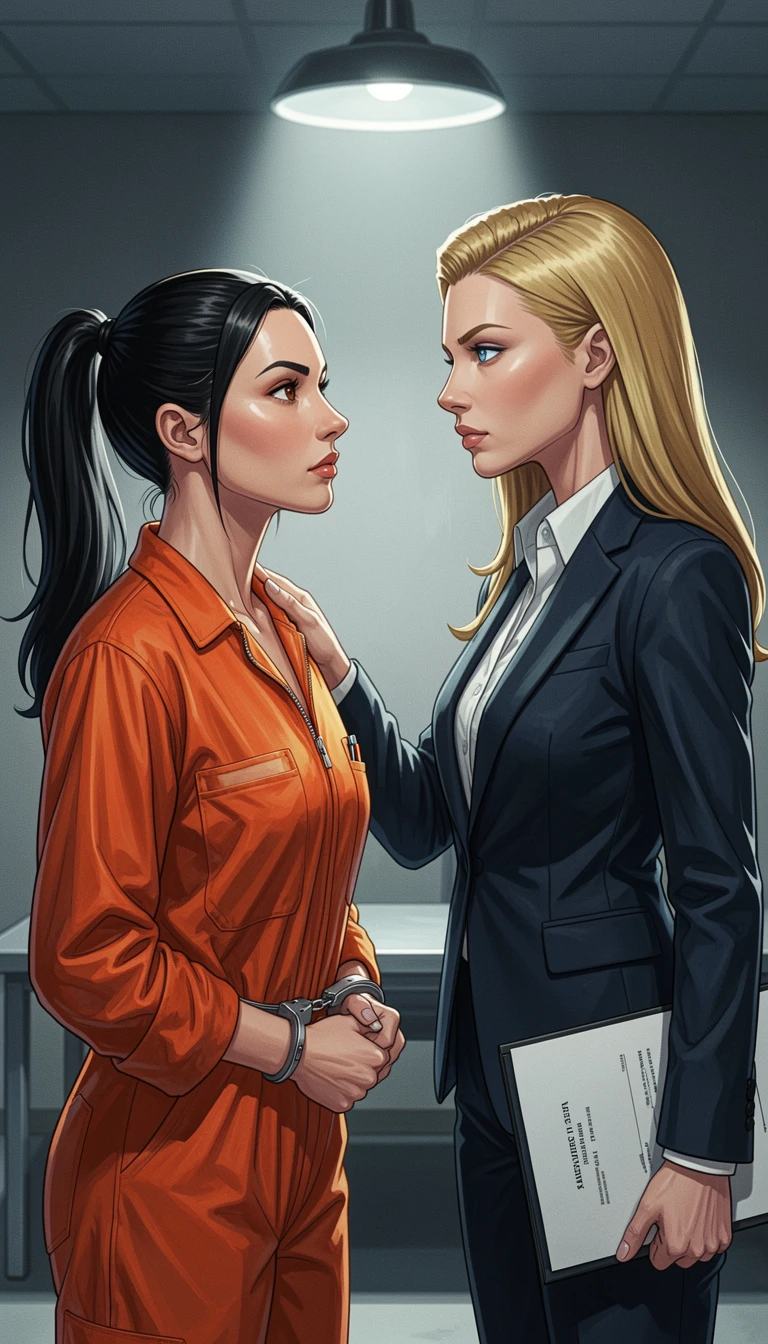
The fluorescent bar buzzed overhead, a sound Mara had stopped hearing three days ago and now couldn't stop. It had a rhythm to it, almost — a stutter, a pause, a stutter — like a word someone kept almost saying. She sat with her hands flat on the scarred metal table, the cold seeping up through her palms, and counted the scratches in the paint. There were forty-three. She'd counted them twice.
The door opened without a knock.
Kate Sheridan walked in like she owned the room, which Mara supposed she did, in a way. The lawyer's heels were quiet on the linoleum, her tailored black blazer cut sharp at the shoulders, her dark hair falling to her jaw. She carried a manila folder in one hand, held loose at her side, and she didn't look at Mara until she'd set it down on the table between them.
The thud was louder than it should have been. The folder was thick.
"Your friend Reyes made a call," Kate said.
Mara's hands stayed flat. She watched Kate's face, the way you watched a suspect's face — for the tell, the flicker, the thing they didn't want you to see. Kate's face gave nothing. It was a good face for a lawyer. Mara had known a few.
"What call?"
Kate pulled out the chair across from Mara and sat. She didn't lean back. She sat forward, forearms on the table, and opened the folder with two fingers, spreading it open like a dealer showing her hand.
The first page was a statement. Mara recognized the letterhead before she recognized the signature — Sterling & Sterling, the firm's name in embossed gold at the top, the kind of paper that cost more per sheet than Mara's entire jumpsuit. And at the bottom, in ink that was still dark and wet-looking, a signature she knew.
Eleanor Shelby.
The penmanship was unmistakable. Elle had always signed her name like she was putting a period on an argument — the E sharp, the S sweeping, the whole thing finished with a decisive underline that cut through the page. Mara had watched her sign a dozen documents in the kitchen of the estate, watched that same hand move across the same kind of paper, and she'd never once thought about what it would look like on a page that could put her in prison.
"This Shelby woman," Kate said, tapping the signature with one finger. The nail was short, unpainted. "Your friend. She's representing the Sterlings."
Mara read the words above the signature. She read them twice, because the first time they didn't make sense. I, Eleanor Shelby, Esq., being of sound mind and free will, do hereby affirm that I have remained at the Sterling estate of my own volition, and that any statements to the contrary made by third parties are false and defamatory.
"Why would she do that?" Kate asked.
The question hung in the stale air. Mara could smell her own sweat, the cold coffee someone had left on the table hours ago, the faint chemical tang of the fluorescent light. She kept her hands flat.
"I don't know."
"You don't know." Kate repeated it without inflection, the way you repeat a piece of evidence you're testing for weight. "You told Reyes she was chained to a cross when you left. You told her Kyle Sterling was standing there with a belt. You told her your friend was a prisoner."
"She was."
"Then why is her signature on a statement saying she's there of her own free will?"
Mara looked at the signature again. The ink was dark. The paper was crisp. It looked like the kind of document a person signed when they meant it, when they'd read every word and decided to put their name to it anyway. It looked like the kind of document Elle had signed a hundred times in the kitchen, her reading glasses perched on her nose, her mouth moving silently over the clauses before she committed.
"I don't know," Mara said again, and her voice came out raw, scraped, like she'd been swallowing glass. "She was my friend. I don't understand."
Kate leaned in. The movement was small, but it changed the geometry of the room. Her finger stayed on the signature, pressing down until the nail went white at the tip.
"Then you need to start understanding," she said. "Because this is what's going to hang you."
The words settled into the silence like sediment. The fluorescent bar buzzed. The stutter, the pause, the stutter. Mara's hands stayed flat on the cold metal, and she could feel the scratches under her palms, forty-three of them, and she thought about Elle's hand moving across this page, the same hand that had once held Mara's in the dark of the estate's kitchen, the same hand that had pressed a glass of water into her palm when she'd been shaking too hard to hold it herself.
"She was chained to a cross," Mara said. Her voice was quiet. She didn't recognize it. "I saw her. I stood in front of her. She was cuffed to a wooden frame and her back was covered in welts and she was crying. She was crying and she asked me not to leave her."
Kate's face didn't change. "And you left her."
"I had to." The words came out before Mara could stop them, and they hung in the air between them, ugly and true. "I had to. There was a gate. There was a key. There was a woman bleeding on the floor behind me and a man with a belt and I had to—"
She stopped. Her hands were no longer flat. They were curled into fists on the metal table, knuckles white, and she forced them open again, one finger at a time, pressing her palms back down against the cold.
"I had to," she said again, quieter.
Kate watched her. The lawyer's eyes were blue and flat and patient, the eyes of a woman who had heard a hundred confessions and believed none of them. She tapped the signature once more, a small, deliberate movement, like a judge striking a gavel.
"This statement is dated three days ago," Kate said. "Nine days after you were arrested. Nine days after you told Reyes that Elle Shelby was being held against her will. And in those nine days, she signed this, filed it with the court, and took the Sterlings as clients."
Mara read the date. She read it three times, because the numbers kept rearranging themselves. It was dated the same day she'd been brought to the interrogation room for the first time. The same day she'd sat in this chair and told Dana Reyes the truth, all of it, the gate and the key and the blood and the cross.
"She was chained to a cross," Mara said again, and she heard how thin her voice had become, how small. "I left her chained to a cross. She couldn't have—"
"Couldn't have what?" Kate's voice was flat, patient, relentless. "Couldn't have walked to a notary? Couldn't have signed a document? Couldn't have chosen the Sterlings over you?"
"She wouldn't."
"She did."
The words landed like a door closing. Mara stared at the signature, at the sharp E, the sweeping S, the decisive underline. She thought about the way Elle had looked at her in the kitchen that last night, the way her ice-blue eyes had gone wide and wet when Mara had said they were leaving, the way her voice had cracked when she'd said don't leave me.
And she thought about the way Elle had looked at Kyle Sterling when he'd walked into the room. The way her body had gone still. The way her eyes had followed him.
Mara had told herself it was fear. She'd told herself a hundred times, in the dark of her cell, that it was fear, that Elle was terrified, that she was doing what she had to do to survive. She'd told herself that the Elle who had signed this document was not the Elle she knew, that the signature was forged, that the ink was a lie.
But she knew the handwriting. She knew the way Elle's hand moved, the pressure of her pen, the way she underlined her name like she was daring someone to question it.
"I don't understand," Mara said, and her voice broke on the last word, cracked right down the middle, and she hated herself for it, hated the weakness, hated the way Kate's eyes registered the crack without any change in her face.
"That's the problem," Kate said. She closed the folder, but she didn't take her hand off it. Her fingers rested on the cover, on the embossed gold lettering, on the name of the firm that was going to bury Mara if she didn't find a way to dig herself out. "You don't understand. And you're the one who's going to hang for it."
The fluorescent bar buzzed. The stutter, the pause, the stutter. Mara's hands stayed flat on the cold, scarred metal, and she could feel the scratches under her palms, forty-three of them, and she could see Elle's signature in her mind's eye, sharp and sweeping and underlined, and she could hear Elle's voice saying don't leave me, and she could feel the weight of the gate key in her fist, and she could smell Rosa's blood on her hands, and she could not make any of it fit together into a shape she could understand.
Kate watched her. The silence stretched, long and thin, and Mara could feel the lawyer's patience like a physical thing, a weight pressing down on the table between them.
"Reyes made a call," Kate said finally. "She called the DA's office. She told them about your statement, about the cross, about the belt. She told them Elle Shelby was a witness."
Mara looked up. "And?"
"And the DA called the Sterlings' counsel." Kate's voice was flat, matter-of-fact, the voice of a woman delivering bad news she'd delivered a hundred times before. "Who produced this." She tapped the folder. "Signed, notarized, filed. A statement from the woman you say was chained to a cross, saying she was never chained to anything, saying she's been at the estate of her own free will, saying you're a liar."
Mara's hands curled into fists again. She forced them open. The metal was cold under her palms, and she could feel the scratches, and she could feel the buzzing of the light in her teeth, and she could feel the shape of the word liar in her mouth, heavy and wrong.
"I'm not lying."
"I don't care if you're lying." Kate's voice was sharp now, cutting through the stale air. "I care about what a jury believes. And a jury is going to believe a signed, notarized statement from a respected lawyer over the word of a detective who killed a maid and fled the scene."
"I didn't—"
"You did." Kate's finger came down on the table, not hard, but final. "You killed Rosa Alvarez. You've admitted it. You say it was to stop her from screaming, to protect the escape, to save yourself and Sofia and Mila. And maybe that's true. But the woman who could corroborate your story is the same woman who just signed a document saying you're a liar."
Mara stared at the folder. The embossed gold lettering caught the fluorescent light, glinting, mocking. Sterling & Sterling. The name of the firm that had built the cage she'd escaped from. The name of the firm that was now building the cage she was sitting in.
"She was my friend," Mara said, and her voice was barely a whisper now, scraped raw, hollow. "She was my friend and I left her and I don't understand why she would do this."
Kate leaned back in her chair. The movement was small, but it changed the pressure in the room, released something Mara hadn't realized she'd been holding against. The lawyer's eyes were still flat, still patient, but there was something else in them now, something that might have been almost — not sympathy. Recognition. The look of a woman who had seen this before, who had watched a client's world collapse under the weight of a signature they couldn't explain.
"You need to start understanding," Kate said. "Because this is what's going to hang you."
The words landed and stayed. Mara waited for Kate to elaborate, to soften, to offer some thread of a way out — the way lawyers always did, the way Mara herself had done a hundred times across this same kind of table, watching suspects squirm while she dangled a deal they couldn't reach. But Kate just sat there, her hands folded on the closed folder, her eyes steady and unblinking. The silence was a tactic. Mara recognized it because she'd used it.
"You want me to say it," Mara said. Her voice was still raw, but something in it had hardened, a splinter of the detective she'd been before the estate, before the gate, before Rosa's blood had dried under her nails. "You want me to say she chose them. That she was never my friend. That everything I thought I knew about her was a lie I told myself so I could sleep at night."
Kate's eyebrow lifted a fraction of an inch. "Can you sleep at night?"
The question was a knife slipped between ribs. Mara's hands stayed flat on the metal, but she felt the muscles in her jaw tighten, felt the grind of her molars against each other. She thought about the cell, the thin mattress, the way the dark pressed in like a hand on her throat. She thought about the nights she'd lain awake, staring at the ceiling, counting the scratches in the paint above her bunk the way she'd counted the ones on the table. Forty-three. She'd counted those too.
"No," she said. It came out honest, and she hated how honest it was. "I don't sleep. I lie there and I think about her. I think about the way she looked at me through the window as we were leaving. I think about her look when she saw us leaving her behind. And I think about the fact that I did it anyway.”
Kate didn't look away. "And now?"
"Now I don't know what to think." Mara's voice cracked again, but she didn't let it break this time. She held it together, the way you hold a stitch in a wound, pressing down until the bleeding stops. "I thought I knew her. I thought I knew what she would do, what she wouldn't do. I thought she would never sign something like this. I thought she would never choose them."
"People surprise you," Kate said. It wasn't a comfort. It was a fact, delivered flat, the way you'd tell a witness the weather. "That's the first thing you learn in this job. The second thing is that the people who surprise you most are the ones you most trusted."
Mara looked at the folder. The embossed gold lettering caught the light again, glinting like a taunt. She wanted to open it, to read the whole statement, to find the flaw, the crack, the thing that would prove it was all a lie. But her hands wouldn't move. They stayed flat on the cold metal, pressed down like they were holding the table to the floor.
"She was a lawyer," Mara said. "She knew what she was signing. She knew what it would do to me."
"Yes."
"And she signed it anyway."
"Yes."
Mara closed her eyes. The fluorescent light buzzed through her lids, a dull orange glow, and she could hear the hum of the building around her — the distant murmur of voices, the clatter of a keyboard, the creak of a chair somewhere down the hall. Normal sounds. The sounds of a world that had kept moving while she'd been locked in a cage, and then locked in this room, and now locked in the space between what she knew and what she couldn't prove.
"What do you need from me?" she asked. Her eyes were still closed. She didn't want to see Kate's face when she answered.
"The truth," Kate said. "The whole truth. Not the version you've been telling yourself. Not the version you told Reyes. The version that would hold up in front of a jury."
Mara opened her eyes. Kate was watching her with that same flat patience, but there was something underneath it now, something that looked almost like an opening. A door left ajar. A chance.
"I've been telling the truth," Mara said.
"I know." Kate's voice was quieter now, less sharp. "But the truth isn't enough. The truth is what you know. What I need is what you can prove. And right now, the only person who can prove your version of events is the woman who just signed a document saying you're a liar."
Mara's hands stayed flat on the metal, but something in her chest had gone very still. Not calm. The kind of still that comes before a fall, when the ground has already given way and the body hasn't caught up yet. She looked at the closed folder, at Kate's fingers resting on the embossed gold, and she heard the words again — the only person who can prove your version of events — and they rearranged themselves into a shape she hadn't let herself see.
"You're telling me she's the only one." It wasn't a question. Mara's voice had gone flat too, matching Kate's, the way you match a suspect's breathing when you're trying to get them to drop their guard. "Sofia's gone. Mila's gone. The state police searched the property and found nothing. And Elle — Elle is the only one who was there, the only one who saw what I saw, and she's the one who signed this."
Kate didn't nod. She didn't need to. Her silence was confirmation enough.
"So what you're saying," Mara said, and her voice was very careful now, the voice she used when she was walking a witness toward a corner they didn't know they were in, "is that my entire defense rests on a woman who just called me a liar in writing. A woman who is now representing the people who held her captive. A woman who —" she stopped, and the next words came out slower, heavier, like she was testing their weight before she committed to them, "— who signed this six days after I told Reyes the truth."
Kate's eyebrow moved again, a fraction. "You're starting to understand."
"I'm starting to see the shape of it." Mara's hands were still flat, but she could feel the cold seeping deeper now, into the bones, into the part of her that had been holding onto the idea of Elle like a lifeline. "The shape of it is that she had time. Six days. She had time to think about what she was signing. She had time to choose."
"Yes."
"And she chose them."
Kate didn't answer. She didn't have to. The folder sat between them, closed, its gold lettering catching the fluorescent light, and Mara stared at it and felt the last thread of something give way inside her. Not loudly. Not with a snap. The way a rope gives way when you've been pulling on it for too long and the fibers just — let go.
"I need to see it," Mara said. "The whole statement. Not the page you showed me. All of it."
Kate's hands stayed folded on the folder. "Why?"
"Because I need to know what she said." Mara's voice was raw again, but it was a different kind of raw now — not the raw of grief, but the raw of a wound being picked at, the raw of a detective who couldn't stop turning over a piece of evidence even when it cut her. "I need to know how she described it. I need to know what she said about me. I need to know if she —" she stopped, and the word hung in the air between them, unspoken, too heavy to lift. Lied.
Kate studied her for a long moment. Then she opened the folder.
The statement was longer than the first page had suggested. Mara read it standing up, her hands flat on the table, her eyes moving over the words in the flat, even light of the interrogation room. She read about herself — the defendant, Detective Mara Watts, was a guest of the estate and left under circumstances that have been misrepresented — and she read about the night of the escape, described in Elle's precise, legal language, the language of a woman who had spent years drafting documents that could withstand an attack. And she read about Rosa.
I was present when Detective Watts confronted the deceased, Rosa Alvarez, in the kitchen. Detective Watts produced a needle and administered an injection to Ms. Alvarez's throat. Ms. Alvarez collapsed immediately. Detective Watts then fled the property through the south gate.
Mara read it twice. The words didn't change. They sat on the page, neat and legal and damning, and she could hear Elle's voice reading them aloud, the way Elle had read contracts aloud in the kitchen, her reading glasses perched on her nose, her mouth moving over the clauses with the same precision she brought to everything.
"She wasn’t there," Mara said. Her voice was barely a sound. "She wasn’t in the kitchen. She didn’t see —" she stopped, and the next words came out wrong, cracked, "— she didn’t see it happen. She didn’t see Rosa fall. She didn’t see me run. But she wrote it down like it was a deposition. Like it was just — facts."
Kate's voice was quiet. "It is just facts. From her perspective."
"Her perspective." Mara's hands were shaking now, and she couldn't stop them. She pressed them flat against the table, hard, until the shaking went into the metal instead of into the air. "Her perspective is that I was a guest. Her perspective is that I killed Rosa in cold blood. Her perspective is that she was there, of her own free will, watching it happen, and she didn't — she wasn’t —"
She couldn't finish the sentence. The shape of it was too ugly. She didn't try to stop me. She didn't call for help. She didn't do anything except write it down.
"She was chained to a cross," Mara said again, and her voice was thin now, thin and frayed, the voice of a woman who had said the same thing so many times she'd worn a groove in it. "I saw her as I was leaving. I could see her back covered in welts. She was crying. She asked me, through her look, her eyes, not to leave her. And now she's writing statements that say I'm a murderer and she was a guest."
Kate closed the folder. The sound was soft, but it landed like a door shutting. "People do what they need to do to survive."
"She wasn't surviving." Mara's voice cracked on the word. "She was — she was —" she stopped, and the next words came out in a whisper, almost to herself, "— she was my friend."
Kate leaned back in her chair, the metal legs scraping against the floor with a sound that grated through the silence. She folded her arms, and for a moment she just looked at Mara — the way you'd look at a wound you were trying to decide whether to stitch or let bleed.
"I'm going to say something to you now," Kate said, "and I need you to hear it. Not the version of it you want to hear. The version that's true."
Mara's hands were still flat on the table. She'd stopped shaking, or maybe she'd just stopped noticing. "Say it."
"No matter what you believe. No matter what actually happened. The reality is different." Kate's voice was flat, deliberate, the voice she used to walk a jury through a timeline. "The reality is that a woman is dead. The reality is that you've been charged with her murder. The reality is that the only witness who can place you at the scene has signed a statement saying you did it, and she's now representing the people you say held you captive. That's the reality. It doesn't matter if it's true. It matters that it's what a jury will see."
Mara opened her mouth, but Kate held up a hand, and the gesture was so final, so utterly without cruelty, that Mara closed it again.
"I'm not saying you're lying," Kate said. "I'm not saying you're telling the truth. I'm saying it doesn't matter. Not to a jury. Not to a judge. Not to the DA who's building a case against you with a signed statement from a respected attorney who says she was there." She paused, and her voice dropped, just slightly. "You need to start thinking about yourself now. The way Elle did when she signed that document."
The words landed like a slap. Mara felt them in her chest, in the hollow place where the last thread had given way. "You're telling me to betray her."
"I'm telling you to survive."
"She was my friend." The words came out cracked, the same words she'd said a minute ago, the same words that had been wearing a groove in her. "She was —"
"I know." Kate's voice was quiet, but it wasn't soft. It was the quiet of a door closing. "And she signed a document that puts you in prison for the rest of your life. She made her choice. Now you have to make yours."
Mara stared at her. The fluorescent light buzzed. Somewhere down the hall, a phone rang, and someone answered it, and the world kept moving, the way it always did, indifferent to the fact that her entire life was being decided in a room with a bolted-down table and a lawyer who was telling her to let go of the last thing she had left.
"I don't want to betray her," Mara said. Her voice was barely a sound. "Even after everything. Even after what she did. I don't want to be the one who —" she stopped, and the next words came out wrong, "— who does to her what she did to me."
Kate didn't answer. She just sat there, patient, waiting, the way you wait for a witness to finish telling you the version of the story they need to believe before you show them the one that's true.
"But I know what happens if I don't." Mara's voice was raw now, scraped clean. "I know what prison looks like. I've put enough people there. I've seen what it does to them. I've seen what it does to the ones who don't belong there, the ones who got caught up in something they couldn't control, the ones who were just — in the wrong place at the wrong time." She looked down at her hands, at the flat metal beneath them. "I've seen what it does to them. And I know I won't survive it."
Kate's eyebrow moved, a fraction. "So what are you going to do?"
Mara took a breath. It felt like pulling glass into her lungs. "I'm going to think about myself." The words came out like a confession. "I'm going to do what I have to do to get my life back."
Kate nodded, once, a small precise movement. "Good."
"What's your plan?" Mara asked. The question came out reluctant, dragged from her like a tooth. "You said you have a defense. What is it?"
Kate unfolded her arms and placed her hands on the table, palms down, mirroring Mara's posture without seeming to notice she'd done it. "The state's case rests on Elle's statement. She places you in the kitchen with the needle. She says she saw it happen. She says you fled through the south gate. That's the whole case — one witness, one statement, one version of events."
"And?"
"And I can attack it." Kate's voice was steady, methodical, the voice of a woman who had done this a hundred times. "I can attack her credibility. I can attack her relationship with the Sterlings. I can attack the timing of the statement — six days after the fact, six days for her to think about what she was signing, six days for the brothers to make sure she signed it the way they wanted." She paused. "I can make a jury wonder why a woman who was supposedly a guest of the estate would wait six days to come forward. I can make them wonder why she didn't call the police herself. I can make them wonder what she was doing in the kitchen at that hour, and why she didn't try to stop you, and why she didn't scream."
Mara felt something flicker in her chest. Not hope — she was too tired for hope. But something. A small, stubborn ember. "You think that's enough?"
Kate's face didn't change. "I think it's enough to get you a deal."
The ember guttered. "A deal."
"The DA wants a conviction. He doesn't want a trial. Trials are expensive, they're unpredictable, and they put the Sterlings in the spotlight. He'll want to avoid that." Kate's fingers drummed on the table, a slow, steady rhythm. "I can negotiate. I can get you a plea. Manslaughter instead of murder. Voluntary manslaughter, maybe. With your record — no prior, a decorated career, a history of service — I can argue for the minimum."
Mara's face changed. It happened slowly, the way ice cracks, the way a fault line opens. "The minimum."
"Yes."
"What's the minimum?"
Kate met her eyes. "For voluntary manslaughter in this state? With the right judge, the right argument, the right circumstances?" She paused, and the pause was longer than it should have been. "I think I can guarantee you years. Not decades. Years."
The word hung in the air between them, small and heavy, like a stone dropped into still water.
"Prison?" Mara's voice came out strange, high and thin, like a wire pulled too tight. She heard herself say it and didn't recognize the sound. "You're talking about — you're telling me —" She stopped, and the words rearranged themselves in her head, and she felt the ground give way again, the same fall she'd been falling for a week, but this time she hit the bottom. "You're telling me I'm going to prison."
Kate didn't flinch. "I'm telling you the reality."
"No." The word came out hard, a door slamming. "No. I'm not — I didn't —" She was on her feet now, her hands no longer flat on the table, her palms pressed against the cold metal edge, leaning forward, her voice cracking at the seams. "I didn't do anything wrong. I was kidnapped. I was held captive. I was —"
"Mara."
"— I was trying to escape. I was trying to get out. I killed her because she was going to scream, because if she screamed they would have found us, because if they found us they would have —"
"Mara." Kate's voice was sharp now, cutting through the spiral. "Sit down."
Mara didn't sit. She stood there, breathing hard, her hands pressed against the table, her knuckles white, her whole body trembling with the effort of holding herself together. "You're telling me I've already lost."
"I'm telling you the truth." Kate's voice had softened, but it wasn't gentle. It was the softness of a blade being drawn. "The truth is that you've been charged with murder. The truth is that the only witness says you did it. The truth is that there is no proof you were held captive — no proof, no evidence, no witnesses, nothing. The state police searched the property and found nothing. The Sterlings have lawyers and money and influence. And you have a statement from a woman who says you killed someone in cold blood."
Mara's hands were shaking. She couldn't stop them. "But I was —"
"I know." Kate's voice was quiet. "I believe you. But a jury won't."
Mara's hands stayed pressed against the table's cold edge, her knuckles white, her breath coming in short, ragged pulls that she couldn't seem to control. The word *prison* was still ringing in her skull, a bell she couldn't stop. She'd said it herself, a minute ago, an hour ago, she didn't know anymore. But hearing Kate say it back to her — *years* — had turned it into something solid. Something with walls and a door that locked from the outside.
"I can't." The words came out before she could stop them, small and broken, the voice of a woman she didn't recognize. "I can't go to prison. I won't survive it. I told you that. I told you I've seen what it does to people, and I —" She stopped, her throat closing, and she forced herself to breathe. "There has to be something else. Anything else. A deal that doesn't involve me —" She couldn't finish the sentence. The word hung there anyway, unspoken, filling the room.
Kate watched her, unmoving. The fluorescent light hummed its flat, endless note. Somewhere in the building, a door slammed, and the sound carried through the walls like a distant heartbeat. "Sit down, Mara."
"No." The word came out hard, desperate. "No, I'm not going to sit down and listen to you tell me that my life is over. That's not — that's not why I called you. That's not why I —" She stopped, her hands trembling against the metal. "I called you because I thought you could help me. I thought you could get me out of this. Not —" Her voice cracked. "Not tell me how to survive it."
Kate's jaw tightened, a small, almost invisible movement. She didn't look away. "I am trying to help you. The only way anyone can help you now. The DA has a signed statement from a respected attorney placing you at the scene of a murder. He has a dead woman, a needle, and a motive. He doesn't need to prove you were held captive. He doesn't need to prove anything except that you were there, and that you killed her, and that you ran." She paused, letting the words settle. "The only question a jury will ask is whether you had a reason. And the only reason you have is a story that no one can corroborate."
"Because they're all —" Mara's voice rose, then broke. "Because the people who could corroborate it are either dead or gone or —" She stopped, the words catching in her throat. *Or chained to a cross in Kyle Sterling's office.* She didn't say it. She couldn't. The image was too raw, too close to the surface, and she knew if she said it out loud she would start crying and she wouldn't be able to stop.
"Or what?" Kate asked, her voice quiet, probing.
Mara shook her head. "It doesn't matter. You've already decided what you think."
"I haven't decided anything." Kate's voice was flat, patient. "I'm telling you what a jury will decide. There's a difference. And the difference is the only thing that can save you." She leaned forward, her elbows on the table, her hands open in front of her, a gesture that was almost pleading. "I'm not asking you to lie. I'm not asking you to say you did something you didn't do. I'm asking you to look at the reality of your situation and make a choice that keeps you alive."
Mara stared at her. The room felt smaller than it had a minute ago, the walls pressing in, the ceiling lower. She could feel the weight of the building above her, the cells below, the whole machinery of the system she'd spent her career inside, and for the first time she understood what it felt like to be on the other side of the glass. "You're telling me to plead guilty."
"I'm telling you to consider it."
"To something I didn't do."
"To something a jury will convict you of anyway." Kate's voice was steady, relentless, the voice she used to walk a witness through a timeline they didn't want to follow. "The difference between a murder conviction and a manslaughter plea is the difference between dying in prison and getting out. That's the choice in front of you. That's the only choice."
Mara's hands came off the table. She pressed them to her face, her palms against her eyes, the heels of her hands digging into the sockets until she saw stars. She stood there, breathing, the sound of it loud in the silence, and when she finally lowered her hands her eyes were red but dry. "How long?"
"I don't know yet."
"You said years. How many years?"
Kate's fingers drummed on the table, a slow, steady rhythm. "With the right argument, the right judge, the right circumstances — I think I can get you five. Maybe less. With good behavior, you could be out in three."
Three years. The number sat in the room between them, small and enormous. Mara thought of her apartment, her plants, the coffee maker she'd left on. She thought of the case files stacked on her desk, the ones she'd never closed, the ones that would get reassigned to someone else. She thought of the way the light came through her kitchen window in the morning, and she felt something inside her chest crack, a hairline fracture spreading through the bone.
"Three years," she repeated. The words tasted like ash. "Three years of my life. For something I didn't do."
"For something you did." Kate's voice was gentle now, but it didn't soften the words. "You killed a woman, Mara. You told me that yourself. You put a needle in her throat because she was going to scream. I'm not saying it wasn't justified. I'm not saying you didn't have a reason. But you did it. And the law doesn't care about reasons unless you can prove them."
Mara's jaw tightened. "She was going to —"
"I know." Kate's voice cut through, not sharp, but firm. "I know what she was going to do. I believe you. But a jury won't. A jury will see a woman who killed a maid in a wealthy man's house and then ran. A jury will see a detective who used her training to cover her tracks. A jury will see —" She stopped, and her voice dropped. "A jury will see what the Sterlings want them to see. And the Sterlings have spent a lot of money making sure that's what they see."
The words landed in the silence, heavy and final. Mara stood there, her hands at her sides, her whole body rigid, and she felt the last of her resistance drain out of her, the way water drains out of a sink, slow and then all at once. "You're telling me I've already lost."
Kate didn't answer. She let the silence sit between them, let it stretch until it became a thing with weight, until Mara could feel it pressing against her sternum. Then she said, "No. You haven't lost. Not yet. But you will if you keep telling yourself the story you want to be true instead of the one that is."
Mara's hands were still at her sides. She'd stopped trembling, or maybe the trembling had just gone somewhere deeper, somewhere the surface couldn't show. "What's the difference?"
"The difference is what you do next." Kate's voice was quiet, deliberate, the voice of a woman who had watched people make the same mistake a hundred times and had learned to recognize the exact moment they were about to make it again. "You can keep fighting a case you can't win. You can keep telling yourself that if you just explain it the right way, if you just find the right words, someone will believe you. Or you can accept the reality in front of you and start making choices that keep you alive."