
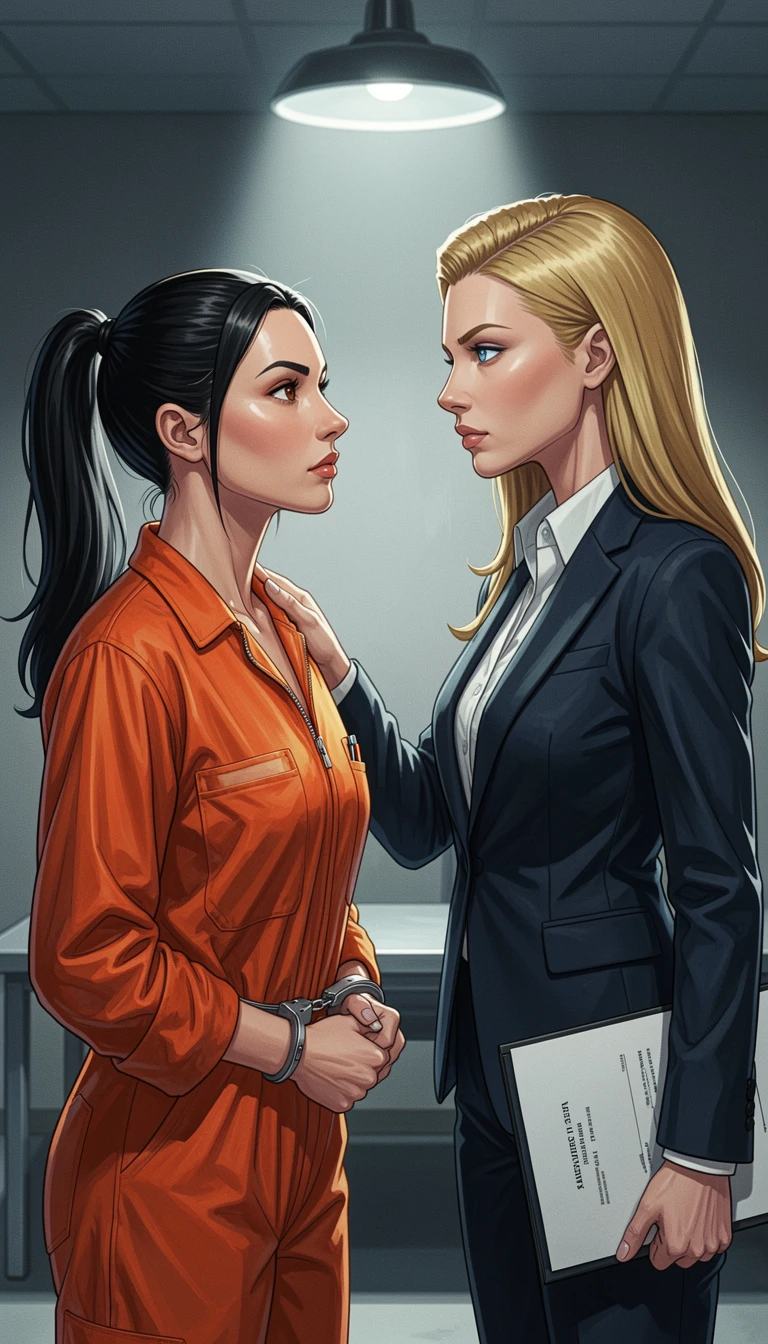
The door closed with a sound like a lock turning, and Mara was alone with it.
She didn't move. Her hands stayed flat on the metal table, palms down, fingers spread, the way she'd learned to hold herself in rooms that wanted her to flinch. The table was cold — not cool, cold, the kind of cold that came up through the steel and into the bones of her wrists and stayed there. She'd been sitting across from it for an hour. She'd stopped feeling it an hour ago. Now it was back, because now there was something on the table besides her hands.
One sheet. Letterhead. Cream stock, heavy, the kind of paper that cost more per ream than she made in a day. She didn't reach for it. She looked at it the way she'd look at a weapon on a table — not because she was afraid of it, but because she wanted to know where it was pointing.
The fluorescent light above her buzzed. It had been buzzing since she'd been brought in a week ago, and she'd stopped hearing it the way you stopped hearing your own pulse, and then it came back, and now it was the loudest thing in the room. She counted the tubes. Four. One of them flickered at the far end of the fixture, a stutter every few seconds, and she found herself timing her breath to it without meaning to.
She reached for the paper.
Her fingertips found the corner first, and the paper moved under them — light, almost nothing, the way a confession felt when you finally said it out loud and it turned out to weigh less than the silence had. She turned it toward her. The letterhead read Sterling Holdings in a serif that looked like it had been carved rather than printed, and beneath it, in a block of dense legal type, was the language she'd heard in her head for a week and had never once believed she'd see on paper.
A legal response. Filed this morning. And at the bottom, above the notary line, a signature.
Her hand flattened over it before she decided to. The heel of her palm came down on the page and her fingers spread wide, covering the signature the way you'd cover a wound, and she felt the ink under her skin — not the ink itself, the paper, but the pressure of the name under her hand like something with a temperature.
Eleanor 'Elle' Shelby, Esq.
She pressed. Not hard enough to tear, just enough to feel the loops of the letters through the paper, the way she'd once felt a pulse through a wrist. The E was wide, confident, the kind of signature someone had practiced until it looked effortless. The Shelby ran long and slanted, the tail of the y reaching toward the margin like it had somewhere to be.
Mara's thumb found the date. Today's. This morning, before the light in this room had even been turned on, before she'd been pulled from her cell and sat down at this table and told nothing. While she'd been lying on a cot with her eyes open, counting the ceiling tiles she'd already counted a hundred times, Elle Shelby had been sitting somewhere with a pen in her hand, signing her name to the document that would bury her.
She heard her own voice before she knew she'd spoken.
"She was on the frame."
The words came out hollow, scraped from somewhere below her ribs, and they sat in the room and didn't get answered because there was no one to answer them. The light buzzed. The far tube stuttered. She looked at the signature again and her thumb traced the three words — Eleanor Shelby — and then the small, sharp parenthesis of the nickname, the one nobody in the world would have known to put on a legal filing unless they'd heard it spoken in that house.
Elle had told her the nickname. In the office, on the cross, with the wax still cooling on her back and Kyle's belt hanging from his hand, she'd said it the way you said a thing you were trying to remember about yourself. Elle. People call me Elle. And Mara had said it back to her, and Elle had looked at her like the name was a hand reaching into a room she'd already decided to leave.
And now the name was on a filing. In her own hand. Dated this morning.
Mara let go of the paper. She pulled her hand back and set it on the table, palm up, and looked at her own fingers as if they'd done something she hadn't asked them to. There was a faint smudge of ink on the pad of her thumb. She rubbed it against her palm until it was gone.
The door opened.
Dana Reyes came in with her shoulders squared and her jaw set, and she didn't sit. She stood just inside the door and let it close behind her, and she folded her arms across her chest, and she looked at Mara the way a person looked at a thing they'd already decided to believe and were now waiting to be proven right about.
She was in uniform. The silver badge caught the light. The scar on her left eyebrow was a pale line against her brown skin, and her hair was pulled back in the tight bun she always wore, not a strand out of place, the way a woman wore her hair when she'd stopped expecting anyone to look at it.
"You read it," Dana said. Not a question.
"I read it."
"Then you know what it is."
Mara looked down at the sheet again. The signature sat there under the fluorescent light like a fact, and facts didn't care what you believed about them. She'd spent fifteen years learning that. She'd spent the last week being taught it again, harder.
"It's a legal response," she said. "On behalf of the Sterling brothers. Filed this morning." She turned the page with two fingers, not lifting it off the table, just sliding it a quarter-turn so the signature faced Dana. "Signed by their counsel."
"By her," Dana said. "Their counsel is her."
"Their counsel is her."
Dana's arms stayed crossed. She hadn't moved from the door. The silence between them stretched long enough that Mara could hear the far tube stutter twice, three times, and in the pause she understood something she didn't want to understand: Dana had read this before she'd brought it in. Dana had stood somewhere else with this sheet in her hand and had already had the thought Mara was about to have, and had brought it here anyway, because she wanted to watch Mara have it too.
"No coercion affidavit," Dana said finally.
Mara's eyes came up.
"No standby counsel motion," Dana went on. Her voice was low, level, the voice she used on the stand. "No request for an independent psychiatric evaluation. No motion to withdraw. Nothing that a lawyer files when they're being made to sign something." She uncrossed her arms and let them fall to her sides, and her hands were open. "Just her name on the line."
Mara's mouth was dry. She swallowed and it didn't help. "She's their lawyer. That's what lawyers do."
"That's what lawyers do when they're representing someone." Dana took one step away from the door, then stopped, as if she'd remembered she wasn't going to sit yet. "But a coerced lawyer — a lawyer signing under duress — files a sealed motion. She files a notice. She does something to leave a trail, because she knows somebody will eventually look, and she wants to be found." She tipped her chin toward the paper. "This doesn't want to be found. This wants to be seen."
"You've been thinking about this," Mara said.
"I've been thinking about this since I pulled the file this morning." Dana's jaw tightened, the small tell, the one Mara had learned to read across a table in the first three hours of the first day. "You told me she was on a cross."
"I did."
"You told me she was chained. In an office. In that house. You told me her statement exonerating the brothers was signed three days before you got out, and that it was coerced, and that she was still there when you left."
"I did."
"And now she's filing court documents." Dana's voice didn't rise. It didn't have to. "From that house. This morning. Under her own name. With no indication anyone's holding her pen."
Mara's hand came back down on the paper. She didn't mean it to. It landed on the signature like a slap, and she felt the loops of the name through her palm again, and she pressed, hard, the way you'd press a bruise to see if it was still yours.
"She was on the cross," she said. Her voice came out lower this time. Steadier. Worse. "When I left her. She was on the cross and she was still cuffed and Kyle Sterling was standing in the doorway of that office with a belt in his hand and I heard him say he'd be back. I heard it. I was in the hall." She looked up at Dana. "I heard the door close behind me."
Dana held her gaze for a long moment. Then she moved.
She came around the table on Mara's side, not the other side, and she stood beside the empty chair and looked down at the sheet of paper, and her shadow fell across the signature and darkened it. She stood there for a beat, two, three, and Mara watched her read the whole filing from above, the way you'd read a page over someone's shoulder when you already knew what it said and wanted to see it again anyway.
"That's the part I can't get past," Dana said quietly. "You're the only person in this building who's seen her. You're the only person who can say she was in that house. And the one piece of paper that could prove you right is the one piece of paper she signed herself."
"It's not proof of anything," Mara said. "It's proof she was alive this morning. That's all it is."
"It's proof she's alive and choosing."
The words landed and sat there. Mara looked at the paper, at the name, at the date, at the notary block at the bottom with its blank line and its seal. The page was clean. Too clean. No folds except the one, no coffee ring, no thumbprint but hers. It had been carried into this room the way a piece of evidence was carried, flat and protected, and she wondered who had handled it before Dana and whether they'd known what they were holding.
"Why are you showing me this?" she asked.
Dana didn't answer right away. She reached down and picked up the paper — carefully, by the corner, the way you'd handle anything you might have to produce later — and turned it over. The back was blank. She turned it back and set it down again, and this time she set it down in front of the empty chair, not in front of Mara, as if she were laying out a hand of cards.
"Because I sat on this for four hours before I brought it in here," she said. "Because I called the clerk's office and confirmed the filing, and I called the DA's office and asked whether anybody had flagged counsel for a welfare check, and the answer was no, and then I sat in my car in the lot and asked myself whether I was about to walk in here and hand you the thing that makes you look like a liar."
Mara's jaw worked once. "And you decided to hand it to me anyway."
"I decided I'd rather watch you look at it." Dana's eyes were steady, brown, tired in a way that had nothing to do with sleep. "I've been doing this nineteen years. I can tell when somebody's lying to me and I can tell when somebody's lying to themselves, and you're not doing either. You keep telling me the same thing in the same words. Most people, by day three, they've started sanding the edges off. You haven't sanded anything."
"I don't have anything to sand."
"That's what I keep coming back to."
Dana pulled out the chair. The legs scraped the floor — a long, ugly sound, metal on linoleum, and it went on a half-second longer than it should have because she didn't lift the chair, she dragged it, deliberately, the way you did when you wanted the other person to hear you sitting down. She sat. She folded her hands on the table, one over the other, and she looked at Mara across the sheet of paper, and her mouth opened.
"Then tell me why she's defending them."
Mara opened her mouth. Nothing came out of it.
She sat there with her hands flat on the table and her jaw half-open, and the answer she needed — the clean, direct, detective's answer she'd been giving for a week straight, the one that had held up under every question Reyes threw at her — was not there. It wasn't hiding. It wasn't somewhere behind her teeth waiting to be sanded into shape. It was simply gone, the way a word goes when you need it most, and she sat in the silence of its absence and felt the fluorescent hum fill the space where it should have been.
Dana watched her. Didn't fill the pause. Dana had the patience of someone who'd spent nineteen years letting other people's silences do the work for her, and she used it now the way she used everything — without hurry, without cruelty, just the flat steady waiting of a woman who knew the truth would come out eventually and preferred to be sitting when it did.
Mara heard herself breathe. In through the nose. Out. She did it again, and on the second exhale the words finally arrived, and they arrived small.
"I don't know."
Dana's eyebrows didn't move. Her hands stayed folded.
"I don't—" Mara stopped. Started again. "When I was in that house, we weren't together. We weren't ever together. They kept us separated. Different rooms, different floors. I saw her maybe four times the whole week and a half I was in there, and every time I saw her, she was—" She stopped again. Her hand came up off the table and made a shape in the air, a small useless shape, and then dropped back down. "She was on the frame, or she was being walked somewhere, or she was in the office with the door open and Sterling was standing behind her. That's all I have. That's the whole of it."
"Four times," Dana said.
"Four times."
"And in those four times, did she ever tell you she was being held against her will?"
Mara's jaw tightened. "She didn't have to tell me. She was cuffed to a wooden cross in a private office in a house with a wall around it. That tells you."
"That tells me what you saw." Dana's voice was still level, still the courtroom voice, but there was something underneath it now, a pressure, a thing being held down. "It doesn't tell me what she'd say about it. It doesn't tell me what she'd sign."
"She wouldn't sign this." Mara's hand came down on the paper and her voice came up with it, and the sound of her own voice surprised her — louder than she'd meant, harder than she'd meant, the edge of it scraping against the walls of the small room. She pulled it back. Dropped her voice. "She wouldn't sign this. Dana, she was a lawyer. She was a real lawyer, she had a practice, she had a name. You don't just— you don't just start defending the men who put you on a cross. Something happened. Something happened to her after I left."
"Something happened to her," Dana repeated. She said it slowly, deliberately, the way you said a thing back to a person so they could hear how it sounded when someone else's mouth made it. "You mean Kyle Sterling happened to her."
"Yes."
"You mean he broke her."
"I mean he broke her or he forced her or he—" Mara stopped. Her fingers curled against the paper. "I mean it doesn't make sense. That's all I'm saying. It doesn't make sense."
Dana unfolded her hands. She reached across the table and laid one finger on the signature — not on the paper, on the signature itself, the tip of her index finger resting on the S of Shelby like a woman touching a map to point at a city she'd never been to. She didn't lift the finger. She left it there, and she looked at Mara across it, and her eyes were doing the thing they did when she was about to say something she'd already decided was true.
"That's her name," she said.
"I know it's her name."
"That's her hand."
"I know it's her hand."
"That's today's date, on a filing that went through the clerk's office at nine-forty this morning, on behalf of the Sterling brothers, in a case where she is listed as lead counsel of record." Dana lifted the finger. She put her hand back in her lap and sat up straighter, and her jaw set the way it did when she'd decided to stop asking and start telling. "I've had three people look at that signature. A handwriting guy at the county lab. The clerk who took the filing. The DA's paralegal, who happens to have known Eleanor Shelby professionally for six years, and who says that's her hand, that's her pen, that's the way she's signed every document she's ever filed."
"Which proves she signed it."
"It doesn't prove she wanted to."
"No." Dana's mouth was a flat line. "It doesn't prove she wanted to. But it doesn't prove she didn't, either, and that's the problem. That's the whole problem, Mara. You've been sitting in this room for a week telling me that the one witness in the world who could back your story is a woman chained to a cross in a locked office. And this morning that woman filed a document with the court. In her own hand. Under her own name. With no sealed motion, no notice, no request for a welfare check, no nothing. Just her signature on the line, defending the men you say put her there."
Mara shook her head. She kept shaking it, small and automatic, the way you shook your head at a thing you couldn't make fit.
"Something's wrong," she said.
"I'm sure something is."
"No, Dana, listen to me. Something is wrong. She wouldn't do this. I know it looks like she did it, I know the paper says she did it, I know the clerk and the lab and the paralegal all say she did it, and I'm telling you, something is wrong. Something happened to her between the night I left and this morning. Something happened to her in that house."
"And you know this because—"
The question hung there, and Mara reached for an answer and found nothing but the hum of the light and the paper under her palm.
Because she didn't know. That was the thing. She had built her whole week on knowing — on being the one person in this building who had been inside the house and could say with certainty what was in it. But she had been in a locked room with a bolted door and a mattress on the floor, and Elle had been in a locked room somewhere else, and between those two rooms were hallways and stairwells and the sound of a man's voice through a wall. She had never asked Elle a single question. She had never sat with her and said, tell me what they did to you. She had only ever seen her from across a room, and now she was being asked to explain her from across a city, and she couldn't.
"I don't know," she said.
Dana's face didn't change.
"That's the honest answer. I don't know what happened to her after I left, because I wasn't there. I was out the gate and in a gas station and then in a cell, and she was still in that office, and I have spent every night since trying to figure out what it would take to make a woman like Eleanor Shelby sign her name to a lie, and I don't have it. I don't have the answer. But I know it would take something. It would take something, Dana. Because she was a lawyer. She knew what a signature meant. She knew what lead counsel of record meant. She knew exactly what she was doing when she put her hand on that line, and the only way a woman like that does it is if she has been made to."
"Made to how."
"I don't know how."
"Made to by whom."
"By Kyle Sterling." Mara said it flat. "By Kyle Sterling, in that office, with that frame and that belt and whatever else he keeps in the drawer, because that's the only thing that's changed for her. That's the only variable. She went in there free and she's still in there and now she's defending him, and there is no version of that where she chose it."
Dana sat back. She crossed her arms and looked at Mara the way she looked at a witness she was trying to decide whether to believe, which Mara had seen her do a hundred times from the other side of a table.
"Okay," Dana said. "Say you're right."
"I'm right."
"Say you're right. Say he's got her in there and he's made her sign. What do you want me to do with that? You want me to take it to a judge and say, my source believes the document is coerced, and the source is the defendant in the murder charge that document is going to be used against?" She shook her head once. "I can't work that way. I need something I can hold up. A witness. A statement from somebody who's been in the house since you left. A medical record. A phone record. A single thread I can pull. Right now all I have is your word against a signature that three people say is real."
"Then get me a thread."
Dana's eyes came up.
"You're a detective," Mara said. "You've got a badge and I've got a cell. Go knock on the door of that house and ask to see the woman who lives there. Ask her to come to the station and give a statement in person. If she's fine, she comes in and talks to you and I'm wrong and you can put me away and I'll go quietly. If she's not fine, you'll know. You'll know the second you see her. You'll know before she opens her mouth."
"I can't walk up to the Sterling estate and ask to see their counsel."
"Why not."
"Because their counsel is their counsel. She's not a resident, she's not a witness I can compel, she's an officer of the court representing two men who are not currently charged with anything. I've got no probable cause, no warrant, no standing. If I show up at that gate and ask for Eleanor Shelby, I tip them off that we're looking, and the next thing I know she's on a plane to the Caymans and I've burned the only lead I've got."
Mara's jaw worked. She looked down at the paper and the signature and the date, and she did the math she'd been avoiding all morning.
"The search warrant," she said.
"What about it."
"The second search. Adrian's lawyer filed for it, the state signed it, you said forty-eight hours. When they go in, they go inside the house this time, right? Full interior. Every room."
"That's what the warrant says."
"Then she'll be in there when they go in. She'll be in that office, or she'll be wherever he keeps her, and somebody with a badge will see her and then it's not my word anymore. It's a state trooper's word. It's a photograph." Mara's hand pressed flat on the paper. "You keep that search on schedule. You don't let anybody slow it down. You put it in motion and you keep your eyes on the door of that office, and when they come out of there, you'll have your witness."
Dana was quiet for a long moment. The fluorescent hum filled the room. Somewhere down the hall a door opened and closed, and a phone rang twice and stopped.
"The search is on schedule," Dana said finally. "I didn't tell you that, but it is. The state police execute it day after tomorrow."
"Good."
"But I want you to hear the rest of it." Dana leaned forward and put her forearms on the table, and her voice dropped into the register Mara had learned to recognize — the one she used when she was about to hand you the part of the file she'd been holding back. "The DA's office called me this morning, before you came in. There's a scheduling conference Friday. Judge Halloran. And the state is moving to set a trial date."
Mara's stomach went cold.
"A trial date."
"Against me."
"Against you."
"For Rosa."
"For Rosa." Dana didn't blink. "They're not waiting on the search. They're not waiting on anything. They've got a dead maid, a needle with your prints on it, a gate key with your prints on it, and a signed statement from the one witness who was in the house with you saying she stayed of her own free will and that you're the one who did the killing. That's a case. That's a real case, Mara, and the DA's office is going to run it."
"When."
"Friday's conference sets the date. But the word I got is they're pushing for a week. They want it on the calendar before the search shakes anything loose, because if they get it on the calendar first, anything the search turns up becomes a defense problem instead of a charging problem. They're racing you. They know the search is coming and they're trying to lock the door before it does."
Mara sat very still. She could feel her own pulse in her throat, and she hated it, hated that her body had a tell her mind couldn't shut off. A week. Seven days. She'd been in this room for one and she had spent it building a story out of nothing, out of four glimpses of a woman on a frame, and now she had one week to turn those four glimpses into something a jury could hold.
"Something's wrong," she said. Not to Dana this time. To the paper. To the signature. To the smooth practiced S at the front of Shelby's name. "Something has to be wrong, because if nothing's wrong, then she sat down at a desk in that house and did this herself, and that means —"
"It doesn't matter if something's wrong."
Mara looked up.
"It doesn't matter," Dana said again. "Not to the court. Not to the DA. Not to the clerk who took the filing. You want to know what matters? What matters is that the paper says what it says and the signature says what it says and the date says what it says, and in seven days you're going to stand in front of a judge and try to explain to him that the woman who signed it didn't mean it. And you're going to need more than a feeling."
"I don't have more than a feeling."
"Then you'd better get some."
Dana stood. She gathered the paper and squared it against the table, and she slid it back into the file and closed the file, and she held it against her chest the way she held everything — like it was already evidence of something.
"You've got six days before the conference and seven before the trial date they want," she said. "I'll do what I can with the search. But you need to understand what you're asking me to do, and you need to understand what it costs if I'm wrong. I'm not going to burn my career on a feeling either."
"You're not burning it on a feeling. You're burning it on the truth."
Dana looked at her for a long moment. Then she did the thing Mara had only seen her do twice in nine years, which was almost smile.
"You know what your problem is, Watts?"
"Tell me."
"You're a detective. You've been one your whole life. And now you're sitting in a cell in an orange jumpsuit trying to run a case from inside it, and you're doing it the way you'd do it from a desk. You're building it piece by piece, and you don't have the time, and you don't have the reach, and you don't have a single thing you can hand a judge." Dana walked to the door. She put her hand on it and stopped. "So stop building it like a detective. Build it like a defendant. Find the one thing in the world those two men are afraid of, and make them afraid of it. That's the only clock you've got."
She pulled the door open. The hallway light came in, white and flat, and the sound of the station came with it — a phone, a typewriter, somebody laughing at the far end.
"Six days," she said.
And she was gone, and the door shut, and Mara was alone with the cold table and the hum and the shape of a signature she couldn't stop seeing.
She put her hands flat on the metal and looked at the empty chair across from her, the one Dana had just left, and she thought about Elle in that office with the light coming through the window and the gate out past the lawn — the gate Elle had stopped looking at. She thought about the week between the escape and this morning. She thought about what a man would have to do to a woman to make her sign her own name to her own captivity, and she thought about the fact that she had no idea, and she thought about the fact that not knowing had never once stopped her from being sure.
Something was wrong in that house. She was sure of it the way she was sure of the needle in her hand, the way she was sure of the blood on her fingers, the way she was sure of the gate opening and the road and the gas station and the phone.
Six days.
She closed her eyes and started counting.