
The bus smelled like diesel and somebody's cold fried chicken, and the window glass was so cold against Sofia's forehead that it had gone past cold into a kind of burn. She kept her eyes half shut and let the road come up through the frame of the seat, through the floor, through her teeth. Every seam in the asphalt tapped against her jaw. She'd been riding so long that her body had started to mistake the vibration for a heartbeat—something the bus was doing for her, since hers had gone quiet somewhere back at the gas station and hadn't quite agreed to start again.
Her right hand wouldn't open. The keyring had been in that fist since the shed, since Luis's coat, since the dark. Three keys on a brass ring, one of them the one she'd used on the south gate, and now the metal had warmed to her and the edges had left a red seam across her palm that she could feel with her thumb like a little railroad track. She didn't need to look at it. She knew the shape. She'd known the shape of it for three years without ever holding it, and now she couldn't put it down.
The collar was still on her throat. She'd tried, at the bus stop, in the gas station bathroom with its caged bulb and its cracked mirror—she'd gotten her fingers under the leather and worked and worked until her short nails bent, and it hadn't budged, because the buckle was a small brass thing with a pin that wanted a tool, not a hand. So she'd pulled her braid over it. The braid was loose and greasy and it didn't cover much, but it covered enough that the driver had looked at her once and then looked away.
The driver was a broad man in his fifties with a belly that pushed at the wheel and a limp gray cap. He hadn't asked her for money. She'd had no money. He'd looked at her bare feet, and at the collar she hadn't managed to hide, and at the way she stood at the stop with her arms crossed over the maid's uniform like she was holding herself together, and he'd said, "Get on," in a voice that didn't want an answer, and she'd gotten on.
She looked at her hands. The blood had dried in the creases of her knuckles and gone the color of old tea. Not hers. Rosa's, or some of it, and she'd scrubbed at it at the gas station with the paper towels Dee gave her, and it had come off her fingers but not out from under her nails, and not out of the little lines in her palms. She turned her hands over. The backs were clean. The palms remembered.
The bus was half empty. An old woman two rows up with a plastic bag of oranges on her lap. A kid in headphones in the back, head against the window, mouth open. A man in a work shirt who'd gotten on at the last stop and smelled like cigarettes. Nobody was looking at Sofia. That was the thing she kept noticing—nobody was looking at her, and her shoulders had been up around her ears since she sat down, and they wouldn't come down, because for three years being looked at had mostly meant being seen, and being seen had meant being chosen for something.
The window was a gray smear of field and fence and the occasional farmhouse with a satellite dish on the roof. The pines had thinned out an hour back, and after the pines had come the flat land, and the flat land went on and on like somebody had unrolled it and forgotten to cut it. No trees to hide behind. No curves in the road. Just the long straight of it, and the bus chewing it up, and the sky sitting low and white over everything.
She pressed her forehead harder against the glass and watched her own reflection come up in it. A woman with a dark braid and dark eyes and a face that had gone thin in the last week, cheekbones doing too much work. The reflection sat over the fields like a ghost that had decided to ride along. She didn't recognize her. She hadn't recognized her in a while, if she was being honest, and she wasn't sure when the not-recognizing had started—whether it was the collar or the blood or the moment she'd turned her back on the window and left Elle hanging there.
The radio was on in the driver's cab, turned low, a tinny little speaker that made everything sound like it was coming through a paper cup. She'd stopped hearing it a while ago the way you stop hearing a fan. Then the music cut off, and a voice came in, and the voice had that flat newscaster rhythm that meant somebody had decided what you were about to hear was important.
"—charged this afternoon in the death of Rosa Alvarez, a domestic worker found deceased at a private residence in the county—"
Sofia's stomach dropped. It was a physical thing, a lurch like the bus had hit a pothole, and she kept her face against the glass and her eyes half shut and her body absolutely still, because the man in the work shirt had turned his head at the radio and she could feel it, the way you feel a room turn.
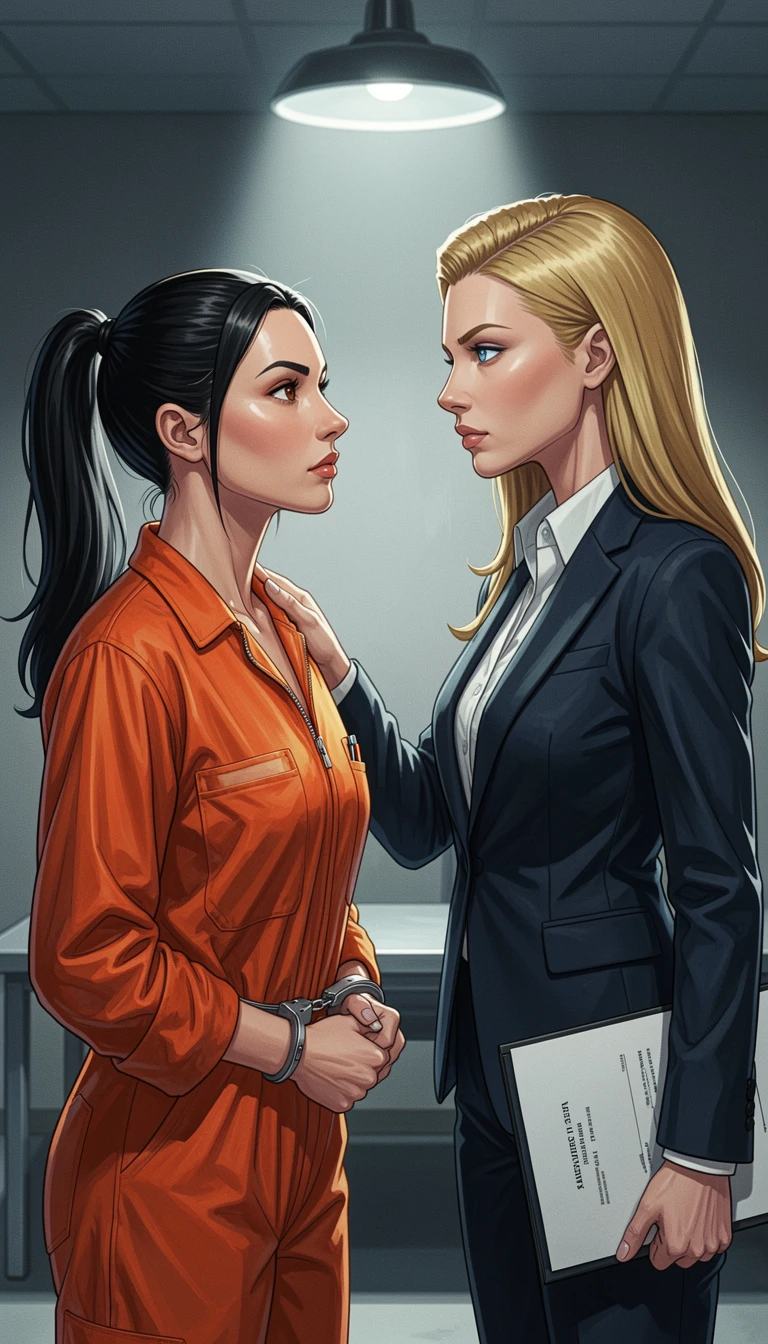
"—Detective Mara Watts, thirty-four, of the city police department, has been charged in connection with the death. Watts was taken into custody following an incident at the residence earlier this week. Authorities have not released further details—"
Her fist closed harder on the keyring. The teeth bit in. She felt the skin of her palm break somewhere, a small wet sting, and she didn't open her hand, because opening her hand meant moving and moving meant being a person who was reacting to the radio, and she had spent three years learning not to be that person. She kept her forehead on the glass and her breath going in and out and her eyes on the field going by.
Mara. Mara with the gate key in her fist. Mara with Rosa's blood on her hands. Mara standing in the gas station with the phone to her ear, saying it all out loud—the house, the brothers, the women—saying it in her clipped detective voice like the truth was a thing you could just hand over and have taken seriously.
And they'd charged her. Of course they'd charged her. Sofia had known it the way you know weather. The Sterlings had lawyers the way other people had cousins. The Sterlings had the county, maybe the state, maybe the whole flat gray middle of the map. She'd known it since the first night, when she'd knelt on the tile in the kitchen and heard Adrian on the phone in the next room, laughing, saying a name that Sofia recognized from the news.
The radio crackled and the music came back, something soft and old, and the man in the work shirt turned his head back to his window. Sofia let out a breath through her nose, slow, so it wouldn't fog the glass.
She thought about Mara's hands on the gate. Not the blood on them—the hands themselves, the way they'd worked the latch in the dark, quick and sure, a woman who'd done hard things with her hands before. Mara had held the gate for her. Mara had stood in the gap and said go, and Sofia had gone, and behind her the house had stood up black against the sky with one window lit, and in the window—
She stopped the thought there. She'd gotten good at stopping that thought there. It was a door she'd learned to hold shut with her shoulder, and if she let it crack she'd be back in the dark with the collar and the cold, and the bus would keep going, and she'd still be in the dark. So: shoulder. Door. Shut.
The fields went by. A fence post. A fence post. A fence post. A red barn with the roof caved in like a hat somebody had stepped on. A truck parked in a driveway with its hood up and no one around it. The flat land didn't care about any of it. The flat land just lay there being the flat land, and Sofia watched it and let it be boring, and the boring was a kind of mercy, because nothing in the flat land had ever hurt her.
She started, without meaning to, to plan.
It came up in her like water coming up in a well. She'd been doing it her whole life—the planning, the small arithmetic of getting by. Where the next meal was. Which door to stand near. Which man in the room to keep her eyes off of. Three years in the house had taught her to plan in hours instead of days, but the muscle was still there, and now it flexed and started doing what it did.
The city was east. The bus was going east. She had nothing but the keyring and the collar and a uniform that said maid in a way that a stranger could read. So the first thing was to get out of the uniform. The second thing was the collar. The third thing—
The third thing was a name.
She'd been turning names over since the gas station. It was a strange thing to do, and she knew it was strange, sitting on a bus seat with somebody else's blood under her nails and picking out a name like picking out a lipstick. But it was the only thing she could do that felt like forward. She couldn't go back. She couldn't go to the police—look what they'd done to Mara, look what they'd do to a maid with a collar and no papers and a story about a house nobody could find. She couldn't call her mother, because her mother was in a two-room apartment in a city Sofia had left at nineteen and her mother would ask where she'd been and Sofia would have to lie and then her mother would worry, and worrying was a thing Sofia had spent her whole life trying to spare her.
So. A name. Something plain. Something that wouldn't make anybody look twice at a woman with a braid and no shoes and a mark on her throat.
She tried a few on. Ana. Too close to her own. Marisol. Too pretty. Ruth —she liked Ruth, the bluntness of it, the way it sounded like a woman who'd been through something and come out the other side with her jaw set. But Ruth was the kind of name people remembered, and she didn't want to be remembered. She wanted to be a smudge. She wanted to be the woman at the register who nobody could describe afterward.
She settled, somewhere around the third fence post past a water tower, on Elena. It was her grandmother's name, or close enough—her grandmother had been Elvira, but Elvira was too much, and Elena was the soft version, the version you could put on a job application. Elena Delgado was too close to Sofia Delgado. But Elena something-else. Elena Reyes. No—Reyes was a cop's name now, she'd heard it on the phone. Elena Mora. Elena Vega. Vega was a star. She'd seen it on a weather map, the kind Mila used to stand in front of with a pointer, and she'd always thought it was a good name for a woman who wanted to be somewhere else.
Elena Vega. She said it in her head, twice, and it didn't fit yet, the way a new pair of shoes doesn't fit, but it would. She'd make it fit. She'd say it to a landlord and a boss and a woman at a counter and after a while it would stop feeling like a lie and start feeling like hers.
The lie she needed came right after the name, and it came easy, because she'd been rehearsing it without knowing. I've been out of the country. I'm coming back. I have no papers yet—they're being sent. I'll take anything. I'll work anything. She'd been a cleaner her whole life. She could be a cleaner in a city where nobody knew her, and a cleaner was invisible, and invisible was the whole point, and if she was invisible then the Sterlings would never find her, and if the Sterlings never found her then the last three years would just be a thing that had happened to a woman named Sofia who no longer existed.
She almost believed it. That was the thing. She almost believed it, sitting there with the fields going by and the radio playing something soft, and her body had gone a little looser, her shoulders down an inch, her breath coming easier, and she thought: this is what it feels like. This is what it feels like to leave. She'd never left anything before. She'd only ever been left, or taken. This was different. This was her own two feet on the step of a bus.
The radio crackled again.
"—Watts, a fourteen-year veteran of the department, is being held pending arraignment. In a related development, authorities are seeking a person of interest in the case—a former household employee—"
Sofia's eyes snapped to the window.
Her reflection stared back at her. The dark braid. The thin face. The collar hidden under the braid, mostly, not entirely. A woman she didn't recognize, sitting in a bus seat, going east, with a name she'd just made up in her mouth and a keyring she couldn't open her hand to drop.
A person of interest. A former household employee. That was her. That was her, and the radio had said it in the same flat voice it had said Mara's name, and somewhere behind that voice there was a file with her name in it, and somewhere behind the file there was a man in a suit who worked for the Sterlings and knew how to make files say what he wanted.
The name Elena Vega died on her tongue. She felt it go—a little pop, like a bubble—and she sat there with her forehead on the glass and her fist on the keyring and her heart doing something she didn't want to name, and the fields went by, and the bus went east, and the driver up front hummed along with the radio like nothing had happened at all.
She swallowed. The collar moved against her throat. She thought about the window in the house, the lit one, the one she'd turned her back on. She thought about the shape of a woman hanging on a frame, and she made herself stop thinking about it, and she couldn't, and that was the worst of it—that she couldn't. That she'd gotten on a bus and ridden it past the county line and she was still, somehow, standing in the dark at the south gate with her hand on the latch and her eyes on the window.
She closed her eyes. The vibration of the road came up through the seat and into her teeth. Somewhere up ahead the driver tapped the brakes, and the bus slowed, and a sign went by outside the window that she didn't catch the name of, and the driver's voice came back over the noise of the engine, easy and bored, calling out a town she'd never heard of.
Sofia opened her eyes. The bus was slowing. The keyring was still in her fist. She looked at the window, at her own face in the glass, and then past it, at the little town coming up on the right—a gas station, a diner, a strip of low houses, a road going off into nothing. She had no shoes. She had no money. She had a collar she couldn't get off and a name she couldn't keep.
The bus rolled to a stop. The door hissed. The driver looked up into his mirror, at her, and waited, and Sofia sat there with her hand on the keyring and the town waiting outside the window, and she had to decide.
She got up.
There was no ceremony to it. Her knees did the work before the rest of her agreed, and she came down the aisle with the keyring still shut inside her right fist and her bare feet finding every seam in the rubber flooring, and the driver watched her in his mirror with the flat patience of a man who had seen every kind of passenger get off his bus and none of them his business. She stepped down onto the concrete and the door hissed shut behind her and the engine took up its noise again and pulled away, and just like that the bus was a small square of taillights going east without her.
The town was smaller than it had looked through the window. One street, really, with a gas station on the near corner and a diner across from it and a strip of low houses going off toward nothing, and a water tower standing up over all of it on four legs like something that had decided to stay put. The air smelled like diesel and cut grass and, faintly, like fryer grease. Somewhere a screen door banged. She stood on the gravel shoulder with the collar under her braid and her uniform reading maid to anybody who cared to look, and nobody looked, and that was the first thing the town gave her: the gift of being nobody's problem.
She walked.
Her feet had been bare so long that the gravel had stopped being pain and become information — this stone sharp, this one flat, this patch of shoulder warm from the sun that had finally come out from under the white. She kept to the edge of the road where the dirt was packed and the weeds grew thin, and she counted the buildings as she passed them the way she'd counted fence posts on the bus. A laundromat with one machine going. A church with a sign out front whose letters had been rearranged by somebody with a sense of humor. A tire shop with its bay doors open and a radio playing inside, and she slowed at that one without meaning to, because a radio meant news, and then she made herself keep walking, because she couldn't spend the rest of her life flinching at radios.
The garage was at the far end of the street, past the last house, where the town gave up and the fields took over again. It wasn't much — a cinder-block building with a hand-painted sign that said HAL'S in letters that had gone chalky in the sun, two bays, one of them open with a pickup inside it up on the lift, and a dog asleep in a patch of light by the door with its legs twitching. A bell on a coiled spring hung over the doorway. It rang when she pushed through, and the dog lifted its head without opening its eyes and put it back down.
Inside it smelled like oil and hot metal and coffee that had been on the burner since morning. A fan turned somewhere overhead, slow, moving the smell around instead of out. There was a counter with a register and a rack of air fresheners shaped like pine trees, and behind the counter a doorway into the bay, and in the bay a man was leaning over the open hood of the pickup with a wrench in his hand and a rag over his shoulder.
He straightened up when the bell rang. He was maybe fifty, sixty, with forearms like knotted rope and a bald spot he'd stopped pretending about, and he looked at her the way the bus driver had looked at her — once, and then away — and then he looked again, because the second look always came, and it came for the collar.
"Help you?"
She had rehearsed nothing. That was the trouble with a plan that had never gotten past the name. She stood in the middle of his floor with the keyring in her fist and her toes curling on the cold concrete and she heard her own voice come out flat and low, the voice she used when she wanted to be small.
"I need something cut off."
He set the wrench down on the fender. He wiped his hands on the rag, slow, taking his time, and his eyes went to her throat and stayed there a second longer than was polite, and Sofia made herself stand still under it. She'd been looked at worse. She'd been looked at by men who owned the room she was standing in.
"That's a collar," he said.
"It is."
"That's a real one. Buckle and all."
"I know what it is."
He came around the counter. He was shorter up close than he'd looked in the bay, and older, the lines around his eyes deep as the cracks in his hands. He didn't reach for her. He just tipped his head and looked at the brass buckle where it sat under her braid, and Sofia turned her head to give him the angle, and he made a low sound in his throat that wasn't quite a whistle.
"Pin's got a set screw," he said. "Little hex. That's why your fingers couldn't do it. Whoever put that on you didn't want it coming off in a hurry."
She hadn't known that. Three years and she hadn't known that, and the knowing landed in her chest like a stone dropped down a well. Somebody had chosen the buckle. Somebody had stood behind her and worked a tiny wrench and made sure she couldn't ever get it off herself, and she'd spent that whole time thinking her own hands were just too weak.
"Can you get it off," she said. Not a question, the way she said it. She heard it come out of her and it sounded like Mara, a little, that clipped thing at the end of a sentence, and she didn't mind it.
"I got a hex set in the drawer. Hang on."
He went back behind the counter and pulled the drawer open with a scrape and fished through it, and the dog by the door rolled onto its other side and sighed. Sofia stood in the fan's slow turning air with her heart going and her fist still shut on the keyring and she watched the man's hands the way she watched all men's hands now — where they went, what they picked up, how fast they moved. They moved slow. That was the thing about him. Everything he did, he did like the day was long enough, and something in her shoulders came down half an inch that she hadn't told them to.
"Here," he said, and came back around with a little T-handle hex key, the kind you'd use on a bicycle. "Turn around. Keep your hair out of the way."
She turned. She lifted her braid with her left hand and held it clear of her neck, and the back of her throat went tight, because this was the part she hadn't thought through — the part where she let a stranger stand behind her. Three years of learning what it meant to have a man at her back, and here she was, offering it up on purpose, in a garage that smelled like oil, to a man whose name she didn't know. She felt him step in close. She felt the warmth coming off him. She felt the little metal tip of the hex key find the set screw and seat itself, and then the small precise twist of it, and the click.
"That's the lock," he said. "Now the buckle. Hold still."
His fingers found the brass and worked the pin through the hole, and the leather gave, and she felt it go slack against her throat for the first time in three years. It was such a small thing. It was a strap loosening by a quarter inch. But her eyes went hot and she had to look up at the ceiling and blink at the fan, because she was not going to cry in a garage, not over a buckle, not with a stranger's hands at her neck.
The collar came away. He pulled it off her throat and it slid over her skin and she felt the air hit the place where it had been, and the place where it had been was pale and chafed and had a line worn into it like the ring a jar leaves on a shelf. He held the collar in his hand and looked at it, the two of them standing there, and then he held it out to her.
"Yours, I guess."
She took it. She didn't want it. She took it anyway, because it was hers the way a scar is yours, and she bunched it up and pushed it down into the pocket of the uniform, and the pocket was too small and it stuck out, and she didn't care. Her throat was bare. She kept swallowing, feeling it, the nothing there.
"What do I owe you," she said.
He looked at her feet then, at the bare toes and the dirt and the red seam the road had worn into the side of her foot, and he looked at the uniform, and he looked at the collar sticking out of her pocket, and something moved behind his face that she couldn't read and didn't try to, because reading men's faces was a habit she was trying to put down along with the collar.
"Coffee's free," he said. "You look like you could use the sugar."
She didn't say yes and she didn't say no. He took that for whatever it was and went to the pot and poured into a paper cup and set it on the counter, and she came over and picked it up with her left hand because her right was still shut on the keyring, and the coffee was bad and burnt and had probably been on that burner since six in the morning, and it was the first thing she'd been given in three years that didn't have a price attached to it that she'd have to pay later, and she drank it standing up, looking out the open bay door at the fields going yellow in the afternoon.
"You passing through?" he said.
"Yeah."
"Where to."
She thought about the city. She thought about the name she'd built on the bus and then buried. She thought about the radio and the file and the man in the suit who knew how to make files say what he wanted, and she thought about how a woman with no shoes and no money and no papers was a woman the county could pick up and hold and hand back to whoever asked.
"East," she said. "City, eventually."
"Bus don't come back through till tomorrow." He said it like it was just information. "You got somewhere to sleep?"
"I'll figure it out."
He nodded at that, slow, and didn't push, and Sofia finished the coffee and set the cup down and turned to go, and he said, "Hey," and she stopped with her hand on the door and her back to him, and every muscle in her went tight, because there it was, the price, the thing he wanted, the reason he'd given her the coffee —
"There's a motel two miles up the county road. Blue sign. Tell 'em Hal sent you, they'll let you wash up in the office sink even if you can't pay."
She stood there with her back to him and her hand on the door and her eyes on the fields, and she said, "Thanks," and it came out rough, and she pushed out into the afternoon and the bell rang behind her and the dog didn't move.
She walked.
The county road was two lanes with a center line that had gone faded and a ditch on either side full of Queen Anne's lace and the dry stalks of something that had already bloomed and died. The sun was low now, coming in at her from behind, throwing her shadow out long and thin ahead of her on the asphalt, and she watched it walk in front of her — the shadow of a woman with a braid and no shoes, going east, and she thought about the name she'd buried on the bus and the name she'd have to pull up out of the ground and use anyway, because Hal had asked her where she was going and she'd gotten away with it, but the motel would want a name for the register, and the city would want a name on a lease, and the whole flat gray world would keep asking until she answered.
Elena Vega.
She said it out loud, out there on the empty road where nobody could hear her. The wind took it. She said it again, and this time it didn't taste like a lie. It tasted like a coat that didn't fit yet but would, if she wore it long enough in the cold.
Behind her, back down the road, a car came up out of the town with its headlights already on. Sofia heard it before she saw it — the low growl of it, the gravel ticking under the tires at the shoulder — and she did what three years had taught her to do. She stepped off the asphalt onto the dirt and she kept her face forward and her shoulders down and her gait even, a woman walking a road, nobody worth slowing down for.
The car slowed anyway.
The car pulled onto the shoulder behind her, and Sofia kept walking. That was the first rule and it was the only rule — keep walking, keep your face forward, do not turn around for the sound of a car. Three years had taught her that turning around was how you became someone's problem or someone's property, and she had just gotten her throat back. The gravel ticked under the tires. The engine idled, low and patient, and then a window came down.
"You walking to the motel?"
A woman's voice. Older. Not the voice she'd braced for. Sofia let her stride break, one step, two, and she turned her head just enough to see without turning her body — a pickup, dark green, dusty to the windows, an arm hanging out of it, and behind the arm a woman in her sixties with short gray hair and sunglasses pushed up on her head.
"Blue sign," the woman said, and pointed up the road with her chin. "Two miles. That's a long two miles with no shoes."
"I've walked longer."
"I don't doubt it." The woman looked at her feet and then at her face, and the looking was unhurried, the way Hal's had been, and Sofia was starting to think there was something in the water out here that made people slow. "I'm going that way anyway. You want the ride, you get in. You don't, no offense taken."
Sofia stood in the road with the keyring shut in her fist and the collar bunched in her pocket and the long shadow she'd been walking behind now lying flat under the truck's wheels. She thought about the price. There was always a price. But the woman's truck bed was empty except for a coil of hose and two buckets, and the woman's hands on the wheel were dry and bare and had dirt worked into the knuckles, and she had the face of somebody who had spent her whole life in one county and never once needed to be anybody's keeper.
"Okay," Sofia said.
She went around to the passenger side and got in, and the seat was cracked vinyl hot from the sun and the cab smelled like cigarettes and peppermint and cut flowers, and there were three paperwhites in a coffee can wedged against the gearshift. The woman pulled back onto the asphalt without checking her mirror, because there was nothing behind them for miles, and Sofia sat with her hands in her lap and her back off the seat and watched the road come at them.
"Hal's?" the woman said.
"Yeah."
"He get that thing off you?"
Sofia's head turned before she could stop it. The woman was watching the road. She hadn't looked at Sofia once since she'd gotten in, and that — the not-looking — was doing something to Sofia's shoulders that she hadn't given it permission to do.
"You saw it."
"I saw it at the bus stop this morning. You were standing there with your arms crossed and your hair pulled over, and I thought, that girl's got something on her neck she doesn't want me to see, and I drove on, because it wasn't my business." She changed gears, and the truck took the hill without complaining. "Then I came back through and you were still walking, and I figured it had become my business."
Sofia didn't say anything. The paperwhites in the coffee can nodded against the gearshift with every seam in the road.
"I'm not going to ask," the woman said. "I want you to know that. I'm not going to ask you where you came from or who put it on you or what you did. I'm just going to give you the ride, because I've got a daughter about your age and I'd want somebody to give her the ride."
"Thank you," Sofia said, and it came out low, and she looked out the window at the ditch and the Queen Anne's lace going by so she wouldn't have to look at the woman, because if she looked at the woman she was going to do something stupid with her face.
They rode in silence for a while. The sun went down behind them and the sky in front of them went the color of a peach, and the fields turned gold and then gray, and the road ran straight as a plumb line to the horizon and then kept going. Sofia counted the fence posts. She'd been counting fence posts for two days now, on the bus and off it, and she had started to think the counting was the only thing holding her together — that if she stopped counting she'd have to start feeling, and she did not have the room for feeling yet.
"That's it up there," the woman said, and nodded at a blue sign coming up out of the dusk. MOTEL. VACANCY. The sign was missing a letter and the vacancy part was a lie Sofia could see from the road, because there were three cars in the lot and one of them had weeds around its tires. "You want me to pull in?"
"This is fine."
"It's not fine, it's a quarter mile."
"This is fine," Sofia said again, and the woman looked at her then, a real look, the first one, and whatever she saw in Sofia's face made her pull over without another word.
Sofia got out. She stood on the shoulder with the door open and the dome light on and the woman's face lit up in it, and she didn't know what to say, because there was no way to say it. She'd been given a ride by a stranger and a coffee by a stranger and a collar cut off her throat by a stranger, and none of them had asked her for anything, and she didn't have anything to give them anyway, and the not-having was its own kind of debt.
"Hey," the woman said. "What's your name?"
Sofia stood in the open door with the night air coming in around her and the woman's engine ticking and the motel sign flickering blue across the road, and she opened her mouth to say Elena, and what came out was:
"Elena."
She heard herself say it and she felt the ground tilt under her a little, because she'd spent the whole bus ride burying that name and here she was handing it to a stranger in a pickup truck like it was nothing. But the woman just nodded, slow, like she'd been given something true and knew enough to hold it carefully.
"Elena," she said. "Okay. I'm Beth. I run the flower stand at the four corners, so if you're still here in the morning, come by and I'll give you something to eat."
She put the truck in gear and pulled away, and Sofia stood in the dark and watched the taillights go small and then gone, and then she crossed the road to the motel.
The office was lit and empty. A bell on the door woke a man behind the counter who had been asleep with his chair tipped back against the wall, and he looked at her bare feet and her uniform and her face, and Sofia said, "Hal sent me," and he said, "Wash up's in the back," and went back to sleep with his chair tipped, and that was that.
The sink was a utility sink in a little room behind the office with a mop and a bucket and a shelf of towels. Sofia ran the water until it went hot and then she stood over the sink and washed her hands, and the dried blood came out from under her nails in dark curls and went down the drain, and she watched it go and she thought about Rosa, who had brought her a lunch tray and told her she looked pale, and who had a mother in the city and two kids in a school somewhere, and who was dead because Sofia had needed a gate open.
She washed her feet. The water going into the drain turned gray and then brown. She washed her face and her neck, and her neck where the collar had been stung under the water, and she stood there with her hands braced on the edge of the sink and her head down and let the water run over the back of her neck, and she didn't cry. She'd decided on the bus that she wasn't going to cry until she was somewhere with a door that locked, and this wasn't it, so she didn't.
She dried off with a towel from the shelf and put the uniform back on, because it was the only thing she had, and she went out into the dark and sat down on the concrete walk outside the motel with her back against the wall and the keyring in her lap and looked up at the sky.
There were more stars out here than she remembered there being anywhere. Three years in a house with tall fences and floodlights on the lawn and she'd forgotten the sky was that big. She sat with her knees up and her arms around them and she thought about the house — not the way she usually thought about it, not the way that made her want to be sick, but the way you think about a place you've left. The kitchen at five in the morning. The way the floor in the east hall creaked in one spot. Rosa's radio on the counter, playing something soft. The window in Kyle's office, lit, with the shape of a woman hanging in it.
She made herself look at that one. She'd been holding the door shut with her shoulder since the gate, and she was tired, and the shoulder was giving out, and so she let it open and she looked at it — the window, the frame, the woman on it — and she sat on the concrete in the dark and looked at it for a long time.
She'd told Elle she was sorry. That was the thing she kept coming back to. She'd stood in the doorway with the keys in her fist and she'd said sorry, and Elle had looked at her, and Elle had understood — Sofia had watched her understand, watched it land, watched the exact second it went in — and then Sofia had turned around and walked out and left her there. She hadn't even been brave about it. She hadn't made it a sacrifice. She'd just been scared and she'd wanted to live and so she'd chosen herself, and Elle had watched her do it.
And Mara. Mara had asked her, at the gas station, standing by the payphone with her hand over the receiver — is she still in there? — and Sofia had said yes, and Mara had gone quiet, and then Mara had made the call anyway. Mara had told the truth to the police and the police had charged her with murder, and somewhere in a cell in the city Mara was sitting on a bench with her hands flat on her knees, and Sofia was sitting outside a motel with a keyring in her lap, and neither of them was any closer to free than Elle was.
She put her forehead down on her knees.
Somewhere out in the dark past the motel, out past the fields, there was a house with tall fences and floodlights and a woman in it. And somewhere out there, too, was Mila — Mila, who had run into the pines that night with Adrian's silk knotted on her wrist and had not come out the other side, and who nobody had found, and who Sofia had promised she'd be right behind, and then hadn't been. Sofia had promised her. She'd said it in the dark with her hand on Mila's arm, I'm right behind you, go, and Mila had gone, and Sofia had turned the other way.
She'd been telling herself Mila got out. That was the story she'd been carrying since the gas station. Mila got out and she's on a bus somewhere and she's fine. But there was a radio in a bus and a radio in a garage and a radio in a truck, and none of them had said anything about a woman found in the pines, and none of them had said anything about a woman found anywhere, and Sofia had been a weather presenter once and she knew what it meant when a storm didn't show up on the radar and didn't show up on the ground either. It meant it was still out there. It meant it hadn't landed yet.
She lifted her head and looked up the road, east, where the county line was and the city was past it, and she thought about getting up and walking. She could. She could walk all night and be at the county line by morning and put her thumb out and be in the city by afternoon and find a room and a job and be Elena Vega and never say the name Sofia out loud again. That was the plan. That was the good plan. That was the plan she'd built on the bus with the fields going by.
She didn't get up.
She sat on the concrete with the keyring in her lap and the towel around her shoulders and the stars overhead, and she listened to the crickets and the far-off sound of a truck on the highway, and she felt the shape of the country around her — the flat land and the fences and the long straight roads — and she understood, in a way she hadn't on the bus, that it was all one county. That the fences went on past the horizon. That a woman with no papers and no money and a face the county was looking for could walk east until her feet bled and still be standing in the same place.
She opened her hand. The keyring sat in her palm, three keys on a brass ring, and the red seam across her palm had gone dark and crusted, and she looked at it for a while and then she closed her hand again, because she still couldn't put it down.
Down the road, the motel sign flickered blue and then blue and then blue. A dog barked somewhere out in the dark and then stopped. The crickets went on. Sofia sat against the wall with the towel around her shoulders and watched the east, where the city was, and where the county line was, and where the house was too, if you drew the line the long way around, and she didn't know yet which way she was going to walk in the morning, and the not-knowing sat in her chest like a swallowed stone.
She stayed there until the man inside the office got up to close the blinds. He looked out at her through the glass once, and she looked back, and he didn't come out, and she didn't ask to come in, and after a while he turned off the light and the office went dark and the sign went on flickering over an empty parking lot.
Sofia pulled the towel tighter and put her back against the wall and closed her eyes, and behind her eyes, in the dark, a window was still lit.
---
Somewhere east of the county line, in a dark that had no windows in it, Mila Rodrigues lay curled on her side on bare concrete and shook.
She had been shaking for a while now. Long enough that it had stopped being a thing her body was doing and become a thing she was — a woman made of cold and shiver and the small animal sound her breath kept making in her throat no matter how hard she tried to swallow it back. The concrete pulled the heat out of her hip, her shoulder, the side of her face. It pulled and pulled and never got full.
Her wrists were chained. She didn't know to what. She'd stopped trying to find out. The cuffs sat high on the bones, above where her hands could reach, and every time she moved — and she moved without meaning to, because the shaking moved her — the chain rattled against the floor and the sound went out into the dark and came back to her with nothing on it. No echo. No walls she could measure. Just the rattle and then the silence, and the silence was the worst of it, because the silence meant she was alone, and being alone meant nobody was coming, and she needed somebody to be coming.
She'd been a woman on television. She kept coming back to that, the way you keep touching a bruise. Two weeks ago — was it two? was it three? — she'd stood in front of a weather map in a blue dress with her hair done and her smile on, and she'd said clear skies through the weekend, folks, not a cloud in sight, and the camera had loved her, and she'd gone home to an apartment with a plant she kept forgetting to water. That woman was dead. Mila didn't know when she'd died exactly. Maybe in the pines. Maybe before.
She turned her face against the concrete and the cuff bit her wrist and she made the small sound again and hated herself for it.
She'd run. That was the thing she couldn't stop turning over. She'd run into the pines with Adrian's silk knotted on her wrist and she'd run and run and the branches had whipped her face and the dark had been total, no moon, nothing, just the sound of her own feet on the needles and her own breath sawing in and out, and behind her the house had stood up with its floodlights on and its tall fence around it, and she'd thought — she remembered thinking it, she remembered the exact shape of the thought — I'm getting out, I'm getting out, Sofia's right behind me, I'm getting out.
And then the ground had gone. Not a cliff. Nothing dramatic. Just a hollow, a dip in the pine floor full of dead needles and old leaves, and her foot had gone into it and her ankle had turned and she'd gone down hard on her hands and knees, and when she'd tried to get up the ankle had folded under her and the pain had gone up her leg like a live wire, and she'd crawled. She'd crawled on her hands and knees through the pine needles with her ankle screaming and the silk still knotted on her wrist, and she'd kept going because going was the only thing left.
She should have waited. That was the regret, and it sat in her chest like a swallowed stone, heavier than the cold. She should have waited for Sofia. Sofia had said I'm right behind you, and Sofia had meant it, Sofia was the kind of person who meant things, and Mila had gone anyway because she'd been so scared, so stupid-scared, and she'd run out ahead of the only person who knew the way.
The chain rattled. She pulled her knees up closer to her chest and pressed her forehead against them and squeezed her eyes shut, and behind her eyes the pines were still there, and the dark, and the moment the hands had come down on her.
She didn't know whose hands. That was the other thing she couldn't stop turning over. They'd come out of the dark behind her while she crawled, two hands, big, and they'd caught her by the back of the neck and the arm and hauled her up, and she'd screamed and kicked with her good foot and got one hand free and swung it and hit nothing, and then there'd been a weight on her, a body, a smell — cigarettes and something sweet, cologne, something she almost recognized and couldn't place — and then a cloth over her face, and then the dark had gone deeper and she'd woken up here.
Here. Wherever here was. A room with no light and no window and no door she could find, with concrete under her and a chain on her wrists and nothing to measure time by but her own body's slow slide from cold to colder.
She was thirsty. She'd been thirsty for a long time. Her tongue felt too big for her mouth and her lips had gone cracked at the corners, and she kept thinking about water — a glass of it, cold, sweating, the way a glass of water sweats when you pour it from the tap — and the thinking made it worse and she couldn't stop.
She lifted her head. The dark pressed in on her face like a hand. She'd stopped calling out hours ago — or what felt like hours, or days, she couldn't tell — because her voice had gone to gravel and because nobody had answered, and calling out into the dark with nobody answering was a thing that took something out of you every time you did it, and she was running low.
But she called out now. She couldn't help it. The word came up out of her before she could hold it down.
"Hello?"
Her voice cracked on it. It went out into the dark and the dark took it and gave nothing back, and Mila lay there with her mouth open and her heart going and waited, and the waiting was the worst part, the waiting was always the worst part, and then the silence closed over her again and she let her head fall back down onto the concrete.
"Please," she said, quieter, to nobody. "Please. Somebody."
She'd never been a person who prayed. She'd been raised in a house where you went to church on Christmas and Easter and the rest of the year you didn't think about it. But she prayed now, in the dark, with her cheek on the concrete and her wrists in the cuffs — not a proper prayer, not words, just a direction, a leaning, the whole weight of her pushing out into the black at whatever might be listening. Somebody. Anybody. Please.
And then, because she was out of anybody to hope for, because the dark had eaten every other name she'd sent into it, her mind did the thing she'd been trying not to let it do for — she didn't know how long. It turned toward Adrian.
She hated that it did. She hated it with what was left of her, the small hot scrap of it down under the cold, and she hated it and she couldn't stop it. Because Adrian had been gentle with her. That was the thing. That was the trick of it, the part she couldn't make her body understand even when her mind knew better. Adrian had touched her like she mattered. He'd brought her things. He'd sat with her and talked to her in that low warm voice and looked at her like she was the only thing in the room, and he'd knotted his silk around her wrist himself, careful, two turns, and he'd said something to her she couldn't quite remember now and she'd felt — she'd felt chosen. That was the word. He'd made her feel chosen, and she'd spent her whole life wanting to be chosen, and her body had learned the shape of his hands, and now in the dark her body kept reaching for that shape like a tongue reaching for a missing tooth.
She turned her face and pressed her mouth against her own shoulder and made a sound into it that was almost a sob, because she knew. She knew what he was. She'd seen the house, she'd seen the room with the cross in it, she'd seen what they did — she'd heard things through the walls at night that she would never unhear. Adrian was not safe. Adrian was the reason she was here. Adrian was the reason any of them were here.
But he'd come back for her. He would. That was the thought that kept surfacing no matter how many times she drowned it. He'd notice she was gone and he'd come looking, and when he found her — whoever had her — he'd take her back. He'd take her back to the house, back to the room with the soft bed and the door that locked from the outside, back to the place where at least she got water and food and a shower and the small terrible mercy of being wanted. And that was a thing she would have spat on a week ago, that being wanted by Adrian Sterling was a mercy, and now she lay on the concrete in the dark and wanted it, wanted it the way you want a light in a window when you're lost.
She hated herself for it. She hated herself and she wanted it anyway, and the two sat in her chest side by side with no room between them.
The chain rattled. She shifted, tried to find a position where the concrete didn't press its cold into the same three spots, and there wasn't one, and she gave up and lay flat on her back with her arms out to either side, and the cuffs pulled her wrists up above her head like a woman in a painting, and she looked up into the dark overhead and it was the same as the dark to the side and the dark below, all of it the same, all of it with no top and no bottom.
She tried to think about Sofia. Sofia, who'd promised. Sofia, who'd said I'm right behind you with her hand on Mila's arm in the dark, and Mila had believed her, and then Mila had run and the ground had gone and the hands had come. Maybe Sofia had gotten out. Maybe Sofia was out there right now, free, walking a road somewhere with the sky over her, and maybe she'd tell somebody, maybe she'd bring help, maybe there was a whole world of people out there who didn't know about the house and the fence and the room with the cross, and Sofia would tell them and they'd come.
Mila held onto that for a while. It was warm, that thought, and she needed warm. But the warmth kept going out of it, the way heat goes out of everything down here, because the more she held it the more she saw the shape of it: Sofia, barefoot, with a collar on her throat and no money and no papers, running down a dark road. Sofia couldn't bring anybody. Sofia was as lost as she was. Sofia was probably dead in the pines by now, or worse, and the thought of Sofia dead in the pines made Mila's eyes go hot and she pressed the heels of her hands against them — as far as the cuffs allowed, which wasn't far — and made herself stop.
She turned onto her side again. The chain rattled. She drew her knees up and put her hands between her thighs where it was a little warmer, and she curled in on herself, and the shaking came back, and she let it.
She thought about the weather. That was what she did when it got bad — she'd done it in the house, lying on the bed in the room that locked from the outside, she'd done it to keep her mind from eating itself. She did it now, in the dark, and it worked a little. A warm front coming up out of the southwest. Dew point in the low sixties. The kind of evening where the air holds the day's heat and gives it back slow, where you can sit on a balcony with a glass of wine and not need a jacket. She built the forecast in her head, all of it, the numbers and the map and the little arrows, and for a minute she was standing in front of a camera in a blue dress with her smile on, and the studio lights were warm on her face, and the teleprompter was rolling, and she was Mila Rodrigues, weather presenter, and she was fine.
Then the concrete came back. The cold. The cuffs. The dark with no top and no bottom.
She opened her eyes and there was nothing to see and she closed them again, and this time, when the hope came up — and it kept coming up, it wouldn't stay down, that was the thing about hope, it was a weed — the hope had a face on it. And the face wasn't Sofia's. The face was Adrian's, honey-brown eyes and that slow disarming smile, and he was standing over her in the dark with his hand out, saying there you are, saying come on, let's get you home, and she was reaching up for him with her wrists still in the cuffs, and the reaching felt like rescue, and she didn't care anymore that it wasn't.
She lay on the concrete in the dark with her eyes shut and her wrists chained above her head and she held the face in her mind as hard as she could, because it was the only warm thing she had left, and she waited for somebody — anybody, Adrian — to come and open a door.
The chain rattled once as she settled, and then went still, and the dark went on being the dark, and Mila breathed into it and shook and waited.