
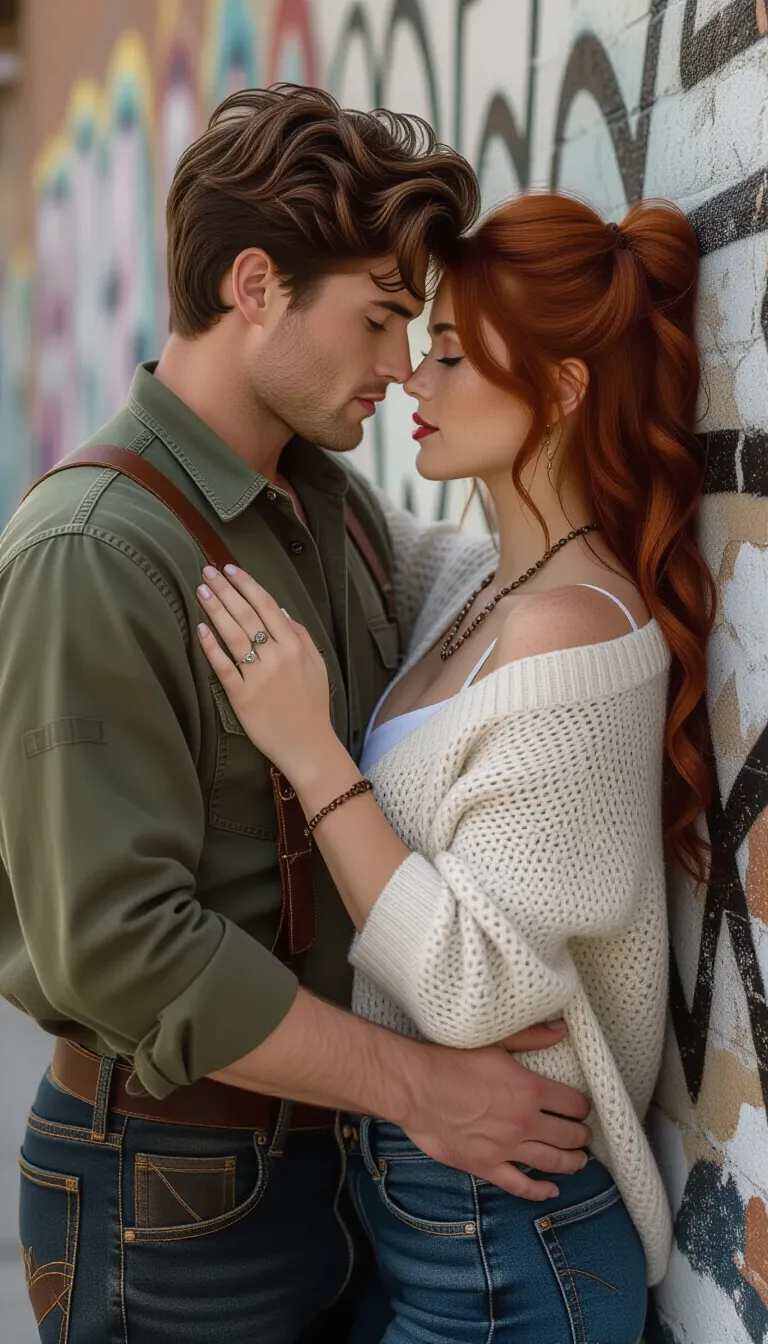
The creak is closer now—deliberate, a man's weight on the stairs. Siobhan's hand clamps over my mouth, her eyes wide and black in the moonlight. I'm still inside her, softening, and there's no time to dress, no window low enough, no lie that will hold.
She pushes me off. It's not gentle—her palms flat against my chest, shoving like she's putting out a fire. My back hits the wall. My trousers hit my chest, shoved by her hands, and I catch them without thinking. Reflex. A carpenter catches things.
Her face shifts. I watch it happen—the fear draining out, something else flooding in. Calculation. She's already becoming someone else, the schoolteacher who can look her father in the eye and smile. Her spine straightens. She pulls the quilt up to her chin, tucks it under her arms, and her voice when she speaks is groggy, thick with sleep.
"Da?"
I press myself flat against the wall beside the door. The floorboards are cold under my bare feet. My trousers are bunched in my hands, my shirt still on the floor somewhere by the bed. I don't remember taking it off. I don't remember anything except her mouth on my throat and the way she said my name when she came.
The footsteps stop. I can hear him breathing on the other side of the door—the wheeze of a man who's spent thirty years in a linen mill, cotton dust in his lungs. Sean Connolly. Her father. The man who shook my hand at dinner and said "You'll do" and I believed him.
"Siobhan." His voice is low, roughened by sleep. "You awake?"
"Mm. Just. What's wrong?" Her voice is perfect. Not too alert, not too groggy. The voice of someone who's been woken up and doesn't want to be. She even blinks slowly, as if he can see her through the wood.
"Thought I heard something."
"I was reading late. Dropped the book." She gestures vaguely at the floor, even though he can't see her. "Sorry. Did I wake you?"
A pause. I stop breathing. My heart is so loud I swear he must hear it, must feel it through the doorframe like a second pulse in the house.
"No." His voice is quieter now. "Couldn't sleep. Your mother's restless tonight."
"She's been bad since dinner?" She's asking like she cares, and she does, but underneath the question is a map—how far away is a bedroom? How long do we have?
"Aye. The old ache in her hip. Same as always. I'll get her some tea."
His weight shifts. One foot, then the other. He's going to turn. He's going to walk back down the stairs, and we're safe, and I'll count to a hundred and then I'll dress and climb out the window and—
"Siobhan."
Her eyes flick to mine. Just for a second. Then back to the door, calm and steady.
"Aye, Da?"
"I saw the light under your door. That's all. Thought I'd check."
I don't move. I don't breathe. I'm wearing nothing, pressed against the wall, hard from the nearness of her father and the fear of being found and the memory of being inside her. I should be soft by now. I'm not.
"Go back to bed," she says. "I'll see you at mass."
A pause. The longest pause of my life.
Then his footsteps retreat. One. Two. The creak of the stairs as he descends. The groan of the fifth step from the bottom. The kitchen door opening, the clink of the kettle being set on the stove.
Siobhan's shoulders drop. Just an inch. She exhales slowly, deliberately, the kind of breath she's been holding since the first creak. Her hand finds mine in the dark, presses once, and then she's moving—out of bed, wrapping the quilt around herself, crossing to the window.
"Dress," she whispers. "Now."
I don't argue. I pull on my trousers, my shirt, my boots. My fingers fumble with the laces. I can't stop looking at her—the way she stands at the window, one hand on the sill, watching the street below. The quilt has slipped off one shoulder. I can see the marks I left on her collarbone.
"Declan." She doesn't turn. "The back garden. Over the wall into the alley. If anyone sees you, you're a drunk looking for the privy."
"I'm not leaving you."
She turns then. Her face is unreadable in the dark, but I know her well enough now to see the crack in the armor—the way her lips press together, the way her throat moves when she swallows.
"You are. Because if my father finds you here, he'll kill you. And if he kills you, I'll have to watch. And if I have to watch that, I'll never forgive him. And then what's left of this family will burn."
Each word is precise. Clean. A lesson she's giving me. This is what we are now, she's saying. Conspirators in a house that wants us dead. You follow my instructions, and I follow yours, and we meet in the middle when the world is sleeping.
I cross to her. I take her face in my hands, and she doesn't pull away. Her skin is warm, still flushed from what we did, and I press my forehead to hers and breathe her in. Lavender and salt and something deeper, something that smells like the inside of her mouth.
"Thursday," I say.
"Thursday."
"The butcher's. Same time."
"I know."
I kiss her. Quick. Hard. A kiss that promises, not a kiss that lingers. Then I let her go, and I climb out the window, and I drop into the dark garden below.
The ground is wet. Rain earlier, or dew, I can't tell. I land silent as I can, rolling my weight through the ball of my foot like I'm coming off a roof, and I'm already moving toward the back wall before I've fully straightened.
Behind me, I hear the window slide closed. Soft as a whisper.
The wall is high—seven feet, maybe eight. But there are bricks loose in the mortar, and I've climbed worse. I find the holds by touch, haul myself up, swing my legs over and drop into the alley on the other side. I land in a puddle. Cold water seeps through my boot. I don't care.
I stand there for a moment, catching my breath. The alley is dark, narrow, the buildings leaning in on either side. Somewhere a dog barks. Somewhere a baby cries. The city is full of sounds, and none of them are for me.
I walk. I don't know where I'm going. Back to the Shankill, eventually. Back to my mother's house, to the attic room where her photograph is hidden under my mattress. But not yet. Not while my blood is still hot and my hands are still shaking.
I find a wall to lean against. The bricks are cold through my shirt. I press my palms flat against them, grounding myself, and I close my eyes and try to still the image of her face at the window.
The brick is cold through my shirt. I'm still hard—stupid, stubborn, a body that won't listen to reason. I press my palms flat against the wall and breathe. In. Out. Slow.
Her father is in the kitchen now. I can see the light spill through the back window, a pale yellow rectangle on the wet grass. He's making tea. A man who woke at three in the morning, checked on his daughter, and decided he needed something warm before he could sleep again. A man who didn't find what he was looking for. A man who has no idea I was inside his daughter, my hand over her mouth, my pulse in her throat.
I hate this. I hate the wall I need to climb, the alley I need to walk, the city I need to cross. I hate that I can't stay. I hate that she's up there alone, wrapped in her quilt, pretending she wasn't just—
Stop. I press harder into the brick. The mortar scrapes my palms. I focus on the pain. It helps.
I count to sixty. Then I push off the wall and start walking.
The alley runs parallel to the Falls Road, a narrow corridor of shadows and wet bins and the smell of rotting vegetables from the shops that closed hours ago. I know this route now. I've memorized it. The loose drainpipe at the third house. The dog that always barks but never bites. The gap in the fence where you can slip through into the next street. This is my secret map of her world, drawn in darkness and desperation.
I reach the end of the alley and stop. The main road is empty. The streetlights cast pools of orange light on the wet tarmac, and the rain has started again—a fine mist that settles on my skin like a second shirt. I turn left, toward the peace wall, toward the Shankill, toward home.
But I don't walk.
I stand at the mouth of the alley, looking back at the row of terraced houses. I can't see hers from here—it's too far down, too many corners, too much darkness. But I know which window is hers. Third from the left, top floor. The one with the crack in the frame that lets in the draft. The one she's watching me from, maybe, if she's still at the window.
I imagine her there. Her hand on the sill. Her breath fogging the glass. Her eyes scanning the darkness, looking for a shape that might be me.
The rain picks up. I turn and walk.
The streets of Belfast at three in the morning are a different country. The checkpoints are empty. The patrols have retreated to their barracks. The city holds its breath between the last pub closing and the first milk float rattling over the cobbles. It's the only time the city feels like it belongs to no one. Not the Republicans, not the Loyalists, not the Army. Just the rain and the stray cats and the men like me, walking home with salt on their skin and a girl's name on their tongue.
I cross the peace wall through the gap we use—a section where the corrugated iron has been pried back, just enough for a man to slip through if he turns sideways and holds his breath. It's not guarded. Not at this hour. The boys who watch it during the day are sleeping, dreaming of the violence they'll commit when the sun rises.
I'm through in three seconds. Back on my side. Back in the Shankill, where the kerbs are painted red, white, and blue, and the murals on the gable walls show hooded men with rifles. I've walked past them my whole life. I've never really seen them until I had something to lose.
Now I see everything.
The house is dark when I reach it. My mother's bedroom window is black—she's sleeping, or pretending to, which is the same thing lately. The door is locked, but I have a key. I let myself in as quietly as I can, slipping through the gap like a ghost, and I stand in the hallway and listen.
Silence. The house is silent in a way it hasn't been since Da died. No labored breathing from the front room. No footsteps shuffling to the bathroom at odd hours. Just the ticking of the clock in the kitchen, the groan of the old house settling, the distant hum of the city beyond the walls.
I climb the stairs. The third one creaks. I step over it. The fifth one groans. I shift my weight to the edge, where the wood is solid. I know every sound this house makes. I've spent twenty-eight years learning them.
The attic door is open. I slip inside and close it behind me, then lean against it, letting my head fall back, letting the tension drain from my shoulders.
The room is cold. The single bed is unmade, the sheets tangled from the nights I've lain awake, staring at the ceiling, thinking of her. The photograph is still under the mattress. I pull it out, careful, like it might break, and I sit on the edge of the bed and look at her face in the dim light coming through the attic window.
It's the photograph she gave me. Her mother and Thomas, the Protestant boy whose hands were broken. Maeve is young in this picture, maybe nineteen, her hair pinned up, her smile uncertain. Thomas is beside her, dark-haired, narrow-shouldered, a hand resting on her waist like he's afraid she'll disappear. They look happy. They look like they thought love was enough.
I trace the outline of Maeve's face with my thumb. Then I fold the photograph carefully and put it back under the mattress.
I lie down. The sheets smell like her. Lavender and salt and the damp heat of her skin. I close my eyes and I'm back in her bed, my hand on her hip, her breath warm against my neck. I can still feel her—the ghost of her body against mine, the echo of her voice whispering my name.
My cock stirs. I ignore it. I can't—not now, not here, not with her father's voice still ringing in my ears. But the memory is insistent. Her hand on my chest. Her leg hooked over my thigh. The way she looked at me when I was inside her, like she was seeing something no one else had ever seen.
I breathe. Slow. Deep. I think about wood. About the grain of oak, the weight of a hammer, the smell of sawdust. I think about the table I'm building for Mrs. Donnelly, the one with the carved legs she wants for her dining room. I think about the measurements, the joinery, the precise angle of the mortise and tenon.
It doesn't work. I'm still hard.
I open my eyes and stare at the ceiling. The plaster is cracked, a network of fine lines spreading from the corner like veins. I've counted them before. Two hundred and thirty-seven, if you count the small ones. Two hundred and thirty-eight, maybe, if one has grown.
I close my eyes again. This time I let myself think of her. Not the sex—the moment after. The way she curled into me, her head on my chest, her fingers tracing lazy patterns on my skin. The way she said my name, soft and sleepy, like it was a word she'd been saving.
"Declan."
I can hear it. I can hear her.
I roll onto my side, face the wall, and try to sleep. The rain taps against the window. The house settles. Somewhere in the distance, a dog barks once and falls silent.
Thursday. Two days. I can survive two days.
I think of her face in the window. I think of her hand finding mine in the dark. I think of her voice, precise and clean, telling me to dress, to go, to live so we can meet again.
This is what we are now. Conspirators in a house that wants us dead.
I fall asleep with her name on my lips, and I dream of a city with no walls.
The knock comes at the door and I'm on my feet before I know I've moved, the photograph still in my hand, the sheets still tangled from where I was lying. For a moment—just a moment—I think it's her. I think she's followed me, climbed the wall, crossed the peace line, found her way to the Shankill because she couldn't bear the waiting either.
But the knock comes again, harder this time, and I know. Billy Patterson doesn't knock twice. He knocks once, a warning, and then he knocks again to tell you he's still there.
The stairs creak. My mother's bedroom door opens. I hear her voice, thin and startled, asking who it is at this hour. I hear Billy's voice, low and flat, saying he needs to speak to Declan. Now.
I shove the photograph under the mattress and pull on my trousers. The zipper catches and I force it, the metal scraping my knuckles. I'm still buttoning my shirt when I reach the top of the stairs.
She's standing at the bottom, my mother, her dressing gown pulled tight around her, her gray hair loose and wild from sleep. She's looking up at me with an expression I've seen before—the one she wore when the men came to tell her Stephen was dead. Fear and resignation, mixed into something that looks like acceptance but isn't.
"Declan." Her voice is careful. "Billy Patterson is here to see you."
I nod. I don't say anything. There's nothing to say.
I walk down the stairs, stepping over the third one, and I find him in the kitchen. He's standing by the stove, his back to me, his hands in the pockets of his coat. He's wearing the same coat he always wears—a dark wool thing with leather patches at the elbows, like he's trying to look respectable. He turns when he hears me, and his eyes are flat, hard, the eyes of a man who's already decided what he's going to do.
"Declan." He says my name like it's a disappointment. "I thought we had an understanding."
I don't answer. I stand in the doorway and wait.
My mother hovers behind me. I can feel her presence, the heat of her fear, the tension in her hands as she grips the edge of the doorframe. She knows. Everyone knows. The whole street knows what Billy Patterson does when he pays a visit at three in the morning.
"Billy." I keep my voice level. "What do you want?"
He smiles. It doesn't reach his eyes. "I want to talk. Man to man. About the company you've been keeping."
I don't say anything.
"I saw you tonight," he says, and his voice drops, becomes intimate, confiding. "Crossing the peace wall. Coming back from her side. I thought we agreed, Declan. I thought I made myself clear."
"You made yourself clear."
"And yet." He spreads his hands, a gesture of helplessness that's completely practiced. "Here we are. You, coming home at three in the morning with her smell on your skin. Me, having to drive over here in the middle of the night to remind you of our arrangement."
He takes a step toward me. I don't move.
"My mother's here," I say. "This isn't the place."
"Your mother." He looks past me, at her, and his smile widens. "Mrs. Morrow. I'm sorry to disturb you at this hour. I just need a word with your boy. Man to man."
My mother doesn't speak. Her hand finds mine, cold and trembling, and I squeeze it once, a promise, before I let go.
"Outside," I say. "We'll talk outside."
Billy Patterson nods, satisfied, and walks past me through the door. I follow him into the narrow hall, into the cold air of the street, and I close the door behind me.
The rain has stopped, but the pavement is wet and the streetlights cast long, distorted shadows on the ground. Billy leads me to the end of the row, past the parked cars and the bins and the dog that's started barking again, until we're standing in the mouth of the alley that runs behind the houses. The same alley I crossed hours ago, coming from her.
He turns to face me. The streetlight catches his face, illuminating the scar that runs from his right eyebrow to his jaw—a souvenir from a knife fight in the Maze, or so the story goes. I've heard different versions. None of them make him look good.
"You're going to leave her," he says. Not a question.
"I'm not."
"You're going to leave her, or I'm going to make sure her father loses his job at the docks. I'm going to make sure her mother's shop window gets broken every night for a month. I'm going to make sure the Connolly family knows exactly what happens when a Catholic girl opens her legs for a Protestant boy."
His words are casual, conversational, like he's discussing the weather. That's what frightens me most. The ease of it. The way he's already done this a hundred times before, with a hundred different families, a hundred different girls.
"You touch her—" I start, but he cuts me off.
"What? You'll do what? Kill me?" He laughs, short and humorless. "You're a carpenter, Declan. You build tables. What are you going to do, hit me with a hammer?"
"I'll do whatever it takes."
"No." His voice hardens. "You won't. Because if you do anything—anything—I'll make sure your mother loses this house. I'll make sure your father's name is dragged through the mud. I'll make sure the whole Shankill knows that Thomas Morrow's son is a fenian lover."
I feel the words like a punch to the chest. My father. He's bringing my father into this now.
"Your father was a good man," Billy says, softer now, almost kind. "He served his community. He raised his sons to be Loyalists. And one of them died for it." He pauses. "Don't make his sacrifice mean nothing, Declan."
The mention of Stephen cuts deeper than anything else could. I feel the grief rise in my throat, hot and bitter, and I swallow it down.
"My brother died for nothing," I say. "He was nineteen. He was drunk. He got caught in a crossfire that had nothing to do with him, and he died in a gutter with his guts hanging out." My voice is shaking, but I don't stop. "Don't talk to me about sacrifice. Don't use his name to make me afraid."
Billy Patterson studies me for a long moment. His eyes are unreadable, flat as slate.
"You love her," he says. Not a question.
I don't answer.
"You love her, and you think that's enough. You think love will protect her from the men who will come for her when they find out. You think love will keep her safe when the UVF gets word that a Catholic schoolteacher has been meeting a Protestant boy in the back of a butcher's shop."
He steps closer. I can smell the whiskey on his breath, the cigarette smoke in his coat.
"I've seen love, Declan. I've seen it get people killed. I've seen it destroy families. I've seen it turn peaceful streets into war zones." He shakes his head. "Love is a luxury for people who don't live in places like this."
"Then why are you here?" I ask. "If you've already decided, if you're going to destroy her anyway, why bother coming to talk to me?"
He doesn't answer immediately. He looks down at his hands, at the scarred knuckles and the dirt under the nails, and when he looks up, his face is different. Softer. Almost human.
"Because I knew your father," he says. "And I knew your brother. And I don't want to see another Morrow boy get himself killed over something that doesn't matter."
"She matters."
"She's a Catholic, Declan. She matters to her people, and you matter to yours. That's the only truth that's ever mattered in this city."
He reaches into his coat and pulls out a photograph. It's creased and worn, edges frayed, like it's been carried in a wallet for years. He holds it out to me.
I take it. It's a picture of two men, arms around each other, standing in front of a pub. One of them is Billy Patterson, younger, thinner, his scar fresh and pink. The other is a man I don't recognize—dark-haired, broad-shouldered, with the same flat eyes Billy has now.
"That's my brother," Billy says. "Patrick. He fell in love with a Catholic girl, back in '72. Thought they could run away together, start a new life in the Republic. He was found in a ditch three days later with his throat cut." He takes the photograph back, folds it carefully, and puts it in his pocket. "The IRA killed him. Not because he was a soldier. Because he loved the wrong girl."
I don't know what to say. The story sits between us, heavy and cold, and I can feel him watching me, waiting for me to understand.
"I'm not trying to threaten you, Declan. I'm trying to warn you. The men who will come for her won't be like me. They won't talk to you first. They'll just act. And by the time you find out, it'll be too late."
He turns and walks away, his footsteps echoing on the wet pavement. I stand in the alley mouth, the photograph still warm in my memory, and I watch him disappear into the darkness.
The door opens behind me. My mother's voice, soft and scared.
"Declan?"
I don't turn around. I can't. If I look at her, I'll break.
"I'm fine, Ma."
"You're not fine. You're standing in the street at four in the morning, talking to Billy Patterson." She comes up behind me, her hand on my arm. "What did he want?"
I close my eyes. The city is quiet around us, the rain starting again, a fine mist that settles on my skin like a second shirt. Somewhere, on the other side of the peace wall, Siobhan is sleeping in her narrow bed, dreaming of a city without walls.
And I'm here, on this side, with a dead man's photograph in my pocket and a dead man's warning in my ears, trying to figure out how to love her without destroying her.
"Nothing," I say. "He wanted nothing."
My mother doesn't believe me. I can feel it in the weight of her silence, the tension in her hand on my arm. But she doesn't push. She just stands beside me, looking out at the empty street, and waits.
The rain falls harder now, drumming on the rooftops, running in rivulets down the gutters. I think of Siobhan's hand on my chest, her breath warm against my neck, her voice whispering my name in the dark. I think of Billy Patterson's brother, dead in a ditch, and his flat eyes as he told me the story.
I think of the bullet that killed Stephen, fired from a passing car, meant for someone else. I think of my father's coffin, closed because the body was too damaged to show. I think of my mother's hands, gripping the edge of the doorframe, holding on to the only thing she has left.
And I think of Siobhan, walking through the streets of her neighborhood, memorizing every doorstep, every window, every place a man might be waiting.
I can't stop loving her. It's too late for that. But maybe I can stop being the reason she gets hurt.
Maybe that's what love means, in a place like this. Not holding on. Letting go.
The rain soaks through my shirt. My mother shivers beside me. I put my arm around her, pull her close, and lead her back inside the house.
The door closes behind us, and the city falls silent again, holding its breath, waiting for dawn.
The night air hit my face as I stepped out the back door. Still dark. Still cold. Still the same Belfast sky, low and heavy, holding its breath.
I didn't go back inside. I couldn't. The house was a cage now, filled with my mother's silence and Billy Patterson's words still hanging in the kitchen air. I needed to move. I needed to breathe. I needed to see her.
The streets were empty. The kind of empty that only exists at four in the morning, when even the drunks have found their doorsteps and the soldiers have pulled back to their posts. I walked fast, my boots loud on the wet pavement, not caring who heard.
The peace wall loomed ahead, grey and graffitied, covered in messages I'd never read and names I'd never know. I found the gap—the one behind the boarded-up shop on Cupar Street—and slipped through, the wire catching my sleeve, the rust smelling like blood.
On the other side, the streets were the same. Same row houses. Same closed curtains. Same silence. But different. Everything was different.
I knew her house. I'd memorized it the first time she pointed it out, the blue door with the chipped paint, the window box with dead flowers still standing. I stood across the street, my hands in my pockets, and I watched.
The front door was locked. I knew it would be. The back garden—I'd seen it from her bedroom window, the narrow strip of grass, the wall she'd said she climbed as a girl. I circled around through the alley, my shoulders brushing both walls, and found the gate.
It was unlocked.
I pushed it open, the hinges screaming in the quiet, and stepped into her garden. Her window was dark. The whole house was dark. I picked up a pebble from the flower bed and tossed it at her glass.
Nothing.
I picked up another, bigger this time, and threw harder. The tap echoed in the silence, and I held my breath, waiting.
The curtain moved. A sliver of light. Then her face, pale in the darkness, her hair loose and wild, her eyes wide.
She saw me. Her hand went to her mouth. Then the curtain fell, and I waited, my heart hammering, not knowing if she'd come down or send me away or scream for her father.
The back door opened. She stood in the doorway, barefoot, wearing a thin nightdress that did nothing against the cold. Her arms were crossed, her shoulders hunched, and she looked at me like I was a ghost.
"Declan." Her voice was a whisper, barely there. "What are you doing here?"
"I had to see you."
"It's four in the morning."
"I know."
She stepped out, closing the door behind her, and crossed the garden to me. The grass was wet, soaking her feet, but she didn't seem to notice. She stopped a foot away, close enough that I could smell her—lavender and sleep and something warm underneath.
"What happened?" she asked.
I told her. Billy Patterson. The photograph. The story about his brother. The warning that wasn't a threat but might as well have been. I told her the words I'd been carrying since the alley, the ones I hadn't been able to say to my mother or to myself.
"He said they'll come for you. The men who killed his brother—they'll come for you, and by the time I find out, it'll be too late."
She didn't flinch. She stood there, barefoot in the wet grass, and looked at me with those green eyes that saw everything I tried to hide.
"And what do you think?" she asked.
"I think he's right." The words came out hollow, empty. "I think I'm going to get you killed."
"Declan." She stepped closer, her hand finding my chest, her palm flat against my heart. "Look at me."
I did. I couldn't help it. I always did.
"I'm not afraid," she said.
"You should be."
"I'm not." Her voice was steady, harder than I'd ever heard it. "I've been afraid my whole life. Afraid of my father. Afraid of the Church. Afraid of the men on the street corners who look at me like I'm something they want to break. I've been afraid of everything, Declan, every single day, and I'm tired of it."
She pressed her hand harder against my chest, and I could feel her fingers trembling, just a little.
"I'm not afraid of Billy Patterson. I'm not afraid of his dead brother or the men who killed him. I'm not afraid of the UVF or the IRA or any of the other letters that people use to decide who lives and who dies." She took a breath, and her voice cracked, just once. "I'm afraid of losing you."
I couldn't speak. The words were stuck in my throat, tangled with everything I wanted to say and everything I knew I couldn't.
"So don't you dare come here at four in the morning to tell me you're going to let me go," she said. "Don't you dare stand in my garden and tell me you're doing this for my own good. Because if you walk away now, Declan Morrow, if you leave me to save me, I will never forgive you."
Her hand was still on my chest, and I covered it with my own, feeling her fingers cold against my palm.
"I don't know how to protect you," I said. "I don't know how to keep you safe."
"Then stop trying."
"What?"
"Stop trying to protect me. Stop trying to keep me safe. Just love me, Declan. That's all I need."
I looked at her, standing there in the dark garden, her hair loose around her shoulders, her feet bare on the wet grass, and I saw her. Not the schoolteacher who corrected grammar in the pub. Not the daughter who bit her lip when she lied. Not the Catholic girl who prayed to a God I wasn't sure I believed in. Just her. Siobhan. The woman who made me believe that love was worth dying for.
I kissed her. Hard and desperate, my hands in her hair, her body pressed against mine, and I felt her melt into me, her arms around my neck, her breath warm against my cheek.
We stood there in the garden, the cold seeping through our clothes, the night holding its breath around us, and I kissed her like it was the last time.
Because it might be.
When we broke apart, she was crying. Silent tears running down her cheeks, her hands still tangled in my hair.
"I love you," she whispered. "I don't care what happens. I love you."
"I love you too."
She laughed, a broken sound that was half sob. "Promise me you won't leave."
I looked at her. At the tears on her cheeks. At the green eyes that saw through every wall I'd ever built. At the woman who had walked into my life and turned everything upside down, who had made me believe that a world without walls was possible, who had given me hope even when hope was the most dangerous thing I could carry.
"I promise," I said.
And I meant it.
She led me inside, through the dark kitchen, up the creaking stairs, past her parents' closed door. Her room was small and warm, the bed still rumpled from when she'd left it, the window still open a crack to let in the night air.
She closed the door behind us and turned to face me.
"Stay," she said. "Until dawn."
I didn't answer. I just pulled her close, my arms around her, her head against my chest, and I held her.
We stood there, in the dark of her room, the city sleeping around us, and I felt her breathing slow, her body relaxing against mine.
"What do we do?" she asked, her voice muffled against my shirt.
I didn't have an answer. I didn't know what we did. I knew what the smart thing was, the safe thing, the thing Billy Patterson would tell me to do. I knew what my mother would say, and her mother, and the priest who had told her she was damned for loving me.
But I also knew that I couldn't let her go. That I'd rather die than watch her walk away. That whatever came, whatever happened, I'd face it with her or not at all.
"We keep going," I said. "We keep fighting. We don't let them win."
She looked up at me, her eyes bright in the darkness, and I saw something there that I hadn't seen before. Not hope. Something harder. Something like steel.
"Good," she said. "Because I'm not done fighting."
She kissed me again, softer this time, and I felt the world drop away. The walls. The war. The dead brothers and the warnings and the long list of reasons why we shouldn't be together. All of it fell away, and there was only her, only this, only the two of us in the dark.
She pulled back, her hand on my chest, and looked at me.
"Stay," she said again. "Stay with me."
I nodded. "Till dawn."
She led me to her bed, and we lay down together, fully clothed, her head on my chest, my arm around her. The bed was narrow, too small for two people, but we fit.
The window was open, and I could hear the city outside. A dog barking somewhere. A car in the distance. The wind in the trees.
I lay there, holding her, and I thought about Billy Patterson's brother, dead in a ditch. I thought about Stephen, shot from a passing car. I thought about all the bodies in all the ditches, all the lives cut short because someone loved the wrong person.
And I thought about her. Asleep on my chest, her breath warm against my neck, her hand curled against my heart.
I didn't know how to protect her. I didn't know how to keep her safe. But I knew, with a certainty that went deeper than bone, that I would die trying.
I didn't sleep. I lay beside her, watching the moonlight shift across her ceiling, feeling her breathe against my chest, and I thought about dying. About how easy it would be. One bullet, like Stephen. One knife in a dark alley. One car that slows instead of passes and it's over, and she's alone, and Billy Patterson stands at my grave and tells himself he did the right thing.
Her hand curled against my heart, and I felt it—the truth I'd been trying to outrun. I couldn't keep her safe by staying. But I couldn't protect her by leaving either. Because leaving would kill her just as surely, just slower, and I'd be alive somewhere in England or Scotland, wondering if she was still breathing.
When the first grey light touched the window, I moved. Carefully. Slowly. I slid my arm out from under her head, and she stirred, her brow furrowing, her hand reaching for me in her sleep. I froze, watching her face, the way her lips parted, the way she sighed and settled back into the pillow.
I dressed in the dark. Trousers first, then my shirt, still damp from the garden. I didn't bother with my jacket. I needed to move fast, and the jacket would only slow me down, catch on fences, make noise where I needed silence.
The house was still sleeping. I crept down the stairs, avoiding the third step that creaked, and slipped out the back door into the grey dawn. The air was cold and wet, the kind of cold that seeps into your bones and stays there. I pulled the gate closed behind me, the latch clicking softly, and I started walking.
The streets were empty. A milk cart rattled in the distance. A dog barked somewhere, then fell silent. I walked with my head down, my hands in my pockets, trying to look like I belonged, like I had every right to be here at this hour, like I wasn't a Protestant boy walking through the Falls Road with a Catholic girl's scent still on my skin.
I didn't know what I was going to say to her. I didn't know how to explain that I'd spent the night fighting with myself, that I'd lain awake for hours trying to find a way out that didn't end in blood, that I'd failed. But I knew I had to see her. I had to look her in the eye when I told her that Billy Patterson had shown me a photograph of his dead brother, that the threat was real, that we were walking through a minefield and the bombs were already primed.
The peace wall loomed ahead of me, grey and graffitied, a scar across the city. I'd climbed it twice now, once to find her and once to leave her. This would be the third time. Third time lucky, my father used to say. Before he died. Before everything.
I found the spot where the barbed wire had been cut, where the fence sagged just enough to give. I climbed over, my boots scraping against the metal, and dropped into the alley on the other side. My hands were shaking. From the cold, I told myself. From the cold.
Her street was quiet. The curtains were drawn, the lights off. I stood across from her house, watching the front door, waiting for a sign that she was awake, that she was alive, that I hadn't already lost her to the night.
The door opened.
She stepped out onto the stoop, wrapped in a cardigan, her hair loose around her shoulders, her eyes searching the street until they found me. She didn't smile. She just nodded, once, and I crossed the street, my heart hammering against my ribs, my hands cold and useless at my sides.
"You came back," she said. Her voice was flat. Not accusing. Just stating a fact, like she was testing whether it was true.
"I said I would."
"You left without saying goodbye."
I didn't have an answer for that. I'd left because I couldn't bear to see her face when I told her what Billy had said. I'd left because I needed to think, to breathe, to find the words that would make this right. But I hadn't found them. I'd just found more fear, more doubt, more reasons to run.
"I'm sorry," I said. It wasn't enough. It would never be enough.
She stepped closer, and I saw the red in her eyes, the shadows under them. She hadn't slept either. She'd lain awake, wondering if I'd come back, wondering if I'd already decided that she wasn't worth the fight.
"What happened?" she asked. "After you left. What did he say to you?"
I told her. Standing there in the grey dawn, on the street where anyone could see us, I told her about Billy Patterson and his dead brother, about the photograph, about the warning. I told her that he'd said he would burn her house down with her inside it, that he would make her mother watch, that he would destroy everything she loved if I didn't walk away.
She listened. Her face didn't change. When I finished, she was quiet for a long moment, and then she said: "Come inside."
"Siobhan—"
"Come inside." She turned and walked back into the house, leaving the door open behind her.
I followed.
The kitchen was warm, the kettle still hot from the morning. She poured two cups of tea without asking, set them on the table, and sat down. I sat across from her, my hands wrapped around the mug, the heat burning into my palms.
"I've been thinking," she said, not looking at me. "All night. About what we do."
"And?"
She looked up. Her eyes were tired, but there was something else there. Something hard. Something I hadn't seen before.
"We leave."
"Leave?"
"Belfast. The North. All of it." She set her mug down, her hands steady. "We go south. To the Republic. We start over. New names, new lives. No one has to know."
I stared at her. "You'd leave your family?"
"I'd leave everything." Her voice cracked, just slightly, and she pressed her lips together, holding it in. "I can't lose you, Declan. I can't. I'd rather lose everything else than lose you."
I reached across the table and took her hand. Her fingers were cold, trembling slightly, and I held them tight, trying to warm them, trying to hold her together.
"If we run," I said, "they win. Billy wins. The walls win. We spend the rest of our lives looking over our shoulders, waiting for someone to find us."
"Then we don't run." She pulled her hand back, tears spilling down her cheeks. "We stay, and we fight, and one of us ends up dead in a ditch like your brother, like Billy's brother, like everyone who's ever tried to love across this fucking line."
Her voice broke on the last word, and she covered her face with her hands, her shoulders shaking. I stood up, moved around the table, and pulled her into my arms. She buried her face in my chest, her hands clutching my shirt, and I felt her body shake with sobs she'd been holding in all night.
"I'm sorry," I whispered. "I'm sorry."
She looked up, her eyes red, her cheeks wet. "Don't apologize. Just—don't leave. Promise me you won't leave again without telling me."
"I promise."
She wiped her eyes with the back of her hand, a rough, angry motion. "Then we stay. And we fight. And we don't let them win."
"We stay," I repeated. "We fight."
She kissed me, hard and desperate, her hands in my hair, and I tasted salt and tea and the stubborn, stubborn hope that she carried like a flame against the dark. I held her close, my arms around her, and I felt the world narrow to this—the two of us, in a kitchen on the Falls Road, choosing each other over everything.
The kettle whistled. She pulled back, laughed a broken laugh, and turned it off. The morning light was stronger now, filtering through the curtains, painting the room in pale gold.
"I should go," I said. "Before your father wakes up."
"He knows."
I froze. "What?"
"He knows you were here last night. He heard you come in." She didn't meet my eyes. "He didn't say anything. But he knows."
I stood there, the words sinking in. Her father had heard us. Had known I was in his house, in his daughter's room, and he hadn't come in. He hadn't thrown me out. He had let it happen.
"Does he know about Billy?" I asked.
"He knows about the threat. I told him. This morning, after you left." She wrapped her arms around herself. "He said—" She stopped, her voice catching. "He said he'd talk to some people. Old friends. People who owe him favors."
"Siobhan." I stepped closer, my voice low. "If your father gets involved—"
"I know." She looked up at me, and I saw the steel in her eyes. "But we're past the point of playing nice. Billy Patterson threatened to burn my house down. My mother's house. My father's house." She shook her head. "They need to know we won't be scared off."
I didn't know what to say. She was right, and she was wrong, and the line between them was so thin I couldn't see it anymore.
"I have to go," I said. "I'll come back tonight. After dark. We'll figure out what to do."
She nodded, and I kissed her one last time, soft and slow, like I had all the time in the world. Then I pulled away, opened the back door, and stepped out into the morning.
The air was cold, the sky a pale, washed-out blue. I walked through the alley, past the bins and the sleeping cats, and I climbed back over the peace wall, my hands raw from the metal, my heart heavy in my chest.
I didn't know what came next. I didn't know how to fight a war that had been going on for centuries, how to love a woman in a city that wanted us dead. But I knew one thing, with a certainty that burned through the cold, through the fear, through the long grey morning ahead.
I would not let her go.
I would burn this city down before I let her go.