
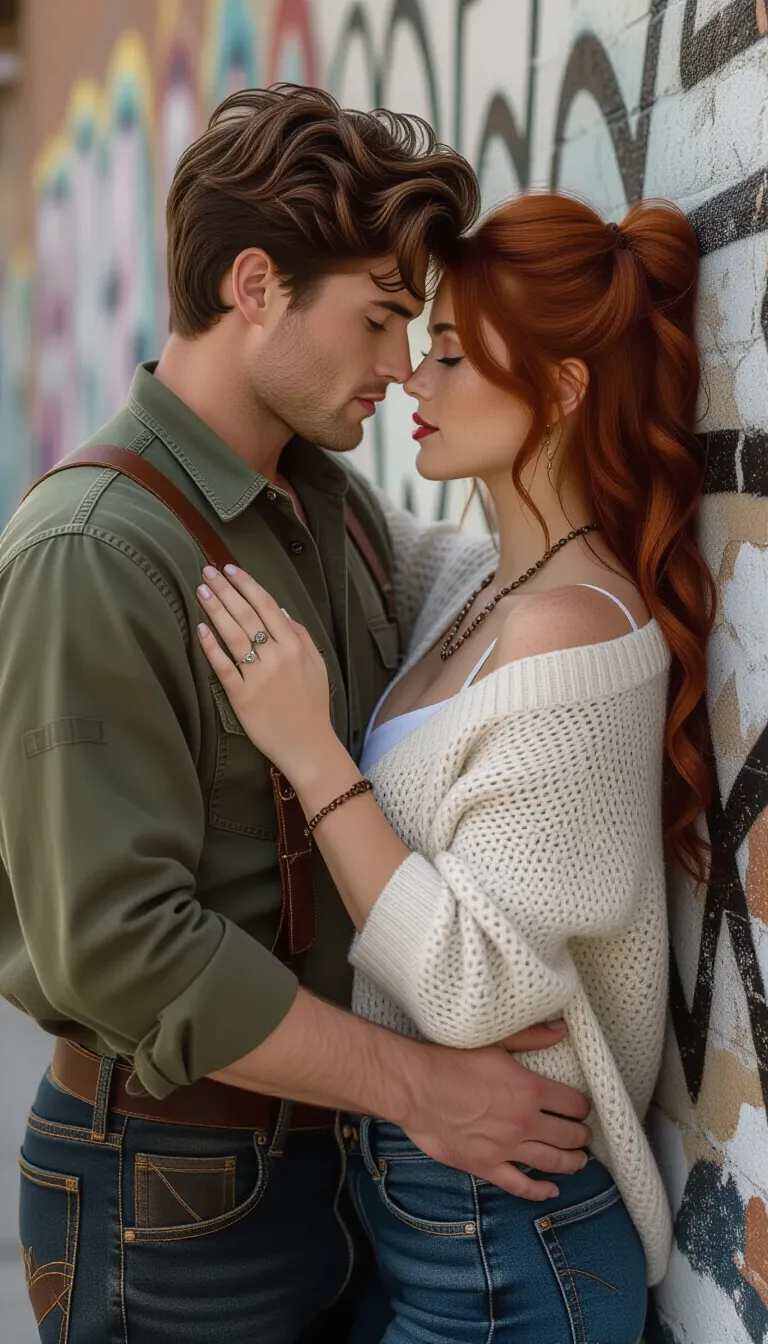
She woke to the weight of his hand on her belly. Not moving. Not yet. Just resting there, his palm flat against the cotton of her skirt, the heat of him seeping through like a question she wasn't sure she knew how to answer.
The room was dark except for the moon cutting through the thin curtains—a pale strip of light across the foot of the bed, across the notebook still open on the nightstand. She could hear his breathing, slow and deliberate, not the rhythm of sleep.
"You're awake," she said. Not a question.
"I've been thinking." His voice was low, roughened by the hour. His fingers shifted, tracing a slow line across her lower ribs, then down again. "About tomorrow. About Malloy. About—" He stopped. His thumb pressed into the curve of her hip, a small pressure, as if he were steadying himself.
She turned her head on the pillow, trying to read his face in the dim light. He was looking at her. Not at her body—at her eyes.
"Declan."
"I need you to give me something." His hand stilled at the waistband of her skirt, the tips of his fingers tucked under the edge of the fabric. "Something I don't have yet."
Her chest tightened. Not from fear. From the weight of what he was asking, the way he was asking it—not with demand, but with a kind of reverence that made her feel seen in a way she hadn't been since she was a girl kneeling in confession, her sins still wet on her tongue.
"What do you want?"
He didn't answer right away. His hand stayed where it was, unmoving, a threshold he wouldn't cross without permission. "I know you," he said slowly. "The way you laugh. The way you bite your lip when you're lying. The way you smell when you've been teaching all day—chalk and that soap your mother sends from Galway. I know your body. I know the sound you make when you come."
She felt heat rise to her cheeks, but she didn't look away.
"But there's a part of you," he said, "that you keep buried. Even with me. Even when I'm inside you." He paused. "I can feel it. The way you hold something back. Like you're standing at a door you won't open."
The air in the room felt thinner. She pressed her hand over his, her fingers lacing through his where they rested at her waist. "I'm not holding back."
"You are." His voice was soft, not accusatory. "And I don't need to know why. But I need you to trust me with something. One thing. Small, maybe. But yours."
She stared at the ceiling, at the crack in the plaster that ran like a river from the light fixture to the wall. She thought of all the things she'd never told anyone. The night she'd held her father's hand while he died, the way she'd prayed to a God she wasn't sure was listening, the names she'd whispered in the dark when she was alone and no one could hear.
Her mother's maiden name. The one she'd never spoken aloud, not even in confession. The one she'd written in the back of her childhood Bible, pressed between the pages of Psalms, as if leaving it there made it sacred.
She turned her head to look at him. His gray eyes were steady, patient, holding no expectation. Just the question. Just the waiting.
"O'Shea," she said. The word came out rough, barely a whisper. "My mother's maiden name. She was Bridget O'Shea before she married my father. And when I'm alone—when I'm scared or angry or trying to remember who I am—I say it. In the dark. Like a prayer."
She felt the word hang between them, fragile and exposed, a piece of her she'd never given anyone.
His thumb moved, a single stroke against her skin. "Siobhan O'Shea."
Her breath caught. Not from the sound of it—from the way he said it. Reverent. Possessive. As if he were claiming a part of her she'd thought was invisible.
"Say it again," she whispered.
"Siobhan O'Shea." His hand pressed flat against her belly, and she felt the heat of his palm through the cotton, grounding her. "The woman who smells of chalk and lavender. Who bites her lip when she's about to lie. Who laughs too quickly and stops like she's remembering she shouldn't be happy." He shifted closer, his lips brushing her temple. "Who gives me a name she's never given anyone."
She closed her eyes. The world tilted, rearranged itself around the sound of her secret in his mouth, and she felt something crack open in her chest—a door she'd kept locked so long she'd forgotten she was standing behind it.
"Declan."
"I've got you." His voice cracked, just slightly. "I've got all of you now."
She turned into him, her face pressing against his neck, her fingers curling into the fabric of his shirt. He held her, his hand still spread across her belly, and she felt the future they'd spoken of—the whitewashed cottage, the yellow table, the garden of roses—settle into something real, something with roots that went deeper than hope.
His hand moved, sliding beneath the waistband of her skirt, his fingers spreading over the bare skin of her hip. She shivered, and he stilled, waiting.
"Yes," she said. "Always yes."
He kissed her then, slow and deep, his tongue finding hers in the dark, and she felt the question in the kiss—not what he could take, but what she was willing to give. She answered with her body, arching into him, her legs parting as his hand slid lower, his fingers tracing the edge of her underwear, pressing gently into the heat he found there.
She gasped against his mouth. He swallowed the sound, his thumb circling in a slow, deliberate rhythm that made her toes curl against the worn sheets. His other hand cradled her face, holding her steady, keeping her eyes on his even as the pleasure built.
"I want to hear you," he murmured. "No holding back. Not anymore."
She felt the wall she'd built—the careful distance she'd maintained even in their most intimate moments—begin to crumble. She let her head fall back, let her breath come in short, uneven gasps, let the sound escape her throat when he found the exact place that made her hips buck against his hand.
"Declan—"
"I know." His voice was rough. "I've got you."
He worked her slowly, deliberately, watching her face in the dim light, his fingers sliding inside her as his palm pressed against her clit. She felt the orgasm building, a slow wave rising from her core, and she didn't fight it. She let it take her, let her body tremble against his hand, let the cry tear free from her throat—a sound she'd never made before, raw and unguarded and utterly her own.
He stayed with her through it, his hand gentle, his lips pressed to her forehead, whispering her name—the name she'd given him, the name he'd claimed.
"Siobhan O'Shea."
She opened her eyes. The moonlight had shifted, casting a silver stripe across his face. She reached up, tracing the line of his jaw, feeling the roughness of stubble, the warmth of his skin.
"I'm yours," she said. "All of me."
He closed his eyes, and she saw the tension leave his shoulders, the surrender of a man who'd been holding his breath for years and finally let it go.
"And I'm yours," he said. "Siobhan O'Shea. I'm yours."
The future was still waiting. The notebook with its names and dates. The confrontation with Brendan Malloy. The truth that could destroy everything they'd built. But in that room, in that hour, none of it existed. There was only the weight of his hand on her skin, the sound of her secret in his voice, the knowledge that she had given him something no one else would ever receive.
And he had received it like a sacrament, with the reverence of a man who understood the weight of a name.
She pressed her lips to his chest, feeling his heartbeat slow beneath her mouth, and closed her eyes.
Tomorrow would come. But tonight, she was Siobhan O'Shea, and she was not alone.
Her hand drifted from his chest, fingers finding the edge of the mattress, then the cool metal of the nightstand. The notebook sat there, a dark rectangle in the moonlight, its leather cover worn soft at the corners. She felt its weight before she touched it—the names, the dates, the careful accounting of a world that had been hunting them.
Declan's hand caught her wrist. Gentle. Not stopping her. Waiting.
She looked at him. His gray eyes held no judgment, no fear—just that patient stillness that made her feel seen, truly seen, in a way that terrified and calmed her in equal measure.
"Not tonight," he said. His voice was low, rough from the hour of silence. "We know what's in it. We know what we're walking into tomorrow."
She could feel the pulse in her wrist, quick and certain. "I want to know," she said. "All of it. Before we walk into that room."
He held her gaze for a long moment. Then he released her wrist, his hand sliding down to rest on her hip, his thumb tracing a slow arc against her skin.
She pulled the notebook into her lap, the leather cool against her thighs. The pages were dog-eared, the ink faded in places, the handwriting precise and small—a man who'd learned to make every line count. She opened it to the first page.
Robert Morrow. February 1971. Shipment: 12 rifles, 3 crates ammunition. Origin: Libya. Contact: Brendan Malloy.
Her breath caught. She turned the page.
March 1971. Shipment: 6 handguns, 4 boxes rounds. Malloy handled payment. Robert took 20%.
She felt Declan shift beside her, his hand tightening on her hip. She didn't look at him. She kept reading, her fingers turning pages that smelled of dust and old paper, the record of a war fought in back rooms and midnight deliveries, men who'd never held a rifle but had profited from every bullet fired.
The entries continued through 1972, 1973, the shipments growing larger, the names multiplying. She recognized some of them—politicians, businessmen, a priest she'd seen on the news. The scope of it made her stomach turn.
"He was running guns for both sides," she said, her voice barely a whisper.
Declan's hand stilled. "What?"
She turned the page, pointing to an entry dated August 1974. Robert Morrow. Shipment: 8 rifles, 2 crates ammunition. Destination: Catholic parish, Andersonstown. Malloy arranged delivery.
She heard Declan's breath leave him in a slow, controlled exhale. "My uncle was arming the men who killed his own brother's friends. The men he claimed to hate."
She closed the notebook, her hand pressing flat against the cover. The weight of it seemed to have doubled, grown roots, grown teeth.
"He didn't care about any of it," she said. "The cause. The side. The war. He cared about money."
Declan was silent. She felt his hand slide from her hip, his fingers interlacing with hers, squeezing once, hard.
"Brendan Malloy," he said. "He's the key. He's been at the center of this from the beginning."
She nodded, turning to face him. His jaw was tight, his eyes fixed on some point beyond her shoulder, beyond the room, beyond the city.
"Declan." She waited until his gaze met hers. "We find him tomorrow. We ask him what he knows. And then we decide."
"Decide what?"
"Who we give this to. The police. The papers. A priest. A solicitor. Someone who can do something with it."
He looked at the notebook in her lap, his expression unreadable. "And if it's not enough? If Malloy's dead, or he won't talk, or the evidence doesn't hold?"
She felt the question land, sharp and cold. But she didn't look away.
"Then we find another way. We keep going. We don't stop until he's answered for it."
He reached out, his thumb brushing the corner of her mouth, a gesture so tender it made her chest ache.
"You're brave," he said. "Braver than anyone I've ever known."
She shook her head. "I'm not brave. I'm just too stubborn to let them win."
He smiled, a small, tired smile that didn't reach his eyes. "That's the same thing."
She set the notebook aside, the leather cover falling open to the page she'd left marked. She didn't close it. She wanted it there, open, its evidence visible in the moonlight, a reminder of what they were carrying together.
"Read it to me," she said. "All of it. From the beginning."
He looked at her, a question forming on his lips.
"I need to know," she said. "Every name. Every date. Every shipment. I need to know what we're walking into tomorrow."
He hesitated. Then he reached for the notebook, pulling it into his lap, his fingers finding the first page.
"Robert Morrow. February 1971. Shipment: 12 rifles, 3 crates ammunition. Origin: Libya. Contact: Brendan Malloy."
His voice was low, flat, a recitation of facts that had been someone else's life for twenty years. She listened, her hand resting on his thigh, her thumb tracing the seam of his trousers, grounding herself in the warmth of his skin through the fabric.
The entries continued. He read them without inflection, without pause, the words falling like stones into the quiet room. She heard the war in them—not the war of bombs and bullets, but the war of ledgers and handshakes, the quiet war that had built the world she'd grown up in, the world that had tried to keep them apart.
When he reached the end, the final entry dated October 1994, he closed the notebook and set it aside. His hand found hers, their fingers lacing together in the space between their bodies.
"That's it," he said. "That's the shape of it."
She was quiet for a long moment, feeling the weight of what she'd heard settling into her bones, changing her, making her something she hadn't been before.
"We find him," she said. "We find Brendan Malloy, and we ask him to tell us the truth."
Declan's grip tightened. "And if he won't?"
She turned to face him, her eyes finding his in the dark. "Then we make him."
He held her gaze, and she saw something shift in his eyes—something that looked like hope, or faith, or the beginning of trust in a future he'd never believed he deserved.
"Together," he said. It wasn't a question.
"Together," she said. "All the way down."
He pulled her close, his arms wrapping around her, his face pressing into her hair. She felt his breath against her scalp, slow and steady, and she closed her eyes, letting herself be held, letting the rhythm of his heartbeat anchor her in the dark.
The notebook lay open on the nightstand, its pages catching the moonlight. She could see the names, the dates, the careful accounting of a war that had shaped them both before they were born. It was a burden she hadn't asked for, a weight she hadn't known she'd be carrying when she'd walked into that butcher's back room months ago.
But she was carrying it now. They were carrying it together.
And tomorrow, they would find Brendan Malloy, and they would ask him to account for what he'd done.
She woke to moonlight and the weight of his arm across her waist. The room had cooled, the cheap radiator ticking in the corner, and she could feel the stillness of the city outside, the deep quiet of the hour before dawn.
Declan's breathing was slow and even, his face turned toward her, softened in sleep. She lay still, watching him, the way his mouth relaxed, the way the lines in his forehead smoothed when he wasn't holding the world at arm's length.
She didn't reach for the notebook. She didn't think about tomorrow. She let herself have this—the warmth of his body, the quiet dark, the simple fact of being here, alive, together.
His hand shifted on her waist, his thumb tracing a slow arc across her skin, and she realized he wasn't asleep anymore.
"You're watching me," he said, his voice rough with sleep.
"I am."
"Should I be worried?"
She smiled, her hand finding his chest, her fingers tracing the line of his collarbone. "No. I'm just... looking."
"At what?"
"At you." She propped herself on her elbow, her hair falling around her face. "At this. I keep thinking I'm going to wake up and it'll be gone. That I'm going to reach for you and you won't be here."
His hand moved to her cheek, his thumb brushing the corner of her mouth. "I'm not going anywhere."
"I know." She leaned into his touch, her eyes closing for a moment. "But I still need to see it. To know it's real."
He pulled her down, his lips finding hers, soft and slow, a kiss that tasted of sleep and salt and something that felt like home. She melted into him, her hand sliding up his chest, her fingers finding the pulse at his throat, steady and strong.
When they broke apart, she was breathless, her forehead pressed against his.
"It's real," he said, his voice barely a whisper. "I'm here. I'm not leaving."
She nodded, her throat too tight for words.
He shifted, rolling onto his side so they were facing each other, their legs tangled beneath the thin sheet. His hand found her hip, his thumb tracing the bone through the fabric of his shirt she was wearing—the one she'd put on after their first time, the one that smelled like him.
"Tell me something," he said. "Something you've never told anyone."
She looked at him, the question landing soft but sharp, cutting through the tenderness into something rawer beneath.
"You want a secret."
"I want all of you." His hand moved to her waist, warm and steady. "I want the parts you don't show anyone."
She was quiet for a long moment, her fingers tracing patterns on his chest, feeling the rhythm of his heart beneath her touch.
"My mother's maiden name," she said finally, her voice barely audible in the dark. "O'Shea. I've never told anyone that."
"Why not?"
"Because it's hers. The only thing I have that's just from her. My father's family, they—" She stopped, her jaw tightening. "They didn't approve. They never said her name after she died. It was like she'd never existed."
His hand stilled on her hip. "Siobhan."
"I say it sometimes, when I'm alone. When I need to remember who I am, underneath everything else. I whisper it in the dark, like a prayer." She met his eyes, her voice barely a thread. "O'Shea. That's who I am. That's the name I carry when no one's watching."
He looked at her for a long moment, his gray eyes holding hers, unreadable in the dim light.
Then he said it, soft and reverent, the word falling from his lips like a promise. "Siobhan O'Shea."
She felt something crack open in her chest, a door she'd kept locked for years swinging wide. No one had ever said it like that. Like it meant something. Like she meant something.
"Say it again," she whispered.
"Siobhan O'Shea." His hand moved to her face, cupping her jaw, his thumb tracing the line of her cheekbone. "Siobhan O'Shea, who saved my life in a butcher's back room. Siobhan O'Shea, who crossed a city in the dark to find me. Siobhan O'Shea, who made me believe I could be more than what I was born into."
Tears slid down her cheeks, hot and silent. She didn't try to stop them.
"I love you," she said, the words breaking as they left her. "I love you so much it terrifies me."
He pulled her close, his arms wrapping around her, his face pressing into her hair. She felt his breath against her scalp, uneven and warm, and she held onto him, her fingers digging into his back, clinging to the solid fact of him.
"I love you too," he said, his voice cracking. "I love you, Siobhan O'Shea. And I'm going to spend the rest of my life proving I deserve you."
He held her for a long time, his hand moving in slow circles on her back, tracing the curve of her spine through the thin cotton of his shirt. She could feel his heart beneath her cheek, steady and strong, a rhythm she wanted to memorize.
"What are you thinking?" she asked, her voice muffled against his chest.
His hand stilled for a moment, then resumed its slow path. "About tomorrow. About what we're walking into."
"You're scared."
"I'm always scared." He said it simply, without shame. "I've been scared since the moment I saw you in that back room. Scared you'd be hurt. Scared I'd be too late. Scared I'd become the thing my brother was."
She lifted her head, meeting his eyes in the dim light. "You're nothing like him."
"I know." He said it like he was still learning to believe it. "But I know what I'm capable of. I've felt it—the rage, the want to hurt someone who deserves it. And Malloy..." He trailed off, his jaw tightening.
"What about him?"
"He's the one who kept the books. Who wrote down every shipment, every payment. He knows where the bodies are buried, Siobhan. He knows who gave the order for my da's murder." Declan's voice dropped, rough and low. "And tomorrow, I'm going to walk into his office and ask him to tell me everything."
"And if he doesn't?"
He was quiet for a long moment. Then: "Then I'll make him."
She felt the words land in her chest, heavy and cold. She didn't flinch. She'd known who he was when she chose him—a man shaped by violence, carrying a wound that hadn't healed. She'd chosen him anyway.
"I'm coming with you."
"I know." He smiled, a thin, tired thing. "I stopped trying to talk you out of it."
"Good." She shifted, reaching for the nightstand. Her fingers found the leather notebook, cold and worn. She pulled it into the space between them, the pages falling open to a page she'd read twice already—a list of dates, ship names, and sums of money, all leading back to Robert Morrow.
"He's been doing this for twenty years," she said, tracing the column of numbers. "Running guns from Libya through the Republic, storing them in barns in Monaghan, moving them across the border. Both sides. IRA and UVF. He didn't care who died, as long as he got paid."
Declan stared at the page, his face unreadable. "My uncle killed my da for this."
"And Brendan Malloy helped him."
"Malloy was at my da's funeral. He stood in the rain and shook my mother's hand and told her my da was a good man." Declan's voice cracked. "I was twelve. I remember thinking he had kind eyes."
Siobhan reached for his hand, threading her fingers through his. "What are you going to do when you see him?"
"I don't know." He looked at her, his gray eyes dark and searching. "I thought I knew. I thought I'd be able to look him in the eye and demand the truth. But now..." He shook his head. "Now I'm sitting here with you, and all I can think about is what happens after. If we get the truth, if we bring him down—what then?"
"Then we go to Donegal." She said it like it was already decided. "We find that whitewashed cottage with the blue door. We plant roses. We build a window seat. We live."
He laughed, a soft, broken sound. "You make it sound so simple."
"It's not simple. But it's possible." She squeezed his hand. "We've already done the impossible, Declan. We survived. We found each other. We found your da. We can do this too."
He looked at her for a long moment, his eyes moving across her face like he was memorizing it. Then he reached up, his hand cupping her cheek, his thumb tracing the line of her jaw.
"I don't deserve you."
"You keep saying that."
"Because it's true."
"It's not." She leaned into his touch, her eyes closing. "You deserve a life. You deserve to be happy. You deserve to wake up every morning and know that someone loves you, that someone is waiting for you."
"You're that someone."
"I am." She opened her eyes, meeting his. "And I'm not going anywhere."
He kissed her then, slow and deep, his hand sliding into her hair, pulling her close. She melted into him, her body fitting against his like it belonged there, like they'd been shaped for each other.
When they broke apart, her breath was shallow, her heart hammering against her ribs. She could feel the heat of him through the thin sheet, the hard line of his body, the way his hand trembled against her hip.
"We should sleep," she said, her voice barely a whisper.
"I know."
Neither of them moved.
"Tell me about Donegal again," she said. "Tell me about the cottage."
He was quiet for a moment, his hand still resting on her hip. Then he spoke, his voice low and rough, like he was pulling the words from somewhere deep inside him.
"The road runs along the coast, past the cliffs. You can see the sea from every window. The cottage is whitewashed, with a blue door and a roof of slate that gleams after rain. There's a garden in the back—wild, mostly. Roses and fuchsia and something that smells like honey in the summer. I'd build you a window seat in the front room, big enough for you to curl up with a book."
"And a yellow kitchen table."
"And a yellow kitchen table," he repeated, a smile touching his lips. "With four chairs, because one day we'll have someone to sit in them."
She felt her throat tighten. "Our children."
"Our children." He said it like a prayer, like a promise. "And they'll grow up knowing what it means to be loved. They'll never know the sound of gunfire in the street. They'll never learn to hide."
She pressed closer, her face against his neck, her breath warm against his skin. "I want that. I want it so much."
"We'll have it." He wrapped his arms around her, pulling her tight. "I swear it."
They lay in silence for a long time, the notebook forgotten beside them, the moonlight shifting across the floor. She could feel his heartbeat slowing, his breathing deepening, but she knew he wasn't asleep. Neither of them could sleep.
Tomorrow, they would walk into Brendan Malloy's office and demand the truth. Tomorrow, they would face whatever came—the lies, the danger, the possibility of losing everything. But tonight, in this room, in this moment, they were together. They were alive. They were choosing each other.
"Declan?"
"Mm."
"Thank you."
"For what?"
She lifted her head, looking at him in the dim light. "For asking. For wanting all of me. For making me feel like I'm worth something."
His hand found her cheek, his thumb brushing away a tear she hadn't realized was falling. "You're worth everything, Siobhan O'Shea. Everything."
She kissed him again, softer this time, a kiss that tasted of salt and promise and the future they were building. Then she settled back against his chest, her ear over his heart, and let herself believe, just for a moment, that tomorrow would be kind.
Outside, the city of Dublin slept. Somewhere in the dark, a pub door opened and closed, a car engine turned over, a voice called out in the night. But in the room above the street, two people held each other, their bodies tangled, their secrets shared, their hearts beating in the same quiet rhythm.
They didn't sleep. Not yet.
They lay awake, holding each other, preparing for tomorrow—the fear, the hope, the truth waiting to be uncovered. They lay awake, believing they could make it through.
And in the dark, Declan whispered her name again—Siobhan O'Shea—as if it were a prayer, a talisman, a promise he would carry into the morning.
His voice hung in the dark, her name still settling like dust motes in the moonlight. She felt it land somewhere deep in her chest, a stone dropped into still water, rippling outward through her ribs.
"Tell me what you're most afraid of tomorrow."
The question sat between them, naked and unexpected. She felt him shift beneath her, his hand still resting on her hip, his thumb tracing a slow, absent arc on her skin.
She didn't answer right away. She lay her head back down on his chest, her ear finding the steady rhythm of his heart. The window was a rectangle of pale light, the street below silent now, the city holding its breath.
"Him not believing us," she said finally. "Malloy. Looking at me and seeing nothing, just a girl who doesn't matter. Laughing. Telling us to go home."
"He won't."
"You don't know that." She pressed her palm flat against his chest, feeling the heat of him. "I'm not anyone to him. I'm just—" She stopped, her throat tightening. "I'm just a schoolteacher who followed a man into trouble. He'll see my rosary beads and my cardigan and think he can talk circles around me."
Declan's hand found her hair, his fingers threading through the loose strands. "He won't talk circles around you. He'll talk circles around me. You're the one who sees through people."
She smiled against his skin, a small, sad curve of her lips. "That's a nice thing to say."
"It's not a nice thing. It's a true thing."
She lifted her head, propping herself on her elbow to look at him in the dim light. His face was half in shadow, his gray eyes catching the moonfall, his jaw soft with exhaustion. She traced the line of his cheekbone with her finger, feeling the slight stubble, the warmth of him.
"What are you afraid of?" she asked.
He was quiet for a long moment. She watched his throat work, watched him swallow.
"That we find him and he has nothing," Declan said. "That the notebook is all there is. That we've burned everything—our lives, our families, our futures—for a stack of paper that proves nothing new."
"And then what?"
"Then we've got nothing to trade. No leverage. No way to clear my name." His voice dropped, rough at the edges. "And I go back to hiding, to running. And you come with me, because you won't leave, and I'll watch you give up everything for a life of looking over your shoulder."
"Declan."
"I mean it, Siobhan. I can live with being hunted. I've done it before. But watching you—" He broke off, his jaw tightening. "Watching you lose the life you should have had. That's what I'm afraid of."
She leaned down and kissed him, soft and slow, her lips brushing his as if she were trying to pour every word she couldn't say into that single touch. When she pulled back, her eyes were wet.
"I don't want the life I should have had," she said. "I want the life I'm choosing. With you. Even if it's hard. Even if it's dangerous. I'd rather have that than a hundred safe mornings in a house I don't belong in."
He reached up and cupped her face, his thumb brushing the tear that had escaped down her cheek. "You belong everywhere. You know that?"
"I belong with you."
He kissed her again, deeper this time, his hand sliding into her hair, pulling her closer until she was half-sprawled across him, the sheet tangled around their legs. She could feel his heart beating against her palm, steady and strong, a rhythm she was learning by heart.
When they broke apart, she rested her forehead against his, their breath mingling in the narrow space between them.
"What if he has everything?" she whispered. "What if the notebook is the key, and we walk in and he tells us everything, and we walk out with enough to clear your name and put Robert Morrow and every man who's been pulling the strings for twenty years behind bars?"
"Then we go to Donegal."
"And build the window seat."
"And plant the garden."
"And buy the yellow table."
He smiled, a real smile, the first she'd seen in hours. "And we sit at it every morning, drinking tea, watching the sea."
She kissed his chin, his jaw, the corner of his mouth. "And we tell our children about the night we lay in a cheap hotel room in Dublin, afraid of tomorrow, and chose each other anyway."
His arms tightened around her, pulling her close, her body fitting against his like a lock finding its key. She felt his breath slow, felt the tension in his shoulders ease by degrees.
"Siobhan O'Shea," he murmured into her hair, the name warm and reverent.
She closed her eyes, letting the sound of it wash over her. It felt like a new skin, a new self, something she'd buried so long she'd almost forgotten it existed. But here, in the dark, in his arms, it felt like coming home.
"Declan Morrow," she whispered back.
He pressed a kiss to the top of her head. "Tomorrow, we walk into that office. We show him the notebook. We ask him the questions that need asking. And whatever happens, we face it together."
"Together," she repeated.
The moonlight shifted across the floor, the dust motes still floating in the beam, and the city of Dublin breathed quietly around them. Tomorrow was waiting, sharp and uncertain, but tonight, in this room, they had each other. They had the secret name she'd given him. They had the cottage in Donegal, the yellow table, the window seat by the sea.
They had everything they needed.
Siobhan pressed closer, her hand finding his, their fingers lacing together on his chest. She could feel his heartbeat through her palm, steady and real, and she let it pull her toward the edge of sleep—not all the way, not yet, but close enough to taste the peace on the other side.
In the dark, Declan whispered her name one more time, soft as a breath, a promise he would carry into the morning.
And she held onto it, held onto him, and let herself believe.
She held onto him, held onto the sound of her secret name in his mouth, and let herself believe.
The silence settled around them like a blanket, soft and warm, the city outside humming its low Dublin hum. She could feel his heartbeat through her cheek, steady and sure, and she let it pull her toward the edge of sleep—but something held her back, a question she'd been carrying since the night in the cottage, since the first time he'd kissed her like he was drowning and she was air.
She lifted her head, propping herself on her elbow to look at him. The moonlight caught the lines of his face, the hollows beneath his cheekbones, the shadows that never quite left his eyes.
"Declan."
His hand found her hip, warm and heavy. "Mm?"
She traced the collar of his shirt with her finger, following the line of his collarbone. "I gave you my secret. The one I've never told anyone."
His fingers tightened, just slightly. "I know."
"What's yours?"
The silence that followed was different. Thicker. She watched his throat move as he swallowed, watched his jaw tighten and release, watched the calculation flicker behind his gray eyes.
"I don't—" He stopped. Started again. "I've given you everything, Siobhan. You know everything."
"I know what you've shown me." She kept her voice soft, careful. "I know about your father. I know about the door, about the year you stopped speaking. I know about Patrick and the poetry." She leaned down, pressing her lips to the hollow of his throat. "But there's something else. Something you haven't said."
His hand came up to cup the back of her head, his fingers threading through her hair. He held her there, her mouth against his pulse, and she could feel it racing beneath her lips.
"There are things," he said slowly, "that I've never told anyone. Not Patrick. Not my mother. Not the priest who heard my first confession."
She lifted her head to meet his eyes. "Tell me."
He looked away, toward the window where the moonlight pooled on the floorboards. The dust motes still floated in the beam, suspended and unhurried, as if the world outside this room had stopped turning.
"Do you remember," he said, "when I told you about the men who came to the door?"
She nodded, her hand finding his chest, resting over his heart.
"I told you I opened the door. I told you I let them in." His voice dropped, barely above a whisper. "But I didn't tell you what I saw."
She waited. The room held its breath.
"There were three of them. Two in suits, one in a police uniform. The one in uniform—he was young. Younger than the others. He had red hair, like yours. And he looked at me, and I could see it in his eyes. He didn't want to be there." Declan's voice cracked, recovered. "He was the one who told me. 'Son, there's been an accident.'"
Her hand pressed harder against his chest, feeling the shake beneath his skin.
"I remember thinking, 'He's lying. He doesn't know how to lie. Look at his eyes.' And I was right. He wasn't telling the truth. It wasn't an accident. It was a bullet from a British soldier's rifle, and everyone knew it, and no one would say it."
He stopped. The silence stretched, and she didn't fill it.
"I saw that soldier's face in my dreams for years. The red-haired one. The one who couldn't lie. And I used to wonder—if I'd been older, if I'd said something, if I'd told him I knew he was lying—would he have told me the truth? Would the whole story have come out that night, and my mother wouldn't have spent twenty years wondering?"
He turned his head to look at her, and his eyes were wet, glinting in the moonlight. "That's not the secret, Siobhan. That's the frame around it."
"Then tell me the picture."
He took a breath. Let it out slowly. "After my father died—after the year I stopped speaking—I started following that soldier. The red-haired one. I was nine years old. I'd wait outside the barracks, hiding behind a wall, watching him come and go. I learned his name. I learned where he lived. I learned he had a wife and a baby daughter."
She felt her blood go cold.
"I followed him for months," Declan said, his voice flat now, detached, as if he were reading from a report. "I learned his route home. Learned which pub he drank at on Fridays. Learned that he walked his daughter to school every morning, that he held her hand crossing the street, that he kissed the top of her head before he let her go."
"Declan—"
"I was going to kill him."
The words hung in the air, raw and unsparing. She felt them land in her chest like stones.
"I had it planned. I was nine, but I was smart. I knew where he kept his service revolver. I knew which nights his wife worked late. I knew that if I waited behind the hedge at the end of his garden, I could get close enough before he saw me." Declan's voice shook, but he didn't stop. "I was going to take his gun and shoot him in the back of the head, the same way his people shot my father."
She couldn't speak. Her hand was still on his chest, and she could feel his heart hammering, could feel the tremor running through him.
"I was nine years old," he repeated, "and I was going to become a killer. Because I thought that's what my father would have wanted. I thought that's what made a man."
He closed his eyes, and a tear slipped down his temple, disappearing into his hair.
"What stopped you?" she whispered.
"The daughter." He opened his eyes, and they were raw, wounded, utterly bare. "She was three years old. Same age as my sister when she died. And I watched her one morning—she was wearing a yellow dress, and she was laughing, and he picked her up and spun her around, and I could see how much he loved her. And I thought, if I kill him, she'll be me. She'll be the one opening the door when the men come to tell her. She'll spend the rest of her life wondering if she could have stopped it."
He swallowed. "So I went home. And I didn't tell anyone. Not my mother. Not Patrick. Not the priest. I buried it so deep I almost forgot it myself. But sometimes, in the dark, I remember the yellow dress. And I remember how close I came."
She leaned down, pressing her forehead to his, her own tears falling onto his cheeks. "You were a child, Declan. A child who lost his father, who watched his mother fall apart, who carried a weight no nine-year-old should carry."
"I know." His voice was barely a breath. "But I've never said it out loud. And I needed you to know."
"Why?"
He reached up, cupping her face, his thumbs brushing away her tears. "Because you gave me your secret. The one you whispered in the dark when you were alone. And I wanted to give you mine. The one I've been running from my whole life."
She kissed him—soft, slow, salt-tasting. "You're not that boy anymore."
"I know."
"You chose differently."
"I know."
"And you've been choosing differently ever since. Every day. Every time you walked away from a fight. Every time you refused to become your brother." She pulled back, meeting his eyes, her voice fierce and low. "You are not the bullet. You are the hand that set it down."
His breath caught. She watched the words land, watched them settle into the hollows of him, watched something loosen in his chest.
"Siobhan O'Shea," he whispered, and the name was a prayer, a confession, a claim.
"Declan Morrow," she answered, and it was a vow.
They lay there in the dark, tangled together, the secret now shared between them like a third body in the bed. She could feel the weight of it, the shape of it—the nine-year-old boy behind the hedge, the yellow dress, the gun he never fired. And she could feel the man he'd become, the man who held her like she was something precious, the man who read Yeats by candlelight and dreamed of a cottage by the sea.
He pressed his lips to her forehead. "Thank you."
"For what?"
She waited. Her hand on his chest, the moonlight pooling across the floorboards, his heartbeat steadying under her palm.
"For staying," he said finally. "For not running when you heard what I am."
"I heard what you were." She traced the line of his collarbone, felt the tremor that ran through him. "And I heard what you chose instead."
He was quiet for a long moment. Then he turned his head, and when he looked at her, his eyes were darker in the dim light—not wet anymore, but something else. Something older.
"There's more," he said. Not a question. A statement, offered like a blade laid flat across his palms.
She felt her chest tighten. "Tell me."
He sat up slowly, the sheet pooling around his waist. The moonlight carved the lines of his ribs, the shadows beneath them, the map of a body that had carried too much for too long. He reached for his trousers on the floor, pulled a crumpled pack of cigarettes from the pocket, and lit one with hands that barely shook. He didn't offer her one. He just sat there, smoking, staring at the wall where the wallpaper was peeling, the pattern long faded.
"My brother Frank," he said, and the name landed like a stone dropped into still water. "I told you he was the one who pulled the trigger on Billy Patterson. I told you he was the one who turned into the man our father never wanted us to become."
He took a long drag, let the smoke curl from his nostrils. "I never told you what I did to him."
She sat up slowly, the sheet falling to her waist, the cold air raising goosebumps on her arms. She didn't speak. She watched his profile, the way the cigarette trembled between his fingers, the way the smoke drifted across his face like a veil.
"It was the summer I turned fourteen," he said. "Two years after my father died. Tommy and Frank had been running with the UVF for months, doing small jobs—delivering messages, cleaning weapons, standing lookout. I wanted in. I wanted to be useful. I wanted to be part of something that meant something."
He laughed, but there was no humor in it. "I was a child. I didn't know what I was asking for."
She waited.
"Tommy gave me a test. A rite of passage. He said if I wanted to be a man, I had to prove I could handle the weight." He stubbed out the cigarette on the windowsill, not looking at her. "He told me to steal a car. A specific car. A green Ford Cortina that belonged to a Catholic man who lived on the other side of the peace wall. He gave me the address, the keys he'd had copied, and a window of time when the man would be at mass with his family."
He ran a hand through his hair, and she saw it—the tremor in his fingers, the slight shake that betrayed everything he wasn't saying.
"I did it. I was fourteen years old and I walked across the peace wall, into a neighborhood I'd been taught to fear, and I stole a man's car from his own driveway. I drove it to the scrapyard where Tommy was waiting, and I watched them strip it down, repaint it, change the plates. It was gone by nightfall. Like it never existed."
He finally looked at her, and his eyes were raw, stripped bare. "That car was used in a hit three weeks later. A drive-by on the Falls Road. Three people died. One of them was a mother of two."
The words hung in the air. She felt them land, felt the weight of them settle into her chest, cold and heavy.
"I didn't know," he said, and his voice cracked. "I swear to God, Siobhan, I didn't know what they were going to do with it. I thought it was just a test. I thought if I passed, they'd let me in, and I'd finally have something to belong to. I didn't know—"
He stopped. Pressed the heels of his hands against his eyes. When he spoke again, his voice was muffled, barely audible. "I found out at the funeral. Tommy took me to the wake. He said I needed to see what our work looked like. What it cost. He made me stand at the back of the church and watch the coffins come in. The mother's coffin was white. The children's were smaller. I stood there in my Sunday suit, and I wanted to die. I wanted to walk up to the priest and tell him what I'd done. But I didn't. I stood there, and I kept my mouth shut, and I went home, and I never told anyone."
He lowered his hands, and his face was wet, the tears tracking down his cheeks in the moonlight. "That's the secret, Siobhan. That's the one I've been running from my whole life. Not the soldier. Not the boy with the gun behind the hedge. That was a thought. A plan. Something I stopped before it became real." He swallowed. "This was real. I stole that car. I helped them. And three people died."
The room was silent. She could hear her own heartbeat, could feel it in her throat, in her temples, in the hollow of her chest.
She thought of her own confession—the name she'd whispered in the dark, the girl she'd buried to survive. She'd given him her mother's maiden name, the secret she'd never spoken aloud. And he'd held it like a blessing, repeated it like a prayer.
Now he was giving her this. The thing he'd never told anyone. The weight he'd carried for fourteen years.
She reached out and took his hand. He flinched, but she held on, threading her fingers through his, feeling the calluses, the tremor, the warmth.
"Declan Morrow." She said his name slowly, deliberately, the way he'd said hers. "Look at me."
He did. His gray eyes were red-rimmed, raw, terrified.
"You were fourteen years old." Her voice was steady, even, the same voice she used to calm a classroom full of children. "You were a child who'd lost his father, who was being raised by men who taught him that violence was the only language that mattered. And you made a choice that had consequences you couldn't have imagined."
"I know," he said, his voice breaking. "But I still—"
"Listen to me." She squeezed his hand, hard enough to make him stop. "You made a choice. And you've been paying for it ever since. Every time you walked away from a fight. Every time you refused to pick up a gun. Every time you chose to be different from the men who raised you—you've been paying for it. And you've been doing it alone, without telling anyone, carrying it in the dark."
He didn't speak. His jaw was tight, his shoulders shaking.
"You told me," she said. "You told me, and I'm still here. I'm not leaving. I'm not running. I'm not going to look at you differently."
"How can you not?" His voice was barely a whisper. "I helped kill people, Siobhan."
"You stole a car when you were fourteen years old because your brother told you to. You didn't know what they were going to do with it. And when you found out, you carried that guilt with you for fourteen years, and it shaped every choice you've made since." She leaned closer, her forehead almost touching his. "That's not the mark of a monster, Declan. That's the mark of a man who has a conscience. A man who learned the cost of his actions and chose never to pay that price again."
He closed his eyes, and the tears slipped down his cheeks. She reached up, catching one with her thumb, wiping it away.
"You've been burying this for fourteen years," she said. "Burying it so deep you thought it was part of your bones. But it's not. It's a scar. And scars don't define you."
"What defines me, then?"
She cupped his face in her hands, forcing him to meet her eyes. "You choose. Every day. And you've been choosing the hard thing, the right thing, the thing that makes you different from the men who raised you. That's what defines you. Not the choice you made at fourteen. The choices you've made every day since."
He stared at her, and something in his eyes shifted—the terror easing, the raw edges softening. He reached up and covered her hands with his own, pressing them against his cheeks.
She held his face in her hands, feeling the tremor in his jaw, the wet heat of his tears against her palms. The moonlight caught the lines around his eyes, the ones she'd traced a hundred times without asking what put them there.
"There's more." She said it softly, not a question. "You said you stopped something before it became real. The boy with the gun behind the hedge." She watched his eyes flicker, something dark passing through them. "What were you going to do, Declan?"
He pulled back slightly, just enough to break her hold, and reached for the cigarette pack on the windowsill. His hands were shaking as he lit one, the flame trembling in the dark. He took a long drag, held it, let the smoke curl out slow.
"I was going to kill a man."
The words landed flat, matter-of-fact, like he was reading a headline from someone else's life.
She didn't move. Didn't speak. Just waited, her hands falling to her lap, the sheet pooling around her waist.
He stared at the window, at his own reflection superimposed on the dark street below. "There was a man named Eamon Byrne. He was a Catholic businessman who owned a pub on the Falls Road. My brother Tommy said he was IRA. Said he'd been funneling money to the Provos for years." He took another drag, the tip glowing orange. "Tommy said if I wanted to prove myself—really prove myself, not just steal a car—I had to send a message."
He laughed, short and bitter. "A message. That's what he called it. I was seventeen. Old enough to know better. Young enough to still want to be loved."
Siobhan felt her chest tighten, but she kept her voice steady. "What was the message?"
"A bullet." He said it without flinching. "Through his front window. While he was sitting in his living room, watching television with his wife."
The room went cold. Or maybe it was her, the blood draining from her face, her hands going numb.
"I sat in the hedge across the street for three hours," he said, his voice distant, like he was describing a film he'd seen once. "I had the rifle. Tommy had given it to me, shown me how to load it, how to sight it. I had a clear line of sight through the window. I could see him in his armchair, his feet up on a stool, a glass of whiskey on the table beside him. His wife came in and handed him something—a plate of biscuits, maybe. She kissed the top of his head and sat down on the sofa."
He stubbed out the cigarette, though it was barely half-smoked. "I sat there for three hours, and I couldn't do it. I couldn't squeeze the trigger. I kept thinking about the mother and the children in that white coffin. I kept thinking about what I'd already helped do, and I couldn't add to it. So I took the rifle apart, buried the pieces in three different places, and walked home."
He turned to look at her, and his eyes were hollow, exhausted. "Tommy didn't speak to me for six months. Frank called me a coward to my face. My mother looked at me like she didn't know who I was anymore. And I let them think whatever they wanted, because the truth—the truth was worse than cowardice. The truth was that I'd wanted to do it. For three hours, I sat in that hedge, and I wanted to pull the trigger. I wanted to be the man my brother wanted me to be. I wanted to belong. The only thing that stopped me was the memory of those coffins."
He pressed the heels of his hands against his eyes again, hard enough to leave red marks when he lowered them. "That's the secret I've been burying. Not that I almost killed a man. But that I wanted to. That I sat there, finger on the trigger, and I wanted to."
Siobhan felt the weight of it settle between them, heavy and raw, pulsing like an open wound. She thought of her own secrets—the name she'd whispered, the girl she'd buried, the lies she'd told to survive. She thought of the way she'd held herself together for years, afraid that if she let anyone see the cracks, she'd shatter completely.
She reached out and took his hand, pulling it away from his face. He let her, his fingers limp, his gaze fixed on the floor.
"Declan." She waited until he looked at her. "You didn't pull the trigger."
"But I wanted to."
"You wanted to belong." She squeezed his hand. "You wanted your brother's approval. You wanted to be part of something. And you still chose not to do it. You chose the memory of those coffins over the approval of your family. That's not the mark of a man who wanted to kill. That's the mark of a man who wanted to be loved and found a better way."
He stared at her, something fragile cracking in his expression. "How do you do that?"
"Do what?"
"Take the worst parts of me and find a way to make them something I can live with."
She smiled, small and sad. "Because I know the worst parts of myself, Declan. And I know they don't define me either."
He leaned forward, his forehead pressing against hers, his breath warm and uneven. She felt his hand find her waist, his fingers tracing the curve of her hip, the touch light, hesitant, asking instead of taking.
"I don't deserve you," he whispered.
"That's not for you to decide."
He kissed her, soft and slow, his lips barely brushing hers. She felt the tremor in his hands, the way he held himself back, like he was afraid of breaking her—or of being broken. She opened her mouth against his, deepening the kiss, pulling him closer until his chest pressed against hers, his heart hammering against her ribs.
He pulled back, just enough to look at her. His gray eyes were dark, pupils blown wide in the dim light. "I want to make love to you," he said, his voice rough. "But I need you to know—I'm not doing it to prove anything. I'm not doing it because I need forgiveness. I'm doing it because I want to be inside you, and I want to feel you come around me, and I want to fall asleep holding you, and I want to wake up tomorrow and do it all over again."
She felt the words land in her chest, warm and heavy, settling into the spaces she'd kept empty for so long. She reached up and traced the line of his jaw, feeling the stubble rough against her fingertips.
"Then do it," she said. "But don't hold back this time. Don't protect me from yourself. I want all of you, Declan. Even the parts you think are too dark to show."
He kissed her again, harder this time, his hand sliding up her back, pulling her against him. She felt the heat of his skin, the tension in his muscles, the way his breath caught when she bit his lower lip, just hard enough to make him gasp.
He eased her back onto the mattress, the springs creaking beneath them. The moonlight painted his face in silver and shadow, and she watched him as he hovered above her, his eyes tracing her body like he was memorizing every inch.
"You're beautiful," he said. "Not just the way you look. The way you are. The way you hold me together when I'm falling apart."
She felt tears prick at the corners of her eyes. She blinked them back, reaching up to cup his face. "You hold me together too. You just don't see it."
He lowered himself, his lips finding her collarbone, her shoulder, the curve of her breast. She arched into him, her fingers threading through his hair, pulling him closer. He took his time, his mouth tracing a path down her body, his hands following, learning her, claiming her.
When he finally entered her, it was slow, deliberate, his eyes locked on hers. She felt the stretch, the fullness, the way he filled every empty space inside her. He moved with a rhythm that matched her breathing, deep and steady, and she let herself fall into it, let herself be carried.
She came with a sound she'd never made before—a cry that was almost a sob, her body tightening around him, her nails digging into his shoulders. He followed a moment later, his breath catching, his forehead pressing against hers as he shuddered through it.
Afterward, they lay tangled together, the sheets twisted around their legs, the cool night air raising goosebumps on her skin. He pulled the blanket over them, tucking it around her shoulders, and she pressed her face into his chest, listening to the slow steady rhythm of his heart.
"Siobhan."
"Mm."
"I told you everything." His voice was quiet, almost wondering. "Everything I've never told anyone."
She lifted her head, looking at him. "And?"
He smiled—a real smile, tired and soft and full of something she couldn't name. "And I'm still here. And so are you."
She kissed his chest, just above his heart. "That's not going to change."
He was quiet for a long moment, his hand tracing slow circles on her back. Then he spoke, his voice barely above a whisper. "Tomorrow, we find Brendan Malloy. And we end this. One way or another."
She nodded, feeling the weight of it, the fear and the hope tangled together in her chest. "Together."
"Together," he repeated.
She closed her eyes, letting his breathing pull her toward sleep, the notebook waiting on the nightstand, the morning waiting somewhere beyond the dark. But for now, there was only this—his arms around her, his heartbeat under her ear, the future they'd spoken into existence still fragile, still possible, still theirs.
He shifted beside her, his arm tightening around her waist, pulling her closer until there was no space left between them. The moonlight had moved across the floor, painting a silver stripe across the worn boards, and somewhere outside a car passed, its headlights sweeping across the ceiling before fading.
"The window," he said, his voice low and rough with sleep. "The one on the east side of the cottage. I kept thinking about it while I was in the cell."
She lifted her head, looking at him. His eyes were half-closed, his face soft in the dim light, and there was something almost boyish in the way he spoke, like he was telling her a secret he'd been saving.
"What about it?" she asked.
"It faces the sea. The whole east wall does, actually—three windows, but the one in the kitchen, that's the one I kept seeing." He traced a circle on her back, slow and absent. "There's a stone sill. Deep enough to sit on. And outside, right beneath it, there's this patch of ground that gets the morning sun first. Before anything else on the property."
She felt her chest tighten, the image forming behind her eyes. "And?"
"And I was thinking—you could plant roses there. Climbing roses, up the wall, so when you're sitting at the yellow table, you'd see them through the glass. They'd catch the light in the morning, and—" He stopped, his throat working. "And I'd watch you look at them. Every morning. For the rest of my life."
She didn't realize she was crying until she felt the wetness on her cheek, a single tear sliding down to catch in the corner of her mouth. She blinked, and another followed, and then she was pressing her face into his chest, her shoulders shaking with something that was half laugh, half sob.
"Declan."
"What?"
"You were in prison. Waiting to find out if you'd spend the next three years there. And you were planning my garden."
His hand found her hair, his fingers threading through the tangled strands. "I was planning our garden. And I wasn't waiting. I was building it. In my head. Stone by stone, brick by brick. Every night, when the lights went out and I couldn't sleep, I'd go back to that cottage and I'd build another piece of it." He paused. "It's how I got through."
She lifted her head, wiping her eyes with the back of her hand. "Tell me the rest."
"The rest?"
"Everything you built. Every brick. I want to see it."
He was quiet for a moment, his hand still moving through her hair, his eyes distant. When he spoke again, his voice was softer, almost reverent.
"The front door is blue. Not bright blue, but the blue of a winter sky just before it snows. And there's a brass knocker, an old one, shaped like a fish—my father had one on his workshop door when I was a boy. I don't know why I remember it, but I do. I've been carrying it for twenty years."
She closed her eyes, seeing it. "A fish."
"A salmon. Leaping." He smiled, small and tired. "And inside, the kitchen's on the left. Big enough for a table that seats four, maybe six if we squeeze. The yellow table, with chairs that don't quite match—one blue, one green, one white, and one that I'll carve myself, with a pattern on the back. Something Celtic. A knot that never ends."
"A never-ending knot." She whispered it. "For us."
"For us." His voice cracked. "And there's a fireplace in the sitting room. Stone. Big enough to burn wood that's been drying for two years, so it crackles and pops and smells like smoke and winter. And a sofa—old, comfortable, the kind you sink into. With a blanket your grandmother knitted. The one she gave you for your confirmation."
She stared at him. "You remember my grandmother's blanket?"
"You told me about it once. That first week, when we were hiding in the safe house. You said it smelled like her house, like turf and tea and something sweet you couldn't name." He shrugged, a small, vulnerable movement. "I remembered."
She kissed him. Hard. Her hands framing his face, her lips pressing against his until he gasped, and then she pulled back, breathing unsteady, her forehead resting against his.
"I love you," she said. "I love you so much it terrifies me."
"Why does it terrify you?"
"Because I've never had anything this good. And I don't know how to hold onto it." She felt the truth of it in her chest, raw and aching. "I've spent my whole life waiting for the other shoe to drop. For God to punish me for being happy. And every moment I spend with you, I'm waiting for it. For the moment you realize I'm not worth it. For the moment you leave."
He pulled her closer, his arms wrapping around her, his chin resting on the top of her head. "I'm not leaving."
"You don't know that."
"I do."
"How?"
He was quiet for a long moment. When he spoke, his voice was barely audible, thick with emotion. "Because I've already lost everything. My father. My mother. My brothers. My name. My home. I've sat in a cell and watched the world move on without me. I've stood in a graveyard and buried people I loved. And I've never—" He stopped, his breath catching. "I've never been afraid of losing any of it the way I'm afraid of losing you."
She felt the words settle into her bones, heavy and warm, filling the spaces she'd kept empty for so long. She pressed her hand flat against his chest, feeling his heart beat steady beneath her palm.
"Then don't lose me," she said. "Hold on."
"I am." He covered her hand with his. "I'm holding on with everything I have."
She closed her eyes, letting the silence stretch between them, the only sound the slow rhythm of his breathing and the distant hum of the city outside. The notebook sat on the nightstand, a dark shape in the dim light, holding the names and numbers that could destroy a dozen men—or get them both killed. But for now, it was just a book. For now, there was only this.
"The roses," she said after a while. "What color?"
He blinked, pulled from his thoughts. "What?"
"The climbing roses. What color are they?"
He smiled, slow and soft, like he was watching the image form behind his eyes. "Red. Deep red, almost burgundy. The kind that smell like honey and spice. And they bloom from June until the first frost, so you'll have them all summer, all autumn, until the cold comes and they go dormant. And then they'll come back the next year, bigger and stronger, and you'll sit at the yellow table and watch them grow, and I'll sit across from you and watch you watch them, and—" He stopped, his voice breaking. "And that's all I want. That's the only thing I've ever wanted."
She reached up, her fingers tracing the line of his jaw, feeling the stubble rough against her skin. "We'll get there."
"You sound so sure."
"I am." She looked at him, her eyes steady. "Because I've seen the way you look at that notebook. I've seen the fear in your eyes when you think about tomorrow. And I've seen the way you hold on to me when you think I'm not looking. You're not a man who gives up, Declan Morrow. You're a man who builds cottages in his mind and plants roses for women he loves. And that's not the kind of man who loses."
He stared at her, something breaking open in his expression, raw and unguarded. "How do you do that?"
"Do what?"
"Make me believe I could be that man."
She smiled, small and sad and full of love. "Because I see him. Every time I look at you. And I'm not going to stop until you see him too."
He kissed her, slow and deep, his hand sliding up her back, pulling her against him. She felt the heat of his skin, the tremor in his hands, the way he held her like she was something precious, something fragile, something he was terrified of breaking. And she let herself be held, let herself be loved, let herself believe that this could be real.
"The window." His voice dropped lower, as if he was telling her a secret. "It faces south, so the light falls in all afternoon. And it's wide—wide enough that you could sit on the sill with your knees drawn up and your book open, and the sun would warm your back for hours."
She felt the shape of it forming behind her eyes, the heat of that imagined light. "And the roses?"
"They'll climb the wall beside it. I'll build a trellis, simple—white wood, nothing fancy—and train them up until they reach the windowsill. And when you sit there reading, you'll smell them. Honey and spice. And sometimes you'll look up and see me in the garden, and I'll wave, and you'll wave back, and we'll both know—" He stopped, swallowing hard. "We'll both know that this is it. This is the life we built."
She pressed her palm flat against his chest, feeling his heartbeat. "And it'll be ours."
"It'll be ours." He echoed it like a promise. "And no one can take it from us. Not the past. Not the names in that notebook. Not—" His voice cracked. "Not even the ones we've lost. Because they'll be in the walls, in the garden, in the way the light falls through that window. They'll be part of it. Part of us."
She felt the tears before they fell, hot and sudden, spilling down her cheeks. She didn't wipe them away. "You've imagined it all."
"Every detail." He lifted his hand, his thumb tracing the wet line on her cheek. "For months. In the cell, when I couldn't sleep. On the boat. In the safe house. Every night I lay awake, I built it. Piece by piece. The walls. The door. The window. The roses. You."
"Me?"
"You're in every room. You're the reason the house is warm. You're the reason the garden grows." He smiled, small and broken. "Without you, it's just a building. With you, it's home."
She kissed him, soft and slow, her lips tasting of salt. "Then build it. Build it with me."
He nodded, his forehead resting against hers, their breath mingling in the dark. "I will. Tomorrow, we find Malloy. We end this. And then—"
"And then we find that cottage."
"And we paint the door blue."
"And we plant the roses."
"And we live."
The word hung between them, fragile and enormous. She felt it settle into her chest, heavy as stone, light as air. She reached up, her fingers threading through his hair, pulling him down to her.
"Show me," she whispered. "Show me what we're building."
He understood. His hand slid down her belly, slow and deliberate, stopping at the waistband of her skirt. His fingers traced the edge of the fabric, not pushing past, just resting there, waiting. His eyes met hers, pale gray in the dim light, asking a question he didn't need to speak.
She answered by lifting her hips, letting the skirt slide up her thighs, feeling the cool air against her skin. He watched her, his breath catching, his hand still resting on her belly.
"Siobhan." Her name, spoken like a prayer. His voice was thick with something raw and unguarded. "I need—" He stopped, shaking his head. "I need something from you."
"Anything."
"Not anything." His hand pressed against her belly, a gentle weight. "Something you've never given anyone. Not even me. Not yet."
She felt her breath catch, a prickle of fear and anticipation running up her spine. "What?"
"Your name."
She blinked. "You know my name."
"No." He shook his head slowly. "Not the one everyone knows. The one you whisper when you're alone. The one you hide from the world because it's too close to who you really are." His hand moved, a barely perceptible shift, his thumb tracing the line of her hip bone. "The one you've never trusted anyone enough to say aloud."
The fear sharpened, a blade sliding through her chest. She'd never spoken that name aloud. Not to her mother. Not to her priest. Not in the confessional, where she was supposed to lay bare every hidden corner of her soul. It was the name she whispered into her pillow at night, the name she wrote in the margins of her journal and then erased, the name that belonged to the girl she'd buried under years of catechism and duty and careful, careful obedience.
"Declan—"
"I know." His voice was gentle, a balm against the wound he was opening. "I know I'm asking for something that costs you. But I need you to trust me with it. I need to know that you can give me everything, even the parts you've buried."
She stared at him, her heart hammering. The room was silent except for the distant hum of the city, the soft creak of the bed frame, the sound of her own breathing. She felt the weight of his hand on her belly, the heat of his body beside hers, the steady rhythm of his heartbeat, patient and waiting.
She closed her eyes. And then she said it.
"O'Shea."
His hand stilled.
"Siobhan O'Shea." Her voice was barely a whisper, trembling. "My mother's maiden name. She gave it to me as a baptismal name, but we never used it. My father refused. He said it was too Irish, too Catholic, too—" She laughed, a broken sound. "Too everything. So it became my secret. The name I whispered to myself when I was afraid. The name that wasn't Connolly, wasn't the family that I can never escape."
She opened her eyes. He was watching her, his expression unreadable, his hand still pressed against her belly.
"I've never told anyone," she said. "Not a soul."
He said it then, her name. The new one. The hidden one. He spoke it like he was tasting it, letting it settle on his tongue: "Siobhan O'Shea."
She felt the world shift, a crack running through the ground beneath her, the foundations of her carefully constructed self trembling. He said it again, and again, each repetition a thread pulling her closer, winding around her heart, claiming her.
"Siobhan O'Shea. Siobhan O'Shea. Siobhan—" He stopped, his voice breaking. "I'll never call you anything else."
"Yes you will." She reached up, her fingers touching his lips. "In public. In front of the ones who can't know. But here—" She pressed her hand over his heart. "Here, I'm yours. I'm Siobhan O'Shea, and I'm yours."
He kissed her then, hard and desperate, his hand sliding from her belly to her waist, pulling her against him. She felt the shape of him, the heat of him, the trembling in his arms as he held her like she was the only thing keeping him anchored to the earth.
His hand found the hem of her skirt, pushing it up, his fingers grazing the inside of her thigh. She gasped, her head falling back, her fingers digging into his shoulders. He moved slowly, deliberately, his mouth tracing a path down her neck, her collarbone, the hollow of her throat.
"I love you," he said against her skin. "Siobhan O'Shea. I love you."
She felt the words like a physical thing, settling into her bones, filling the spaces she'd kept empty for so long. She pulled him closer, her legs wrapping around his waist, her hands fisting in his hair.
"Show me," she whispered. "Show me what we're building."
He lifted his head, his eyes meeting hers, pale gray and burning with something raw and unguarded. He reached down, undoing his belt, the sound of the buckle clicking open loud in the silence. She watched him, her breath caught in her throat, her body aching for him.
He entered her slowly, inch by inch, watching her face, reading every flicker of sensation. She felt the stretch, the fullness, the way her body opened to him like a door swinging inward. She cried out, a broken sound, her hands gripping his shoulders, her nails leaving half-moon crescents in his skin.
He stilled, buried inside her, his forehead pressed against hers. "Is this—"
"Yes." She breathed the word into his mouth. "Yes. Keep going. Don't stop."
He moved, slow and deep, each thrust a sentence, a promise, a brick laid in the foundation of the life they were building. She felt it in her bones, in the ache of her hips, in the trembling of her thighs, in the heat pooling low in her belly. She held onto him, her arms wrapped around his neck, her face buried in his shoulder, her breath coming in ragged gasps against his skin.
He reached down, his fingers finding her where they were joined, pressing, circling, coaxing her toward the edge. She felt the wave building, cresting, breaking over her, and she gasped his name—the first name, the real name, the name she'd carry with her across every border and through every checkpoint until they found their cottage by the sea.
"Declan."
He followed her, his body shuddering, his face pressed into her neck, his breath hot and ragged. She felt him come undone inside her, felt the tremor run through him like a current, and she held him through it, her hands stroking his back, her lips pressing soft kisses against his temple.
They lay tangled together afterward, the sweat cooling on their skin, the sheet twisted beneath them. The notebook sat on the nightstand, a dark shape in the dim light, holding the names and numbers that could destroy a dozen men—or get them both killed. But for now, it was just a book. For now, there was only this.
He pressed a kiss to her hair. "Siobhan O'Shea."
She smiled against his chest. "I know who I am."
"Do you?" He pulled back, looking down at her, his eyes soft and serious. "Because I want to make sure you know. The woman who saved my life. The woman who crossed every line she believed in because she loved me. The woman who whispered her secret name into the dark and trusted me to hold it."
She felt the tears again, hot and welcome. "I know."
"Good." He kissed her forehead, her nose, her lips. "Because you're not just Siobhan O'Shea. You're the woman I'm going to build a cottage for. The woman I'm going to paint a blue door for. The woman I'm going to plant roses for. And that—" He stopped, his voice thick. "That's who you are. That's who you'll always be."
She held onto him, her hand laced through his, the notebook waiting beside them, tomorrow pressing at the edges of the dark. But for now, there was only this—his heartbeat beneath her ear, his arm around her waist, the future they'd whispered into existence, taking root in her chest.
She closed her eyes and let herself believe it.
Siobhan woke first.
The light had changed—gone from silver to gold, slanting through the thin curtains in long bands that fell across the worn floorboards like prison bars. She lay still, Declan's arm heavy across her waist, his breath warm against her shoulder. The room smelled of them—sweat and sex and the faint metallic tang of the radiator clicking in the corner.
She didn't move. Didn't want to break the spell.
His hand twitched against her skin, and she felt the shift in his breathing as he surfaced. He pressed his face into her hair, inhaling, and she felt the small sound he made—something between a sigh and a hum, a sound of recognition, of finding something you'd been searching for.
"Morning," she said, her voice rough with sleep.
His arm tightened around her. "Is it?"
"Half past seven, maybe." She turned in his arms, facing him, her hand finding his jaw. Stubble rough against her palm. Dark shadows under his eyes. He looked like he'd been awake half the night, running through the names in the notebook, the dates, the ledgers. "Did you sleep?"
"Some."
"Liar."
He almost smiled. "Enough."
She traced the line of his cheekbone, the curve of his ear, the place where his hair curled against his neck. He closed his eyes, leaning into her touch like a man starving for contact. She wanted to give him more. Wanted to stay in this bed until the afternoon light turned to dusk, until the city outside forgot they existed, until the notebook on the nightstand turned to dust.
But the notebook was there. Solid. Real. Holding the names of men who would kill them if they found out.
"What time is Malloy's shop supposed to open?" she asked.
"Nine." He opened his eyes. "We've got time."
"Time for what?"
He didn't answer. His hand slid from her waist to her hip, his thumb tracing the curve of her hipbone, a question she could feel in the pressure of his fingers. She wanted to say yes. Wanted to pull him on top of her and let the morning dissolve into the heat of his body, the weight of him, the way he said her name when he was close.
But the light was gold, and the notebook was dark, and she could feel the future pressing against the edges of the room, waiting for them to step into it.
"We should eat something," she said. "Before we go."
He nodded, but his hand didn't stop moving. Didn't stop tracing that slow, deliberate path across her skin, as if he was memorizing the shape of her, the texture of her, the way she shivered when his fingers found the hollow of her hip.
"Declan."
"I know."
"We have to—"
"I know."
She caught his hand, pressing it flat against her belly, holding it there. He looked at her, and she saw something in his eyes she hadn't seen before—not desire, not exhaustion, not the raw vulnerability of the night before. Something steadier. Something that looked like certainty.
"Whatever happens today," he said, "I want you to know something."
"Don't." Her voice came out sharp. "Don't talk like that. Like this is a goodbye."
"It's not. It's just—" He stopped, his jaw tightening. "I spent four months in prison imagining a life with you. Every detail. Every corner of that cottage. Every rose on that wall. And now we're here, and I don't want to waste another minute pretending I'm not going to fight for it."
She felt the tears coming before she could stop them. She blinked, hard, forcing them back. "Then fight. But don't talk to me like I need to be prepared to lose you. Because I'm not. I won't."
He stared at her for a moment, and then he kissed her—not desperate, not hungry, but soft. Deliberate. A kiss that tasted like the morning, like the salt of her tears she hadn't let fall, like the quiet certainty of a man who had made up his mind.
"I love you," he said against her lips. "Siobhan O'Shea. I love you."
She held onto him, her fingers curling into the fabric of his shirt, her forehead pressed against his. The notebook sat on the nightstand, waiting. The light crept across the floor, reaching the edge of the bed. Somewhere in the city, a church bell tolled eight.
"We should eat," she said again, her voice smaller now.
He nodded, and this time he let go.
They dressed in silence, trading the bed for the narrow bathroom, the cold tile against bare feet, the single tin of shared water from the sink. Siobhan pinned her hair up, catching her reflection in the cracked mirror. The woman who looked back at her had shadows under her eyes and a flush on her cheeks, and she didn't look like a woman who was about to walk into a shop and confront a man who had helped run guns for both sides of a war.
She looked like a woman who had been loved.
Declan appeared behind her in the mirror, his shirt hanging open, his hands finding her waist. He pressed a kiss to the curve of her neck, and she felt the small shiver that ran through her, felt her body lean back into his without her permission.
"You look beautiful," he said.
"I look like I got four hours of sleep."
"Beautiful."
She turned in his arms, her hands coming up to frame his face. "You need to stop looking at me like that."
"Like what?"
"Like I'm the only thing in the world that matters."
He didn't smile. "You are."
She kissed him, quick and sharp, then pulled away before she could lose herself in it. "Come on. We need to eat, and then we need to find Brendan Malloy, and then we need to figure out how to bring down your uncle without getting ourselves killed."
He followed her out of the bathroom, buttoning his shirt. "You make it sound simple."
"It's not simple. But it's what we're doing." She pulled on her cardigan, the wool soft and worn against her skin. "Together."
The hotel's ground floor held a small dining room, empty save for a man reading a newspaper in the corner. A woman with gray hair and a stained apron brought them tea and toast, setting it down without meeting their eyes. Siobhan watched her retreat, wondering what she saw—a couple passing through, a man with shadows under his eyes, a woman with a teacher's cardigan and a secret name.
She sipped her tea. It was weak, bitter, perfect.
Declan ate his toast in mechanical bites, his eyes fixed on the notebook he'd brought downstairs. He had it open beside his plate, flipping through the pages, his jaw tight.
"What are you looking for?" she asked.
"Something I missed." He turned a page. "A name. A date. Something that tells me how deep this goes."
"You've read it three times."
"I know." He closed the notebook, his hand resting on the leather cover. "But I keep thinking there's something my father was trying to tell me. Something between the lines."
"Maybe there is." She reached across the table, her fingers brushing his wrist. "But maybe it's exactly what it looks like. Evidence. A way to prove what Robert did."
"And Malloy?"
"Malloy is the one who can confirm it." She squeezed his wrist. "That's why we're going to see him. To ask him to tell the truth."
He looked at her, and she saw the doubt flickering in his eyes. The fear that Malloy would refuse, that the trail would go cold, that Robert would slip through their fingers like smoke.
"What if he doesn't?" Declan asked. "What if he tells us to go to hell?"
"Then we find another way." She held his gaze. "We've come this far. We're not stopping now."
He let out a breath, something loosening in his shoulders. He picked up his toast, took a bite, and chewed slowly. She watched him, and she thought about the cottage, the blue door, the window seat facing the sea. She thought about the yellow table, the climbing roses, the garden she would plant with her own hands. She thought about the future they had spoken into existence in the dark, and she held onto it like a stone in her pocket, solid and real.
"We should go," she said.
He nodded, folding the napkin beside his plate, sliding the notebook into his jacket. She finished her tea, the last bitter swallow burning down her throat, and stood.
The morning air hit her as they stepped outside, sharp and cold. The street was coming to life—a butcher sweeping his doorstep, a woman with a pram, a postman on a bicycle. None of them looked at her. None of them knew she was carrying a secret name, a stolen future, a notebook full of evidence that could tear a family apart.
Declan took her hand. His palm was warm, his calluses catching against her skin. She held on tight.
"Brendan Malloy," he said, his voice flat. "His shop is on Camden Street. We can walk."
"Then let's walk."
They moved together through the morning streets, Dublin waking around them. The light was pale and golden, the air carrying the smell of bread from a bakery, the distant clatter of a tram. She watched the city pass and thought about how strange it was—to be walking through a place she'd never planned to see, beside a man she'd never planned to love, toward a confrontation she'd never imagined.
And yet here she was. Choosing it.
They reached Camden Street twenty minutes later, stopping outside a narrow shop wedged between a bookbinder's and a pub with its shutters still drawn. The sign above the door read M'CLOSKEY & SON — BOOKS AND PRINTS — EST. 1910, painted in peeling gold letters.
Siobhan looked at Declan. "A bookseller?"
"Cover." He nodded toward the window, where stacks of dusty books were visible behind the glass. "Malloy's been running this shop for fifteen years. It's how he laundered the money."
She stared at the window, at the spines of the books, at the small handwritten sign that said CLOSED UNTIL 9. The door was dark, the lock engaged.
"He's not here yet," she said.
"No." Declan didn't move. "But he will be."
She felt the weight of the waiting, the silence of the street pressing in around them. She tightened her grip on his hand.
"Then we wait."
He looked at her, and she saw the strain in his face, the sharp edge of fear beneath the calm. She stepped closer, pressing her shoulder against his, her arm sliding around his waist.
"We wait together."
He didn't say anything. But his arm came around her, pulling her close, holding her against the cold morning air. They stood like that, wrapped around each other on the narrow street, waiting for a door to open and a future to begin.