
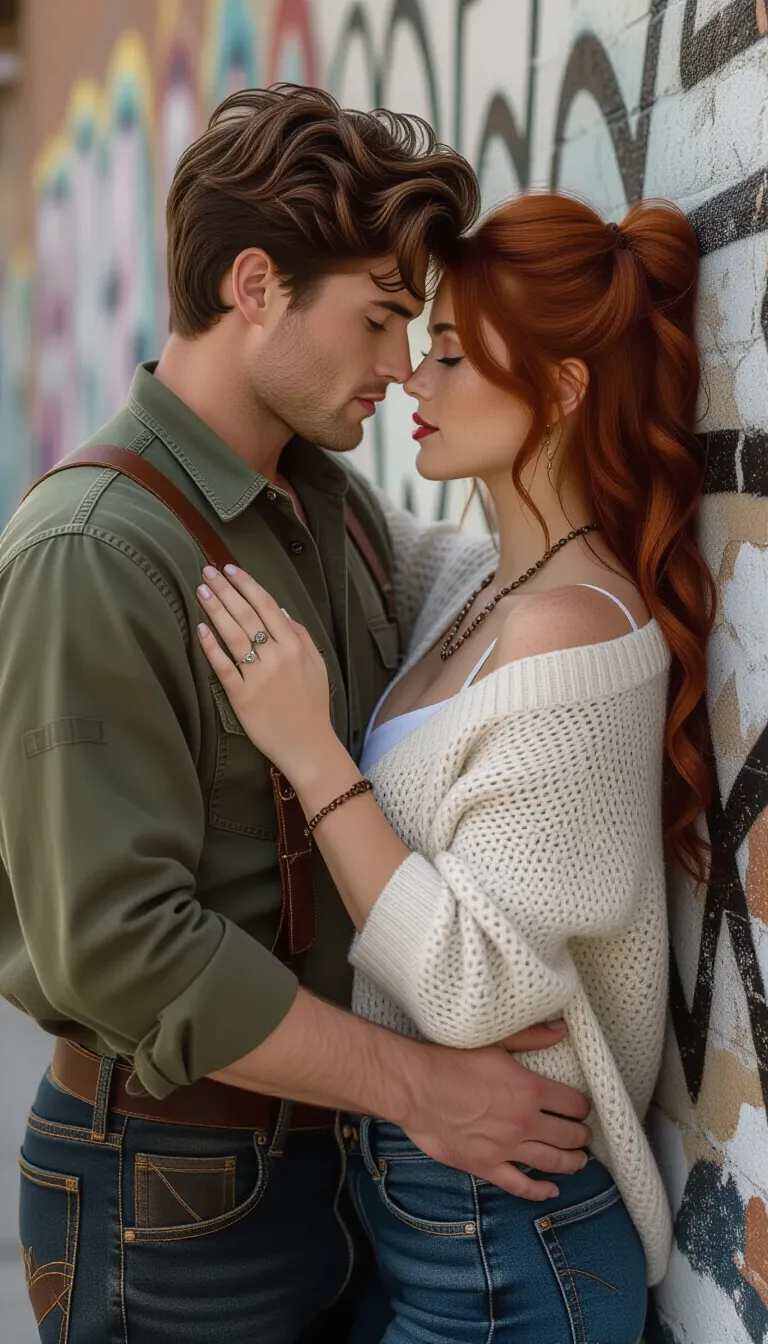
The detective's pen hovered over the page. A single bead of ink trembled at the tip, waiting to fall. Siobhan watched it, her throat tight, the fluorescent light humming its flat song above them.
"Miss Connolly." Detective Reilly's voice was patient. Neutral. "You understand what I'm asking you."
She did. The question hung between them like smoke—why she'd helped Declan Morrow, why she'd lied to her family, why she'd crossed every line she'd drawn for herself. The answer was a noose around her neck, and she knew it.
Declan's knee pressed against hers under the table. Solid. Warm. He didn't look at her, didn't squeeze her hand, didn't give her any sign at all. Just that pressure, that presence, like a wall at her back.
Her job. The school board would have no choice. A Catholic teacher harboring a fugitive, traveling with him across the border, lying to the RUC. They'd strip her of her post before the week was out.
Her family. Her mother would weep. Her father would say nothing, and the silence would be worse than any shouting. The neighbors would know by morning—the Connolly girl, running with a Protestant boy, mixed up in murder and guns.
Her place. The parish where she'd sat in the same pew since she was six, where Father Brennan had given her first communion, where the old women crossed themselves when they passed—a ghost now, already, before she'd even spoken.
The pen trembled. Ink pooled at the tip.
She looked at Declan. His hands were clasped on the metal table, fingers laced tight, knuckles pale. Like he was praying. She'd never seen him pray. She didn't know if he knew how.
But he was doing it now. For her. For them.
She opened her mouth.
"Because I love him."
The words landed like stones in still water. Rippling. Spreading. The room shrank around them, suddenly too small for everything she'd just unleashed.
Reilly's pen touched paper. A single dot appeared, black and certain. Then he wrote, his face giving nothing away.
"You understand the implications of that statement, Miss Connolly." Not a question.
"Yes."
"You aided a man wanted for questioning in connection with the death of Billy Patterson. You traveled with him across the border. You concealed his whereabouts from the authorities."
"Yes."
"And you did this—" He looked up, his pen still. "Because you love him."
"Yes."
Declan's hands tightened on each other. His jaw worked, a muscle jumping beneath the stubble. He didn't speak. He didn't need to.
Reilly set the pen down. He leaned back in his chair, the springs groaning, and studied them both for a long moment. The clock on the wall ticked. Somewhere down the hall, a phone rang twice and went silent.
"I'm going to tell you something, and I need you to hear it clearly." His voice dropped, losing its official edge. "The file on this case is thin. Billy Patterson was a loyalist enforcer with more enemies than friends. No one is going to lose sleep over his death." He paused. "But the RUC has to be seen to investigate. You understand?"
Siobhan nodded. Declan's knee stayed pressed against hers.
"Your statement, Miss Connolly, places you at the scene. It makes you an accessory, at minimum. If this goes to court, that's a prison sentence."
Her stomach dropped. She'd known. She'd known and she'd said it anyway.
"But." Reilly picked up his pen again, tapped it once against the table. "If your statement matches Mr. Morrow's account—that you were not present when the shooting occurred, that you came upon him after the fact, that you assisted him out of fear and confusion rather than complicity—then the charges look very different."
Declan's head came up. His gray eyes met hers, sharp and warning.
"That's not what happened," she said.
"Miss Connolly." Reilly's voice was gentle now. Almost kind. "I'm offering you a way out."
"I don't want a way out." She heard her own voice, steady and clear, as if it belonged to someone else. "I want the truth told. All of it."
Declan's hands unclasped. One of them found her leg under the table, his palm flat against her thigh, warm through the wool of her skirt. A warning. A plea.
"Declan shot Billy Patterson," she said, and the words felt like glass in her mouth. "Because Billy Patterson was going to kill him. And I would have done the same."
Reilly's pen moved. Scratch scratch scratch across the page.
"You witnessed the shooting?"
"I heard it. I came around the corner and saw Declan standing over the body." She swallowed. "He was covered in blood. He was shaking. He didn't know what to do."
"And you helped him."
"I helped him."
"Why?"
She looked at Declan. His gray eyes held hers, and she saw the fear there—not for himself, but for her. For what she was doing to herself.
"Because I love him," she said again, and this time the words felt like a promise. "Because he's not a killer. Because he spent twenty-eight years carrying a wound that wasn't his fault, and when he finally had a chance to put it down, he chose mercy."
Reilly's pen stopped. He looked at Declan.
"Is that true, Mr. Morrow? You chose mercy?"
Declan's voice was rough when it came. "I chose her."
The silence stretched. Siobhan felt the weight of everything they'd done, every mile they'd run, every lie they'd told, pressing down on her shoulders. But Declan's hand was still on her leg, solid and warm, and she held onto that like a lifeline.
Reilly closed the file. He stood, pushing his chair back, and walked to the window. Outside, the street was quiet, a pale winter sun struggling through the clouds.
"I'm going to make a recommendation," he said, without turning around. "To the DPP. I'm going to recommend that Mr. Morrow be charged with manslaughter, not murder. And that Miss Connolly be charged with obstruction, not accessory." He turned. "But that recommendation depends on your full cooperation. Everything. The names in that ledger. The meeting at Warrenpoint. The tape."
Declan nodded. "You'll have it."
"And you'll testify."
"Yes."
Reilly studied them. His face was unreadable, but something shifted behind his eyes—a softening, almost imperceptible.
"There's a holding cell downstairs. You'll be separated for the night. In the morning, we'll take formal statements, and then we'll see what the DPP decides." He picked up the file. "I'll have someone bring you tea."
He walked to the door, paused, looked back.
"For what it's worth—" He stopped. Shook his head. "Never mind."
The door closed behind him.
They sat in silence, the fluorescent light humming, the clock ticking. Declan's hand was still on her leg, and she covered it with her own, her fingers lacing through his.
"You didn't have to say that," he said, his voice low. "You could have taken the way out."
"I didn't want the way out." She squeezed his hand. "I wanted you."
He turned to her, and she saw the crack in his armor—the fear, the hope, the desperate love he'd been carrying for her since the first moment she'd walked into that butcher's back room.
"They're going to separate us," he said.
"I know."
"I don't know when I'll see you again."
"I know."
He leaned forward, his forehead touching hers. She felt his breath, warm and uneven, against her lips.
"I love you, Siobhan Connolly." His voice cracked on her name. "I love you, and I'm sorry I brought you into this."
"You didn't bring me. I walked." She pressed closer, her lips brushing his. "And I'd walk again."
The kiss was soft. Brief. A promise, not a goodbye.
When they pulled apart, his eyes were wet. She reached up, her thumb tracing the line of his jaw, feeling the stubble rough against her skin.
"We're going to be okay," she said. "Whatever happens. We're going to be okay."
He nodded. Didn't speak. Couldn't.
The door opened. A uniformed officer stood there, his face apologetic.
"Mr. Morrow. If you'll come with me."
Declan stood. His hand slipped from hers, and the absence was a cold thing, a hollow in her chest. He walked to the door, stopped, turned.
He didn't say anything. He didn't need to.
She watched him go, the door closing behind him, the lock clicking into place.
The room was very quiet. The fluorescent light hummed. The clock ticked. The pen lay where Reilly had left it, the ink dried on the tip.
She wrapped her arms around herself, feeling the cold, and waited.
Somewhere in the building, a door opened and closed. Footsteps echoed down a corridor. A voice called something she couldn't make out.
She thought of her mother. Of the rosary beads still wrapped around her wrist, the ones she'd stopped praying with. She thought of her classroom, the chalk dust, the smell of pencil shavings and rain on the windows.
She thought of Declan's hands. The way they'd trembled when he'd first touched her. The way they'd held her through the night. The way they'd clasped together on the table, like he was praying for something he didn't know how to ask for.
The door opened again. A different officer, a woman this time, holding a styrofoam cup.
"Tea," she said. "Detective Reilly said to bring you tea."
Siobhan took it. The warmth seeped through the cup, into her palms, into the cold hollow of her chest.
"Thank you."
The officer nodded. She hesitated at the door, as if she wanted to say something, then thought better of it and left.
Siobhan sat alone in the small room, the tea cooling in her hands, and listened to the silence.
She thought of what she'd said. Because I love him. The words that had cost her everything. The words she'd pay for, every day, for the rest of her life.
She took a sip of the tea. It was too hot. It burned her tongue.
She didn't care.
Somewhere in the building, Declan was in a cell. She couldn't see him, couldn't touch him, couldn't feel his hand on her leg. But she knew he was there. She knew he was breathing. She knew he was thinking of her.
She pressed her palm flat against the metal table, where his hands had been, and she felt the ghost of his warmth still there.
The fluorescent light hummed.
The clock ticked.
She waited.
The fluorescent light buzzed. She'd stopped hearing it an hour ago, but now it pressed against her skull, a sound she couldn't shake. The tea had gone cold. She held it anyway, letting the damp chill seep into her palms.
The door opened.
Detective Reilly stood there, his face unreadable. He held a manila folder in one hand, the edge bent from gripping too hard. Behind him, the corridor stretched empty, pale light on linoleum.
"Miss Connolly."
She set the cup down. Her hands were steady. She didn't know how.
He stepped inside, let the door close behind him, and took the seat across from her. The chair scraped against the floor, a sound like something breaking.
"The Director of Public Prosecutions has reviewed the evidence," he said. "Your statement. Mr. Morrow's statement. The tape." He opened the folder, though he didn't look at it. His eyes stayed on her. "They've decided not to charge you with accessory to murder."
The words landed. She felt them somewhere deep, a knot loosening, but she didn't let it show. She waited.
"Obstruction of justice," he said. "That's what you're looking at. Withholding information, aiding a fugitive. The DPP is willing to accept a guilty plea in exchange for a suspended sentence and twelve months of probation."
"And Declan?"
Reilly's jaw tightened. He looked down at the folder, flipped a page. "Manslaughter. Voluntary. They're recommending a custodial sentence—"
"No."
"Miss Connolly—"
"No." Her voice cracked, split down the middle. "He shot a man who was going to kill him. That's not manslaughter. That's—"
"That's what the DPP is offering." Reilly closed the folder. His voice was quiet, level, the kind of calm that cost something. "Your boyfriend shot a man in the street. There were witnesses. There was a gun. The fact that they're not charging murder is a miracle, and the only reason they're not is the evidence you two brought in. The tape. The ledger. Those names." He tapped the folder. "That bought you leniency. But it didn't buy you a walk."
She pressed her palms flat against the table. The metal was cold. She thought of Declan's hands, the way they'd clasped together, the way he'd held her through the night. She thought of his voice on the headland, the wind carrying his words out over the water.
I love you, Siobhan Connolly.
"How long?" she said.
Reilly hesitated. "The sentencing guidelines for voluntary manslaughter—"
"How long, Detective?"
"Three to five years. With good behavior, he could be out in two."
Two years. She did the math. Two years of visiting rooms with glass between them. Two years of letters that would arrive with the edges soft from being read and reread. Two years of waking alone in a bed that still smelled of him.
"And me?"
"Suspended sentence. Probation. You'll need to stay in the jurisdiction. Report to a probation officer once a month." He paused. "You'll lose your job. The school board will be notified."
She nodded. She'd known. She'd known when she opened her mouth in this room and said the words that cost her everything. She'd known, and she'd said them anyway.
"There's one more thing," Reilly said. He reached into the folder and pulled out a single sheet of paper. "The DPP has authorized protective custody for both of you until the trial. Fletcher's men are still out there. The Millar brothers. Gorman and Reid. They know you talked."
He slid the paper across the table. It was a form, typed, with boxes checked and signatures at the bottom.
"You'll be moved to a safe house outside Dublin. Separate locations."
"Separate."
"For your protection."
She looked at the form. The words blurred. She thought of the night they'd spent in the B&B, tangled together, his breath warm against her neck. She thought of waking in the gray light, his arm around her, the world outside the window still and waiting.
"When?" she said.
"Now."
She stood. Her legs were steady. She didn't know how.
"Can I see him?"
Reilly shook his head. "He's already been moved. They're transporting him to the courthouse in the morning for his arraignment. You'll be at a separate location."
"And after?"
"After the trial, if he's sentenced, you can request visitation."
She closed her eyes. The fluorescent light pressed against her lids, red and pulsing. She thought of his hands. The way they'd trembled. The way they'd held her.
"I need to give him something," she said. "Before I go."
Reilly watched her. His face was unreadable, but something shifted in his eyes. Something soft.
"What?"
She reached into her pocket. Her fingers found the rosary beads, the ones her grandmother had given her, the ones she'd stopped praying with. The crucifix was warm from her skin.
"This."
Reilly looked at the beads. Then at her. "He's Protestant."
"I know."
"He won't want—"
"He'll want it." She pressed the beads into her palm, feeling the familiar weight. "Because I gave it to him."
Reilly was quiet for a long moment. Then he stood. "I'll see what I can do."
He left. The door closed. The lock clicked.
She sat alone in the small room, the rosary beads warm in her hand, and she waited.
She didn't know how long it was. Minutes. An hour. The fluorescent light hummed. The clock ticked. She pressed her thumb against the crucifix, feeling the edges, the shape of it.
The door opened again. Reilly stood there, a uniformed officer behind him.
"Come with me."
She stood. The officer led her down the corridor, past closed doors, past a desk where a woman looked up and then looked away. They stopped at a door with a small window.
The officer opened it.
Declan stood inside. He was standing. His hands were cuffed in front of him, his hair falling across his face, his gray eyes finding hers the moment the door opened.
He didn't move. He didn't speak.
She stepped forward. The officer didn't stop her. She reached up and pressed the rosary beads into his cuffed hands, the warmth of her skin still on them.
"For luck," she said. "Protestant or not. You need luck."
He looked down at the beads. His fingers closed around them. When he looked up, his eyes were wet.
"I love you," he said. His voice cracked. "I love you, and I'm sorry—"
"Don't." She reached up, her hand finding his jaw, her thumb tracing the line of his cheekbone. "Don't be sorry. I walked into this. I'd walk into it again."
He leaned into her touch, his eyes closing. She felt his breath against her palm, warm and unsteady.
"They're taking me to Dublin," he said. "The courthouse. They said you're going somewhere else."
"I know."
"Two years." His voice broke. "Maybe more. Siobhan—"
"I'll wait."
"You don't have to."
"I know." She pressed closer, her forehead against his. "But I will."
The officer cleared his throat. "Miss Connolly. We need to move."
She pulled back. Her hand slipped from his face. The absence was a cold thing, a hollow she couldn't fill.
"Write to me," she said. "Every day."
He nodded. He couldn't speak.
She turned. She walked to the door. She stopped, her hand on the frame, and looked back.
He was still standing there, the rosary beads clutched in his cuffed hands, his gray eyes following her like she was the only light in the room.
She didn't say anything. She didn't need to.
She walked out. The door closed behind her. The lock clicked into place.
The officer led her down the corridor, past the desk, past the woman who didn't look up, past the fluorescent lights that hummed and buzzed and pressed against her skull. They stopped at a side door. A car waited outside, gray and anonymous.
"Miss Connolly."
She stepped into the cold air. The sky was pale, the sun hidden behind clouds. She thought of the B&B. The narrow bed. His hands. His voice.
I love you, Siobhan Connolly.
She got into the car. The door closed. The engine started.
The car pulled away from the station, and she watched the building shrink in the side mirror, watched the door where she'd left him get smaller and smaller until it was nothing, just a shape, just a memory.
She pressed her palm against the cold glass of the window.
Somewhere behind her, Declan was in a cell. The rosary beads wrapped around his fingers. Her grandmother's beads, the ones she'd stopped praying with.
She closed her eyes.
She started to pray.
The road stretched ahead of her, gray and empty, and she didn't know where it led. But she knew, somewhere behind her, he was holding the beads. He was thinking of her. He was breathing.
And that was enough.
For now, that was enough.
The road unwound beneath the car, gray tarmac bleeding into gray sky, the world drained of color. Siobhan pressed her palm flat against the cold glass and watched her breath fog the window in small, uneven clouds. The driver hadn't spoken since they left Warrenpoint. A Garda, young, his cap pulled low, his hands at ten and two on the wheel like he was driving to Mass.
She closed her eyes. The image of Declan stood behind her lids—his hands cuffed, the rosary beads wrapped around his fingers, the way his gray eyes had followed her out the door like she was the last light before night. She pressed her forehead against the glass.
Don't let him be alone. Don't let him be scared.
The car turned off the main road onto a narrow lane lined with hedgerows, their dark leaves wet with the afternoon's damp. The tires crunched over gravel, and Siobhan opened her eyes. A house sat at the end of the lane, low and whitewashed, its windows dark. No car in the drive. No smoke from the chimney.
The driver pulled up and killed the engine. The silence rushed in, thick and sudden.
"This is it," he said. His accent was Dublin, flat and quick. "There's food in the press. Mrs. O'Shea will be by in the morning with fresh milk. You're not to leave until someone tells you different."
She nodded. Her throat was too tight for words.
He got out and opened her door. The cold air hit her face, damp and clean, smelling of wet earth and something green. She stepped out, and her legs felt strange, like she'd been sitting too long, like the ground had shifted beneath her feet and she hadn't noticed.
The driver handed her a key. "Back door. Bedroom's upstairs, first on the left."
"Thank you."
He nodded once, got back in the car, and drove away. The gravel spat beneath the tires, and then the lane was empty, and she was alone.
She stood in the grey light, the key cold in her palm. The house stared back at her, silent and unfamiliar. A safe house, they'd called it. But it didn't feel safe. It felt like a holding cell, a place you waited in while the world decided what to do with you.
She walked to the back door, her footsteps loud on the gravel. The key turned stiffly in the lock. She pushed the door open and stepped inside.
The kitchen was small and clean, the counter wiped down, a kettle sitting on the stove. A loaf of bread sat wrapped in brown paper on the table, next to a jar of jam and a tin of tea. Someone had been here. Someone had prepared this for her, had left the bread and the tea and the clean sheets she could see folded at the end of a narrow bed through the open door of the sitting room.
She set the key on the table. Her hand trembled. She wrapped her arms around herself, pressing her fingers into her own shoulders, trying to hold herself together.
The silence pressed in. No ticking clock. No hum of traffic. Just the creak of the old house settling, the distant call of a bird, the sound of her own breath.
She walked through the sitting room, past the narrow bed with its folded sheets, past the cold fireplace, to the window. She looked out at the lane, empty and wet, the hedgerows dark against the pale sky. Nothing moved. No one came.
She thought of him. Of his hands. Of the way he'd said her name, like it was the only word he knew.
I love you, Siobhan Connolly.
Her chest cracked open. A sound came out of her, a sob she hadn't known was waiting, and she pressed her fist against her mouth, her shoulders shaking, the tears hot against her cold cheeks.
She cried until there was nothing left, until her body was empty and still, until the light through the window had shifted from grey to a deeper grey, the afternoon bleeding into evening.
She wiped her face with the back of her hand. She walked to the kitchen, filled the kettle, lit the stove. The small act of making tea—the familiar ritual, the sound of water heating, the scent of steam—anchored her to the moment, to the house, to the body she was still living in.
She sat at the table, her hands wrapped around the warm mug, and stared at the brown paper wrapping on the loaf of bread. She thought about writing a letter. But she didn't have an address. She didn't know where they'd taken him. She didn't know anything except that he was alive, that he was breathing, that somewhere in a cell in Dublin he was holding her grandmother's rosary beads and waiting.
The tea went cold. She didn't drink it.
She carried the mug to the sink, rinsed it, set it on the drying rack. She walked to the sitting room, to the narrow bed, and she pulled the sheets from their folded stack. She spread them across the mattress, tucking the corners, smoothing the wrinkles. The fabric was stiff, fresh from the line, smelling of soap and wind.
She sat on the edge of the bed. The springs creaked beneath her weight.
She pulled the photograph from her coat pocket—William Morrow's face, young and smiling, his arm around a woman Siobhan didn't recognize. Declan's father. The man who had chosen love over hate. Who had written a letter to a son he'd never see again, telling him to live.
She traced the edge of the photograph with her thumb. The paper was soft, worn, the corners rounded.
"I'll take care of him," she whispered. "I promise."
The words hung in the empty room. The house creaked. Somewhere, a clock ticked.
She lay back on the bed, her coat still on, the photograph pressed against her chest. The ceiling was white, cracked, a water stain spreading from one corner like a map of a country she'd never visited.
She closed her eyes.
She saw his face. His gray eyes. The way he'd looked at her when she'd pressed the rosary beads into his hands, like she was giving him something he'd been searching for his whole life.
Write to me. Every day.
She opened her eyes. The ceiling was still there. The water stain still spread.
She sat up. She pulled her knees to her chest, wrapping her arms around them, and stared at the window where the light was fading, where the lane was disappearing into darkness.
She didn't know how long she'd be here. A week. A month. Until the trial. Until they decided if she was a witness or a criminal.
She didn't know if he'd write. She didn't know if the letters would reach her.
She didn't know anything except the cold and the silence and the shape of his name in her mouth.
The house settled around her, creaking and sighing, and she stayed on the bed, her knees against her chest, her eyes fixed on the darkening window.
Somewhere, he was in a cell. Somewhere, the rosary beads were warm in his hands.
She closed her eyes.
She started to pray.
The knock shattered the silence.
Three sharp raps on the front door. Not a fist—knuckles. Someone who knew how to knock, who expected to be answered.
Siobhan's body went still. Her breath stopped in her chest, her hands frozen around the empty mug she'd been rinsing. The water stain on the ceiling stared down at her, unmoved.
Another knock. Harder this time. A voice followed—low, male, with a Northern Irish accent she didn't recognize: "Mrs. Connolly? Garda Síochána. Open the door."
She set the mug down. Her fingers were cold, trembling, and she pressed them against her thighs to still them. Mrs. Connolly. Not Ms. Not Siobhan. They knew her name. They knew she was here.
She walked through the sitting room, past the narrow bed where the photograph of William Morrow lay face-up on the pillow, and stopped at the front door. The lock was old, a simple bolt, and she slid it back with a sound that seemed too loud in the quiet house.
She opened the door a crack, keeping the chain on.
A man stood on the doorstep, mid-forties, in a plain dark coat. No uniform. He held up a badge—Garda ID, the photo matching his face. Behind him, the lane was empty, the hedgerows dark in the fading light.
"Siobhan Connolly?" he said. Not a question.
"Yes."
"I'm Detective Moran. I've been assigned to your protection detail." He lowered his badge, slipping it back into his coat pocket. "May I come in?"
She looked past him again, scanning the lane, the hedgerows, the pale sky. Nothing moved. No car idled. No figure waited in the shadows.
She closed the door, slid the chain off, and opened it wide.
Moran stepped inside, glancing around the small kitchen with quick, assessing eyes. He was shorter than Declan, stockier, with a weathered face and grey threading his dark hair. His hands were empty—no folder, no file, no weapon visible—but he moved like a man who knew where his gun was.
"You're alone?" he asked.
"Yes."
"Good. Stay that way." He walked to the window, parting the curtain an inch, scanning the lane. "We've got a car at the end of the road, two men watching the approach. No one gets within a quarter mile without us knowing."
She stood in the middle of the kitchen, her arms wrapped around herself, watching him work. "How long?"
"How long will you be here? Until the trial. Could be months. Could be a year." He turned from the window, his face unreadable. "You'll be moved every few weeks. Different house, different town. You won't know the address until you arrive."
She nodded. She'd known this. She'd agreed to this.
"You'll have a phone," he continued. "Landline. No calls out except to me or the investigating team. No letters unless they're vetted through the station. No contact with anyone without approval."
"What about Declan?"
Moran's expression flickered—a micro-shift, barely visible. "Morrow is in Dublin, awaiting transfer to the Midlands Prison. He's been charged with manslaughter. His statement, your statement, the evidence you provided—it's all with the DPP. The hearing is in two weeks."
"Can I write to him?"
Moran was quiet for a moment. Then he reached into his coat and pulled out a folded envelope, cream-colored, addressed in a hand she knew. He held it out to her.
"This came through the station this morning. It's been cleared."
Her hand trembled as she took it. The paper was warm from his pocket. She turned it over, saw the seal—a single drop of wax, red, no insignia. Just a seal. Something he'd done himself.
"I'll be outside," Moran said. "Giving the all-clear. You have fifteen minutes. Then I need to go over your statement again."
He walked to the door, pulled it open, and stepped out into the grey evening. The door clicked shut behind him.
Siobhan stood alone in the kitchen, the envelope in her hands, her heart beating so hard she could feel it in her throat.
She didn't open it right away. She carried it to the table, sat down in the same chair where she'd watched the tea go cold, and set it in front of her. She stared at her name on the front—Siobhan—written in his careful, deliberate hand. The letters were neat, almost childlike, each one formed with a precision that spoke to the carpenter's patience.
She slid her finger under the flap. The wax cracked. She pulled out a single sheet of paper, folded twice, the creases sharp.
His voice came through in the first line:
Siobhan—
I don't know how to start a letter. I've never written one before. But I put the beads on the bed beside me, and I thought of you, and the words came.
She pressed her hand over her mouth. The paper trembled in her grip.
They moved me last night. A cell in Dublin, small, grey, a window high up that shows the sky. I look at it and think of the sky over you, wherever you are. I hope it's the same sky. I hope somewhere we're both looking up.
I don't know what happens now. The solicitor says the hearing will be short, that with the evidence and your statement they'll likely accept the plea. Three years, maybe less. I can do three years. I've done worse.
But I need you to know something. I need you to know that I don't regret it. Any of it. The alley. The tunnel. The way I kissed you in the rain that first night, like I'd been waiting my whole life for the chance. I don't regret a single second.
I love you, Siobhan Connolly. I loved you when I was a boy, before I knew your name, before I knew what love was. I loved you the way you love a song you've never heard but somehow know the words to.
I don't know if this letter will reach you. I wrote it anyway. I'll write another tomorrow. And the next day. And every day until I can say it to your face.
Wait for me.
—Declan
The paper dropped from her hands. She pressed her palms against her eyes, the tears coming hot and fast, her breath ragged in the quiet kitchen. She cried until there was nothing left, until the sobs faded to silence, until the light through the window had deepened to a bruised purple.
She picked up the letter again. She read it twice more, tracing the words with her finger, memorizing the shape of his sentences, the weight of each syllable.
Then she folded it carefully, returned it to the envelope, and tucked it into the inside pocket of her coat, next to the photograph of William Morrow.
The house was still. The silence had changed—less threatening, more patient. It felt like waiting now, not emptiness.
She stood, walked to the sink, and filled the kettle. She lit the stove, measured the tea leaves, and made a fresh cup. She sat at the table and drank it while it was hot, the warmth spreading through her chest, anchoring her to the moment.
Somewhere, he was in a cell. Somewhere, the rosary beads were warm in his hands.
She touched the envelope in her coat pocket. She traced the edge of his handwriting, the shape of her name.
She didn't know how long the wait would be. But she knew, with a certainty that settled in her bones like the first heat of summer, that she would wait.
For him. For the day she could look at his face again, touch his hands, hear him say her name in that quiet way he had, like it was the only word that mattered.
For the day they could stand together under a sky that held no fear, no walls, no war.
She finished her tea. She rinsed the mug and set it in the drying rack. She walked to the sitting room, to the narrow bed where the photograph still lay, and she picked it up.
William Morrow smiled at her, young and alive, his arm around a woman who looked at him like he was the only man in the world.
"I'll wait," she whispered. "For both of you."
She lay back on the bed, the photograph in her hand, the envelope against her heart. The ceiling was white, cracked, the water stain spreading like a map of a country she'd never visited.
She closed her eyes. She saw his face. His gray eyes. The way he'd looked at her when she'd pressed the beads into his hands.
The house settled around her. The silence held her.
And somewhere in Dublin, in a cell with a high window showing the same night sky, Declan Morrow was holding her rosary beads and waiting.
She kept her eyes closed, her breath steady, her hand pressed to the letter in her coat pocket.
She started to count the days.
Detective Moran's knock was three short raps, businesslike, the kind that expected immediate compliance. Siobhan set down the letter she'd been reading—third pass through in the last hour—and stood, her legs heavy, the envelope pressed against her ribs beneath her coat.
"Miss Connolly?" His voice through the door was low, patient. "We need to go over your statement. The prosecution team has questions."
The kitchen clock showed half past four. She'd been sitting in the safe house for six hours, the same chair at the same table, the letter open in her hands every time the silence pressed in too close. She'd memorized his words by now. Wait for me. As if she could do anything else.
She opened the door. Moran stood in the narrow hallway, a folder tucked under his arm, his face unreadable. "Detective Reilly asked me to walk you through it. We'll be in the station, not far. You'll come back here after."
It wasn't a question. She nodded anyway.
The drive was short, the streets of Warrenpoint washed in the flat grey of evening. The Garda station was the same green door she'd walked through that morning, still heavy, still final. Moran held it open for her, and she stepped into the fluorescent hum she already knew.
The interview room was identical to the one she'd sat in before: metal table, two chairs, the smell of floor wax and stale coffee. A recording device sat in the center, its red light dead for now. She took the seat facing the door and folded her hands on the table. Her fingers were cold.
Moran sat across from her, opened the folder, and slid a single sheet across the metal surface. "Read it through. If it's accurate, you'll initial each page and sign the last."
The words blurred at first. She blinked, focused, and started at the top.
Statement of Siobhan Connolly, taken under caution at Warrenpoint Garda Station, 14th March 2002.
I met Declan Morrow in Belfast in November 2001. I knew him to be a Protestant. I knew our families would not approve. I met him in secret.
She kept reading. The facts were there, clinical and bare—the alley, the shooting, the flight across the border, the confession in the Coastguard station, the surrender at this same building. Every detail flattened into police language, stripped of fear and love and the weight of a man's life in her hands.
She reached the final paragraph and stopped.
I helped Declan Morrow because I love him. I believed he was acting in self-defense. I do not regret my actions, though I understand the consequences.
Her throat tightened. She read it again, the words settling into her chest like stones dropped into still water.
"It's accurate," she said. Her voice was steady. She hadn't expected that.
Moran pushed a pen across the table. "Initial each page. Signature on the last."
She took the pen. Her hand was steady, too. She initialed each page with a small SC, the letters neat and deliberate, and when she reached the final sheet she signed her full name—Siobhan Mary Connolly—the way she'd signed attendance registers and permission slips and the lease on her flat. Like it was ordinary. Like she wasn't signing away the life she'd built.
She slid the folder back across the table. "What happens now?"
Moran closed it, his fingers resting on the cover. "The file goes to the Director of Public Prosecutions. They'll decide on charges. The recommendation is manslaughter for Mr. Morrow, obstruction for you. But it's not a guarantee."
"And Declan?"
"He'll stay in custody until the hearing. The solicitor is filing for bail, but given the circumstances—" He paused, something flickering behind his eyes. Sympathy, maybe. Or exhaustion. "It's unlikely."
She nodded. She'd known. She'd known since she pressed the rosary beads into his hands and watched him walk away.
Moran stood. "You can wait here. I'll have someone drive you back to the house."
The door closed behind him. The fluorescent light hummed, flat and constant, and the ceiling was the same white, the same water stain shaped like a country she'd never visited.
She sat in the silence, her hands folded on the table where the statement had rested. Her fingers were still cold. The envelope in her coat pocket pressed against her ribs, and she touched it, feeling the shape of his handwriting through the fabric.
She thought about the photograph of William Morrow, still on the bed in the safe house, his young face smiling at a woman who looked at him like he was the only man in the world. She thought about the letter Declan had written, the words he'd chosen—I loved you when I was a boy, before I knew your name—and she pressed her palm flat against the paper.
The door opened.
Detective Reilly stood in the frame, his jacket off, his sleeves rolled to the elbow. He looked tired, the kind of tired that settled into bone. "Miss Connolly. A moment?"
She stood. He gestured to the hallway, and she followed him to an office down the corridor, small and cluttered, a desk buried in files. He closed the door behind them and motioned to a chair.
"Sit. Please."
She sat. He lowered himself into his chair, the springs creaking, and leaned forward, his elbows on the desk. "I've read your statement. I've read Mr. Morrow's. I've listened to the tape."
She waited.
"The evidence is consistent. The ballistics match your account. The ledger confirms everything Fletcher told you. The tape—" He shook his head. "I've been doing this job twenty-three years. I've heard a lot of confessions. I've never heard one like that."
She didn't speak. The hum of the fluorescent light was louder here, the air thicker.
Reilly's eyes met hers, grey and steady. "I'm not supposed to say this. But I want you to know: what you did, coming in here, telling the truth—that took something. I don't know if the courts will see it that way. But I do."
The words lodged in her throat. She swallowed them down. "Thank you."
He nodded. "There's a car waiting. Moran will take you back." He paused, then reached into a drawer and pulled out a small envelope. "This came for you. Delivered this morning."
Her name on the front. The same handwriting as the letter in her pocket.
She took it, her fingers brushing the paper, and she felt the shape of another sheet inside, another message from across the distance.
"I'll give you a moment," Reilly said, and stood, and left.
The door clicked shut.
She sat alone in the cluttered office, the envelope in her hands. She didn't open it immediately. She held it, feeling the weight of it, the thinness of the paper, the words waiting inside.
She thought of him in his cell, writing by whatever light he had, the rosary beads warm in his hand. She thought of the way he'd looked at her when she'd pressed them into his palms, the fear and the hope and the quiet certainty in his eyes.
She slid her finger under the seal and opened the envelope.
A single sheet. The same handwriting. The same careful letters.
Siobhan—
I don't know if you'll get this before or after the statement. I don't know if you've signed yet. But I needed to say it again, in case I don't get another chance.
I love you. I love you in the morning when the light comes through the window and I think of your hair. I love you at night when I lie in the dark and hear your voice. I love you in between, in all the minutes I'm not thinking of you, because those minutes don't exist anymore.
Don't wait for me if it costs you everything. I meant what I said—I want you to live. Not survive. Live. If waiting breaks you, don't wait. I'll understand.
But if you can—if there's a part of you that still wants to try—I'll be here. Counting the days. Holding the beads. Looking at the same sky.
Always yours,
Declan
The paper trembled in her grip. She pressed it to her chest, over the envelope from before, over the photograph she'd left behind, over the place where her heartbeat was trying to find its rhythm.
"Always yours," she whispered. The words hung in the air, small against the hum of the light, the distant murmur of the station, the weight of the day.
She folded the letter carefully, returned it to the envelope, and tucked it into her coat pocket beside the first one. Two letters. Two promises. Two threads holding her to him across the miles of silence.
She stood. She walked to the door. She opened it and stepped into the hallway, where Moran was waiting, his coat on, the keys in his hand.
"Ready?" he said.
She nodded. She followed him through the corridor, past the front desk, out the green door into the evening air. The sky was deep blue, the first stars showing above the rooftops. The air smelled of salt and exhaust and something green, something alive.
She got into the car. She watched the streets of Warrenpoint slide past, the shop fronts closing, the lights flickering on in upstairs windows. She pressed her hand to her coat pocket, feeling the shape of the letters, the weight of his words.
She didn't know how long the wait would be. She didn't know if the hearing would go the way Reilly predicted, if the plea would hold, if three years would stretch into four or five or more. She didn't know if she would still be the same person when he came out, if he would still look at her like she was the only word that mattered.
But she knew, with a certainty that settled into her bones like the first heat of summer, that she would carry the letters until the paper wore thin. She would trace the shape of his handwriting until the words were part of her. She would wait under the same sky, counting the same days, holding the photograph of a man she'd never met but somehow understood.
The car pulled up to the safe house. The porch light was on. The kitchen window glowed.
She stepped out, thanked Moran, and walked to the door. She unlocked it, stepped inside, and closed it behind her.
The silence was there, patient and familiar. The kettle sat on the stove, the tea leaves in their tin, the mug still in the drying rack.
She went to the sitting room. She picked up the photograph of William Morrow, his young face still smiling, still alive in a moment that had been frozen for twenty-eight years. She set it beside the letters on the small table by the bed.
She lay back on the narrow mattress, her hand resting on the stack of paper, the whole weight of him pressed against her fingertips.
Outside, the sky darkened. The stars came out, one by one, the same stars he was looking at from a cell in Dublin.
She closed her eyes. She saw his face. His gray eyes. The way he'd looked at her when she'd said I love you, like it was the first time anyone had ever told him and he wasn't sure he believed it yet.
"I believe it," she whispered. "I'll say it until you do."
The house settled around her. The silence held her.
And somewhere, miles away, in a room with a high window and a cot and a pair of rosary beads warm in his hands, Declan Morrow was looking at the same stars and waiting.
She pressed her hand to the letters. She let the silence hold her.
She started to count the days.
The safe house phone sat on a small table in the hallway, black plastic and utilitarian, its cord coiled like a sleeping snake. Siobhan stood in front of it for a long moment, her hand resting on the receiver, the shape of Declan's letters pressing against her ribs from inside her coat pocket.
She'd memorized Mary's number from the slip of paper Declan had given her in Derry. Written in his careful hand, pressed into her palm like a talisman. If anything happens, call my ma. She'll know what to do.
Something had happened. Not the something they'd feared—not a bullet, not a disappearing into the dark—but something that had changed everything anyway. The statement. The charges. The separation. The letters.
She lifted the receiver. She dialed.
The ringing sounded distant, hollow, crossing miles of wire and silence. Once. Twice. Three times. Siobhan's thumb found the edge of her grandmother's rosary beads, wrapped around her wrist beneath her sleeve, the familiar shape grounding her.
A click. A breath.
"Hello?" Mary's voice, cautious, worn at the edges.
Siobhan's throat tightened. "Mrs. Morrow. It's Siobhan."
A pause. Then, softer: "Siobhan. Love. Are you all right?"
The word love hit her in the chest, unexpected, a door opening onto warmth. She pressed her free hand to her mouth, breathed through the sudden press of tears, forced her voice steady. "I'm fine. I'm safe. I'm—" She stopped, swallowed. "I'm in a safe house near Warrenpoint. The Gardaí put me here."
"The Gardaí." Mary's voice sharpened, not with accusation but with the quick alertness of someone who'd learned to read danger in silence. "Declan?"
"He's in Dublin. Midlands Prison." The words came out flat, clinical, the only way she could say them without breaking. "We went to the station. We gave them everything—the evidence, the names, the tape. He handed over his father's revolver."
A long silence. Siobhan heard a kettle clicking on a stove in the background, the familiar sound of Mary making tea, the ritual of steadiness.
"Tell me," Mary said. Not a demand. An invitation.
Siobhan leaned against the wall, the receiver pressed to her ear, and told her. The interview room with its flat fluorescent light. Detective Reilly's careful questions. The moment she'd said she loved Declan and watched the words land like stones in still water. The charges—obstruction for her, voluntary manslaughter for him. The plea deal. The three to five years. The separation.
She told her about the letters. The first one, asking her to wait. The second one, telling her not to wait if it cost her everything. The way she'd pressed them to her chest and felt the shape of his handwriting through the paper, like a pulse she could hold.
Mary listened. The kettle clicked off. A cup was filled. A chair creaked.
When Siobhan finished, the silence stretched, filled with the hum of the safe house, the distant sound of a car passing on the road, the weight of everything she'd just poured into the space between them.
"You went to the station," Mary said finally. Her voice was quiet, not quite steady. "You walked in and told them everything."
"Yes."
"Knowing what it would cost you."
Siobhan closed her eyes. "Yes."
A breath. A pause. Then Mary's voice, thick with something that might have been tears or might have been pride: "You're braver than I was, love. When they came for my William, I hid. I stayed silent. I let the fear win."
"You survived," Siobhan said. "You raised him. You kept going."
"Aye. But I didn't choose the hard thing. Not until the end, when I let you in." Mary's voice cracked, steadied. "Declan told me about the tape. About William's voice. He told me what his father said."
Siobhan's hand tightened on the receiver. "He played it for me. At the B&B, before we went to the station."
"And what did you hear?"
The question hung in the air, simple but not small. Siobhan thought of the cassette tape, the crackle of static, the voice of a dead man speaking across twenty-eight years of silence. I want you to live, Declan. Not just survive. Live.
"I heard a father who loved his son," she said. "A man who made a choice and paid for it with his life and still believed it was worth it. Someone who wanted peace more than he wanted to be right."
Mary was quiet for a long moment. When she spoke, her voice was soft, almost wondering. "That's what I heard too. When Declan told me. I'd spent twenty-eight years hating the men who killed him, hating the cause he died for, hating myself for not being there. And then my son brought me a tape of William telling me to live."
Siobhan pressed her forehead to the cool wall. "How do you do it? Live with the weight of it?"
"One day at a time, love. One breath. Sometimes one second." Mary's voice gained strength, the practical woman who'd raised a son in a war zone, who'd cut Siobhan's red hair with steady hands, who'd chosen love over twenty-eight years of hate. "You find something worth carrying the weight for. You hold onto it. And when you can't hold it anymore, you let someone else hold it for you."
The tears came then, finally, silently, tracking down Siobhan's cheeks. She didn't wipe them away. "I don't know if I'm strong enough to wait three years. Or five. I don't know if I'll still be me when he comes out."
"You'll be different," Mary said. "That's not a bad thing. You'll be the woman who loved him through the waiting. The woman who walked into a Garda station and told the truth when it would have been easier to lie. The woman who carried his letters in her pocket and counted the days."
Siobhan laughed, a wet, shaky sound. "You sound like him."
"He learned it somewhere." A pause, then Mary's voice softened further. "When can you visit?"
"I don't know. Reilly said they'd arrange something. A hearing, probably. To formalize the plea. After that..." She trailed off, the uncertainty pressing against her ribs. "I don't know what happens after that."
"Then you wait. You write. You call me when you need to hear a voice that isn't your own."
"I will."
"And Siobhan?"
"Yes?"
"You're part of this family now. That means you're not alone. Not anymore."
The receiver felt heavier in her hand, weighted with something she hadn't known she needed. A thread connecting her to Derry, to Mary, to the life Declan had promised her. A hand reaching across the miles of silence.
"Thank you," she whispered. "For answering. For—" She stopped, searched for the word. "For letting me in."
"You saved my son's life," Mary said simply. "I'd let you in a hundred times for that."
They said their goodbyes—soft, unhurried, the way people do when they know there will be another call, another letter, another chance. Siobhan set the receiver back in its cradle and stood in the hallway, the silence settling around her like a familiar coat.
She walked to the sitting room. The photograph of William Morrow still sat on the small table by the bed, his young face frozen in a moment of happiness, unaware of the bullet that would find him, the legacy he would leave, the son who would carry his words into a Garda station and choose to live.
She picked up the photograph. She traced the line of his jaw, the same jaw she'd traced on Declan in the dark of the B&B, the same stubborn set of the mouth, the same watchful eyes.
"I'll take care of him," she said softly. "I'll wait. I'll write. I'll be there when he comes out."
The photograph said nothing. But the smile seemed to deepen, just slightly, as if William Morrow had heard her from wherever dead men went when the living finally let them rest.
She set the photograph back beside the letters. She lay on the narrow bed, her hand resting on the stack of paper, the whole weight of them pressing against her fingertips.
Outside, the sky was deepening toward evening. The stars would come soon, the same stars Declan was watching from his cell. She closed her eyes and saw his face—the gray eyes, the auburn hair, the way he'd looked at her when she'd said I love you, like it was the first time anyone had ever meant it.
The phone sat silent in the hallway, the warmth of Mary's voice still lingering in the wires, a thread connecting her to something larger than herself.
She counted the days. She held the letters. She waited.
And somewhere in Dublin, in a room with a high window and a pair of rosary beads warm in his hands, Declan Morrow was looking at the same stars and doing the same.
The door clicked shut behind her, and the night opened wide.
Siobhan stood on the small concrete step of the safe house, her cardigan pulled tight around her shoulders, the cool air raising goosebumps on her bare arms. The street was quiet—a residential lane on the edge of Dundalk, the houses dark behind their curtains, the only light a single streetlamp at the corner casting a pale orange circle on the pavement. She hadn't noticed the salt in the air until she was standing in it, the faint iodine tang carried inland from the sea, mixing with the green smell of wet grass and the distant hint of chimney smoke.
She stepped off the stoop, her shoes crunching on gravel, and walked to the end of the short path where a low stone wall separated the garden from the road. She sat on it, the stone cool through her trousers, and tilted her face up.
The stars were out. Hundreds of them, thousands, scattered across the black dome like salt thrown against dark cloth. The sky was clear, free of the cloud cover that usually hung over Belfast, and she could see the Milky Way—a faint smear of silver dust cutting across the darkness, ancient and indifferent and beautiful.
She found the Plough first, then followed the line to the North Star. The same star Declan was looking at from his cell in Dublin. The same star she'd traced as a child, lying in the grass behind her parents' house, before she knew what the Troubles meant, before she understood that the lines drawn on maps and the lines drawn in blood were the same thing.
The night was so quiet she could hear her own heartbeat. No distant gunfire. No helicopter rotors. No shouts in the street. Just the rustle of leaves, the faint hum of a refrigerator from a window left open, the occasional car passing two streets over, its engine a low growl that faded into silence.
She wrapped her arms around herself and breathed in the salt air, letting it fill her lungs, letting it push out the stale smell of the interview room, the metallic tang of fear, the weight of words spoken under fluorescent light.
Because I love him.
The words repeated in her mind, not as regret but as something else—a fact she was still learning to sit with. She'd said them to a detective. She'd said them to Declan's mother. She'd said them to Declan himself, in a B&B in Warrenpoint, with his body warm against hers and the recording of his father's voice still echoing in the walls.
She'd never said them to her own mother.
The thought sat in her chest, heavy and cold. Her mother, who'd taken her to Mass every Sunday, who'd pressed a rosary into her hands before her first day of teaching, who'd told her to marry a good Catholic boy from the parish. Her mother, who'd probably heard about Billy Patterson's murder on the news, who'd seen the sketch of the suspect's face, who'd called the school and gotten no answer, who'd been sitting in the kitchen of the house on the Falls Road, waiting for a phone call that would never come.
Siobhan pressed her palms against the cold stone on either side of her thighs, grounding herself. She couldn't think about her mother. Not yet. The guilt was sitting somewhere in her chest, coiled and waiting, but if she let it unspool now, she'd fall apart, and she didn't have the luxury of falling apart. Not when Declan was in a cell. Not when she had to write him tomorrow, had to be steady for him, had to be the thread he held onto.
She looked up at the stars again, letting them pull her out of her own head, letting the vastness swallow the smallness of her fear.
Somewhere up there, light was still traveling from stars that had already died. Burning for millions of years, then gone, and their light still falling on her face in a garden in Dundalk. It made her feel small, but not in a bad way. Small like she was part of something larger, not small like she didn't matter.
She thought of Declan's hands. The way they'd held the photograph of his father. The way they'd cupped her face when he kissed her. The way they'd trembled—just slightly—when he'd handed his revolver to the detective. She thought of his voice, rough and low, saying her name like it meant something, like she was the answer to a question he'd been carrying his whole life.
I love you, Siobhan. I'll wait. I'll write. I'll be here.
She pressed her hand to her chest, feeling the warmth through her cardigan, the steady thump of her heart. She was alive. She was free. She was sitting under the same stars as the man she loved, and somewhere in Dublin, he was counting them too.
The salt air settled around her like a blessing. She let it. She let the night hold her for a long moment, her breath slowing, her shoulders dropping, the tension draining out of her jaw.
Then she heard something—a sound that pulled her back to the present. Footsteps, soft on pavement, approaching from the end of the street.
She turned her head, her body instinctively tensing, her hand reaching for the rosary beads at her wrist—a habit she'd developed in the weeks since she'd started running. A figure emerged from the darkness, walking slowly, hands in pockets. A woman, middle-aged, with a scarf wrapped around her head and a shopping bag in one hand.
Siobhan's shoulders relaxed. Just a neighbor. Coming home late from somewhere, probably a night shift at the hospital, or a visit to a relative, or any of the ordinary reasons people walked home at this hour.
The woman glanced at Siobhan as she passed, and Siobhan nodded. "Good evening," she said, her voice steady.
The woman's footsteps faded down the street, swallowed by the quiet, and Siobhan was alone again with the stars and the salt air and the weight of everything she'd set in motion.
She drew her knees up onto the wall, wrapping her arms around them, the stone pressing against her thighs through the thin cotton of her trousers. The night had grown cooler, the warmth of the safe house already a memory, and she could feel the cold seeping into her bones, settling there like a truth she was still learning to carry.
Because I love him.
The words had been simple when she'd said them. Three syllables, a breath, a confession that had been building in her chest since the first time he'd touched her wrist in the butcher's back room. But sitting here, under the vast indifference of the sky, they felt larger—a stone dropped into a well, still falling, still echoing, still sending ripples through every life she'd touched.
Her mother's face rose in her mind, unbidden. The way she'd looked at Sunday Mass, her hands folded around her rosary, her lips moving in prayers Siobhan had memorized by the time she was six. Hail Mary, full of grace, the Lord is with thee. She'd said that prayer a thousand times, a thousand thousand, and it had never prepared her for this—loving a Protestant who'd killed a man, who'd handed over his revolver in a Garda station, who'd looked at her with those gray eyes and said wait for me like it was the simplest thing in the world.
A car passed on the main road, its headlights sweeping across the hedgerow, and she watched it go, a brief intrusion of light and sound that left the darkness deeper when it passed. The engine faded, and the quiet settled back, thicker than before.
She pressed her palm flat against the stone beside her, grounding herself in its solidity, its permanence. The wall had been here for decades, would be here long after she was gone, long after the names on Declan's father's ledger had faded into history. It didn't care about the Troubles or the peace or the lines drawn on maps. It just held the earth, stone on stone, indifferent and true.
She wanted to be that solid. She wanted to be that sure.
Her hand drifted to her wrist, to the rosary beads she still wore—her grandmother's, the ones her mother had pressed into her palm on her first day of teaching. The beads were warm from her skin, the crucifix cool, the familiar weight of them a comfort she hadn't known she needed. She looped them through her fingers, feeling each bead like a station of a cross she was still walking.
She thought of Declan, somewhere in Dublin, holding the beads she'd given him. She thought of him in his cell, under the same stars, his hands wrapped around that small piece of her, his fingers tracing the same prayers she was tracing now. She didn't know if God was listening. She didn't know if God cared about a Catholic girl and a Protestant carpenter whose love had cost more than either of them had to give. But she believed, somewhere beneath the fear and the guilt and the grief, that what they had was worth praying for.
The salt air filled her lungs, cool and sharp, and she tilted her face up again, letting the stars blur into streaks of light as her eyes watered. She blinked, and the tears slipped down her cheeks, warm against the cold skin of her face, and she let them fall.
She cried for her mother, who would hear the truth from someone else—a neighbor, a cousin, a priest—and whose heart would break when she learned her daughter had lied, had run, had fallen in love with a man who'd killed another. She cried for her father, who'd died when she was sixteen, who'd never seen her graduate, who'd never met the man who was, in some strange way, the only person who made her feel like she was exactly where she was supposed to be. She cried for the life she'd left behind—the chalk dust, the lesson plans, the children's laughter in the hallway, the smell of textbooks and floor wax and the particular quiet of an empty classroom at dusk.
She cried for herself, for the girl she'd been before she'd walked into the butcher's back room, before she'd met a man with gray eyes and callused hands, before she'd learned that love was not a soft thing but a sharp one, a thing that cut through the comfortable lies of her life and left her standing in the wreckage, shivering but alive.
And when the tears stopped, when her breath steadied and the salt on her cheeks dried to a tightness she could almost ignore, she wiped her face with the back of her hand and looked up at the stars again.
They were still there. Still burning. Still indifferent. Still beautiful.
She thought of Declan's father, the photograph of him smiling, the way Declan's face had softened when he'd traced the lines of his father's jaw in the B&B. She thought of the cassette tape, the voice of a dead man filling the room, reaching across twenty-eight years to tell his son he was loved, he was worthy, he was meant for more than revenge.
She thought of Declan's hands on the table in the interview room, clasped like he was praying, holding nothing but her name and his father's memory.
"I'll wait," she said aloud, the words a whisper against the night, a promise to the stars, to the salt air, to the man who was looking at the same sky from a cell in Dublin. "I'll write. I'll be here."
The stars didn't answer. But the silence felt different now—fuller, softer, like a hand resting on her shoulder, like a breath held and released, like a door left open.
She stood, her legs stiff from the cold, and walked back toward the safe house. The gravel crunched under her shoes, and she paused at the door, her hand on the handle, the cool metal pressing against her palm.
She looked up one last time. The Plough had shifted, the North Star still fixed above her, a point of constancy in a world that had become nothing but change.
"Tomorrow," she said, the word soft and firm, a promise she was making to herself. "Tomorrow I'll write him. Tomorrow I'll start counting."
She pushed open the door and stepped inside, the warmth of the safe house wrapping around her, the smell of old wood and dust and the faint trace of the previous occupant's tea filling her senses. She closed the door behind her, the lock clicking into place with a sound that was final and temporary all at once.
The photograph of William Morrow was still on the table. She crossed to it, picked it up, held it in both hands as if it were something fragile, something holy. The smile pushed something in her chest, a quiet ache that was not grief but recognition—the line of his jaw, the set of his mouth, the way his eyes held a secret that was now hers to keep.
She tucked the photograph into the pocket of her cardigan, close to her heart, and walked to the narrow bed in the corner of the room. She lay down, still dressed, the letters Declan had written pressed against her ribs, the photograph warm against her chest, the rosary beads a cool circle around her wrist.
Outside, the salt air continued its slow drift across the garden, carrying the smell of the sea inland, carrying the prayers of a girl who had nothing left to give but her patience.
Inside, Siobhan Connolly closed her eyes and let herself believe that waiting was not an ending but a beginning—a slow tide that would, eventually, bring him back to her.
She pressed her lips together, tasting salt, tasting tears, tasting the promise she'd made under the stars.
I love you. I'll wait. I'll be here.
And somewhere in Dublin, under the same sky, a pair of rosary beads sat warm in Declan's hands, his lips moving in a prayer he was still learning to believe in—the prayer that she would, that she could, that she would still be there when the door finally opened.
She lay in the narrow bed, the springs creaking beneath her weight, and let herself feel the room around her—the cool air on her face, the rough blanket under her fingers, the distant sound of the sea pulling at the shore like a breath she couldn't quite match. The letters pressed against her ribs through the cardigan, the paper warm from her skin, each fold a promise she'd read until the words were scored into her memory.
Her grandmother's rosary beads circled her wrist, the crucifix cool against her pulse point, and she traced the first bead with her thumb—a habit she'd learned as a child, sitting in the pew beside her mother, her fingers moving through the Hail Marys while her mind wandered to the stained glass and the smell of incense.
She hadn't prayed in years. Not really. Not the way she had as a girl, when the words felt like armor, like something solid between her and the world. But tonight, with Declan's letters against her heart and his father's photograph warm on her chest, she found herself reaching for the old words—not as a plea, not as a demand, but as a way of holding herself steady in the dark.
Hail Mary, full of grace.
The words came unbidden, soft and half-formed, the rhythm of them familiar as her own heartbeat. She let them fill the space inside her, let them settle in the quiet places where fear and doubt had taken root.
The Lord is with thee.
She thought of Declan's hands on the interview table, clasped like he was praying to a God he wasn't sure existed. She thought of his voice on the tape, his father's voice, reaching across twenty-eight years to say I love you, son, and I am proud of you.
Blessed art thou among women.
Her thumb moved to the next bead, the next, the rhythm steady and sure, and she felt something loosen in her chest—a knot she'd been carrying since the moment she'd walked into the butcher's back room, since she'd seen the gray eyes of a Protestant carpenter and known, with a certainty that had nothing to do with faith, that her life would never be the same.
And blessed is the fruit of thy womb, Jesus.
She pressed her lips together, tasting salt, tasting the promise she'd made under the stars. I'll wait, I'll write, I'll be here. The words felt fragile in the dark, like glass she was afraid to drop, but she held them anyway, cupped them close to her chest where the photograph sat warm and steady.
Holy Mary, mother of God.
The photograph shifted against her collarbone as she breathed—William Morrow's smile, captured in black and white, a moment frozen in time before the bullet, before the betrayal, before the long silence that had shaped his son into a man who clenched his fists when the wrong name came on the news.
She thought of Declan reading Yeats by candlelight, the book open on his knee, his lips moving silently over words he would never speak aloud. She thought of the way he hesitated before touching her, as if he were afraid she might disappear, as if the world were a thing that took and took and never gave back.
Pray for us sinners, now and at the hour of our death.
The words hung in the air, unfinished, and she let them stay there, let them settle into the silence like dust motes in the lamplight of a room she was still learning to call home. She didn't know if she was asking for anything—she didn't know if there was anyone listening. But the act of speaking the words, of letting them pass through her lips and into the dark, felt like a bridge she was building between herself and the man who was staring at the same stars from a cell in Dublin.
Amen.
She opened her eyes. The ceiling was cracked, the paint peeling in the corner where the damp had seeped through, and she watched the shadows shift as a car passed on the main road, its headlights sweeping across the window before fading into the night. The room dimmed, then settled, and she was alone again with the quiet and the weight of everything she'd set in motion.
Her hand drifted to her chest, to the photograph beneath the cardigan, and she pressed her palm flat against it, feeling the warmth of William Morrow's smile through the paper, feeling the presence of a man she'd never met but whose blood was woven into the shape of the man she loved. She thought of Declan's face when he'd read the letter—the way his jaw had tightened, the way his hands had trembled, the way he'd looked at her afterward, raw and unguarded, as if she were the only solid thing in a world that had just been turned inside out.
She wanted to be that. She wanted to be the thing he held onto when the ground shifted beneath him.
The rosary beads clinked softly as she shifted, and she wrapped them around her fingers, the familiar weight of them a comfort she hadn't known she was still carrying. She thought of her grandmother, who had held these same beads during air raids, during hunger strikes, during the long gray years when hope was a luxury she couldn't afford. She thought of her mother, who had pressed the beads into her palm on the first day of teaching, who had said these will remind you that the world is bigger than the classroom, even when it doesn't feel that way.
The bedroom door was slightly ajar, and she could see the faint light from the kitchen spilling across the floorboards, a thin rectangle of gold in the dark. The safe house was silent—the kind of silence that settled into the bones, that wrapped around the room like a blanket, that felt less like emptiness and more like waiting.
She closed her eyes again, and the image of Declan's face rose behind her lids—the gray eyes, the line of his jaw, the way his lips curved when he smiled, rare and precious, something she'd learned to treasure like a photograph she'd carry with her into any darkness. She saw him in the interview room, his hands clasped on the table, his voice steady as he answered Reilly's questions, his knee pressing against hers under the table like a secret they shared with the world.
She thought of the last time he'd kissed her—the cold metal of the handcuffs against her wrist, the warmth of his lips on hers, the way he'd whispered wait for me against her mouth, as if the words were a prayer he was still learning to believe in.
"I will," she whispered into the dark, the words soft and firm, a promise she was making to herself as much as to him. "I'll wait."
The letters rustled against her ribs as she breathed, and she felt the weight of them like a second skin, a map of the distance between them, a bridge she was building one word at a time. She would write him tomorrow—long letters filled with the small details of her day, the shape of the clouds, the sound of the sea, the way the light fell across the garden in the afternoon. She would tell him about the photograph, about the way his father's smile pushed something in her chest, about the rosary beads and the prayers she was learning to speak again.
She would tell him she was still here. Still waiting. Still believing.
The photograph grew warm against her chest, the paper soft and worn from her touch, and she pressed her hand flat against it, feeling the pulse of her heart beneath, feeling the steady rhythm of breath and blood and hope, the stubborn and foolish and necessary persistence of a life she was choosing, minute by minute, to live.
Outside, the sea continued its slow pull against the shore, the sound of it a kind of music, a kind of prayer, a kind of promise that the tide would return, that the water would always come back to the place it had left.
She let her breath slow, let her body sink into the mattress, let the weight of the day settle into her bones like sediment settling at the bottom of a river. The tears she had cried had dried on her cheeks, leaving a tightness she could almost ignore, and the knot in her chest had loosened, the edges of it softening like a wound beginning to heal.
She was tired. Bone-deep tired, the kind of tired that comes not from the body but from the soul, from the long labor of holding herself together while the world cracked open around her.
The rosary beads were warm in her hand, and she held them loosely, letting them slip through her fingers like water, like sand, like the hours that had passed since she'd last seen Declan's face. She didn't know how many days it would be, how many weeks, how many nights of staring at the ceiling and listening to the sea. She didn't know if the legal process would bring justice, or if the truth she'd told in the interview room would cost her more than she had to give.
But she knew—with a certainty that had nothing to do with faith, nothing to do with hope, everything to do with the steady weight of the photograph against her chest and the letters pressed against her ribs—that she would still be here when the door finally opened.
She let the thought settle, let it wrap around her like the blanket, let it fill the spaces where fear and doubt had been. She was not alone. She was not lost. She was a girl with red hair and green eyes, lying in a narrow bed in a safe house by the sea, holding a dead man's photograph and a living man's letters, waiting for a future she was building one breath at a time.
Her grip on the rosary beads loosened, the beads slipping through her fingers, the crucifix cool against her palm. The thought of Declan at dawn, his hands callused from a day's work, his voice rough from the night before, drifted through her mind, soft as a dream she was still learning to remember.
She closed her eyes.
The sea pulled at the shore, a slow and steady rhythm, a breath the earth took and released, took and released, patient and eternal.
She let her breath match it. In. Out. In. Out.
The room grew quieter, the shadows deeper, the weight of the night settling into her like a hand on her shoulder, like a voice she was just beginning to hear.
And she let sleep take her.
The next morning, she woke to gray light filtering through the curtains and the sound of gulls crying over the water. The photograph had slipped onto the pillow beside her, William Morrow's smile facing the ceiling, and she picked it up carefully, tracing the edge with her thumb before pressing it to her chest and closing her eyes.
She dressed in silence—the cardigan she'd worn into the interview room, a pair of jeans that hung loose on her hips, shoes that had carried her across the city and through the tunnel and into this strange and borrowed life. The rosary beads were warm from where they'd rested against her skin all night, and she wrapped them around her wrist, the familiar weight a kind of armor she hadn't known she needed.
The safe house was quiet. Eileen had left tea on the counter, a note in careful handwriting: Back by noon. Bread in the press. Siobhan poured herself a cup and stood at the window, watching the sea shift through the morning light, watching the way the clouds gathered and scattered and gathered again, patient and restless both at once.
She didn't know when she'd decided. It wasn't a choice she'd made—it was a thing that had been growing in her chest since the interview room, since the moment she'd said because I love him and felt the world tilt and settle into a new shape. She needed to speak to someone. Not a person—someone older than that. Someone who had been listening to prayers in this country for centuries, through war and peace and the long gray in-between.
She found the church at the edge of the village, a small stone building set back from the road, its walls dark with damp and age. The gate creaked when she pushed it open, and the path was uneven, worn by generations of feet that had walked the same way she was walking now—seeking something they couldn't name, carrying something they couldn't put down.
The door was heavy, the wood cool beneath her palm, and when she pushed it open, the smell of wax and cold stone and old incense washed over her, familiar as a voice she hadn't heard in years. The light inside was dim, filtered through stained glass that showed a saint she didn't recognize, his hands raised in blessing, his face serene and distant.
She stepped inside.
The door closed behind her with a soft thud, and the silence settled around her like water, deep and still and older than any sound she'd ever known. The pews were empty, the altar bare, a single candle burning in a red glass holder near the tabernacle. She stood in the aisle, her hands at her sides, and felt the weight of the space pressing against her, not heavy but full, as if the room itself were holding its breath.
She walked to the front, to the second pew on the left, and she sat down slowly, her knees creaking, her hands finding the worn wood of the kneeler. The cushion was thin, the wood hard beneath it, and she pressed her palms flat against the surface, feeling the grain, feeling the grooves worn by hands that had clutched this same wood through the long nights of their own desperate prayers.
She didn't kneel at first. She sat, her eyes on the altar, on the single candle, on the crucifix that hung above it, the figure of Christ twisted in agony, his head bowed, his ribs visible through the stretched skin. She had looked at that image a thousand times in her life—in her grandmother's kitchen, in the chapel at school, in the church she'd walked past every Sunday on her way to mass—and it had never looked like this. It had never looked like a man who had been broken by the same world that was breaking her.
She slid off the pew and onto her knees.
The kneeler was hard, the stone floor cold through the thin cushion, and she felt the ache in her knees immediately, a small and familiar pain that anchored her to the moment, that reminded her she was here, in this body, in this place, in this life she was still learning to believe in.
She closed her eyes.
The silence was vast. It stretched out around her, above her, beneath her, a silence that held the weight of every prayer that had ever been spoken in this room, every plea, every confession, every desperate and broken and hopeful word. She felt small in it, smaller than she'd ever felt, a single voice in a sea of voices, a single life in a world that had seen so many lives end too soon.
She opened her mouth, and the words came slowly, uncertain, like a child learning to speak a language she'd forgotten.
"I don't know if you're listening."
Her voice was barely a whisper, swallowed by the stone walls and the high wooden ceiling, and she felt foolish for a moment, felt the weight of her own doubt pressing against her chest. But she kept going, because stopping felt like giving up, and she had promised she would wait.
"I don't know if I deserve to be heard. I've done things—things I'm not proud of. I've lied to people who trusted me. I've broken rules I swore I'd keep. I've let a man into my life who I knew would cost me everything, and I did it anyway, and I don't regret it."
Her hands were clasped in front of her, the rosary beads pressed between her palms, and she felt the shape of the crucifix against her skin, sharp and small and real.
"I don't regret him. I don't regret any of it. But I'm scared."
The word hung in the air, small and naked, and she let it stay there, let it sit in the silence like an offering.
"I'm scared he won't come back. I'm scared the system will fail him, the way it's failed everyone in this country who tried to tell the truth. I'm scared I'll spend the rest of my life waiting for a door that never opens, a letter that never comes, a voice I'll only hear in my dreams."
Her throat tightened, and she swallowed hard, forcing the words past the lump that had formed there.
"But I promised him I'd wait. And I meant it. I meant every word."
She pressed her forehead against her clasped hands, the wood of the kneeler hard against her knuckles, and she felt the tears coming, hot and unstoppable, sliding down her cheeks and dripping onto the stone floor where they disappeared into the dark grain of the wood.
"Please," she whispered, and the word cracked, broke open like a thing that had been held too long. "Please keep him safe. Please let him come home. Please let the truth mean something, let the justice mean something, let all of this—" she gestured vaguely, blindly, at the church, at the world, at everything she couldn't name "—let it mean something."
She was crying openly now, her shoulders shaking, her breath coming in ragged gasps, and she let herself cry, let the sound of it fill the silence of the empty church, let the tears fall without shame or pretense or the careful composure she'd worn like armor for months. She was alone. There was no one to see her, no one to judge, no one to tell her she was being dramatic or foolish or weak.
She was just a girl on her knees in a stone church by the sea, praying for a man who might never come back.
The tears slowed after a while, the sobs softening into quiet breathing, and she stayed there, her forehead against her hands, her knees aching, her body heavy and still. The silence had changed—it was no longer vast and empty. It had become something else, something that felt almost like presence, like a hand resting gently on her shoulder, like a voice she couldn't hear but could feel, wordless and warm and steady.
She opened her eyes.
The candle near the tabernacle was still burning, the flame steady and small, and she watched it for a long moment, watched the way the light shifted and flickered, casting shadows that danced across the stone wall. It was just a candle—a simple, ordinary candle, the kind that burned in every church in every town in every country in the world. But in this moment, in this silence, it felt like more. It felt like a sign she wasn't alone, a reminder that something was still burning, even in the dark.
She wiped her face with the back of her hand, the tears still wet on her cheeks, and she sat back on her heels, her knees screaming in protest. She looked up at the crucifix, at the figure of Christ hanging in his agony, and she thought of Declan, thought of the way his hands had trembled when he'd read his father's letter, thought of the way he'd held her in the narrow bed at the B&B, thought of the way he'd said wait for me like it was the only prayer he had left.
"I'll wait," she said again, the words a promise, a vow, a thing she was carving into the stone of her own heart. "I'll wait as long as it takes."
She reached into the pocket of her cardigan and pulled out the photograph of William Morrow, the edges soft from where she'd held it, the image creased from where it had been folded and unfolded and folded again. She looked at his face—the same gray eyes as his son, the same line of the jaw, the same quiet and watchful stillness—and she held it up, as if offering it to the altar, as if placing it in the hands of someone who might understand.
"This is his father," she said, her voice soft. "William Morrow. He died because he believed in peace. He died telling the truth. And his son has been carrying that weight for twenty-eight years, and I don't know how to take it from him, but I want to try. I want to be there when he puts it down."
She lowered the photograph and pressed it against her chest, felt the paper warm against her skin through the thin fabric of her shirt.
"So please. Keep him safe. Bring him home. And let me be strong enough to be what he needs when he gets here."
The silence answered her, not with words but with stillness, with the steady glow of the candle, with the weight of the stone walls holding the space around her. She didn't know if she'd been heard. She didn't know if anyone was listening. But the act of speaking—of putting the words into the world, of letting them exist outside the closed circuit of her own mind—had changed something. She felt lighter, as if she'd set down a stone she hadn't known she was carrying.
She sat there for a long time, her knees aching, the photograph pressed against her chest, the rosary beads warm around her wrist. The light shifted through the stained glass, the shadows moving across the stone floor, and she let the silence hold her, let it fill the spaces where fear and doubt had been.
Finally, when her knees could take no more, she rose slowly, carefully, her legs stiff and unsteady. She stood in the aisle, looking at the altar, looking at the candle, looking at the crucifix that had watched over this village for a hundred years and would watch over it for a hundred more.
She didn't genuflect. She didn't cross herself. She just stood there, her hands at her sides, and she said the words one last time, quiet and steady and sure.
"I'll wait."
Then she turned and walked down the aisle, her footsteps soft against the stone, and she pushed open the heavy door and stepped out into the morning light.
The sea was still there, gray and patient, pulling at the shore with the same slow rhythm it had held for centuries. The gulls were still crying, the clouds still drifting, the world still turning in its long and ordinary arc. She stood on the church steps, the cold wind pulling at her hair, and she felt the weight of the day settle around her—the waiting, the hoping, the long and uncertain road ahead.
But she also felt something else. Something that had been buried so deep she'd almost forgotten it existed, a quiet and stubborn thing that refused to die, no matter how many times the world tried to kill it.
Hope.
She pressed her hand to her chest, to the photograph that rested there, and she started walking back toward the safe house, her steps steady, her breath slow, her heart beating in the same rhythm as the sea.