
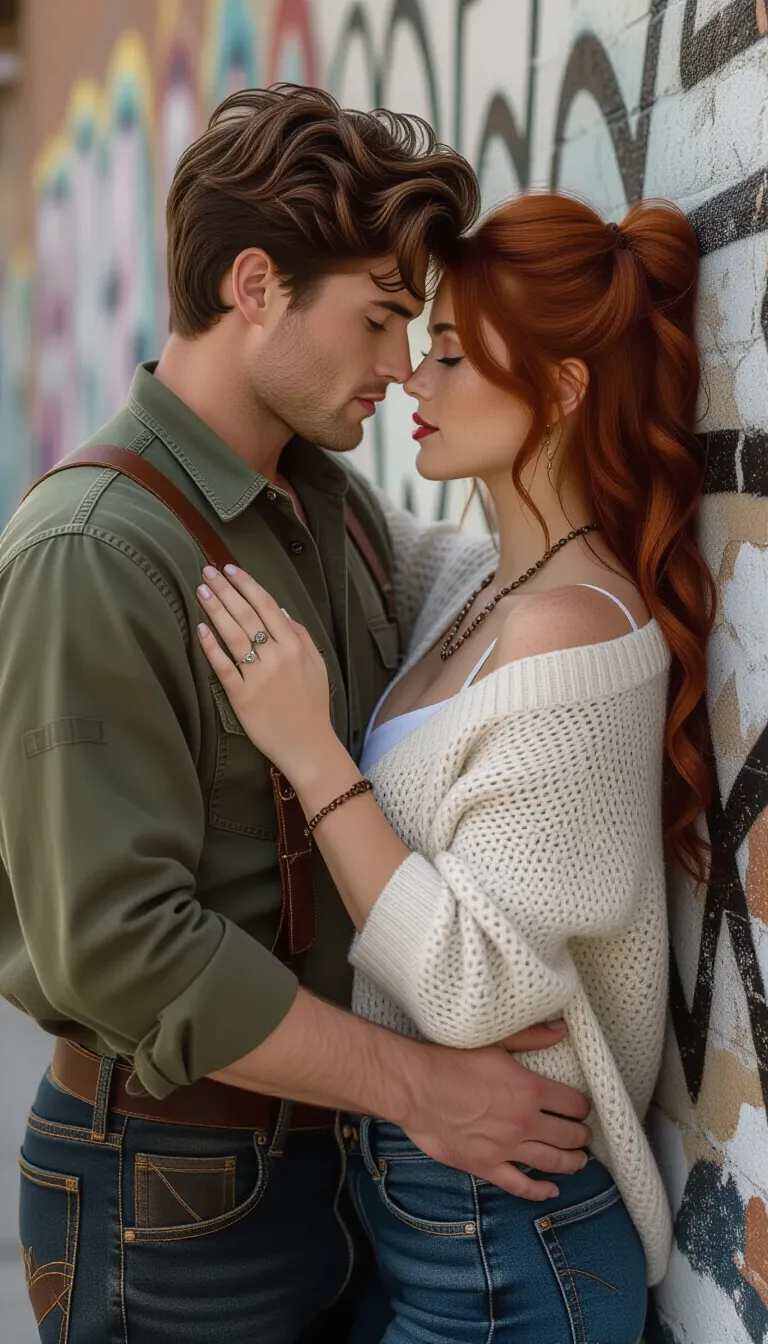
The bell above the door jingled, a thin, tinny sound that cut through the hum of the street and died in the sawdust-heavy air of the back room. Siobhan stepped through, and the smell hit her first — blood and salt and something metallic she'd never learned to name, even after all these weeks. Her hand still on the door handle a beat too long, her lungs refusing to fill properly.
He was already there. Leaning against the counter like he owned the place, like he had every right to be standing in the back room of a Catholic butcher's shop in a part of town that would kill him if it knew his name. Declan. His dark auburn hair curled at his collar, catching the greasy light of the single oil lamp. He didn't smile. He never smiled first. He just watched her cross the room, and she felt every inch of the distance between them like a wire pulled tight — humming, dangerous, vibrating with the weight of what they were doing.
Her cardigan was buttoned wrong. She'd noticed it on the walk over, the third button in the second hole, but she hadn't stopped to fix it. Couldn't stop. The whole walk here was a blur of rain-wet cobblestones and the rhythm of her own heartbeat in her ears, counting down the blocks until she saw him again.
"You came," he said. It wasn't a question.
Her breath caught. "I shouldn't have."
But she was already closer than safe. Her shoes made soft sounds on the sawdust-covered floor — the only sound in the room besides the oil lamp's faint hiss and the distant murmur of the street beyond the closed door. She stopped a foot from him, close enough to see the sawdust in his hair, the way his jaw tightened as he looked at her.
His fingers found her wrist. Barely a touch — the lightest brush of callused skin against the thin blue veins beneath her pale skin. But her body remembered it like a burn. The heat spread up her arm, into her chest, settling low in her belly. Her breath went shallow.
"Declan." His name in her mouth was a confession. The sound of it felt like stepping off a ledge.
He didn't answer with words. His thumb moved, just a fraction of an inch, tracing the inside of her wrist where her pulse hammered against the surface. He could feel it. She knew he could. His gray eyes stayed on her face, watching the way her lips parted, the way her breath came faster.
"Someone saw me," she whispered. "Coming here. I don't know who. A woman at the corner of Saint Joseph's, just standing there, watching."
His hand didn't stop. "What did she see?"
"A red-haired woman in a buttoned wrong cardigan walking too fast toward the butcher's."
"That could be anyone."
"It couldn't. You know it couldn't."
His thumb stilled. The silence stretched, and in it she heard everything they didn't say: the priest's warnings, her mother's tears, the boys on the corner with their hard eyes and harder fists. She heard the bullet that had clipped the wall three streets over last week, the one that had sent her running home with her hand pressed to her mouth to keep from screaming.
"I know," he said. Soft. His accent thickening the way it did when the mask slipped. "I know what you risked coming here."
Her eyes burned. She blinked hard. "Then why did you ask me to?"
His hand moved from her wrist to her hand, threading his fingers through hers. His palm was warm, rough with calluses, and his grip tightened like he was afraid she'd pull away. "Because I couldn't go another day without seeing you."
The words hit her like a blow. She swayed, and his other hand came up to steady her — resting on her hip, his thumb pressing into the soft wool of her cardigan. The contact was a live wire. Her skin flooded with heat, and she felt the wetness begin, a slow, shameful ache that made her press her thighs together.
"This is mad," she said, her voice cracking. "We're mad. They'll kill us, Declan. Your brother—"
"Don't." His jaw tightened. "Don't bring him in here."
"He put a gun to my head last week." The words came out flat. She hadn't told him. Hadn't known how. "He was waiting for me after school. In the alley behind the gates. He said if he saw me near you again, he'd do worse than the warning."
Declan's face went still. Not the practiced stillness of a man who'd learned to hide — the real stillness, the one that came before the storm. His hand on her hip tightened until it almost hurt. "He touched you."
"He didn't." She shook her head. "He just wanted me to know he could."
"He touched you." Declan said it again, and this time it wasn't a question. His hand left her hip, and for a sickening moment she thought he would pull away entirely. Instead he cupped her face, his palm warm against her cheek, tilting her head up to meet his eyes. "Where. Show me where."
The tenderness in his voice undid her. She leaned into his hand, her eyes closing. "My shoulder. Near the collarbone. He shoved me against the wall."
His thumb traced her collarbone through the fabric of her cardigan, feather-light. "Here?"
She nodded. The touch was so gentle it hurt. Her breath hitched, and a tear slipped from beneath her closed lashes.
"I'll kill him." Declan said it like he was telling her the time — matter-of-fact, certain. "If he ever touches you again, I'll kill him with my bare hands."
"Declan."
"I will." His gray eyes met hers. "He's my brother. I've spent my whole life protecting him from the consequences of his own violence. I won't protect him from this."
She should argue. She should tell him that violence only breeds violence, that her priest had said forgiveness was the only path, that her grandmother's rosary beads had worn smooth in her hands from praying for a peace she no longer believed in. But the words wouldn't come. All she could feel was the heat of his palm against her cheek, the promise in his voice, the terrible, beautiful certainty that he meant every word.
"Don't," she whispered. "Don't become what they want you to be."
"What do they want me to be?"
"A killer."
He was quiet for a long moment. The oil lamp flickered, casting dancing shadows across his face. When he spoke, his voice was raw. "I've been a killer since the day I was born into this city. The only question is who I kill for."
She pulled back. Not far — just enough to look at him properly. The man she'd met six months ago at a book stall in the city center, both of them reaching for the same worn copy of Yeats. She'd apologized. He'd said nothing, just handed her the book. And then — inexplicably, dangerously — he'd been there the next week. And the week after. And every week since, until the book stall became a bench in the park, and the bench became a café on the border, and the café became this: a butcher's back room in the wrong part of town, with sawdust in her hair and his taste on her tongue.
"We can't keep meeting like this," she said. It came out weaker than she'd intended.
"I know." He stepped closer. His chest brushed hers, and she felt the heat of him through their clothes. "But I don't know how to stop."
"Neither do I."
His hand slid from her cheek to the nape of her neck, fingers threading through the hair she'd pinned up that morning. The pins loosened, and a strand fell against her shoulder. He wound it around his finger, watching the movement with an intensity that made her breath catch.
"Your hair," he said, his voice low. "I think about it more than I should. The way it looks when it's down. The way it smells."
She laughed — a broken, surprised sound. "You think about my hair?"
"I think about everything." His eyes lifted to hers. "The way you bite your lip when you're lying. The way you move your hands when you talk. The way you say my name, like it costs you something."
"It does." Her voice was barely a whisper. "Everything about this costs me something."
"Then why do you keep coming?"
She didn't answer with words. She rose on her toes and kissed him.
It was not a gentle kiss. It was desperate, hungry, the press of months of fear and longing and the constant, grinding terror of being caught. Her hands fisted in his shirt, pulling him closer, and he made a sound against her mouth — a low, rough groan that vibrated through her chest.
His hands found her waist, her hips, pulling her hard against him. She felt him through his trousers — the thick, straining pressure of his erection against her belly — and a pulse of heat went through her, sharp and aching. Her knees weakened, and he held her up, his mouth never leaving hers.
"Siobhan." He breathed her name like a prayer. "Siobhan, we shouldn't—"
"I know." She kissed him again, harder. "I don't care."
His hands slid up her back, bunching the fabric of her cardigan. The buttons strained. She felt the cool air of the room against her skin where her shirt had pulled free from her skirt. His fingers found the bare skin of her lower back, and she gasped into his mouth.
"You're shaking," he said, pulling back just enough to look at her.
"I'm terrified." She didn't try to hide it. "Every time I'm with you, I'm terrified. And I keep coming back."
His thumb traced her lower lip, a gesture so tender it made her chest ache. "I don't deserve you."
"Don't." She caught his hand, pressed a kiss to his palm. "Don't do that. Don't make this noble. We're not noble people, Declan. We're a Protestant carpenter and a Catholic schoolteacher meeting in a butcher's back room while the city burns around us. There's nothing noble about it."
A ghost of a smile touched his lips. "Then what are we?"
She thought about it. The word formed in her mind, heavy and dangerous. "Hopeful," she said. "Stupid and hopeful."
He kissed her again, softer this time. Slower. His lips moved against hers with a tenderness that made her heart crack open. His hand found hers, lacing their fingers together, pressing their joined hands against his chest. She felt his heartbeat under her palm — steady, strong, alive.
"I don't want to leave," she whispered against his mouth.
"Then stay."
"I can't."
"I know."
They stood there, foreheads pressed together, breathing each other's breath. The oil lamp flickered. Somewhere in the distance, a car backfired — or a gunshot — and they both tensed, the moment snapping like a thread.
He pulled away. Not far — just enough to look at her face, to memorize it. "Next week. Same time. Can you?"
Her throat closed. She nodded. "I'll find a way."
He released her hand. The absence of his touch was a physical pain. She stepped back, and the distance between them felt like a chasm. The sawdust crunched under her shoes. The cold air rushed in to fill the space where his body had been.
At the door, she paused. Her hand on the handle. The street beyond was quiet, but she knew the quiet was a lie. Somewhere out there, someone was watching. Someone was waiting. The peace wall was covered in graffiti, and the words were all the same: danger, stay out, this is not your place.
She turned back. He was still standing in the same spot, watching her. The oil lamp cast half his face in shadow, making him look older, harder, more like the man his brother wanted him to be. But his eyes — his gray winter-sky eyes — were soft. Vulnerable. A crack in the armor.
"Declan."
"Aye?"
She wanted to say it. The word that had been building in her chest for months, pressing against her ribs like a living thing. But she couldn't. Not yet. Not in a butcher's back room with the smell of blood in her nose and the ghost of his touch still burning on her skin.
Instead she said, "Next week."
He nodded. "Next week."
She opened the door and stepped into the street. The cold air hit her face, sharp and clean after the thickness of the back room. She walked fast, her head down, her hands shoved into the pockets of her cardigan. The street was empty. The woman at the corner of Saint Joseph's was gone, replaced by a stray dog sniffing at a pile of rubbish.
Safe. For now.
She turned a corner and pressed her back against the brick wall, her eyes closed, her breath coming in short, ragged gasps. Her hand went to her wrist, where his thumb had traced her pulse. The spot was still warm. Still alive with the memory of him.
A car passed. An old Ford, engine rattling. She opened her eyes, watched it disappear around the bend. The license plate was from the Shankill. Protestant territory.
It could be nothing. It could be everything.
She started walking again, faster this time. The rosary beads around her wrist clicked with every step — a rhythm she'd known since childhood, the rhythm of prayer, the rhythm of survival. She was late. Her mother would worry. The dinner would be cold. The questions would come.
Where were you?
I was grading papers.
Your cardigan is buttoned wrong.
I was distracted.
By what?
By a man with sawdust in his hair and Yeats on his tongue. By a kiss that tasted like the end of the world. By a hope so stupid and reckless it could get them both killed.
She turned the last corner and saw her street, the row of terraced houses, the light in the kitchen window where her mother was waiting. She stopped at the gate, her hand on the cold iron, and looked back the way she'd come.
Nothing. No one. Just the darkening street and the distant hum of a city that had never known peace.
She opened the gate and walked up the path. Her hand found the door handle. The house was warm and smelled of stew, and her mother's voice called out from the kitchen — Is that you, love? — and she answered, Yes, Mam, it's me, and the lie came as easily as breath.
But under her sleeve, the spot on her wrist where his thumb had rested was still warm. Still burning. Still his.