
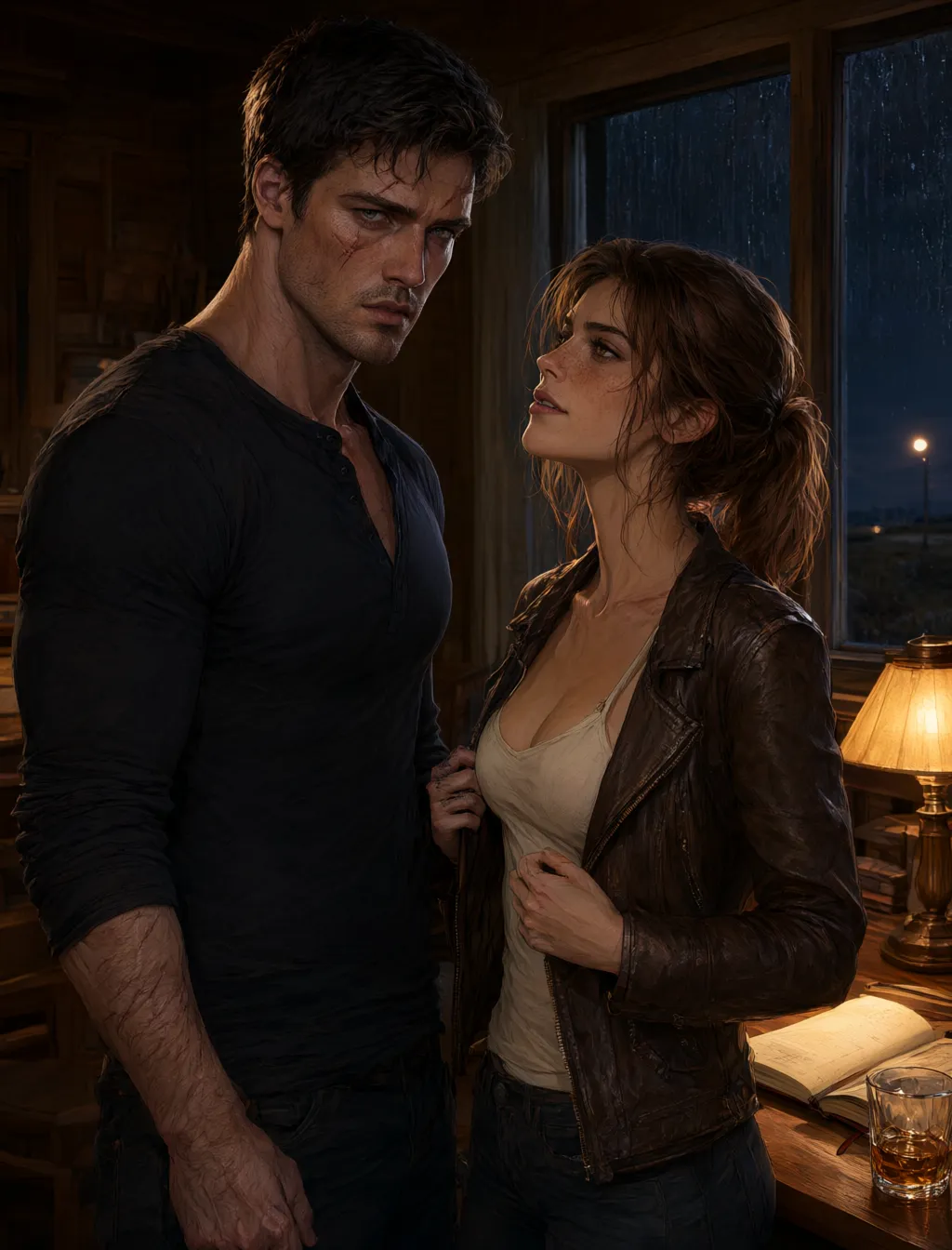
The rain had softened the road to mud, but here at the gate the stone path was clean, each paver dark with wet and gleaming under the cloud-heavy sky. Sofia shifted the notebook higher under her arm, felt the worn leather of her jacket creak with the movement. The iron bars were cold when she touched them—really cold, the kind that bit through skin and settled in the knuckles. Beyond the gate, the estate rose in gray stone and shadow, windows dark, no smoke from the chimney. A place that didn't welcome.
She heard him before she saw him. Boots on stone. Deliberate. Not hurrying. The sound came from somewhere inside the courtyard, and then he was there, stepping out of the shadow of the main house like the house had made him. Viktor Volkov. The file photo hadn't done him justice—or maybe it had done him too much, because the man in front of her was harder. The scar through his left eyebrow pulled the skin just slightly, gave his face a permanent look of having been interrupted. His dark henley was clean but old, the fabric worn soft at the collar. He didn't speak.
"Sofia Reyes," she said. "I called."
His gray eyes dropped to the press badge she held up. He studied it the way someone studied a weapon they hadn't decided was a threat yet. The rain picked up, beading on his shoulders, darkening the short crop of his hair. He didn't seem to notice. "You're early."
"The bus was early."
Something flickered behind his eyes. Not warmth. Recognition, maybe, of a sparring partner. He pulled a key ring from his belt—old iron keys, heavy, the kind that opened heavy doors—and worked one into the padlock. The metal ground against metal, a sound that carried in the wet air. He didn't rush. The lock clicked open and he caught it in one palm, calloused fingers closing around the rust-streaked iron. Then he pulled the gate toward him, slow, the hinges complaining.
She stepped through. The space was narrow—he hadn't opened the gate all the way, just enough for her to pass—and for a moment she was close enough to smell the cold that clung to his clothes, the faint sharpness of gun oil, something older beneath it. Wood smoke, maybe. Or just the house itself. He didn't move aside. Didn't step back to give her room. His hand stayed on the keys, knuckles white against the iron, and his eyes stayed on her face.
She stopped with one foot still on the outer stone, one inside his courtyard. The rain had soaked through her jacket at the shoulder. Her fingers were numb. "You're going to let me in."
"You're already in."
But he didn't close the gate. Didn't move. Just watched her cross the threshold the rest of the way, her boots leaving wet prints on the courtyard stone. She felt his gaze on her back, between her shoulder blades, and she didn't turn around. Didn't give him the satisfaction. The courtyard opened in front of her—bare, functional, a well in the center with a wooden cover, a toolshed with a padlock that matched the gate. The main house loomed, its front door dark oak, iron hinges, one small window beside it with the curtain drawn.
The gate clanked shut behind her. The lock clicked. Keys jangled as he returned them to his belt. She heard his boots again, crossing the stone, and then he was beside her, his shoulder a hand's width from hers. "You wanted the interview. You'll get it. But you stay where I tell you. You go where I say. The border's not safe."
"The border's exactly why I'm here."
He looked at her then. Really looked. And something in his face shifted—not softening, never that, but settling into a different kind of stillness. Like he'd been braced for a fight and she'd given him something else instead. "I know," he said. "That's what worries me."
He turned toward the house and she followed, her notebook still tucked tight under her arm, the rain still falling, the iron gate behind them a black line drawn between the world she'd come from and the one she'd just walked into.
The door was heavier than it looked. Oak, iron hinges, the kind of weight that remembered centuries. Viktor pushed it open with one hand and the inside air rushed out—cold, dry, smelling of stone and old ashes. No lights on. The windows were narrow and high, the gray rain-light falling in slats across a long wooden table, a hearth black with last night's fire, a rifle rack on the far wall with three slots and two rifles.
"Kitchen's through there," he said, nodding left. "You'll want coffee."
"I'll want answers."
He didn't turn around. Just kept walking, boots echoing on the stone floor, and she followed because the alternative was standing alone in a dead man's foyer waiting for permission. The kitchen was smaller than she'd expected—functional, clean, a single window over a deep iron sink. No dishes in the drainer. No photographs. A pot of coffee on the stove, still warm, and one cup beside it. His.
"You don't get visitors."
"You noticed." He reached into a cupboard and pulled down a second mug—plain ceramic, chipped at the rim—and set it on the counter near the pot. "Cream's in the icebox. Sugar's stale."
"Black's fine." She set her notebook on the table, a long slab of wood scarred with knife marks and water rings. The leather cover was damp at the edges. Her fingers found a pen, clicked it once, twice. Nervous habit. She made herself stop. "The border patrol records show three shipments logged through this sector in the last month. None of them cleared at the checkpoint. None of them exist on any manifest I could find. Someone's moving something through here, and you're the only person living close enough to see it happen."
Viktor poured coffee into her mug, then his, slow, the steam rising between them. He didn't sit. Didn't offer her a chair. "You came a long way for a question I can't answer."
"Can't or won't?"
His eyes met hers over the rim of his cup—that pale gray, the color of winter water, and just as cold. "Both."
She held the stare. Most people didn't. Most people looked away after three seconds, four, found something to do with their hands or their coffee or their notebook. Sofia had been stonewalled by better men than Viktor Volkov. She'd been stonewalled by generals and governors and men who'd killed people and slept fine. She didn't blink. "The last journalist who came here disappeared. Six months ago. His name was Carrillo. He was good. Better than me, probably. And no one's heard from him since he crossed into this territory."
Something moved in Viktor's face. Not guilt. Not surprise. Something older, buried deeper—a wound touched by accident. His jaw tightened. The muscle at the corner of his jaw, just below the scar, jumped once. "I know who he was."
"Then you know why I'm asking."
He set his mug down. Hard. The sound cracked through the quiet kitchen, and coffee sloshed over the rim, pooling on the wood. He didn't wipe it up. His hands—those scarred, capable hands—gripped the edge of the table, and he leaned forward, close enough that she could see the flecks of darker gray in his irises, the silver at his temples, the way his breath came shallow and controlled. "What I know," he said, low, "is that the people moving those shipments don't leave witnesses. What I know is that Carrillo asked the wrong questions to the wrong person at the wrong checkpoint, and they found his car three days later with the engine still running and blood on the driver's seat. What I know, Miss Reyes, is that you're standing in my kitchen asking me to sign your death warrant."
She should have been afraid. Some part of her was—a cold knot in her stomach, a prickle at the back of her neck. But the bigger part, the part that had gotten her through courthouse archives and midnight stakeouts and three years of bylines that mattered, that part felt something else entirely. He'd just told her more in ten seconds than she'd gotten from six weeks of records requests. He'd just confirmed that Carrillo was dead. And he'd said it like someone who'd seen the blood himself.
"You're protecting something," she said. "Or someone. At the border."
He straightened. The storm behind his eyes didn't break—he didn't let it break—but something in the set of his shoulders shifted. Like a man who'd been holding a weight so long he'd forgotten he was holding it, and someone had just named it out loud. "You should go back to the city," he said. "Write about corruption somewhere safer. This isn't your fight."