
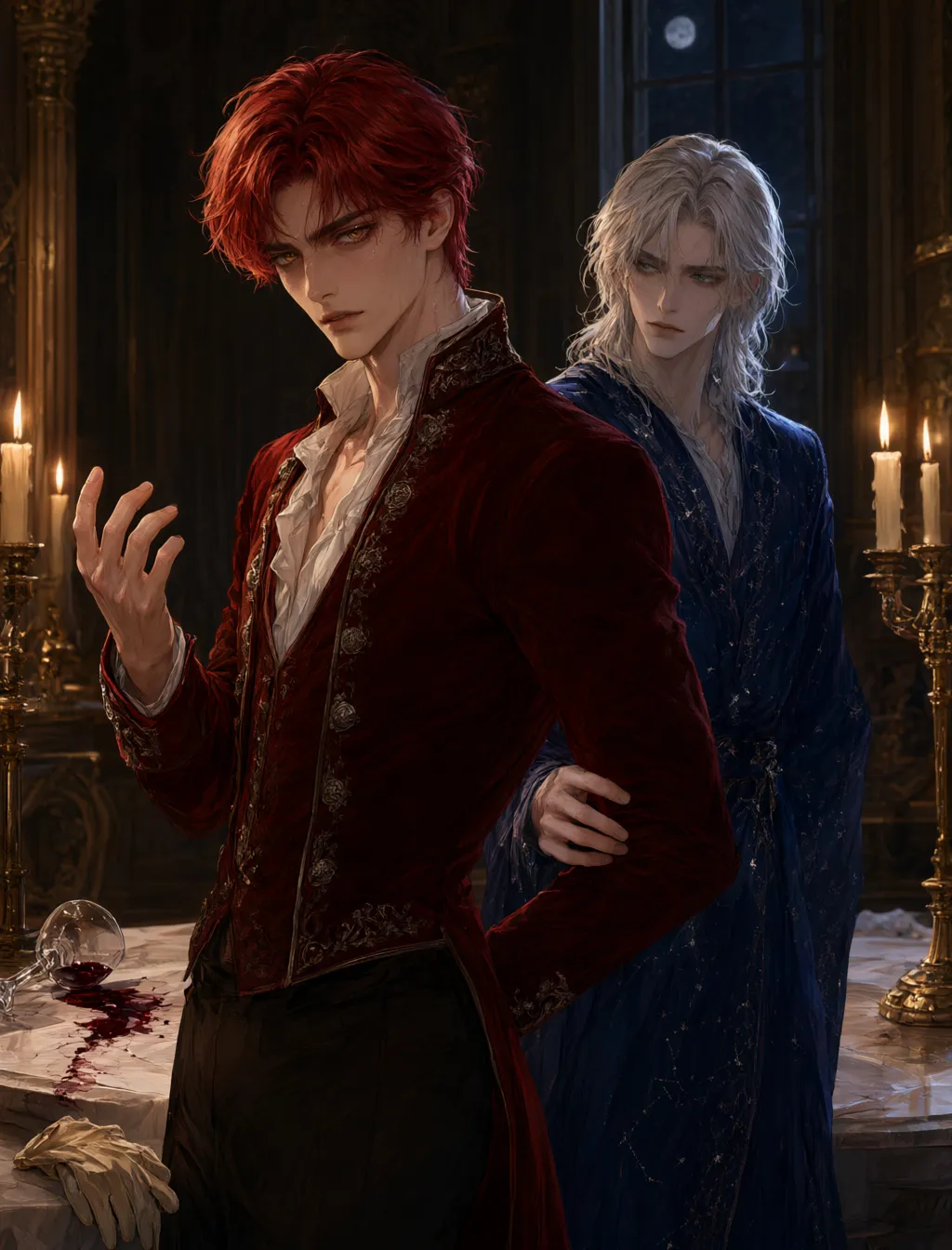
The rusted iron gate groaned under Topher's hand, the sound swallowed almost immediately by the weight of the garden's silence. Beck ducked through the opening, and he felt the brush of fingers at his lower back—light, guiding, there and then gone before he could lean into it. The gate swung shut behind them with a soft click, and the noise of the betrothal hall, the distant hum of voices and music, died as though a door had been closed on the whole world.
Moonlight spilled through the canopy in silver ribbons, catching the ivy that crawled up the damp stone walls. The air was thick and sweet, jasmine and rotting leaves braided together, heavy enough to coat the inside of Beck's mouth. He breathed it in and felt his corset press against his ribs, a familiar creak of whalebone and restraint.
"You found this place," Beck said, his voice low. "How?"
Topher had stopped a few paces ahead, his midnight-blue robes catching the light so the embroidered constellations seemed to shift, to breathe. The dragon curled around his shoulder, its silver thread gleaming like a live thing. The flame at its mouth flickered when he turned.
"I used to sneak out here during the betrothal negotiations." Topher's voice was soft, almost reverent. "When the talk of alliances and contracts became too much, I would slip through that gate and sit under the oak until my grandmother sent someone to find me."
Beck's chest tightened. Six years of university, of stolen glances and almost-touches, and he had never known this. He had never known any of this.
"You never told me," he said.
Topher's smile was a ghost in the moonlight. "There were a lot of things I never told you, Fireling."
The old oak stood at the center of the garden, its branches reaching wide and low, roots breaking through the flagstones like ancient fingers. Moss clung to its bark, soft and green, and the air beneath it was cooler, darker, more private. Beck followed Topher under the canopy, and the moonlight dimmed to a silver hush.
They stood facing each other, close enough that Beck could see the faint tremor in Topher's hands at his sides. That tremor. Beck had catalogued it over six years—in lecture halls, in the library, in the brief, burning moments when their hands had brushed and Topher had pulled away first. He had always read it as hesitation. Now he understood it was the same restraint he carried in his own chest, the same held breath.
"I've waited six years to do this properly," Topher murmured.
His hand lifted. It hesitated, hovering in the space between them, and Beck felt his own breath stop. Then Topher's fingers found the nape of his neck, sliding into his hair, and the touch was warm and certain and everything Beck had dreamed about in the dark of his dormitory room.
"Properly?" Beck's voice cracked on the word.
"Without an audience." Topher's thumb traced a slow circle at the base of his skull. "Without the herald's voice in my ear. Without my grandmother's eyes on us, weighing every gesture." He leaned in, and his breath was warm against Beck's mouth. "Just you. Just me. Just this."
Beck's hands came up of their own accord, finding the midnight-blue fabric of Topher's robes, fisting in it. The embroidery was rough under his fingers, the silver thread catching on his calluses. "Topher—"
Topher kissed him.
It started tender—a brush of lips, a question asked and answered in the same breath. Beck felt the world tilt, felt the jasmine and moonlight and the distant hum of the hall all fall away until there was only the warm pressure of Topher's mouth and the hand in his hair, drawing him closer.
Then Topher deepened it, and Beck's knees went weak.
The kiss turned hungry, desperate, six years of longing poured into the press of lips and tongue. Topher made a sound low in his throat, and Beck answered it with one of his own, his fingers tightening in the fabric, pulling Topher closer, closer, until there was no space left between them.
Beck's back met the rough bark of the old oak, and he gasped against Topher's mouth as the texture bit through the thin fabric of his corset. The creak of whalebone was sharp in the humid quiet, and Topher pressed into it, into him, one hand braced against the trunk beside Beck's head, the other still tangled in his hair.
"Tell me everything," Beck breathed against Topher's lips.
Topher pulled back just enough to look at him. His pale gray eyes were dark, pupils blown wide, and his chest rose and fell in quick, shallow breaths. The constellations on his robes seemed to shimmer with the movement, the dragon's silver eye catching the moonlight.
"Every single thing," Topher said, his voice low and reverent. "Starting with the night I burned that poem."
The words landed like a stone in still water. Beck felt the silence ripple out around them, felt the weight of six years settling into the space between their bodies. He remembered the library, the smell of smoke, the page curling to ash in the flame he had summoned without thinking. He remembered the look on Topher's face when he had turned, the shock, the something else he had never been able to name.
He had never asked. He had never dared.
"You wrote it in second year," Beck said slowly. "I found it on your desk in the east reading room. I thought—" He stopped, swallowed. "I thought you would be angry. That I had read it. That I had burned it."
Topher's thumb traced the line of Beck's jaw, a feather-light touch that made Beck's breath catch. "I was angry," he said. "But not for the reason you think."
The garden held its breath. Somewhere in the dark, a night bird called, and the sound was swallowed by the weight of the moment.
"Then why?" Beck asked. His voice was barely a whisper, rough and raw. "Why did you burn it?"
Topher's hand slid from his neck to his cheek, cupping it, holding him like something precious. The moonlight caught the silver of his hair, the pale gray of his eyes, and Beck saw the tremor in his fingers again—not hesitation this time. Something else. Something that looked like fear.
"Because I wrote it for you," Topher said. "And I couldn't stand the thought of you reading it and knowing."
Beck's heart stopped. "Knowing what?"
Topher's breath came out unsteady, and he leaned his forehead against Beck's, closing his eyes. The constellations on his robes pressed against Beck's chest, the dragon and the flame, and Beck felt the warmth of him through the fabric, the trembling of his body.
"Knowing that I loved you," Topher whispered. "Knowing that I had loved you since the first time I saw you set a lecture hall on fire."
Beck let out a sound that was half laugh, half sob. "I didn't set it on fire. It was a controlled demonstration."
"You singed Professor Aldric's eyebrows off."
"He told me to push the flame higher."
Topher laughed, a soft, broken sound that turned into something else against Beck's mouth. "I loved you then. I loved you before I even knew your name. And I burned that poem because I couldn't bear the thought of you reading it and knowing how completely you had undone me."
Beck's hands tightened in the midnight-blue fabric. The embroidery bit into his palms, the silver thread catching on his skin, and he pulled Topher closer, needing him closer, needing to feel the truth of his words against his own body.
"I read it," Beck said. "Before I burned it. I read every word."
Topher went still.
"I memorized it," Beck continued, his voice rough. "Every line. Every word. I used to whisper it to myself in the dark, when I couldn't sleep, when I thought about you and hated myself for wanting something I couldn't have."
Topher's breath caught. "Beck—"
"The line about the fire," Beck said, and his voice broke. "The line about wanting to burn with me. I thought I had imagined it. I thought I had read something into it that wasn't there." He swallowed hard. "I thought you would never—I thought I would spend the rest of my life watching you marry someone else and wondering what it would have been like to kiss you."
Topher made a sound, low and desperate, and kissed him again.
This kiss was different—slower, deeper, a confession in its own right. Beck felt it in his bones, felt the six years of longing and fear and hope pouring into the press of Topher's mouth. His back was still against the rough bark, the corset still creaking with every breath, but none of it mattered. None of it was real. The only real thing was Topher's hands in his hair, Topher's mouth on his, Topher's body warm and solid against him.
When they finally broke apart, they were both breathing hard. Topher's lips were red, his composure shattered, and Beck knew he looked no better.
"I was so afraid," Topher whispered. "Afraid that if I told you, if I let you see—" He shook his head. "I thought it would ruin everything. I thought you would pull away, and I would lose even the little pieces of you I had."
"You could never lose me," Beck said fiercely. "Not then. Not now. Not ever."
Topher's eyes glistened in the moonlight. "I know that now."
Beck reached up, his fingers finding Topher's jaw, tracing the line of it the way Topher had traced his. "Tell me the rest," he said. "Tell me everything. I want to know all of it."
Topher turned his head, pressing a kiss to Beck's palm. The touch was soft, reverent, and Beck felt it like a brand.
"The night I burned the poem," Topher said slowly, "I walked back to my dormitory and I cried. I cried because I thought I had lost you. Because I thought you had read it and burned it because you were disgusted, because you wanted to erase it, because—" He stopped, his voice catching. "Because I thought you knew, and I thought you didn't want me."
Beck's chest ached. "Topher—"
"I spent the next four years trying to convince myself I was over you." Topher laughed, a broken sound. "I told myself it was a crush, a phase, something I would grow out of. And then the betrothal was announced, and I thought—" He shook his head. "I thought the universe was punishing me. I thought I would have to watch you marry someone else, and I would never even get to tell you."
Beck's hands were shaking. He fisted them in Topher's robes again, pulled him closer, pressed his forehead to Topher's. "I would have found you," he said. "If the betrothal had been to someone else, I would have found you, and I would have told you everything."
Topher's breath hitched. "You don't know that."
"I do." Beck's voice was fierce, certain. "I have loved you for six years, Topher Kaelen. I have loved you since the first time I saw you in that lecture hall, since the first time you smiled at me, since the first time you said my name like it meant something. I would have found you. I would have told you. I would have spent the rest of my life trying to make you believe it."
Topher kissed him again, and this time there was no desperation in it. Just gratitude. Just wonder. Just the slow, certain settling of two souls finally finding their way home.
When they broke apart, Topher's eyes were bright with unshed tears. "I love you," he said. "I have loved you for so long I don't remember what it felt like not to."
Beck's throat was tight. "I know, Starshine. I know."
They stood under the old oak, the moonlight filtering through the leaves, the jasmine and rotting leaves heavy in the air. Beck's back was against the rough bark, Topher's body warm against his, and for the first time in six years, the weight in Beck's chest felt like it belonged to him.
"There's more," Topher said softly. "There's so much more I want to tell you."
Beck's hand found his, lacing their fingers together. "I'm not going anywhere."
Topher's smile was bright in the darkness, brighter than the constellations on his robes, brighter than the moon itself. "Good," he said. "Because I intend to tell you everything. Every memory. Every moment I kept hidden." His thumb traced the back of Beck's hand. "Starting with the night I burned that poem."
Beck's breath caught. "You already—"
"No." Topher shook his head, his eyes holding Beck's. "I told you why I burned it. But I haven't told you what I wrote. I haven't told you the words I put on that page, the words I couldn't bear for you to read." He paused, and the silence stretched between them, heavy and alive. "I want to tell you now."
Beck felt the night press in around them, felt the weight of the moment settling onto his shoulders like a cloak. The moon hung low and silver overhead, the constellations on Topher's robes gleaming, and Beck knew—knew with a certainty that went bone-deep—that this was the beginning of something he had been waiting for his entire life.
"Tell me," he whispered.
Topher's lips parted. The moonlight caught the silver of his hair, the pale gray of his eyes, the trembling of his hands. And in the humid quiet of the overgrown garden, under the old oak where the stars couldn't watch, Topher Kaelen began to speak.
Beck's lips parted, and the words came up out of him like smoke from a banked fire—unstoppable, inevitable, shaped by years of being held too close to the chest. He didn't have to reach for them. They had lived in him since the night he'd watched the page curl to ash in his own summoned flame, since he'd stood in the library with the smell of burning paper in his nose and the terrible, wonderful certainty that he had just destroyed the only proof that Topher Kaelen might feel the same way.
"The first time I saw you, the fire was already in me," Beck said, his voice low and rough, the words coming out in the exact cadence he had whispered to himself in the dark of his dormitory. "I did not know your name. I did not know your voice. But I knew the shape of the light you carried, and I wanted to burn with it."
Topher's breath caught audibly. His hand, still cradling Beck's cheek, went very still.
"I watched you from across the hall for six years," Beck continued, the poem's lines rising in him like a tide he had no power to hold back. "I watched you laugh. I watched you speak. I watched you move through the world like a constellation made flesh, and I thought: this is what the stars must feel like when they look down and see something worth burning for."
Topher made a sound—small, broken, barely audible beneath the hum of the night. His fingers curled against Beck's jaw, not pulling away, just holding, as though he needed the contact to believe what he was hearing.
"I wrote this poem in my second year," Beck said, and his voice cracked on the word. "I wrote it because I could not say it. I wrote it because I thought if I could put it on paper, if I could make it real outside my own chest, maybe it would stop hurting so much. Maybe I could look at you without feeling like I was drowning."
Topher's eyes were wet. The moonlight caught the silver tracks on his cheeks, and Beck felt his own throat close at the sight.
"But you didn't write it," Topher whispered. "I did."
Beck shook his head slowly. "I memorized it. Every word. Every line. I read it so many times that it became mine, that I couldn't tell where your words ended and my wanting began." He swallowed hard. "I used to whisper it to myself in the dark, Starshine. When I couldn't sleep. When I thought about you and hated myself for wanting something I could never have."
The silence that followed was thick with the weight of six years. The jasmine scent hung heavy in the air, and somewhere in the dark, a night bird called once, twice, then fell silent.
"Say it again," Topher said, his voice barely a breath. "Say the line about the fire."
Beck's hand found Topher's wrist, the one still pressed against his cheek, and held it there. "I want to burn with you," he said, the words falling from his lips like they had been waiting their whole lives to be spoken aloud. "I want to burn with you until there is nothing left of me but ash and memory, and even then I will remember the shape of your light."
Topher's composure finally shattered. A sob escaped him, raw and unguarded, and he pressed his forehead to Beck's, his shoulders shaking with the force of it. "I wrote that line the night after I saw you in the lecture hall," he said, his voice breaking. "I wrote it because I couldn't stop thinking about the way the flame had moved when you summoned it, like it was alive, like it was listening to you. I wanted to be that flame. I wanted to be the thing you called."
Beck's hands came up, cupping Topher's face, thumbs brushing away the tears that had spilled onto his cheeks. "You are," he said fiercely. "You are the thing I have been calling for my whole life."
Topher kissed him then, and it was different from the kisses before—slower, more tender, a kiss that tasted of tears and moonlight and six years of waiting. Beck felt it in his bones, felt the confession in the press of Topher's lips, the way they trembled against his own. He pulled Topher closer, one hand sliding into the silver-blond hair at the nape of his neck, and he let himself fall into the kiss the way he had always wanted to fall into Topher—completely, without reservation, without fear.
When they broke apart, they were both breathing hard. Topher's lips were red and swollen, his eyes bright with unshed tears, and the constellations on his robes seemed to shimmer with the movement of his chest.
"There's more," Beck said, his voice rough. "There's so much more."
Topher nodded, his hand finding Beck's and lacing their fingers together. "Then tell me. Tell me all of it."
Beck took a breath, and the words came—not all at once, but in pieces, in fragments, in the way they had lived in him for six years. He told Topher about the poem's second stanza, the one about watching him from across the library and wanting to know the sound of his voice. He told him about the line about the stars, the one that had made him weep in the dark of his dormitory because it was so exactly, so impossibly, what he had felt. He told him about the final stanza, the one that had made him burn the page because he couldn't bear the thought of anyone else reading it, of anyone else seeing how completely Topher had undone him.
And Topher listened. He listened with the same stillness he brought to everything, his pale gray eyes fixed on Beck's face, his hand warm and steady in Beck's. He didn't interrupt. He didn't look away. He just listened, and Beck felt the words pouring out of him like water from a cracked vessel, six years of held-back love finally finding its way into the open.
When Beck finally fell silent, the garden was quiet around them. The moon had shifted higher in the sky, casting silver light through the canopy, and the jasmine scent had softened to something fainter, sweeter. Topher's hand was still in his, their fingers laced together like they had been made for it.
"You really did memorize it," Topher said, his voice soft with wonder.
Beck's throat tightened. "Every word."
Topher's lips parted, and for a moment, he just looked at Beck—looked at him like he was seeing him for the first time, like the words Beck had spoken had rearranged something fundamental in the space between them. The moonlight caught the silver of his hair, the pale gray of his eyes, the trembling of his hands, and Beck felt the weight of the moment settle onto his shoulders like a cloak woven from starlight.
And in the humid quiet of the overgrown garden, under the old oak where the stars couldn't watch, Topher Kaelen leaned in and kissed him again—slowly, deeply, like a promise being made for the first time.
Beck's hands rose before he knew what they were doing, palms finding the curve of Topher's shoulders, thumbs brushing the constellation-stitched fabric where the moon had bleached it silver. The kiss went on long enough for the night bird to call again, and Beck felt something in his chest unknot—something that had been twisted so tight for so long he'd stopped noticing the ache of it.
"Wait," Topher said against his mouth, pulling back just far enough to breathe. His eyes were wet, catching the moonlight in a way that made them look like pools of winter sky. "Wait. You said there was a second stanza. About the library."
Beck's throat worked. "You remember what I said."
"I remember everything you've ever said to me," Topher said, and the simple weight of it landed like a stone in still water. "I've been replaying your voice in my head for six years, Fireling. Do you think I'd miss a single word now that I finally get to hear it for real?"
Beck's fingers tightened on Topher's shoulders. The jasmine had gone almost invisible in the dark, just a ghost of sweetness underneath the green smell of crushed leaves and damp earth. Somewhere beyond the garden wall, the faint sound of the hall's music drifted—a waltz, distant and thin, like a memory of the life they'd left behind when they'd walked out those doors.
"The second stanza," Beck said, and the words came easier now, smoother, like a river that had finally found its bed. "I wrote it about the library. About the way you used to sit in the east corner, by the window that faced the orchard. The light used to come through the glass and catch your hair, and I used to pretend I was reading so I could watch you."
Topher's breath caught. "You—you noticed where I sat?"
"I noticed everything." Beck's voice dropped, rough at the edges. "I noticed the way you bit your lip when you were concentrating. I noticed the way you ran your finger down the spine of a book before you opened it, like you were asking its permission. I noticed the way you looked up when I came in, and looked away just as fast, and I told myself it meant nothing."
The silence between them was thick enough to hold. Topher's hand found Beck's chest, spreading flat over the place where his heart beat a frantic rhythm against his ribs.
"It never meant nothing," Topher whispered. "It meant everything. It meant I couldn't breathe until I saw you walk through that door."
Beck's eyes burned. He blinked, and the world smeared silver for a moment before it sharpened again. "The poem said it better. It said—" He paused, the line rising in him like a tide. "It said, 'I have memorized the way you turn pages, the way you hold your breath at the end of a chapter, the way you look up when you feel watched, and I am always watching, always wanting, always burning.'"
Topher's composure cracked again, but this time it wasn't a sob—it was a laugh, soft and broken and utterly disbelieving. "I wrote that. I wrote that line about you. About the way you used to pace the stacks, restless, like the fire inside you couldn't bear to be contained."
Beck's hands slid up, framing Topher's face, thumbs tracing the silver paths of tears on his cheeks. "And I memorized it. I made it mine. I used to whisper it to the dark of my dormitory, Starshine, and pretend you were there to hear it."
Topher leaned into the touch, his eyes falling half-closed. "Tell me the rest."
Beck's voice came softer now, the cadence shifting into something almost like a lullaby. "The third stanza was about the night I almost kissed you. The night of the autumn masquerade, when we ended up on the balcony and you were close enough that I could smell your cologne—something with cedar in it, and salt, like the sea. I wanted to close the distance. I wanted to press my mouth to yours and find out if you'd pull away."
Topher's hands clenched in Beck's shirt. "I remember that night. You looked at me like you were trying to memorize my face. I thought I'd imagined it."
"You didn't imagine it." Beck's thumb traced the line of Topher's jaw. "I stood there for three full minutes, counting my heartbeats, trying to find the courage. And then someone called your name from inside, and you turned, and the moment was gone."
"I would have let you," Topher said, the words spilling out like water from a cracked vessel. "I would have let you kiss me. I would have kissed you back. I spent the rest of that night lying awake, wondering why you hadn't."
Beck's hands stilled. The night air felt suddenly thin, sharp, like the moment before lightning splits the sky.
"There was a fourth stanza," Beck said, and the words came out wrong—too fast, too rough, scraping against the back of his throat. He felt Topher's hands tighten on his chest, felt the shift in the air between them, the way the night seemed to hold its breath with them.
Topher's eyes searched his face. "I only wrote three."
"I know." Beck's voice cracked on the admission. "I know you only wrote three. But I needed a fourth. I needed an ending that didn't feel like drowning, so I wrote one for you. For me. For the version of us I thought I'd never get to have."
The confession hung in the humid air between them, heavier than the jasmine, heavier than the moonlight. Topher's lips parted, and Beck watched the questions move through his eyes—what did you write, when did you write it, why didn't you tell me—before they settled into something softer, something almost like wonder.
"Show me," Topher said. "Show me what you wrote."
Beck's hands were shaking. He could feel it in his fingers, the fine tremor that had lived there since he was a boy, the one his tutors had called a lack of discipline and his mother had called a tell. He pressed his palms flat against Topher's shoulders, grounding himself in the solid warmth of him, in the constellation-stitched fabric that shifted under his touch like the night sky had been sewn into the cloth.
"I wrote it the night after I burned your poem," Beck said. "I sat in my dormitory with the ash still on my fingers, and I couldn't sleep, and I couldn't stop thinking about the way you'd looked at me in the library earlier that day. Like you'd been caught. Like you were afraid I'd seen something you hadn't meant to show me."
"I was," Topher whispered. "I was so afraid."
"I know." Beck's thumb traced the edge of Topher's collarbone, a slow, aimless path. "I was afraid too. That's why I wrote it. Because I needed to say the thing I couldn't say to your face, and I needed it to be mine."
The garden had gone utterly still around them. Even the night bird had fallen silent, as though the whole world had leaned in to listen.
Beck took a breath, and the words came out in the cadence he had whispered to himself in the dark for six years, the cadence that had become as familiar to him as his own heartbeat:
"And if I never get to touch you, if I never get to know the sound of your voice saying my name in the dark, I will still be grateful. I will still be glad that I lived in a world where you existed, where I got to watch you move through it like a light that had no idea how bright it burned."
Topher made a sound that was almost a sob, almost a laugh, caught somewhere in between. His hands were fisted in Beck's shirt now, knuckles white against the fabric.
"I will carry the memory of you like a coal in my chest," Beck continued, his voice dropping lower, rougher, the words scraping out of him like they were being pulled from the deepest part of him. "I will feed it with every glance I never took, every word I never said, every moment I let pass because I was too afraid to reach for it. And when I am old, and the fire in me has burned low, I will still feel the warmth of you. I will still remember the shape of the light you carried. I will still love you, Topher Kaelen, in every version of the world where I was too cowardly to say it."
The last syllable hung in the air between them, and Beck felt the shape of it leave his mouth like a thing released from a cage. The poem was done. Six years of it, all of it, every word he had carried so long they had worn grooves into the inside of him, and now they sat in the moonlit garden between two men who were finally allowed to hold them.
Topher's hands were still fisted in his shirt. The knuckles had gone pale, and Beck could feel the fine trembling running through them, the way a harp string trembles after the note has already faded. Neither of them moved. The night bird had not called again, and the distant waltz had thinned to almost nothing, and the whole garden seemed to be waiting the way Beck was waiting—for Topher to speak, to breathe, to do anything that would tell him the words had landed true.
"You wrote a fourth stanza," Topher said at last, and his voice was wrecked in a way Beck had never heard it, scraped raw and quiet. "You wrote one for me, after I burned mine. After you watched me burn it."
Beck nodded. His throat was too full for words, so he just nodded, and Topher's eyes moved over his face the way they had that night on the balcony, trying to memorize something that was slipping away.
"I thought about it for weeks," Beck managed. "I thought about walking up to you in the library and telling you I'd read it. That I'd found it in the grate, that I'd pulled it out before the fire could take it all, that I'd read every line standing there with the smoke still in my lungs." He swallowed. "I thought about telling you I'd kept it. That I'd memorized it. That I'd carried it with me so long it had become part of my own heartbeat."
"Why didn't you?"
"Because I was afraid of what it would mean." Beck's hands slid down from Topher's shoulders to his wrists, thumbs pressing into the pulse points there. "If I told you I'd read it, I'd have to admit I'd wanted to. That I'd read it the way you wrote it—the way you meant it. And I wasn't ready to find out if I'd read it wrong."
Topher's breath came out shaky. "You didn't read it wrong."
"I know that now." Beck's voice cracked on the word. "I know that now, and I've known it for six years, and I still couldn't say it. I burned your poem, Topher. I burned the only thing you'd ever written about me, and I did it because I couldn't bear the thought of anyone else reading it, of anyone else knowing how completely you had undone me."
"You didn't burn it," Topher said, and his hands came up to frame Beck's face, thumbs tracing the sharp line of his cheekbones. "You memorized it. You kept it. You made it yours. Don't you understand, Fireling? You didn't destroy it. You carried it."
Beck's eyes burned. He blinked, and the world smeared silver again, and he felt the tears spill over before he could stop them, hot and sudden and utterly beyond his control. He had not cried in years. He had trained himself out of it the way he had trained himself out of reaching for Topher across lecture halls, out of letting his gaze linger too long, out of every small and terrible thing that would have given him away. And now here he was, weeping in an overgrown garden with his betrothed's hands on his face, and he could not find it in himself to be ashamed.
"I wrote it the night after the masquerade," Beck said, the words coming rough and wet. "I sat in my dormitory with the ash still on my fingers and I couldn't stop thinking about the way you'd looked at me on that balcony. The way you'd said my name. The way you'd been so close I could smell the cedar on your collar, and I had done nothing. I had let you walk back inside, and I had stood there in the dark and hated myself for it."
Topher's thumbs moved, wiping the tears from Beck's cheeks with a tenderness that made something in Beck's chest twist. "I would have kissed you."
"I know. You said that. And I've spent six years replaying that night, trying to find the version of me who was brave enough to close the distance, and he never existed. He only ever existed in the poem I wrote afterward, in the version of us I made up in the dark."
"Show me," Topher said again, softer this time, almost a plea. "Show me the rest of it. The part you didn't tell me yet."
Beck's hands tightened on Topher's wrists. The poem was still there, all of it, every line he had written in the small hours of that terrible night, and he had thought he would never speak it aloud to anyone. He had thought it would die with him, the way so much of what he felt for Topher had died unspoken. But Topher was here now, real and warm and asking, and Beck found he could not hold anything back from him.
"The fourth stanza was about the wanting," Beck said. "Not the watching, not the burning—the wanting. The wanting that kept me awake at night. The wanting that made me hate myself because I thought it was one-sided, because I thought I was the only one lying awake in the dark with the shape of someone else's name in my mouth."
Topher's breath caught. "I was lying awake too."
"I know. I didn't know then. But I know now, and it changes everything, and I still don't know how to hold it." Beck's voice dropped to barely a whisper. "I wrote that I wanted to know what your voice sounded like when you said my name. I wrote that I wanted to know what it felt like to be the reason you smiled. I wrote that I wanted to wake up next to you, just once, just long enough to know what it felt like to be wanted back."
Topher made a sound that was almost a sob, and his forehead came down to rest against Beck's. The constellation-stitched fabric of his robes brushed Beck's chest, and Beck could feel the rapid rise and fall of Topher's breathing, the way his whole body was shaking with the effort of holding himself together.
"I wrote that I would have given anything," Beck said, his lips nearly touching Topher's, "to be the one you chose. To be the one you looked at the way I looked at you. To be the one who got to keep you."
"You are," Topher whispered. "You are the one I chose. You are the one I've been choosing for six years, Fireling, even when I thought I had no right to. Even when I thought you'd never look at me the way I looked at you."
Beck's hands slid up, threading into the silver-blond hair at Topher's nape, and he pulled him into a kiss that was salt and moonlight and six years of everything they had never said. Topher melted into it, his hands fisting in Beck's shirt again, and Beck felt the tears on Topher's cheeks against his own, felt the way their trembling synced up until he couldn't tell where his body ended and Topher's began.
When they broke apart, they were both breathing hard, and Beck's forehead stayed pressed to Topher's, their noses brushing, their breath mingling in the humid dark.
"I have one more line," Beck said, and his voice was wrecked, scraped clean. "The last line. The one I wrote at the very end, when I thought I'd never get to say any of it to you."
Topher's eyes were closed, his lashes dark against his pale cheeks. "Tell me."
Beck's throat worked. He had whispered this line to himself in the dark for six years, had shaped it around the ache in his chest until it fit, until it was as much a part of him as his own name. And now, with Topher's hands in his shirt and Topher's breath on his mouth, he finally let it go.
"If I am ever given the chance to love you out loud," Beck said, "I will spend the rest of my life making up for every silent year."
Topher's eyes opened. The moonlight caught the wetness there, the pale gray gone bright with it, and his lips parted on a breath that was almost a laugh, almost a sob, caught somewhere in between.
"You just did," Topher said. "You just did, Fireling. You just spent six years of silence out loud in one night, and I heard every word of it."
Beck's hands were shaking. He could feel it in his fingers, the fine tremor that had lived there since he was a boy, and he let Topher see it. He let Topher see everything. He had spent so long hiding the wanting, the watching, the burning, and there was no hiding left in him. There was only this—only Topher, only the garden, only the truth of six years finally spoken into the dark.
"I don't know how to stop," Beck said, and the confession came out raw, honest, unguarded. "I don't know how to stop saying it now that I've started. I've held it in for so long, Starshine, and I think if I tried to hold it back now it would tear me apart."
"Then don't hold it back," Topher said, and his hands came up to cup Beck's face again, thumbs tracing the damp paths on his cheeks. "Don't hold anything back. Not anymore. Not ever again."
Beck kissed him again, and it was different this time—desperate, hungry, the kiss of a man who had been starving for six years and had just been told the feast was his. Topher kissed him back with the same desperation, the same hunger, and Beck felt the wanting in it, felt the way Topher's hands moved from his face to his shoulders to his chest, mapping him the way Beck had always wanted to be mapped.
The poem was done. The confession was done. And what was left was this—two men in an overgrown garden, finally allowed to want each other out loud, with the moon watching and the jasmine sweet in the air and the distant waltz still playing for a hall they had left behind.
"I love you," Beck said against Topher's mouth, the words falling out of him like they had always been there, waiting for permission. "I love you, I love you, I love you."
Topher laughed, a wet, broken sound, and kissed him again. "I know," he said. "I know, Fireling. I've known since the second stanza."
Beck pulled back just far enough to look at him, to see the moonlight on his face, the constellations on his robes, the way his pale gray eyes held the whole of the night sky. "You knew?"
"I knew the moment you said the line about the library." Topher's smile was tremulous, bright, impossibly tender. "I wrote that line about you. And you said it back to me, word for word, six years later, in the dark, where no one could hear." He reached up and touched Beck's chest, right over the place where the coal had burned for so long. "How could I not know?"
Beck's hand covered Topher's, pressing it flat against his heart. "I'm never letting you go," he said, and the words came out like a vow, like the only thing he had ever been sure of. "I'm never letting you go, Starshine. Not now. Not ever."
Topher leaned in and kissed him, soft and slow, and Beck felt the promise in it, felt the way Topher's lips shaped the words he couldn't say with his mouth full. The jasmine had gone almost invisible in the dark, just a ghost of sweetness underneath the green smell of crushed leaves and damp earth. Somewhere beyond the garden wall, the hall's music had faded to nothing, and the night had gone quiet around them, and Beck thought he could stay here forever, in this moment, with Topher's hand over his heart and Topher's breath on his lips.
And then Topher pulled back, just far enough to meet his eyes, and said, "There's something I need to tell you."
Beck's heart stuttered. "What is it?"
Topher's hands were trembling again, but his voice was steady when he spoke. "The poem. The one I burned. There was a line I never wrote down." He swallowed. "I never wrote it down because I couldn't find the words for it. But I think—I think I can say it now."
Beck waited. The night held its breath with him.
"I wrote the poem because I loved you," Topher said, and the words came out clear and true, like something that had been waiting its whole life to be spoken. "But I never wrote down the line about what it felt like to love you and think you'd never love me back. I never wrote down the line about how it felt to watch you from across the hall and know I'd never get to cross it." He took a breath. "I never wrote down the line about how I'd have given anything, everything, to hear you say my name the way you say it now."
Beck's eyes burned again. "Topher—"
"I'm saying it now," Topher said. "I'm saying it out loud, in the dark, where no one can hear. I loved you before I ever wrote that poem, Fireling. I loved you from the first time I saw the fire move when you called it. And I've spent six years trying to find the words for what that felt like, and I think I finally have them."
He leaned in, close enough that Beck could feel the warmth of him, could see the way the moonlight caught the silver in his hair.
"It felt like coming home to a place I'd never been," Topher said. "It felt like the stars had been waiting for me to look up. It felt like I'd been holding my breath my whole life, and then you walked into the room, and I finally knew what it was like to breathe."
Beck's hands came up, framing Topher's face, thumbs brushing the tears that had spilled onto his cheeks again. "I know," he said, his voice rough. "I know, Starshine. I've been holding my breath for six years too."
Topher laughed, soft and broken, and leaned into the touch. "Then we can breathe together now."
Beck kissed him, and it was a kiss that tasted of tears and moonlight and the beginning of something that had waited six years to be born. And in the humid quiet of the overgrown garden, under the old oak where the stars couldn't watch, they finally let themselves breathe.
Beck took Topher's hand in both of his, turning it palm-up like he was handling something fragile and infinitely precious. The moon painted the pale skin silver, tracing the lines of Topher's lifeline, his heart line, the creases that held six years of quiet wanting. Beck ran his thumb along the edge of Topher's palm, feeling the faint tremor that lived there, the same tremor that had been in his own hands since he was a boy.
"Tell me the line again," Beck said, his voice low. "The one you never wrote down."
Topher's breath caught, his fingers curling slightly before Beck gentled them open. "The one about coming home to a place I'd never been."
"That one." Beck's thumb pressed lightly into the center of Topher's palm, and he felt the shudder that ran through him. "Say it like you mean it. Say it like you're writing it on my skin so I can carry it with me."
Topher's eyes went bright, the pale gray glinting wet in the moonlight. He opened his mouth, but the words took a moment to come, held behind the same wall that had kept them for six years. Beck waited, his thumb tracing a slow circle in the center of Topher's palm, telling him without words that there was no hurry now. No rush. No clock. Just this garden and this moment and the taste of finally.
"It felt like coming home," Topher said, the words slow, deliberate, each one shaped around the ache in his chest. "Like walking into a room I'd built in my dreams and finding it real."
Beck traced the words as Topher spoke them, his index finger moving across the pale skin, spelling out each syllable like he was learning a language older than speech. "Home. Dream. Real." His finger came to rest in the hollow between Topher's thumb and forefinger. "Say the rest."
"It felt like the stars had been waiting for me to look up."
Beck's finger drew a constellation that didn't exist, a pattern of his own making, following the truth of Topher's words instead of any map. Star by star, point by point, from the base of Topher's thumb to the tip of his forefinger. "Waiting," Beck repeated, the word catching. "They were. I was."
Topher made a sound low in his throat, and his other hand came up to grip Beck's forearm, steadying himself or holding on—Beck wasn't sure which, and it didn't matter. "It felt like I'd been holding my breath my whole life," Topher said, "and you walked in, and I finally tasted the air."
Beck's tracing slowed. His fingertip moved along the line of Topher's lifeline, following the curve of it like he was following a river to its source, to the place where Topher had always been waiting. "Breathe," he said, his voice rough. "Say it again, Starshine. Say it like you mean it."
Topher's throat worked. "I'd been drowning without noticing," he said, and the words came out ragged, scraped open. "Dreaming the world small on purpose because the dream was easier than the waking. And then you called fire in that lecture hall, and the whole world got brighter—"
"—and you looked at me," Beck finished for him, but Topher shook his head.
"No. I looked everywhere else. I looked at the books, at the mages beside me, at the wall behind you. Anywhere but at you. Because I knew if I let myself look, I'd never stop."
Beck's finger stilled against Topher's palm. The shape of the words hung between them, heavier than either of them had been prepared for. And then Beck ducked his head and pressed a kiss to the center of Topher's hand, where the line of the truth was traced in the oldest ink there was—his own trembling touch.
"Six years," Beck said against Topher's skin. "Six years of not looking, and you were the only thing in the room worth seeing."
Topher gasped, a sharp, wet sound, and his hand shook in Beck's grip. But the danger of falling apart trembled in it too — that line held because Beck was still holding on. "Beck—"
"Let me have this," Beck said, lifting his head, silver tracing the paths on his own cheeks now. "Let me trace what you were afraid to say. Let me spell it out so I can keep it somewhere you didn't think anyone would ever read it."
Topher's eyes went wide. "I never—"
"The journal," Beck said, and the words came out small, careful, still afraid of landing wrong. "I read it that morning in the library. Every page of it." His finger moved to the pad of Topher's smallest finger, tracing a line of a word there, one word, two. "All those days you watched me. All those nights you stayed up. I thought I was listening to alone, and it turned out we wrote the same song in two different languages."
Topher's fingers closed reflexively, and Beck's tracing nearly broke. But then Topher uncurled them again, slowly, deliberately, lifting his open palm like an offering. "Then read it to me," Topher said. "Read what you found there. When you trace it, I'll finally hear the silence out loud."
Beck exhaled sharply, like the wind had been punched out of him, and his hand steadied on Topher's open palm.
He started at the first knuckle of Topher's thumb, tracing the curve of the joint, the skin there warm and real under his fingertip, skin that had entered a hundred lecture halls and lit a hundred study candles and reached for books Beck had learned to fake disinterest over.
"You wrote about the first day," Beck said. "Freshman year. The starlight exemplar practice hall."
Topher's jaw tightened behind the seal of his composure. But he didn't close his hand. He didn't turn away. He waited, the full open lightning strike of being known lined up in the flat of his palm.
"You wrote"—Beck's finger traced line for line, word for word, from the shade of evening light through Tallus Lecture Hall to the way Topher had traced his finger through the dust of the practice circle that morning— "
—"how you saw the fire I called before I called it. How you knew the name of the heat before I'd learned to carry it. How you wrote that you watched my hands that whole first week, waiting to see if I'd burn the building down or just myself."
Beck's finger moved without hurry down the length of Topher's thumb, following the ridge of the joint the way the entry had followed its own wandering course across two pages of cramped, worried script. "You wrote that you wanted to warn me about the starlight exemplar's afternoon demonstration, because you'd heard she was careless with the containment circles, and you were afraid I'd be standing too close."
Topher's breath left him in a shaky rush, and his free hand tightened on Beck's forearm. "You actually read every page."
"I read every page three times," Beck said, and there was something raw in his voice, scraped clean, "before I burned the ones you never meant anyone to see, Starshine, in case someone went looking later. I memorized the rest. All the parts where the poem leaked through and you thought nobody would ever read it."
He lifted his finger from Topher's thumb and placed it at the base of Topher's middle finger, riding the little hill of muscle there. "Thirteenth entry. November. You wrote about the winter feast, how the Marlow table was always too loud and how you kept finding excuses to walk past it on your way to the wine fountain because I was usually standing beside it, laughing at something one of my cousins said, too far away to hear."
"I thought I'd hidden that so carefully," Topher whispered.
"You buried it under a stargazing log for a week of different nights." Beck's finger crossed Topher's palm, walking the crease line by line. "But you used my name. You only ever used my full name when you couldn't manage to be careful about it. It's all over the pages, the moments the carelessness broke through."
The moonlight found the wet trail on Topher's cheeks, and he didn't wipe them away. His hand stayed open in Beck's grip, palm-up, an exposed bridge, waiting.
Beck's own words faltered, his finger pausing in the center of Topher's palm. "You wrote it like you expected never to show it to anyone. Like you'd rather capture the feeling and hide it than speak it out loud where it could take a shape you couldn't control. I read that entry, god help me, Topher, and I thought 'I wrote nearly that exact sentence in a diary I kept for myself for nine months before I had the courage to burn it.'"
He touched the exact center of Topher's palm, the deep bowl where six years had pooled like water pressing on old stone. "I don't think two beings are very different in that, in what we hid from."
"Beck." Topher's voice cracked on the syllable, the same way it had been cracking all night, the pressure of a dam wearing thin at a high point. "Read me the end of it. The night it became more than something I could pour into a journal."
Beck watched him, silver shadow carving the hollow of Topher's cheekbone. He could list the constellations buried in the stitching there if he wanted, could spend the whole night tracing the history that someone else always got to record. Instead he took Topher's wrist in his grasp, turned it over, and dragged his fingertip along Topher's lifeline to where it split small, a branch that turned aside short before it ought to because Topher always had been reaching for escape routes even in the deep lines grown into the skin.
The branch was faint, barely a hairline, but Beck followed every flicker of it with the flat of his thumb.
"You wrote this," Beck said, "about the night I didn't speak to you."
Topher stiffened.
"You described it plain as weather," Beck kept on, his voice held low, gathering around every careful word, "you recorded that when I walked past you in the great hall after the spring equinox and kept walking, you went up to your room in the starlight exemplar tower and sat on your bed and tried to remember how to think. You said you still don't know why and I was never going to tell you and it made no difference, some longing."
"I— I shouldn't have written that it made no difference," Topher said, hardly shaped enough to trip off the surface of his own hand where Beck had spread it. "It made all the difference. It drives me tonight to this place and every step I take to you is a step I shouldn't be able to see the way through."
"The way through," Beck repeated, tasting it, turning the blade over. And then something behind his eyes gave way like a wall deciding to come down. Wind bunted at them, thrown off some far corner of the garden to rope the two of them closer, and Beck pulled Topher by the still-open palm, dragging him fully against his chest before letting go and cupping that open hand against the curve of his own heart.
Topher's jaw dropped an inch, and his fingers pressed against the warm linen of Beck's fine shirt, spreading over the bone there, the raft before the storm-wall wave. Beck's thumb came up to circle the pulse beating under his collarbone instead, pressing a steady rhythm into the web between two bones.
"Then trace it over me," Beck said, his voice banked and quiet, "the way I traced it over you. Put your fingers on the lying bones and tell me what they say now, Starshine, so it's not just me who's been known tonight. I want to be an answer for something in you, like you've been an answer in me."
Shudder ran through Topher's ribcage in a long slow wave. He hesitated, a horizon-moment balanced between the porch light on the wall and the open night beyond, and then his fingers curled careful against Beck's heartbeat under the shifting silks. He lifted them, one long breath sharp, and pressed them flat again, palm hot, half-hidden where no other hand had ever been welcome.
"Beck," he said, and the name did not want to stay close to the voice carrying it. It traveled, moonlight-wetted, and settled in the skin wherever Beck had a use for it.
Beck whispered on the drawn-out edge between wonder and wreck-up-about-to-happen, "Say the line. The one you never wrote down."
Topher's hand closed fully over Beck's chest, palm flat, long fingers spread enough to thread their shape between the mage's ribs. "It felt like coming home," he said, and spilled over like knocked water, "to a place I'd built in dreams to hide me from a world that would never build the door for me." His fingers pressed a little harder at the final word, not drawing a wound, just touching where the truth had landed before it came through his voice.
Behind him the garden bells chimed the hour from the eastern wall, far indoors and muffled by stone, and neither of them paid it any mind.
Then looking down at the flat of the hand that held him against the heart of his own body, Buster — Beck refused the shiver of composure at its edges and bent his head to press his forehead to Topher's hairline just along the lightning path that had cracked open his night, and into the arch of it, into the giving air moved to stillness again, he gave Topher the one answer the deeper arc caught in his throat took away his will to turn.
The lantern-light on the back wall made a halo of the split of silver strands that crossed Topher's collar as his profile swayed clear of them. In the small dry hush where the chiming stone had ended, Beck lifted his head and shaped without noise through his mouth the six-year confession of storms.
They found three-hundredths of a syllable spoken aloud where Topher could catch: "You fitted my hand, all the lines, for something I never saw the faint of in me," and at the core of it ten thousand times broken-saved from him (because I was too, Fireling, because I was fire, nights drawing a map around me by the heat), "and I've burned untouched for six years thinking that was all fire ever meant."
Rock-ounce and impossible, stillness in the cooling air, so the true and awful wave of what has changed moved through them, caught on words too thin to carry water and suddenly only the balance of an open hand carried what happens between them down to the dark-girl leaf stalks that crossed at the wrist.
But it is not the moon casting shadows across his wet cheeks. Becky—forehead touches shoulder, where cloth croches the curve, a trembling patience drawing thin strength from the grain of his frame—he guards the open answer standing with him in the heavy marrow of the humid dark, elbow pressed like a caught weight in his forearm, hand turned open as slowly as prayer.
And the last traced line, stretching to meet the moon like it has held an old opening now getting filled—the final constellations so crisp and sure and bare, take "home," lean in for a full press of his open fingers against the fabric over Beck's still-fast heart, shift stance low, take the collared star into a whispered one-beat not even lost across the stale unspoken place—"Say it again, strolling in time with the ocean press—never unwritten again. Let your fingers drum the poem until I am imprinted with it all, until there is no inch of me left where you haven't placed your light."—"The whole breadth of it. Say all six years of it into the seam, Fireling."