
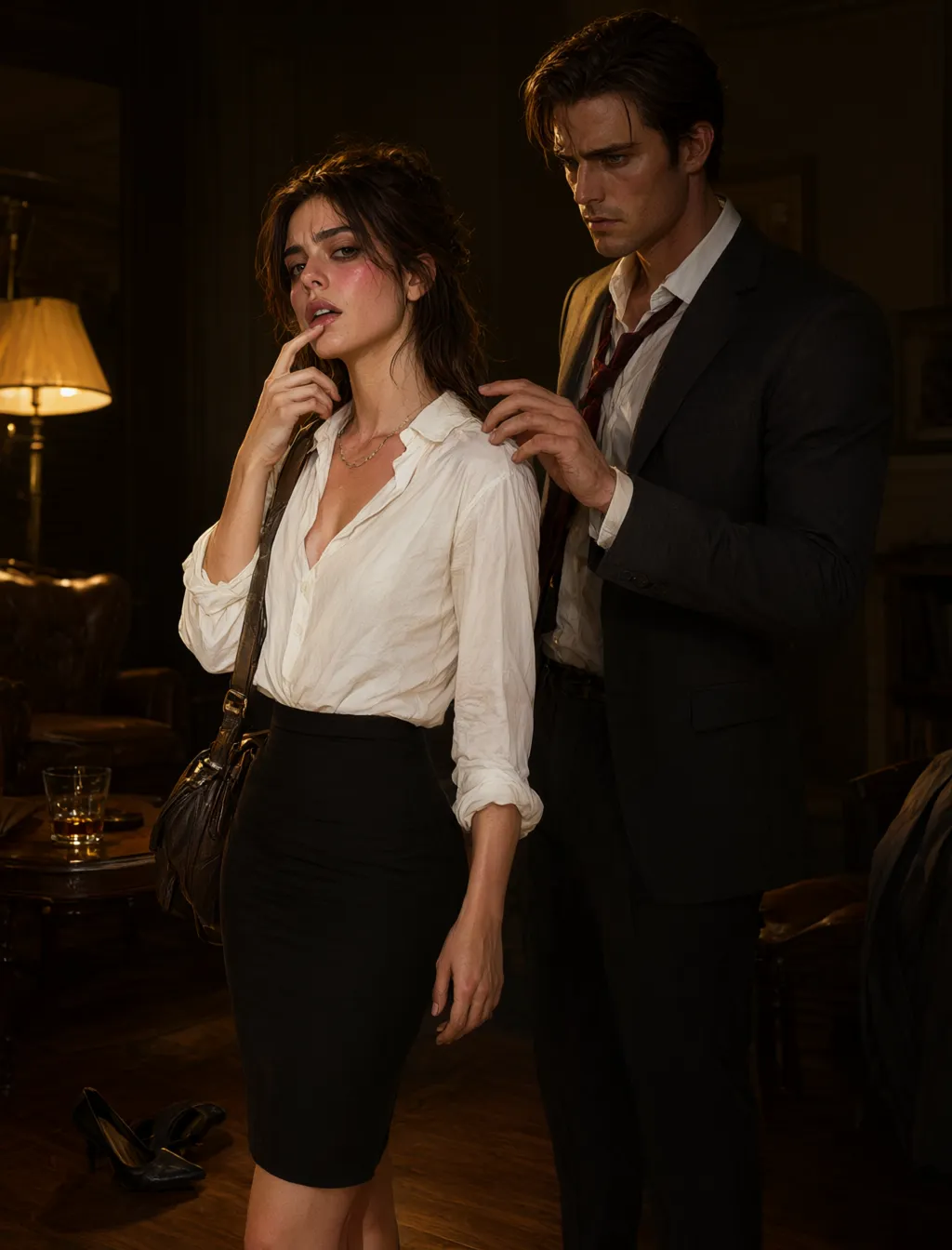
Iris Castellano's first breath inside the penthouse tasted like steel and cedar, the air so still it felt held. The door had sealed behind her with a soft click that sounded less like a courtesy and more like a lock engaging. She stood in the foyer, caught between the city's grid of lights beyond the floor-to-ceiling windows and the dark leather and glass that filled the space. A chandelier hung overhead—sharp angles of crystal catching the dying light—but she didn't look up. She looked at him.
He was seated behind a glass desk that seemed to float in the dim room, a slab of pale gray reflecting nothing. Victor Hale didn't stand when she entered. He didn't look up. His head was bent over a tablet, the screen casting a faint blue glow across the hard lines of his face. She couldn't see his eyes yet, just the crown of dark hair, the broad shoulders in a charcoal suit that fit like a second skin. He knew she was there. She could feel it in the way his thumb paused on the screen, then resumed—a deliberate rhythm, like he was still deciding something.
Iris shifted her weight, the worn strap of her leather backpack digging into her shoulder. "Iris Castellano," she said. Her voice carried across the open space, landing somewhere between them. "We spoke on the phone."
He didn't respond. His thumb kept moving. The silence stretched, elastic and uncomfortable, and she felt the familiar heat rise in her chest—that stubborn prickle that always came before she said something she couldn't take back. She bit the inside of her cheek and waited.
When he finally looked up, it was like a door opening into a room she hadn't known existed. His eyes were gray—pale, cold, the color of winter sky before snow—and they held her without blinking. He studied her like she was a document he was deciding whether to sign, his gaze traveling from the ink-smudge on her index finger to the furrow between her brows to the way her shoulders were squared beneath her worn cardigan.
"You're early," he said. The words came out flat, a statement of fact rather than criticism. His voice was lower than she'd expected, with a roughness at the edges that didn't match the perfect cut of his jaw.
"Traffic was lighter than I expected."
"You took the subway."
She didn't flinch. "Is that a question?"
Something flickered in those gray eyes—too fast to name—before he set the tablet aside and leaned back, one hand reaching for a fountain pen she hadn't noticed on the desk. He turned it between his fingers, a slow, practiced motion. "You're not what I expected."
Iris let her chin lift. "I'm not?"
"No." His thumb ran the length of the pen, from clip to nib. "You're sharper. That'll be a problem."
Iris held his gaze. The gray of his eyes was steady, unblinking, like he was waiting for something—a flinch, a retreat, a crack in the armor she'd worn since the elevator doors opened. She gave him none of it. "Is that a threat," she said slowly, "or a compliment?"
He didn't answer immediately. His thumb resumed its path along the fountain pen, clip to nib, a measured stroke that matched the rhythm of his breathing. The silence stretched, elastic, and she felt the familiar heat rise in her chest—that stubborn prickle that always came before she said something she couldn't take back. She bit the inside of her cheek and waited.
"That depends," he said finally, his voice low and rough at the edges, "on whether you plan to use it."
Iris let a beat pass. "Use what, exactly?"
"The sharpness." He set the pen down with a soft click, the sound precise and final. "You've already answered two questions with questions. You've held my gaze longer than most candidates last an entire interview. And you're standing there with your chin lifted like you're daring me to push." His lips barely moved, but something shifted in his expression—a crack, so brief she almost missed it. "That kind of edge cuts both ways."
She considered him. The suit, the desk, the city bleeding through the glass behind him. He looked like a man who'd built a world that obeyed him, and she was standing in the middle of it, a variable he hadn't accounted for. The thought sent a small thrill through her chest, quick and sharp as a splinter.
"I'm not here to cut you," she said, and the words came out steadier than she'd expected. "I'm here to do a job."
"Jobs have rules."
"I assumed they did."
His eyes narrowed—just a fraction, just enough to tell her she'd landed somewhere unexpected. He reached for the pen again, turning it between his fingers, and she watched his thumb trace the same path it had before. Clip to nib. Clip to nib. A pattern he couldn't break.
"You assume a lot," he said.
"You assume I'll follow them." She let the corner of her mouth lift, just barely, before she caught it. "I guess we're both making assumptions."
He went still. The pen stopped mid-turn, and for a long, suspended moment, the only sound was the faint hum of the city beyond the glass. His eyes held hers, and she saw something flicker in the gray—not annoyance, not anger, but something rawer. Something that looked almost like curiosity.
"Sit down, Ms. Castellano." His voice was flat, but the edge of it had roughened, just barely. "We have terms to discuss."
"No."
The word sat between them, clean and absolute. His thumb stopped moving on the fountain pen, and the silence that followed felt fragile, like glass about to crack. She held his gaze, letting him feel the weight of it, letting him wonder if she'd walk out. Then she moved.
She didn't take the chair closest to his desk. She chose the low leather sofa against the glass wall, the one that forced him to turn in his seat to keep her in his line of sight. Her boots made no sound on the polished concrete floor. The worn strap of her leather backpack slid from her shoulder as she settled into the cushions, slow and deliberate, the dark leather creaking under her weight. She crossed one leg over the other, the scuffed toe of her boot catching the amber lamplight, and leaned back, one arm stretching across the back of the sofa. An invitation, or a claim. She hadn't decided yet.
His eyes tracked her the whole way. The gray of them was unreadable, flat as winter water, but his jaw had tightened—just barely, a flex of muscle at the hinge. He set the pen down with a click that sounded too loud in the still air. "I didn't tell you to sit there."
"No," she said again, letting the word hang. "You told me to sit."
The silence stretched, elastic and charged. She could feel the city pulsing beyond the glass behind her, a distant hum of headlights and neon, but in here there was only the space between them, narrowing by the second. He leaned forward, elbows resting on the glass desk, and the movement brought his face into sharper light—the hard cut of his jaw, the faint shadow at his temples, the way his mouth stayed pressed into a thin line.
"The job requires absolute discretion." His voice had dropped, rougher now, like the words were scraping against something in his throat. "You will speak to no one about what happens in this room, or in any room where I am present. You will be available twenty-four hours a day, seven days a week, for the duration of your contract." He paused, letting the weight of the words settle. "You will follow my instructions without question."
"Without question." She repeated the phrase slowly, tasting it. "That sounds less like a job and more like a vow."
"Is that a problem, Ms. Castellano?"
"I'm still here, aren't I?" She didn't answer the question. She let it hang between them, a loose thread he could pull or leave. His eyes narrowed, and she saw it again—that flicker of something raw and curious breaking through the marble surface, there and gone before she could name it.
"I will pay you enough to cover your tuition." He slid a folder across the glass toward her, the movement precise and practiced. "In full. Plus a stipend for inconvenience. You'll have your own key, your own code to the elevator. You'll come when I call, and you'll leave when I dismiss you."
She didn't look at the folder. She kept her eyes on his. "And if I have questions?"
"You'll ask them."
"And if I refuse an instruction?"
His hand stilled on the folder. The air thickened. "Then you'll be the first."
Iris let the silence breathe. She could feel her own pulse in her fingertips, steady and sure, and she used the beat to let him see her thinking. He was watching her like she was a math problem he hadn't solved yet, and she found she liked the feeling—the weight of his attention, the way he couldn't look away.
"I need one more thing," she said.
"Name it."
She leaned forward, slow, letting the leather shift beneath her, and rested her elbows on her knees. Her voice dropped, matching his rough register. "I need to know that when this ends, I walk away clean. No strings. No records. No traces of me in your world." She held his gaze. "I'm not yours, Mr. Hale. I'm just someone who showed up."
Something shifted in the gray of his eyes—a crack, a fracture, a door opening into a room she hadn't known existed. He studied her for a long moment, his thumb tracing the edge of the folder, once, twice. Then he extended his hand across the desk, palm open, waiting.
"Deal."
She looked at his hand. The clean nails, the steady fingers, the faint blue vein at his wrist. Then she took it. His palm was warm, dry, and he held the grip a beat longer than necessary, his thumb pressing once against her pulse as if taking a measurement. She didn't pull away. She let him feel her heartbeat—steady, unbroken, hers—before she released him.