
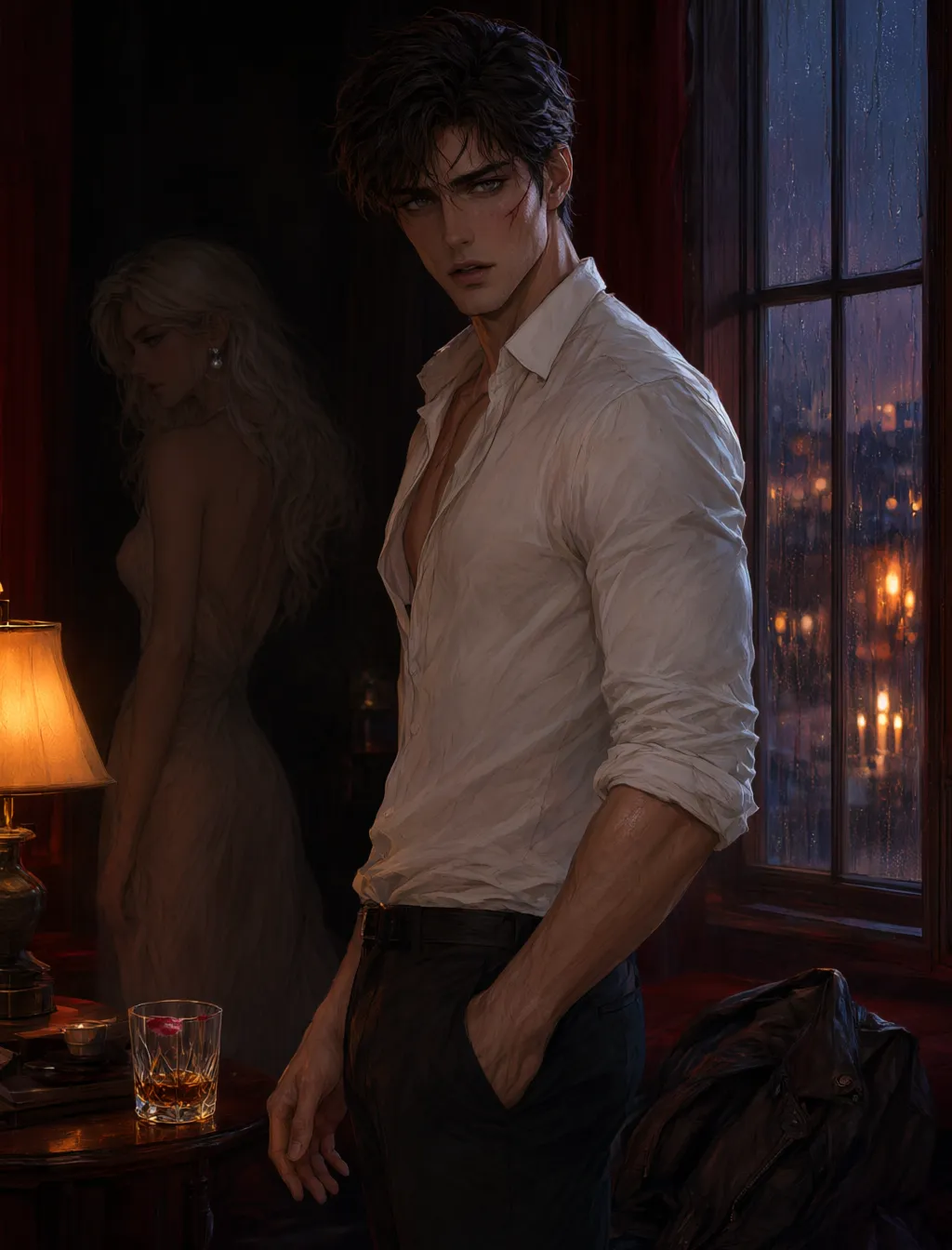
The door swung shut behind them with a sound like a held breath released, and the Erro Society's receiving hall opened up around Beck like a cathedral made of dust and late light.
The ceiling rose impossibly high, dark beams crossing in patterns he couldn't quite follow, and the afternoon sun slanted through the tall windows in long, golden sheets that caught the floating dust and turned it to slow, drifting stars. The floorboards beneath his boots were worn smooth in the center, years of footsteps worn into the grain like a river carving its bed. The air smelled of old paper and something sweeter underneath—like dried flowers pressed between the pages of a book no one had opened in decades.
Baby's hand tightened on his arm.
He felt it through the fabric of his jacket, her small fingers digging in with that nervous grip she'd had since she was a child, the one that meant she was trying very hard not to be overwhelmed and losing the fight. He looked down at her. Her brown eyes were wide, her lips parted, her head tilted back as she tried to take in the ceiling and the windows and the impossible height of it all at once.
"Is this really it?" she whispered.
Her voice was small in the vastness, swallowed by the high ceiling and the distant murmur of voices somewhere deeper in the building. Beck felt the question land in his chest like a stone. He'd asked himself the same thing when their mother had first told them where they were going. The Erro Society. A name that had meant nothing to him, a place that had been only a set of directions and a train ticket and a promise that here, at last, they would find what they'd been missing.
"Yeah," he said, and his voice came out rougher than he'd meant it to. "This is it."
He shifted the strap of his bag higher on his shoulder, feeling the familiar weight of it settle against his hip. The leather was worn soft from years of use, the buckle scratched and dull. He'd packed light—he always packed light now—but the bag still held everything he owned that mattered. A few changes of clothes. A book he'd been carrying for six years, the spine cracked, the pages soft. A photograph he never looked at but couldn't leave behind.
Baby let go of his arm and took a step forward, her sundress swaying around her calves as she moved into a shaft of light. The dust motes swirled around her, catching in her dark hair, and for a moment she looked like something out of a painting—a girl standing at the edge of a world she didn't understand yet, lit from above by a sun that didn't care how small she was.
"It's so quiet," she said, and her voice had lost some of its nervous edge, replaced by something softer. Wonder. "I thought it would be louder."
Beck followed her, his boots echoing on the floorboards. The sound was too loud in the stillness, each step a small announcement of his presence. He scanned the room without seeming to, the way their mother had taught him—eyes moving in slow, deliberate sweeps, cataloging exits, noting the positions of the few people scattered near the far walls, reading the room the way other people read a book.
It was a habit he'd never been able to break, even in places that didn't require it. Even in the six years since he'd left university, since he'd left everything behind, the vigilance had stayed. It was the only thing that had.
Baby stopped in the middle of a shaft of light and turned in a slow circle, her sundress flaring. "Beck, look at the windows."
He looked. The windows were tall and arched, set deep into the stone walls, and the glass was old—wavy in places, distorted, so that the world outside seemed to swim and bend when you looked through it. The sun caught the imperfections and turned them into prisms, casting faint rainbows across the floorboards.
"They're beautiful," Baby breathed.
They were. Beck couldn't argue with that. The whole place was beautiful in a way that felt ancient and deliberate, every surface worn smooth by the people who had passed through it before them. He could feel the weight of that history pressing down on him, the knowledge that he was standing in a place where so many others had stood before, that he was part of something larger than himself just by being here.
It was unsettling. He'd spent six years learning to stand alone, to need no one, to keep his head down and his heart locked away where it couldn't be touched. And now here he was, standing in a hall that felt like it was waiting for him, like it had been waiting for a long time.
Baby turned to him, her eyes bright. "Mom said there would be people here to help us. People who understand."
"She said a lot of things," Beck said, and the dryness in his voice made her laugh—a small, bright sound that cut through the stillness.
"You're such a pessimist."
"I'm a realist." He adjusted his bag again, feeling the familiar ache in his shoulder. "There's a difference."
"Is there?" Baby's grin was teasing, and for a moment she looked like the girl she'd been before everything, before their mother had started talking about the Erro Society, before the quiet tension had settled over their small apartment like a held breath. "Because from where I'm standing, they look an awful lot alike."
Beck felt the corner of his mouth twitch. "You're nineteen. You don't know what pessimism looks like yet."
"I know what it sounds like." She stepped closer, looping her arm through his. "It sounds like my big brother trying to pretend he's not just as nervous as I am."
He didn't answer. He couldn't. Because she was right, and they both knew it, and there was no point in lying to the one person in the world who could always see through him.
Baby leaned her head against his shoulder, the gesture so familiar it made his chest ache. "It's going to be okay, Beck."
"You don't know that."
"I know you." She squeezed his arm. "And I know that whatever happens, we're together. That's enough."
He wanted to believe her. He wanted to let himself sink into the warmth of her certainty, to believe that this place—this strange, ancient, beautiful place—could be what their mother had promised. A home. A family. A community of people who understood what they were becoming.
But he'd learned not to trust promises. He'd learned that lesson six years ago, in a dorm room that smelled like rain and cheap coffee, with a boy who'd looked at him like he was the only thing in the world that mattered.
He'd learned it the day he'd walked away.
Beck pulled in a slow breath, feeling the weight of the air in his lungs. The dust motes danced in the light, indifferent to his memories. The distant murmur of voices continued somewhere deeper in the building, a low, steady hum like the sound of a river moving underground.
"Come on," he said, and his voice was steadier now, the roughness smoothed over by habit. "We should find someone. Figure out where we're supposed to go."
Baby nodded, but she didn't let go of his arm, and he didn't pull away. They stood together in the shaft of light, two figures at the edge of a world they didn't understand yet, and Beck let himself feel the warmth of her presence, the solid reality of her at his side.
He'd spent six years learning to stand alone. But standing alone had never meant he wanted to.
Baby's head lifted, her eyes catching something across the room. "Beck," she said, her voice dropping to a whisper. "Who are those people?"
He followed her gaze. Near the far wall, half-shadowed by one of the tall windows, a small cluster of figures stood in quiet conversation. They were dressed simply, unremarkably, but there was something about them that set them apart—a stillness, a watchfulness, a way of holding themselves that suggested they were not quite as casual as they appeared.
Beck felt the familiar prickle at the back of his neck, the instinctive alertness that had kept him alive through six years of moving, of never staying long enough to put down roots. He scanned the figures, cataloging them, reading the angles of their bodies, the way they stood in relation to one another.
"I don't know," he said, keeping his voice low. "But I think we're about to find out."
One of the figures—a woman, tall and graceful, with pale hair that caught the light—turned toward them. Her head tilted, a small, curious movement, and even from across the room, Beck could feel the weight of her gaze.
She started walking toward them.
Baby's hand tightened on his arm. "She's coming over."
"I see that."
"What do we do?"
"We wait." Beck's voice was calm, steady, the voice he used when he needed to be the one in control. "We see what she wants."
The woman moved through the hall with an easy grace, her flowing dress catching the light as she walked. She was beautiful in a way that felt almost otherworldly—her platinum-blond hair falling in soft waves around her face, her grey eyes bright and perceptive, her head still tilted as she studied them.
She stopped a few feet away, close enough that Beck could see the faint smile playing at the corners of her mouth, the way her gaze moved between him and Baby with a gentle curiosity.
"Hello," she said, and her voice was warm, melodic. "I don't think I've seen you here before."
Beck felt Baby relax slightly beside him, the tension in her grip easing. "We just arrived," he said. "We're looking for—"
"The Erro Society," the woman finished, and her smile widened. "You've found it. I'm Octavia." She tilted her head again, studying Beck with an intensity that made him want to look away. "And you are…"
She trailed off, her brow furrowing slightly. Her gaze sharpened, and Beck felt a prickle of unease run down his spine.
"I'm Beck," he said. "This is my sister, Baby."
Octavia's eyes didn't move from his face. "Beck," she repeated, as if tasting the word. "You're familiar."
Beck's throat tightened. He'd spent six years learning how to answer questions without giving anything away, how to deflect and redirect and smile through the cracks. But there was something in Octavia's gaze that made those defenses feel flimsy, like paper held up against a storm.
"I don't think we've met," he said carefully, keeping his voice even. "We just got here."
"No," Octavia agreed, her head tilting further. "We haven't met. But you're familiar anyway." She said it with the same casual certainty she might use to describe the weather, and Beck felt the unease in his spine deepen. "It's strange. I have a good memory for faces, and yours—" She stopped, her brow furrowing again. "Yours is one I feel like I should know."
Baby glanced up at him, a question in her eyes. Beck gave a small shake of his head, a silent *don't worry about it* that he wasn't sure he believed himself.
"Maybe I just have one of those faces," he offered, and the dryness in his voice earned a small, puzzled smile from Octavia.
"Maybe." She didn't sound convinced. "Where are you from, Beck?"
The question was innocent enough, but Beck felt the weight of it settle between them. He could feel Baby's attention shift to him, her grip on his arm loosening as she waited for his answer.
"Everywhere," he said, which was true in the way that mattered. "We've been moving around for a while."
"And now you're here." Octavia's smile softened, losing some of its intensity. "Well, wherever you've come from, you're welcome. The Erro Society has a way of collecting people who need a place to land."
Baby's eyes lit up. "That's what our mom said."
"Your mom?" Octavia's gaze moved to Baby, and something in her expression shifted—a flicker of recognition that Beck couldn't quite read. "What's her name?"
"Jessica," Baby said, before Beck could stop her. "Jessica Beckett."
The name landed in the space between them, and Beck watched Octavia's face change. It was subtle—a tightening around her eyes, a brief stillness in her smile—but he caught it. He'd spent years learning to read people, and Octavia was suddenly very easy to read.
"Jessica," she repeated, and the word came out softer, almost wondering. "Wait here."
She turned before Beck could respond, her dress swirling around her ankles as she moved back across the hall with that same easy grace. Beck watched her go, his hand tightening on his bag strap, a cold knot forming in his stomach.
"Beck?" Baby's voice was small. "What was that about?"
"I don't know." He said it honestly, which made it worse. "I don't know."
They stood in the shaft of light, watching Octavia's pale head move through the crowd until she reached a figure near the far wall—a woman, taller than Octavia, with the same platinum hair cut in a sharp bob. She was dressed in a tailored suit, her posture rigid, her face turned toward something Beck couldn't see.
Octavia leaned in, speaking close to the woman's ear. Beck watched the woman's head turn, her gaze cutting across the room with an accuracy that made his skin prickle. She was looking at them. At him.
And then she was walking toward them, her heels clicking against the floorboards in a rhythm that felt like a countdown.
Baby pressed closer to his side. "Beck."
"I see her."
"What do we do?"
"We wait." The words came out steady, but Beck could feel his pulse in his throat, a steady drumbeat that matched the click of her heels. "We see what she wants."
The woman stopped a few feet away, her grey eyes sweeping over them both with a cold, assessing precision. Up close, she was striking in a way that had nothing to do with softness—her features sharp, her jaw set, her gaze carrying the weight of someone who had spent a lifetime learning to hide everything she felt.
"Jessica," she said, and the name came out like a verdict. "Where is she?"
Beck felt the question land in his chest. "She's not here," he said. "It's just us."
The woman's eyes narrowed. "Just you."
"Me and my sister." Beck met her gaze, refusing to look away. "Our mother sent us. She said we'd find help here."
The silence stretched between them, long enough that Beck could hear the dust settling in the light. The woman studied him with an intensity that made Octavia's earlier gaze feel like a warm embrace, her grey eyes moving over his face as if she were reading a language written in his bones.
"Aurora," a voice said from behind them, and Beck felt the world tilt.
He knew that voice. He had known it for six years, had heard it in his dreams and in the quiet moments before sleep, had replayed its cadence so many times that it had become a part of him, a scar he couldn't stop touching.
Aurora's gaze lifted, and her expression shifted—a crack in the ice that Beck couldn't quite name. "Christopher."
Beck turned.
The man standing at the edge of the room was broader than he remembered, his shoulders carrying a weight that hadn't been there at twenty, his brown hair cropped short, his jaw sharp and hard. He was wearing a leather jacket that Beck had never seen before, and there was a faint scar above his brow that hadn't been there six years ago.
But the eyes. The eyes were the same.
Dark brown, intense, fixed on Beck with an intensity that made the air leave his lungs.
Topher took a step forward, and the sound of his boots on the floorboards was deafening in the sudden stillness. His gaze never left Beck's face, and Beck felt himself frozen in place, his hand still tight on his bag strap, his heart pounding so hard he could feel it in his teeth.
Topher stopped a few feet away, close enough that Beck could see the way his jaw worked, the muscle jumping beneath the skin. His voice, when it came, was low and rough, scraped raw by years of silence.
"Where were you?"
The words hit Beck like a hand closing around his throat. Six years of rehearsed answers, of carefully constructed walls, of lies he'd told himself so many times they'd almost become true—all of it evaporated in the space between one heartbeat and the next. He opened his mouth, but nothing came out. The dust motes continued their slow dance in the shaft of light, indifferent to the fact that his entire world had just tilted on its axis.
Topher's jaw worked again, that muscle jumping beneath the skin, and Beck watched him take in the changes the way he'd just taken in Topher's—the new breadth of his shoulders, the scar above his brow, the way his eyes had lost something soft and gained something harder. But underneath all of it, the same man. The same man who'd once held Beck's face in his hands and promised him forever in a dorm room that smelled like rain and cheap coffee.
"Beck." Baby's voice came from somewhere far away, a thread of concern woven through the word. "Beck, who is this?"
The question broke the spell. Beck blinked, and the world rushed back in—the high ceiling, the worn floorboards, the weight of his bag still cutting into his shoulder. He could feel Baby's hand on his arm, her fingers digging in with that nervous grip, and he realized he'd been standing there in silence for too long, staring at a ghost made flesh.
"This is—" Beck started, and his voice cracked on the first word. He cleared his throat, tried again. "This is Christopher. Christopher Jacobs."
He didn't say *Topher*. He couldn't. That name belonged to a different time, a different version of both of them, a boy who'd laughed easily and loved recklessly and believed in things like forever. The man standing in front of him now was not that boy. But the eyes—the eyes were the same.
"Christopher," Baby repeated, and Beck could hear her trying to place the name, to understand why her brother was looking at this stranger like he'd just seen a ghost. "How do you two know each other?"
The question hung in the air between them, and Beck felt the weight of it pressing down on his chest. He could feel Topher's gaze on him, dark and intent, waiting for an answer that Beck didn't know how to give. Six years. Six years of silence, of unanswered questions, of a wound that had never quite healed—and now here they were, standing in a hall full of dust and late light, and Beck had no idea what to say.
"We went to university together," Beck said finally, and the words felt inadequate, too small to hold the weight of what they'd been to each other. "A long time ago."
"Six years," Topher said, and his voice was still rough, still scraped raw. "Six years ago."
The correction landed like a stone in still water, sending ripples through the silence. Baby's head turned, her brown eyes moving between them with a dawning understanding that made Beck's stomach clench. She'd always been too perceptive for her own good.
"Oh," she said softly, and the single syllable carried more weight than Beck wanted to acknowledge.
Aurora cleared her throat, and Beck had almost forgotten she was there. The woman stood with her arms crossed, her grey eyes sharp as she watched the three of them with an expression Beck couldn't quite read. "Christopher," she said, and her voice was clipped, precise. "I wasn't aware you knew the Becketts."
"I didn't know they were Becketts," Topher said, and his gaze never left Beck's face. "I didn't know they were coming here at all."
There was something in his voice—an edge, a rawness—that made Beck's breath catch. He wanted to ask what it meant, wanted to demand answers to the questions that had haunted him for six years, but the words wouldn't come. They were lodged somewhere in his throat, buried beneath the weight of everything he'd never said.
"Beck." Topher's voice was softer now, almost gentle, and the sound of it made Beck's chest ache. "Can we talk? Alone?"
Beck felt Baby's hand tighten on his arm, a silent question. He looked down at her, saw the concern in her brown eyes, the way she was biting her lip the way she always did when she was worried. He wanted to tell her it was fine, that everything was fine, that he didn't need her to worry about him. But he couldn't make himself say the words.
"It's okay," he said instead, and he wasn't sure if he was saying it to her or to himself. "I'll be fine."
Baby didn't look convinced, but she let go of his arm, stepping back to give him space. Aurora moved too, her hand coming to rest on Baby's shoulder with a surprising gentleness. "Come," she said to Baby, her voice softening slightly. "Let's give them a moment."
Beck watched them go, watched Baby look back over her shoulder one last time before disappearing through an archway at the far end of the hall. And then it was just the two of them, standing in the shaft of late afternoon light, the dust motes swirling around them like slow, silent witnesses.
Topher took a step closer, and Beck felt his breath catch. He could smell him now—leather and something else, something warm and familiar that made his chest ache with a longing he'd spent six years trying to bury.
"You look good," Topher said, and his voice was rough, almost reverent. "You look—" He stopped, shook his head. "I don't know what I expected. But you look good."
Beck felt the corner of his mouth twitch, a ghost of the dry humor that had always been his defense mechanism. "You look like you've been through a war."
"Something like that." Topher's gaze moved over Beck's face, cataloging the changes the way Beck had cataloged his. The faint scar on his jaw. The new hardness in his features. "You've been taking care of yourself."
"I've been taking care of my sister." Beck's voice came out steadier than he felt. "Someone had to."
The words hung in the air between them, heavy with meaning. Topher's jaw tightened, and Beck saw something flicker in his eyes—guilt, maybe, or regret. The same look Beck had seen in his own mirror a thousand times over the past six years.
"Beck," Topher said, and his voice cracked on the name. "I—"
"Don't." Beck held up a hand, stopping him. "Don't. I can't—" He stopped, swallowed hard. "I can't do this right now. I just got here. My sister is somewhere in this building, and I don't even know where we're supposed to sleep tonight. I can't—"
He stopped again, the words dying in his throat. He could feel the tears building behind his eyes, the pressure of six years of suppressed grief and longing and anger all threatening to break through the carefully constructed walls he'd built around his heart.
Topher's hand reached out, and Beck felt the touch of his fingers against his wrist—a light, tentative contact, as if Topher was afraid he might shatter. "Beck. Please. Just—give me five minutes. That's all I'm asking."
Beck looked down at the hand on his wrist, at the familiar shape of those fingers, the way they curled around his skin like they remembered the shape of him. He'd dreamed about this moment for six years—imagined what he'd say, what he'd do, how he'd demand answers and explanations and apologies. But now that it was here, all he could feel was the ache of a wound that had never quite closed.
"Five minutes," he said, and his voice was barely a whisper. "That's all."
Topher nodded, and Beck felt the tension in his shoulders ease slightly—not gone, but lessened, like a storm that had finally started to break. He let go of Beck's wrist, but he didn't step back, didn't put distance between them. He just stood there, in the shaft of late afternoon light, looking at Beck like he was the only thing in the world that mattered.
"There's a room," Topher said, his voice low. "Down the hall. It's quiet. We can talk there."
Beck nodded, not trusting his voice. He followed Topher across the hall, his boots echoing on the worn floorboards, the dust motes swirling in their wake. He could feel the weight of the place pressing down on him—the history, the silence, the sense that he was walking into something he didn't fully understand.
But more than that, he could feel the weight of Topher's presence beside him, the familiar shape of him after all these years, and he didn't know if that was a comfort or a threat.
They passed through an archway and down a narrow corridor, the light dimming as the tall windows gave way to smaller, darker ones. Topher stopped at a door near the end of the hall, pushing it open to reveal a small room with a single window and a worn wooden table in the center. The light here was softer, grayer, filtering through dusty glass that hadn't been cleaned in years.
Beck stepped inside, and the door clicked shut behind him.
They stood on opposite sides of the table, the worn wood between them like a boundary neither was willing to cross. Topher's hands were at his sides, his fingers curling and uncurling in a gesture Beck remembered—the way Topher always fidgeted when he was nervous, when he didn't know what to say.
"Six years," Topher said finally, and his voice was rough, scraped raw. "Six years, Beck. I looked for you. I looked everywhere."
Beck felt the words land in his chest like stones. "I know."
"I thought you were dead." Topher's voice cracked on the word, and Beck saw the flash of pain in his eyes. "I thought—I don't know what I thought. But I never stopped looking."
Beck swallowed hard. He'd known, somehow, that Topher would have looked. He'd known it in the same way he'd known that leaving was the only thing he could do, the only way to protect the people he loved from the danger that followed him like a shadow.
"I'm sorry," Beck said, and the words felt inadequate, too small to hold the weight of six years of silence. "I should have—"
"Should have what?" Topher's voice was sharp now, cutting through the dusty air. "Should have told me where you were going? Should have let me come with you?" He took a step forward, his hands coming down on the table with a thud that made Beck flinch. "I would have followed you anywhere, Beck. Anywhere. You know that."
The words hung in the air between them, heavy with meaning. Beck felt the tears building behind his eyes again, the pressure of everything he'd never said threatening to break through.
"I know," he said, and his voice was barely a whisper. "That's why I couldn't let you."
The words landed between them like a stone dropped into deep water, and the silence that followed was so complete Beck could hear the dust settling in the light. Topher's hands were still flat on the table, his weight leaning into them, and Beck watched the muscle in his jaw jump again—that same tell, the one that had always meant Topher was holding something back.
"You couldn't let me," Topher repeated, and the words came out slow, like he was tasting each one. "You left because you couldn't let me follow."
Beck nodded, not trusting his voice.
"What were you running from, Beck?"
The question was soft, almost gentle, but it hit Beck like a hand closing around his throat. He'd spent six years building the walls around that answer, layering them with silence and distance and the careful art of never staying long enough for anyone to ask. And now Topher was standing three feet away, looking at him with those dark eyes that had always seen through everything, and Beck could feel the walls starting to crack.
"I can't—" He stopped, swallowed. "I can't tell you that."
"Can't or won't?"
"Does it matter?"
"It matters to me." Topher's voice was rough, scraped raw. "It's mattered to me for six years."
Beck felt the tears building behind his eyes again, that familiar pressure he'd spent so long learning to suppress. He looked away, fixing his gaze on the worn surface of the table, tracing the grain with his eyes like it might offer some kind of answer. The wood was scarred and pitted, years of hands and cups and secrets worn into its surface.
"You look at me," Topher said, and his voice had dropped, gone quiet and careful. "Please. Just look at me."
Beck didn't want to. He knew that if he looked, the walls would crumble completely, and he'd spent six years building them. But Topher's voice was the same voice that had once talked him down from every ledge, that had whispered promises into his skin in the dark, that had said his name like it was something precious. And Beck had never been able to deny that voice anything.
He looked up.
Topher had moved around the table without Beck hearing him, and now he was close—close enough that Beck could see the faint scar above his brow up close, the way it cut through the dark arch of his eyebrow. His eyes were wet, Beck realized with a jolt. Topher's eyes were wet, and he was looking at Beck like he was seeing something he'd spent six years praying to find.
"There you are," Topher breathed, and the words were barely a whisper, barely a sound at all.
Beck felt his breath catch. He opened his mouth to say something—he didn't know what, anything, a deflection, a joke, a question—but before he could form the words, Topher's hand was moving.
Slow. So slow Beck could have stopped it if he'd wanted to. Could have stepped back, could have turned away, could have done any of the things he'd trained himself to do over six years of running. But he didn't. He stood frozen, watching Topher's hand rise, watching those familiar fingers reach for his face like they were reaching for something sacred.
Topher's palm cupped his jaw.
The touch was light, barely there, but Beck felt it like a current running through his entire body. Topher's hand was bigger than he remembered, rougher, calloused in ways it hadn't been at twenty. But the gentleness was the same. That careful, reverent gentleness that had always made Beck feel like he was something fragile and precious, like Topher was afraid he might break.
"God," Topher whispered, his thumb tracing the line of Beck's jaw, the faint scar that had never quite faded. "God, it's good to see you, beautiful."
The word hit Beck like a physical blow. *Beautiful.* Topher had called him that a thousand times in their year together, murmured it into his skin and his hair and the space between his shoulder blades. Beck had spent six years trying to forget the sound of it, and now it was here, in this dusty room, falling from Topher's lips like it had never stopped being true.
Beck's eyes closed.
He didn't mean to. It just happened, his lids falling shut as the weight of everything pressed down on him. He could feel Topher's palm against his jaw, the warmth of it seeping into his skin, and he let himself lean into it. Just for a moment. Just for one breath. He let himself remember what it felt like to be held by someone who loved him.
His breath hitched.
It was a small sound, barely audible, but Topher heard it. Beck felt the other man's hand shift, his fingers sliding into Beck's hair, the touch so familiar it made his chest ache. Six years. Six years of silence and distance and running, and here they were, standing in a dusty room in a place Beck had never heard of until a week ago, and Topher was holding his face like he'd never let go.
"I looked for you," Topher said, and his voice was cracked, raw. "I looked everywhere. I thought—" He stopped, swallowed. "I thought you were dead."
Beck felt the tear slip down his cheek before he could stop it. It traced a hot path over his skin, and he felt Topher's thumb catch it, wiping it away with a tenderness that made it worse.
"I'm sorry," Beck whispered, and his voice broke on the words. "I'm so sorry."
"Don't." Topher's other hand came up, cupping Beck's face in both palms, tilting it up so Beck had no choice but to open his eyes and meet his gaze. "Don't apologize. Just—" He stopped, his jaw working. "Just tell me you're here now. Tell me you're not going to disappear again."
Beck looked at him. At the scar above his brow, the new hardness in his features, the way his shoulders carried a weight that hadn't been there at twenty. But underneath all of it, the same eyes. The same eyes that had looked at Beck like he was the only thing in the world that mattered, that had promised him forever in a dorm room that smelled like rain and cheap coffee.
The words wouldn't come. Beck stood in the circle of Topher's hands, feeling the heat of those palms against his cheeks, and the answer to that question sat in his throat like a stone he couldn't swallow. He wanted to promise. God, he wanted to. Six years of wanting to say the words and here they were, finally within reach, and his tongue had turned to lead.
Topher's thumbs moved, sweeping across his cheekbones, and Beck felt the tremor in them. That was new. Topher had never trembled. At twenty, he'd been all easy confidence and steady hands, the kind of certainty that made Beck believe anything was possible. But this Topher shook, just barely, like he was holding something too heavy to carry alone.
"I can't promise you that," Beck heard himself say, and the words came out wrong, too honest, too raw. "I can't—I don't know if I can keep it."
Topher's hands stilled. The silence between them stretched, and Beck watched something shutter behind those dark eyes, a door closing that had just been pried open.
"Why not?" The question was quiet. Careful. The voice Topher used when he was trying not to break something.
"Because I don't know what's waiting for me out there." Beck's hands came up, closing around Topher's wrists, and he felt the pulse hammering there, fast and alive. "I don't know what followed me here. If anything did."
"Then stay." Topher said it simply, like it was the easiest thing in the world. "Stay here. With us. Whatever's out there—" He shook his head, a small, fierce motion. "It doesn't get to have you anymore."
Beck's breath caught. The certainty in Topher's voice was the same certainty that had once convinced Beck to skip class and drive three hours to see the ocean, that had talked him into jumping off a bridge into water that turned out to be freezing, that had made him believe, for one perfect year, that he could have a future that wasn't running.
"It's not that simple," Beck said, but his voice had gone soft, and he could feel himself leaning into Topher's hands, his body betraying every wall he'd built.
"It is." Topher's grip tightened, just a fraction. "It's exactly that simple. You stay. I keep you safe. We figure out the rest together."
Beck wanted to believe him. He wanted to let himself sink into the promise, to be held by it the way Topher's hands were holding his face. But there was a voice in the back of his head, the same voice that had been whispering warnings for six years, telling him that staying meant putting Topher in the crosshairs. That the danger Beck had fled wasn't a thing you outran—it was a thing you carried, and anyone who got close enough got burned.
"You don't know what you're asking for," Beck whispered.
"I don't care." Topher's jaw was set, that stubborn line Beck remembered from a hundred arguments about nothing. "I've spent six years not knowing where you were, not knowing if you were alive. You think I'm going to let you walk out of this room because you're scared of something I can't even see?"
"You should be scared."
"I'm not."
"Topher—"
"I'm not," Topher repeated, and his voice cracked on the words. "I'm not scared of whatever's out there. I'm scared of you leaving again. I'm scared of waking up tomorrow and finding out this was a dream, that I imagined you standing here, that I'm still in that room in Athens, staring at a phone that never rings."
The confession landed hard. Beck felt it in his chest, a pressure that made it hard to breathe. Athens. They'd been in Athens when it happened, when Beck had disappeared without a word. He'd left Topher sleeping in a hostel bed, tangled in sheets that smelled like both of them, and he'd walked out into a pre-dawn city and never looked back. He'd told himself it was the only way. He'd told himself a thousand times, in a thousand different rooms, that leaving was the kindest thing he could do.
He'd never once believed it.
"I'm here now," Beck said, and his voice was barely there. "I'm here."
Topher's breath shuddered out of him, and Beck felt the other man's forehead drop against his, a clumsy, desperate gesture that sent a jolt through him. They stood like that, foreheads touching, Topher's hands still cupping Beck's face, and Beck could feel the warmth of Topher's breath on his lips, could smell the same soap he'd always used, something clean and simple that Beck had spent years trying to forget.
"I used to dream about this," Topher murmured, his voice rough. "Finding you. Touching you. I'd tell myself it was enough, just to see you once more. Just to know you were alive." His thumb traced the line of Beck's jaw again, slow and reverent. "And now you're here, and it's not enough. It's not close to enough."
Beck's eyes fluttered. He knew he should pull away. He knew that every second he stayed in this room, in these hands, was a second he was risking everything. But Topher was warm and solid and real, and Beck had been cold for six years.
"What do you want from me?" Beck asked, and the question came out smaller than he meant it to, almost childlike.
Topher's eyes searched his, dark and intent. "Everything."
The word hung between them, heavy and impossible. Beck felt his heart stutter, felt the walls he'd spent six years building start to crumble at the edges.
"I can't—"
"You can." Topher's hands slid from Beck's face, trailing down his arms, and Beck felt the loss of contact like a physical ache. But then Topher's fingers found his, threading through them, holding on. "You can, Beck. You just have to decide you're done running."
Beck looked down at their joined hands. Topher's fingers were rough, calloused from work Beck didn't know about, from years Beck hadn't been there to see. But they were wrapped around his, steady and sure, and Beck could feel the pulse in Topher's wrist against his own, two heartbeats finding a rhythm.
"What if I don't know how?" Beck whispered.
"Then I'll teach you." Topher's voice was soft, almost tender. "I'll teach you how to stay."
Beck felt the tear slip down his cheek before he could stop it, and this time Topher didn't wipe it away. He just held Beck's hand tighter, letting it fall, letting it be real.
Somewhere in the building, a door opened and closed. Voices drifted through the walls, distant and muffled. The real world was still out there, waiting. The danger Beck had fled was still a shadow at the edge of everything. But right now, in this dusty room with Topher's hand in his, Beck let himself pretend, just for a moment, that staying was possible.
"I don't even know where to start," Beck said, and his voice was steadier than he expected.
"Start with me." Topher squeezed his hand. "Start with tonight. We don't have to figure everything out at once."
Beck looked at him. At the hope flickering in those dark eyes, fragile and fierce. At the man he'd loved and left and never stopped aching for. And he felt something shift in his chest, a crack in the armor he'd worn so long he'd forgotten it was there.
"Okay," Beck said, and the word felt like stepping off a ledge.
Topher's breath caught. "Okay?"
"Okay." Beck nodded, and the motion sent another tear falling, but he didn't try to hide it this time. "I'll stay. For tonight, at least. I'll stay."
Topher's face broke open, a smile so bright and unguarded it made Beck's chest ache. He pulled Beck forward, wrapping his arms around him, and Beck went willingly, burying his face in the crook of Topher's neck, breathing him in. He smelled the same. He felt different—broader, harder—but he smelled the same, and Beck let himself be held, let himself be wrapped in the warmth of someone who had never stopped loving him.
"Thank you," Topher murmured into his hair. "Thank you for coming back."
Beck didn't answer. He just held on, his fingers curling into the fabric of Topher's jacket, and let himself believe, for one fragile moment, that he could have this. That he could have him.
The sun was lower now, the light through the tall windows gone amber and gold, painting the room in warmth. Beck felt it on his skin, felt Topher's arms around him, and for the first time in six years, he didn't feel like he was running.
He didn't know what tomorrow would bring. He didn't know what the danger that had driven him away would do when it found him here. But right now, in this moment, with Topher's heartbeat against his ear and the dust settling in the golden light, Beck let himself stay.
Beck held the warmth of the embrace for another long moment before he let himself pull back, just enough to see Topher's face. The amber light caught the scar on his brow, the hard line of his jaw, the way his eyes still hadn't let go of Beck's. Six years of questions lived in that gaze, but Beck had one of his own now, one that had been scratching at the back of his mind since the moment he'd walked into the hall and seen Octavia's face, seen the way she'd tilted her head at him like she was reading a language he didn't know he was speaking.
"Topher." Beck's voice came out steadier than he felt. "The woman in the hall. Octavia's mother." He watched Topher's expression, looking for the flicker he knew would come. "You know her."
It wasn't a question. It came out flat and certain, a statement born from the way Topher had gone still against him, the way the heartbeat under his palm had changed rhythm.
Topher's hands were still wrapped around his, rough and warm, but Beck felt the grip tighten, felt the small shift in his posture like a door closing somewhere deep inside him.
"Aurora." Topher said the name like it cost him something. "Yeah. I know her."
Beck waited. The silence stretched between them, filled with the distant sounds of the building settling, the creak of old wood, the muffled murmur of voices somewhere beyond the walls.
"How?" Beck asked, and the word was softer than he meant it to be, almost careful, like he was afraid of what the answer might break.
Topher's eyes dropped to their joined hands. He stared at them for a long moment, his thumb tracing a slow arc across Beck's knuckles, and Beck could feel the weight of whatever he was deciding, could feel it in the tension running through Topher's shoulders.
"She's my aunt," Topher said finally, and the words landed like stones in still water. "My mother's sister. I've been living here for two years."
The room seemed to tilt. Beck felt it in his chest, a strange hollow opening up beneath his ribs. Two years. Topher had been here, in this place, the same place Beck's mother had sent him, the same place where a woman with platinum hair and calculating grey eyes had looked at Beck like she recognized him without ever having met him.
"Two years," Beck repeated, and he heard the way his voice had gone thin, heard the edge of something he didn't want to name creeping in.
"Two years." Topher's jaw was set, that stubborn line Beck remembered. "I came here looking for answers. Looking for—" He stopped, shook his head. "I didn't expect to find you walking through that door."
"You never told me." Beck heard the accusation in his own voice, felt it rising like bile. "You never told me you had family here. You never told me about any of this."
"I didn't know." Topher's grip tightened, almost desperate. "I didn't know about Aurora, about the Erro Society, any of it. I found out after—" He stopped again, and Beck saw something flicker across his face, something raw and quickly buried. "After you left. I was looking for you. I was looking everywhere, and someone mentioned this place, mentioned that people came here when they needed to disappear."
The words hit Beck like a physical blow. He felt them land, felt the weight of them settle into his chest, and for a moment he couldn't breathe.
"You were looking for me," Beck said, and it came out smaller than he meant it to, almost childlike.
"I never stopped." Topher's voice cracked on the words. "I never stopped looking, Beck. I tore apart Athens looking for you. I went back to the university, I talked to everyone we ever knew, I—" He broke off, his throat working. "I thought you were dead. I thought something had happened to you, that someone had—"
"I'm not dead." Beck said it quickly, the words tumbling out before he could stop them. "I'm here. I'm alive."
"I know." Topher's hand came up, cupping Beck's face again, and Beck felt the warmth of his palm against his cheek, felt the slight tremor in his fingers. "I know you're here. I just—" He let out a breath, something that was almost a laugh. "I keep expecting to wake up."
Beck leaned into the touch before he could stop himself, his eyes closing for just a moment. The feel of Topher's hand on his face was familiar and foreign all at once, the same gesture from six years ago but weighted now with all the years between them.
"Aurora," Beck said again, pulling himself back to the thread of it. "She recognized my mother. She knew her name."
Topher's expression shifted, something guarded sliding into place. "Jessica Beckett." He said the name carefully, like he was testing it. "She's the one who sent you here."
"Yes." Beck opened his eyes, met Topher's gaze. "She told us this was where we needed to be. She didn't tell us why. She didn't tell us anything."
Topher was quiet for a long moment. Beck could see him thinking, could see the calculations happening behind those dark eyes, the same way Topher had always gotten quiet when he was trying to figure out how to say something difficult.
"Aurora and your mother," Topher said slowly, "they have history. I don't know all of it. I don't think anyone does." He paused, his thumb tracing the line of Beck's jaw again, almost absently. "But I know Aurora's been looking for her. For years, Beck. She never said why, but I know she's been looking."
The words settled into Beck's chest like cold water. He thought of his mother's face, the way she'd hugged him goodbye at the bus station, the way she'd pressed something into his palm and told him not to open it until he was inside the Erro Society's gates. He thought of the letter still tucked in his jacket pocket, unopened, waiting.
"She gave me something," Beck said, and he heard his own voice as if from a distance. "Before we left. She said to open it when we got here."
Topher's eyes sharpened. "What is it?"
"I don't know." Beck reached into his jacket, felt the folded paper there, worn at the edges from being handled and re-folded a dozen times on the journey. "I haven't opened it yet."
He pulled it out, held it between them. The envelope was plain, unmarked, sealed with a single drop of wax the color of dried blood. Beck had stared at it for hours on the bus, turning it over in his hands, trying to guess what his mother could have written that she couldn't just say to his face.
"Are you going to open it?" Topher asked, and there was something careful in his voice, something that made Beck look up at him.
"I don't know." Beck turned the envelope over in his hands. "I'm afraid of what it says."
"Beck." Topher's hand found his again, warm and steady. "Whatever it says, you're not alone anymore. You understand that, right? You're not alone."
Beck looked at him. At the man who had spent two years in this place, looking for answers, looking for Beck. At the man who had never stopped searching, even when Beck had given him every reason to give up.
"Why?" Beck asked, and the question came out raw, torn from somewhere deep in his chest. "Why did you keep looking? I left you. I disappeared without a word. I didn't call, I didn't write, I didn't—" He stopped, his throat closing. "Why?"
Topher's hand tightened around his. "Because I loved you." The words were simple, direct, the same way Topher had always said things that mattered. "Because I never stopped loving you, even when I thought you were dead, even when I thought you'd chosen to leave me. I couldn't stop. I didn't want to stop."
Beck felt the tears prick at his eyes again, felt the sting of them, and he didn't try to hold them back this time. He let them fall, let them trace hot paths down his cheeks, and he saw Topher's expression soften, saw the way his eyes went gentle in a way they hadn't been for anyone else.
"I'm sorry," Beck whispered. "I'm so sorry, Topher. I should have—"
"Don't." Topher's thumb caught a tear at the corner of Beck's eye, wiping it away. "Don't apologize. Not yet. We have time for that later. Right now, I just want you here."
Beck nodded, not trusting his voice. He looked down at the envelope in his hand, at the wax seal that his mother had pressed her thumb into, leaving a faint ridge in the blood-red surface.
"She knew," Beck said quietly. "My mother. She knew you'd be here."
Topher went still. "What do you mean?"
"She must have." Beck's mind was racing, pieces clicking into place. "She sent me here. She told me this was where I needed to be. She knew Aurora, she knew—" He looked up at Topher, a new understanding dawning. "She knew you'd be here. She sent me to you."
Topher's face went through a series of expressions Beck couldn't quite track—surprise, confusion, something that looked almost like fear.
"Why would she do that?" Topher asked, and his voice was rough. "Why would she send you back to me after all this time?"
Beck shook his head slowly. "I don't know. But I think—" He looked down at the envelope again, at the wax seal that seemed to pulse in the amber light. "I think this might tell us."
Topher's hand found his, covering the envelope, warm and steady. "Then open it."
Beck looked at him, at the certainty in those dark eyes, at the way Topher was looking at him like he was the only thing in the room that mattered. And he felt something shift in his chest, the same crack in his armor from before, widening just a little more.
"Will you stay?" Beck asked, and the question was small and vulnerable and terrified. "While I open it?"
Topher's smile was soft, almost tender. "I'm not going anywhere, beautiful. Not ever again."
Beck felt the words settle into him, felt the warmth of them spread through his chest. He looked down at the envelope one more time, took a breath, and broke the seal.
The wax gave way with a soft, dry crack, the sound of something old finally surrendering. Beck's fingers were unsteady as he worked the flap open, the paper inside stiff with age, folded into precise thirds the way his mother folded everything—bills, letters, grocery lists, all of them treated with the same quiet ceremony.
He pulled it out. One page. The handwriting was his mother's, familiar and slanting, the ink slightly smudged at the edges like she'd written it in a hurry or pressed too hard. Beck's eyes found the first line and stopped there, the words blurring for a moment before they came into focus.
My dearest TJ,
She only called him TJ when she was afraid. He'd learned that years ago, the way other children learned their mothers' tells. When she used his full name, it meant she was angry. When she used TJ, it meant she was scared, scared enough that she couldn't bring herself to use the nickname she'd given him as a boy.
"What does it say?" Topher's voice was low, careful, not pushing.
Beck shook his head, not ready to speak the words out loud yet. He read on, his eyes moving down the page, and he felt the room grow quieter around him, felt the amber light shift as the afternoon deepened beyond the windows.
By the time you read this, you'll be inside the Erro Society, and you'll have questions I couldn't answer to your face. I'm sorry for that. I've been sorry for a lot of things, and I've never been good at saying them out loud.
The paper trembled in his grip. Beck felt Topher's hand settle on his shoulder, warm and solid, grounding him without saying a word.
I knew Christopher would be there. I've known for two years. I sent you to him because I couldn't keep you safe anymore, and I couldn't keep you from him either. That was never my right.
Beck's breath caught. He read the line again, and again, the words rearranging themselves in his mind like pieces of a puzzle he hadn't known he was holding.
There are things about your father, about my family, about the reasons I left—things I should have told you years ago. Aurora knows some of them. She knows more than I'd like. But she's not your enemy, TJ. She's not your friend either. She's something else entirely, and you'll need to decide for yourself what that means.
Beck felt Topher's hand tighten on his shoulder. He looked up, met those dark eyes, and saw the question there, the same question that was forming in his own chest.
"She knew," Beck said, and his voice came out rough. "My mother knew you'd be here. She knew about Aurora. She knew—" He stopped, the letter still clutched in his hand. "She knew everything."
Topher's jaw worked. He looked at the letter, at the single page, at the words Beck had read but not yet shared. "What else does it say?"
Beck looked back down at the page. The final paragraph was shorter than the rest, the handwriting slightly more hurried, like his mother had been running out of time or courage.
I'm not coming back, TJ. Not for a while. Maybe not ever. But I needed you to be somewhere safe, somewhere with people who would find you, and I needed you to be with Christopher. Not because he can protect you, though he will. Because he's the only person who ever made you laugh the way you used to.
The last line was almost an afterthought, written smaller, squeezed into the bottom corner of the page.
Don't be angry with me. I did what I had to. I always did what I had to.
Beck lowered the letter. The words sat in his chest like stones, heavy and immovable. He thought of his mother's face at the bus station, the way she'd hugged him goodbye, the way she'd pressed the envelope into his palm like it was the most important thing she'd ever given him.
"She's not coming back," Beck said, and the words came out flat, empty. "She's not coming back, Topher."
Topher's hand found his, lacing their fingers together. "Then we go find her."
Beck looked up at him, at the certainty in those dark eyes, at the way Topher was looking at him like he was the only thing in the room that mattered. And he felt something shift in his chest, the same crack in his armor from before, widening just a little more.
"Okay," Beck said, and the word was small and vulnerable and terrified. "Okay."
Topher's hand was still on his shoulder, warm and solid, but something in the way he held himself had shifted. The quiet intensity in his dark eyes had sharpened into something else—a focus that made Beck feel like he was being read, every line of him, every secret he'd tried to bury.
"Okay," Topher repeated, the word soft, almost gentle. Then he tilted his head, a gesture Beck remembered from a hundred late-night conversations in a cramped dorm room, the way Topher would circle a thing before he said it out loud. "Now tell me what you were running from."
Beck's hand tightened on the letter. The paper crackled, the sound loud in the quiet of the hall. He could feel the words his mother had written pressing up against him, the weight of them, the way they'd rearranged everything he thought he knew.
"I don't—" he started, and stopped. The lie was right there, familiar as his own reflection. He'd told it so many times over the last six years that it had worn grooves into his tongue. I wasn't running from anything. I just had to go. It wasn't about you.
But Topher was looking at him with those dark eyes, patient and unblinking, the same way he'd looked at Beck that first night in the library, when Beck had been drowning in a philosophy paper and Topher had slid into the chair across from him and said, "You look like you're fighting a war in there."
Beck had told him everything that night. He hadn't meant to. It had just come out, the way things always came out around Topher, like Topher had a key to a door Beck didn't even know he'd locked.
"I was running from something," Beck said finally, and the words felt like they were being pulled out of him, one by one, each one leaving a mark. "I've been running for six years. I just—" He stopped, his throat closing. "I didn't know how to stop."
Topher was quiet for a long moment. The amber light from the windows caught the faint scar on his brow, the one he'd had since before Beck knew him, the one Beck had traced with his thumb a hundred times in the dark.
"What was it?" Topher asked. His voice was low, careful, like he was approaching something wounded. "What were you running from?"
Beck looked down at the letter in his hands. His mother's handwriting, slanting and familiar. She only called him TJ when she was afraid. She'd been afraid when she wrote this. Afraid enough to send him away, to send him here, to send him to Topher.
"I don't know," Beck said, and the admission felt like a wound opening. "That's the worst part. I don't know. I've been running for six years, and I don't know what I was running from."
Topher's hand moved, sliding from Beck's shoulder to the back of his neck, a warm, grounding weight. "Start at the beginning," he said. "The night you left. What happened?"
Beck closed his eyes. The memory was there, waiting for him, the way it always was. He'd been twenty years old, in love for the first time, stupid with it, convinced that nothing could touch them. And then his mother had shown up at his apartment with a look on her face he'd never seen before, a look that had made his blood go cold.
"My mother came to see me," Beck said. "The night before I left. She was—" He stopped, searching for the word. "She was terrified. I'd never seen her like that. She wouldn't tell me what was wrong, wouldn't tell me anything. She just said I had to leave. That I had to go somewhere no one would find me, and I couldn't tell anyone where I was going. Not even you."
The last words came out rough, scraped raw. Beck opened his eyes, met Topher's gaze, and saw something flicker there—hurt, old and deep, quickly buried.
"I tried to call you," Topher said. "A hundred times. A thousand. The first year, I called your phone so often I memorized the voicemail. 'The number you have reached is no longer in service.' I used to call it anyway, just to hear your name in the recording."
Beck felt something crack in his chest, a fissure running through the armor he'd built. "Topher—"
"I'm not saying it to make you feel guilty." Topher's voice was steady, but there was a roughness under it, the same roughness Beck had heard when Topher said I loved you, when he'd said I never stopped loving you. "I'm saying it because I need you to understand. I looked for you. For years, I looked. And you were just—gone. Like you'd never existed."
"I know," Beck whispered. "I know. I'm sorry. I'm so sorry."
"I don't want sorry." Topher's hand tightened on the back of Beck's neck, gentle but insistent. "I want the truth. What was your mother running from? What was she so afraid of that she made you disappear?"
Beck shook his head. "She never told me. She just said I had to go, and that I couldn't tell anyone where I was going. She gave me money, a burner phone, a list of names—people she said I could trust. And she made me promise I wouldn't contact you. She said it wasn't safe. That if I stayed, if I called, if I—" He stopped, the words catching in his throat. "She said they would find me. Through you."
Topher went very still. The hand on Beck's neck didn't move, but Beck could feel the tension in it, the careful, deliberate stillness of a man holding himself back.
"Who?" Topher asked. "Who would find you?"
"I don't know." The words came out broken, desperate. "I never knew. She wouldn't tell me. She said it was better if I didn't know, that I couldn't run from something I didn't understand—no, that's not—she said I couldn't hide from something I didn't understand. She said if I knew too much, they'd find me faster."
Beck was shaking now, he realized. The letter was trembling in his hands, the paper rattling softly. He hadn't told anyone this. He'd never told anyone. For six years, he'd carried it alone—the fear, the uncertainty, the not-knowing. He'd built his whole life around staying invisible, staying small, staying ready to run at a moment's notice.
And now Topher was here, looking at him with those dark eyes, and Beck felt the whole thing cracking open inside him, the pressure of six years of silence finally finding a way out.
"She sent me to you," Beck said, and his voice was barely a whisper. "After all that—after making me leave you, after making me promise I'd never contact you—she sent me to you. Why? Why would she do that?"
Topher's jaw worked. He looked at the letter in Beck's hands, at the words Beck had read but not shared, and Beck could see him putting pieces together, the same way Beck had been doing since he'd broken the seal.
"She said she couldn't keep you safe anymore," Topher said slowly, repeating Beck's words back to him. "And she said she couldn't keep you from me either. That it wasn't her right."
Beck nodded, the movement jerky. "She knew. She knew about us. She knew about you. She knew you'd be here."
"How?" Topher asked. "How would she know that? I've been here for two years, but before that—" He stopped, something flickering across his face. "Before that, I was looking for you. I was everywhere. I asked everyone. I thought—" He broke off, shaking his head. "I thought if I could just find you, I could—"
"Could what?" Beck asked, the question small.
Topher looked at him, and for a moment, the mask slipped. Beck saw it—the exhaustion, the grief, the years of searching with nothing to show for it. "Could bring you home," Topher said quietly. "Could make you see that whatever you were running from, we could face it together."
Beck felt the tears prick at his eyes again. He blinked them back, but they came anyway, hot and unwanted, tracing down his cheeks. "I wanted to come home," he said. "Every day. Every single day, I wanted to come back to you. But I couldn't. I couldn't risk it. If they found you because of me—"
"Who?" Topher asked again, and this time there was something harder in his voice, something that reminded Beck of the man Topher had become, the one who'd lived here for two years, who'd searched for Beck for six. "Who are you so afraid of, Beck?"
Beck opened his mouth to answer, to say the words he'd never said to anyone, the words he'd been carrying for six years like a stone in his chest.
And then he heard it.
A sound from somewhere in the hall—footsteps, quick and purposeful, heading toward the room where they stood. Beck's body reacted before his mind caught up, his muscles tensing, his hand moving to the letter, his eyes darting toward the door.
Topher's hand tightened on his neck. "It's okay," he said, low and quick. "It's just—"
The door swung open.
A woman stood in the doorway, silhouetted against the amber light from the windows behind her. She was tall, sharp-featured, her platinum-blond hair cut in a severe bob that framed a face of cold, aristocratic beauty. Her grey eyes swept the room, taking in Beck and Topher in a single, assessing glance, and Beck felt something in his chest go cold.
"Christopher," Aurora said, and her voice was clipped, precise, carrying the weight of someone who was used to being obeyed. "I need to speak with you. Now."
Topher's hand didn't leave Beck's neck. If anything, it tightened, a brief, deliberate squeeze that said stay, don't move, I've got this. Then he turned, and Beck watched the softness drain out of his face, replaced by something smoother, more practiced—the mask of a man who'd learned to navigate this place, these people, this woman.
"Aunt Aurora," Topher said, and his voice was different too, steadier, more formal. "We were just—"
Aurora's gaze didn't waver from Topher's face, but Beck felt the weight of it anyway, a cold pressure against his skin. "I don't care what you were just doing," she said, each word clipped like a blade being sharpened. "Your aunt has been waiting for a report on the new arrivals, and I've been patient. That patience has limits."
Topher's hand finally left Beck's neck, and Beck felt the absence like a cold spot where warmth had been. "The new arrivals are right here," Topher said, gesturing toward Beck without looking at him. "I was just getting acquainted. You remember Beck Beckett."
Aurora's grey eyes slid to Beck, and he felt the full weight of her attention settle on him like frost. "I remember a Beckett," she said slowly, the name drawn out like she was tasting it. "Though the one I remember was a girl with your mother's face and your father's eyes."
Beck's throat tightened. "You knew my parents?"
"Knew is a generous word." Aurora's smile was thin, sharp as a paper cut. "I knew of them. Your mother and I had... an arrangement, once. A long time ago." She tilted her head, studying him the way Octavia had, but where Octavia's gaze had been warm and curious, Aurora's was clinical, dissecting. "You have her mouth. The same stubborn set to it. I'd recognize it anywhere."
Topher stepped slightly in front of Beck, a subtle shift of weight that put his body between Aurora's line of sight and the man behind him. "Aunt Aurora, he's just arrived. He hasn't even had a chance to settle in. Whatever you need to discuss with me can wait—"
"It cannot." Aurora's voice cut through his words like a blade through silk. "Your aunt has been more than patient with your... distractions, Christopher. But there are matters at hand that require your attention now, not when you've finished catching up with old friends."
The word friends landed like a slap. Beck felt it sting, felt the heat rise to his cheeks, and hated himself for it. Six years, and he still couldn't hear that word without flinching.
Topher's jaw tightened, a muscle jumping beneath the skin. "I'll be there in five minutes."
"You'll be there now." Aurora's voice didn't rise, but the temperature in the room seemed to drop. "Your aunt has been clear about the importance of this meeting. She sent me to fetch you personally. Do you think that's an accident?"
Something flickered across Topher's face—a shadow Beck didn't recognize, something newer than the boy he'd known. "Fine," Topher said, the word flat. "Five minutes. I need to make sure Beck knows where he's staying."
Aurora's lips pressed into a thin line, but she nodded, a single, curt movement. "Five minutes. Not a second more." She turned, her heels clicking against the worn floorboards, and swept out of the room without looking back.
The door closed behind her with a soft click, and the silence that followed felt enormous, pressing in from all sides.
Topher exhaled slowly, a long, controlled breath that seemed to carry some of the tension out of his shoulders. "I'm sorry about her," he said, turning back to Beck. "She's—"
"Intense," Beck finished. "I gathered."
"That's one word for it." Topher's mouth quirked, almost a smile, but it didn't reach his eyes. "She's been like that since I got here. More since—" He stopped, shook his head. "It doesn't matter. What matters is you. You're staying, right? Tonight?"
The question hung in the air between them, fragile as glass. Beck could feel the weight of it, the hope buried under the careful neutrality of Topher's voice.
"I said I would," Beck said slowly. "I meant it."
Topher nodded, but something in his expression shifted, the mask slipping just enough for Beck to see the fear underneath. "You said a lot of things, six years ago. You meant those too."
The words landed like a blow to the chest. Beck felt them echo through him, felt the familiar ache of guilt twisting in his gut. "That was different."
"Was it?" Topher's voice was quiet, not accusatory, just tired. "You promised you'd never leave. You promised we'd figure it out together. And then you were gone."
"I know." Beck's voice cracked on the words. "I know, Topher. I've spent six years knowing. Every single day, I've known."
Topher was quiet for a long moment, studying Beck's face like he was looking for something he'd lost. "Why now?" he asked finally. "Why did you come back now?"
Beck looked down at the letter in his hands, the paper creased and softened from his grip. "My mother sent me. She said it was time." He paused, the words catching in his throat. "She said she couldn't keep me safe anymore. That the only way to protect me was to send me somewhere she couldn't follow."
Topher's brow furrowed. "Somewhere she couldn't follow, or somewhere she didn't want to go?"
The question hung in the air, sharp and unexpected. Beck opened his mouth to answer, but the words wouldn't come. He'd never thought about it that way. He'd never let himself think about it that way.
"I don't know," he said finally, the admission heavy. "I don't know anything anymore. Six years, and I know less than I did the night I left."
Topher stepped closer, close enough that Beck could smell the leather of his jacket, the faint trace of something clean and sharp beneath it. "Then we figure it out together," he said, his voice low and steady. "That's what I've been trying to tell you. That's what I've been trying to do for six years. You don't have to carry this alone anymore."
Beck felt the tears prick at his eyes again, hot and unwanted. He blinked them back, but one escaped, tracing a slow path down his cheek. "I don't know how to stop," he whispered. "I've been running so long, I don't know how to stand still."
Topher's hand came up, cupping Beck's jaw with a gentleness that made Beck's chest ache. His thumb brushed the tear away, a feather-light touch that felt like a promise. "Then I'll teach you," Topher said. "I'll stand still with you until you remember how."
Beck closed his eyes, leaning into the warmth of Topher's palm. Six years of running, six years of looking over his shoulder, six years of never letting himself want anything because wanting meant risking it. And here was Topher, solid and real, offering him something he'd stopped allowing himself to even dream of.
"I'm scared," Beck admitted, the words barely a whisper. "I'm scared that if I stop, everything will catch up to me."
"Let it," Topher said. "Whatever it is, whatever's been chasing you—we'll face it together. You and me. Like we should have done six years ago."
Beck opened his eyes, met Topher's gaze. The dark eyes were steady, unwavering, holding a certainty Beck hadn't seen in anyone for years.
"Promise me," Beck said, the words coming out before he could stop them. "Promise me you won't leave."
Topher's thumb traced the line of Beck's jaw, a slow, deliberate touch. "I promise," he said, his voice rough with emotion. "I'm not going anywhere. Not this time."
Beck nodded, not trusting himself to speak. The words felt like a lifeline, something to hold onto in the dark.
Topher's hand lingered for a moment longer before he stepped back, the loss of contact leaving Beck feeling oddly bereft. "I have to go deal with Aurora," he said, a hint of reluctance in his voice. "But I'll find you after. We'll finish this conversation."
"Finish it?"
"The one we started six years ago." Topher's mouth curved into something that was almost a smile, but there was a weight to it, a seriousness that made Beck's heart stutter. "The one we never got to finish."
Beck swallowed hard. "Okay."
Topher held his gaze for a long moment, like he was memorizing the shape of Beck's face, then turned and walked toward the door. His hand was on the handle when he paused, looking back over his shoulder.
"Beck."
"Yeah?"
"The danger you're running from. The thing your mother was so afraid of." Topher's voice was low, careful. "I'm going to find out what it is. And when I do, I'm going to make sure it can never hurt you again."
Beck felt something crack open in his chest, a fissure of warmth spreading through the cold he'd been carrying for years. "Topher—"
"I mean it." Topher's eyes were fierce, burning with a intensity that made Beck's breath catch. "Six years I looked for you. Six years I searched. Now that I've found you, I'm not letting you go again. Not for anything."
He opened the door, and the light from the hall spilled in, casting long shadows across the floor. "Stay," he said, the word a command and a plea all at once. "Don't go anywhere. I'll be back."
Beck nodded, not trusting his voice.
Topher held his gaze for one more heartbeat, then stepped through the door and was gone.
The silence that followed was different from before—not empty, but charged, humming with the weight of everything that had just been said. Beck stood alone in the amber light, the letter still clutched in his hands, and felt something he hadn't felt in years.
Hope.
It was terrifying. It was overwhelming. It was the most alive he'd felt since the night he'd left.
He looked down at the letter, at his mother's familiar handwriting, and read the words again, the ones that had brought him here.
There are things I should have told you, TJ. Things about your father, about the Society, about what you are. I thought I could protect you by keeping you in the dark. I was wrong.
Beck's thumb traced the words, feeling the weight of them. What was he? What had his mother been hiding?
A knock sounded at the door, sharp and impatient.