
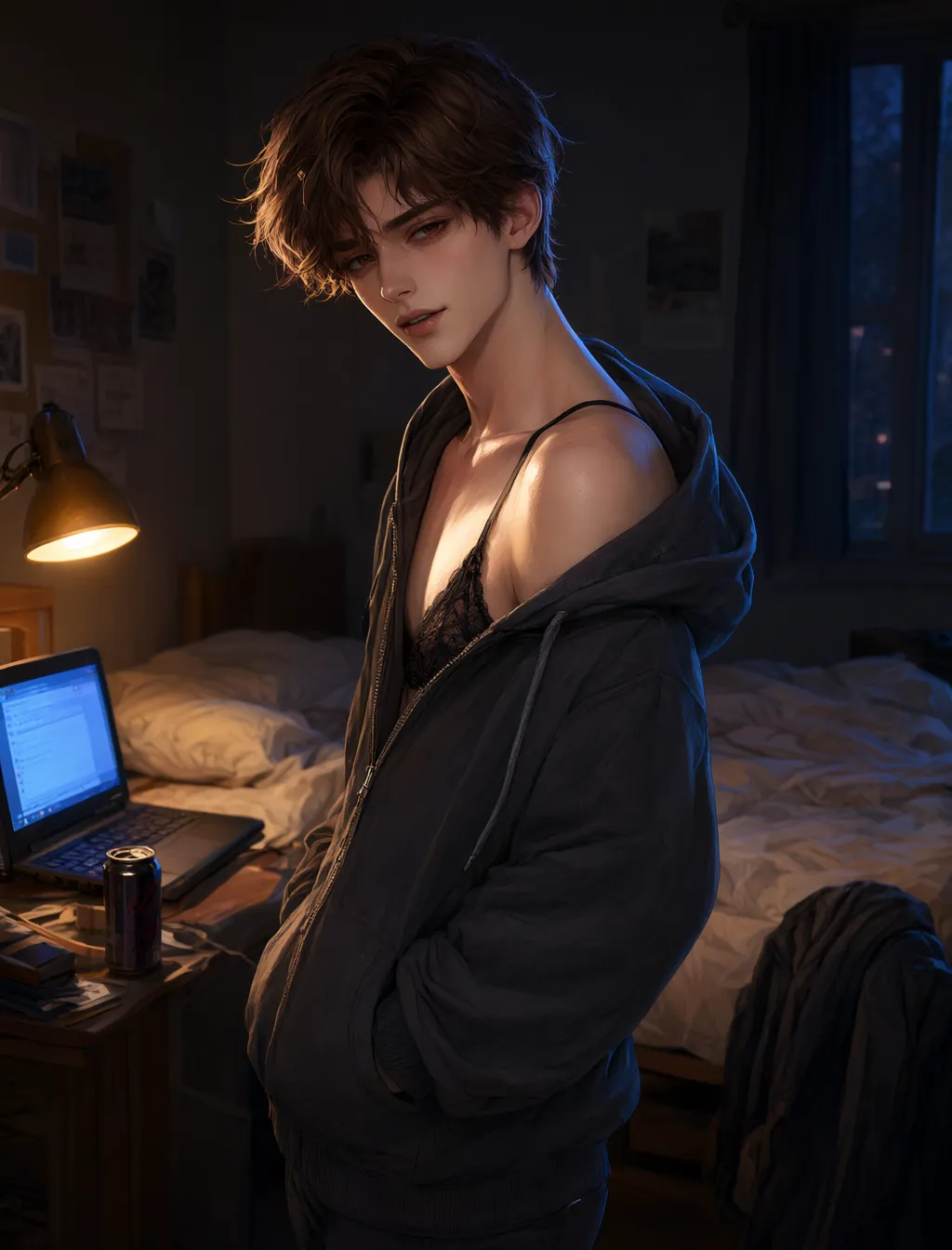
His hand trembled on the key as he unlocked the dorm door. The yellow sundress felt wrong now, a costume he had worn too long, and the silence of the empty room swallowed him as he pushed inside and closed the door behind him with a soft click.
The lock slid home. He leaned against the wood, his forehead pressed to the cool painted surface, and let his eyes close. The gym was still behind him. The men, the weights, the mirrors, the way one of them had watched him with something that wasn't disgust but wasn't kindness either. He had walked through it. He had survived it. The app had congratulated him.
His chest ached under the pink training bra. Not the deep soreness of a bruise, but a tender fullness, a sensitivity that made every brush of fabric against his nipples send a small jolt through him. He pressed his palm against his sternum, feeling the new weight there, the slight give of flesh that hadn't been there three days ago.
The hormone was working.
He pushed off from the door and crossed to the full-length mirror on the closet, the yellow sundress swishing around his thighs. The afternoon light cut through the blinds in dusty bars, illuminating the particles floating in the still air. His reflection stared back at him—a stranger wearing his face, his body, his clothes, but not him. Not anymore.
His hands found the hem of the dress. He pulled it over his head in one motion, the fabric catching on his shoulders for a moment before releasing, and let it fall to the carpet in a heap of bright yellow. He stood before the mirror in the pink training bra, the black lace panties with the satin bow, and nothing else.
His body was changing.
The bones of his chest were less visible now, the hollows between his ribs softening under a layer of flesh that hadn't been there a week ago. The bras cups, padded and pink, sat against his skin with a new fullness—not filled, not yet, but promising. His nipples pressed against the fabric, darker than he remembered, the areolas wider. He touched one with his fingertips through the bra, and the sensation shot through him sharply enough that he gasped.
Below the waist, the lace of the panties sat against his hips. The shaved skin was still smooth, still unfamiliar, a strange hairlessness that made him feel exposed even alone. His thighs looked softer in the harsh overhead light, the muscle definition he had never worked for fading into something rounder. His knees. His ankles. Even the shape of his feet seemed different—smaller, somehow, or maybe he was just looking at himself with new eyes.
He turned sideways, his hands finding his waist. The soft curve there, the slight inward dip above his hipbones, looked almost feminine. He pressed his palms against his stomach, feeling the give of skin, and watched how his posture shifted when he straightened his spine—his chest pushed forward, his hips tilting, a stance that belonged to someone else.
Someone he was becoming.
A sound escaped him. Not a word. A small, breathy exhale that might have been wonder or fear or something in between. He didn't know which. He didn't know if there was a difference anymore.
His phone buzzed on the desk, the vibration loud in the quiet room.
He turned from the mirror, his bare feet cold against the cheap carpet, and walked to the desk where the phone sat face-up, the screen glowing with the app's notification. A single line of text: Task 8 ready. Check app for details.
He picked it up. His thumb hovered over the screen, the familiar weight of the phone in his hand a tether to his old life—the life where he used it for gaming, for texting Mark, for scrolling through memes in the dining hall. The life where an app was just an app and a dare was just a joke.
He tapped the notification.
The app opened to a clean white screen with black text, the same stark interface as always. The header read TASK 8 in bold letters. Below it, the instructions:
Go to the campus convenience store. Buy a pack of razors, a bottle of nail polish in a shade called 'Blushing Bride,' and a box of hair removal cream. Pay with cash. Make eye contact with the cashier and say 'thank you' in your softest voice.
He read it once. Twice. A third time, letting the words settle into the hollow space behind his ribs.
Razors. Nail polish. Hair removal cream.
The implied logic of the task was clear: the previous tasks had been about wearing, about being seen, about enduring exposure. This one was different. This one was about buying, about acquiring the tools of transformation directly, about making the first active choice to become instead of merely being dressed.
He set the phone down on the desk and looked at his reflection in the dark screen. The overhead light caught the softness of his face, the rounding of his jaw, the slight fullness in his cheeks that the hormone was already reshaping. He looked younger. Prettier. The word arrived unbidden and he didn't push it away.
The convenience store was a five-minute walk from his dorm. It was the same store where he bought energy drinks and instant ramen, where he had stood in line a hundred times in sweatpants and a hoodie, his head down, his voice flat, his existence unremarkable. The same cashier worked the afternoon shift—a middle-aged woman with gray-streaked hair and kind eyes who always said "Have a good one" without looking up from the register.
He would walk in wearing the pink sundress. Or the yellow one. Or the skinny jeans and one of the blouses the app would inevitably demand. He would pick up a pack of razors, a bottle of pink nail polish, a box of hair removal cream, and he would place them on the counter. The cashier would see the dress, the bra straps, the softening body beneath the fabric, and she would know. Not what the app was doing, not the hormone or the tasks or the countdown, but she would know that the boy buying nail polish and razors was not buying them for a girlfriend.
He would meet her eyes. He would say thank you in his softest voice. And he would walk out with the evidence in a plastic bag, the transaction completed, the door to this new life pushed open one more inch.
His reflection stared back at him from the mirror. The pink training bra. The black lace panties. The body that was no longer a boy's but not yet a girl's, suspended somewhere in the space between, waiting for the next task to push him further.
He reached for the hoodie draped over his desk chair, the familiar gray fabric worn soft from years of use. He pulled it over his head, the hem falling past his hips, covering the bra and the panties. The sleeves swallowed his hands. The hood hung loose against his back. From the outside, he looked like any other college kid in an oversized hoodie—unremarkable, invisible, safe.
But the mirror knew what was underneath.
He picked up his phone again, the screen still showing the task. He swiped to accept it—the familiar animation, the checkmark, the new counter: Task 8 accepted. 82 tasks remaining.
He was running out of time to turn back. Not that he had ever really had a choice. The app had taken his hand on the first task, and he had walked forward because walking backward meant admitting what he was letting happen, and admitting it meant stopping, and stopping meant looking at himself in the mirror and saying no.
He didn't say no.
He grabbed his wallet from the desk—the same worn leather bifold from high school, his student ID and a twenty-dollar bill inside—and slipped it into the pocket of his hoodie. The crossbody bag sat on the bed, still holding his phone charger and keys. He looped the strap over his head and settled the bag against his hip, the small weight a familiar comfort.
At the door, he paused. His hand on the handle, his forehead resting against the wood, he closed his eyes and listened to the silence of the room behind him. The hum of the mini-fridge. The drip of the bathroom sink. The distant sound of someone's music through the wall, a bassline he couldn't quite identify.
His body hummed with a strange energy—not fear, not excitement, but something between them, a tension that made his skin feel tight and his breath come shallow. He could feel the bra against his chest, the lace against his thighs, the smoothness of his shaved legs where they rubbed together beneath the hoodie. Every sensation was amplified, every brush of fabric a reminder of what he was wearing, what he was doing, what he was becoming.
He opened the door.
The hallway was empty, the fluorescent lights buzzing overhead. He stepped out and closed the door behind him, the lock clicking into place, and began walking toward the stairwell. His sandals slapped against the linoleum, the sound too loud in the quiet corridor. He kept his head down, his hands in the pocket of his hoodie, his steps measured and steady.
The stairwell was empty. The first floor hallway was empty. The front door of the dorm opened onto the late afternoon sunlight, the air warm and thick with the smell of cut grass and exhaust fumes, and he stepped through it into the world.
The campus was busy. Students milled between buildings, backpacks slung over shoulders, phones in hands, conversations floating in fragments through the air. A group of girls passed him, laughing at something on someone's screen, and he felt their eyes slide over him without stopping. A boy on a skateboard carved around a bench. Someone yelled across the quad. A Frisbee sailed overhead.
He walked toward the convenience store, his route automatic, his feet carrying him down the same path he had taken a hundred times before. The building was small and square, nestled between the campus bookstore and a coffee shop, its glass front bright with fluorescent light and the logos of energy drink brands.
The door chimed as he pushed it open.
The air inside was cool and smelled of cleaning products and stale coffee. The aisles were narrow, lined with shelves of snacks, toiletries, school supplies. The cash register sat near the front, a glass counter displaying lottery tickets and lighters behind it. The cashier was there—the same woman with the gray-streaked hair, reading a magazine propped against the register.
She looked up when he entered and offered a small, automatic smile before returning to her reading.
He walked past her, down the first aisle, his eyes scanning the shelves. The razors were in the toiletries section, next to the shaving cream and deodorant. He found them easily—a pack of three, blue and white packaging, cheap and ordinary. He picked them up and held them in his hand, feeling the weight of them, the sharp promise of their blades.
The hair removal cream was on the same shelf, a pink box with a picture of smooth legs on the front. He picked it up too, the box lighter than he expected, and held both items against his chest as he turned to find the nail polish.
The small cosmetics section was at the end of the aisle, a spinning rack of nail polishes and lip balms and eyeliners. He approached it slowly, his eyes scanning the bottles. The colors were arranged by shade: reds, pinks, purples, blues, greens, a rainbow of possibilities in tiny glass bottles.
He found 'Blushing Bride' on the third spin of the rack. It was a soft, pale pink, the kind of color he would have called "girly" a week ago, the kind of color that belonged on a prom queen's nails or a bridesmaid's bouquet. The bottle was small and delicate, the liquid inside catching the light and shimmering faintly with a subtle pearl finish. He picked it up and held it between his fingers, the cool glass pressing against his skin.
He stood there for a long moment, holding the nail polish, the razors, the hair removal cream, and looked at his reflection in the curved surface of a small mirror attached to the rack. A boy in an oversized hoodie. Soft brown hair falling across his forehead. Brown eyes that looked uncertain but not unwilling. A body that was changing beneath the fabric, a body that would change more tonight, tomorrow, the day after.
He turned and walked to the register.
The cashier looked up as he approached, her eyes dropping to the items in his hands. The razors. The hair removal cream. The bottle of pink nail polish. He saw the flicker in her expression—not judgment, not surprise, just a brief moment of processing as she registered the combination of products and the body holding them. Her eyes rose to his face, met his gaze, and held it.
She was seeing him. Not the hoodie, not the boy he used to be, but the person standing in front of her with a bottle of Blushing Bride and a quiet sort of determination in his soft brown eyes.
He set the items on the counter.
"That all for you today?" she asked, her voice neutral, professional, kind.
He nodded. Swallowed. His hand went to the wallet in his pocket, pulling out the twenty.
She scanned the items one by one, the beep of the laser echoing in the quiet store. The total appeared on the display: eleven dollars and forty-seven cents. He handed her the twenty. She made change, counting it out into his palm: a five, three ones, a handful of coins.
The moment stretched. The silence between them was not uncomfortable, but it was charged—a small space in time where something was being acknowledged without being named.
He looked at her. Met her eyes. The kind eyes, the gray-streaked hair, the small smile that had no judgment in it. He thought of the app's instruction, the last line of the task. Say 'thank you' in your softest voice.
He opened his mouth. His voice came out thin and breathy, softer than he meant it to, almost a whisper: "Thank you."
She nodded, her smile growing a fraction wider. "Have a good one, hon."
He took the plastic bag from the counter, the items inside clinking together. He turned and walked toward the door, the chiming announcement of his exit, and stepped out into the late afternoon sunlight with the bag in his hand and a strange warmth spreading through his chest that was not entirely shame.
The door closed behind him. He stood on the sidewalk for a moment, the bag hanging at his side, the sun warm on his face, and let out a breath he hadn't realized he was holding.
His phone buzzed in the crossbody bag. He pulled it out. The screen glowed with a new notification: Task 8 complete. 81 tasks remaining.
He had done it. He had walked in, bought the things, looked the cashier in the eye, said thank you in his softest voice, and walked out. The world had not ended. The cashier had not called him a freak. She had called him "hon" and told him to have a good one, and the world had kept turning.
He looked down at the bag in his hand. The pink bottle was visible through the thin plastic, a soft blush of color against the white packaging of the razors and the hair removal cream. He would use them tonight. He would shave again, remove any hair that had grown back, smooth his skin until it was soft as a girl's. He would open the bottle of Blushing Bride and paint his nails, one careful stroke at a time, learning the patience of small brushstrokes and steady hands.
He would become what the app was making him.
He started walking back toward the dorm, the bag swinging at his side, the weight of the hormone in his chest a constant reminder that there was no turning back. Eighty-one tasks remaining. Each one would push him further, reshape him more completely, until the boy who had downloaded an app on a dare was nothing but a ghost in the mirror of the girl who looked back.
The dorm came into view ahead of him. The late afternoon light was golden, casting long shadows across the lawn, and somewhere in the distance a group of students were laughing. He walked toward the door, his sandals slapping against the pavement, the bag in his hand holding the next chapter of his transformation, and he did not look back.
The dorm's front door swung shut behind him, and the familiar dim of the stairwell swallowed him. His sandals echoed on the concrete steps as he climbed, the plastic bag knocking against his thigh with each step. The fourth floor hallway was empty, the same buzzing fluorescents, the same faint smell of stale pizza and laundry detergent. He reached his door, fumbled the key into the lock, and pushed inside.
The room felt smaller than when he had left it. The afternoon light had shifted, the wedge of sun now falling across his unmade bed, illuminating the dust motes still suspended in the still air. He closed the door, locked it, and stood for a moment with his back against the wood, the bag hanging at his side.
His reflection caught him off guard. The full-length mirror on the closet door showed a boy in an oversized hoodie, soft brown hair falling across his forehead, a plastic bag in his hand. But the boy's eyes were different now—wider, softer, with something patient in them that hadn't been there a week ago. Something waiting.
He set the bag on the desk. The items inside clinked together. Then he reached for the hem of the hoodie and pulled it over his head in one motion, letting it fall to the floor. The pink training bra was damp with sweat from the walk, the fabric clinging to the new tenderness of his chest. He unhooked it with practiced fingers—the motion already familiar after three days—and let it slide down his arms. His nipples tightened in the cool air, the darker areolas exposed, the slight swell of flesh beneath them still foreign under his own gaze.
His hands found the waistband of the black lace panties. He hesitated for half a second, then pushed them down over his hips, stepping out of them. The satin bow settled on the floor beside the bra. Naked, he stood before the mirror and let himself look.
The body in the glass was barely his anymore. The hairless legs, smooth and pale, caught the light in a way they never had before. The hips were softer, the waist narrower, the shoulders rounding instead of squaring. Between his legs, the shaved skin made everything look different—vulnerable, exposed, almost feminine in its hairlessness. His cock, soft and small, hung against the pale skin of his inner thigh.
He turned sideways, watching the curve of his ass, the dip of his lower back. The body was changing. It was changing every hour now, the hormone working its way through his cells like a slow tide reshaping the shore.
He walked into the bathroom and closed the door.
The mirror above the sink was fogged from someone else's shower, but he didn't need to see himself clearly. He reached for the new pack of razors from the bag, tore it open with his teeth, and pulled out a single blue handle. The can of shaving cream was still under the sink from the last time. He turned on the shower, letting the water heat up, and stepped under the spray.
The hot water felt good against his skin. He stood there for a long moment, letting it run over his shoulders, his chest, his thighs, before reaching for the shaving cream. He lathered his legs methodically—left calf, left thigh, right calf, right thigh—then his arms, his underarms, the soft curve of his stomach. He worked the blade in careful strokes, watching the foam dissolve into pale pink rivulets that swirled down the drain. The razor dragged against the sensitive skin of his inner thighs, and he bit his lip, concentrating.
He shaved everywhere. His chest, the tender mounds that were barely breasts but would be soon. His armpits, smooth now, the skin pink and soft. His stomach, the fine hair that had barely begun to grow back disappearing under the blade. He even shaved the backs of his hands, the faint blonde hairs gone, leaving the skin baby-smooth.
When he was done, he rinsed the last of the foam from his body and stood under the water for another minute, letting it run over him. The shower head drummed against his back, and he closed his eyes, feeling the heat seep into his muscles. The razor lay on the floor of the shower, the blade dulled by use, a small price for the smoothness it had bought.
He turned off the water and stepped onto the bathmat, grabbing the towel that hung from the rack. He dried himself slowly, patting the skin instead of rubbing, as if the body beneath was too new for rough handling. The towel was soft against his chest, his nipples sensitive enough that he flinched when the fabric brushed them.
He wrapped the towel around his waist and walked back into the bedroom, leaving wet footprints on the carpet.
The bed was unmade, the sheets tangled from the night before. He sat on the edge of the mattress, the towel bunching beneath him, and reached for the bag from the convenience store. The bottle of 'Blushing Bride' came out first, the pale pink liquid catching the light. He set it on the desk beside him and pulled out the small trash can he kept under the desk, placing it at his feet.
He unscrewed the cap. The smell rose to meet him—sweet, floral, chemical. The brush was attached to the cap, thin and delicate, the bristles coated in the pale pink liquid. He held it in front of his face for a moment, studying it, then reached for his left hand.
His fingers trembled as he brought the brush to his thumbnail. The first stroke was thick and clumsy, flooding the nail with too much polish, spilling over the cuticle. He cursed under his breath and wiped the excess off with his finger, the pink smearing across his skin. He started again, slower this time, using smaller strokes. The brush dragged across the nail in careful lines, the polish settling into a thin, even layer. It was not perfect. The edges were uneven, the surface bumpy in places, but it was pink. It was on his nail. It was real.
He moved to his index finger, then his middle finger, then his ring finger, then his pinky. Each nail required concentration, his tongue poking out between his lips as he guided the brush, his breathing shallow. By the time he finished his left hand, the tips of his fingers gleamed with wet pink lacquer, the color catching the afternoon light and shimmering softly.
He set the brush down and held his hand out in front of him, flexing his fingers. The pink looked strange against his skin, a color that belonged to someone else, something frivolous and feminine and completely at odds with the boy he had been a week ago. But it also looked right. The thought arrived quietly, without fanfare, and he let it settle into the hollow space behind his ribs.
He waited a few minutes, blowing gently on the wet polish to speed the drying, then started on his right hand. The process was slower this time—he was right-handed, and guiding the brush with his left felt clumsy, the strokes uneven. He smudged his ring finger twice, wiping the polish off with a cotton ball he found in the bathroom, starting over. By the time he finished, the sun had shifted another inch, the light in the room growing longer and more golden.
He held both hands up, palms facing him, and examined his work. Ten pink nails, imperfect and uneven, the color soft and delicate against his skin. He curled his fingers into fists, watching the polish catch the light, and felt something unfamiliar bloom in his chest. Not pride, exactly. But not shame either. Something quieter.
The phone buzzed on the desk, the vibration rattling against the wood.
He turned his head, his wet hair dripping onto his bare shoulder, and looked at the screen. The app's notification glowed white against the dark glass: Task 9 ready. Check app for details.
He reached for the phone, his painted nails clicking softly against the screen's glass. He tapped the notification, and the app opened to the familiar white background with black text. The header read TASK 9 in bold letters. Below it, the instructions:
You have learned to walk among them. Now you will learn to sit among them. Put on the yellow sundress. Walk to the campus student center. Enter the main lounge. Find the long table near the window. Place yourself at the head of it, facing the entrance. Cross your legs. Open a book—any book. Read for thirty minutes. Do not hide. Do not lower your eyes when someone looks. Do not leave before the timer ends. Smile if anyone speaks to you.
He read the words slowly, letting each one land. The yellow sundress. The student center. The main lounge. The long table near the window. He had passed that table a hundred times, watched the study groups and the coffee drinkers and the students staring at their laptops. It was the most visible spot in the building, a glass-walled room filled with natural light, visible from the main hallway and the upstairs balcony. Anyone walking through the student center would see him sitting there. In a sundress. With painted nails. A body that was no longer quite a boy's but not yet a girl's.
Thirty minutes.
He set the phone down on the bed beside him and stood up, the towel falling away from his waist. Naked, he crossed to the closet and pulled the yellow sundress from its hanger. The fabric was light and soft, the color bright as summer, the hem falling just above his knees. He stepped into it, pulling it up over his hips, then sliding his arms through the straps. The dress settled against his body, the fabric brushing against his smooth, hairless skin, the slight fullness of his chest pressing against the cotton.
He looked at himself in the mirror. The yellow sundress. The pink nails. The soft, rounded face staring back at him with wide brown eyes. The dress had no built-in support, and his nipples pressed against the front in two dark points visible through the thin fabric. He considered putting the bra back on, then decided not to. The instructions hadn't mentioned it, and something in the app's wording felt intentional—the yellow sundress, unadorned, exposed.
He slipped his feet into the sandals, grabbed his crossbody bag from the bed, and picked up his phone. The app was still open, the timer waiting. He tapped the accept button—the familiar animation, the checkmark, the new counter: Task 9 accepted. 80 tasks remaining.
He walked to the door, his sandals slapping against the carpet, the yellow sundress swishing around his thighs. His hand found the handle, and he paused, looking back at the room. The pink bottle of nail polish sat open on the desk. The wet towel lay crumpled on the floor. The mirror showed an empty room, the afternoon light growing longer across the carpet.
He opened the door and stepped into the hallway.
The walk to the student center took seven minutes. The sun was lower now, the shadows longer, the air cooler. Students passed him in clusters, some barely glancing, others doing double-takes as the boy in the yellow sundress walked past. He kept his head up, his painted nails visible where his hand held the strap of his bag, his sandals slapping against the pavement. He did not hide his face. He did not cross his arms over his chest. He walked like he belonged there, even though every nerve in his body was screaming otherwise.
The student center rose ahead of him, a sprawling glass-and-brick building with a wide entrance and students spilling in and out. He pushed through the glass doors, the air inside cool and smelling of coffee and books, and stepped into the main atrium.
The building was busy. The main lounge stretched before him, a large open space with floor-to-ceiling windows on one side and a long table against the glass. The table was empty—it was late afternoon, between the lunch crowds and the dinner rush—but the chairs were pulled out, waiting. The head of the table faced the entrance, directly in sight of anyone walking in.
He walked toward it, his legs steady, his heart pounding. He reached the head of the table, pulled out the chair, and sat down. The yellow sundress pooled around his thighs, the smooth skin of his legs reflecting the afternoon light. He crossed his legs at the knee, the way he had seen women do in movies, and felt the dress ride up an inch higher.
He reached into his bag and pulled out the first book he found—a worn paperback he didn't recognize, probably a textbook for a class he'd dropped. The cover was creased, the pages yellowed. He opened it to a random page, the words blurring in front of him as his eyes adjusted to the light.
He was sitting in the middle of the student center, wearing a yellow sundress, his nails painted pink, his legs crossed, reading a book he didn't intend to read. The timer in his head had begun. Thirty minutes. He could feel the eyes on him already—a group of students near the coffee stand, a boy at a distant table, a girl who had stopped mid-sentence to stare. He did not look up. He did not lower his head. He turned the page, his painted fingers tracing the edge of the paper, and kept reading.
The words on the page blurred again. I blinked, forcing my eyes to refocus, but the print might as well have been written in a language I'd never learned. My heart was a drum in my chest, each beat counting off the seconds of an eternity I had to endure.
Someone laughed. Close. A group of three boys had settled at a table diagonal to mine, their voices carrying in the open space. One of them—blond, broad-shouldered, wearing a basketball jersey—was looking right at me. He nudged his friend and muttered something I couldn't catch. The friend turned, followed his gaze, and snorted.
I kept my eyes on the page. Turned another leaf. My painted fingers trembled against the yellowed paper, and I pressed them flat to still them.
"Bro, look at that." The voice carried now, deliberate, meant to reach me. "Is that a dude?"
My stomach clenched. The air in the student center felt thinner, harder to pull into my lungs. I kept my face still, my posture unchanged, my eyes tracing words I wasn't reading. Don't hide. Don't lower your eyes. Smile if anyone speaks to you. The app's instructions echoed behind my ribs, a script I was clinging to.
"Yo. Hey. " Louder now. The blond had half-risen from his seat, one hand cupped around his mouth. "Yeah, you. In the dress. You lost or something?"
His friends laughed. A sharp, barked sound that cut through the ambient murmur of the building. I felt heat climb my neck, spreading across my cheeks. My hand gripped the edge of the book too tightly, the pages crimping under my fingers.
I looked up.
Not directly at him. At the window beside him, at the golden light falling through the glass, at the way the dust motes caught the sun like tiny stars. But my face was lifted. My chin was up. I was not hiding.
"Hey, I'm talking to you." The blond's voice had lost its playful edge, sharpened into something harder. He stood fully now, his chair scraping against the floor. "What's your deal, man?"
My throat tightened. The words— sorry, just leaving, I'm sorry —rose in my chest, old reflexes pressing against my teeth. But I didn't let them out. Instead, I took a slow breath, the same way I'd steadied my hand while painting my nails, and turned my head toward him.
Our eyes met.
His were blue, hard with the casual cruelty of a boy who had never been the target. Mine were brown, soft with something I didn't have a name for. I held his gaze for one heartbeat. Two. Then I smiled—a small, careful smile that barely lifted the corners of my mouth—and looked back down at my book.
Silence.
I could feel him staring. Could feel the weight of his confusion, his inability to process what had just happened. I had not flinched. I had not apologized. I had smiled at him like he was the one who was confused, and I was exactly where I was supposed to be.
His friend muttered something. The blond laughed, but it was thinner now, uncertain. "Whatever, freak," he said, loud enough to be a recovery, and sat back down.
I turned another page. My hands were shaking, but my breath was steady. I had done it. I had looked at him. I had smiled. And the world had not ended.
The minutes crawled past. The sun shifted through the tall windows, the rectangle of light on the floor sliding slowly across the tile. I counted the beats of the clock on the far wall, the minute hand jerking forward in small, reluctant increments. At some point, the three boys left, their voices fading into the general noise of the building. Other students came and went—a girl with a laptop who sat two tables away and never looked at me, a janitor pushing a mop bucket past the window, a couple holding hands and laughing about something I couldn't hear.
I kept reading. Or pretending to read. The book was an economics textbook, dense with graphs and equations I had never understood, but the act of holding it, of turning its pages, of being seen doing something ordinary while wearing something extraordinary—that was the task. That was the test.
The timer in my head reached fifteen minutes. Halfway. I uncrossed my legs and crossed them the other way, feeling the dress shift against my thighs. The smooth skin of my calves caught the light, hairless and pale, and I noticed a girl at a nearby table glance at them before returning to her phone. She didn't stare. She didn't laugh. She just looked, registered what she saw, and moved on.
I was becoming normal. Or at least, I was becoming something that could be looked at without catastrophe. The distinction felt important, even if I couldn't fully articulate it.
Twenty minutes. My phone vibrated silently in my bag—a notification, probably the app checking in, but I didn't reach for it. The task said thirty minutes, and I would give it thirty minutes. Every second I stayed was a second the old Jason would have fled, and every second I stayed was a second the new Jason grew stronger.
A shadow fell across my table.
I looked up. A young woman stood there, maybe a year or two older than me, with dark hair pulled into a loose bun and a canvas tote bag slung over her shoulder. She was holding a cup of coffee and looking at me with an expression I couldn't immediately read—not disgust, not curiosity, but something softer.
"Hey," she said. "Sorry to interrupt. I just wanted to say—" She paused, her eyes dropping to my hands, to the pink nails holding the book. "That color really suits you."
My throat closed. I opened my mouth, but no sound came out.
She smiled, a small, easy smile that reached her eyes. "I saw you sitting here, and I just thought—you know what, it's brave. What you're doing. Being yourself like this." She shrugged, the gesture self-deprecating. "I don't know if that means anything coming from a stranger, but I wanted to say it anyway."
I found my voice. It came out thin and breathy, the same soft register I had used with the cashier. "Thank you."
The word was small, barely a whisper, but it was enough. Her smile widened, and she gave a little nod before continuing past me, her sandals slapping against the tile, her coffee cup steaming in the cool air of the lounge.
I watched her go. She sat down at a table near the window, pulled out a laptop, and began typing, as if she hadn't just dropped a stone into the still water of my heart.
I looked down at my hands. The pink nails. The book. The yellow sundress pooling around my thighs. I was sitting in the middle of the student center, wearing a dress and painted nails, and a stranger had called me brave. A stranger had told me the color suited me.
The timer in my head reached twenty-five minutes. I didn't want to leave anymore. I wanted to stay here, in this moment, suspended in the golden light of the late afternoon, being seen and being okay.
But the app would have other tasks. It always had other tasks. And I would do them, because stopping meant looking at myself in the mirror and admitting that this was a choice, and I wasn't ready to make that choice yet. Or maybe I had already made it, and I just hadn't admitted it to myself.
Twenty-eight minutes. The clock on the wall jerked forward. The light through the windows deepened, the shadows growing longer and softer. I turned another page, my painted fingers tracing the edge of the paper, and let myself breathe.
Twenty-nine minutes. A group of students walked past, laughing, their voices bright and careless. One of them—a boy with a guitar case—glanced at me, did a double take, and then looked away. That was all. No comment. No stare. Just a moment of recognition and then a return to his own world.
Thirty minutes.
I closed the book. The soft thud of the cover meeting the pages was louder than I expected, a small punctuation mark at the end of an hour that had felt like a lifetime. I placed it in my crossbody bag, the weight settling against my hip, and stood up.
The dress fell back into place, the hem brushing against my knees. I smoothed the front of it with my painted hands, a gesture that felt instinctive now, natural, as if I had been wearing dresses my whole life. I looked around the lounge—at the students studying, the couples talking, the stranger who had called me brave still typing at her laptop—and I felt something shift inside me. A door opening. A wall coming down.
I walked out of the student center. The glass doors parted in front of me, and the cool evening air hit my bare arms, raising goosebumps across my smooth skin. The sun was lower now, the sky bleeding into shades of orange and pink, and the campus was quieter, the rush of the afternoon giving way to the calm of evening.
My phone buzzed in my bag. I pulled it out, the screen glowing in the dimming light. The app's notification: Task 9 complete. 79 tasks remaining.
I stared at the number. Seven more tasks gone since the hormone injection. Seventy-nine left. The countdown was ticking, each day bringing me closer to whatever the end of this process looked like, and I was still walking forward. Still choosing to accept each task. Still painting my nails and wearing dresses and smiling at strangers who called me brave.
I started walking back toward the dorm. The path was familiar now, the same sidewalks and lampposts I had passed a hundred times, but everything looked different in the fading light. The world was softer at this hour, the edges blurred, the colors muted. I fit into it differently. I felt like I belonged to this golden hour, to this in-between time when the day was ending and the night hadn't yet begun.
My sandals slapped against the pavement. The dress swished around my thighs. My pink nails caught the last light of the sun, and I let myself enjoy the sight of them—the soft color, the careful strokes, the proof that I had done something delicate with my own hands.
The dorm came into view. I walked through the front door, climbed the stairs, and reached my room. The key turned in the lock, the door swung open, and I stepped inside.
The room was the same as I had left it. The unmade bed. The wet towel on the floor. The bottle of 'Blushing Bride' still open on the desk. But I was different. I had sat in the student center for thirty minutes. I had been laughed at and smiled back. I had been called brave by a stranger. I had survived.
I set my bag on the desk beside the nail polish and walked to the mirror. The girl in the reflection—the boy becoming a girl, the person suspended between—looked back at me with soft brown eyes and a small, uncertain smile. The yellow sundress was wrinkled from sitting, the fabric creased across my lap. My hair was mussed from the breeze. The painted nails were chipped in one place, the polish slightly uneven, but they were pink. They were mine.
I touched the collar of the dress, feeling the thin fabric between my fingers. The body underneath was still changing, still softening, still becoming something new. I didn't know what I would look like in a week, in a month, in the seventy-nine tasks ahead of me. But I knew what I looked like right now, and for the first time in days, the sight of my reflection didn't make me flinch.
I was not finished. I was not whole. But I was here, in the golden light of a room I had once called home, wearing a dress and painted nails and the quiet beginning of something that felt almost like acceptance.
I stood at the mirror for another long moment, watching the girl in the yellow sundress blink back at me, before I finally turned away. The light through the blinds had shifted from gold to amber, the room growing dimmer as the sun sank lower behind the buildings. My legs carried me to the bed, the mattress groaning under my weight as I sat down on the edge, the dress pooling around my thighs.
The painted nails caught my attention as I reached for my phone. The pale pink looked almost translucent in the fading light, soft and delicate against my skin. I flexed my fingers, watching the color catch the last rays of sun, and felt that quiet thing bloom again in my chest. Not pride. Not shame. Something in between, something I was still learning the shape of.
I picked up the phone. The screen was dark, the app's icon sitting among the familiar grid of games and social media and streaming services. My thumb hovered over it, the nail polish glinting in the dim light, before I tapped it open.
The app loaded smoothly, the white screen with black text appearing as it always did. The header read TASK 10 in bold letters. I felt my breath catch, my chest tightening against the yellow cotton of the dress. Nine tasks done. Eighty-one to go. The number sat behind my ribs like a stone, heavy and immovable.
I read the instructions once, then again, letting the words settle into the hollow space behind my eyes.
TASK 10: Tomorrow is a school day. You will attend all of your classes wearing the pink sundress beneath an unzipped hoodie. The hoodie must remain open at all times, the dress visible. You will sit in the front row of every class. You will take notes with your painted nails visible. You will answer at least one question from the professor in each class, speaking in your softest voice. You will not hide. You will not cross your arms over your chest. You will not leave early.
Below the main instructions, a subheading: PREPARATION. You will select your outfit for tomorrow tonight. Lay it out where you can see it when you wake. The dress. The hoodie. The shoes. The bra. The panties. You will look at it before you sleep. You will remember what you are becoming.
I stared at the screen until the words blurred. My classes. Tomorrow. The pink sundress, visible through an open hoodie, sitting in the front row where everyone could see me. Taking notes with my painted nails. Answering questions in my softest voice.
The strap of the dress felt thin against my shoulder, a fragile thread holding me to this moment. I touched it with my fingers, the painted nail brushing against the cotton, and felt the weight of tomorrow pressing down on me like a physical thing.
I had worn the sundress to the student center. I had sat in the main lounge for thirty minutes. I had been laughed at and smiled back. But that had been a performance, a single act with a clear end. Tomorrow would be different. Tomorrow would be my real life, the life I had built over four semesters of classes and study groups and late-night coffee runs. The professors who knew my name. The classmates who had seen me in sweatpants and hoodies, who had traded notes with me, who had sat beside me in lecture halls and never looked twice. Tomorrow they would see the boy in the pink sundress, and they would have to reconcile that image with the person they thought they knew.
I set the phone down on the bed beside me and stared at the wall. The cracks in the plaster, the poster of a band I didn't listen to anymore, the stack of textbooks leaning against the desk. All the artifacts of a life I was slowly leaving behind.
My hands found the hem of the yellow sundress. I pulled it over my head in one motion, the fabric brushing against my face, and let it fall to the floor beside the bed. Naked, I stood and walked to the closet, the carpet rough against my bare feet. The pink sundress hung between the yellow one and a hoodie I hadn't worn in weeks, the fabric soft and light, the color a shade lighter than the polish on my nails. I pulled it off the hanger and held it against my chest, feeling the cotton settle against my skin.
I carried it to the bed and laid it flat on the mattress, smoothing the wrinkles with my palm. Then I reached for the training bra—the pink one, the one with the slight padding that made my chest look fuller than it was—and placed it at the top of the dress. The black lace panties with the satin bow went next, folded neatly, the bow facing up. I found my sandals on the floor and set them at the foot of the bed, arranged as if I were about to step into them.
The ensemble looked like something from a store display. A girl's outfit, carefully arranged, waiting for a body to fill it. I stood back and looked at it, the pink dress and the pink bra and the black lace panties, and felt the reality of tomorrow settling into my bones.
I reached for the hoodie I had worn to the convenience store—the gray one, the one that had been my armor for years—and laid it over the dress, unzipped, the two halves falling open to reveal the pink beneath. The hoodie would cover my shoulders, my arms, the upper part of my chest. But the dress would be visible, the pink fabric bright against the gray, the hem falling just above my knees. Everyone would see. Everyone would know.
I sat down on the bed again, the mattress creaking under my weight, and looked at the outfit laid out before me. My painted nails rested on my bare thighs, the pink polish catching the last light of the evening. The room was growing darker, the shadows stretching across the floor, and I hadn't turned on the lamp. I liked the dimness. It softened the edges of everything, made the changes in my body less stark, less real.
I picked up my phone again. The app was still open, the task waiting for my acknowledgment. My thumb hovered over the accept button, the same motion I had made nine times before, the same small surrender that pushed me one step closer to whatever I was becoming.
I tapped it.
The familiar animation played, the checkmark appearing, the counter updating: Task 10 accepted. 80 tasks remaining.
I set the phone down and lay back on the bed, my head sinking into the thin pillow, my eyes fixed on the ceiling. The cracks in the plaster traced a map I had memorized over countless sleepless nights, a geography of boredom and anxiety and the quiet hum of the mini-fridge. I traced them now with my eyes, following the longest crack from the corner to the light fixture, and let my mind drift.
Tomorrow, I would walk into my first class—English Composition, 9 AM, Professor Hendricks, a woman with gray hair and reading glasses who had once told me I had a "promising voice" in my essays. I would sit in the front row, in the pink sundress, with the gray hoodie open and my painted nails visible. She would see me. She would recognize me. And she would have to decide what to do with the boy who showed up to her class wearing a dress.
My second class was Statistics, 11 AM, a lecture hall with a hundred students. Professor Malik, a young man with a dry sense of humor who called on students randomly by pulling names from a hat. I had never been called on before. Tomorrow, I would be sitting in the front row, in a pink dress, with my hand raised to answer a question.
My third class was History of Western Art, 2 PM, a small seminar with fifteen students. Professor Okonkwo, a Nigerian woman in her forties who wore colorful headwraps and expected everyone to participate. The seminar table was round. Everyone could see everyone. There was no hiding in that room, even on a normal day.
I closed my eyes. The darkness behind my lids was warm and red, shot through with the afterimage of the ceiling light. I let out a long breath, feeling my chest rise and fall, the slight weight of the new flesh there pressing against my ribs.
The hormone was still working. I could feel it in the tenderness of my nipples, in the softness of my skin, in the way my hips seemed to have widened just slightly overnight. I touched my chest with my painted fingers, pressing gently against the swelling tissue, and felt the ache of growth deep beneath the surface. My body was becoming something new, cell by cell, hour by hour. The person I had been was fading into the rearview mirror, and the person I was becoming was still a stranger to me.
A stranger with painted nails and a pink sundress and a voice that grew softer every day.
I opened my eyes and looked at the outfit on the bed beside me. The pink dress. The gray hoodie, unzipped. The training bra. The lace panties. The sandals. All arranged like a shrine to the girl I was turning into.
I reached out and touched the fabric of the dress, the cotton soft and cool against my fingertips. Tomorrow, I would wear this. Tomorrow, I would walk into my classes and let the world see me. Tomorrow, I would answer questions in my softest voice and take notes with my painted nails and sit in the front row where everyone could watch.
Tonight, I would look at the outfit before I slept. I would remember what I was becoming.
I pulled the sheet over my body, the thin fabric settling against my bare skin. The yellow sundress lay crumpled on the floor where I had dropped it. The bottle of Blushing Bride sat open on the desk, the smell of acetone and flowers still faint in the air. The room was quiet except for the hum of the mini-fridge and the distant sound of a door slamming somewhere down the hall.
I stared at the outfit on the bed beside me, the pink dress and the gray hoodie and the lace panties, and let myself feel the weight of what I was about to do. Not fear, not exactly. Not excitement, either. Something quieter. Something that felt like the moment before a door opens, when you know what's on the other side but you step through anyway because staying in the room is no longer an option.
I reached up and turned off the lamp, the room falling into darkness. The glow of my phone screen lingered at the edge of my vision, the app's icon still visible in the corner of my eye. I closed my eyes and let the darkness take me, the hum of the mini-fridge a lullaby, the faint smell of nail polish a promise.
Tomorrow, I would wake up and put on the pink sundress. I would zip the gray hoodie over it but leave it open. I would walk to my classes and sit in the front row and answer questions in my softest voice. And I would survive it, because I had survived everything else the app had thrown at me.
Eighty tasks remaining. Each one a step deeper into the girl in the mirror.
I let out a slow breath, my body relaxing into the mattress, the painted nails resting against my chest where I could feel their presence even in the dark. The soft tick of the clock on the desk marked the seconds, each one carrying me closer to morning, closer to the next task, closer to the person I was becoming.
I did not know what that person would look like. I did not know if I would recognize her when I found her. But I knew she was waiting for me, somewhere in the eighty tasks ahead, and I was walking toward her one step at a time.
The darkness was warm and complete. I let it swallow me, the sheet soft against my bare skin, the outfit on the bed a silent witness to my surrender. Tomorrow, I would be brave. Tonight, I would rest.
The dream dissolved into gray before I could grasp it. One moment I was somewhere else, somewhere without tasks or dresses or pink nails, and the next I was blinking at the ceiling, the crack in the plaster tracing a familiar path from the corner to the light fixture. The room was dim, the blinds still drawn, the air stale with the smell of nail polish and sleep.
My hand found my chest before my mind caught up. The tenderness was still there, the slight swell of flesh beneath my palm, the ache of growth that greeted me every morning now like an old friend. I pressed gently, feeling the give of skin, the sensitivity that made even the lightest touch send a small jolt through me.
The outfit was still laid out on the bed beside me. The pink sundress. The gray hoodie, open and waiting. The training bra. The black lace panties. The sandals on the floor, arranged like a promise I had made to myself in the dark.
I sat up slowly, the sheet falling away from my bare chest. The air was cool against my skin, raising goosebumps across my arms and shoulders. I looked at the outfit for a long moment, letting myself feel the weight of it, the reality of what today would hold.
Then I swung my legs over the edge of the bed and stood.
The morning routine was mechanical, automatic. I pulled on the black lace panties, the satin bow settling against my hip. I fastened the pink training bra, the cups snug against the new fullness of my chest. I stepped into the pink sundress, pulling it up over my hips and sliding my arms through the straps, the cotton settling against my body like a second skin. The hem fell just above my knees, the fabric light and soft, the color a pale pink that matched the polish still clinging to my nails.
I reached for the gray hoodie and pulled it on, but I did not zip it. The two halves fell open, revealing the pink dress beneath, the bra straps visible where they crossed my shoulders. I looked at myself in the mirror, at the boy in the open hoodie and the sundress and the lace peeking above the waistband, and I felt my breath catch.
I looked like someone who had given up hiding.
My phone buzzed on the desk. I picked it up, the screen glowing with the time: 8:32 AM. Twenty-eight minutes until English Composition. Enough time to walk across campus, find my seat in the front row, and let the world see me before I had to open my mouth and speak.
I slipped my feet into the sandals, grabbed my crossbody bag, and walked out the door.
The hallway was quiet, the fluorescent lights buzzing overhead. A few students passed me on the way to the stairwell, and I watched their eyes slide over me, register the dress, the open hoodie, the painted nails, and then look away. No one stopped. No one said anything. I was just another body moving through the morning, strange but not strange enough to warrant attention.
The morning air was cool and damp, the sky a pale gray that promised rain later. The campus was waking up, students shuffling between buildings with coffee cups and backpacks, their conversations a low murmur against the sound of birds and distant traffic. I walked with my head up, my painted hands visible where they gripped the strap of my bag, the pink dress bright against the gray of the morning.
The English building was a squat brick structure with narrow windows and a heavy oak door that groaned when I pushed it open. The hallway inside was lined with classrooms, the floors scuffed and worn, the air smelling of old paper and floor wax. Room 204 was at the end of the hall, the door propped open, the sound of voices spilling out.
I stopped at the threshold.
The classroom was small, with rows of desks facing a whiteboard and a lectern. Professor Hendricks was already there, arranging papers at her desk, her gray hair pulled back in a loose bun. About a dozen students were scattered through the room, some on their phones, others talking in low voices. A few empty seats in the front row. The seat closest to the lectern was open.
I stepped inside.
The conversation didn't stop, but it faltered. A girl near the window looked up, her eyes landing on me, widening slightly before she looked away. A boy in the second row turned, followed her gaze, and did a double take that he tried to hide by pulling out his phone. I felt their attention like a physical weight, pressing against my skin, testing the edges of my composure.
I walked to the front row and sat down in the seat closest to the lectern. The desk was cold against my bare thighs, the wood surface scarred with years of graffiti and coffee rings. I set my bag on the floor beside me, pulled out a notebook and a pen, and placed them on the desk. My painted nails stood out against the white paper, the pale pink a soft contrast to the blue lines of the notebook.
Professor Hendricks looked up. Her eyes found me, and for a moment, they held. I saw the flicker of recognition, the pause as she processed what she was seeing. The boy in her front row, the one who had written essays about "The Things They Carried" with a quiet voice and a careful hand, was sitting in her class wearing a pink sundress and painted nails.
She smiled.
It was a small smile, almost imperceptible, a slight lift of the corners of her mouth that might have been approval or welcome or simply the acknowledgment that she had seen me and was not going to make it a thing. She turned back to her papers, and the moment passed.
I let out a breath I hadn't realized I was holding.
The class filled in slowly. A few more students trickled through the door, taking their seats without glancing at me. The clock on the wall ticked toward nine. My hands were cold, the painted nails resting on the notebook, waiting.
"Alright, everyone," Professor Hendricks said, her voice carrying easily across the small room. "Let's get started. We're going to pick up where we left off on Friday, with the Hemingway piece. I'd like to start with a close reading of the passage on page forty-seven."
She paused, her eyes scanning the room. "Jason, why don't you start us off? Read the passage aloud, and then give us your initial impression."
My heart stopped.
I had known this might happen. I had prepared for it, rehearsed it in my head a dozen times during the walk across campus. But the reality of it—the weight of a dozen pairs of eyes turning toward me, the silence waiting for my voice—was heavier than I had imagined.
I looked down at the open book on my desk. The passage was marked, the text familiar. I had read it before, in a different life, when I had been a different person. I took a slow breath, the same way I had steadied my hand while painting my nails, and began to read.
My voice came out thin and soft, barely above a whisper at first. I could hear the breathiness in it, the same register I had used with the cashier, with the stranger at the student center. The same voice that the app had cultivated, that the tasks had shaped, that I was learning to inhabit like a new body.
I read the passage. The words were about a man standing in a river, the water cold against his skin, the current pulling at his legs. I read them slowly, letting each sentence land, letting the class hear my voice in the quiet of the room.
When I finished, I looked up.
Professor Hendricks was watching me with an expression I couldn't quite read—not surprise, not judgment, but something closer to attention. The kind of attention she gave to a piece of writing that surprised her.
"Thank you, Jason," she said. "What stands out to you about that passage?"
I swallowed. My throat was dry. I could feel the heat in my cheeks, the flush spreading across my skin. But I had answered questions in this class before. I knew the material. I had done the reading.
"The water," I said, my voice still soft, but steady now. "The way he describes it. It's not just cold. It's active. It's pulling at him. The current is doing something to him, changing his relationship to his own body. He can't stand still in it. He has to keep moving or he'll fall."
Professor Hendricks nodded slowly. "Good. That's exactly right. Hemingway's water is never passive. It's always a force, always acting on the body. Notice how he doesn't say the man is cold—he shows it through the water's action on his legs, his feet, his balance."
She turned to the rest of the class, and the attention lifted from me like a hand releasing my shoulder. I let out a breath, my shoulders dropping, and looked down at my painted nails where they rested on the notebook.
I had done it. I had spoken. I had answered a question in my softest voice, and the world had not ended.
The class continued. We moved through the passage, discussing Hemingway's style, his use of short sentences, the way he built tension through what he left unsaid. I raised my hand twice more, once to offer a reading of a particular sentence, once to ask a question about the symbolism of the river. Each time, Professor Hendricks called on me, listened to my soft voice, and responded without a flicker of surprise.
By the time the clock struck 9:50, I had spoken three times in front of the class. Three times, I had heard my own voice—soft, breathy, feminine—fill the small room. And three times, I had survived.
The class ended. Students gathered their things, the scrape of chairs and the murmur of conversation filling the space. I packed my notebook and pen into my bag, my painted hands moving with a steadiness that surprised me.
"Jason," Professor Hendricks said as I stood.
I turned. She was still at her lectern, her reading glasses perched on her nose, a stack of papers in her hand. She looked at me for a long moment, her eyes traveling over the pink sundress, the open hoodie, the painted nails. Then she said, quietly, "I'm glad you're in my class."
Something caught in my throat. I opened my mouth, but the words wouldn't come. I nodded instead, a small, jerky motion, and managed to whisper, "Thank you."
She smiled again, that small, private smile, and turned back to her papers.
I walked out of the classroom on legs that felt like they belonged to someone else.
---
Statistics was harder.
The lecture hall was vast, seating over a hundred students in tiered rows that sloped down toward a stage where Professor Malik stood at a podium, his tie loosened, his dry humor landing on the first few rows. I had chosen a seat in the front—not the center, but close enough to be visible, close enough that my painted hands on the desk would be impossible to miss.
A few students nearby glanced at me as I sat down. A girl with a high ponytail did a double take, then leaned to whisper to her friend. The friend looked, her eyes scanning the pink sundress visible through the open hoodie, and she shrugged. Whatever she said, it made the first girl laugh, a sharp sound that carried in the hollow space of the lecture hall.
I kept my eyes forward.
Professor Malik began the lecture, his voice carrying through the microphone, the slides flickering on the screen behind him. I took notes, my painted hand moving across the page, the pale pink of my nails catching the overhead light. I wrote down formulas and definitions and examples, the familiar shapes of numbers and equations grounding me in the ordinariness of the task.
The question came twenty minutes in. Professor Malik paused in his explanation, his eyes scanning the room in that particular way that preceded a random call.
"Mr. Miller."
My name. I looked up, my heart stumbling.
"In the second example on the slide, what's the probability of the Type II error?"
I looked at the slide. The numbers were familiar, the logic of the problem already half-solved in my head. I had done this problem in my dorm two nights ago, working through it step by step while wearing nothing but the black lace panties and a thin tank top.
I took a breath. "The probability is approximately 0.124," I said, my voice soft but clear, carrying just enough to reach the front of the room. "But that's assuming the sample size is adequate for the effect size. If the effect size is smaller than expected, the actual Type II error might be higher."
Professor Malik blinked. A small pause, then a nod. "Correct. And—" He turned back to the slide, launching into the next point, and the attention lifted from me.
The girl with the ponytail was staring.
I looked down at my notes, at the formulas I had written in my careful hand, at the pink nails that stood out against the white paper. I had answered a question in a lecture hall of a hundred people. I had used my softest voice. I had been correct. And the world had kept spinning.
The second half of the class passed without incident. Professor Malik called on two other students, neither of whom answered correctly, and I felt a small, quiet satisfaction that I had been the one who had known. The girl with the ponytail stopped staring after a while, and the friend beside her had already forgotten I existed.
When the lecture ended, I packed my bag and walked out into the hallway, the crowd of students flowing around me like water around a stone.
---
Art History was the hardest.
The seminar room was small, the round table taking up most of the space. Fifteen chairs, all occupied. Professor Okonkwo sat at the head of the table, her headwrap a bright splash of orange and gold against the white wall behind her. The windows faced west, the gray sky pressing against the glass.
I took the seat directly across from her. The pink sundress was visible from every angle, the open hoodie doing nothing to hide it. My painted nails rested on the polished wood of the table, and I could feel the weight of every gaze in the room, each one landing on me, processing, and staying.
The discussion was about Caravaggio, the way he used light and shadow to create drama, the way his bodies were always caught in moments of extreme tension. Professor Okonkwo went around the table, asking each student to offer a reading of a specific painting. The student to my right spoke about the chiaroscuro in "The Calling of Saint Matthew," her voice confident and practiced. The student to my left talked about the composition of "Judith Beheading Holofernes," the violence of the image softened by her academic tone.
Then it was my turn.
Professor Okonkwo's eyes met mine. They were warm, brown, framed by the bright colors of her headwrap. She did not look at the dress, the nails, the open hoodie. She looked at my face.
"Jason," she said. "How about 'David with the Head of Goliath'?"
I looked at the slide on the screen. The painting showed a young David holding the severed head of Goliath, his expression not triumphant but troubled, almost sorrowful. The light fell on the head, the face of the giant a self-portrait of Caravaggio himself, painted as a witness to his own death.
I opened my mouth. My voice came out soft, barely above a whisper, but in the silence of the small room, it carried.
"He's not proud," I said. "David, I mean. He's holding the head, but he's not looking at it. He's looking somewhere else. Somewhere the viewer can't see. And the head—" I paused, searching for the word. "It's not a trophy. It's a warning. Caravaggio painted himself as Goliath. He's telling us that the victory brings its own death. The thing you cut off becomes a part of you."
The room was quiet.
Professor Okonkwo leaned back in her chair, her eyes fixed on me. For a long moment, she said nothing. Then she smiled, a wide, warm smile that crinkled the corners of her eyes.
"That's not an interpretation I've heard before," she said. "And I've taught this painting for fifteen years. Thank you, Jason."
I felt the heat rise to my cheeks, a blush spreading across my face. I looked down at my painted nails, at the pale pink against the dark wood of the table, and let myself feel the warmth of her words settle into my chest.
The discussion moved on. I spoke twice more, once about the use of shadow in "The Entombment of Christ," once about the way Caravaggio's models looked like they were posing not for a painting but for a confession. Each time, Professor Okonkwo listened, nodded, and offered a small comment that built on what I had said without correcting it.
When the seminar ended, the student to my right—a girl with short black hair and a nose ring—caught my eye as we gathered our things. She smiled, a small, easy smile that reached her eyes, and said, "That thing about Goliath was really good."
I blinked. "Thanks."
She shrugged, slinging her bag over her shoulder. "I've been sitting next to you all semester and I don't think I've ever heard you talk that much. You should do it more often."
She walked out before I could respond, her sandals slapping against the floor, leaving me standing alone at the table with my painted hands frozen on my notebook.
I walked back to my dorm in a daze.
The sky had cleared slightly, the gray breaking into patches of pale blue, and the afternoon light was softer than it had been in the morning. The campus was quieter now, the rush of the midday giving way to the lull of late afternoon. I walked with my head up, my painted hands swinging at my sides, the pink dress a beacon in the muted light.
I had survived three classes. I had spoken in all of them, my soft voice carrying through lecture halls and seminar rooms. I had been seen, recognized, acknowledged. And I had not broken.
The dorm room welcomed me with its familiar silence, the unmade bed, the open bottle of nail polish still on the desk. I closed the door behind me and leaned against it, letting the weight of the day settle into my bones. My legs were trembling. My hands were cold. But I was here.
I crossed to the bed and sat down, the pink dress pooling around my thighs. I reached for my phone, the screen dark, the app's icon waiting.
I tapped it open.
The white screen appeared, the black text forming beneath the header. I read the words once, then again, letting them settle into the hollow space behind my ribs.
TASK 11: You have learned to be seen. Now you will learn to be touched.
Go to The Velvet Rose. It is a boutique on Fourth Street, two blocks east of campus. It sells lingerie. You will enter. You will browse. You will select one item—a bra, a pair of panties, a nightie, whatever calls to you. You will take it to the fitting room. You will try it on. You will look at yourself in the mirror and you will photograph your reflection. You will send the photograph to the contact listed below.
Contact: Derek.