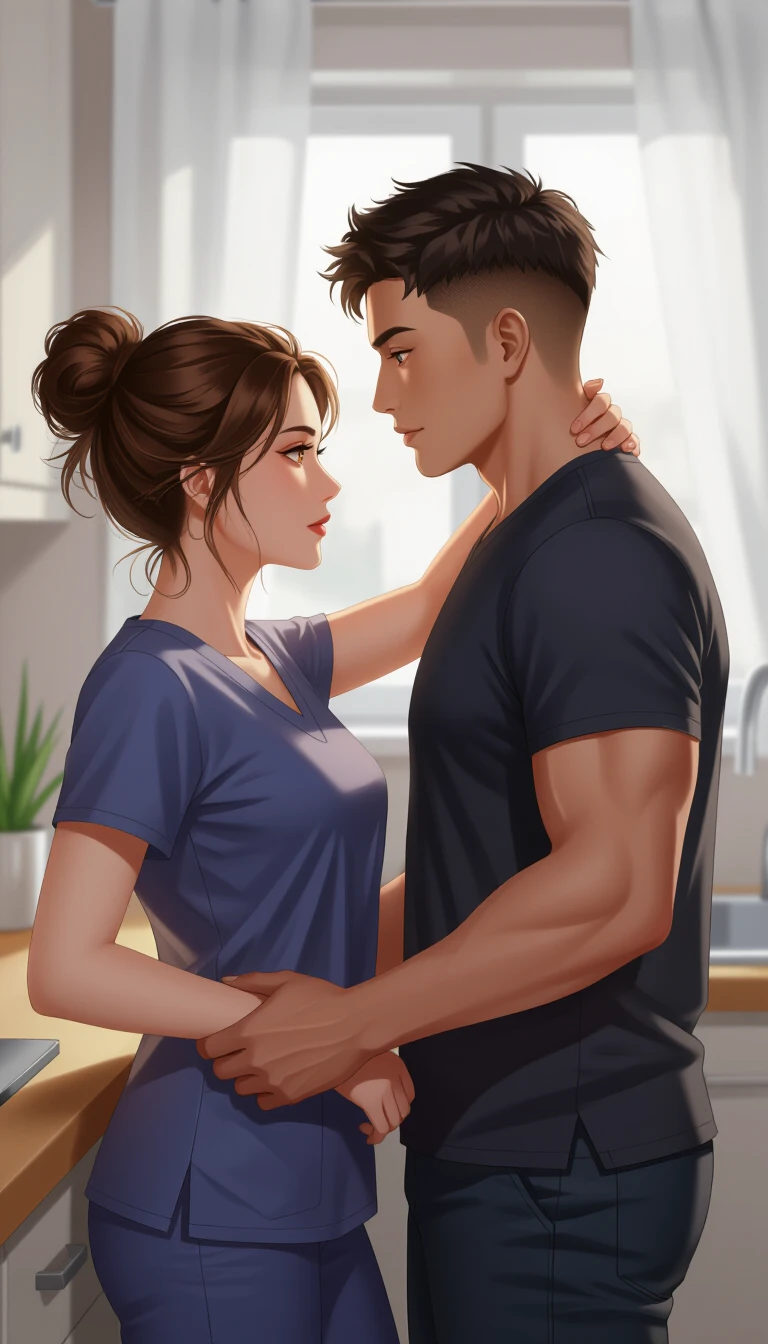
The duffel strap bit into her shoulder, a dull ache she'd been carrying since the bus stop three blocks ago. Her scrub top clung to her back with the damp of a sixteen-hour shift, and the hallway smelled like him—sweat and coffee and something sharper, almost metallic, like the structural blueprints he used to leave spread across his desk in college.
His forearm dragged across her spine.
Warm cotton. Muscle beneath. The brief pressure of skin that wasn't hers, gone before she could decide whether to flinch. Lena held her breath and stared at the peeling paint on the baseboard, counting the scuff marks. Three from the doorframe. Two near the laundry basket. One where someone had kicked something heavy across the floor.
"Second box." Marcus didn't look at her. He lifted the cardboard past her hip, close enough that she caught the faint scent of deodorant and the undershirt beneath his button-down. The box landed on the leather sofa with a soft thump. Dust motes spun in the yellow hallway light.
He turned. His jaw was tight, the muscle at the hinge flexing once before stilling. Dark brown eyes fixed on something just past her head—the coat hook, she realized, the one shaped like a dog's tail that his ex must have picked out because it was too whimsical for a man who designed bridges and never raised his voice.
"Living room's yours."
The words landed flat. Lena waited for the rest—the I'm doing this as a favor to your brother, the this is temporary, the don't make this weird—but instead he rolled his shoulders back, that tell she remembered from years of watching him across dinner tables and graduation parties. Shrugging off a weight.
"No leaving dishes in the sink."
He didn't say don't touch me. He didn't have to. It was in the way he stood half-turned, one hand still gripping the edge of the box like he might need it between them. In the way his eyes never dropped below her collarbone, even though her scrub top was pulling across her shoulders from the duffel strap and she'd been wearing the same bra for eighteen hours and she probably looked exactly as wrecked as she felt.
"Got it." Lena let the duffel slide off her shoulder. It hit the hardwood with a muffled thunk, and she flexed her fingers against the red groove the strap had carved into her palm. "Dishes. Sink. No leaving."
She was rambling. Exhaustion did that—turned her mouth into a faucet she couldn't quite shut off. She bit the inside of her cheek, hard enough to taste copper, and forced herself to meet his eyes.
He was already walking toward the kitchen. The box stayed on the couch, cardboard flaps open, her textbooks visible beneath a tangle of charging cables and the framed photo she'd wrapped in her favorite hoodie. Marcus stopped at the counter and picked up a stress ball—blue foam, squeezed into a misshapen oval—and worked it once in his palm before setting it down exactly where it had been.
"There's coffee," he said. Not an offer. An observation. The coffee maker behind him was still half-full, the glass carafe smudged with fingerprints and the dregs of what smelled like the cheap grounds she'd been living on since intern year started. He didn't drink cheap coffee. She knew that because she'd made him a cup once, years ago, and he'd taken one sip before setting it down very carefully and never mentioning it again.
"I'm fine." Her voice cracked on the word fine. She wrapped her arms around her ribs, fingers finding the edge of her scrub top where the seam was starting to fray. "Thanks. For the—" She gestured vaguely at the couch, the box, the hallway that was now technically half hers. "The everything."
Marcus turned. This time, he looked at her. Really looked, dark eyes tracking from the dark circles under her eyes to the messy bun that had started the day at a 45-degree angle and was now listing somewhere closer to 60. Something flickered across his face—too fast to name, too fast to be anything but a trick of the dim hallway light—and then it was gone.
"Shower's at the end of the hall. Towels in the closet." He paused, one hand on the kitchen counter, the other already reaching for the stress ball again. "You look like hell, Lena."
She laughed. It came out wrong—too loud, too sharp, the sound of someone who'd been holding things together for fourteen hours and just discovered she'd been using the wrong glue. "Yeah. I know."
He didn't smile. But his shoulders dropped half an inch, and when he turned away this time, it was slower. Softer. Like maybe he'd decided she wasn't a structural problem he needed to solve tonight.
Lena picked up her duffel. The strap left a fresh groove in her shoulder, and her scrub top was definitely going to need washing before tomorrow's shift, and somewhere in the kitchen Marcus was pouring the last of the cheap coffee down the drain because even his pipes deserved better. But the couch was hers. For now. And the hallway still smelled like him, and her spine still remembered the weight of his arm, and she was too tired to pretend either of those things didn't matter.
The duffel was still on the floor.
Lena stood in the narrow hallway, one hand braced against the wall, the other reaching back—slow, like she was checking for a wound she wasn't sure she'd actually received. Her palm pressed flat against the spot on her spine. Just above the waistband of her scrub pants. Where his forearm had dragged.
The skin was still warm. Or maybe that was her. Maybe she was imagining it, the way exhaustion made everything feel closer to the surface—nerves raw, boundaries thin, the ghost of a touch lingering longer than it should. She pressed harder. The pressure was hers now. Not his. She was the one making the ache.
From the kitchen came the sound of water running. The coffee maker gurgling. The soft clink of ceramic against countertop. Marcus was rinsing the carafe, or filling it again, or doing something that kept him on the other side of the wall, and she was grateful for the wall, and she hated the wall, and none of that made sense so she pressed her palm harder until her shoulder blades pinched together and her breath caught somewhere between her ribs and her throat.
He hadn't meant anything by it. The arm. The graze. It was physics—a body in a narrow hallway, a box too heavy for one hand, the angle of a lift that required a pivot. He'd probably already forgotten it. Marcus Chen, who designed bridges that didn't buckle, did not spend his evenings cataloging the places his forearm had touched.
She dropped her hand.
The spot on her spine went cold. A small death—the warmth bleeding out into the hallway's stale air, replaced by the damp of her scrub top and the ache of sixteen hours on her feet. She flexed her fingers. Counted the scuff marks again. Three from the doorframe. Two near the laundry basket. One where someone had kicked something heavy across the floor. The numbers didn't help. They never did.
"You planning to sleep standing up?"
Marcus was in the kitchen doorway. She hadn't heard him stop running the water. His shirtsleeves were pushed to his elbows now, forearms bare, and the stress ball was back in his right hand—slow, rhythmic squeezes that made the tendons shift under his skin. He wasn't looking at her face. He was looking at her hand, still half-raised, still hovering near the spot on her spine like she'd been caught in the middle of something she couldn't explain.
"Just working out a cramp." The lie landed flat between them. She could feel it sitting there, taking up space in the narrow hallway, and for a terrible moment she thought he was going to call it—raise an eyebrow, say something sharp and quiet that cut right through her. But he didn't. He just squeezed the stress ball twice more and stepped back into the kitchen without a word.
Lena picked up the duffel. The strap found the same groove in her shoulder, and the spot on her spine was still cold, and somewhere in the kitchen Marcus was probably pouring fresh water into the coffee maker like tonight was just another Tuesday. Like she wasn't standing in his hallway pressing her palm to the place where his skin had almost met hers. Like it didn't matter.
It didn't matter. She was too tired for it to matter. That's what she told herself as she carried the duffel toward the couch—her couch, her box of textbooks and tangled cables, her framed photo wrapped in a hoodie that still smelled like the apartment she'd lost. The leather was cool under her palm. The cushions sighed when she sat down. And her spine still remembered the weight of his arm, and she was too exhausted to pretend otherwise, so she didn't.
She pressed her palm to the spot again.
Slow, this time. Deliberate. Her fingers spread wide across the base of her spine, the heel of her hand finding the exact vertebrae where his forearm had dragged. The scrub fabric was still damp from sixteen hours of wear, and beneath it the skin was—
Warm. It was warm.
Not imaginary. Not exhaustion playing tricks on frayed nerves. The heat was real, a small trapped sun lodged between muscle and bone, and she could feel it radiating outward in slow pulses that matched her heartbeat. She pressed harder. Her knuckles cracked. The leather couch creaked beneath her as she shifted her weight, angling her palm to cover more surface area, as if she could measure the temperature with nothing but her own skin.
The water stopped in the kitchen. She heard the soft click of the faucet, the gurgle of the drain swallowing the last of the cheap coffee. Marcus's footsteps crossed the linoleum—four steps, she counted them, four steps from sink to counter—and then silence. The kind of silence that meant he was standing still. Listening. Probably wondering why she hadn't moved from the couch in the past forty-five seconds.
She should drop her hand. She should unzip the duffel, pull out her toothbrush, pretend she had a nighttime routine that didn't involve pressing her palm to the place where her brother's best friend had accidentally touched her. But the warmth was still there, a stubborn ember refusing to die, and part of her—the part that hadn't slept more than four hours in three days, the part that had lost her apartment and her dignity in the same week—wanted to see how long it would last.
The skin was cooling now. She could feel the heat bleeding out, leaching into the damp scrub fabric, dissipating into the apartment's stale air. In another thirty seconds it would be gone. Just a memory. Just another thing she'd imagined because she was lonely and exhausted and living on a man's couch because she had nowhere else to go.
Her thumb traced a small circle against her spine. The pressure was grounding—the only thing keeping her tethered to the leather couch, to the cardboard box full of textbooks, to the reality that this was her life now. A hallway with scuffed baseboards and a coat hook shaped like a dog's tail and a man in the next room who squeezed a stress ball instead of saying whatever it was he actually wanted to say.
The warmth faded. Her palm was just a palm again, and her spine was just a spine, and somewhere in the kitchen the coffee maker beeped twice—a cheerful little sound that felt obscene in the heavy quiet of the apartment.
"Shower's still there." Marcus's voice came from the kitchen doorway. She hadn't heard him move. He was leaning against the frame, arms crossed, the stress ball tucked into the crook of his elbow. His dark brown eyes tracked from her face to her hand—still pressed flat against her back—and stayed there. "Cramp again?"
She dropped her hand like the vertebrae had burned her.
"Yeah." The lie tasted like copper. She flexed her fingers, letting the blood flow back into the joints, and forced herself to meet his eyes. "Long shift."
He didn't blink. Didn't move. Just stood in the doorway with his arms crossed and his jaw tight and something unreadable flickering behind his eyes—something she couldn't name, something she wasn't sure she wanted to name. Then he pushed off the frame, rolled his shoulders back once, and disappeared into the kitchen without another word.