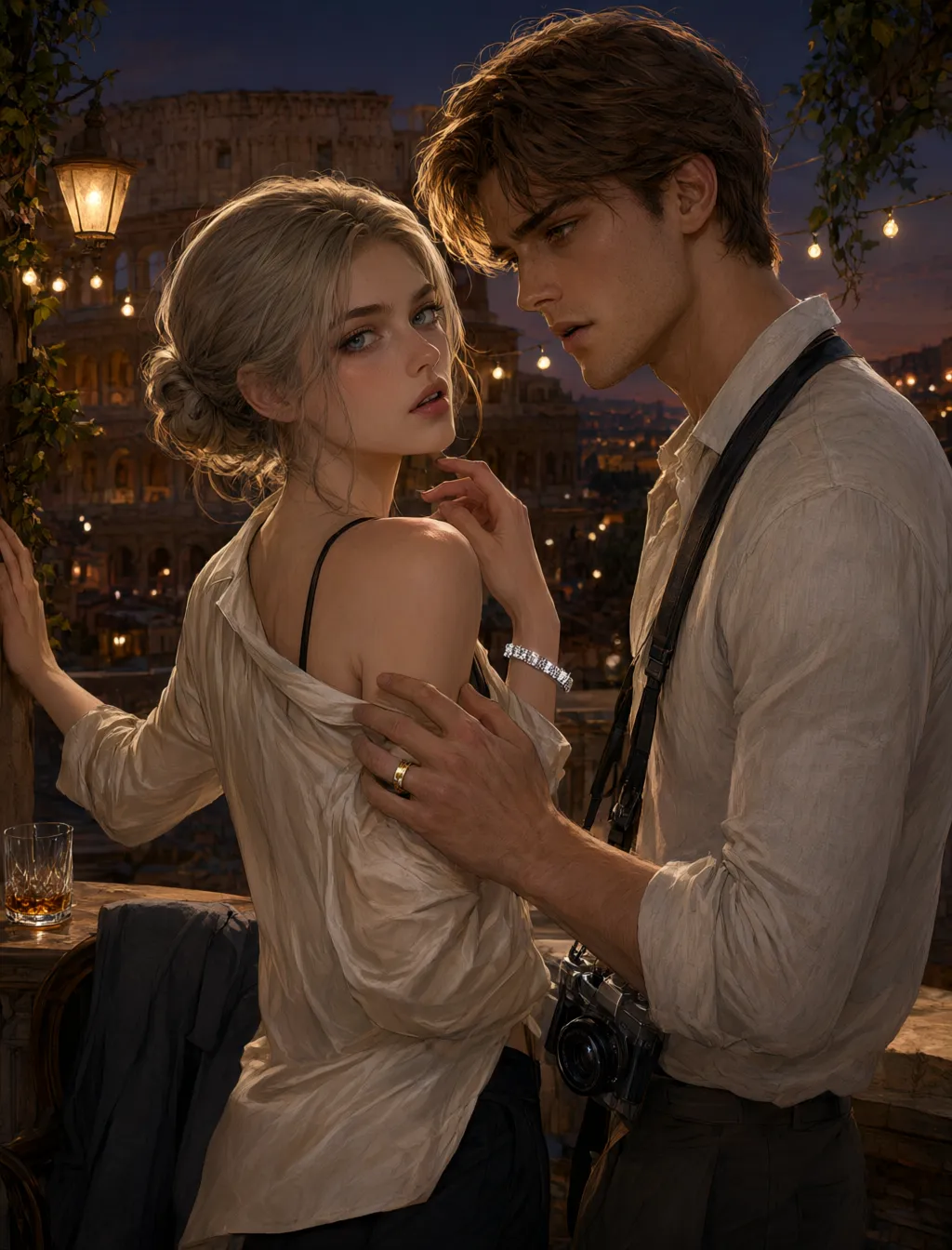
The camera strap slips from my fingers. The weight of it falling feels like permission.
Noah stands first. His hand stays open, palm up, waiting.
I take it.
His skin is warm against mine, a shock I feel in my throat. He doesn't squeeze, doesn't pull — just holds, letting me feel the calluses on his fingers, the way his thumb settles against my palm like it belongs there.
He leads me through the dim hotel corridor, the carpet muffling our footsteps. I don't ask where we're going. My hand in his feels like the only real thing in the world.
He stops at a door I've never noticed — plain, unmarked, tucked between a supply closet and a service elevator. He pulls a key from his pocket, the metal catching the hall light.
"What is this?"
"Darkroom," he says. "Converted it myself."
He opens the door.
The smell hits me first — damp heat, chemicals, something sharp and metallic. Then the light: red, deep, painting everything in blood and shadow. A single safelight glows above a metal counter lined with trays. Prints hang from a wire overhead, faces half-formed in the developer.
He steps inside. His hand still holds mine.
I follow.
The door closes behind us. The lock clicks.
The sound is quiet, but I hear it like a bell — my marriage ending in a language I didn't know I spoke. I don't turn around.
Noah stands in front of me, the red light carving his face into angles. His eyes are dark in this light, almost black, but I feel them on me — patient, waiting, asking nothing.
"Now you see it," he says quietly.
I look around the room — the trays, the prints, the chemical smell. "See what?"
He gestures with his free hand. "Where I live."
I let out a breath I didn't know I was holding. The red light makes everything look raw, honest, like the room has no secrets. I feel exposed in a way I can't name — not frightened, but close.
I look down at our hands. Still holding. Still warm.
"I don't know what to do with this," I say.
"Then don't do anything."
His thumb traces a slow circle on my palm. I feel it in my chest.
Outside, the hotel hums with its nighttime routines — room service, turn-down, the distant clatter of a cart. But in here, there's only the red light, the chemical smell, and the heat of his skin against mine.
I look up at him. His hazel eyes hold mine, steady, unhurried, like he has all the time in the world.
I don't let go.
I look at the prints hanging from the wire overhead. Faces half-formed, bodies emerging from chemical baths, moments caught in silver and shadow. A woman's laugh frozen mid-breath. A child's hand reaching for something off-frame. The grain of the paper makes everything feel raw, unfinished.
"Which ones are yours?" I ask.
Noah's thumb still traces my palm, slow circles that send warmth up my arm. He gestures with his chin toward a row of prints clipped to the line. "These. From last week. The Colosseum at dawn."
I step closer, and his hand slides from mine, fingers brushing as he lets go. The prints are landscapes — arches and ancient stone, light cutting through ruined corridors. But it's the shadows that catch me. The way he's captured darkness pooling in corners, light spilling through gaps like it's searching for something.
"You see things other people miss," I say.
"That's the job."
"No." I turn to face him. The red light paints his jaw, his throat, the hollow beneath his collarbone. "You see them differently. Like you're the only one who notices the way light moves."
He doesn't answer. His eyes hold mine, steady, and I feel the weight of his attention settle on my skin.
I look back at the prints. There's one half-submerged in a tray, the image still developing — a woman's silhouette against a window, her face blurred, her hand pressed to the glass. I recognize the angle of her shoulder, the way her hair falls.
"Is that me?"
Noah is quiet for a long moment. "Yes."
I stare at the image. My shape emerging from the chemical bath, still forming, still becoming. He saw me through a window. He saw me when I didn't know I was being watched.
"When?"
"Three nights ago. You were in your room. The light was on."
I remember that night. Damian was at a late dinner. I stood by the window, looking out at nothing, feeling the weight of another evening spent waiting.
"I didn't see you," I say.
"I know."
I reach toward the tray, my fingers stopping an inch from the chemical surface. The image of me swims in the liquid, not yet fixed, not yet real. "Why this one?"
He steps closer. I feel the heat of him at my back, not touching, close enough that I feel his breath on my shoulder.
"Because you weren't performing," he says. "You were just... there. Alone. Real."
My hand hovers over the tray. The red light turns my skin dark, unfamiliar, like I'm seeing myself for the first time.
"Can I see it when it's finished?"
"If you want."
I turn. He's so close I could count his eyelashes, the faint lines at the corners of his eyes. His hand rises, stops, hovers near my cheek. He doesn't touch.
"I want to show you," he says. "But I need you to tell me you're sure."
I don't look away. "Show me."
His fingers find my jaw, gentle, the calluses rough against my skin. He tilts my face toward the red light, studying me like I'm one of his prints — a moment worth capturing, worth holding.
"Stay still," he says.
I do.
Her fingers break the surface of the chemical bath. The liquid is cool, almost cold, and she feels the paper beneath her touch—slick, fragile, still becoming. She lifts it carefully, the excess chemicals streaming back into the tray, and holds the print up to the red light.
Her silhouette emerges slowly, like a memory rising from water. She's standing at the window in her hotel room, one hand pressed to the glass, the other at her collarbone—that restless gesture she thought no one noticed. The light catches the curve of her shoulder, the fall of her hair, the tension in her spine. She looks lonely. She looks real.
"You watched me for a long time," she says. Her voice is quiet, not accusatory.
"Long enough." Noah is still close, his warmth at her back. "Long enough to know you weren't going to turn around."
She doesn't ask how he knew. She doesn't ask how he got close enough to capture this without her hearing. She only looks at the image of herself—a woman she recognizes but doesn't know, a stranger she's been carrying for years.
"I look like I'm waiting for something," she says.
"You were."
She sets the print on the counter, edge of the developing tray catching the drips. Her hands are stained with chemicals now, the smell clinging to her skin. She doesn't wipe them. She wants to carry this scent out of this room, into the hallway, into her life—proof that she was here, that she touched something that was still forming.
Noah reaches past her and slides the print into a bath of fixer, gently. The image stabilizes, darkens, becomes a thing that can survive the light. She watches him work—economical, focused, his hands sure. When he lifts the print again, rinsed and steady, her face is clear: a woman alone in a window, her hand to her throat, her mouth slightly open, as if she's about to speak a word she hasn't yet found.
"Can I keep it?" she asks.
He looks at her. The red light deepens the hollows of his face, turns his eyes dark. "It's yours," he says. "It always was."
She takes the wet print from his fingers. The paper is damp, curling at the edges. She holds it carefully, her thumb pressing into the corner of the image, smudging the edge of her own shoulder. A flaw. A mark. Something she made.
"I want to remember this," she says, and she's not sure if she means the photograph or the room or the way his fingers brushed hers when he handed it over. But she says it anyway, and the words hang in the red air between them, still forming, still becoming real.