
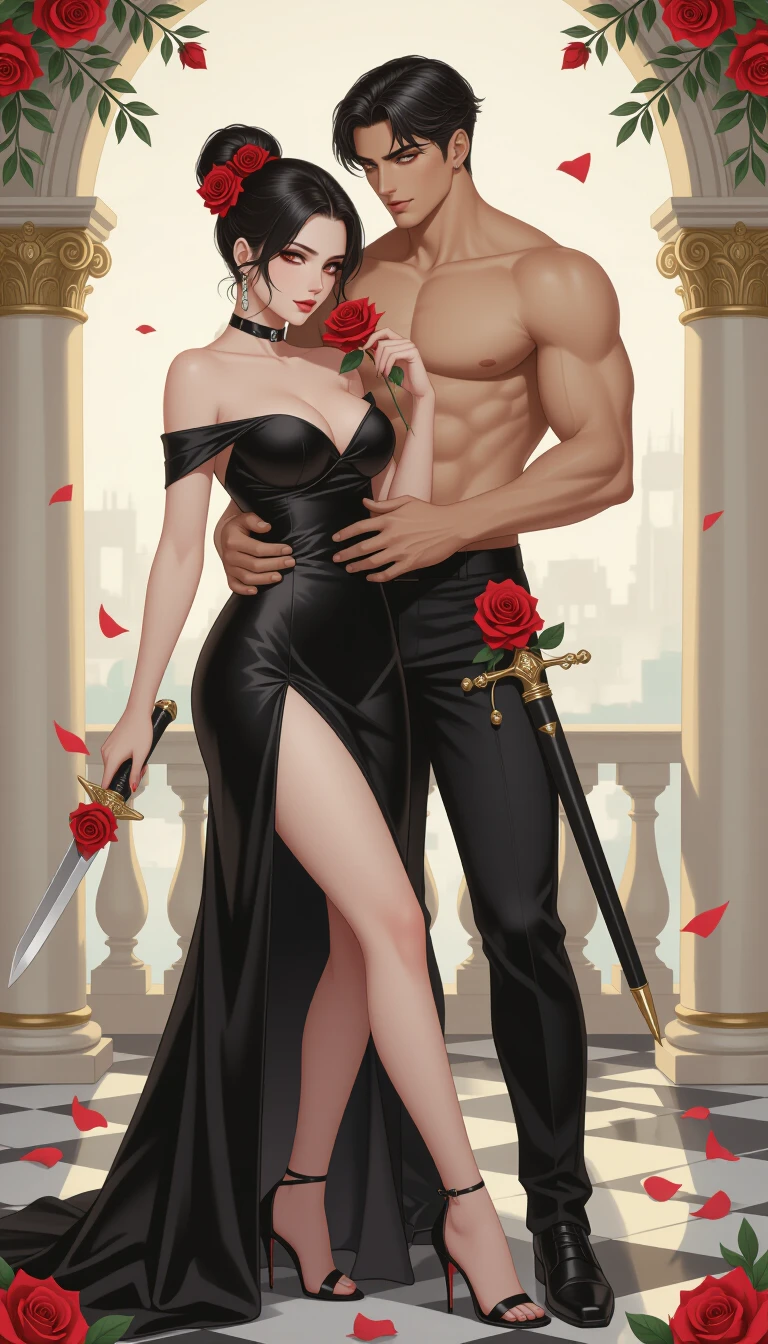
The marble chilled through the thin soles of my heels. Ice crept up through the silk, a cold reminder that I did not belong at this altar of graft and blood. Uncle Marco's fingers were damp on my elbow, his grip a sweaty apology that said everything his mouth had failed to say in the car. Sorry won't clear the debt you signed my name to.
Around us, the hall glittered with cut glass and the perfume of women who wore their husbands' money like armor. Crystal chandeliers, ten feet across, threw refracted light across white tablecloths and the black suits of men who had killed for a living. I knew their faces. I had studied their dossiers. Three of them had men I'd buried in unmarked graves, and not one of them recognized the woman in the black mask standing at the edge of their celebration.
Uncle Marco's hand tightened. I didn't flinch.
"Smile," he hissed under his breath, his voice cracking at the edges. His graying temples were slick with sweat, his ill-fitting suit straining at the shoulders. "Just—smile, nod, don't make eye contact. We get through tonight, and I can—"
"You can what."
He swallowed. Couldn't meet my eyes. "I can fix it."
The smell of cut flowers and expensive cologne pressed against me as we moved deeper into the crowd. Men with thick necks and thicker watches tracked my passage. Their gazes slid across the black silk of my dress, the hint of collarbone at my neckline, the flow of fabric that pooled at my ankles like a widow's train. They saw a woman in a mask. They did not see the knife strapped to my thigh.
Then the chattering stopped.
It happened in stages—first the nearest tables, then a wave of silence rolling outward, glasses pausing mid-lift, conversations dying in throats. The musicians faltered. A woman's laugh cut short.
Scara's voice sliced through the hush. Low. Certain. A command dressed as a question.
"That woman. Bring her to me."
I felt the weight of his gaze before I located him. He stood at the head of the room, half a step from the altar where another woman should have been waiting. Tall, broad-shouldered, raven-black hair swept back from a face that belonged on a wanted poster in a museum. His indigo eyes fixed on mine. There was no wedding band on his hand. No bride at his side.
Uncle Marco's grip turned desperate. "Don't—don't make a scene. Please, Rose. Just—"
I didn't move. I held Scara's stare.
He was already crossing the room.
The crowd parted like water. Men who commanded armies of their own stepped aside, eyes lowering, as he strode toward me with the unhurried certainty of someone who had never been refused. His black suit was immaculate, cut to follow the breadth of his shoulders, the taper of his waist. A man who paid for precision. A man who expected perfection in return.
He stopped in front of me.
"Remove the mask."
Not a suggestion. His hand rose, and I let him take the edge of the silk between his fingers, let him lift it away. The cool air hit my cheeks. His indigo eyes widened by a fraction—recognition? Suspicion? I couldn't read it. His thumb brushed my jaw. The touch was casual, proprietary. A man examining a purchase.
"Your uncle's debt," he said, his voice dropping to something meant only for me. "Fifty million. Two months overdue." His thumb traced the line of my cheekbone, then fell away. "He offered you as collateral. I thought he was lying."
I said nothing. Uncle Marco's breathing had gone fast and shallow beside me.
Scara's hand found my lower back. The heat of his palm seared through the silk as he guided me forward, his fingers spread wide, possessive, herding me toward the raised dais where the wedding cake stood untouched. The entire room watched. The hunger in their eyes was a weight I could feel—every man in this hall had paid fortunes for the fantasy of one night with Black Rose, and not a single one knew she was the woman in their midst.
He pulled me onto the stage.
The orchestra had stopped entirely. A hundred faces turned up to us, and Scara's hand pressed into my spine as he faced the crowd. When he spoke, his voice carried to every corner of the cavernous room, the voice of a man who had never needed a microphone.
"Gentlemen. Ladies. It seems my wedding will proceed after all."
A murmur rippled through the hall. Scara's smile didn't reach his eyes.
"Allow me to introduce my fiancée."
The word landed like a blade in the silence. I felt the crowd's focus sharpen, felt the jealousy and hunger and calculation in their stares. Uncle Marco stood frozen at the edge of the dais, his face the color of ash.
I held the smile. Light. Demure. A sweet woman playing her part behind a mask that was no longer made of silk.
But beneath the black hem of my dress, my fingers brushed the rose-shaped knife pressed against my thigh.
"I said, Mr. Scara." My voice came out flat. Measured. The same tone I used when I slid a blade between a man's ribs and watched his eyes go wide and empty. "I am not in this marriage. I'll pay the debt right now." I let each syllable land like a coin on marble. "So. Let. Me. Go."
His hand was still on my lower back. The heat of his palm had not moved, had not faltered. If anything, it pressed deeper, fingers spreading, claiming territory his voice had already marked. His indigo eyes held mine, and something shifted behind them—a door opening onto a room I hadn't seen him enter.
"Pay the debt." He said it slowly, tasting the words. "With what, exactly?"
I reached into the fold of my dress. The room tensed—I felt it in the sharp inhales, the scrape of chairs, the hands sliding toward concealed weapons. Scara didn't flinch. His eyes stayed on my face as my fingers found the thin platinum card tucked against my thigh, warm from my skin, and held it up between two fingers.
"Fifty million. Untraceable. Certified." I let the card catch the chandelier light. "Your men can verify it in thirty seconds. The debt clears tonight. I walk out that door, and you never see me again."
Silence. The hall held its breath.
Scara looked at the card. Then at my face. Then back at the card. A smile touched his mouth—not the polished thing he'd worn for the crowd, but something slower. Darker. A crack in the mask he'd been wearing all night.
"You're not what I expected."
"You don't know what I am."
"Don't I."
He plucked the card from my fingers, but he didn't look at it. His thumb brushed my knuckles, once, a touch that lingered a breath too long. Then he turned to the man at his right—a thick-necked lieutenant with a scar splitting his eyebrow—and handed him the platinum rectangle without a word. The lieutenant vanished into the crowd.
The hall began to murmur. Men who had been frozen in their seats found their voices, low and speculative. Women fanned themselves, eyes darting between Scara and me. I felt their attention like a spotlight, hot and unforgiving.
I did not move. I did not blink.
Uncle Marco had gone the color of old paper. He stood at the edge of the dais, his hands clasped in front of him, knuckles bone-white. He opened his mouth. Closed it. I did not look at him.
Scara stepped closer. Close enough that I caught the scent of him—cedar, smoke, something metallic beneath. His voice dropped, intimate and certain, meant only for me. "Fifty million is a lot of money. But I've been wondering all night what kind of woman walks into a wedding wearing a black mask and a dress that looks like a funeral."
"I didn't come to be studied."
"No. You came to disappear." His hand rose, and this time he didn't touch my face. He touched the silk rose pinned in my hair. His fingers brushed the petal, gentle, almost reverent. "But I don't think you're the disappearing kind."
I held his gaze. "The debt will be confirmed. Then I leave."
"And if I say no?"
The floor went quiet beneath us. I felt the weight of the question land, heavy and deliberate, and I let my hand drift to the hem of my dress. My fingers found the knife strapped to my thigh—the familiar weight, the carved rose handle, the blade that had ended seventeen lives.
"Then I'll leave anyway."
Scara's smile widened. It did not reach his eyes. "You're threatening me. In my own hall. In front of a hundred men who would kill for the chance to prove their loyalty."
"I'm not threatening." I kept my voice even. "I'm informing."
The lieutenant returned. He leaned close to Scara's ear, murmured something too low for me to catch. Scara's expression didn't change, but his eyes—those indigo eyes—went dark. Hungry. The look of a man who had just realized he'd been chasing the wrong prize all night.
"The card is clean," he said. "Fifty million, exactly. Untraceable, exactly." He tilted his head, studying me like a painting he'd just appraised at triple its value. "Which means you're not just some woman your uncle dragged in to settle a debt. You're the woman who has fifty million to throw at a debt that wasn't even yours."
I said nothing.
"Who are you?"
I could have lied. Could have given him a name that meant nothing, let the mask settle back into place, walked out of this hall and into the night. It would have been clean. Simple. The way I always worked.
But I was tired of masks.
"Rose." I let the name land. Watched recognition flicker in his eyes—the widening, the sharp intake of breath, the way his hand tightened at his side. "They call me Black Rose."
The name landed like a blade thrown into the center of the hall. For one breath, nothing. Then—chairs scraped marble. Crystal shuddered in its settings. Men rose from their tables as if pulled by invisible wires, their faces cycling through shock, recognition, and something far uglier. Hunger. I felt it wash over me in waves—a hundred pairs of eyes stripping the silk from my body, imagining what they would do with the woman who had killed their best men, their rivals, their sleeping guards.
Scara did not move. But his hands—both of them now—came up to frame my face, thumbs tracing the line of my jaw, gentle and possessive all at once. His indigo eyes had widened, pupils blown, swallowing the color until they were nearly black. He drank me in like a man who had just found water in a desert.
"Black Rose," he said. Not a question. A confirmation. His voice scraped low, raw. "I've heard the stories. Seventeen kills. Never a witness. Never a trace." His thumb pressed against my lower lip, just enough to feel the warmth. "I thought they were exaggerating."
I held his gaze. Did not pull back. Did not flinch.
The lieutenant at his side had gone still, hand hovering near his holster. The other men in the hall had started to shift—whispers spreading like fire through dry grass. A few hands crept toward jackets, toward concealed weapons, toward the dark shapes at their hips. The air thickened with violence waiting to happen.
"You're all thinking the same thing," I said, loud enough for the front rows to hear. "You're wondering if you could take me. If I'm really that good. If the price on my head is worth the risk."
A man near the front—broad, scarred, with rings on every finger—rose from his seat. His hand wasn't at his weapon. It was at the woman beside him, fingers tightening on her arm. His eyes never left my face.
Scara's voice cut through the murmur like a blade. "Anyone who touches her dies." He didn't turn. Didn't raise his voice. Just let the words settle, heavy and absolute. "Not by my hand. By hers. And I would very much like to watch."
The hall went silent.
His eyes found mine again, and beneath the hunger, something else surfaced. Possession. Not the casual claim of a man buying a woman—the deeper, darker certainty of a man who had just realized what he'd been missing his entire life. His hand slid from my face to my shoulder, fingertips trailing down my arm until they found my hand. He lifted it, turned it over, ran his thumb across my palm where a thin scar bisected the lifeline.
"Seventeen men," he murmured, tracing the scar. "And not a mark on those red eyes of yours." He looked up. "What does it feel like? Knowing you're the most dangerous woman in this room?"
I didn't answer. But my fingers tightened on the knife at my thigh.
His smile was slow, devastating. "You still think you're leaving."
"I paid the debt."
"Forget the debt." He stepped closer until there was no air between us, until I could feel the heat of his chest through the silk, until his voice was a whisper meant only for me. "I want you as my real wife. No contracts. No terms. Just you—in my bed, in my life, under my name."
Behind him, the hall erupted. Men shouting, chairs overturning, the scrape of metal against leather as weapons cleared holsters. Uncle Marco's voice cut through—high, desperate—but I didn't hear his words. I was watching Scara's eyes, and I saw the moment he decided that every man in this room was a threat to what he had just claimed.
He turned. Slowly. Faced the hall. His voice, when it came, was ice wrapped in steel. "The wedding is off. The bride is mine. Anyone who disagrees can leave through the window."
No one moved.
His hand found mine again, and he pulled me off the dais, through the frozen crowd, toward a door I hadn't noticed before. His grip was iron. His steps did not falter.
And I—Black Rose, seventeen kills, no witnesses—let him.
I moved before my mind caught up.
One breath—Scara's hand warm on mine, his indigo eyes locked on my face, the promise of something dark in his voice. The next—my body remembering what it was before this night, before the silk and the mask and the false smile. My fingers twisted, broke his grip, and I was gone.
The heels should have slowed me. They didn't. I'd learned to run in them on rooftops, through alleys, across marble floors slick with blood. My dress whispered behind me like a second skin as I weaved between tables, ducking under a server's tray, leaping over a fallen chair. Behind me, the hall erupted—shouts, the scrape of shoes on stone, the unmistakable click of safeties being released.
I didn't look back.
A man lunged from my left—broad, scarred, rings on every finger. His hand reached for my arm. I sidestepped, caught his wrist, used his momentum to spin him into a table. Crystal shattered. White linen tore. He went down in a tangle of shattered glass and his own surprised grunt. I was already past him, my pulse steady, my breath even.
They always forgot how fast I was.
The front doors loomed ahead, massive oak panels banded with iron. Locked, probably. I didn't slow. I veered right, toward a service door half-hidden behind a velvet curtain. My hand found the handle, pulled—locked. Of course. I kicked the frame just below the handle, once, twice, and the wood splintered with a sound like a gunshot.
I was through before the third impact settled.
Darkness. A narrow corridor. The smell of dust and old wine. I ran, my heels clicking on stone now, the sound too loud in the silence. Behind me, the door groaned—someone had reached it. I rounded a corner, found a staircase leading down. I took it three steps at a time, my hand brushing the wall for balance.
At the bottom, a wine cellar. Racks stretching into shadow, bottles glinting in the dim light from the stairwell. I ducked between two racks, pressed my back against the cool stone, and finally—let myself breathe.
The silence settled. My heartbeat slowed. I reached down, touched the knife at my thigh. Still there. I pulled it free, the rose-etched blade catching the faint light. Seventeen kills. No witnesses. I had never run from a fight before.
I was running now.
Above, footsteps. Distant. Searching. A voice—low, calm, carrying through the walls. Scara. "She went toward the cellars. Close the exits. No one leaves until I find her."
I closed my eyes. The silk of my dress was cool against my skin. The blade in my hand was warm from my grip. I could fight my way out. Could kill half his men before they realized what was happening. Could leave this place and never look back.
But his eyes. Those indigo eyes, hungry and certain, had seen through every mask I wore.
And I had let him pull me through that door.
I opened my eyes. The footsteps were closer now. I tightened my grip on the knife and waited.
The cold stone pressed against my back through the silk. Above, footsteps moved in a pattern—organized, methodical. They were sweeping the cellar row by row. I had maybe two minutes before they reached this aisle.
I could kill them. All of them. The wine racks would be tight quarters for my knives, but that worked in my favor—they couldn't bring more than two men down here at once. I counted the bottles on the nearest rack. Seven. Enough for seven more bodies tonight. My uncle's debt didn't cover that kind of mess.
But Scara's words kept surfacing. I want you as my real wife. No one had ever looked at me like that—like they had found something they didn't know they'd been searching for. The hunger in those indigo eyes wasn't the same as the other men's. Theirs was transactional. His was personal.
A boot scraped stone. Close now. Ten feet away, maybe less.
I shifted my grip on the knife, settled into the balls of my feet, and waited. The first man rounded the corner with a flashlight in one hand and a gun in the other—raised, ready. He saw me. His mouth opened to shout.
My knife was already in his throat.
He gurgled, dropped the gun, and I caught it before it hit the floor. I eased his body down behind the rack, retrieved my blade, and wiped it on his jacket. One down. The gun I tucked into the waistband of my dress—heavy against my hip, unfamiliar weight. I preferred my knives, but I wasn't stupid enough to leave a weapon behind.
"Patrizio?" A voice from the far end of the aisle. "You found something?"
I didn't answer. I melted deeper into the shadows, counting footsteps. Two more, maybe three. They'd sent a team.
The second one appeared, cautious now, his flashlight sweeping left and right. It caught the blood on the stone floor before it found me. His eyes went wide, and I saw him reach for his radio. I threw. The knife took him in the chest, just below the collarbone—not instantly fatal, but enough to drop him. His radio clattered across the floor, squawking static.
I was already moving, retrieving my blade from his body. Behind me, the door at the top of the stairs creaked open.
"Get back. She's armed." Scara's voice. Calm. Almost amused. "I said find her, not die for her."
I pressed my back against the nearest rack, gun in my hand, knife in the other, breath slow and even. There was a window. High up, near the ceiling, a grimy rectangle of moonlight barely visible through cobwebs and dust. Too small for me to squeeze through, even if I could reach it. This cellar was a trap. Designed that way, probably—a place where guests were safe but prisoners weren't.
But I had been worse places. And I still had six bullets.
I chambered a round. The sound was loud in the silence. "You want me so badly, Scara?" My voice carried through the cellar, steady, cold. "Come down here yourself."
Silence. Then his laugh—low, warm, like we were sharing a private joke. "Darling. If I come down there, I won't let you leave. Are you sure you want that?"
My finger tightened on the trigger. He was baiting me. Trying to make me angry, careless. I had killed men for less. But his voice did something to my chest—a flutter I didn't invite and couldn't name. I forced the feeling down, locked it somewhere deep.
"I've killed seventeen men," I said. "Your men count as eighteen through twenty-four if they don't move."
The footsteps stopped. A different voice—anxious, urgent—murmured something I couldn't catch. Scara's response was too quiet for me to hear. Then a new sound: glass breaking. I tensed, scanning the darkness for movement.
Gas. Something sweet-smelling flooding the cellar. I'd been gassed once before, three years ago in a Moscow hotel. I didn't plan on being gassed again.
I dropped the gun, found the hem of my dress, tore a strip from the lining. Wet it with wine from a broken bottle I kicked over. Pressed it over my nose and mouth as the gas curled through the aisles—thick, white, smelling of flowers I couldn't name.
My eyes burned. I blinked, forced them open. Stay sharp. Stay awake.
Through the fog, a shape moved. Tall, broad-shouldered, unhurried. Scara walked through the gas like he owned it, like it recognized him. His eyes found mine through the haze, and he smiled—slow, devastating, certain.
"Well, well, well," he said, stepping closer. "Better luck next time catching me."
"Better luck next time catching me," he said, stepping closer through the fog.
I opened my mouth to answer, to slice him with something cold and sharp, but my knees gave a warning tremor—a small betrayal beneath the silk. The gas. I'd been breathing it longer than I should have, the wine-soaked cloth only a partial defense. I locked my legs, steadied myself against the wine rack, and kept my face blank.
"Did you really think a little smoke would stop me?" I let the words come out steady, unhurried, even as I felt the floor tilt slightly beneath my heels.
His smile widened. He knew. Those indigo eyes missed nothing, tracked the micro-flinch in my fingers, the breath I took half a second too deep to compensate.
"You're swaying, darling." He said it gently, almost tenderly, and that was the worst part—he sounded like he actually cared.
I pushed off the rack and forced myself upright. "Tsk. I didn't think you'd play this dirty trick just to get me." I let the words hang, a lash of dismissal. "But... not so fast."
I saw the window in my peripheral vision. High, grimy, small. But—wait. Not that one. Behind me, four rows down, a larger cellar window I'd noted when I first came down here. Propped open with a rusted pipe, just wide enough for a woman's shoulders if she turned sideways.
I didn't look at it. Didn't change the angle of my body. I let my gaze stay locked on Scara, let my hand stay visible on the knife, let him believe I was calculating my last stand.
He took another step closer. The gas curled around his shoulders like a living thing, and he didn't even blink. "I have men at every exit. Every window. Every drain. You're not leaving this cellar, Rose—not on your feet."
My name in his mouth. He'd never said it before. It landed somewhere I didn't want it to.
I took one step backward. Then another. Letting my knees wobble more than they needed to—making him believe the gas was winning.
His head tilted. "You're not as steady as you sound."
"I don't need steady," I said. "I need one second."
I threw the knife. Not at him—at the chandelier above his head. The one I had noticed on my way down, the rusted chain holding it to the beam. The blade struck true, the chain snapped, and crystal and metal crashed down between us—a wall of noise and shattered glass.
He didn't flinch. But he had to raise an arm to shield his face, and that was the second I needed.
I turned and ran. Three strides to the window. I grabbed the rusted pipe, yanked it loose, and hauled myself onto the sill. The opening was tight—the frame scraped my ribs through the silk, snagged my bun, pulled a rose loose—but I twisted, forced my shoulders through, and then I was falling.
Three stories of open air. No rope. No net. Just the wind tearing at my dress, my hair whipping loose from the bun, the ground rushing up—
I hit the awning of the first-floor window, rolled with the impact, felt the fabric rip under my weight. The second-floor awning caught me next, softer, and I used it to redirect—a controlled fall into the garden bed below. I landed in a crouch, heels sinking into wet earth, and came up running.
Behind me, the wedding hall erupted. Shouts. Orders. Something that might have been Scara's voice—low, furious, and somehow still amused.
I didn't look back. I hit the street, slipped into the alley between two buildings, and let the shadows swallow me whole. Two blocks later, I flagged a cab, gave the driver an address across the city, and let my head fall back against the seat.
My hand was shaking. A fine, barely perceptible tremor I couldn't stop.
The key turned in the lock with a familiar click—the sound of safety, of walls that knew my name without asking for it. I pushed the door open and stepped into the narrow hallway of the safe house, letting it swing shut behind me. The deadbolt slid home with a thud that echoed through the empty space.
I stood there for a long moment, forehead pressed against the cool wood, listening to my own breathing. Too fast. Too shallow. I forced it slow, counting the beats: in for four, hold for four, out for four. The discipline of a body I had trained to obey me, even when the rest of me wanted to shake apart.
The safe house was small—a studio apartment in a building that didn't officially exist, leased through three shell companies and paid in cash that left no trail. A single bed in the corner, a kitchenette with chipped tiles, a bathroom barely big enough to turn around in. Nothing personal. Nothing that could be traced. I had chosen this place for its emptiness, for the way it asked nothing of me.
Tonight, the emptiness felt like a mercy.
I crossed to the bed and sat down on the edge, my heels still on, the torn hem of my dress pooling around my ankles. The rose that had fallen from my bun was gone, left behind somewhere in the cellar or the garden. I would have to buy new ones tomorrow—or let my hair stay loose, which I hated. Loose hair was something that could be grabbed. A handle for an enemy to use.
My hands were still trembling. I looked at them—pale, slender, the hands of a woman who had killed two dozen men and never lost sleep over any of them. They were shaking now over one man who had looked at me like I was the only thing in the room worth seeing.
I pressed my palms flat against the mattress and held them there until the trembling stopped.
The gas was still in my lungs, I could feel it—a faint sweetness at the back of my throat, a soft heaviness in my limbs that made me want to lie down and close my eyes. I fought it. I had work to do. I needed to check the perimeter, review the security feeds, make sure I hadn't been followed.
But the bed was soft. The room was dark. And for the first time in hours, no one was watching me.
I reached up and pulled the remaining rose from my bun, letting my hair fall in a dark curtain around my shoulders. The pins followed, one by one, until my scalp ached with the release of tension. I had worn that bun since noon—eleven hours of holding myself together, of being watched and wanted and hunted—and now I let it all fall apart in the privacy of this empty room.
Scara's voice echoed in my memory: I want you as my real wife.
Not a question. A declaration. The kind of sentence that didn't leave room for negotiation because the man speaking it had never learned the word no.
I should have killed him when I had the chance. In the cellar, before the gas, before the window, before he said my name like he had been saving it for years. I could have thrown the knife at his throat instead of the chandelier. I had the angle. I had the speed. I had everything I needed except the will to pull the trigger.
And he knew it. He had seen it in my eyes, that half-second of hesitation, and he had smiled like he had won something I didn't know I was betting.
My hands were shaking again. I closed my eyes and let myself fall backward onto the bed, the thin mattress catching me with a sigh of old springs. The ceiling was cracked, water-stained, familiar in its ugliness. I had stared at it on a dozen other nights, after a dozen other jobs, and it had never failed to ground me. Tonight, it looked back at me like a stranger.
I reached under the pillow and found the knife I kept there—rose-shaped, balanced perfectly, the blade cool and reassuring against my palm. My fingers closed around the handle, and the trembling stopped.
I was alive. I was home. I was still the most dangerous woman in the city.
But somewhere across the streetlights and the river, in a wedding hall still glittering with shattered crystal and the scent of gas, a man with indigo eyes was thinking about me. And I had the cold, sinking feeling that I had not seen the last of him.
My phone buzzed on the bedside table. A number I didn't recognize. I let it ring, watching the screen glow in the dark, until it stopped.
The silence that followed was heavier than the sound.
The torn silk had ridden up my thigh—a long split from the cellar escape, the black fabric gaping open to reveal pale skin and the edge of the garter strap I wore to keep my knife holster in place. I noticed it in the dim light filtering through the curtainless window, the way the rent in the fabric exposed the curve of my hip, the line of muscle I had earned through years of rooftop sprints and close-quarters kills.
I didn't bother pulling it down. There was no one here to see.
The ceiling was still cracked. The bed was still too thin. The silence was still pressing in on all sides like a held breath. I let my eyes drift half-closed, the knife still warm in my grip, the gas still faintly sweet in my lungs—and then the light flickered.
Once. The bulb in the kitchenette buzzed, dimmed, and flared back to full brightness. I was already moving, my body responding before my mind caught up—legs swinging off the bed, fingers tightening around the blade, every nerve wired for the threat that hadn't come yet.
The light flickered again. This time, it stayed dim. A long, dying buzz, like something electrical had been cut. Then the bulb went dark, and the room fell into black so absolute it felt solid, pressing against my eyes like a hand.
I didn't breathe. I listened. The safe house had no windows I could see through from this angle—just the one above the bed, and the darkness was complete enough that even my night-trained eyes couldn't find the edges of the room. I heard nothing. No footsteps. No breathing. No creak of floorboards.
But I felt him.
The air changed. That subtle shift in pressure that comes when someone enters a space—not through the door, not through the window, but through the dark itself, like he had been waiting in the shadows longer than I had been lying in that bed.
"Finally got you, darling."
The voice came from behind me. Low. Smooth. Amused in a way that made my blood run cold and hot at the same time. Scara's voice, unmistakable—the same velvet menace from the wedding hall, the same possessive hunger that had curled around my name like a brand.
I moved. My body knew the geometry of this room—the bed three steps behind me, the kitchenette to my left, the door six strides ahead. I lunged forward, my hand already cocked back to throw the knife—
And something caught my wrist. Not a hand. A cord, thin and strong, wrapping around my forearm with a speed that felt rehearsed, like he had practiced this exact move a hundred times. I twisted, tried to bring my other hand up, but the cord was already there, looping around my elbow, my shoulder, pulling my arm back and down in a motion that felt almost gentle—until I couldn't move it anymore.
"Shh," he breathed, close to my ear now. I could smell him—cologne, something dark and expensive, and beneath it the clean scent of soap and the faint metallic tang of blood. "Don't make me hurt you."
I kicked backward, aiming for his knee. My heel caught something solid—his shin, maybe—but he didn't grunt, didn't stumble. Instead, the cord tightened around my other arm, pinning it to my side, and I felt myself being lifted, turned, guided backward through the dark with a precision that spoke of too much practice. The chair hit the back of my knees—the wooden chair I kept at the kitchen table, the one I had eaten at a hundred times alone—and I was being pushed down into it, the cord winding around my chest, my waist, my wrists, binding me to the frame with a speed that left no room for resistance.
I bit down on the inside of my cheek, hard, tasting copper. My hands were pinned behind the chair back, the knife still in my grip but useless now—I couldn't angle it, couldn't reach the cord, couldn't do anything but sit there in the dark, breathing hard, while Scara's warmth settled behind me.
"There," he said, and I could hear the smile in his voice. "That's better."
A match flared. I blinked against the sudden light—small, golden, illuminating his face from below as he lit a candle on the table beside me. The flame steadied, casting long shadows across the room, and I saw him clearly for the first time since the wedding hall.
He was still in the black suit, though the jacket was gone and his sleeves were rolled to his elbows, revealing forearms corded with muscle and a thin line of dried blood along his right wrist—from the shattered window, probably, or the glass I had rained down on him. His hair was slightly disheveled, a dark lock falling across his forehead, and his indigo eyes caught the candlelight like oil on water.
He was looking at me the way I had looked at targets before a kill. Complete. Unhurried. Certain.
"You're harder to catch than I expected," he said, pulling the other chair from the table and settling into it across from me, close enough that his knees almost touched mine. "I respect that."
I said nothing. My eyes tracked the room, cataloging exits, weapons, anything I could use. The knife was still in my hand, but the cord was too tight—I couldn't twist it toward the rope. The window was behind him. The door was to my left, but he was faster than me, and I knew it.
He followed my gaze and smiled. "I wouldn't."
"What do you want?" My voice came out flat. Controlled. The voice I used on jobs, when the target was still breathing and I was deciding where to put the blade.
Scara leaned back in his chair, crossing one ankle over his knee. The candlelight flickered across his face, catching the sharp line of his jaw, the dark amusement in his eyes. "I told you at the wedding. I want you as my wife."
"I declined."
"You ran." He said it like it was the same thing. "But running isn't declining, darling. It's just postponing the conversation."
I tested the cord around my wrists—a fraction of a millimeter of give. Not enough. "This isn't a conversation. This is a kidnapping."
"Semantics." He reached into his pocket, and I tensed, but he only pulled out a folded piece of paper—cream-colored, expensive, the kind of stationery that came in monogrammed sets. He unfolded it and held it up to the candlelight. "Your uncle's debt. Fifty million. Paid in full, by the way—I had my accountant transfer the funds this morning. Consider it a wedding gift."
My jaw tightened. "I told you I could pay it myself."
"I know." He set the paper down on the table between us, smoothing the creases with his thumb. "But I didn't want your money, Rose. I told you that too."
The way he said my name—soft, deliberate, like he was tasting it—made my skin prickle. No one called me Rose. Not anymore. I had buried that name years ago, along with the girl who had worn it.
"You don't know me," I said.
"I know enough." He leaned forward, elbows on his knees, the candlelight casting his face in sharp relief. "I know you killed Victor Chen three years ago with a single knife throw from forty meters. I know you took out the Marchetti brothers in a single night, left them in their own wine cellar with roses in their mouths. I know every mafia boss in this city has a picture of you in a drawer somewhere, and half of them have tried to find you. I know you've been untouchable for seven years."
He paused. His eyes dropped to the torn silk on my thigh, the pale skin exposed by the rip in the fabric. The candlelight caught the edge of the garter, the shadow of the knife holster beneath it.
"And I know you're the most dangerous woman I've ever met," he said, his voice dropping lower, rougher. "Which is exactly why I'm not letting you go."
I saw where his eyes went. Down. To the torn silk on my thigh, the pale skin exposed by the rip, the edge of the garter and the shadow of the knife holster beneath it. His indigo eyes stayed there a beat too long, and something flickered in their depths—not surprise, not concern. Hunger.
"Pervert," I said, and the word came out flat, cold, the same voice I used on targets. But my pulse had shifted, a fraction faster, and I hated that he might see it.
Scara's gaze lifted to mine slowly, unhurried, and the smile that touched his lips wasn't apologetic. It was pleased. "I'm not pretending to be a gentleman, Rose. I never have been."
The candlelight carved shadows across his face, and in the flickering dark, the sharp line of his jaw looked almost cruel. He didn't look away. He held my eyes with that same unhurried certainty, and the silence between us stretched, loaded with the weight of everything unsaid.
"You broken into my home," I said, my voice steady even as my hands stayed useless behind the chair. "Bound me to a chair. Paid a debt I told you I could clear myself. And now you're staring at the tear in my dress like it's a meal." I paused. "What part of this is supposed to convince me you're anything but a predator?"
"The part where I'm honest about it." He leaned forward, elbows on his knees, the candlelight catching the dark amusement in his eyes. "I am a predator. And I have chosen my prey."
His voice dropped on the last word, rougher, lower, and I felt it settle somewhere deep in my chest. A shiver that had nothing to do with cold.
I forced myself to hold his gaze. "You're going to regret this."
"I don't regret anything, darling." He reached out, and I tensed, but he only picked up the candle, tilting it so the light fell across my face. "I don't make mistakes. I make decisions."
"This is a mistake."
"Then it'll be my first." He set the candle back down, and for a moment, the heat of it was close enough that I could feel it on my skin. "Tell me something, Rose. How many men have tried to own you?"
I said nothing. My jaw tightened.
"How many have tried to cage you, chain you, keep you?" He leaned back in his chair, studying me with those indigo eyes. "Every mafia boss in this city. Every one of them has a fantasy, a plan, a bid. And you've killed three of their best men." He smiled again, and this time it was sharp, edged with something that looked almost like admiration. "I know. I checked."
"Then you know I'll find a way out of this."
"I know you'll try." He tilted his head, and the candlelight caught the dark strands of hair falling across his forehead. "And I'm counting on it."
The words landed strange. Not a threat. A promise. He wanted me to fight. He wanted the chase.
I looked down at the cord around my wrists, the knife still in my grip, useless. My fingers ached to move, to twist, to find the angle that would cut me free. But the cord was too tight, too precise—he had done this before. Many times.
"You have me at a disadvantage," I said, forcing the words through my teeth. "You know who I am. I know nothing about you except that you're obsessive and you have bad taste in suits."
He laughed. The sound was low, genuine, and it caught me off guard—a crack in the mask I hadn't expected. "My suits are Italian, darling. And you know more about me than you think. You know I found your safe house. You know I brought a cord instead of a gun. You know I paid your uncle's debt before I came here." He paused. "What does that tell you?"
I stared at him. The candlelight flickered, casting long shadows across the kitchen wall, and I felt the shape of the answer forming in my chest.
"It tells me you're patient," I said slowly. "That you planned this. That you didn't want to hurt me."
"Good girl." His voice was soft. "Keep going."
The praise was a hook, sinking into something I didn't want to name. I ignored it. "It tells me you want something from me that isn't just the body. That you're playing a longer game."
"And what game is that?"
I met his eyes. The candlelight caught the red of my own, and I saw his pupils dilate, a fraction, a tell he couldn't control.
"You want me," I said, "because I'm the one thing you can't buy."
He held my gaze for a long moment—and then he smiled, slow, devastating, the light catching the full force of it.
"That's exactly it, Rose." He reached across the table, and before I could pull away, his fingers brushed my jaw, tilting my face toward the candle. "I don't want a wife who has to love me. I don't want a woman who has to pretend." His thumb traced the line of my jaw, featherlight, and I felt the touch like a brand. "I want the one who will make me earn it."
The room was silent. The candle flame trembled. And somewhere in the dark beyond the window, the first car door slammed shut. Heavy. Deliberate. Too close to be coincidence.
Scara's eyes flicked to the window, and his hand dropped from my face. The amusement in his expression sharpened into something harder, colder.
"Company," he said. "And they're not here for the candlelight."
The car door slammed, and the sound cut through the kitchen like a blade. Scara's indigo eyes flicked to the window, the amusement bleeding out of them, replaced by something colder, more calculating. He didn't move for a long breath—just listened, his head tilted, the candlelight carving shadows across his sharp jaw.
I watched him, and for a second, the walls of the room fell away. I was five again, curled behind the sofa in the hallway of my childhood home, listening to the wet thud of bodies hitting the floor. The smell of iron. Mother's scream cut short. I had buried that girl so deep I forgot she existed, but something in the stillness of this moment—the silence before violence—dragged her back to the surface. A flicker. A crack in the ice. I felt it pass across my face before I could stop it.
Scara turned back to me. His eyes caught the candlelight, and they were not the eyes of a predator anymore. They were sharper—like he had seen something he hadn't expected. A fissure in the marble. He didn't speak, but his gaze lingered on my face a beat too long, and I knew he had seen it. That flash of the girl I used to be.
I looked away first. It was the first time I had broken eye contact since he bound me to this chair.
"How many?" I asked, forcing my voice flat. "How many men did you bring?"
"Only two," he said, but his voice had dropped, softer somehow, and I hated that it made something in my chest tighten. "One at the front. One at the back. They're not mine anymore."
Footsteps. Heavy. Coming around the side of the house. Not trying to hide.
Scara stood in one fluid motion, his hand disappearing inside his jacket. He moved to the window, his shoulder blocking my view of the driveway, and I heard him exhale a quiet curse. "Not your friends," he said. "Not mine either."
The kitchen door—the one leading to the garden—rattled in its frame. Once. Twice. Then a shoulder hit it, and the wood groaned.
Scara turned to me, and for a second, he looked almost human. "I didn't bring company, Rose. This is someone who followed me." He paused, and something in his gaze flickered. "Someone who wants what I found."
The door cracked. Splintered. The third hit sent it swinging inward, and a man stepped through the frame—broad-shouldered, bald, a scar carved across his left cheek. He held a shotgun low, muzzle pointed at the floor.
Behind him, another figure. Taller. Suit. Cold eyes.
"Well," Scara said, his voice sliding back into that smooth, dangerous register, "if it isn't the Mancini underboss. I heard you were looking for me."
The scarred man grinned, and his teeth were yellow in the candlelight. "Not you, Scara. Her." He nodded toward me. "The Black Rose. The boss wants her alive. I'm getting five hundred million for the delivery."
Scara didn't move, but I saw his posture shift—not a flinch, but a gathering. The predator settling into his weight. "She's mine," he said, and the words carried the weight of a signature on a blood contract.
"Your claim died the moment you walked into her safe house," the underboss said. "Now step aside, or I'll send your body back to your consiglieri in a suitcase."
I sat in the chair, my wrists raw against the cord, and watched the candlelight dance across both their faces. My knife was still strapped to my thigh. They had both forgotten about it.
And I began, very slowly, to work the blade against the cord.
The cord snapped against my wrist. A whisper of sound—lost beneath the scarred man's laugh, beneath Scara's steady breathing. My fingers closed around the hilt of the rose-shaped knife, the metal warm from my skin, and I felt the shift begin somewhere deep in my chest. The ice that had cracked a moment ago sealed itself over, harder than before, and I felt the cold spread through my veins like a living thing.
My eyes darkened. I felt it—the red deepening, the color bleeding from crimson to the shade of fresh arterial blood. The candlelight caught the change, and I saw Scara's gaze flick to me, his indigo eyes narrowing as he registered the shift. The underboss was still talking, his voice a drone of demands and threats, but I was no longer listening.
"Are you going to handle him, Scara?" My voice slid through the room like a blade drawn from its sheath—quiet, flat, the voice I used when men begged for mercy they would not receive. "Or let me just get up. I'll make him taste his own blood."
The scarred man's laugh died in his throat. He looked at me—really looked—and I saw the first flicker of recognition cross his face. The Black Rose was not a story told over whiskey anymore. She was here, in this kitchen, still bound to a chair, with blood-red eyes that promised a death he could not outrun.
"You're tied to that chair," he said, but his voice cracked on the last word, and I smiled. It was not a kind smile.
"I've killed thirty-seven men," I said, my voice never rising. "I counted. Each one with a blade. Each one while someone told me I couldn't. Tell me, how many have you killed while tied to a chair?"
The underboss took a step back. The scarred man's grip on the shotgun tightened, but his knuckles were white, and I knew—I knew—he was already dead. He just hadn't fallen yet.
Scara moved. Not fast—slow, deliberate, the way a man steps between a child and a falling object. His hand came up, palm flat, a gesture that said wait. But his eyes were on me, and they were not the eyes of a man who wanted to protect me from harm. They were the eyes of a man who wanted to watch what I would do.
"Rose," he said, and his voice was low, intimate, the same register he had used when his thumb traced my jaw. "You've made your point. Let me handle this."
I met his gaze. The red of my eyes was a mirror now, reflecting the candlelight, reflecting the fear in the room. "I don't need handling, Scara. I need space."
"I know." He didn't look away, and something in his voice shifted—softer, almost gentle. "But this man works for someone I still need alive. Let me negotiate first. If it fails, you can have the scraps."
I considered him. The underboss was trembling now, his cold eyes gone wide, and I could smell the sweat breaking on his skin. The scarred man had lowered the shotgun a fraction, his brain catching up to his instincts. They knew. Every mafia boss in that wedding hall had known the stories. Now they understood that the stories were incomplete.
"You have five minutes," I said, and I let the knife slide back against my thigh, its point resting against my skin—a promise, not a threat. "Then I get up."
The underboss opened his mouth, and I saw the words forming—a demand, a threat, something stupid. But Scara turned to face him fully, and the shift was immediate. The man who had touched my jaw, who had spoken to me in that soft, devastating voice, was gone. In his place stood the Mafia boss who had built an empire on blood and silence.
"You're going to walk out of this kitchen," Scara said, his voice carrying no trace of negotiation. "You're going to tell your boss that the Black Rose is under my protection. That any attempt to collect on her head will be treated as an act of war." He stepped forward, and the underboss stepped back. "And if I see your face again, I will remove it from your skull personally."
The scarred man's finger twitched on the trigger. I saw the calculation in his eyes—the shot, the chaos, the chance to take me while Scara was distracted. I saw the moment he decided it was worth it.
I was already moving. The knife left my thigh before his finger could tighten, a flick of my wrist that sent it spinning through the candlelight. It caught him in the shoulder—not the kill, but the lesson. The shotgun clattered to the floor, and he went down with a wet gasp, his hand clawing at the blade buried in his flesh.
"Five minutes," I said, my voice flat, "doesn't start until you're both gone."
The underboss grabbed the scarred man by the collar and dragged him toward the splintered door. He didn't look back. The kitchen fell silent, the candle flame still trembling, the smell of gunpowder and blood mixing with the lingering scent of vanilla from the wax.
Scara turned to me. His indigo eyes were dark, hungry, and I saw the smile tugging at the corner of his mouth. "You counted?"
"Every one."
"Good girl." The words were soft, and I felt the hook sink deeper, pulling at something I had sworn I would never give. I looked away, forcing my gaze to the candle flame, and I felt the weight of his attention settle over me like a coat I could not shrug off. The night was not over. And somewhere in the dark, I knew, more doors were still opening.
The realization arrived not as a thought but as a sensation—the familiar bite of cord against my wrists, the rough fibers pressing into skin I had only just freed. My fingers still held the knife, but my arms were pinned behind me, the chair's wooden arms biting into my elbows. When had he moved? I had been looking at the candle flame. Three seconds. Maybe four.
I tested the bindings. Tight. Professional. The same knots I had used to tie up targets before I killed them, the ones that tightened when you struggled. My jaw tightened, and I felt the cold spread through my chest—not fear, but something sharper. Something that felt like respect.
"You're thinking about stabbing me," Scara said from somewhere behind the chair. His voice was low, amused, the voice of a man who had already read the ending of this story. "I can hear it in your breathing."
I didn't answer. The knife was still in my hand, but the angle was wrong—my wrist bent at a forty-degree angle, the blade pressing against my own thigh. He had positioned me so that the only way to use it was to cut myself free, and that would take time. Time I didn't have.
I heard his footsteps circle around the chair, slow and deliberate, the leather of his shoes creaking against the floor. The candlelight caught his face as he came into view—those indigo eyes dark and glittering, a slight smile playing at the corner of his mouth. He looked like a man who had just won a game he had been playing for years.
"You counted thirty-seven," he said, crouching down to meet my eyes. His face was close now—close enough that I could smell the whiskey on his breath, the faint aftershave clinging to his skin. "But you didn't count me."
I held his gaze. The red of my eyes was flat, unreadable, the color of a rose pressed between the pages of a book. "You didn't give me a reason to."
"I gave you several." His hand came up, and I tensed, but he only reached for the loose strand of hair that had escaped my bun. He tucked it behind my ear, his knuckles brushing my cheek, and the touch was so gentle it made my skin crawl. "You just weren't paying attention."
I was. I had been. But I had been watching the door, watching the shadows, watching the threats that walked in through the splintered frame. I had not been watching him. And that was the mistake that had cost me my freedom.
"What do you want, Scara?" The words came out flat, stripped of all inflection, the voice I used when I was deciding whether to kill someone or let them live. "Because if this is about the wedding, I already told you—I don't do contracts."
"It's not about the wedding." He stood, looking down at me, and the amusement in his eyes had sharpened into something else. Something that made my stomach tighten despite the ice in my veins. "It's about the fact that you walked into my territory, in my city, wearing that dress, and expected me to let you walk out."
"It's a dress. Not an invitation."
"Everything about you is an invitation." He reached down, his fingers brushing the rose-shaped knife still pressed against my thigh. He didn't take it. He just traced the edge of the blade, slow, deliberate, his eyes never leaving mine. "You just don't know it yet."
I felt the heat rise to my cheeks before I could stop it—a betraying flush that spread across my collarbone, that made my pulse beat faster against my throat. I hated it. Hated that he could see it, that he knew exactly what he was doing, that every word out of his mouth was a trap I kept stepping into.
"You're blushing," he said, and his voice dropped lower, softer, intimate in a way that made my breath catch. "The Black Rose, killer of thirty-seven men, sitting in my chair with my cord around her wrists, and she's blushing."
"I'm not blushing," I said, but the lie was thin, and we both knew it. The heat was still there, burning against my skin, and I could see the satisfaction in his eyes—the slow, predatory pleasure of a man who had found exactly what he was hunting.
He crouched again, this time closer, his face inches from mine. His hand came up to my chin, fingers firm, tilting my face so I couldn't look away. "I'm going to untie you," he said, his voice a whisper against my lips. "And then I'm going to give you a choice."
"I don't want your choices."
"You will." He smiled—slow, devastating, the smile of a man who had never been told no and meant it. "Because the first choice is whether you stay in this chair, or you walk out that door and spend the rest of your life looking over your shoulder. And the second choice—" His thumb traced my jaw, feather-light, and I felt the shiver run down my spine before I could stop it. "The second choice is whether you want to find out what happens if you stay."
The candle flickered. The room was silent. And I sat in his chair, bound by his rope, and felt the trap close around me with a gentleness that was more terrifying than any blade.
I didn't blink. I never blinked. But something moved behind my eyes—a shutter I had locked twenty years ago, rattling against its hinges. I felt the memory rising like bile, and I couldn't stop it, couldn't seal the crack fast enough. I was five years old again, crouched behind the velvet curtains in my mother's sitting room, the smell of copper and roses filling my lungs. The sound of my father's body hitting the floor. My mother's scream cut short. The wet sound I had never been able to forget, the sound that had followed me through every kill I had ever made.
The candle flame doubled, blurred, and I saw the blood spreading across the Persian rug, dark and slow, reaching toward the hem of my mother's dress. I had stayed there for hours, my hand clamped over my mouth, my eyes wide and dry, until the men had left and the house had gone silent and I had crawled out through the window into the rain, still wearing my party shoes, still clutching the rose my mother had pinned to my hair.
I had buried her that night. Not her body—I never found her body. I had buried the girl who had loved roses, who had believed in soft things, who had thought the world was safe because she was loved. I had buried her so deep that I had forgotten she had ever existed. Until now.
The knife in my hand trembled. A micro-movement, barely visible, but I felt it like an earthquake. I tightened my grip, forced my fingers still, but the damage was done. The crack was open. And I could feel the cold air of the room seeping into places I had sealed with iron and silence.
Scara was still crouched in front of me. His indigo eyes hadn't moved from my face, and I watched the shift in his expression—the amusement fading, the hunger receding, something else taking their place. Something I didn't recognize. Something I didn't want to recognize.
"Rose," he said, and the word was soft, almost tentative, as if he were testing the shape of it. Not Black Rose. Not the assassin. Just Rose. The name I had not heard spoken in kindness since I was five years old.
I looked away. The candle flame was easier to hold than his gaze, easier than the weight of that name settling into my chest. I focused on the wax pooling at the base, the way the light caught the liquid edge, the smell of vanilla and smoke. I counted the beats of my pulse until it slowed. One. Two. Three. Four.
"Don't," I said, and my voice was flat again, the ice back in place. "Don't say my name like that."
"Like what?"
"Like it means something."
He was silent for a long moment. I could feel him watching me, reading the tension in my jaw, the way my fingers had gone white around the knife. I could feel him cataloging every detail I was trying to hide, filing them away in that sharp, calculating mind of his.
"It does mean something," he said finally. "You just don't want to admit it."
I turned back to him, my red eyes flat, my face a mask of porcelain and ice. "You don't know me. You don't know anything about me."
"I know you flinched." His voice was quiet, precise, cutting through my armor like a scalpel. "I know something just passed through you that you didn't want me to see. And I know that whatever it was, it's still there." He reached out, and I tensed, but his hand didn't touch me. It hovered an inch from my cheek, close enough that I could feel the warmth radiating from his palm. "It's still there, Rose. And it's still bleeding."
I held my breath. The knife was still in my hand, the edge pressed against my thigh, but I didn't move. I couldn't move. I was trapped in the space between his hand and my skin, the heat of him a barrier I couldn't break, a door I couldn't close.
"I don't bleed," I said, but the words came out wrong—too thin, too quiet, too much like a girl who had once believed in safety.
"Everyone bleeds." His hand dropped, and I felt the absence like a wound. He stood, looking down at me, and the hunger was back in his eyes—but softer now, tempered by something I couldn't name. "You just hide it better than most." He turned, walking toward the door, and I heard the click of the lock releasing. "The choice stands. Stay or go. But if you go—" He paused, his hand on the doorframe, his silhouette dark against the hallway light. "If you go, I'll find you. Not because I want to own you. Because I want to understand what made you flinch."
He stepped through the door, and I was alone. The candle flickered. The rope was loose around my wrists—looser than before, a deliberate slack that told me he had untied me while I was lost in the memory. I could feel the fibers slipping, the freedom waiting.
I didn't move.
The flame burned. The night held. And somewhere in the darkness, I heard my mother's voice, soft and distant, like a song I had forgotten the words to.
I stayed in the chair long after the door closed. The rope hung loose around my wrists, fibers grazing my skin like a whisper I couldn't shake. The candle had burned low, wax pooling at the base, and I could smell the smoke threading through the silence of the kitchen.
The memory was still there, pulsing beneath my ribs like a second heartbeat. I could feel it pressing against the walls I had built, testing the cracks, looking for a way in. I had spent twenty years sealing that night behind iron and silence, and one man with indigo eyes and a gentle voice had cracked it open in a single evening.
I hated him for it. I hated myself for letting him see.
My hand moved before I told it to—reaching up, fingers brushing the rose pinned to my bun. The silk was cool against my skin, the petals soft and familiar. I had worn roses in my hair every day since I was five years old. A ritual. A reminder. A grave I carried on my head.
I pulled the pin free, and my hair fell down my back in a dark wave, loose for the first time in years. The weight of it surprised me—the way it settled against my shoulders, the way it made me feel smaller, softer, like a woman I had stopped being a lifetime ago.
The candle flickered. The night was still. And I sat in the dark, holding a silk rose, and let myself remember what it felt like to be afraid.
My mother's hands had been soft. I remembered that most of all—the way she would cup my face before bed, her palms warm against my cheeks, her voice a low hum of lullabies I had long since forgotten the words to. She had smelled like jasmine and cinnamon, and she had laughed like she meant it, like joy was a thing that belonged to her and she wasn't afraid to spend it.
I remembered the night she died in fragments. The sound of the front door breaking. My father's voice, sharp and desperate. My mother pushing me behind the velvet curtains, her eyes wide and wet, her lips pressed to my forehead in a kiss that I had felt in my bones ever since.
"Don't make a sound," she had whispered. "Not a single sound. Promise me."
I had promised. I had kept that promise. I had not made a sound when the men dragged her away, when my father's body hit the floor, when the house went silent and I crawled out through the window into the rain. I had not made a sound in the years that followed, not when the orphanage sold me, not when the first man tried to break me, not when I learned to kill before I learned to cry.
I had not made a sound. Not once. Not for twenty years.
My throat ached. The pressure was there, building behind my eyes, hot and insistent and terrifying. I pressed my palm against my mouth, fingers splayed, as if I could physically hold the sound inside. But it was too strong, too old, too hungry for release.
The first sob came out wrong—a choked, ragged thing that scraped against my ribs on its way out. I bit down on my hand, tasted copper, felt the sharp edge of pain grounding me in the present. But the second sob followed, and the third, and then I was crying the way I had never let myself cry, the way I had forbidden myself from crying since I was five years old.
I cried for my mother. For the lullabies I had forgotten. For the rain that had soaked through my party shoes. For the girl who had believed in safety, who had been buried alive inside me, who had spent twenty years clawing at the walls of her grave.
I cried for myself. For the woman I had become. For the man who had seen the crack in my armor and had not used it to cut me open.
The candle guttered, drowned in its own wax, and the kitchen went dark.
I sat in the blackness, my hair loose around my shoulders, my tears cold on my cheeks, the silk rose crushed in my fist. And for the first time in twenty years, I did not know what came next. I did not have a plan. I did not have a kill order. I did not have a blade to hide behind.
I was just Rose. A woman alone in the dark, crying over a mother she had never found.
The front door clicked open.
I heard his footsteps before I saw him—measured, deliberate, the gait of a man who owned every floor he walked on. The light from the hallway spilled into the kitchen, casting his shadow long across the tiles. He stopped in the doorway, his silhouette dark against the glow, and I felt his gaze find me in the dark.
"Rose." His voice was quiet. Not soft—quiet. The kind of quiet that came from seeing something fragile and not wanting to break it. "I came back to check on you."
I didn't answer. I couldn't. My voice was somewhere in the dark, lost among the tears I had not shed in twenty years.
He stepped forward, slow, his shoes clicking against the tile. He didn't turn on the light. He just walked until he was standing in front of me, close enough that I could smell the cedar and smoke clinging to his suit, close enough that I could feel the warmth radiating from his body.
He crouched down, his indigo eyes level with mine, and I saw the shift in his expression—the recognition of something he had not expected to find. He saw the tears on my cheeks. He saw the crushed rose in my hand. He saw the hair loose around my shoulders, the armor stripped away, the woman beneath the blade.
He didn't say anything. He just reached out, slow, giving me time to flinch away, and I didn't. I couldn't. I was too tired, too raw, too full of twenty years of silence that had finally broken.
His thumb brushed the tear from my cheek, feather-light, and I felt the crack widen.
"I told you," I whispered, my voice hoarse and broken, "I don't bleed."
He looked at the tear on his thumb, dark in the dim light, and then looked back at me. His eyes were soft, softer than I had ever seen them, and the hunger was gone—replaced by something I didn't have a name for.
"Everyone bleeds," he said again. And this time, I believed him.
I didn't answer. The words were there, somewhere behind the ache in my throat, but they wouldn't form. I had spent twenty years perfecting silence, and now, when I needed it most, it was the only thing I had left.
His thumb was still warm on my cheek. He didn't pull it away.
"You don't have to say anything." His voice was low, careful, like he was handling something he was afraid would shatter. "I'm not asking for an explanation. I'm not asking for anything."
I wanted to believe him. I wanted to believe that this moment would pass, that he would walk out of this kitchen and I would go back to being Black Rose, cold and precise and untouchable. But the silk rose was crushed in my hand, and my hair was loose around my shoulders, and I had let him see me weep.
I had let him see the crack.
"I don't have anyone." The words came out before I could stop them, raw and rough, scraping against the inside of my throat. "I don't have anyone who would ask me if I bleed. I don't have anyone to bleed for."
His hand stilled on my cheek. His indigo eyes searched mine, and I saw something flicker there—not hunger, not obsession, but something quieter. Something that looked almost like recognition.
"Then let me be that."
I shook my head, a small, broken motion. "You don't know what you're asking."
"I'm not asking." His voice dropped, intimate and firm. "I'm offering."
The silence stretched between us, thick and heavy, filled with everything I couldn't say. The candle had burned out, and the only light came from the hallway, casting long shadows across his face. He was beautiful in the dark, dangerous and patient, and I hated him for being here. I hated him for seeing me. I hated him for not leaving.
But I didn't tell him to go.
He shifted, lowering himself to sit on the floor in front of me, his back against the cabinet, his long legs stretched out across the tile. He didn't touch me again. He just sat there, close enough that I could feel the warmth of him, far enough that I could breathe.
"I'll stay," he said, quiet and simple. "Until you tell me to leave."
I stared at the rose in my hand, the petals crushed and bruised, the silk torn where my nails had bitten through. I thought about my mother, about her soft hands and her whispered promise, about the girl who had hidden behind velvet curtains and never made a sound.
I thought about the years of silence. The years of blood. The years of being untouchable.
"I don't know how to let someone stay," I whispered.
He didn't look at me. He just stared at the dark ceiling, his voice drifting through the quiet like smoke. "Then we learn together."
The tears came again, slower this time, not the storm of before but a gentle rain. I let them fall. I didn't wipe them away. And in the dark of my kitchen, with a man who should have been my enemy sitting at my feet, I learned what it felt like to not be alone.
The night held. The silence held. And somewhere in the darkness, I felt my mother's hand on my cheek, warm and soft, telling me it was okay to let someone in.
The crushed silk petals were sharp against my palm, edges digging in where my nails had bitten through. My mother's rose. The last thing she had given me before the blood, before the silence, before I became someone who didn't bleed. I stared at the torn fabric, the black dye smeared across my skin like ink, and felt the weight of twenty years pressing down on my chest.
I didn't hear him move. But I felt the shift in the air, the warmth that preceded his hand, and then something brushed against my fingers. Soft. Delicate. Real.
A fresh rose.
Deep crimson petals, still dewy at the edges, the stem clean and straight, thorns removed. He had placed it across my palm, over the crushed one, like an offering laid at an altar. My breath caught—a sharp, ragged sound I couldn't control—and my eyes flew to his face.
He was watching me. His indigo eyes were dark in the dim light, unreadable, but his hand hovered near mine, close enough to touch, close enough that I could feel the heat radiating from his skin. He didn't pull back. He didn't explain. He just sat there, waiting, his broad shoulders blocking out the light from the hallway, his presence filling the space around me like smoke.
"You don't know what you're doing." The words came out rough, scraping against my throat, barely a whisper. I stared at the fresh rose in my palm, at the contrast between its perfect petals and the torn silk of the one beneath it. "You don't know what you're offering."
He didn't look away. His gaze was steady, unwavering, and when he spoke, his voice was low and careful, like he was crossing a bridge he wasn't sure would hold. "Then tell me."
I shook my head, the motion small and broken. "I can't."
"Why not?"
"Because if I tell you, you'll leave." I looked down at the roses, at the two petals pressed together—one dead, one alive. "And if you leave, I'll be alone again. And I don't think I can survive being alone again."
The words hung in the dark between us, raw and exposed, and I felt the crack widen in my chest, felt the years of ice beginning to thaw. I had never said that to anyone. I had never admitted that the solitude was a wound, not a strength.
He didn't move. He didn't speak. But his hand shifted, slow and deliberate, and his fingers brushed against mine—just the tips, just the lightest touch, like he was asking permission. I didn't pull away. I couldn't. The contact was warm, electric, grounding, and I felt something loosen in my chest, something I had kept locked for so long I had forgotten it existed.
"I'm not leaving." His voice was quiet, but there was steel beneath it, the same steel that made men tremble when he gave orders. But tonight, it wasn't a command. It was a promise. "I told you. I'll stay until you tell me to leave."
"And if I never tell you?"
He smiled—a small, soft curve of his lips that I had never seen before, that I didn't think he was capable of. "Then we have a problem."
The laugh that escaped me was broken, surprised, almost painful. It scraped against my throat like glass, but it was real, and I felt the tears slide down my cheeks again, hot and silent. I looked down at the fresh rose in my hand, at the crimson petals that matched the roses on my dress, and I thought about the woman I had been an hour ago. The woman who had never cried. The woman who had never let anyone close.
She felt like a stranger now.
"I don't know who I am without the walls," I whispered, the confession slipping out before I could stop it. "I don't know how to be soft. I don't know how to let someone in."
His fingers tightened around mine, gentle but firm. "Then we start small."
I looked down at the fresh rose in my palm, at the perfect crimson petals that caught what little light remained, at the clean green stem with its thorns removed. My fingers trembled as I closed them around it, the velvet softness pressing against my skin, and I felt something crack open in my chest—a door I had welded shut twenty years ago, now splintering at the edges.
"How?" The word escaped before I could stop it, small and broken, and I hated how vulnerable it sounded. I hated that he heard it. But I couldn't take it back. "How do I start?"
He didn't answer immediately. His eyes held mine, and I saw something shift in their depths—not calculation, not hunger, but something quieter. Something careful. He reached out, his hand hovering near mine, and when I didn't pull away, he gently touched the petals between my fingers.
"You already have." His voice was low, rough at the edges, like he was feeling his way through the dark. "You didn't tell me to leave. You let me sit with you. You let me see you cry." His thumb brushed against my knuckles, feather-light. "That's more than you've given anyone in years, isn't it?"
I nodded, unable to speak, the motion sending fresh tears sliding down my cheeks. The rose trembled in my grip, and I thought about how easily I could crush it, how natural it would be to destroy something so delicate. But I didn't. I held it like it was made of glass, like it was the only thing keeping me tethered to the earth.
"I don't know what comes next." The confession felt like pulling shards from my own chest. "I don't know how to—" I stopped, the words tangling in my throat. "I don't know how to let someone hold me. I've never..."
"Never?"
I shook my head, the motion almost imperceptible. "My mother. Before she died. That was the last time." I closed my eyes, and the memory surfaced like a body breaking through ice—her arms around me, her smell of lavender and warm bread, her voice telling me everything would be okay. "Twenty years."
I felt his hand leave mine. The absence was immediate, cold, and I almost reached for him before I realized what I was doing. But then I felt the shift of his weight, the rustle of fabric, and when I opened my eyes, he had moved closer. He was right there, his knee brushing against mine, his face near enough that I could see the flecks of silver in his indigo eyes.
"I don't know how to be gentle," he said, the admission surprising me. "I've never had to be. I take what I want, and I don't ask permission, and I don't wait." His jaw tightened, and I watched him fight against his own nature, watched him choose something different. "But I want to try. With you. If you'll let me."
The rose was warm in my hand, the petals soft against my palm, and I thought about all the ways this could go wrong, all the ways I could shatter whatever fragile thing was building between us. But the crack in my chest was widening, and I could feel the cold air of that room rushing in, could feel the space where my walls used to be.
"Show me." My voice was barely a whisper, and I didn't recognize it—soft, uncertain, almost pleading. "Show me how to start."
He moved slowly, like he was approaching a wounded animal, and I realized he was. He raised his hand, palm open, and waited. Waited for me to make the choice. I stared at his hand, at the scars crossing his knuckles, at the strength in his fingers, and I felt terror and longing twist together in my stomach like twin serpents.
I placed my hand in his.
His fingers closed around mine, warm and solid, and he didn't pull me closer. He just held my hand, the rose pressed between our palms, the petals crushed against both of us. He held my hand like it was something precious, something he had been waiting his whole life to touch.
"This is how," he said, and the words felt like a prayer, like he was learning them as he spoke. "One small thing at a time. You let me hold your hand. And when that feels safe, maybe you let me hold you. And when that feels safe, maybe..."
He trailed off, his thumb tracing circles on the back of my hand, and I felt the rough calluses against my skin, felt the warmth spreading up my arm and into my chest. The rose petals were soft and crushed between us, and I watched his thumb move, watched the gentle rhythm of it, and I felt something I hadn't felt in two decades.
I felt hope.
"And when that feels safe?" I prompted, my voice fragile but curious, like a child testing the thickness of ice.
His eyes met mine, and I saw the hunger there—not the greed of a man who wanted to consume me, but the quiet, aching need of someone who wanted to know me. The difference was terrifying. The difference was everything.
"Then maybe I tell you all the reasons I'll never let you go."
I felt the shift before I understood it—the subtle lean of his weight, the way his free hand came up to cradle the back of my head, careful, like he was handling something that might shatter. His palm was warm against my scalp, fingers threading through the tight strands of my bun, and I realized I had stopped breathing. The rose was still crushed between our joined hands, but I barely felt it anymore. I only felt the heat of him, the solid wall of his chest as he drew me closer, slow enough that I could have pulled away at any moment.
I didn't pull away.
My forehead met his shoulder, the wool of his jacket rough against my skin, and I felt the tension in my spine begin to dissolve. Not all at once—the knots were too old, too deep for that—but in small, incremental releases, like ice cracking under a slow thaw. His hand moved from my head to my back, palm flat between my shoulder blades, and he held me there, steady and warm, without saying a word.
I could hear his heartbeat. Steady. Deliberate. Slower than mine, which was still racing, still trying to catch up to the fact that I was letting someone hold me. That I was letting him hold me.
"I don't know what to do with my hands," I whispered against his jacket, and the confession was so absurd, so painfully honest, that I felt a broken laugh shake through me. "I've never—I don't know where they're supposed to go."
His chest vibrated with a low chuckle, and I felt the sound more than I heard it, felt it travel through his ribs into my cheek. "Wherever they want." His voice was rough, frayed at the edges, like he was fighting his own instincts. "You don't have to do anything. Just let yourself be held."
I lifted my free hand, the one not trapped with the rose, and let it hover near his side. The fabric of his suit jacket was smooth and expensive, and I pressed my palm against it, feeling the heat of his body through the layers. It felt like a foreign language, this kind of contact, and I was learning the grammar one clumsy syllable at a time.
He didn't rush me. He just stood there, one hand on my back, the other still holding mine with the rose between our palms, and let me find my way. The crushed petals left a faint scent in the air—sweet, floral, almost fragile—and I breathed it in, letting it anchor me to the moment.
"I can feel your heart," I said, the words muffled against his jacket. "It's not as steady as you pretend."
He was quiet for a long moment, and then his hand on my back tightened fractionally. "You make it difficult to pretend."
I pulled back just enough to look at him, and the movement made the rose shift between our hands, a few dislodged petals falling to the floor like drops of blood. His indigo eyes were dark, soft in a way I had never seen, and I thought about the first moment he had pulled me onto the stage, the way he had claimed me in front of a room full of killers. He had looked at me like I was a prize then.
Now he looked at me like I was something he was afraid to break.
I reached up with my free hand and touched his jaw. The stubble was rough against my fingertips, the bone sharp beneath, and I watched his eyes flutter closed at the contact, watched the tension in his shoulders shift as he leaned into my touch. The most feared man in the underworld, leaning into my palm like a dying man reaching for water.
"Is this safe?" I asked, and I didn't know if I was asking about the moment, about us, about the fragile thing growing in my chest that felt like it could either bloom or rot. "This—whatever this is. Is it safe?"
He opened his eyes, and I saw the hunger there—banked, controlled, but present. He didn't look away from me as he brought his hand up to cover mine, pressing my palm more firmly against his jaw. "I don't know," he admitted, and the honesty was brutal, almost painful. "I've never done this before. I've never wanted to." He turned his head and pressed a kiss to the inside of my wrist, his lips warm and soft against the pulse point. "But I want to try. For you."
The kiss sent a shiver through me, electric and terrifying, and I felt the ice inside me crack a little more. I pulled my hand from his grip, and I saw a flash of something like fear in his eyes before I reached for his tie, tugging him down until our foreheads were almost touching.
"Then show me," I whispered, my voice trembling but determined. "Show me what safe feels like."
His breath caught, and I felt it against my lips, warm and uneven, and then he moved. Not fast, not the way he took everything else in his life. Slowly. Deliberately. His hand cupped my cheek, his thumb tracing the line of my cheekbone, and he waited for me to tell him no. I didn't. I couldn't. The word was a foreign language, and I had forgotten how to speak it.
He closed the distance and kissed me.
It was soft at first—barely a brush of lips against lips, testing, asking. The rose between our hands shifted, and I felt a petal stick to my palm, felt the cool air where his warmth had been, but then his mouth moved against mine, and I forgot about everything else. He kissed me like I was something precious, something he had been waiting his whole life to taste, and I felt my free hand fist in his jacket, pulling him closer, demanding more.
He gave it. His lips parted mine, slow and searching, and I felt his tongue brush against my lower lip, tentative, questioning. I answered by deepening the kiss, by tilting my head and letting him in, and I felt his groan vibrate through his chest and into mine. The hand on my back slid lower, settling at my waist, and he pulled me against him, the rose petals crumbling to dust between our joined palms.
I had kissed men before. A handful, in the years before I became Black Rose, clumsy teenage encounters that had meant nothing. But this—this was different. This was a language I had never learned, a song I had never heard, and every brush of his lips was a new word, a new note, a new piece of a map I hadn't known I was lost on.
He broke the kiss slowly, reluctantly, his forehead resting against mine, his breath ragged against my skin. "That's how," he said, his voice hoarse, almost broken. "One small thing at a time."
I opened my eyes and looked at him, at the flush on his cheeks, at the hunger still burning in his indigo gaze, at the way his hand trembled against my waist. And for the first time in twenty years, I believed that maybe—just maybe—I could learn to be soft.
I leaned into him, my cheek finding the hollow of his shoulder, and I let the silence settle around us like a blanket. The rose was gone now, nothing but a smear of crimson petals on the floor, but I didn't need it anymore. I had something better. I had the warmth of his arms and the steady beat of his heart against my ear, and it felt like a beginning.
The silence had barely settled when I felt him shift beneath me—not pulling away, but repositioning, the muscles of his chest tensing against my cheek. His heartbeat was still steady, still deliberate, but there was something else now, something that made the air between us feel charged, electric, waiting.
He pulled back just enough to look at me, and I saw the question in his indigo eyes before he asked it. His hand came up slowly, giving me time to stop him, to turn away, to retreat behind the walls I had spent two decades building. His index finger brushed my lower lip.
Just a brush. Barely a touch. But I felt it everywhere.
My eyes widened before I could control the reaction, and I felt heat flood my cheeks—a deep, betraying flush that started at my collarbone and crept upward until my face was burning. I hadn't blushed since I was a child. I had trained the reaction out of myself, buried it under layers of ice and precision and the cold, clean efficiency of a blade.
But his finger was still there, resting against my lip now, and the ice was melting.
"I want to taste you," he said, and his voice was low, rough, scraped raw against the quiet of the kitchen. "Not just your mouth. I want to taste everything you've been holding back."
His finger pressed slightly, testing the seam of my lips, and I felt my breath catch in my throat. The pad of his finger was callused—rough from years of handling weapons, of gripping power, of taking what he wanted—and the contrast against the soft, sensitive skin of my mouth was unbearable. Was this what safe felt like? This trembling, aching, terrifying want?
I parted my lips.
It was barely a movement, the smallest surrender, but he saw it. He felt it. His eyes darkened, the indigo deepening to something almost black, and the hunger I had seen before—the hunger that had terrified me when he first looked at me without the mask—returned. But it was different now. It wasn't the hunger of a predator. It was the hunger of a man who had been starving for something he couldn't name.
He slid his finger into my mouth.
Slow. So slow. The rough skin of his knuckle brushed my lower lip as he pushed deeper, and I tasted salt and something darker, something that was just him. My tongue moved instinctively, pressing against the underside of his finger, and I heard his breath hitch—a sharp, broken sound that made something coil tight and hot in my stomach.
"Fuck," he breathed, and the word was reverent, almost prayerful. "Rose."
My name in his mouth, spoken like that, was a different kind of touch. I felt it slide down my spine, felt it settle low in my belly, felt it make my thighs press together beneath the rumpled silk of my dress. His finger was still in my mouth, and I sucked on it lightly, experimentally, watching his face as I did.
His jaw clenched. His free hand, the one still resting at my waist, tightened convulsively, and I felt the strength in his grip—the controlled, deliberate strength of a man who could break bones without effort but was choosing, instead, to tremble.
He didn't stop. His finger curled slightly, the pad finding the slick ridge of my palate, and then he dragged it forward—slow, so agonizingly slow—over the sensitive skin behind my teeth, along the inner curve of my cheek, tracing every hidden place like he was mapping territory he intended to claim.
I made a sound I had never made before. Something between a whimper and a gasp, muffled around the invasion of his finger, and I felt my body betray me completely. My spine arched without permission, my hips shifting against the cold tile as heat pooled low in my belly, and my hands—my killer's hands, steady through a hundred deaths—were trembling against his chest.
He felt it. The tremor traveled through my palms and into the solid muscle beneath his jacket, and his indigo eyes flicked down to watch my fingers shake. A sound rumbled in his chest, low and rough, almost a growl, and he dragged his finger back toward my tongue.
"There," he murmured, pressing down on the center of my tongue, and I gagged. Just slightly. Just enough to make my eyes water and my throat contract around nothing, and the sensation was so overwhelming—so intimate, so vulnerable—that I forgot to breathe.
He pulled his finger back, giving me air, giving me mercy, and I gulped oxygen like a drowning woman. But he wasn't done. His finger traced the edge of my teeth, slow and deliberate, bumping over each ridge, and the sensation made my jaw ache with the effort of staying open. I could feel every callus. Every ridge of his fingerprint. Every tiny movement magnified a hundred times because my mouth had never been this awake, this alive, this sensitive.
"You're trembling," he said, and his voice was thick, almost drunk with it. "Everywhere."
I was. My thighs were shaking. My stomach was trembling beneath the silk of my dress. Even my breath came in uneven, shuddering gasps that fogged against his wrist, and I couldn't stop it. Couldn't control it. Twenty years of discipline, and his finger in my mouth had undone me.
He dragged the tip along the inside of my cheek again, slower this time, and I felt my eyes roll back. The sensation was unbearable—too much and not enough, pleasure and torture twisted together until I couldn't tell them apart. My tongue pressed against his finger without my permission, licking, welcoming, begging.
"Fuck, Rose," he breathed, and the hand on my waist slid lower, gripping my hip with a force that would bruise. "Do you have any idea what you look like right now?"
I couldn't answer. His finger was still in my mouth, pressing down on my tongue again, and the pressure made my jaw ache and my eyes sting and my cunt clench around nothing at all. I was wet. I could feel it soaking through the thin silk of my underwear, and the knowledge that he might see it—might smell it—made the flush on my cheeks burn hotter.
He pulled his finger free, a slow withdrawal that dragged against my lower lip, and a glistening thread of saliva connected us for one aching moment before it broke. His eyes were black now, the indigo swallowed by pupil, and his chest was heaving beneath his tailored suit like he had run a mile.
"Sensitive," he said, and the word was a discovery, a revelation. He brought his slick finger to his own mouth and pressed it to his lower lip, and I watched his tongue flick out to taste what he had taken from me. His eyes closed for half a heartbeat, and when they opened again, the hunger in them was absolute. "Everywhere you're sensitive. I want to find all of it."
I couldn't speak. My throat was raw from the gag, my lips swollen and tingling, and the ice inside me had become water. Warm water, pooling in my belly, running down my thighs, soaking into the ruined petals of the rose we had crushed between us.
His hand on my hip squeezed once, grounding, possessive, and then he pulled me upright until I was sitting against him, my back to his chest, my head falling back against his shoulder. His mouth found my ear, and his breath was hot and uneven against the shell of it.
"One small thing at a time," he repeated, and the words were a promise now, not a comfort. "That was one small thing. Tell me you want the next one."
I felt his other hand come up—the one that had been in my mouth, still wet with my saliva—and rest against my collarbone, his thumb stroking the hollow of my throat. I could feel my pulse hammering against his touch, wild and frantic, a confession my voice couldn't make.
"Yes," I whispered, and the word cracked in the middle. "I want it."