

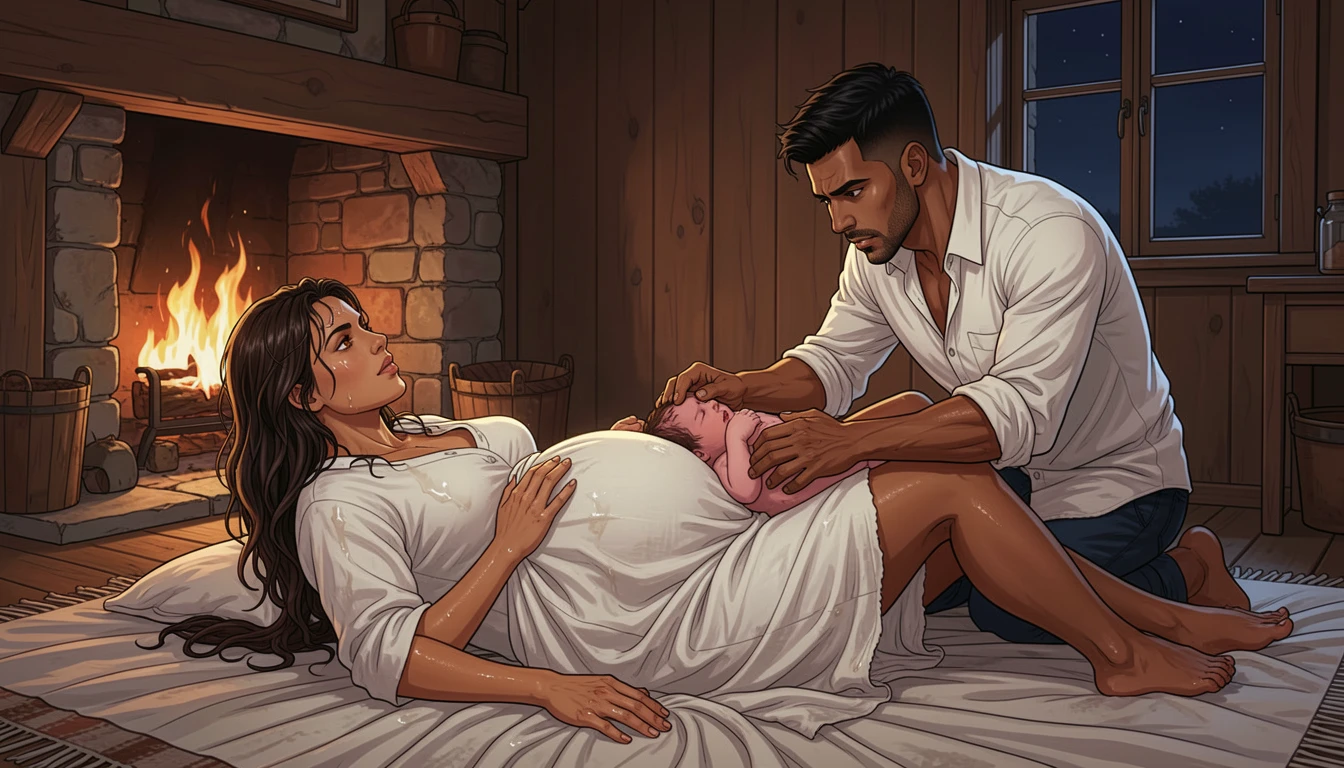
The afternoon sun had crawled halfway across the bedroom floor, a slow golden tide that carried dust motes in its wake. Esme watched it move the way she'd watched everything these past four weeks—from the pillow, her body a vessel she no longer fully trusted. The twins had grown heavy, a weight that pressed her spine into the mattress, and every breath she took felt borrowed from a body that was running out of room.
Adil sat in the chair beside the bed, his forearms resting on his thighs, his dark eyes fixed on her face. He'd been watching her breathe for the better part of an hour, counting each rise and fall like a man tallying coins he was afraid to lose. His hand lay on the swell of her belly, warm and heavy, his thumb tracing slow circles that had become a language between them— I'm here. I'm not going anywhere. You're not alone in this.
"You should eat something," he said, his voice low and rough, the same gravel it always held. "Sera said—"
"Sera said I should rest." Esme's lips curved into a tired smile. "Sera says a great many things."
"She says you need your strength."
"I have strength." She turned her hand over, lacing her fingers through his. "I have you."
He didn't answer, but his thumb stilled, and something moved behind his eyes—that quiet intensity that followed her through every room, that had followed her for years before she'd ever let it touch her. She squeezed his hand, and he squeezed back, and for a moment the farmhouse was just a farmhouse, the hay dust and the cracked windowpane and the cradle he'd built with his own hands standing in the corner, waiting.
The cradle. She looked at it now, the wood still pale and fresh, the edges sanded smooth. He'd spent three nights on it, working by lamplight after she'd fallen asleep, and she'd watched him through half-closed eyes—the way his brow furrowed, the way he tested each joint with his thumb, the way he'd looked up at her once and caught her watching and said nothing, just held her gaze until she'd felt it in her chest like a second heartbeat.
Another tightening rolled through her, low in her belly, and she let out a small breath, her hand clenching the sheet. Not a contraction—not yet—but something. A reminder. A warning.
Adil's eyes snapped to her face. "Esme."
"I'm fine." She forced her fingers to loosen. "They're just—moving. Settling in."
He didn't look convinced. His hand pressed a little firmer against her belly, and she felt the twins respond, a flutter against his palm, a small shifting of weight. She'd felt them move before he had, a secret she'd carried for weeks, and the first time he'd felt it—the first time his face had cracked open with wonder—she'd almost wept.
"They're restless," she said. "Like their father."
His mouth twitched. "I'm not restless."
"You've sharpened that sword three times today."
"It needed sharpening."
"It's sharp."
"It's sharp," he admitted, and the ghost of a smile crossed his face before it faded. He looked down at her belly, at his hand resting on it, and his voice dropped. "I don't know what I'd do if—"
"Don't." She cut him off, her fingers tightening around his. "Don't finish that sentence."
He was quiet for a long moment. Then he lifted her hand to his mouth and pressed a kiss to her knuckles, his lips rough and warm against her skin. "I love you," he said, the words low and steady, the way he'd said them every day since the farmhouse, the way he'd promised. "And I'm going to keep you safe. Both of you. All of you."
She felt the words land in her chest, warm and heavy, and she let herself hold them for a moment before she nodded. "I know."
The sun had moved another hand's breadth across the floor. The dust motes drifted. The cradle waited in the corner.
And then the tightening came again, harder this time, a deep pull low in her belly that made her breath catch and her hand fly to the sheet. She rode it out, her jaw tight, her eyes fixed on the cracked windowpane where the light was starting to turn gold, and when it passed she let out a long, shaky exhale.
"Esme." Adil was on his feet, his hand on her shoulder, his face close to hers. "That was—"
"It's nothing." She shook her head, even as another wave rolled through her, deeper than the last. "They're just—"
She stopped. The heat spread beneath her, sudden and unmistakable, a rush of warm fluid soaking the sheets, and she looked down at herself, at the dark stain spreading across the mattress, and then up at Adil's face.
"Adil," she said, her voice thin and breathless. "It's time."
The words fell into the silence of the room, and for a moment neither of them moved. The dust motes drifted. The light crept. The cradle stood in the corner, empty and waiting.
Then Adil was moving, his hand finding hers, his voice low and steady, the voice he used in the chaos of battle, the voice that had carried men through worse than this. "I'm here, Esme. I'm here."
She gripped his hand, her knuckles white, and another contraction rolled through her, harder than the rest, a deep, grinding wave that tore a groan from her throat. "Adil—"
"I know." He was already turning, already moving toward the door. "I'm going to get Sera. I'll be right back. I'm not leaving you."
"Adil—" She reached for him, her hand catching his sleeve, and he stopped, turning back to her. His face was set, controlled, but she could see the fear behind his eyes, the same fear she felt coiling in her own chest. "Don't go far."
"I won't." He pressed a kiss to her forehead, quick and fierce, and then he was gone, his boots thudding across the floorboards, the door swinging shut behind him.
She lay alone in the room, her hand pressed to her belly, feeling the twins shift and flutter against her palm, and she counted her breaths the way he'd been counting them all afternoon. One. Two. Three. The contractions came in waves, each one a little stronger than the last, and she gripped the sheet and rode them out, her teeth clenched, her eyes fixed on the door.
The water had soaked through the mattress, a dark stain spreading beneath her, and she felt a flicker of fear, sharp and cold. Sera had warned her. Bed rest. No strain. No stress. The twins were coming early—too early—and she could feel the weight of that knowledge pressing down on her chest like a stone.
But the babies were moving. She could feel them, small and fierce, pressing against her palms, and she held onto that—the flutter of life, the proof that they were still fighting—and she breathed.
The door banged open, and Adil was there, and behind him a woman in a worn brown dress, a leather bag clutched in her hands. Sera. The midwife. Her face was lined and weathered, her eyes sharp and assessing, and she took in the scene in a single glance—the stained sheets, Esme's pale face, the sweat beading on her forehead—and then she was moving, crossing the room in three quick strides.
"Out of the way," she said to Adil, and he stepped back, his hands clenched at his sides. She set her bag on the chair and leaned over Esme, her hands cool and capable on her belly. "How long since your water broke?"
"Just—just now," Esme managed, another contraction rolling through her, and she bit down on a groan. "A few minutes."
Sera nodded, her face unreadable. "Adil. I need warm water. Clean cloths. As many as you can find. And something to cut the cord with—a clean knife, boiled."
"I'll—" He was already moving, his voice rough with tension. "I'll find them."
"And a lamp," Sera called after him. "It's getting dark in here. I need to see."
The door swung shut behind him, and Sera turned back to Esme, her hands moving with practiced efficiency, checking the swell of her belly, pressing gently at the base of it. "You're further along than I'd hoped," she said, her voice matter-of-fact. "The babies are coming, and they're coming now."
"They're—they're early." Esme's voice cracked. "They're not ready."
"Babies come when they're ready," Sera said, but her eyes were soft. "And these two are ready to meet their mother."
Another contraction hit, harder than the rest, and Esme cried out, her back arching off the mattress, her hand finding Sera's arm and gripping it tight. "I can't—"
"You can." Sera's voice was firm, steady. "You're a queen. You've carried these babies through worse than this. You can bring them into the world."
The contraction passed, leaving her trembling, sweat cooling on her skin. She lay back against the pillow, her breath coming in ragged gasps, and she looked at the door, waiting for Adil to come back, waiting for him to fill the room with his presence, his steadiness, his voice.
The door opened, and he was there, a basin of steaming water in his hands, a bundle of clean cloths tucked under his arm. He set them down beside the bed, and then he was at her side, his hand finding hers, his dark eyes searching her face.
"I'm here," he said. "I'm here, Esme."
She gripped his hand, and another contraction rolled through her, and she held onto him like he was the only solid thing in a world that was tilting, spinning, coming apart at the seams.
And somewhere beyond the cracked windowpane, in the golden light of the late afternoon, she heard it—the sound of footsteps on the stairs, slow and deliberate, and a knock at the door.
The knock came again, harder this time, and Adil's hand tightened around hers. His jaw was set, his eyes flicking to the door and back to her face, and she could see the war in him—the soldier who wanted to go and face whatever waited outside, and the man who couldn't bring himself to leave her side.
"Adil." Sera's voice was sharp. "Go see who it is. I need to focus on Esme."
He hesitated, his fingers squeezing hers once, twice, a silent promise. Then he released her hand and crossed the room, his boots heavy on the floorboards, his hand resting on the hilt of his sword as he pulled the door open.
Esme couldn't see who stood there, could only hear the low murmur of voices—Adil's rough gravel, and another voice, younger, familiar. Tomas. Of course it was Tomas. The boy who had betrayed them and then warned them, who had ridden through the night to tell them the council's riders were coming, who had stood in this very room with his face pale and his breath ragged.
She heard Adil's voice drop, a question she couldn't make out, and Tomas's answer, quick and urgent. Then the door closed, and Adil was crossing back to her, his face unreadable.
"It's Tomas," he said, low. "The riders are still in the valley. They haven't found the farmhouse yet, but they're close."
Esme's heart lurched, a cold spike of fear that cut through even the pain. "Adil—"
"I know." He was at her side again, his hand finding hers, his eyes steady on her face. "But right now, you're the only thing that matters. The riders can wait. These babies can't."
Another contraction rolled through her, deeper and harder than the last, and she cried out, her back arching, her grip on his hand turning bruising. She heard Sera's voice, calm and steady, telling her to breathe, to push, to hold on, but the words seemed to come from very far away, muffled by the roaring in her ears.
When the wave passed, she lay limp against the pillow, her breath coming in ragged gasps, sweat plastering her hair to her forehead. The light through the cracked windowpane had turned a deeper gold, the dust motes still drifting in the beam, and she thought, absurdly, that the world outside was going on as if nothing was happening, as if she wasn't lying here in a farmhouse in the middle of nowhere, bringing two lives into a world that wanted to tear them apart.
"You're doing well, Esme." Sera's hands were cool on her belly, pressing, measuring. "The first baby is positioned well. A few more contractions, and you'll be ready to push."
Esme nodded, not trusting her voice. She turned her head to look at Adil, at the fear and love warring in his dark eyes, and she reached for him with her free hand, cupping his stubbled jaw.
"Stay with me," she whispered. "Don't leave."
"I'm not going anywhere." He turned his head to press a kiss to her palm, his lips warm and rough. "I'm right here. I'll always be right here."
And in the golden light of the late afternoon, with the dust motes drifting and the cradle waiting in the corner and the sound of the riders somewhere in the valley below, she held onto him, and she breathed.
Sera's hands moved down Esme's belly, pressing firm and sure through the sweat-slick skin, and Esme felt the pressure build again—that deep, grinding wave that had been rolling through her for what felt like hours. Sera leaned in, her weathered face intent, and then she was spreading Esme's legs, her hands cool and competent on her inner thighs.
"The first baby is crowning," Sera said, her voice calm but carrying an edge of urgency. "I can see the head. Esme, I need you to push."
Esme's breath caught. She looked down the length of her body, past the swell of her belly, and saw Sera's hands positioned between her legs, waiting. The reality of it hit her like a wall—there was a baby inside her, a daughter, Aleyana, and she was about to bring her into this world, into a farmhouse with riders in the valley and a cradle that had waited too long.
"I can't," she gasped, her voice breaking. "I can't—"
"You can." Sera's voice was iron. "Push, Esme. Push now."
The contraction surged through her, a deep, grinding force that seized her whole body, and Esme bore down, her hands gripping the sheets, her jaw clenched so hard her teeth ached. The pressure built and built, a burning stretch between her legs that made her cry out, a raw, animal sound torn from her throat.
"Ahhh—"
"That's it," Sera urged. "Keep pushing. Don't stop."
Esme pushed until her vision blurred, until the world narrowed to the burning between her legs and the voice in her ears, and when the contraction finally released her she fell back against the pillow, gasping, sweat streaming down her face.
"Adil—" she whimpered, her hand finding his, gripping it with all the strength she had left.
"I'm here." His voice was rough, strained, his hand crushing hers, and she felt him move closer, felt his other hand brush the sweat-damp hair from her forehead. "I'm right here, Esme. I'm not going anywhere."
She looked up at him, at the fear and love warring in his dark eyes, at the way his jaw was set like he was holding himself together by sheer force of will, and she wanted to say something—wanted to tell him she loved him, wanted to tell him she was sorry, wanted to tell him that if she died here, in this farmhouse, with the riders in the valley and the cradle waiting in the corner, she would die happy because she'd had him.
But another contraction was already building, rising like a tide, and there was no room for words.
"Push," Sera commanded, and Esme pushed, screaming through the burning stretch, feeling something give, something shift, and then—
A cry. Thin and reedy and furious, cutting through the roar in her ears like a blade.
"She's here," Sera said, and Esme looked down, dazed, to see the midwife lifting a tiny, squirming bundle, slick with blood and fluid, her face scrunched and red, her small fists waving. "She's here, Esme. Your daughter."
Esme reached for her, her arms trembling, and Sera placed the baby on her chest, warm and wet and impossibly small, and Esme looked down at the tiny face, at the dark hair plastered to her head, at the eyes that blinked open, unfocused and new, and she felt something crack open inside her chest.
"Aleyana," she breathed. "Oh, Aleyana."
The baby cried, a thin, piercing sound, and Esme laughed and wept at once, her hands cradling the small, warm body against her breast. She looked up at Adil, and he was staring at them—at her and the baby—with an expression she'd never seen before, something raw and broken and whole all at once.
"She's perfect," he said, his voice barely a whisper. "Esme, she's perfect."
"She looks like you." Esme's voice cracked. "She has your eyes."
Adil reached out, his hand hovering over the baby's head, and then he touched her—just his fingertips brushing the damp dark hair—and his face crumpled, and he pressed his fist to his mouth, and Esme watched him try to hold himself together and fail.
"Adil." She reached for him, her hand finding his, squeezing. "Adil, look at her. She's here. She's safe."
He nodded, his throat working, and he looked at her—at his daughter—and then at Esme, and she saw the words in his eyes before he spoke them.
"I love you," he said. "Both of you. I love you so much."
And then Sera was there, her hands moving, her voice low and urgent. "The cord. I need to cut the cord. And there's another baby coming. Esme, I need you to focus."
Esme's eyes flew to the midwife. "The second one—is she—"
"She's coming. You need to push again, Esme. Right now."
Sera's hands worked quickly, a silver flash as she tied and cut the cord, and then she was lifting Aleyana away, wrapping her in a clean cloth and placing her in Adil's arms. He took her like she was made of glass, his big hands cradling the tiny bundle, his face a study in wonder and terror. Esme watched him look down at their daughter, watched his thumb brush the tiny cheek, and she felt the love in her chest swell so fierce it hurt.
"Keep her warm," Sera said, already turning back to Esme. "Hold her against your chest. Skin to skin."
Adil moved without a word, shrugging out of his tunic, and then he was lifting Aleyana against his bare chest, her small body curled against the muscle and heat of him. She mewled, a thin, reedy sound, and he made a low, wordless sound in his throat, a sound Esme had never heard him make before, something broken and protective and raw.
"She's so small," he said, his voice rough. "Esme, she's so small."
"She's perfect," Esme managed, but the words came out strained, because the pressure was building again, a deep, grinding wave that seized her body and made her arch off the mattress. "Sera—"
"I know." Sera was already positioned between her legs, her hands ready. "The second baby is coming. She's turned, but she's coming fast. Push, Esme. Push now."
Esme bore down, the scream tearing from her throat, her hands gripping the sheets until her knuckles went white. The burning was different this time, sharper, and she felt the baby shift, felt the pressure change, and she pushed again, harder, her vision going dark at the edges.
"I can't—" she gasped, her voice breaking. "I can't—"
"You can." Sera's voice was iron. "You're almost there. I can see her head. Push, Esme. Push."
Esme pushed, and the world narrowed to the burning between her legs and the voice in her ears, and she felt something give, something shift, and then the pressure released, sudden and overwhelming, and she fell back against the pillow, gasping, the room swimming around her.
And then another cry cut through the air—weaker than Aleyana's, thinner, but unmistakably there—and Sera was lifting a second tiny bundle, slick and red, her face scrunched, her small fists waving weakly.
"Zara," Sera said, and her voice was careful, measured. "She's here. She's—"
Esme's heart seized. "She's what? Sera, what's wrong?"
"She's small," Sera said, already working, her hands moving over the tiny body. "She's very small. And she's not crying like her sister."
Sera turned the tiny bundle over, her weathered fingers working with desperate efficiency, clearing Zara's mouth, rubbing her small back in firm circles. The baby's skin had a bluish cast, her chest barely rising, and Esme watched the midwife's hands move and felt the world tilt sideways, the way it had when the bleeding had started, the way it had when the water had broken.
"Breathe," Sera muttered, more to herself than to the baby. "Come on, little one. Breathe."
Esme's hand shot out, grabbing Adil's arm, her nails digging into his skin. He was still holding Aleyana against his chest, the baby's tiny fist curled against his collarbone, but his eyes were fixed on Sera, on the small blue body in her hands, and she saw the muscle in his jaw jump, saw the way his throat worked as he swallowed.
"Adil," she whispered, and her voice was thin, reedy, a sound she barely recognized. "Adil, she's not—"
"She is." His voice was rough, almost angry, as if he could make it true by saying it. "She's going to be fine. She's a fighter. She's ours."
Sera rubbed the baby's back again, harder, and then she lifted Zara by her ankles, tilting her head down, and a thin, wet sound escaped the tiny mouth—a cough, a sputter, a gasp. The bluish cast began to recede, pink flooding into the small cheeks, and then the sound came again, stronger this time, a thin, reedy cry that cut through the silence of the room.
"There she is," Sera breathed, and her voice cracked, just slightly, the first crack Esme had ever heard in the midwife's iron composure. "There she is."
The cry grew stronger, louder, a furious, indignant wail, and Esme felt her own breath release in a shuddering rush, tears spilling down her cheeks. She reached out, her arms trembling, and Sera placed the second bundle on her chest, small and warm and impossibly alive, and Esme looked down at the tiny face, at the dark hair plastered to her head, at the eyes squeezed shut in outrage, and she wept.
"Zara," she said, the name a prayer, a promise. "Oh, Zara. You scared me."
Adil moved closer, Aleyana still cradled against his chest, and he looked down at the two small bodies, one against Esme's breast, one against his own, and his face crumpled. He pressed his forehead to Esme's, his breath ragged, and she felt his tears fall on her cheek, warm and unexpected.
"Two," he said, his voice breaking. "Esme, we have two."
"We have two," she echoed, and she laughed, a wet, broken sound, and then she was crying and laughing at once, her hands cradling Zara's small body, her eyes on Aleyana's tiny fist curled against Adil's chest.
Sera worked quietly, her hands moving with practiced efficiency, tying and cutting the second cord, examining both babies with careful, assessing fingers. She counted fingers and toes, pressed her ear to each tiny chest, listened to the rhythm of two small hearts, and when she straightened, her face was softer than Esme had ever seen it.
"They're small," Sera said, and her voice was gentle now, the iron gone. "Both of them. Early. But their lungs are strong, and their hearts are strong, and they're already fighting." She looked at Esme, at Adil, and something moved behind her eyes. "They have their mother's stubbornness."
Esme laughed again, a raw, exhausted sound, and she looked down at Zara, at the tiny face scrunched against her breast, at the small hand that had somehow found its way to Esme's skin and curled there, holding on. The baby's grip was weak, but it was there, a small, fierce claim, and Esme pressed her lips to the damp, dark hair.
"You're early," she whispered. "You're so early. But you're here. You're both here."
Aleyana mewled against Adil's chest, a thin, reedy sound, and he looked down at her, his big hand spanning her entire back, and she saw the wonder in his face, the terror and the love and the disbelief all tangled together. He was a soldier, a man who had faced down armies, who had stood between his queen and death more times than she could count, and here he was, undone by a bundle of cloth and a tiny, furious cry.
"She's hungry," Sera said, her voice matter-of-fact, and she helped Esme shift, propping her up against the pillows, guiding Aleyana to her breast. The baby latched on with surprising strength, her small jaw working, and Esme gasped at the sensation—sharp and strange and utterly overwhelming.
Adil watched, his eyes fixed on the small body at Esme's breast, and she saw his throat work, saw the way his hand trembled as he reached out to touch Aleyana's cheek. The baby's eyes were open now, dark and unfocused, and she looked up at Esme with the blank, trusting gaze of the newborn, and Esme felt something shift inside her, something fundamental, something that would never go back to what it had been.
"She has your eyes," Adil said, his voice low and rough. "I said that before. I meant it."
Esme looked down at Aleyana, at the dark eyes that seemed to hold the whole world in their unfocused depths, and she smiled, a tired, trembling smile. "She has your stubbornness. She latched on like she was afraid someone would take it away."
Adil's mouth twitched, a ghost of a smile, and he looked down at the baby in his arms, at Zara, who had quieted now, her small chest rising and falling in a steady rhythm against his skin. She was so small, so fragile, her head fitting in the palm of his hand, and he looked at her like she was the most precious thing he had ever held.
"Zara," he said, testing the name on his tongue. "My mother's name."
"She would have loved her," Esme said softly. "She would have loved them both."
Adil nodded, his throat working, and he lifted Zara to his lips, pressing a kiss to her forehead, so gentle it made Esme's heart ache. "She would have said they have your fire," he said, his voice rough. "And my stubbornness. She would have said that's a dangerous combination."
"It is," Esme agreed, and she laughed, a soft, exhausted sound. "It's going to be a very dangerous combination."
They sat there, the four of them, in the golden light of the late afternoon, the dust motes drifting in the beam, the cradle waiting in the corner—empty now, but not for long. Aleyana nursed at Esme's breast, her small fist curled against the skin, and Zara slept against Adil's chest, her breathing slow and steady, and for a moment, the farmhouse was just a farmhouse, the hay dust and the cracked windowpane and the sound of two small hearts beating.
And then, from somewhere beyond the walls, came the sound of hoofbeats.
Esme's blood went cold. She looked at Adil, and she saw it in his face—the same fear, the same knowledge. The riders. The council's riders. They had found the farmhouse.
Adil's hand tightened around Zara's small body, and he looked at Esme, at Aleyana at her breast, and she saw the war in his eyes—the soldier who wanted to go and face whatever waited outside, and the father who couldn't bring himself to leave his family.
"Adil," she whispered, and her voice was thin, desperate. "They can't find us. Not now. Not with—"
"I know." His voice was low, steady, the voice he used in the chaos of battle, the voice that had carried men through worse than this. He pressed Zara into her arms, gentle but quick, and then he was on his feet, crossing to the window, his hand on the hilt of his sword.
Esme watched him peer through the cracked pane, his body rigid, and she held her breath, Aleyana still at her breast, Zara cradled against her other arm. The hoofbeats grew louder, closer, and she could hear voices now—low, urgent, the sound of men who had been riding for a long time.
"How many?" she asked, her voice barely a whisper.
Adil was silent for a long moment. Then he turned, his face unreadable, and she saw the answer in his eyes before he spoke it.
"Three," he said. "Three riders. And they're coming up the path."
Adil's hand went to his sword, the motion so familiar it was like breathing. But his eyes flicked back to the bed—to Esme, to the two small bundles against her chest—and she saw the war in him, the soldier and the father tearing at each other.
"Don't." The word came out of her harder than she meant it, and she saw him flinch. "Don't you dare go out there and leave me with these babies."
"I'm not leaving." His voice was low, rough. "But I'm not letting them walk in here while you're—"
"Adil." Sera's voice cut through, sharp and unimpressed. "The door. I need to see who's out there before they decide to knock it down. You can fight them after I've delivered the afterbirth and made sure these girls are breathing."
He looked at the midwife, then back at Esme, and something in his face shifted. He crossed to the door in three strides, his hand still on his sword, and pulled it open—not wide, just enough to see.
The light through the cracked windowpane had gone amber, the dust motes still drifting in the beam, and Esme could hear the low murmur of voices—Adil's rough gravel, and another voice, younger, familiar. Tomas. Of course it was Tomas. The boy who had betrayed them and then warned them, who had ridden through the night to tell them the council's riders were coming, who had stood in this very room with his face pale and his breath ragged.
She heard Adil's voice drop, a question she couldn't make out, and Tomas's answer, quick and urgent. Then the door closed, and Adil was crossing back to her, his face unreadable.
"It's Tomas," he said, low. "The riders are still in the valley. They haven't found the farmhouse yet, but they're close."
Esme's heart lurched, a cold spike of fear that cut through even the pain. "Adil—"
"I know." He was at her side again, his hand finding hers, his eyes steady on her face. "But right now, you're the only thing that matters. The riders can wait. These babies can't."
Aleyana stirred against her breast, a small, mewling sound, and Esme looked down at her—at the dark hair plastered to her head, at the tiny fist curled against her skin. She was so small, so impossibly fragile, her whole body no bigger than Adil's forearm, and yet she had latched on with a fierce, instinctive hunger that made Esme's breath catch.
She felt the tug low in her belly, a deep, pulling sensation that spread through her in waves, and she gasped, her hand tightening around Aleyana's small body. The baby's jaw worked, her cheeks hollowing, and Esme felt the milk let down—a sudden, sharp rush that made her gasp again, her eyes going wide.
"That's it," Sera said, her voice matter-of-fact. "Let her nurse. The more she takes, the sooner your body settles."
Esme looked down at Aleyana, at the small face pressed against her breast, and she felt something crack open inside her chest—something raw and fierce and terrifying. The baby's eyes were open now, dark and unfocused, and she looked up at Esme with the blank, trusting gaze of the newborn, and Esme felt the love in her chest swell so fierce it hurt.
"She's hungry," Esme said, her voice thin, wondering. "She's really hungry."
"Babies are always hungry," Sera said, but her voice was softer now. "Let her take what she needs. She'll let you know when she's done."
Aleyana nursed with a fierce, determined rhythm, her small body pressed against Esme's breast, her tiny hand curling and uncurling against the skin. Esme watched her, mesmerized, feeling the tug and pull of each swallow, the warm rush of milk letting down again, the way the baby's whole body relaxed into the feeding, her eyes drifting half-closed, her small fist loosening.
"She's like her father," Esme murmured, looking up at Adil. "Determined. Doesn't stop until she gets what she wants."
Adil's mouth twitched, a ghost of a smile, but his eyes were fixed on the baby at her breast, and she saw the wonder in his face, the terror and the love and the disbelief all tangled together. He reached out, his hand hovering over Aleyana's head, and then he touched her—just his fingertips brushing the damp dark hair—and she saw his throat work as he swallowed.
"She's so small," he said, his voice rough. "Esme, she's so small."
"She's perfect." Esme's voice cracked. "She's exactly what she's supposed to be."
Zara stirred against her other arm, a thin, reedy sound, and Esme looked down at her—at the smaller bundle, the darker hair, the face scrunched in a newborn's displeasure. She was lighter than Aleyana, more fragile, her skin still carrying a faint blush of pink, and Esme felt the fear coil in her chest again, cold and sharp.
"She needs to feed too," she said, looking up at Sera. "Doesn't she?"
Sera moved closer, her weathered hands gentle as she shifted Zara in Esme's arm. "She does. But she's smaller, weaker. You might need to help her latch."
Esme shifted, easing Aleyana to her other breast—the baby barely paused, her mouth finding the nipple with the same fierce instinct—and then Sera was guiding Zara to the other side, her hands supporting the tiny head, her voice low and patient.
"Gently," Sera murmured. "She's not as strong as her sister. You might need to—there. There she goes."
Esme felt the second tug, weaker than Aleyana's but unmistakable, and she looked down at Zara—at the small face pressed against her breast, the eyes squeezed shut, the tiny fist that found its way to Esme's skin and curled there, holding on. The baby's jaw worked, slow and uncertain, and Esme felt the milk let down again, a warm rush that made her breath catch.
"She's feeding," she breathed. "Sera, she's feeding."
"She is." Sera's voice was gentle, the iron gone. "She's a fighter, this one. She just needs a little more time."
Esme sat there, the two babies at her breasts, their small bodies warm against her skin, and she felt the world narrow to this—the tug of two small mouths, the weight of two small lives, the sound of Adil's breathing somewhere beside her. The hoofbeats had faded, or she'd stopped hearing them, and the golden light through the cracked windowpane had deepened to a warmer amber, the dust motes still drifting in the beam.
She looked down at Aleyana, at the dark lashes fanned against her cheeks, at the small hand that had loosened its grip on her skin, and she felt the love in her chest swell so fierce it hurt. The baby had finished nursing, her mouth gone slack, her breathing slow and even, and Esme pressed her lips to the damp dark hair, breathing in the smell of her—milk and warmth and something new, something that had never existed before.
"She's asleep," she said, her voice barely a whisper. "She's asleep."
"Good." Sera moved closer, her hands gentle as she lifted Aleyana from Esme's breast, wrapping her in a clean cloth. "Let me take her. You need to rest, and Zara needs to finish."
Esme nodded, her arms feeling suddenly empty, and she watched Sera lay Aleyana in the cradle—the cradle Adil had built, the wood still pale and fresh, the edges sanded smooth. The baby barely stirred, her small chest rising and falling in a steady rhythm, and Esme felt the tears prick at her eyes again.
"She's in the cradle," she said, looking up at Adil. "The cradle you built."
He didn't answer, but his hand found hers, his fingers lacing through hers, and she felt the tremor in his grip—the same tremor she'd felt the first time he'd touched her, the same quiet intensity that had followed her through every room. He looked down at Zara, still nursing at her breast, and she saw the wonder in his face, the raw, broken love that he couldn't quite hide.
"Two," he said, his voice rough. "Esme, we have two."
"We have two," she echoed, and she laughed, a wet, broken sound, and then she was crying and laughing at once, her hand cradling Zara's small body, her eyes on the cradle where Aleyana slept.
Zara's mouth went slack, her small body relaxing against Esme's breast, and Esme looked down at her—at the dark lashes, the tiny nose, the small fist still curled against her skin. She was so small, so fragile, her head fitting in the palm of Esme's hand, and yet she had fought her way into the world, had found her breath, had latched on and fed.
"She's done," Esme said, looking up at Sera. "She's finished."
Sera moved closer, her hands gentle as she lifted Zara, and Esme felt the weight leave her arms, the warmth receding. She watched Sera lay Zara in the cradle beside her sister, the two small bodies curled together, and she felt something settle in her chest—something she hadn't felt in weeks, months, maybe ever.
Safe. They were safe.
Adil's hand found hers again, his fingers lacing through hers, and she looked up at him—at the stubble on his jaw, the dark eyes that held the whole world in their depths, the way his throat worked as he swallowed.
"You did it," he said, his voice rough. "You brought them into the world."
"We did it," she corrected, and she squeezed his hand. "We made them. We kept them safe. We brought them here."
He lifted her hand to his mouth, pressing a kiss to her knuckles, his lips rough and warm against her skin. "I love you," he said, the words low and steady, the way he'd said them every day since the farmhouse. "I love you so much."
She felt the words land in her chest, warm and heavy, and she let herself hold them for a moment before she nodded. "I know. I love you too."
Sera moved quietly around the room, cleaning up the aftermath of the birth, her hands efficient and sure. She checked the babies again, pressing her ear to each tiny chest, counting fingers and toes, and when she straightened, her face was softer than Esme had ever seen it.
"They're small," Sera said, her voice gentle. "Both of them. Early. But their lungs are strong, and their hearts are strong, and they're already fighting." She looked at Esme, at Adil, and something moved behind her eyes. "They have their mother's stubbornness."
Esme laughed, a raw, exhausted sound, and she looked down at the cradle, at the two small bodies curled together. Aleyana's dark hair, Zara's scrunched face, the rise and fall of two small chests. She had made them. She had carried them through flight and fear and bleeding and pain, and she had brought them into the world.
And then, from somewhere beyond the walls, came the sound of hoofbeats.
Esme's blood went cold. She looked at Adil, and she saw it in his face—the same fear, the same knowledge. The riders. The council's riders. They had found the farmhouse.
Adil was already moving before the second set of hoofbeats died. He crossed to the window in three strides, his body a hard line against the amber light, and pressed his shoulder to the frame, peering through the cracked pane at an angle that kept him out of sight. Esme watched his jaw tighten, watched the muscle jump in his cheek, and she knew—before he turned, before he spoke—that whatever he saw had made the choice for him.
"They're not stopping," he said, his voice low and flat, the voice he used when he was counting enemy numbers and finding the math unforgiving. "They're coming up the path. Three riders, and they're not slowing."
Esme's hands moved before her mind caught up, pulling the blanket higher over the cradle, tucking the worn wool around the two small bodies. Aleyana stirred, a soft mewling sound, and Zara's face scrunched, but neither woke. She looked at them—at the rise and fall of their tiny chests, at the dark lashes fanned against their cheeks—and she felt the fear in her chest sharpen into something cold and clear.
"The root cellar," she said. "We can hide. All of us, we can—"
"You can't." Sera's voice cut through, hard and practical. She was already on her feet, her hands wiping on her apron, her eyes moving from the window to the cradle to Esme's face. "You just delivered twins. You're bleeding. You can't carry two newborns down a ladder and keep them quiet and hope the horses don't hear them cry."
"Then what do we do?" Esme heard her own voice rise, heard the crack in it. "Sera, they're going to walk through that door and find us."
Sera looked at Adil, and something passed between them—a quick, silent assessment, the kind that soldiers and midwives both learn, the kind that measures a person in a heartbeat. Then she crossed to the cradle and lifted Zara, wrapping the blanket tighter around the tiny body.
"The cellar has a false wall," Sera said. "Behind the wine racks. I found it years ago, when the old farmer who lived here was still alive. He used it to hide his whiskey from the tax men." She looked at Esme, her eyes sharp. "You and the babies go in there. I'll stay up here. If they ask, I'm the midwife, here to attend a woman who's lost a child. They won't want to look too closely at that."
"And me?" Adil's voice was quiet, but Esme heard the steel under it.
Sera didn't flinch. "You're the farmer's son. You were out in the fields when they arrived. You know nothing about any queen or any riders." She held his gaze. "Can you do that? Can you stand there and lie to men who might kill you for it?"
Adil's hand was still on his sword. Esme watched his knuckles go white around the hilt, watched the war in his face—the soldier who wanted to fight, the father who wanted to hide, the man who loved her and could not bear the thought of letting anyone walk past her. She reached for him, her hand finding his arm, and she felt the tension in him, the coiled readiness.
"Adil," she said, and her voice was quiet, steady. "Look at me."
He turned. His dark eyes met hers, and she saw the fear in them—not for himself, never for himself, but for her, for the babies, for the fragile new world they had built in this farmhouse. She held his gaze, and she made her voice as steady as she could.
"You stand there and you lie," she said. "You lie like your life depends on it, because it does. Mine does. Theirs does." She nodded toward the cradle. "You're not a soldier right now. You're a farmer's son who doesn't know anything. Can you do that?"
He looked at her for a long moment. Then his hand released the sword, and he nodded, once, a sharp, soldier's nod that was also something else—a promise, a surrender, a choice.
"I can do that," he said.
Sera was already moving, lifting Aleyana from the cradle and pressing her into Esme's arms. "Go. Now. The false wall is behind the third rack from the left. Push on the center plank—it swings open." She looked at Adil. "Take the lamp. Leave the room dark. And for the love of the gods, keep them quiet."
Adil lifted the cradle—empty now, the wood pale and fresh in the dimming light—and carried it to the corner, out of sight. Then he was back at Esme's side, his hands gentle but quick, helping her swing her legs over the edge of the bed. She gasped at the movement, the ache between her legs flaring sharp and hot, but she bit down on the sound, her jaw tight.
"I'm fine," she said, before he could ask. "Just—help me."
He did. His arm around her waist, his body hard against her side, he half-carried her across the room to the wine racks, the babies clutched against her chest, the blanket wrapped around all three of them. The third rack from the left. She pressed her palm against the center plank, felt it give, and the wall swung open with a soft groan, revealing a dark space behind it—low and narrow, smelling of dust and old wood.
"In," Sera said, her voice low and urgent. "Quickly. I can hear them at the gate."
Adil helped Esme through the opening, his hands steady on her hips as she ducked into the dark. The space was small—barely big enough for her to sit up, the floor packed dirt, the walls rough timber. She lowered herself to the ground, her back against the wall, the babies still clutched against her chest, and she looked up at Adil, at his face framed in the opening, the last of the amber light catching his features.
"I'll be right here," he said. "Behind this wall. If anything happens—"
"Nothing's going to happen." She made her voice firm, even though she could feel the tremor in it. "You're going to go out there and lie, and they're going to believe you, and then they're going to leave, and we're going to be fine."
He looked at her for a long moment, and she saw the words in his eyes before he spoke them. "I love you," he said. "All three of you. Don't forget that."
"I won't." She reached for his hand, squeezed it once. "Go."
The wall swung closed, and the dark swallowed him.
Esme sat in the black, the babies warm against her chest, and she listened. She heard the murmur of voices through the wall—Sera's voice, calm and unhurried, and the deeper rumble of men's voices, questioning, sharp. She heard Adil's voice, rougher than she'd ever heard it, playing a part she'd never seen him play, and she held her breath and prayed.
Aleyana stirred against her breast, a small, mewling sound, and Esme's heart seized. She shifted the baby, pressing her closer, murmuring soft, wordless sounds against the dark hair, and the baby settled, her small mouth finding Esme's skin, rooting blindly. The milk let down again, a warm rush that soaked through the thin cloth of her shift, and she guided Aleyana to her breast, the baby latching on with the same fierce instinct, her small jaw working.
Esme sat in the dark, nursing her daughter, and she listened to the voices through the wall. She heard Sera say, "There's no one here but me and the farmer's boy. The woman I was tending lost her child this morning. It's been a hard day." She heard a man's voice, rough and suspicious, asking questions, and she heard Adil's voice, low and deferential, answering them. She heard the creak of the floorboards as boots crossed the room, and she felt the fear coil in her chest, cold and sharp, and she held her breath and prayed.
The boots stopped. Esme's whole body went rigid, her hand cupping the back of Aleyana's head, pressing the baby's face deeper into the warmth of her breast. The milk flowed, a steady, useless stream, and she could not stop it, could only sit in the black and listen to the silence that had swallowed the room beyond the wall.
Then a voice—the rough one, the suspicious one—said, "The farmer's son. You said the woman lost the child this morning."
A pause. Esme imagined Adil's face, the careful blankness he wore in front of the council, the mask he'd worn for years in her own throne room. She imagined his shoulders, the way he'd square them just slightly, the way he'd let his voice go slower, duller, like a man who spent his days watching crops and not much else.
"Aye," Adil said, and the word hit Esme like a stone to the chest—she had never heard him sound like that, flat and simple and a little slow. "She came to the village midwife. The baby was turned wrong. Nothing to be done."
"And the midwife?" The voice again, closer now, moving through the room. "She's still here?"
"She's tending the woman. She's weak. Lost a lot of blood." A beat. "You want to see her? She's not fit to be moved, but I can wake her."
Esme's heart slammed against her ribs. She heard the floorboards creak, closer, and then Sera's voice, cutting in with the sharp, no-nonsense tone of a woman who had seen too much to be impressed by armed men. "You can wake her if you like, but she'll be no use to you. She's barely conscious, and she's lost a child. Whatever you're looking for, it's not in this house."
Silence. The boots stopped moving. Esme could hear her own breathing, too loud in the dark, and she pressed her hand over Aleyana's ear, muffling the small sounds the baby made as she nursed, the wet, contented swallows that seemed impossibly loud in the black.
Then the rough voice said, "We're looking for a woman. Pregnant. Traveling with a man, a soldier. They were seen heading this way."
"Seen by who?" Sera's voice was flat, unimpressed. "The crows? There's no one on this road but farmers and fools."
"The boy at the inn. Said they stopped there, a woman and a man with a soldier's bearing. The woman was with child."
"Then the boy at the inn saw a traveler," Sera said. "And she's not here. I've been in this house for two days, and I've seen no pregnant woman and no soldier. Just the farmer's boy and his sick mother."
A long pause. Esme felt the babies shift against her, Zara's small body twitching, a thin, reedy sound escaping her lips. Esme clamped her hand over the baby's mouth, gentle but firm, and Zara squirmed, her face scrunching, but the sound died. Esme held her breath, counting the seconds, feeling the milk soak through her shift, cold against her skin.
Then the rough voice said, "The mother. She's in the next room?"
"She's in the bed, where she's been since the bleeding started," Sera said. "You want to look at her, you can. But she's not the woman you're looking for. She's old enough to be your mother, and she's dying."
Esme heard the floorboards creak again, and then a different voice, younger, sharper: "The soldier. What did he look like?"
Adil's voice, still flat and slow: "I didn't see no soldier. I was in the fields all day. The midwife can tell you."
"I saw no soldier," Sera said. "I saw a farmer's boy and a sick woman. That's all."
The silence stretched, and Esme felt the darkness press in around her, heavy and close. She could smell the dust, the old wood, the faint, sour scent of her own fear-sweat, and she could feel the babies' warmth against her chest, the steady rise and fall of their small bodies. She listened to the voices, to the creak of the floorboards, to the sound of her own heart beating in her ears, and she waited.
Then the rough voice said, "We'll search the house."
Esme's blood went cold. She heard boots moving, crossing the room, and she heard Adil's voice, still flat, still slow: "Search all you like. There's nothing here but dust and old straw."
"We'll see."
The boots moved closer, and Esme pressed herself deeper into the corner, her back against the rough timber, the babies clutched against her chest. She could hear them moving through the main room, opening cupboards, kicking at things, and she felt the fear coil in her chest, cold and sharp, and she held her breath and prayed.
Aleyana's mouth went slack, her small body relaxing against Esme's breast, and Esme shifted her, guiding the baby to her other side, feeling the milk let down again, a warm rush that soaked through the thin cloth. Zara stirred, a small, mewling sound, and Esme pressed her hand over the baby's mouth again, feeling the tiny body squirm against her palm.
"What's in here?" The voice was close now, just on the other side of the wall.
"Wine racks," Adil said. "The old farmer who lived here kept a few bottles. Nothing worth stealing."
"Open it."
Esme heard the creak of the rack, the sound of bottles clinking, and she felt her heart stop. She could see the wall in her mind's eye—the third rack from the left, the center plank that swung open, the dark space behind it where she sat with two newborns pressed against her chest.
She heard Adil's voice, still flat, still slow: "It's just wine. You want a bottle? Take it."
A pause. Then the rough voice said, "No. Let's check the barn."
The boots moved away, and Esme heard the door open, the sound of wind and the distant nicker of horses, and then the door closed, and the room was silent.
She sat in the black, the babies warm against her chest, and she counted her breaths the way Adil had counted them all afternoon. One. Two. Three. She heard the murmur of voices, farther away now, and then nothing, and she felt the tears spill down her cheeks, hot and silent, and she pressed her lips to Aleyana's dark hair and wept.
The wall swung open.
Adil's face appeared in the opening, his dark eyes searching the black, and then he was reaching for her, his hands gentle but quick, helping her out of the cramped space and into the dim light of the room. She gasped at the movement, the ache between her legs flaring sharp, but she held the babies tight and let him guide her to the bed.
"They're gone," he said, his voice low and rough, the farmer's drawl gone, replaced by the gravel she knew. "They searched the barn and the yard and rode out. They're heading back toward the valley."
Esme sank onto the mattress, the babies still clutched against her chest, and she looked up at him—at the stubble on his jaw, the dark eyes that held the whole world in their depths, the way his throat worked as he swallowed. She reached for him, her hand finding his, and she felt the tremor in his grip, the same tremor she'd felt the first time he'd touched her.
"You lied," she said, her voice thin, wondering. "You lied to them."
"I told them what they needed to hear." His voice was rough, and he lifted her hand to his mouth, pressing a kiss to her knuckles. "I'd say anything to keep you safe. Anything."
She felt the words land in her chest, warm and heavy, and she let herself hold them for a moment before she nodded. She looked down at the babies, at Aleyana's dark lashes and Zara's scrunched face, and she felt the love in her chest swell so fierce it hurt.
Sera appeared at the bedside, her hands wiping on her apron, her face unreadable. "They're gone, but they'll be back. That one with the rough voice, he's not convinced. He'll be back with more men."
Esme looked up at her, at the midwife's weathered face, and she felt the weight of the words settle over her like a shroud. "Then we can't stay here."
"No," Sera said. "You can't. But you can't travel either. Not with these two, not for at least a week."
Adil's hand tightened around hers. "Then we stay until they can travel, and we leave before the riders come back." He looked at Esme, at the babies, and she saw the war in his eyes—the soldier and the father tearing at each other. "We'll find a way. We always do."
Esme looked down at Aleyana, at the small hand curled against her breast, and she felt the milk let down again, a warm rush that soaked through the thin cloth. The baby stirred, her mouth rooting blindly, and Esme guided her to her breast, watching the fierce, instinctive latch, the small jaw working.
"We'll find a way," she echoed, and she pressed her lips to the damp dark hair. "We always do."