
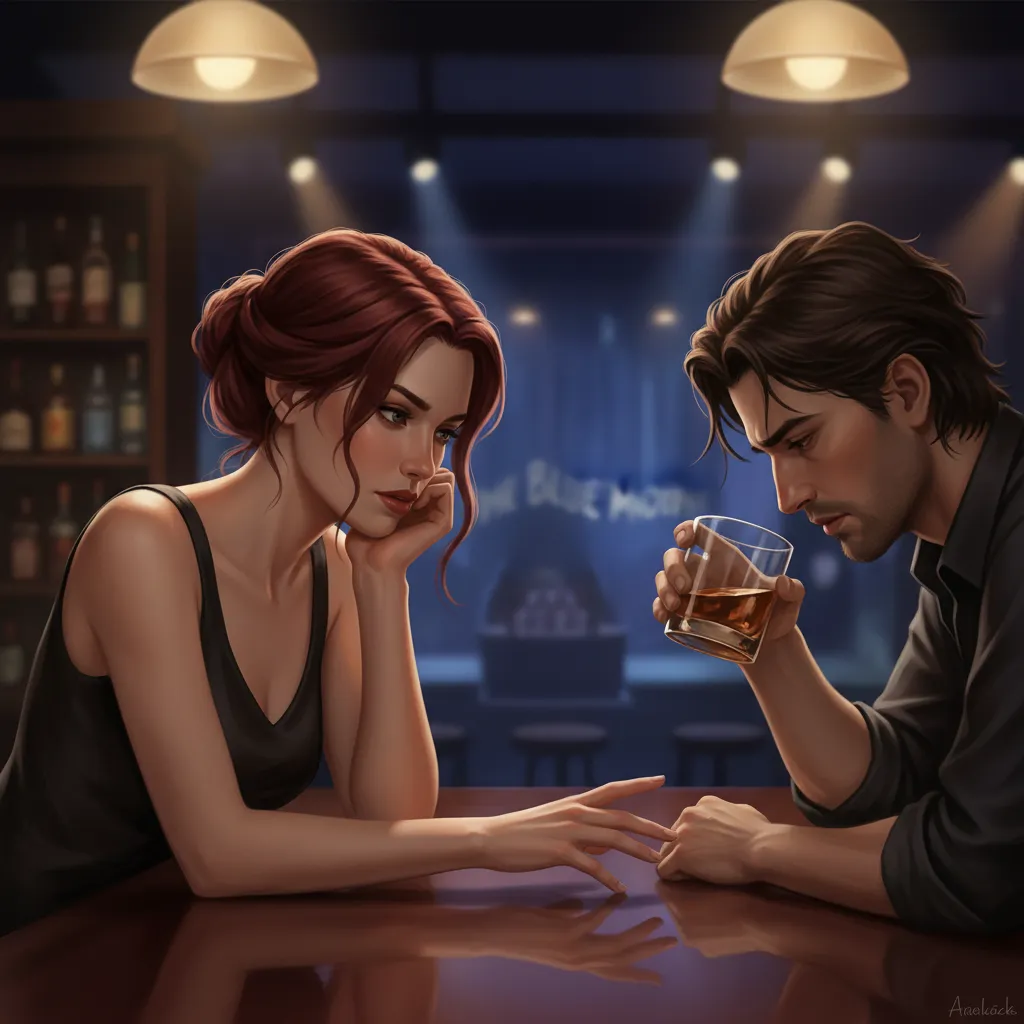
12:04 AM. Twenty minutes to last call.
Vera had turned off the lights over the empty tables, leaving only the bar itself lit — the warm amber glow of the shelf lights behind her, the low lamp at his end. The Blue Moth at this hour was a different place than it was at ten. Smaller. More itself.
She had stopped pretending to clean things and was simply standing across the bar from him, arms resting on the mahogany, close enough that they were talking at a normal volume without trying.
"So," he said. He had a habit, she had noticed, of starting sentences with so when he was moving toward something he hadn't quite decided to say yet. She had counted three of them. "Journalism. What do you write about?"
"People," she said. "Specifically people in cities. How they move through them. What they need from them."
"That's what architecture is," he said.
"I know," she said. "That's why I find architects interesting."
"Architects specifically."
"This one specifically," she said. She held his gaze. She said it cleanly, without decoration, and let it land where it landed.
He was still for a moment. Then: "Vera."
He had read her name from the small pin on her shirt at some point in the evening and had not used it until now. She noticed the timing. People used your name when they had decided something.
"Alex," she said back. Same tone. Same weight.
"Is this—" he stopped.
"Yes," she said.
"You don't know what I was going to ask."
"You were going to ask if this is what it seems like," she said. "And the answer is yes."
He looked at her steadily. "You do this often?"
"Talk to the last guest at the bar?" She tilted her head slightly. "Often enough. This — no."
"What's different about this?"
She considered the honest answer. She gave it. "You defended the ceiling before you knew it would impress me. You were sad about your work in a way that meant you still cared about it. And you've been looking at me," she said simply, "like I'm interesting. Not like I'm a bartender who's being nice to you. Like I'm a person you want to know."
Something in his eyes shifted. Opened. "You are," he said. "A person I want to know."
"I know," she said. "That's what I said."
He laughed — a real one, surprised out of him, the first one of the night, and it changed his whole face. She stored it somewhere.
She reached under the bar and produced a bottle she didn't keep on the shelf — a small Armagnac, fifteen years old, kept for no official purpose. She poured two small glasses and pushed one across to him.
"Last drink," she said. "Off the menu."
He picked it up. She picked hers up. They held them without drinking for a moment.
"To bad days," he said.
"To what comes after them," she said.
They drank.