
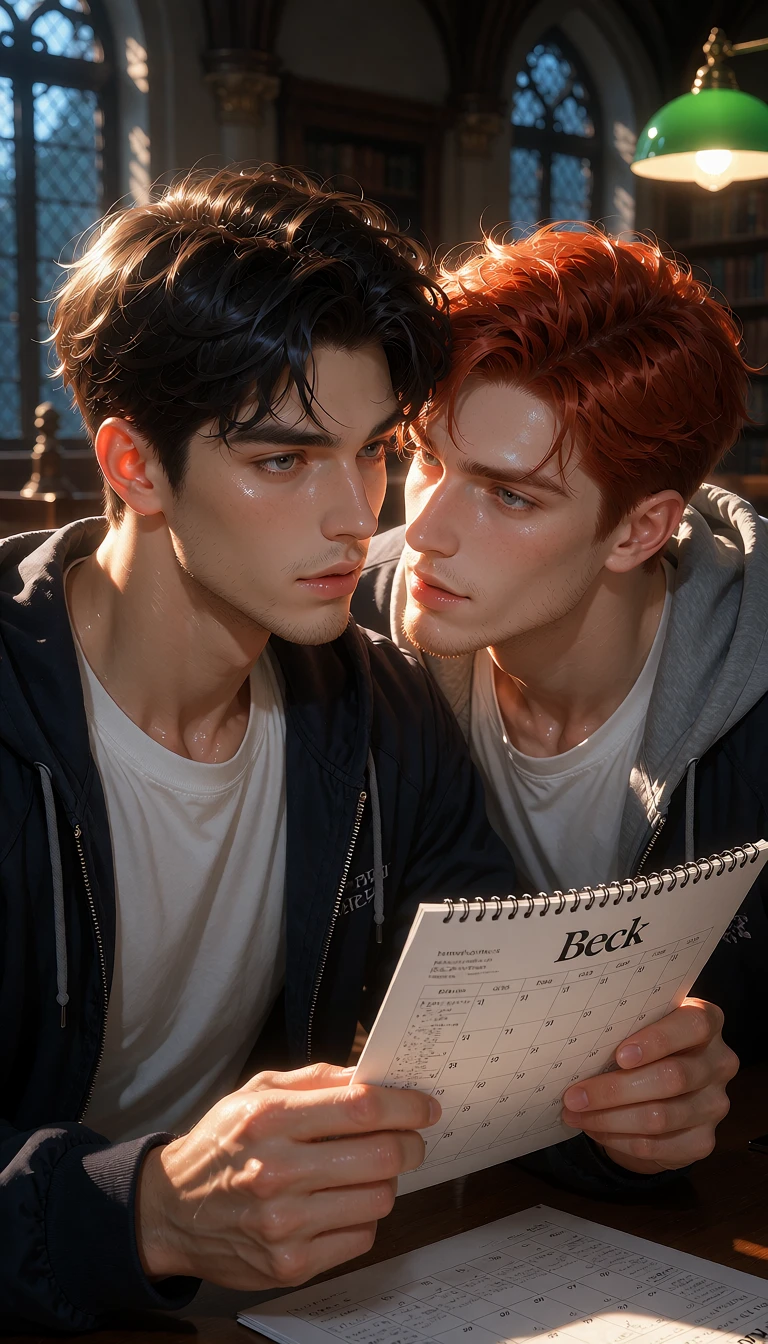
Lydia had been watching Topher underline the same sentence for four minutes.
Not reading it. Underlining it. The pen moved, stopped, moved again over the same three words like he was trying to convince himself they meant something they didn't. His silver-grey eyes tracked left to right, left to right, in that slow rhythm of a man who'd stopped absorbing the page twenty minutes ago and hadn't admitted it yet. The green-shaded reading lamp threw a cone of light across his notebook and left the rest of his face in shadow — the cut of his jaw, the almost-black fall of his hair, all of it dimmed down to suggestion. Only his hands were fully lit. Elegant. Steady. The hands of a man who could tape a sprained ankle in the dark and never fumble it.
Lydia tapped her pen against the tabletop. Slow. Deliberate. The rhythm of a countdown nobody else could hear.
Third floor of the library, late afternoon, the kind of hour when the building went quiet and strange — the photocopier humming somewhere behind the stacks, the radiator clicking like it was keeping time with her pen. Most of the tables had emptied out. A girl two rows over had fallen asleep on her arms. The light coming through the tall windows had gone the colour of weak tea.
Topher turned a page. Underlined something else.
Lydia had been his best friend for six years, which meant she knew exactly what he looked like when he was pretending to study and actually thinking about Beck Marlow. It looked like this. The pen. The page. The jaw set just a fraction too hard. The way his thumb kept finding the corner of the paper and worrying it soft, back and forth, back and forth, like a man working a splinter out of his own skin.
She'd asked him once — last spring, after a house party, after three drinks — what he thought about Beck.
He's a good teammate, Topher had said, and then he'd looked at the wall for a while, and then he'd changed the subject to something so boring she'd let him.
That had been the moment. Not the looks. Not the touches. That wall he'd stared at.
Lydia reached into her bag.
The proposal was folded into quarters, soft at the creases from the three days it had spent in there while she decided whether she was actually going to do this. She ran her thumb along the top edge once — a small, private ceremony — and then slid it across the worn wood of the table, her fingers brushing the corner of his notebook as she passed.
She said nothing.
Topher's pen stopped. He looked up, eyes narrowing, and for a second he just watched her — the way he always did when he suspected a trap, which was most of the time. Then he looked down at the paper.
He unfolded it. Read the first line. His hand went still on the table.
Lydia watched his eyes move down the page. She knew the words by heart — she'd read them enough times to have them memorised, and then she'd read them again just to be sure. The University Athletic Department is pleased to invite applications for the inaugural fundraising calendar, and then the line that mattered, the line she'd been waiting three days to watch land on his face:
Successful applicants will participate in a series of suggestive athletic portraits.
There it was. A flicker at the corner of his mouth. The smallest tightening around his eyes, gone before it finished arriving, but she'd caught it — the exact instant the word suggestive hit his brain and did its work.
He looked up.
"No."
"You haven't read the whole thing."
"I've read enough of it." He slid the proposal back across the table, two fingers flat on the paper, and the edge curled where he'd pressed it. "Lydia. No."
"They're doing the whole department. Hockey, rowing, lacrosse —"
"I don't care what they're doing."
"— and the physio students are eligible, which is why I thought —"
"You thought you'd volunteer me for something without asking."
"I thought I'd inform you," she said, "which is different and better."
He made a sound low in his throat — not quite a laugh, not quite a sigh — and went back to his notebook, which was his way of ending a conversation he didn't want to have. The pen found the page again. He underlined something. He didn't read it.
Lydia leaned back in her chair and tucked a strand of dark hair behind her ear. She'd known he'd say no. She'd known he'd say no the way he said no to everything that actually mattered to him — fast, flat, before the wanting could get a foothold. That wasn't the problem. The problem was the second half of the plan, and the second half of the plan was currently somewhere in the building, and she'd timed this wrong, or maybe she'd timed it exactly right, and she wouldn't know which until the door opened.
She let the silence sit. Let him think he'd won.
The radiator clicked. The sleepy girl two rows over shifted and made a small, unhappy noise. Topher's pen moved. Underlined. Stopped. Moved.
He lasted almost a minute.
"Why me," he said, not looking up. "There's forty guys on the team who'd do it for the attention alone."
"Because you're the only one who'd be good at it."
That got his eyes. Silver-grey, sharp, suspicious. "That's not a compliment."
"It's the truth. You know how to hold still. You know how your body reads from across a room." She shrugged one shoulder. "Hockey taught you that. Physio's teaching you the rest."
"Physio's teaching me how to tape a hamstring."
"And how a body moves when it's being looked at. Same thing."
He opened his mouth — she could see the refusal forming, could see the shape of it, the flat no he was already reaching for — and that was when the chair scraped.
It was a chair across the floor, back legs dragging on linoleum, the sound cutting clean through the hum of the photocopier and the radiator and everything else. Lydia didn't turn around. She didn't have to. She watched Topher's face instead, which was better — the way his whole body went still, the way his hand froze mid-word, the way his eyes lifted over her shoulder and something in them changed so fast it was almost a flinch, and then smoothed over into nothing.
Footsteps. Loose, easy, a stride that had never once had to hurry for anything.
Beck dropped into the chair beside Topher like the seat had been waiting for him. He was still in his practice gear — track pants, a hoodie with the sleeves shoved up past the elbows, his pale skin flushed pink across the cheekbones from the cold outside. Blond hair damp at the temples. He smelled like rink and cheap soap. He didn't say hello. He didn't look at Lydia at all.
"What's that," he said, and reached over Topher's arm to take the proposal off the table.
Topher's hand came down on it a half-second too late. Beck already had it.
Lydia watched him read. He was a fast reader, always had been — she'd watched him skim a playbook once in about nine seconds and then argue about it for an hour — and his eyes moved down the page in a quick, careless sweep that skipped nothing. The corner of his mouth started to curve somewhere around the second paragraph. By the time he hit suggestive athletic portraits it was a full, unrepentant grin, and he tipped his head back and looked at Topher with pale blue eyes that were having the best afternoon of their week.
"Oh," he said. "Oh, this is good."
"Give it back."
"Inaugural fundraising calendar." Beck held it up, away from Topher's reaching hand, and read aloud in a flat announcer's voice. "Suggestive athletic portraits. Proceeds to support —" He broke off, grinning wider. "Support what? Your dignity?"
"Beck."
"They're gonna put you in a speedo, Topher."
"They're not putting me in anything, because I'm not doing it."
"Right, right." Beck folded the proposal along its existing creases, neat as anything, and set it back down on the table between them. He didn't let go of it. His fingers stayed spread across the paper, and Topher's hand was still there on the other edge, and neither of them moved. "Because you said no."
"I said no."
"Sure you did."
Lydia had stopped tapping her pen. She was sitting very still, the way you sit when something wild has wandered into the clearing and you don't want to spook it. Beck's shoulder was a hand's width from Topher's. He'd leaned in without seeming to — that was the trick of him, he never seemed to do anything, it just happened around him — and his voice had dropped into something lower and lazier, the drawl he used on the ice when he was about to say something to an opponent that would get him a penalty if the ref heard it.
"Here's the thing, though," Beck said, and his eyes came up off the page slow, like he had all the time in the world, and landed on Topher's mouth for a beat before they found his eyes. "You're the one who told me last month you wanted to be taken seriously. As an athlete. As a — what did you call it."
"I didn't call it anything."
"You called it a professional image. Very serious. You said it in the locker room with your shirt off, which I thought was funny at the time." Beck's grin didn't move, but something underneath it did — a flick of attention, quick and hungry and gone. "And now the department wants to put you on a calendar, and you're gonna say no because you're shy?"
"I'm not shy."
"No?"
"No."
"Then it's not that." Beck tilted his head. The green lamp picked out the line of his jaw, the faint burn of cold on his cheeks, the way his damp hair was starting to dry into something careless and stupidly good-looking. "So what is it, Topher."
Topher's mouth opened.
Nothing came out.
Lydia saw it — the breath he took, the words that were there and then weren't, the small catch in his throat that was almost a syllable and then just a sound. His fingers curled around the edge of the table. Not the paper. The table. The wood, the worn edge of it, knuckles going pale and tight like he was holding on to something that was trying to get away from him.
"What's the matter," Beck said, quiet, almost kind, which was worse. "Chicken?"
The word landed in the middle of the table like a coin dropped on glass.
Lydia watched Topher's jaw work once. She watched his eyes — silver-grey, steady, the eyes of a man who'd never once in his life backed down from anything he'd actually wanted — come up and meet Beck's pale blue ones, and hold.
"I'm in," he said.
Beck blinked.
It was a small thing, almost nothing, a quarter-second of surprise before the grin came back — but Lydia caught it, and she filed it away, and she leaned back in her chair and let the two of them stare at each other across the folded proposal like the paper had just changed shape on the table.
Neither of them looked away.
The radiator clicked. Somewhere behind the stacks the photocopier finished its job and went quiet, and the silence that came after it was the kind that made the room feel smaller than it was. Topher's fingers were still white on the edge of the table. Beck's hand was still flat on the proposal. Somewhere between them, in the space of about four inches of worn wood and curled paper, something had shifted, and Lydia was the only one in the room who could see it clearly.
"Okay," Beck said finally, and his voice had gone a little rougher than it had been, a little less easy, and he pulled his hand back off the paper and sat back in his chair and looked at the ceiling like it had personally insulted him. "Okay. Fine. If you're in, I'm in."
Topher's head turned. "What?"
"You heard me."
"You don't have to —"
"You think I'm gonna let you do this alone?" Beck looked at him sideways, and the grin was back but it was doing something else now, covering something, holding something down. "You think I'm gonna miss that?"
Lydia picked her pen back up. She spun it once between her fingers, slow, and set it down again, and let the two of them sit in the silence they'd made for themselves.
She'd come here this afternoon planning to plant one idea. She was leaving with two applications and a proposal that had a crease down the middle from Topher's hand, and a question she was going to spend the next week not asking out loud, which was: which of them had just said yes to the calendar, and which of them had said yes to something else entirely.
Beck's shoulder brushed Topher's as he leaned forward to grab the paper again. Neither of them moved apart.
Lydia picked her pen up off the table and dropped it into her bag with a small clatter that neither of them acknowledged. Beck's shoulder was still against Topher's — she could see the exact line where the grey hoodie met the black cotton of Topher's sleeve, the fabric pressed flat and holding, neither man shifting an inch toward the space that had opened up on either side of them.
She gathered the rest of her things slowly. The notebook, the highlighter she'd never used, the phone that had been face-down on the table for the last twenty minutes and hadn't buzzed once. She zipped the bag. Set it on the floor between her feet. Took a breath that neither of them heard because neither of them was looking at her.
Topher's fingers were still on the edge of the table. Beck's hand was still flat on the folded proposal. The four inches of worn wood between them had gone electric, and the two of them were sitting in it like men in a thunderstorm pretending they hadn't noticed the lightning.
Lydia stood up.
The chair legs scraped back. Topher's eyes came up — silver-grey, startled, like he'd genuinely forgotten she was there. Beck didn't move at all. He just tipped his head back against the top rail of his chair and watched her from under his lashes with that pale blue look that gave nothing away and took everything in.
"I'm going to email the coordinator," she said. She slung the strap of her bag over her shoulder and tucked a strand of hair behind her ear, unhurried, letting the sentence sit there. "She said the slots fill up by the end of the week, so if you two want adjacent shoot times, you should probably decide that tonight."
"Adjacent," Topher said. Flat. The way he said a word when he was buying time.
"Adjacent." Lydia smiled at him. Small. Warm. The smile she'd been using on him for six years, the one that meant I know exactly what you're doing and I'm letting you do it. "Same photographer, same afternoon. Otherwise you're looking at separate days and separate rooms and neither of you will like that."
Beck laughed — a short, low thing, more exhale than sound. "You've thought about this a lot, Lydia."
"I've thought about it exactly the right amount." She adjusted the strap on her shoulder and looked at him, and held it a beat longer than she needed to, until something flickered behind his eyes that said he knew she knew. "You two figure out the details. I'll send you both the form."
She didn't wait for an answer. She turned and walked.
Behind her, the library was doing what libraries did at this hour — the long rows of shelves going dim at the far end where the motion-sensor lights had given up, the radiator ticking its slow mechanical count, the smell of old paper and floor wax and the faint chemical tang of whatever they used on the carpet. Her footsteps were the only sound. Neither of them said anything as she went.
That was the part she'd remember later. Not the silence itself — she'd expected the silence. What she hadn't expected was the way it had a shape. The way it held, exactly, the second she'd left them in it. The way the air behind her didn't move the way air moves when two people are about to say something. It moved the way air moves when two people are deciding not to.
She made it to the end of the row before she heard Beck's voice — low, not words, just the register of it, the drawl dropping into something quieter and more private than anything she'd heard him use in a room with other people in it. She didn't turn. She didn't slow down. Six years of being Topher's best friend had taught her exactly how much you could hear by not looking, and how much more you could ruin by looking anyway.
The stairwell door was propped open with a rubber wedge, the way it always was on the third floor, the way the building staff had given up trying to fix. She stepped through it and let it swing shut behind her.
The click was small. Almost nothing. The kind of sound you'd miss if you weren't listening for it.
She stood on the landing for a second with her hand still flat against the door, the cool metal of it under her palm, the stairwell going down in a spiral of painted concrete and handrails, the hum of the fluorescent tube overhead buzzing against the quiet. Below her, somewhere on the second floor, a cart rattled and a voice said something she couldn't make out. Above her, the third floor had gone entirely silent.
Lydia took her phone out of her bag.
The email was easy. She'd drafted it three days ago, sitting in the coffee shop on the corner with the proposal folded open in front of her and the cursor blinking in the subject line, and she'd saved it as a draft and closed the laptop and gone home and not thought about it again until the next morning when she'd opened it back up and read it over and decided she was actually going to do this. She pulled it up now. Read it once. Added a line at the bottom — both applicants confirmed, please book adjacent slots if available — and sent it before she could think about the wording of that either.
The send animation finished. The little paper plane flew off the top of her screen and disappeared.
She put the phone back in her bag.
Down the stairs, past the second floor, past the study rooms with their glass walls and their whiteboards and the two girls in one of them arguing over a laptop with their hands moving too fast to be about anything academic. Past the first floor circulation desk where the student worker was reading a paperback with the spine cracked so hard it lay flat on the counter. Out the front doors into the cold afternoon, where the light had gone the colour of a bruised peach and the wind coming off the quad smelled like snow that hadn't arrived yet.
Lydia stopped on the steps.
She hadn't planned past the email. That was the thing. She'd planned the proposal — the three days it lived in her bag, the exact hour of the afternoon when the third floor emptied out, the timing of Beck's practice ending and his walk across campus and the likelihood that he'd cut through the library to get to the parking lot the way he always did. She'd planned the word chicken without planning it, because she knew Beck, and she knew what he'd reach for, and she'd been right. She'd planned all of that and she hadn't planned what it would feel like to actually leave them in it.
Her phone buzzed in her bag.
She didn't take it out. Not yet. She stood on the steps with her hands in her jacket pockets and watched a kid on a bike cut across the quad and a couple walking with their heads bent together against the wind, and she let herself feel the shape of what she'd just done for one more minute before she looked at it.
Then she pulled the phone out.
Topher. Just his name on the lock screen, no message preview, which meant it was short.
She unlocked it. Read it.
It was one line. Two words, actually, and a period, and the period was doing most of the work.
I hate you.
Lydia read it twice. The wind pushed her hair across her face and she didn't bother moving it. She could hear his voice in it — flat, careful, the same register he'd used on the word adjacent, the register he reached for when the thing underneath was too big to put in a sentence. He wasn't angry. He wasn't even pretending to be angry. He was buying time again, and he'd bought it from her, which meant he knew exactly who to blame and had decided to blame her in the most Topher way available to him: quietly, precisely, and with a period.
She typed back. You're welcome. Sent it before she could second-guess it, because second-guessing it was the whole disease and she'd already caught it once today.
Three dots appeared. Held. Disappeared. Appeared again.
She watched the screen the way she'd watched the table upstairs — the way you watch something that's deciding whether to move. A car went by at the bottom of the steps, its headlights coming on early against the flat grey light. Somewhere behind her the library's automatic doors sighed open and shut, open and shut, letting the warm air out a breath at a time.
The dots stopped. No message came.
She was still standing there with the phone in her hand when the door behind her opened again — not the sigh of the automatic one, the heavier pull of the stairwell door, the one with the rubber wedge under it and the hinge that whined if you let it go too fast. It didn't whine. Whoever came through it was holding it, easing it shut, and the click that followed was the same small almost-nothing as before, and she knew, before she turned, that it wasn't Topher.
Beck came down the steps with his hands in his jacket pockets and his shoulders up against the cold, and he didn't stop next to her. He went past, one step, two, and then he did stop, half a pace below her, so that when he turned he had to tip his head back a little to look at her face. His breath made a shape in the air and dissolved. He'd left his jacket unzipped, the way he always did, as if the cold were something he'd decided not to acknowledge.
"He's still up there," Beck said.
"I know."
"He's been staring at the proposal for ten minutes. Hasn't turned the page. Hasn't said anything." Beck's mouth did something that was almost his usual grin and didn't quite make it. "I told him I was going to the car. He said okay. That's the whole conversation."
Lydia put her phone in her pocket. The wind came across the quad again and this time she moved her hair, tucking it back, a slow deliberate gesture she was aware of making and made anyway. "So why are you on the steps and not in the car."
"Because you're on the steps." He looked at her. Pale blue, steady, the look that gave nothing away and took everything in, and she stood in it the way she'd stood in it at the table, letting it take what it wanted. "You sent that email."
"I sent that email."
"Before we said yes."
"Before either of you said anything." She let the sentence stand. The kid on the bike had come back around the far side of the quad, wheels cutting a thin dark line through the frost that had started to silver the grass. "You want to be angry about that, be angry about it. But you walked into the library at four o'clock and you knew he'd be on the third floor, and you knew I'd be there, and you came up the stairs anyway."
Beck didn't answer for a second. He looked past her, out at the quad, at the couple with their heads bent together who were almost to the far sidewalk now, and something moved behind his face — not much, not long, but she saw it the way she saw everything, which was the problem with her and always had been.
"Adjacent slots," he said finally. Not a question, but not quite the other thing either.
"Same afternoon. Same photographer. Same room." She pulled the strap of her bag up higher on her shoulder. "You'll be fine."
"I didn't say I wouldn't be."
"You didn't have to."
He laughed then — the real one, short and low, more exhale than sound, the one he'd used on her upstairs when he'd said you've thought about this a lot. He shook his head and looked down at the steps and then back up at her, and for one second the shameless thing dropped off him entirely and what was left was just a twenty-two-year-old man standing on a cold set of steps with his hands in his pockets, not sure what to do with the rest of his afternoon.
"You could come back up," he said. "Have a coffee. Watch him not say anything for another hour."
"No."
"No?"
"No." She smiled at him, the small warm one, and this time she meant it at him and not through him. "I've done my part. The rest of it is yours." She stepped past him, down the two steps to the sidewalk, and her boots made a sound on the concrete that she liked — flat, final, hers. "Tell him I said good luck. And tell him I'll forward the form."
She didn't look back. Six years had taught her how much you could ruin by looking, and she'd already spent her one look on the table upstairs and the shoulder that hadn't moved and the four inches of wood gone electric, and that was enough. Behind her she heard Beck's footsteps stay where they were — not following, not going back up, just standing on the steps in the cold with his hands in his pockets, deciding.
She was halfway across the quad when her phone buzzed again.
Not Topher this time. She knew that before she looked, because the buzz was two short pulses and Topher's messages came in single, considered bursts, and Beck had never in his life sent anything in fewer than two parts. She kept walking. The frost on the grass had gone the colour of the sky, and the wind had picked up enough that the bare branches over the path were making their dry winter sound, and the first streetlight came on somewhere behind her and laid her shadow out long on the concrete ahead of her, walking before her like it knew where she was going.
She looked at the message when she reached the corner, waiting for the light.
He came back up. Then, a beat later: He's sitting down.
And then, after a longer beat, because Beck never could leave a thing alone once he'd started it: You're a menace.
Lydia put the phone back in her pocket and crossed the street against the light, because there were no cars, because there was no one to see her, because the afternoon was hers now and she'd earned it. The coffee shop on the corner had its windows fogged and its string lights on early, and she could see the table she'd sat at three days ago through the glass, the one by the window where the draft came under the door, and she thought about going in and ordering something hot and sitting in that exact chair and letting the whole thing finish happening two blocks behind her without her.
She didn't. She kept walking. But she smiled the whole way down the block, at nothing, at the sidewalk, at the cold, and the smile was the small warm one, and there was no one on the street who knew what it meant, which was the best part.