
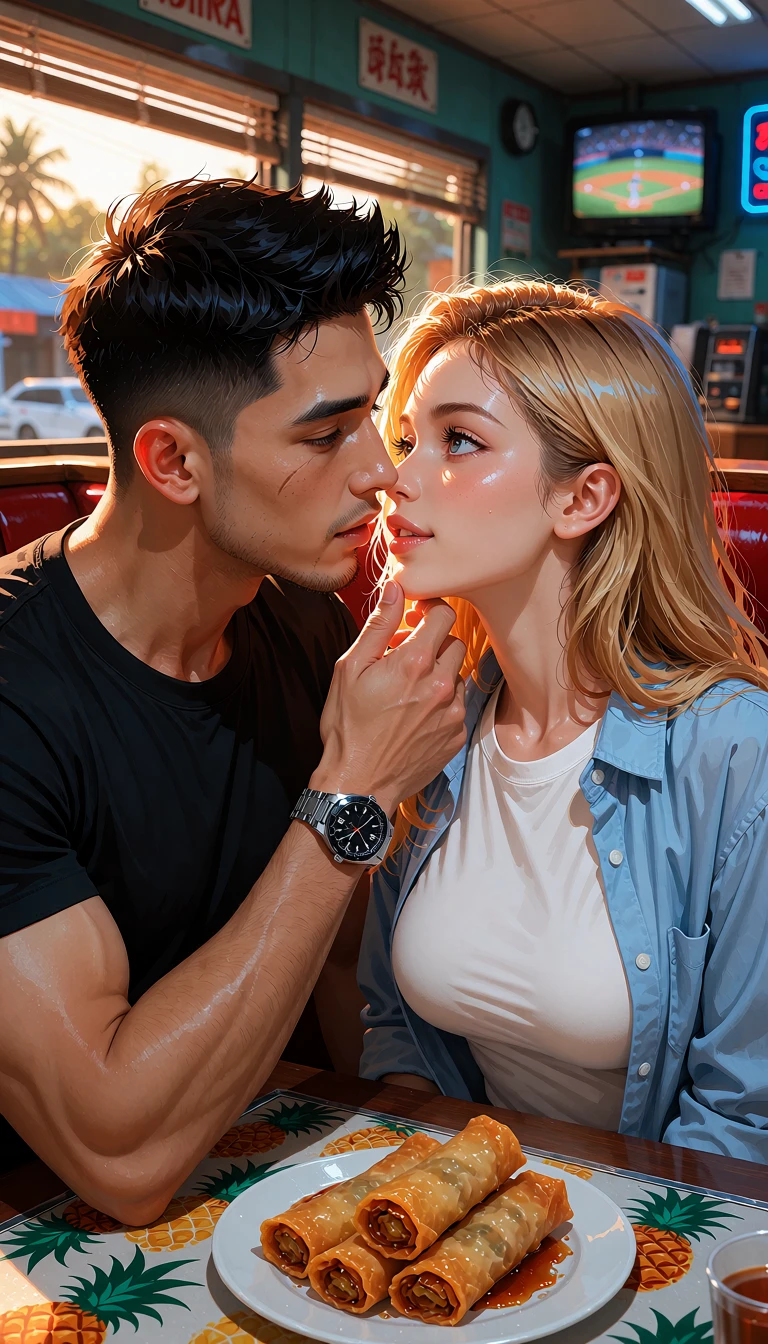
The curtain rings scrape the rod when I pull it back — that cheap metal-on-metal sound every ER bay makes, the sound that means somebody's about to get looked at. I've got a chart in my left hand and a pen behind my ear and a coffee going cold at the nurses' station, and I'm already cataloging him before I even say hello: male, mid-twenties, sitting on the edge of the gurney with his right shoe off and his ankle already ballooning over the sock line. Athletic build, the kind that fills out a T-shirt without trying. Black-rimmed glasses. Hair cut so tight on the sides you could read a headline off the skin.
And he's looking at the curtain like it personally insulted him.
"Hi. I'm Paula. I'm your nurse tonight."
He turns his head. Dark brown eyes behind the Oakleys — no, he's wearing them, not holding them, which is a first for me, most guys yank their glasses off the second they hit the door. He blinks twice, fast, like he's recalibrating.
"Eddie."
Just the one name. No hand out, no smile yet, and I clock the tension in his jaw — the kind of tension that isn't about pain. He's somewhere else in his head. I've seen it in guys who came in for a broken wrist and spent the whole exam asking whether the shop would be okay without them.
"Okay, Eddie. Let's see what we're working with."
I pull the rolling stool over and sit, which puts me below him, and that's on purpose. It's easier to read a face from underneath. Easier to see what someone's hiding. I take his heel in my palm — careful, both hands, no sudden moves — and he hisses through his teeth.
"Sorry. I know."
"It's fine."
"It's not fine, you just went white." I tilt his foot toward the light. The swelling's already past the malleolus, the skin stretched shiny over the bone. "Did you hear a pop?"
"No pop." He adjusts his glasses with his middle finger — a quick, practiced nudge. "Just rolled it. Landed wrong."
"Landed wrong doing what?"
He's quiet a second. Then: "Pitching."
"Pitching what?"
That gets me the first real look — a sideways flick of the eyes, half amused, half something else. "Baseball."
"Oh." I set his heel down on a folded towel and reach for the blood pressure cuff. "Okay, so I don't know anything about baseball. Fair warning. I know it's the one with the bats and the crying."
He laughs. It's short and surprised, like it got past him before he could stop it, and it changes his whole face — the jaw loosens, the corners of his eyes crinkle behind the lenses. He looks younger when he laughs. He looks his age, whatever that is.
"There's not that much crying," he says.
"I'm a nurse. I've seen grown men cry over a paper cut. I stand by my assessment." I wrap the cuff around his arm and hit the button. The machine whirs. "You're a little tachycardic. One-fifteen over seventy. Is that pain, or is that you?"
"Probably me."
"You nervous?"
"No." He says it fast. Then, slower: "I don't like hospitals."
"Nobody likes hospitals. That's not a character flaw." The cuff hisses and deflates. I peel it off and write the numbers down. "Any medical history I should know? Surgeries, conditions, anything that's going to surprise me?"
"No surgeries. No conditions." He watches me write. "You have really neat handwriting."
I look up. "That's the nicest thing anyone's said to me all shift."
"It's a low bar."
"You have no idea how low."
He smiles again — smaller this time, but it stays. I move his foot into the light and start palpating along the lateral ligaments, feeling for the spot where the tissue gives. He's quiet while I work, breathing through it, and I notice he doesn't pull away. Most people pull away. He just sits there and lets me do my job, which is its own kind of trust, and I don't take it for granted.
"Okay. I don't think it's broken, but I want an X-ray to be sure. In the meantime I'm going to wrap it and get you some ice." I stand and reach for the cabinet. "You want to tell me how a pitcher sprains his landing ankle, or is that classified?"
"It's the foot I push off with. The back foot." He gestures vaguely with one hand, like he's drawing a diagram in the air. "You come down on it, and if you come down wrong —" He shrugs. "It's the most common injury in the sport. I've done it before."
"And you kept pitching?"
He doesn't answer that one.
I pull the elastic wrap from the drawer and come back to the stool. "That's a yes."
"That's a no comment."
"Uh-huh." I start the wrap at his toes, firm but not tight, working my way up in overlapping turns. "So you're one of those."
"One of what?"
"One of those guys who thinks 'walk it off' is a medical treatment."
"It's worked so far."
"It's worked so far because you're twenty-four and made of rubber. Give it ten years." I press the tape down at the end and look up at him. "There. Ice for twenty minutes, X-ray after that. Don't unwrap it. Don't test it. Don't stand on it to see if it still hurts, because I know you're going to want to."
He's watching me with an expression I can't quite name. Not flirty. Not grateful, exactly. Something more careful than that, like he's checking whether I mean it.
"You're good at this," he says.
"I should hope so. I just graduated."
"From where?"
"State. SDSU."
"No way." He sits up straighter. "I went there."
"You did?"
"Ninety-six to ninety-eight. Electrical engineering." He adjusts his glasses again. "Didn't finish. Baseball got in the way."
Something clicks in the back of my head — a memory of walking past the athletic building, the banners, the crowds on game days that I never once joined. I never cared about any of it. It was just noise on the other side of campus.
"Small world," I say.
"Smaller than you'd think."
The curtain scrapes open behind me and a guy in a Padres polo sticks his head through — wiry, tan, five o'clock shadow at nine at night, wearing a cap like it's part of his face.
"Rook." He looks at Eddie, then at me, then back at Eddie. "You look like hell."
"Marc." Eddie's voice flattens. "I told you to wait in the car."
"And I told you I wasn't doing that, so here we are." Marc steps into the bay, and the whole space gets smaller. He's got one of those voices that fills a room without trying. He nods at me. "Ma'am. Sorry to interrupt. I'm his babysitter."
"You're not my babysitter."
"I'm his teammate, which is basically the same thing." Marc folds his arms and looks at the wrapped ankle. "How bad?"
"X-ray's pending," I say. "But I'd guess a grade two sprain. He'll be off it a few weeks."
Marc whistles through his teeth. "Doc Pierce is going to kill you."
"Doc Pierce can get in line."
"He's not gonna be the only one in line, is he." Marc says it flat, not a question, and something passes between the two of them that I'm not supposed to see. Eddie's jaw tightens again. The easy version of him from thirty seconds ago is gone.
I stand up and gather my supplies. "I'm going to put the X-ray order in. Try not to let him stand on it while I'm gone."
"That's a full-time job," Marc says.
"Then you'd better get started."
I pull the curtain closed behind me and walk back to the desk. The coffee's cold by now, but I drink it anyway, standing there with the chart in my hand, and I catch myself looking back at the curtain like I might see through it. I don't know why. He's just a patient. A nice one, which is rare, and a funny one, which is rarer, and there's something underneath the easy grin that I can't get a grip on, some weight he's carrying that has nothing to do with his ankle.
I write his name on the X-ray slip. Eddie. No last name yet. I didn't ask.
By the time I get back with the wheelchair, Marc's on his phone and Eddie's got his head tipped back against the wall, eyes closed, glasses pushed up onto his forehead. Without them his face looks different — softer, younger, tired in a way that has nothing to do with the ankle. I stand in the doorway a second before I make noise. I don't know why I do that either.
"Ready?"
He opens his eyes and drops the glasses back down, and there he is again — the grin, the easy shoulders. "Ready."
Marc takes the handles before I can. "I got him."
"He's my patient."
"He's my rookie." Marc grins at me, wide and shameless. "We can share."
I let him push. I walk alongside instead, one hand on the IV pole that isn't there, a habit I can't shake, and Eddie looks up at me from the chair as we roll down the corridor.
"Paula."
"Yeah?"
"Thanks. For the —" He gestures at his ankle. "You didn't have to be nice to me."
"It's literally my job."
"That's not what I meant."
I look down at him. The fluorescent lights are doing him no favors, and he still looks good, and I hate that I noticed. "I know what you meant."
He holds my eyes a second longer than he needs to. Then the X-ray doors swing open and the tech calls his name, and Marc wheels him through, and I stand in the hallway with my cold coffee and my clipboard and the strange, stupid feeling that something just started that I don't have a name for yet.
I go back to the desk. There's a chart waiting. There's always a chart waiting.
But I take his name off the top of the pile and set it aside before I start the next one. Just for a second. Just to look at it.
Reyes, Eduardo. Age twenty-four. No allergies. No history. Occupation: professional baseball player.
I read it twice. Then I put it back in the pile, on top, where I'll see it again when the X-ray comes back.
That's all it is. A chart on top of a pile.
The curtain at the end of the hall rustles, and I tell myself it's the AC.
I make it through two more charts before the X-ray tech calls me. A kid with a fishhook in his thumb, a woman with a migraine that's been going for three days, a man who swears his chest pain is just gas and is probably right but I'm not going to be the one who bets on it. That's the job. You hold twelve people in your head at once and you don't drop any of them, and somewhere in there you're supposed to eat dinner and pee and remember that you have a body of your own.
I haven't peed in six hours. That's a personal record. I should not be proud of that.
When I get back to the bay, Eddie's on the gurney with his leg propped on a pillow and a magazine in his hands that he's not reading. Marc's gone — I can see him through the curtain gap, pacing the waiting room with his phone pressed to his ear, one hand doing that thing where you gesture at someone who can't see you. Eddie looks up when I come in and the magazine drops to his lap.
"Results?"
"Not yet. I came to check on you." I pull the stool over and sit. "How's the pain, one to ten?"
"Four."
"Liar."
"Six." He says it without any shame at all. "It's not the ankle. It's the not-knowing."
"That's the worst part of most things."
"Yeah." He looks at the ceiling. "How long until I know?"
"Twenty minutes, maybe. Radiology's backed up." I lean back on the stool and cross my arms. "You want to tell me what you're actually worried about, or do you want to keep staring at the ceiling like it owes you money?"
That gets me the sideways look again. The one that says he's deciding whether I'm safe. I get that look a lot, actually — it's the look people give you right before they tell you something they haven't told anyone, and I've learned not to push, just to wait, because pushing makes them close up and waiting makes them lean in.
He leans in.
"I'm in my contract year," he says. "Well. Second-to-last. Arbitration after this season, free agency the year after." He adjusts his glasses. "Every start matters. Every inning matters. If I'm out three weeks, that's four starts. Four starts in a season where I'm supposed to prove I'm worth what they're paying me."
"What are they paying you?"
"Nine million."
I blink at him. I can't help it. Nine million dollars is not a number I can hold in my head, not really — it's just a shape, a thing that happens to other people, and here it is sitting on my gurney with a wrapped ankle and a magazine he's not reading.
"Okay," I say. "That's a lot."
"It's not about the money." He says it fast, almost defensive. "It's — you know what people think when they see that number? They think you're set. They think you're a guy who doesn't have to worry. But it's not mine. It's never been mine. It's a bet. They're betting I'm worth it, and every day I'm not on the mound, I'm losing the bet for them."
I don't say anything for a second. I'm thinking about the way he said it — not bragging, not complaining, just laying it out like a diagnosis. Like he's been carrying it around for a while and finally found somewhere to set it down.
"That sounds exhausting," I say.
He laughs. Short and real. "It is."
"Do you like it? The pitching."
He thinks about that one. Actually thinks. The glasses come off, he wipes them on his shirt, puts them back on, and I watch the whole ritual like it's a tell in a card game.
"Yeah," he says finally. "I love it. That's the problem. I love it so much I don't know how to stop, and I've never had to find out."
I stand up. "Well. Tonight you don't have to find out. Tonight you find out whether it's broken, and if it's not broken, you go home and you ice it and you come back in a week and we look at it again. That's the whole assignment."
"That's it?"
"That's it." I reach for the curtain. "You want a blanket? The bays get cold."
"Yeah." He says it quietly, and I hear the shift — the easy grin going soft at the edges. "Yeah, that'd be good."
I bring him a blanket from the warmer and drape it over his legs, and he watches me do it like I'm performing surgery. When I pull my hands back he catches my wrist — light, just two fingers, gone before I can decide whether to pull away.
"Sorry," he says. "That was — sorry."
"It's fine." My voice comes out steadier than I feel. "You want to tell me why you did it?"
"No." He looks at the blanket. "I don't know. I just wanted to see if you'd stay."
I stand there. The monitor behind him beeps its steady rhythm, and somewhere down the hall a cart rattles past, and I should say something professional, something that puts the two of us back on the right sides of the line. I've done it a hundred times. I know the script.
"I'm on until seven," I say. "So. Yeah. I'll be around."
He nods. He doesn't smile. He looks at me with those dark eyes behind the glasses and something in his face opens up, just a crack, and I feel it in my chest like a hand pressed flat against a window.
The X-ray tech appears at the curtain. "Reyes?"
"That's me."
I step back and let her wheel him out. Marc falls in behind them, phone still up, and I hear him say "yeah, he's fine, he's being a baby about it" as they go, and Eddie flips him off without looking back, and the whole thing is so ordinary and so stupid and so — I don't know. Warm. It's warm. That's the word I don't want to use.
I go back to the desk and pull his chart off the pile and write the time of the X-ray in the margin. My handwriting is neat. He noticed that. Nobody notices that.
Twenty minutes later the radiologist calls and says it's clean — no fracture, grade two lateral sprain, follow up with ortho in a week, RICE, the whole speech. I write it down and take the chart back to the bay, and Eddie's already dressed, sitting on the edge of the gurney with his shoe on his good foot and his bad one bare, and Marc is holding the crutches I didn't order yet like he's been waiting for them to hatch.
"It's not broken," I say.
Eddie's whole body lets go. I watch it happen — the shoulders drop, the jaw unclenches, the breath he's been holding since he walked in comes out of him in one long exhale. He closes his eyes. He opens them.
"Thank God," he says.
"Three weeks," I say. "Maybe two if you're good. No throwing, no running, no standing on it to see if it still hurts."
"I heard you the first time."
"I'm saying it again because I know you."
He looks at me. "You don't know me."
"I know enough." I hand him the discharge papers. "Sign at the bottom. There's a follow-up number in there for the ortho clinic, and my extension is on the top if anything changes before then."
He takes the papers and doesn't look at them. "Your extension."
"For medical questions."
"Right." He signs his name — Eduardo Reyes, in a scrawl that loops like a signature he's practiced a thousand times — and hands the papers back. "For medical questions."
Marc snorts from the corner. "Rook, you're about as subtle as a fastball to the ribs."
"Shut up, Marc."
"I'm just saying." Marc pushes off the wall and takes the crutches. "Ma'am, it's been a pleasure. You want me to bring him back in a week or is he gonna find an excuse to come in on his own?"
"I'm right here," Eddie says.
"I know." Marc grins at me. "He's right here."
I walk them out. It's policy, technically, but I walk them out anyway, and at the sliding doors Eddie stops and turns around, balanced on the crutches, and looks at me through the glass with the parking lot lights behind him and the automatic doors breathing open and closed beside us.
"Paula."
"Yeah."
"I'm going to be honest with you, because I don't think I'm going to get another chance to be." He shifts his weight on the crutches. "I came in here tonight thinking about my ankle. That's all I was thinking about. And then you sat down on that stool and made me laugh, and I haven't laughed in — I don't know. A while. And now I'm standing in a parking lot at midnight and I can't remember what I was so worried about."
I should say something. Something light. Something that lets us both off the hook.
"You were worried about four starts," I say.
"Yeah." He smiles. "That."
Marc honks the horn from the car. Eddie doesn't move. Neither do I.
"Goodnight, Eddie."
"Goodnight, Paula." He turns and crutches toward the car, and Marc gets out to help him in, and I stand in the doorway of the ER with the cold air on my face and watch the taillights pull out of the lot and turn left onto the street, and I don't go back inside until they're gone.
When I do, I find his chart still on top of the pile, and under the discharge signature there's a line he wrote that isn't part of the form. Just five digits and a dash and four more. A phone number, in that looping scrawl, right under the words "Patient Signature."
I tear the corner off the page and fold it into my scrub pocket and put the rest of the chart in the bin where it belongs.
Then I go back to the desk. There's a chart waiting. There's always a chart waiting.
But I keep my hand in my pocket for the rest of the shift, and I don't take it out.