
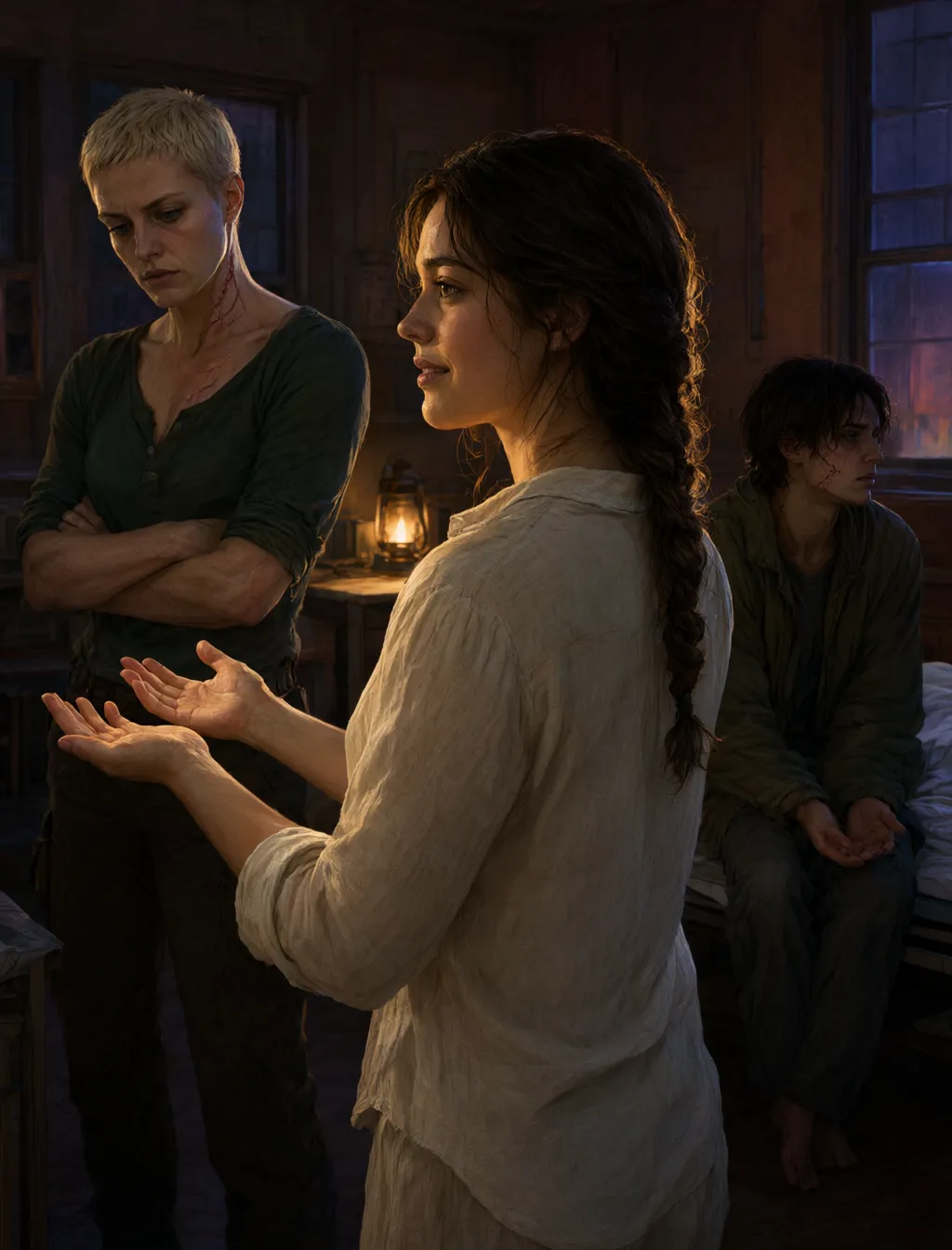
The infirmary cot’s thin mattress smelled of antiseptic and sweat, the single bulb buzzing overhead casting sharp shadows across the linoleum floor. I’d cleaned this room a hundred times, restocked these shelves, changed these sheets, and every time I thought I’d seen the worst the world could deliver through these doors. Then they’d brought in Abby Anderson.
She sat on the edge of the cot now, stripped to a tank top that exposed the wreckage of her shoulders. The wounds were days old, poorly bandaged, the gauze stained brown and rust-red. Infection had started to creep at the edges—pink and angry, warm to the touch. She hadn’t flinched when I peeled the dressing off, hadn’t made a sound. Just sat there, jaw set, pale eyes fixed on the wall like she was somewhere else entirely.
I pulled the tray closer. Needle. Thread. Saline. The tools I’d sharpened and sterilized myself, because the world didn’t come with pre-packaged kits anymore. My hands moved on autopilot, checking the curve of the needle, the tension of the thread, the depth I’d need to close the gap without trapping bacteria beneath the surface.
“This is going to hurt,” I said. “I don’t have enough local left to numb it properly.”
“Just do it.” Her voice came out flat, scraped clean of inflection. She didn’t look at me.
I leaned in. My braid fell forward, brushing against her bare arm as I positioned myself. The light caught the wound—a ragged tear that ran from her shoulder blade to the top of her deltoid, deep enough that I could see the muscle beneath. Whatever had made this hadn’t been clean. A blade, maybe. Or a piece of rebar. Something that had torn rather than cut.
I pressed the wound edges together with my fingers. Her skin was warm, fever-warm, and I felt the slight tremor in her muscles—a tension she was fighting to control. Not pain. Not yet. Anticipation.
“On three,” I said.
She didn’t respond.
I pushed the needle through.
Her breath caught—a sharp, ragged sound she tried to swallow immediately. The needle curved through her flesh, pulling the thread behind it, and I worked the first stitch tight with the practiced economy of someone who’d done this more times than she could count. The wound closed a fraction of an inch. One down. Twenty more to go.
I didn’t look at her face. I kept my eyes on my work, on the precise distance between entry and exit, on the tension of each loop. My hands moved steady and sure, the rhythm of it familiar as breathing. Push. Curve. Pull. Tighten. Repeat.
The only sounds were the buzz of the bulb, the wet slide of the needle through tissue, and the ragged rhythm of Abby’s breathing. She didn’t make another sound after that first one. Not a gasp, not a hiss. Just the occasional hitch in her breath that told me she was still feeling it, still pushing through.
I finished the first line of stitches and sat back. “Halfway.”
She nodded. A small, tight motion. Her hands were gripping the edge of the cot, knuckles white.
“You can let go of the cot,” I said, reaching for the saline to flush the wound again. “You’ll bruise your palms.”
“I’m fine.”
“That’s not what I asked.”
She looked at me then. Really looked. Her pale eyes met mine, and for a second I saw past the flatness—saw the exhaustion underneath, the vigilance that never quite turned off. She was cataloging me. Measuring me. Deciding if I was a threat or not.
I held still under the weight of that stare. I’d been looked at like that before, by soldiers and survivors and people who’d learned the hard way that trust was a luxury. I let her look. I didn’t look away.
“Lev,” she said finally. “Where is he?”
“He’s in the next room. My colleague is checking him over. He was dehydrated, a few cuts and bruises, but nothing life-threatening. He’ll be okay.”
Her jaw tightened. A muscle jumped in her temple. “I want to see him.”
“You will. After I finish closing this.” I picked up the needle again. “One more set. Then I’ll take you to him.”
She didn’t argue. That was worse, somehow, than if she had. Her gaze dropped back to the wall, and I watched the tension settle back into her shoulders—a familiar weight, a coat she’d worn so long she’d forgotten how to take it off.
I leaned in again, closer this time. The wound was clean enough now—the edges pink and angry but free of the yellow pus that would have meant a deeper infection. I’d caught it in time. Another day, another night in the wild, and it would have been a different story. People died from wounds like this. Not from the cut itself, but from what crawled into it afterward.
My fingers pressed the skin together, aligning the edges as carefully as I would a torn photograph. I pushed the needle through again, felt the resistance and then the give, the thread sliding through flesh like a whisper.
Stitch.
Her breath held.
Stitch.
Her fingers tightened on the cot.
Stitch.
A small sound escaped her—a tightening of the throat, a swallowed thing. I pretended not to hear it.
“Almost done,” I said, keeping my voice low. “You’re doing fine.”
She didn’t respond. But her breathing shifted—a fraction of an inch toward normal. Like my words had mattered, even if she wouldn’t admit it.
I finished the last stitch and sat back, surveying my work. The wound was closed now, a neat line of black thread running through her skin like a zipper. It would scar—couldn’t be helped, not with a wound this deep—but it would heal clean. In a month, it would be a pale line. In a year, she’d barely notice it.
“You’re going to have a scar,” I said, reaching for the roll of gauze.
Her jaw tightened. The muscles in her neck corded, and I watched her look down at her forearms—at the lattice of old scars that covered them, some faded to silver, others still pink and raised. A geography of survival, each one a story she’d never tell.
“I already have enough of those,” she said. The words came out rough, scraped from somewhere deep.
I paused, the gauze half-unrolled in my hands. “This one’s different.”
She looked at me again. That sharp, assessing stare. “How.”
“Because this one means you made it.” I met her eyes. “You got here. You survived long enough for someone to stitch you up. That counts for something.”
She held my gaze for a long moment, and I saw something flicker in her eyes—a crack in the armor, a breach in the wall she’d built around herself. It was gone before I could name it, swallowed back into the flatness, but I’d seen it. I knew I’d seen it.
“Lev,” she said again. “Take me to him.”
I wrapped the gauze around her shoulder, snug but not tight, and taped the end down. “Let me wash up first. Then I’ll take you.”
I turned away, letting her have the privacy of my back while I cleaned my hands in the basin. The water ran pink, then clear. I dried them on a towel that had seen better days and turned back to find her standing, one hand pressed to the fresh bandage like she was checking it was real.
“This way,” I said, and led her out of the infirmary.
The hallway was dim, lit only by a few oil lamps we saved for after dark. The generator hummed somewhere in the building’s guts, but we rationed power carefully—enough for the infirmary, the radio room, and the kitchen. Everything else was candlelight and kerosene.
Abby followed a step behind me. I could hear her breathing, the soft scuff of her boots on the linoleum, the way she paused at every intersection to check the corners. Soldier’s habits. They didn’t die easy.
I stopped at the second door on the left and pushed it open.
“He’s in here.”
The room was small—not much bigger than a closet—but we’d made it into a recovery space. A cot, a chair, a table with a pitcher of water. Lev sat on the edge of the cot, a blanket wrapped around his shoulders, a cup of water in his hands. He looked up when the door opened, and something in his face relaxed when he saw Abby.
“You’re okay,” he said. Not a question. A statement of fact, like he’d been holding onto it and needed to confirm.
“I’m okay.” Abby crossed the room in three strides and sat down next to him on the cot. Not touching, but close. The way people sit when they’ve been through something together and don’t need words to fill the space.
I lingered in the doorway, watching them. The kid—Lev, I reminded myself, fourteen years old and already carrying a weight that would break most adults—had the same wariness in his eyes that Abby had, but it softened when he looked at her. She was his anchor. The one fixed point in a world that had tried to swallow him whole.
“There’s food in the mess hall,” I said. “I can bring you both something, if you’re hungry.”
Abby shook her head. “I’m fine.”
“You need to eat,” I said, keeping my voice gentle. “You’ve been traveling for days. Your body needs fuel to heal.”
She looked at me then, and I saw the exhaustion behind her eyes—the bone-deep weariness of someone who hadn’t slept properly in weeks, maybe longer. She wanted to argue. I could see the refusal forming on her lips.
But Lev spoke first. “Abby.” His voice was quiet, steady. “She’s right.”
Abby’s jaw worked. She looked at him, at the hollows in his cheeks, at the way his hands trembled slightly around the cup. Then she looked back at me and nodded. A single, clipped motion.
“Fine.”
“I’ll be back in ten minutes.” I stepped back into the hallway. “Stay here. Rest. I’ll bring enough for both of you.”
I closed the door gently behind me and stood in the dim hallway, letting out a breath I hadn’t realized I’d been holding.
My hands were steady. They always were. But my chest—my chest was a different story. I pressed one hand to my sternum, feeling the rapid thud of my heart, and tried to name what I was feeling.
It wasn’t fear. I’d seen worse wounds, treated worse cases. It wasn’t pity, either—I’d learned long ago that pity helped no one.
It was something else. Something warm and sharp and unfamiliar, like a splinter working its way under my skin.
I thought about Abby’s hands on the edge of the cot, white-knuckled and trembling. I thought about the crack in her eyes when she’d said I already have enough of those. I thought about the way she’d stepped into Lev’s room and immediately found his frequency, settled into his orbit like a body finding its center of gravity.
The survivors who came through St. Catalina were all the same in some ways—hollowed out, running on fumes, carrying ghosts they couldn’t name. But Abby was different. I couldn’t say how, not yet. But I felt it, a pull in my chest like the first tug of a current.
I shook my head and started walking toward the mess hall. There would be time to think later. Right now, I had soup to heat up and two people who needed to eat.
The mess hall was quiet this time of night—just a few off-duty guards nursing cups of coffee at a corner table. The kitchen was empty, the stoves cold. I lit the burner and found the pot of vegetable stew we’d made that morning, still edible if I heated it through.
I ladled two portions into bowls, found a couple of spoons, and wrapped it all in a cloth to carry. The motions were automatic, familiar. I’d done this a hundred times for a hundred patients. But tonight it felt different. Tonight, every movement felt weighted, charged with something I couldn’t name.
When I got back to the room, Abby was sitting on the floor, her back against the wall, her eyes closed. Lev was still on the cot, watching her with the kind of quiet vigilance that spoke to a long history of keeping watch.
“She fell asleep,” he said softly. “I didn’t want to wake her.”
I set the bowls down on the table. “That’s good. She needs it.”
“She doesn’t sleep.” Lev’s voice was matter-of-fact, stripped of self-pity. “Not really. Not deep. She always has one eye open.”
I looked at Abby, slumped against the wall. Her face was slack in sleep, the hardness smoothed away, and she looked younger than she had in the infirmary. Still carrying the same weight, but no longer fighting it every second.
“She’s safe here,” I said, and I meant it. “You both are.”
Lev looked at me, his brown eyes too old for his face. “For how long?”
It was a fair question. The kind of question you asked when you’d learned that safety was borrowed, not owned. I didn’t have an answer that would satisfy him—didn’t have an answer that would satisfy myself.
“I don’t know,” I said honestly. “But tonight? Tonight, you’re safe. Eat something. Rest. Tomorrow, we figure out the rest.”
He held my gaze for a long moment, weighing me. Then he nodded, a small, tired motion, and reached for the bowl of stew.
I pulled the chair over to the corner of the room, far enough to give them space but close enough to keep an eye on Abby’s wound. I sat down, crossed my legs, and watched them eat.
The stew was thin, the vegetables soft, the broth barely seasoned. But they ate like it was a feast, spooning it down with the focused intensity of people who knew what hunger felt like. Lev finished first, setting the bowl aside with a quiet thank you. Abby stirred a few minutes later, blinking awake, looking around the room with a moment of confusion before her eyes landed on me.
“You fell asleep,” I said. “Lev ate. There’s still some left for you.”
She looked at the bowl, then at Lev, then back at me. Something shifted in her expression—a loosening, a softening—before she reached for the food.
She ate slower than Lev, her eyes still tracking the room, cataloging exits, measuring distances. But she ate. Every last drop. And when she set the bowl down, she looked at me properly, her pale eyes meeting mine with something that wasn’t quite trust yet, but wasn’t suspicion anymore either.
“Thank you,” she said. Two words. Low and rough, like they cost her something to say.
I nodded. “You’re welcome.”
She held my gaze a beat longer, and I felt it again—that strange warmth, that pull I couldn’t name. Her hands resting on her knees, scarred and capable. The line of stitches across her shoulder, clean and white against her skin. The way her breath had steadied. The way she was looking at me now, with eyes that let me see a crack of something real.
I looked away first, reaching for the empty bowls. “I’ll let you rest. The infirmary is two doors down if you need anything. I’ll check your wound in the morning.”
“Kassandra.”
Her voice stopped me at the door. I turned.
Abby was still sitting against the wall, her hands loose in her lap, her gaze direct. “Lev and I. We don’t…” She paused, searching for the words. “We don’t stay. We move on. That’s how it works.”
I waited.
“But tonight.” She looked down at her hands. “Tonight, we stay.”
It wasn’t a thank you. It wasn’t a promise. It was a statement of fact, the same way Lev had said she doesn’t sleep. A truth she was offering me, stripped of sentiment.
I held her gaze. “I’ll be here in the morning.”
She nodded. And I stepped out, closing the door behind me, leaning against the hallway wall with the empty bowls still in my hands and my heart beating faster than it had any right to.
The bulb above me flickered, casting jumping shadows across the linoleum. The building hummed with the quiet sounds of night—a distant voice, the creak of settling wood. Somewhere outside, the ocean breathed against the shore, salt and dark and endless.
I carried the bowls to the kitchen, washed them in cold water, set them to dry. The motions were automatic, but my mind was still in that room, still watching Abby’s hands steady on her lap, still feeling the weight of her eyes on mine.
When I was done, I walked back to my quarters—a small room with a single cot, a table, a lamp. I sat on the edge of the bed and looked at my hands. Steady. Always steady. But they remembered the feel of her skin, the warmth of her blood on my gloves, the precise resistance of the needle pushing through tissue.
I’d stitched up hundreds of wounds. I’d never noticed the shape of someone’s shoulders before. I’d never wondered what their hands would feel like against mine, palm to palm. I’d never caught myself hoping a patient would stay longer than their recovery required.
I lay back on the cot, staring at the ceiling, the faint cracks in the plaster making patterns I couldn’t follow.
Tomorrow, I’d check her wound. Change the dressing. Make sure infection hadn’t taken hold. And then what?
I closed my eyes. The image of her face lingered behind my lids—the sharp blue of her eyes, the set of her jaw, the way she’d said my name like it was a risk she was taking.
I let myself hold onto it, just for a moment, before I let the exhaustion take me.