
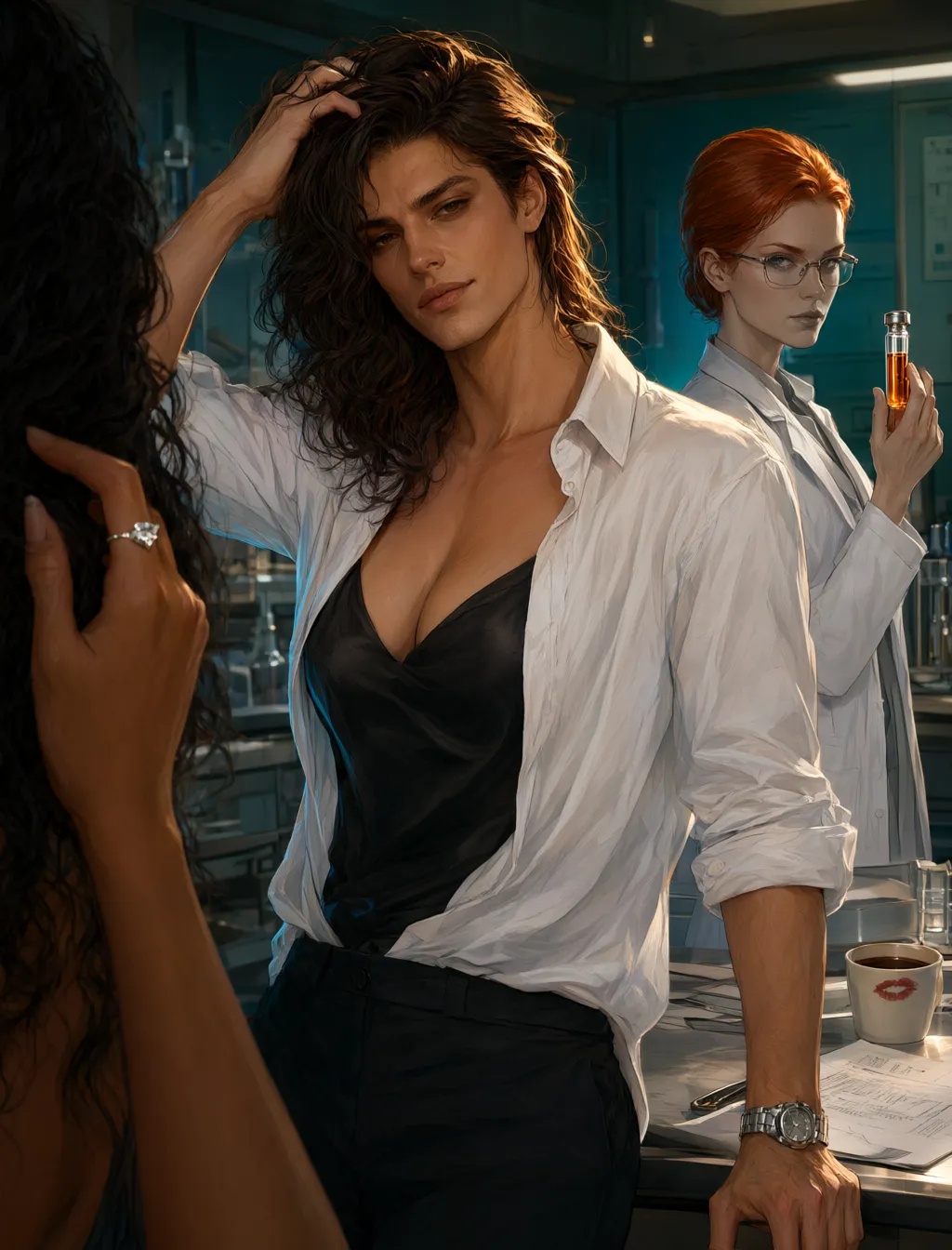
The cold bit first. A flat, metallic cold against his bare back that pulled him up from the dark like a fish on a line. Marcus blinked against the white—too white, the overhead lights bleaching everything to bone—and the fluorescent hum filled his skull before any other sense could catch up. The air tasted like antiseptic and something metallic, copper on his tongue, and the ceiling tiles above him were the kind you saw in every exam room on campus. Standard issue. Institutional. Wrong.
He tried to sit up. His arms shook beneath him—wrong, that was wrong, he could bench two-fifty on a good day and this tremor was not his—and his palms slipped against the vinyl. The sheet beneath him rustled. He registered the sound somewhere behind the confusion. Naked. He was naked on a cold table in a room he didn't recognize, and his last memory was a consent form and a needle and a woman with gray eyes telling him to count backward from ten.
He pushed upright anyway, elbows locking stubbornly, and the world tilted. Something shifted in his chest. A weight. A softness that shouldn't be there. Marcus looked down.
The hands that gripped the edge of the table were not his hands. They had the same shape—the same long fingers, the same knuckles—but the skin was smoother, paler, the veins less visible under the surface. The nails were clean but unpainted, and the fingers looked slender in a way his never had. He turned them over. The palm was softer. The calluses from the weight room were gone. He pressed a thumb into the pad of his opposite hand and watched the skin whiten, then pink back, and his stomach dropped through the floor.
He looked lower. His chest was—it was wrong. There were breasts. Small ones, not large, but unmistakably breasts, the soft swell of them rising where his pectorals should have been, the nipples pink and tender-looking against pale skin. The air hit them and he felt it. He felt the draft in a way he had never felt before, a sensitivity that made his breath catch. His hand came up without permission. His palm pressed flat against his sternum, over his heart, and the softness there made him want to throw up.
"No." The word came out wrong. Thin. Higher than it should have been. He swallowed and tried again. "No. No, this isn't—"
The voice. The voice was wrong. It was higher. Softer. It had a breathiness to it that belonged to someone else, some girl in a dorm hallway, some stranger. Not him. Not Marcus Cole who had cracked jokes at parties and flirted with half the girls in Bio 101 and never once wondered what it would feel like to have a voice that sounded like that.
He pressed harder against his sternum, as if he could push through the skin and find his real ribs underneath. The bones beneath were narrower. The whole architecture of his torso had changed. His shoulders—he looked at them, twisted his neck to see—were sloped, less broad, and the collar bones stood out in a way that looked almost delicate. The word delicate had never applied to a single cell of his body before.
From somewhere to his right: the soft scratch of a pen on a tablet.
Marcus's head snapped toward the sound. The movement sent his hair swinging against his cheek, and he flinched. Hair. Dark strands fell across his vision—longer than he had ever worn it, brushing his jaw, tickling his neck. He shoved it back with a hand that trembled, and his fingers caught on the edge of his ear. His ear. Still his. The same shape. The same notch from a childhood fall off a bike. He clung to that small familiar thing like a lifeline.
The rest was not familiar.
The rest was her.
Dr. Helena Vance stood at the foot of the table, tablet cradled in one arm, her gray eyes moving across his body like she was reading a chart. She had not moved. She had watched him wake, watched him register, watched him panic, and she had simply stood there with the patience of someone waiting for a centrifuge cycle to finish.
"What did you do to me." It was not a question. His voice cracked on the last word, the pitch wavering, and he hated it. He hated how it sounded. He hated that he could hear the fear in it, that his throat could not produce the hard edge he wanted.
Dr. Vance did not look up from her tablet. "The therapy was a success."
"Success?" His voice climbed. He heard it go shrill and could not stop it. "You turned me into a—what the fuck is this? You said I'd be—you said I'd be irresistible. You said girls would—"
"I said the therapy would optimize your genetic expression for maximum mate desirability across the sampled population." She finally looked up, and her gaze settled on his face with the same clinical neutrality she had used when explaining the consent form. "I did not specify that the optimization would express as male."
"You—" He stopped. The words caught in his throat. "You didn't know."
"I knew there was a variable expression risk. The consent form you signed explicitly addressed the possibility of unexpected phenotype outcomes." She said it like she was reading a policy, like the words had no weight, like she had not just turned him into the kind of girl he used to try to take home from parties. "You are the first human subject to undergo full-sequence somatic gene therapy. There was no way to predict the expression vector with complete certainty."
"You turned me into a girl." He said it flatly, testing the words, and they did not become less real. "You turned me into a fucking girl."
"Your chromosomal sex remains XY. The therapy did not alter your karyotype. What you are experiencing is a phenotypic shift—hormonal cascade, secondary sexual characteristic expression, adipose redistribution, and—"
"Stop." His voice broke again. "Stop talking like that. Stop talking like I'm a fucking experiment."
Dr. Vance was quiet for a moment. Her thumb hovered over the tablet screen, and for just a fraction of a second, something flickered in her gray eyes—not guilt, maybe, but the shadow of it. Then it was gone, and she was clinical again.
"You are not an experiment, Mr. Cole. You are a successful test subject. The therapy worked exactly as intended at the cellular level. The expression vector was simply—" She paused. "Unexpected."
He stared at her. The words did not penetrate. His body was wrong. His voice was wrong. He could feel the air moving across his skin differently, the way the sheet felt different against his thighs, the way his center of gravity had shifted so that even sitting upright felt like learning to balance again. He could feel the soft weight on his chest rise and fall with each breath, and every inhalation was a reminder that something fundamental had been taken from him.
His hands were trembling. He looked down at them again, at those too-smooth palms, those slender fingers, and a sound escaped his throat—a raw, broken sound that was almost a sob.
"I want it reversed." His voice was barely more than a whisper. "Fix it. Put me back."
Dr. Vance's jaw tightened almost imperceptibly. "The therapy is permanent. The gene expression cascade has already completed. Reversal would require a second full-sequence intervention, and we have not developed a—"
"I don't care." He was crying. He felt the tears before he saw them, hot and sudden, tracking down his cheeks, and he could not stop them. His shoulders shook. His breath came in ragged gasps. He pressed the heels of his hands against his eyes and felt the softness of his own skin against his palms and cried harder. "I don't care. Fix it. Fix me. Please."
The please came out broken, desperate, the word crumbling on his tongue. He had never begged for anything in his life. He had charmed, demanded, wheedled, talked his way into and out of every situation, but he had never once begged. Now the word hung in the sterile air between them, and he could not take it back.
Silence. The hum of the lights. The soft hiss of air from the vent. Somewhere in the walls, a machine clicked on and off.
"I cannot reverse it." Dr. Vance's voice was quieter now. Almost human. "The therapy is permanent. What I can offer you is—"
"I don't want anything you can offer me." He lowered his hands. His vision was blurred. He wiped at his face with the back of his wrist and the gesture was so foreign, so unlike the way he used to wipe sweat from his brow after a workout, that it made his stomach clench again. "I want my body back. I want my voice back. I want to wake up and not—" He gestured at himself, at the soft curves, the narrow shoulders, the breasts that rose and fell with each hitching breath. "I want to wake up and not be this."
Dr. Vance set her tablet down on the counter behind her. The click of it against the metal surface was loud in the quiet room. She turned back to face him, and for the first time, she did not look at him like a specimen. She looked at him like a person—a person she had broken.
"The physiological changes are permanent," she said. "But the psychological acclimation is not. You will adjust."
"I don't want to adjust."
"You will have to." Her voice was gentler than he had heard it, but the words were still steel. "You are a woman now, Mr. Cole. The sooner you accept that, the sooner you can begin to live with it."
He stared at her. The tears kept coming. He could not stop them. His breath kept hitching, his shoulders kept shaking, and his body—this wrong, soft, alien body—kept betraying him with every tremor. He was crying like a girl. He was crying like the kind of girl he used to see crying in stairwells, in bathroom stalls, at parties where someone had said the wrong thing. He was that girl now. He was every girl he had ever dismissed, ever overlooked, ever walked past without a second glance.
The thought made him want to scream. But when he opened his mouth, what came out was not a scream. It was a sob. High and thin and broken, like a child's, like a girl's, like his.
Dr. Vance watched him cry. She did not move to comfort him. She did not offer a tissue or a hand on the shoulder. She simply stood at the foot of the table, her gray eyes tracking his breakdown with something that might have been pity, if pity could survive inside clinical detachment.
After a long moment, she reached into her coat pocket.
"You will experience some side effects as your body adjusts to the new hormone levels," she said, her voice returning to its professional register. "The first of these should begin within the next hour. You may experience nausea, headaches, and episodes of—intense craving."
He barely heard her. He was still crying, still shaking, still pressing his palms against his face as if he could block out the reality of his own skin.
She pulled a small vial from her pocket. Clear glass. A milky fluid inside, pale and viscous, catching the fluorescent light.
"The craving," she said, "will be specific. Your body has been rewired at a cellular level. The therapy optimized you for a particular kind of—sustenance."
He lowered his hands. His eyes were red, his cheeks wet, his breath still catching in that embarrassing, gulping rhythm. He stared at the vial in her hand, at the pale liquid inside, and something in his gut twisted. Not with disgust. With recognition.
He did not know what it was. But his body knew.
"What is that?" His voice was hoarse. Raw. Still too high.
Dr. Vance uncapped the vial. The smell hit him before she could answer—salt and warmth and something deeper, something that made his mouth water and his stomach clench and his entire body lean forward without his permission. He grabbed the edge of the table to stop himself, and the metal bit into his palm, and he did not care. He could not look away from the vial.
"The first dose is free," Dr. Vance said, holding it out. The milky liquid caught the light as she tilted the vial, and his eyes followed it. "After that, you'll earn it."
He opened his mouth to refuse. To demand she take it away. To tell her he would never—
His mouth was open. The smell filled his lungs. His throat worked. His tongue moved. And the word that came out was not no.
It was a question. Soft. Trembling. Desperate in a way he had never heard from his own lips.
"What is it?"
Dr. Vance's gray eyes met his. She held the vial steady, the pale fluid swaying gently inside, and her voice when she answered was the quietest he had ever heard it.
"What you need."