
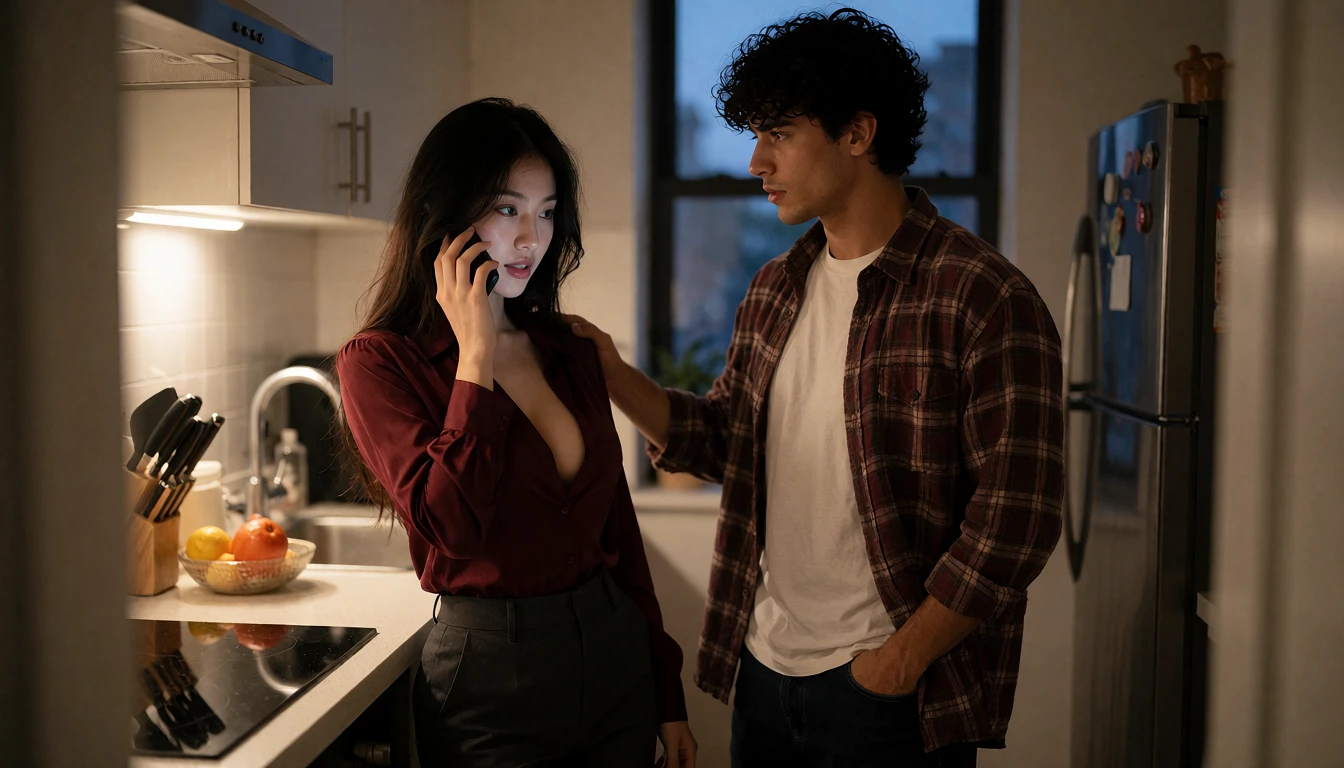
My thumb hovered over Rosa's name. The contact photo was one Mac had taken—his mother mid-laugh at the kitchen table, flour on her apron, the gold cross catching light. I'd saved it the night she'd held my hands across that worn wood and called me mija.
I was about to press it when Mac's hand closed over mine.
Not hard. Just there. His palm warm against my knuckles, his fingers curling around the phone, lowering it from my face like it was something fragile.
"Hey—" I started.
"Wait."
He didn't let go. His thumb brushed over mine, and then he was scrolling. Past Maya, her name bright and new in my contacts. Past Dr. Hart, clinical and cold. Past Officer Reyes, past the pizza place, past Mac's own name saved with a stupid emoji he'd put there himself.
His thumb stopped.
Dad.
The word sat there on the screen, plain black letters on white, and I felt the air leave my lungs like I'd been punched.
"Mac." My voice came out thin. "What are you—"
"We told my mom." He said it quiet, steady, his eyes on mine. Not pushing. Just stating a fact. "Now it's your turn."
The kitchen light hummed above us, that single bare bulb casting everything in sickly yellow. The counter was still greasy from last night's cooking—I'd scrubbed it twice, but the stained laminate held the memory of oil and onions. Stale beer clung to the air from the six-pack Mac had left out. I'd been meaning to throw it away.
I stared at his thumb hovering over the name I hadn't touched since I woke up in this body. Since I looked in the mirror and saw someone else's face looking back.
I hadn't even let myself think the word. Dad. My dad. The man who'd taught me how to ride a bike. Who'd driven me to every science fair, who'd cried at my MIT acceptance letter, who'd called me his genius boy.
"I can't." The words came out before I could stop them. "Mac, I can't. They don't—they don't know anything. They think I'm—"
"They think you're Avery." He said it gently. "And you need to tell them you're not. Not anymore."
"I don't even know what I am anymore."
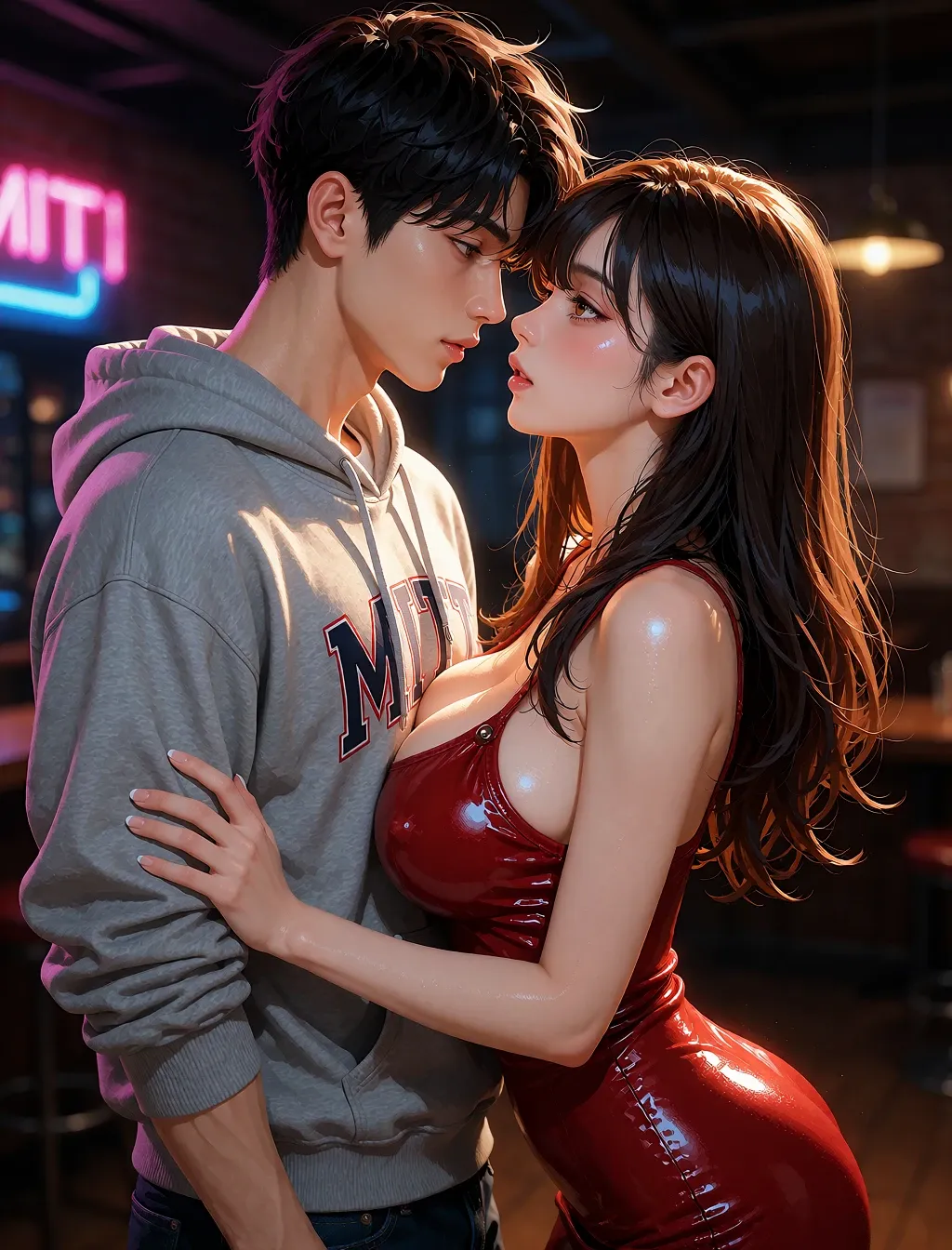
His hand left the phone, came up to cup my jaw. His palm was rough, callused from shop class and football and all the things that made him Mac. His thumb traced the line of my cheekbone, and I leaned into it without thinking, my eyes closing.
"You're Allie," he said. "You're the woman I love. You're the person who's going to carry our baby one day. You're still the smartest person I've ever met, and you're still the same person who followed a hot girl into a bathroom because you thought with your dick instead of your head."
A laugh hiccuped out of me, wet and surprised. "That's not helping."
"It's true though." He was smiling now, that crooked grin that made his whole face light up. "And your parents deserve to know. Not some version of you. You."
I looked down at the phone in his hand. At the name on the screen. Dad.
"They're going to hate me."
"They're not going to hate you."
"You don't know that."
"I know your mom sends you care packages every month. I know your dad calls every Sunday like clockwork. I know they bragged about you to everyone in their neighborhood, and I know they saved every single one of your science fair ribbons." His voice softened. "They love you, Allie. The real you. And the real you is still in there."
The real you. I wanted to believe him. I wanted to believe there was still something of Avery Chen left in this body with its curves and its hips and its hungry, hungry blood.
But every time I looked in the mirror, I saw a stranger. Every time I walked past a man, his eyes followed me. Every time the hunger stirred low in my belly, I wondered how much of what I felt was even mine.
"What if they don't recognize me?" I whispered. "What if I call and my dad answers and he thinks I'm some kind of—" I couldn't finish the sentence.
Mac's arms came around me, pulling me into his chest. I buried my face in his flannel, breathing in the smell of him—coffee and sweat and something clean underneath. His heart beat steady against my ear.
"Then you tell him who you are," he murmured into my hair. "And you let him decide what to do with that."
"And if he hangs up?"
"Then you've still done the right thing. And I'll be right here."
I held onto him for a long moment. The kitchen was quiet around us, just the hum of the bulb and the distant sound of traffic from the street below. Somewhere in the building, a door slammed. A dog barked. The world kept spinning, indifferent to the fact that my entire life was about to shatter.
I pulled back. Looked at the phone in his hand.
"Okay," I said. "Okay."
He didn't smile. Didn't celebrate. Just nodded once, and pressed the call button.
The screen lit up. Dad's name flashed, then the dial tone started. A low, steady buzz that seemed to fill the whole kitchen.
Mac lifted the phone to my ear.
I felt the cold plastic against my skin. Heard the first ring.
My heart was a dull drum in my chest, each beat a fist against my ribs. My hand trembled around the phone, and Mac's fingers tightened on mine, steadying me.
Ring.
The kitchen smelled like stale beer and fried onions. The single bulb gleamed on the greasy countertop. I could see the smear of last night's oil, the ring of a coffee cup Mac had left. I could hear my own breathing, too fast, too shallow.
Ring.
Maybe he wouldn't answer. Maybe he was busy. Maybe I'd get his voicemail and I could hang up and pretend this never happened and go back to pretending I was fine, that I was handling this, that I was—
Click.
"Avery?"
The sound of his voice hit me like a physical blow.
Dad. My dad. Warm and familiar and exactly the same as it had been a week ago, when I'd called to tell him about my orbital mechanics exam, when I'd complained about my roommate leaving his socks everywhere, when I'd been a boy who had no idea what was about to happen to him.
"Avery? You there?"
I opened my mouth.
Nothing came out.
The words were there, stacked up behind my teeth—Dad, it's me, I need to tell you something, I'm not who you think I am, I'm not who I was—but they wouldn't move. They just sat there, heavy and useless, while the silence stretched between us.
I could hear him breathing on the other end. The faint sound of a TV in the background. SportsCenter, maybe. He always watched it in the evenings, half-paying attention while my mom read her romance novels on the couch.
"Avery?" His voice came again, tinged with concern now. "You're scaring me, buddy. Everything okay?"
Everything okay. Everything was so far from okay that the word didn't even mean anything anymore. I was a woman now. I was in love with my roommate. I was going to have his baby. I was a walking, talking science experiment, a victim of a virus that shouldn't exist, a lucid case in a sea of bimbos, and I had no idea how to explain any of it to the man who'd raised me.
Mac's hand was on my shoulder. I could feel his warmth through the thin fabric of my shirt, grounding me, holding me together.
"Allie," he whispered, so quiet only I could hear. "You can do this."
Allie. He'd called me Allie. Not Avery. Not the name my father was saying over and over, waiting for an answer.
I looked at Mac. His brown eyes were steady, certain. He believed in me. He believed I could do this, that I could take this impossible thing and make it real, that I could tell my father the truth and survive it.
I wanted to be that person. I wanted to be worthy of that belief.
I opened my mouth again.
"Dad."
The word came out wrong. Too high. Too soft. Not the voice he knew. Not Avery's voice—Allie's voice, the voice I'd been practicing in front of the mirror, the voice that still surprised me every time I heard it.
There was a pause on the other end.
"...Avery?"
He didn't recognize me. Of course he didn't. Why would he? I didn't recognize myself.
"It's me," I managed. "It's—it's me, Dad."
Another pause. Longer this time.
"You sound... different." His voice was careful now, uncertain. "You okay, son?"
Son. The word hit me in the chest. He didn't know. He had no idea. He was talking to his son, and I was standing here in a body that was nothing like his son, in a life that was nothing like the one I was supposed to have.
"I need to tell you something." My voice cracked on the last word. "Something important."
"Okay." He sounded worried now, properly worried. "I'm listening, buddy. What's going on?"
I looked at Mac. He nodded, his hand still on my shoulder, his eyes never leaving mine.
I took a breath.
And the silence held.
The silence stretched like something physical, a wire pulled taut between my ear and my father's waiting breath. I could hear the SportsCenter anchors chattering in the background, oblivious, and I hated them for it. Hated their easy voices, their highlights, their world where nothing had ever gone this wrong.
"Avery?" His voice came again, softer now, the way he'd spoken to me when I was six and had scraped my knees on the driveway. "Buddy, you're worrying me. Talk to me."
My free hand found the edge of the counter. The laminate was cool under my fingertips, sticky in one corner where the oil had dried into a film I'd missed. I pressed my palm flat against it, grounding myself in the texture, the residue, the proof that I was still in this body, still in this kitchen, still here.
The recipe card was still on the counter. Rosa's handwriting, looped and generous, the ink smudged where I'd set a glass down on it hours ago. Carne asada, she'd written at the top, then a list of ingredients I'd been about to call and ask about. The orange juice for the marinade. The cumin she'd said to toast whole, not ground. The secret pinch of her seasoning blend that made men fall in love.
I'd never gotten to ask her.
Mac's hand was still on my shoulder, warm and steady. I could feel the shape of it through my shirt, the weight of his palm, the way his thumb moved in small circles against my collarbone. A grounding rhythm. A promise.
"Dad." The word came out again, and this time I forced it past the lump in my throat. "Dad, I need you to listen. I need you to hear me out before you say anything."
There was a long pause on the other end. I could picture him in his recliner, the one he'd had since before I was born, the leather cracked and worn soft in the arms. He'd be leaning forward now, elbow on his knee, the remote forgotten in his lap. His forehead would be creased with worry.
"Okay," he said slowly. "I'm listening, son."
Son. The word hit me again, and I felt something crack open in my chest. A fissure, thin and hot, spreading through the careful walls I'd built around this moment. I looked down at my hand—the one holding the phone. Allie's hand. Slender fingers, nails I'd painted a soft pink with Maya's help, a small scar on my knuckle from a lab accident that had healed differently in this body, smoother, like it had never happened.
"I'm not—" I stopped. Swallowed. Started again. "Dad, something happened to me. Something I didn't choose and couldn't stop. And I need you to know that I'm still me. I'm still your kid. But I'm not—"
The words tangled in my throat. I could feel Mac's hand tighten on my shoulder, a silent squeeze. You can do this.
"I'm not Avery anymore," I said. "Not the way you remember me. I'm still your child, but I'm—Dad, I'm a woman now."
The silence on the other end was different this time. Not the comfortable pause of a man waiting for his son to finish a thought. This was something else. Something heavy. I could hear the TV go quiet, a click as he muted it.
"What did you just say?"
His voice was flat. Careful. The voice he used when I'd told him I wanted to switch majors sophomore year, before he'd understood that aerospace was still engineering, still the same trajectory, just pointed at the stars instead of the ground.
"I said I'm a woman now." The words came out steadier than I felt. "I know it sounds impossible. I know it sounds crazy. But it's real, Dad. It happened, and it's permanent, and I need you to know before you hear it from anyone else."
Mac's hand moved from my shoulder to my back, his palm flat between my shoulder blades. I could feel his warmth through the fabric, anchoring me, holding me upright. The phone was cold against my ear, and I could hear my father breathing on the other end, slow and measured, like he was counting to ten.
"Is this some kind of joke?" he asked finally. "Because if it is, Avery, it's not funny. It's not even close to funny."
"It's not a joke." My voice cracked. "I wish it was. I wish I could tell you this was a prank and we could laugh about it and I could go back to being your son. But I can't. I'm not—I'm not the same person I was a week ago. Physically, I mean. I'm still me in here, Dad. I'm still your kid. But my body is different. Everything is different."
The silence stretched again, longer this time. I could hear him breathing, and then a muffled sound, like he'd covered the phone with his hand. Voices in the background—my mom, asking something. I couldn't make out the words, but I could hear the worry in her tone.
Mac's hand was still on my back, and I leaned into it, letting him hold me up. The kitchen was quiet around us, just the hum of the bulb and the distant traffic. The recipe card sat on the counter, Rosa's handwriting waiting for a question I'd never asked.
And then my father's voice came back, low and raw, like he'd been crying or holding it in.
"Avery. Son. Tell me where you are."
I told him the address. The words came out automatic, muscle memory from a thousand pizza deliveries and late-night study sessions, the numbers and street name rolling off my tongue like I was ordering food. Like I was still the boy who'd grown up on that block, who'd ridden his bike over every crack in the sidewalk, who'd known every neighbor by name.
"I'm coming," he said. "I'm getting in the car right now. You stay there. You don't move until I get there."
"Dad—"
"I mean it, Avery. You stay put."
He hung up. No goodbye. No I love you. Just the click of the line going dead, and then the dial tone buzzing in my ear, loud and final.
Mac took the phone from my hand. Set it on the counter. His fingers found mine, laced through them, squeezed.
"He's coming here?"
"No." The word came out hollow. "I'm going there. He's making me come home."
Mac was quiet for a moment. Then he nodded, slow, like he was turning something over in his head. "Okay. We're going, then."
"Mac, you don't have to—"
"I'm going with you." Not a question. A statement. His jaw set in that way it did when he'd decided something, that stubborn line I'd seen a hundred times in our apartment, in the shop, on the field. "You're not doing this alone."
I wanted to argue. I wanted to tell him he didn't owe me this, that this was my mess, my family, my broken life to explain. But the words died in my throat, because the truth was I didn't want to do it alone. I didn't want to walk into that house with its worn carpet and its family photos and its smell of my mother's lavender sachets and face my father without someone holding my hand.
"Okay," I said. "Okay."
We didn't pack. There was nothing to pack. I grabbed my purse—still weird to say, still weird to hold, this small leather thing with a strap that crossed my chest—and Mac grabbed his keys. We left the kitchen with its greasy counter and its recipe card and its single bare bulb still humming, and we walked out into the hallway, down the stairs, out to the car.
The drive was silent. Two hours of highway, of exit signs and rest stops and the sky going gray with afternoon cloud, and neither of us said a word. Mac's hand stayed on the gear shift, and mine stayed in my lap, and the radio played some station I didn't recognize, some pop song about heartbreak that felt like it was about someone else's life entirely.
I watched the familiar landmarks slide past. The diner where my dad took me for pancakes after my first science fair. The gas station where my mom always stopped for lottery tickets, even though she never won. The elementary school with its red brick and its flagpole, where I'd learned to multiply and to lie and to keep my mouth shut when the other kids asked why I talked like a teacher.
And then the street. My street. The one with the cracked sidewalk and the oak tree that dropped acorns on my dad's car every fall and the house with the blue shutters that my mom had painted herself, one summer, standing on a ladder in a straw hat.
Mac pulled into the driveway. Put the car in park. Killed the engine.
And I sat there, staring at the front door, my hands cold and my heart a wild thing in my chest.
"I can't do this."
Mac didn't say anything. He just reached over, took my hand, and squeezed. His palm was warm, rough, real.
"You can," he said. "And I'll be right behind you."
I looked at him. His brown eyes, steady. His jaw, set. The way his thumb traced small circles on my knuckles, grounding me, holding me together.
The front door opened.
My dad stood in the doorway. He was wearing his weekend clothes—jeans and a faded MIT t-shirt, the one I'd bought him at the bookstore that had his alma mater's logo on it, even though he'd never gone there. His hair was grayer than I remembered. His face was creased with worry, his eyes scanning the driveway, looking for the son he'd spoken to on the phone.
He didn't see me. He saw a woman in the passenger seat of a car he didn't recognize, and his brow furrowed, and he took a step forward, squinting.
I opened the door. Stepped out. My heels sank into the soft grass of the lawn I'd mowed every summer since I was twelve.
Dad's eyes tracked me as I walked toward him. I could see the confusion on his face, the way he was trying to place me, trying to understand why this stranger was walking up his driveway like she belonged there.
And then I was close enough, and he saw my eyes. And something shifted in his face. Something I couldn't name.
"Dad."
The word came out in Allie's voice. High. Soft. Not the voice he knew.
His face went pale.
"...Avery?"
I watched his face go through a dozen changes in the space of a second. Denial. Confusion. Something that looked like fear. His eyes moved over me—the hair, the curves, the dress I'd grabbed without thinking, some thin summer thing that showed too much skin—and I could see him trying to reconcile what he was seeing with what he knew.
"Dad. It's me. It's Avery."
He shook his head. Slow. Like he could unsee it if he tried hard enough. "No. No, you're not—Avery's a boy. My son is a—"
"I know." My voice cracked on the words. "I know what I look like. I know what you're seeing. But it's me. I promise you, it's me."
Behind me, I heard Mac's door open, then close. His footsteps on the gravel. He didn't touch me, didn't crowd me, just stood close enough that I could feel his warmth at my back, a solid presence that said *I'm here* without saying anything at all.
Dad's eyes flicked to him, then back to me. "Who is this?"
"Mac. My roommate. He's—he's my boyfriend now. He drove me."
Something in Dad's face tightened. "Your roommate. Your *boyfriend*." He said the word like it was a foreign language, like he was testing it on his tongue and finding it bitter. "Avery, what the hell is going on? You call me after a week of not answering your phone, you tell me you need to come home, and now you show up looking like—" He gestured at me, at all of me, his hand sweeping up and down. "Like *this*."
"Can we go inside? Please. I'll explain everything. I just—I don't want to do this on the front lawn."
He stared at me for a long moment. Then he stepped back, holding the door open, and I walked into the house I'd grown up in.
The smell hit me first. Lavender sachets, like I remembered. But underneath it, something else—coffee, burnt, the way my mom always made it when she was stressed. And something sweet, cinnamon, the scent of the snickerdoodles she baked when she was worried about something she couldn't fix.
My mom was standing in the kitchen doorway. She had a dish towel in her hands, twisted tight, and her face was a mask of confusion and fear. Behind her, I could see two figures on the couch—my little sister Emma, fifteen and all sharp angles and braces, and my brother Danny, twelve, still in his school clothes, his video game abandoned on the coffee table.
They were all staring at me.
I felt Mac's hand find mine. Squeeze.
"Mom," I said, and the word came out in Allie's voice again, that high soft sound that wasn't mine, wasn't Avery's, wasn't anything they knew. "I need to tell you something. All of you. And I need you to listen before you say anything."
My mom's hands went white on the towel. "Avery?"
"It's me. I know I don't look like me. But it's me."
Emma stood up. She was wearing a band t-shirt, some pop punk thing I'd never heard of, and her braces caught the light as she took a step forward, squinting at me like she was trying to solve a puzzle. "You're not Avery. Avery's a boy. You're—you're a girl."
"I know. I know. Please—just sit down. Let me explain."
Nobody moved.
Mac stepped forward, gentle, his voice low and steady. "Mr. Chen. Mrs. Chen. I know this is a lot. I know this doesn't make any sense. But I promise you, this is Avery. And if you'll just give us ten minutes, she'll explain everything."
My dad looked at him. Then at me. Then back at him. "She."
"Yes, sir."
Something in my dad's face cracked. Just a little. Just enough for me to see the grief underneath the confusion, the terror of a father who thought he was losing his son.
"Please," I said. "Please just sit down. I'll tell you everything."
It took a long moment. But then my mom moved, setting down the dish towel, walking to the couch and sitting down between Emma and Danny. My dad followed, slower, his eyes never leaving me. And I sat down across from them, on the ottoman I'd sat on a thousand times, and Mac sat beside me, his knee pressing against mine, grounding me.
I took a breath. Let it out. And then I told them.
I told them about the bar. About Trixie. About the condom with the hole, so small I hadn't noticed, so subtle I'd thanked my lucky stars in the morning before I'd looked in the mirror. I told them about waking up in a body that wasn't mine, about the panic, the fear, the phone call to Dr. Hart. I told them about the Bimbo Virus—the name made Emma snort, a bitter little laugh that died when she saw my face—and about how I was one of the lucky ones, one of the rare cases who kept her mind.
"I'm still me," I said, and I could hear the pleading in my voice. "I'm still the same person. I still love math. I still want to work for SpaceX. I still—" My voice broke. "I still want to make you proud."
My mom was crying. Silent tears, sliding down her face, her hand pressed to her mouth. My dad was staring at the floor, his hands clasped between his knees, his knuckles white.
"I know it's a lot," I said. "I know it doesn't make sense. But I need you to understand—this is real. This is my life now. And I'm not going to let it break me."
Danny spoke up, his voice small. "So you're like... a girl now?"
"Yeah." I laughed, a wet, broken sound. "Yeah, I guess I am."
"That's so cool."
Everyone stared at him. He shrugged. "What? She's still my brother. I mean, my sister. She's still the same person. She still owes me twenty bucks from that bet about the Patriots."
I laughed again, and this time it felt real. "I paid you that."
"No you didn't."
"I literally Venmo'd you."
"That was a tip for the pizza."
My mom let out a sound that was half sob, half laugh. And then she was moving, crossing the room, pulling me into her arms, holding me so tight I could feel her heartbeat against my chest. "My baby," she whispered. "My baby. I don't care what you look like. You're my baby."
I buried my face in her shoulder and cried.
It took a while for everyone to settle. But eventually, my mom pulled back, wiping her eyes, and my dad cleared his throat, and we all sat down again. This time, it felt different. Not easier, exactly. But like we'd crossed something together.
"There's more," I said. "I need to tell you more."
My dad looked up. "More?"
"I want you to meet someone. She's the doctor who helped me. She's been tracking this virus since it started, and she knows more about it than anyone." I pulled out my phone, scrolled to Dr. Hart's contact. "Can I call her? Put her on speaker? I want you to hear it from her."
My dad nodded. Slow. Uncertain. But he nodded.
I pressed the button. The phone rang once, twice, three times. And then Dr. Hart's voice came through the speaker, crisp and clinical.
"Allie. Is everything alright?"
"Yes. No. I mean—I'm home. With my family. I told them everything, but I think it would be better if they heard it from you. About the virus. About what happened to me."
A pause. Then: "Put me on speaker."
I tapped the button. "You're on."
"Mr. and Mrs. Chen," Dr. Hart said, her voice clear and steady, "my name is Dr. Amelia Hart. I'm an epidemiologist with the CDC, and I've been tracking the Bimbo Virus since its first outbreak. I want to start by telling you that your child is a miracle. She is one of a handful of documented cases who retained full cognitive function after exposure. Her intelligence is intact. Her memory is intact. She is, for all intents and purposes, the same person she was before the infection—just in a different body."
She paused, letting that sink in. Then she continued, explaining the virus in detail—the transmission, the symptoms, the physical changes. She explained the stabilizer she'd given me, the one that made me non-infectious. She explained the fertility thing, the way the virus made my body optimized for conception, and I felt my mom's hand tighten on mine.
"There's a high likelihood that Allie will become pregnant within the next one to six months," Dr. Hart said. "She and her partner have made the decision to keep the child. I want you to understand what that means—not just for her, but for your family."
The room went very quiet.
My dad's voice was rough when he finally spoke. "Her partner."
"Yes," I said. "Mac. He's—he's my partner. We're going to have a family together."
I looked at Mac. He reached for my hand, laced his fingers through mine, and squeezed.
"We're going to need help," I said. "I'm still in school. Mac's still in school. And we're going to have a baby—maybe more than one. We're going to need family. We're going to need you."
My mom was crying again. But this time, she was smiling. "A baby," she whispered. "I'm going to be a grandmother."
"And I'm going to be a mom," I said, and the words felt strange and right all at once. "I know it's a lot. I know you didn't sign up for this. But I'm asking you to be part of it. To be there for us. For me."
My dad was quiet for a long moment. Then he stood up. Walked over to me. And pulled me into a hug, his arms wrapping around me, his chin resting on top of my head.
"You're my son," he said, his voice thick. "You're my son, and I love you, and nothing—nothing—is going to change that."
He pulled back, looked at me, and smiled. It was a watery smile, a broken smile, but it was real.
"And if you're going to be a mom," he said, "then I'm going to be the best damn grandfather this family has ever seen."
I pulled the phone away from my ear, thumb finding the red button before I could think about it. The screen went dark, Dr. Hart's name disappearing into the black, and I set it down on the coffee table like it was something that might burn me.
"Thank you," I said to the empty space where her voice had been. "For everything."
My mom squeezed my hand. Her fingers were warm, a little damp from the dish towel she'd been gripping, and I could feel the tremor in them—the same tremor I'd felt in my own hands all week, the one that came from holding too much in.
"She seems like a good doctor," my mom said softly. "A good person."
"She saved me. Or—" I shook my head. "She helped me survive it. There's a difference."
My dad cleared his throat. He was still standing near the armchair, his hands in his pockets, his eyes moving between me and Mac like he was trying to solve an equation with too many variables. I recognized the look. I'd worn it myself, more times than I could count, staring at a problem that shouldn't have a solution.
"Mac." He said the name like he was testing the weight of it. "Can I talk to you for a minute?"
Mac's hand tightened on mine before he let go. "Yes, sir."
They moved toward the back porch—the sliding glass door that led to the patio where my dad had taught me to grill, where we'd sat on summer nights watching fireflies and talking about nothing. Mac glanced back at me once, and I tried to smile, but my face felt like it was made of borrowed parts.
The door slid shut behind them. The glass was old, warped in one corner, and through it I could see my dad's silhouette against the gray afternoon light, his hands gesturing as he started to talk.
My mom tugged my hand. "Come sit. Tell me everything."
She led me to the couch, and I sank into the familiar cushions, the ones that had held me through a thousand childhood fevers and bad dreams. Emma was already there, curled in the corner with her knees pulled up, her eyes big and unblinking. Danny had reclaimed his spot on the floor, his controller forgotten in his lap.
"So," Emma said. "Like. Everything. From the beginning."
I laughed, and it came out wet. "That's a long story."
"We have time." My mom's voice was firm. "You're not going anywhere until I understand this."
So I told them. Not the clinical version I'd given Dr. Hart, not the careful edited version I'd practiced in the car. The real one. The one where I'd been so lonely that I'd followed a pretty girl into a bathroom because she'd smiled at me, because she'd made me feel like someone worth looking at. The one where I'd woken up with my hand between unfamiliar thighs and a scream caught in my throat. The one where I'd looked in the mirror and seen a stranger wearing my face.
Emma interrupted every few sentences. "Wait, so you didn't know?" and "What did it feel like?" and "Did it hurt?" Danny mostly listened, his eyes wide, occasionally muttering "that's so cool" under his breath.
My mom held my hand the whole time. Her thumb traced circles on my knuckles, the same way Mac's had, and I wondered if that was something all mothers knew, some instinct for grounding the people they loved.
"And Mac?" my mom asked. "He was there for you?"
"He was—" I stopped. Tried to find the words. "He's the reason I'm still here. Not just physically. He's the reason I didn't lose myself. When the hunger gets loud, when I feel like I'm disappearing into this body, he's the one who reminds me who I am."
Emma leaned forward. "The hunger?"
I felt my face heat. "It's—it's a symptom. Of the virus. It makes you want—" I gestured vaguely. "Things. A lot. All the time."
"Oh." Emma's eyes widened. "Oh. Like, sex stuff?"
"Emma." My mom's voice was sharp.
"What? She said it."
"It's okay," I said, and I was surprised to hear myself laughing. "Yeah. Like sex stuff. But it's not—it's not just that. It's like this constant hum under everything. Like being hungry and thirsty and needing to move all at once. It's exhausting."
Danny made a face. "That sounds gross."
"It kind of is." I shrugged. "But I'm learning to live with it. And Mac helps."
My mom was quiet for a moment. Then she said, "He loves you."
It wasn't a question. I nodded anyway. "Yeah. He does."
"And you love him."
"Yeah." The word came out soft. "I do."
Through the glass door, I could see my dad and Mac still talking. My dad was doing most of the gesturing, his hands moving in that way they did when he was explaining something important. Mac was standing with his arms crossed, nodding, his jaw set in that stubborn line I knew so well.
"What do you think they're talking about?" Emma asked.
"Me," I said. "Probably."
"You think Dad's giving him the shovel talk?" Danny grinned. "The whole 'if you hurt my daughter' thing?"
"Danny." My mom's voice was sharp, but there was a smile hiding in it.
"What? It's a real thing. I've seen it in movies."
I watched through the glass. My dad had his hand on Mac's shoulder now, and he was saying something—I couldn't hear the words, but I could see the weight of them in the way Mac straightened, the way he met my dad's eyes without flinching.
My dad had never done that with anyone I'd brought home. But I'd never brought anyone home before. I'd never had anyone to bring.
My mom squeezed my hand. "He's a good man, your Mac."
"He is."
"I can tell. The way he looks at you." She smiled, and it was the smile she'd given me when I'd won my first science fair, when I'd shown her the model rocket I'd built from scratch. "You found yourself a good one, baby."
Emma made a gagging noise. "Mom, you're being so sappy."
"I'm allowed to be sappy. My daughter just told me she's in love."
My daughter. The words hit me in the chest, warm and sharp all at once. She'd said it so easily, so naturally, like it was the most obvious thing in the world.
Danny leaned forward. "So, like. Do you have superpowers now?"
I laughed. "No. No superpowers."
"But you're like, super smart still, right? Like, you could still build a rocket?"
"I could still build a rocket, yeah."
"And you're a girl. So that's like—" He waved his hand. "That's like, two things. That's a lot."
"It is a lot." I smiled at him. "But I'm handling it."
The sliding door opened. Mac stepped back inside, and behind him, my dad, his face unreadable. They'd been out there for—I checked the clock on the wall—twenty minutes. Twenty minutes of my dad grilling the man I loved, and I hadn't heard a word of it.
Mac crossed to me, sat down on the ottoman, his knee pressing against mine. He didn't say anything, just reached for my hand and squeezed.
My dad sat down in his recliner. He was quiet for a moment, looking at us—me and Mac, our hands tangled together, our knees touching.
"He told me he's going to take care of you," my dad said finally. "He told me he's going to love you for the rest of his life. He told me he's going to be there for every doctor's appointment, every midnight feeding, every diaper change." He paused. "I told him that's what he's supposed to say. And he said he knows it's what he's supposed to say, but that doesn't make it less true."
I looked at Mac. His eyes were steady, certain, the same way they'd been in the kitchen when he'd pressed the call button.
"I believe him," my dad said. "I don't know why. I just met him. But I believe him."
My mom stood up. "Well. I don't know about the rest of you, but I'm starving. And I'm not letting my daughter—" She caught herself, and a smile spread across her face. "I'm not letting my daughter and her young man drive two hours back to Cambridge tonight. You're staying."
"Mom—" I started.
"No arguments. You're staying. I'll make up the guest room." She was already moving toward the stairs, her voice carrying back to us. "And I'm making dinner. A real dinner. Not that frozen stuff you boys—" She stopped, corrected herself. "Not that frozen stuff you've been living on."
Mac looked at me. "Should we—"
"Don't even try," Emma said. "When Mom decides you're staying, you're staying."
My mom came back down the stairs, a pile of sheets in her arms. "Allie, come help me with the kitchen. Emma, you too. Danny, set the table. Mac—" She pointed at him. "You sit. You look like you need a break."
Mac opened his mouth to protest, but my dad cut him off. "You heard her. Sit. I'll show you where the good sports channels are."
I followed my mom into the kitchen, Emma trailing behind us. The kitchen was smaller than Rosa's, but it was mine—the same counters I'd leaned against while doing homework, the same stove my mom had taught me to scramble eggs on, the same window above the sink where I'd watched the seasons change.
My mom opened the fridge, started pulling things out. "We're making pot roast. Your grandmother's recipe. And mashed potatoes, and green beans with bacon—"
"Mom." I leaned against the counter. "You don't have to do all this."
"I want to." She set a package of meat on the counter. "I've been waiting a week to feed you. I'm not waiting any longer."
Emma grabbed a cutting board. "I'll do the potatoes."
My mom handed me an onion and a knife. "You can do the onions."
I took the knife, tested the weight of it in my hand. It was the same knife I'd used a hundred times, the one with the wooden handle that had a chip in it from the time I'd tried to cut a frozen bagel.
"You know," my mom said, her voice soft, "I always wanted a daughter."
I looked up. The knife was cold in my hand, the onion heavy.
"When you were born—when Avery was born—I was so happy. But there was always this little part of me that wondered what it would be like to have a girl. To teach her to cook, to do her hair, to—" She smiled, a little watery. "To have this."
I set the knife down. "Mom."
"I'm not saying it to make you feel bad. I'm saying it because—" She reached out, cupped my face in her hands. "Because I get to have it now. I get to have this. And I didn't even have to lose my son to get it."
I felt the tears coming before I could stop them. "I'm still—I'm still me."
"I know, baby. I know." She pulled me into a hug, her arms tight around me. "And you're still my child. That's what matters."
Emma cleared her throat. "Okay, this is getting really emotional and I'm trying to peel potatoes."
I laughed, wet and surprised, and pulled back from my mom. "Sorry."
"Don't be sorry." She handed me the knife again. "Now chop. I want these onions fine."
We worked in comfortable silence for a while, the three of us—my mom at the stove, browning the meat, Emma at the counter, attacking the potatoes with more enthusiasm than skill, me at the cutting board, dicing onions into neat little piles. The kitchen filled with the smell of searing beef and onions, warm and familiar, and I felt something in my chest loosen.
"So," Emma said, not looking up from her potatoes. "What's it like?"
"What's what like?"
"Being a girl. Like, a real girl. You were a boy your whole life, and now you're—" She gestured at me. "That."
I looked down at myself. At the curves I still wasn't used to, the softness of my own arms, the way my chest moved when I breathed.
"It's like—" I searched for the words. "It's like being in a body that fits. Finally. Like I didn't know I was wearing shoes that were too small until I took them off."
Emma nodded slowly. "That makes sense."
"But it's also terrifying. Because I don't know how to be this. I don't know how to be a woman. I'm learning, but—" I shrugged. "It's a lot."
"You're doing okay, though." It wasn't a question.
"I think so. Some days are better than others."
My mom turned from the stove, the spatula in her hand. "You're doing more than okay. You're doing amazing. You're still in school, you're in love, you're going to have a baby—" She shook her head. "You're living a whole life, baby. That's more than most people ever do."
I felt the heat rise in my cheeks. "I don't know about that."
"I do." She pointed the spatula at me. "And I'm your mother. I'm always right."
Emma snorted. "That's not true. You said the Patriots were going to win the Super Bowl."
"They should have."
"They lost by twenty points."
"They should have won by more."
I laughed, and it felt real, felt like something I could hold onto. The kitchen was warm, the smell of dinner filling the house, and somewhere in the living room, I could hear my dad's voice and Mac's, low and steady, talking about something I couldn't quite catch.
My mom handed me a wooden spoon. "Stir the gravy. And don't let it stick."
I took the spoon, moved to the stove, and stirred. The gravy was dark and rich, bubbling gently, and I watched it swirl, thinking about everything that had brought me here—the bar, the bathroom, the condom with the hole, the body I hadn't chosen, the man I had.
"Hey, Mom?"
"Mm?"
"Thanks. For this. For—" I gestured at the kitchen, at her, at all of it. "For everything."
She came up behind me, wrapped her arms around my waist, rested her chin on my shoulder. I could feel her heartbeat against my back, steady and sure.
"You're welcome, baby," she said. "You're so welcome."
Emma made a gagging noise. "Okay, I'm leaving. This is too much."
"You're not leaving," my mom said without letting go of me. "You're finishing those potatoes."
Emma groaned, but she picked up the peeler again. And I stood there, in my mother's arms, in my childhood kitchen, and for the first time in a week, I felt like I might actually be home.
My mom finally let go of me, but she didn't go far. She stayed close, one hand on my shoulder as she reached past me for the pepper mill. The gravy was bubbling, dark and thick, and I stirred it slow, watching the swirl.
"You know what your father said to me the first time he came to dinner?" she asked, and her voice had that particular tone—the one she used when she was about to tell a story she'd told a hundred times but still loved. "He looked at the table I'd set—my grandmother's china, the good silver, the candles I'd spent an hour arranging—and he said, 'You know I'm not fancy, right?'"
Emma snorted. "Dad said that?"
"He did. And I said, 'I'm not asking you to be fancy. I'm asking you to be here.'" She smiled, soft and far away. "He ate three servings of my mother's dumpling soup and told me he'd never tasted anything like it. I knew then. Not because of the words—because of the way he held the bowl. Like it was precious. Like I was precious."
I kept stirring. The gravy was the color of dark wood, and Rosa's jar sat on the counter behind me, the one with the handwritten label—*"seasoning blend—use sparingly"*—and I could feel it there, waiting.
"The secret to a good man," my mom said, reaching for the potatoes Emma had abandoned, "isn't finding one who never makes mistakes. It's finding one who learns from them. Your father—" She shook her head, a little laugh escaping. "He was so stubborn when we met. He thought he knew everything about being a husband, about being a father. And he was wrong about so much. But he learned. Every time I told him something, he listened. He changed."
Emma's peeler paused. "How did you meet? Like, actually meet? You never tell us the real story."
My mom set down the potatoes. Her hands were flour-dusted, and she wiped them on her apron, the one with the faded flowers that she'd had longer than I'd been alive. "I was nineteen. Younger than you, Allie." She looked at me. "I was in Guangzhou, working in my aunt's shop. Sewing machine, bolts of fabric, the smell of thread and dust. I'd been there since I was sixteen, sending money home to my parents."
I stopped stirring. I'd heard fragments of this before, but never like this—never with her looking at me like she was trying to hand me something.
"Your father was there for a business trip. He was twenty-four, already working for an American company, already wearing suits that cost more than my aunt made in a month. He came into the shop to buy a gift for his mother. Silk, he said. The best silk I had." She smiled. "I showed him the good bolts—the ones I kept in the back, the ones I wasn't supposed to sell to tourists. He asked me to show him how to tell the difference between real silk and the cheap stuff. I thought he was just being polite. But he came back the next day. And the next."
"He was trying to get your number," Emma said, grinning.
"He was trying to get my attention. There's a difference. He didn't ask me out—not at first. He just kept coming to the shop, asking questions, learning about the fabric, learning about me. And one day, he brought me a book. A Chinese translation of some American novel I'd never heard of. He said, 'I want you to see where I'm from.'"
I could picture it. My dad, younger, in a suit that didn't quite fit, holding out a book like it was an offering.
"I told him I couldn't leave my aunt's shop. I told him I had a duty to my family. And he said—" She laughed, the sound bright and sudden. "He said, 'I'm not asking you to leave. I'm asking you to let me stay.'"
Emma made a soft noise, her peeler forgotten. "That's so romantic."
"It was. It is." My mom's eyes were bright. "He stayed. He learned the shop. He learned my aunt's name and her favorite tea and the way she liked her rice cooked. He learned me. And then, one night, he asked me to come to America with him. Not as a promise of anything—just as a question. 'Will you come see where I'm from?' And I said yes."
She picked up the potatoes again. "I didn't know if I'd love it. I didn't know if I'd love him, not really, not yet. But I knew I wanted to find out. And I knew—" She looked at me, steady. "I knew that love isn't about knowing. It's about choosing. Every day, you choose them. And they choose you."
The gravy was done. I turned off the burner, set down the spoon. My hand found the jar of Rosa's seasoning behind me, the glass cool in my palm.
"That's good advice," I said, and my voice came out a little rough. "For both of us."
Emma was watching me. "Are you going to put that in the gravy?"
I looked down at the jar. Rosa's handwriting, the loops and flourishes she'd used when she'd written out the recipe for me, the one she said made men fall in love. I'd laughed when she'd said it. I wasn't laughing now.
"It's a secret ingredient," I said. "Rosa's. Mac's mom."
My mom's eyebrow rose. "A secret ingredient?"
"She said it's been in their family for generations. You're supposed to use it sparingly." I unscrewed the lid. The smell hit me—warm and dark and something I couldn't name, something that made my stomach tighten. "She said it makes men—" I hesitated. "Attentive."
Emma snorted. "Attentive."
"She said it's why her husband proposed."
My mom was quiet for a moment. Then she said, "And you're putting it in the gravy because...?"
I sprinkled a pinch into the pot. Just a little. Just enough. The dark flecks disappeared into the rich brown, and I stirred, watching them vanish. "Because Mac's been attentive all week. And I thought—" I shrugged. "Dad could use some too."
Emma burst out laughing. My mom's lips pressed together, but I could see the smile hiding there, the way her eyes crinkled at the corners.
"Allie Chen," she said, and there was something in her voice—not disapproval, not quite. "You're poisoning your father's gravy?"
"It's not poison. It's—" I waved the jar. "It's seasoning. It's what Rosa uses. It's what she taught me."
"And what exactly does it do?"
I set the jar down. "It makes men want their women. Badly. All night." I met her eyes. "Both of them."
The kitchen went quiet. Emma's peeler hung frozen over the potatoes. My mom's hands were still, flour-dusted, resting on the counter.
Then my mom laughed. A real laugh, warm and surprised, the kind I hadn't heard from her in years. "You're telling me," she said, "that you put an aphrodisiac in my gravy?"
"Rosa calls it a love blend. She says it's why her husband proposed." I stirred the pot again, watching the flecks swirl. "And I figured—you and Dad have been married a long time. A little spark wouldn't hurt."
Emma was shaking with silent laughter, her hand over her mouth. "Oh my god. Oh my god, Mom's going to—"
"I'm not going to do anything." My mom's voice was calm, but her eyes were bright. "I'm going to let my daughter feed her father a love potion." She picked up the spoon, tasted the gravy, and nodded. "It's good. It's very good."
"You're not mad?" I asked.
"Mad?" She set the spoon down. "Allie, I've been married to your father for twenty-five years. If I'd known about this—" She shook her head. "I'd have been using it since our honeymoon."
Emma howled. I felt the heat rise in my cheeks, but I was laughing too, the sound bubbling up out of me like it had been waiting for an excuse.
"You're terrible," Emma said, pointing at me. "You're the worst sister I've ever had."
"I'm the only sister you've ever had."
"Still the worst."
My mom took the jar from me, examined the label. "Rosa taught you this?"
"She taught me everything. The stew, the mole, the—" I gestured. "She said it's a family secret. She said I'm family now."
My mom was quiet for a moment. Then she set the jar down, gently, like it was something precious. "She's right," she said. "You are."
She turned back to the stove, and I watched her stir the gravy, and I knew she'd seen the pinch go in. I knew she'd let it go. And I knew that tonight, my father would eat his dinner, and then he'd look at my mother the way he'd looked at her twenty-five years ago, and she'd pretend not to notice, and they'd both go to bed early.
And in the guest room, Mac would look at me with that same hunger, and I'd let him take what he wanted, and for one night, the virus and the fear and the constant hum of not-knowing would be quiet.
Emma was still giggling, attacking the potatoes with renewed energy. "So," she said, "does this stuff work on anyone? Like, if I put it in a guy's burger—"
"Emma." My mom's voice was sharp, but there was a smile in it. "You're fifteen."
"I'm just asking."
"No." My mom pointed the spoon at her. "You're not putting love spells on boys at your school. You're going to focus on your homework and your clarinet."
"But Allie gets to—"
"Allie is a grown woman with a boyfriend and a future baby. You're a child with braces and a math test on Friday."
Emma groaned, but she was smiling. "Fine. But I'm remembering this. For later."
My mom turned back to the gravy, and I saw her hands move—a quick, practiced gesture, lifting the spoon to her lips, tasting. She nodded. Then she reached for the jar, unscrewed the lid, and added another pinch.
Emma and I both saw it. Neither of us said a word.
"Your father," my mom said, "has been working too hard. He deserves a good night's sleep."
I bit the inside of my cheek to keep from laughing. "Of course, Mom."
"And Mac—" She glanced at me, a flicker of something warm and knowing in her eyes. "He's been taking care of you. He deserves to be taken care of too."
The kitchen smelled like onions and beef and something else—something dark and warm and promising. I thought about Rosa, about her hands on mine, about the way she'd said *"men don't know what they want until a woman shows them."* I thought about my mother, standing in her own kitchen, sliding a pinch of that same magic into her own gravy, and I felt something settle in my chest.
Not the hunger. Not the fear. Something older than both of them. Something that had been waiting for me to find it.
"Dinner's ready," my mom called toward the living room. "Marcus, wash up. Danny, set the table. Emma, put those potatoes on the stove."
I stood at the counter, the empty jar in my hands, and I watched my family move around me—my mother at the stove, my sister with her peeler, my brother's footsteps on the stairs. In the other room, I could hear my father's voice and Mac's, low and steady, talking about something I couldn't catch.
I screwed the lid back on the jar and set it on the shelf above the stove. Rosa's handwriting faced the wall, but I knew what it said.
*Use sparingly.*
I'd used it sparingly. And I'd use it again.