

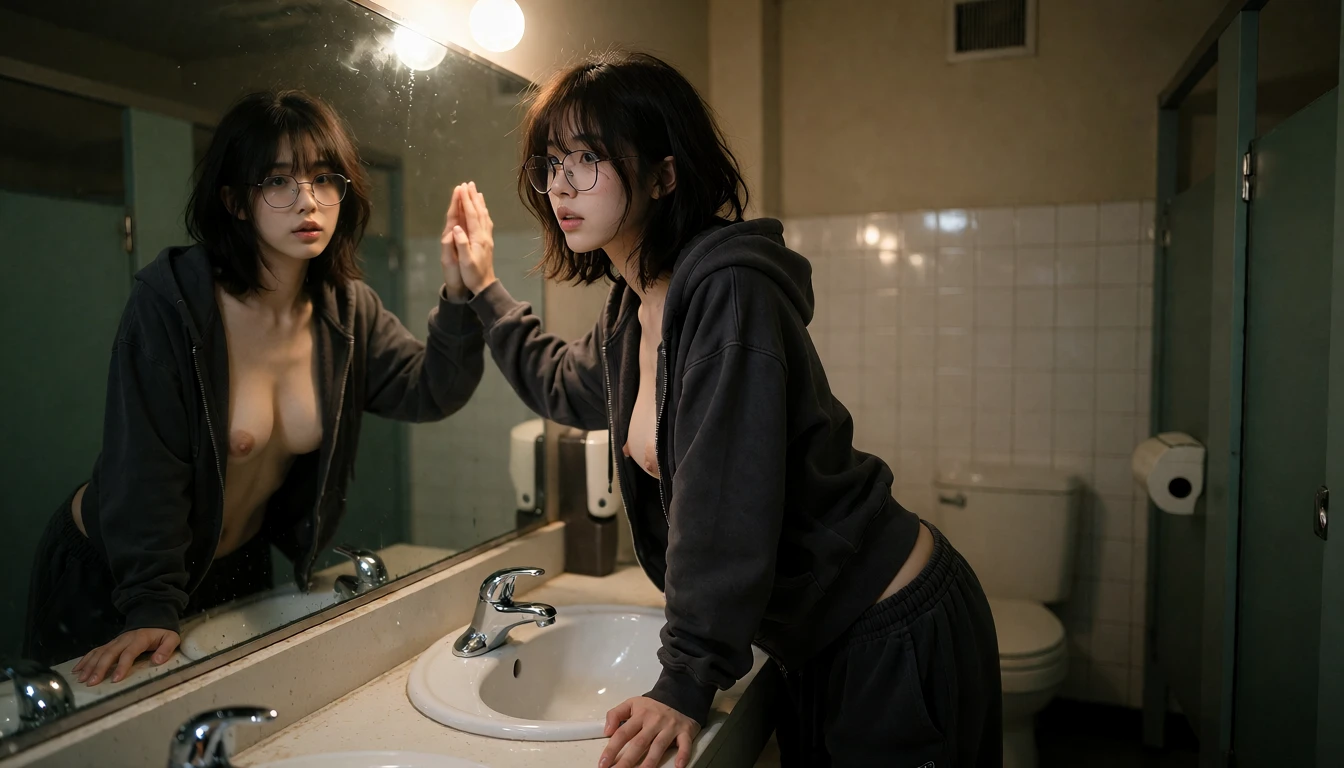
The fluorescent bulb stuttered above us, painting the bathroom in pulses of sickly white. Cheap cologne and spilled beer fought for space in my lungs, and the cracked porcelain dug into my lower back where Trixie had me pinned against the sink. Her red dress was already bunched around her waist, a slash of crimson against pale thighs, and her baby-blue eyes had that lazy, half-lidded look that made my dick twitch inside my jeans.
"There he is," she breathed, trailing a manicured nail down my chest. "The smartest boy in the whole bar."
"I—I'm not—" I started, but she pressed a finger to my lips and I felt the stutter die in my throat.
"Shhh. You don't gotta talk, baby. Trixie knows what she wants."
She reached into her clutch purse with a wink, and when her hand came back out, there was a foil packet between two glossy nails. She pressed it into my palm, and I felt the crinkle of the wrapper against my skin. The whole thing felt surreal — like something out of a movie I'd never been cast in. Me, Avery Chen, nineteen-year-old aerospace whiz who spent more nights alone in the library than anywhere else, standing in a bar bathroom with a woman who looked like she'd been carved from sin and handed a matching dress.
"Go on," she said, and her voice was honey and static. "Put it on, baby. Show Trixie what that big brain of yours can do."
I didn't think twice. The foil tore easy, and I rolled the condom on with shaking hands, the latex snug against my cock. She watched me the whole time, that same lazy smile on her glossed lips, and when I was ready, she hopped onto the counter with a little giggle that bounced off the tiles.
Her legs wrapped around my waist and pulled me in close. The heat of her cunt seeped through the thin fabric of her dress where it was bunched at her hips, and I could feel her through the latex — wet, already slick, already hungry.
"That's it," she whispered, her nails raking through the hair at the back of my neck. "Fuck me, baby. Fuck me like you mean it."
"I—" I swallowed hard, my voice cracking. "I've never—"
"Never what, smart boy?" Her hips rolled against mine, grinding me against her through the latex. "Never fucked a woman like me?"
"Never done this at all." The confession came out strangled. "I mean— I've done stuff. But not— not this. Not—"
"A virgin." She said it like it was the hottest thing she'd heard all night. Her hand slid down my chest, past my stomach, fingers wrapping around the base of my cock through the condom. "Trixie gets to pop the smartest boy in the bar's cherry. That's a fucking gift, baby."
"I—yeah. I guess." My face was burning. I could feel the flush crawling up my neck, past my collar, into my cheeks.
"Don't be shy." She guided me to her entrance, the head of my cock pressing against her slick heat. "You're gonna fuck me so good, baby. I can already tell. That big brain of yours knows exactly what to do."
I pushed inside her and the world went white.
"Oh—fuck—" The word tore out of me, raw and unfamiliar.
"Yeah, that's it," she breathed. "That's my smart boy. You feel that? Feel how tight I am?"
"Yes. God, yes. You're so—" I couldn't finish the sentence. My brain had gone static.
God. She was so wet. So hot. Her cunt gripped me like a fist, pulling me deeper with every inch, and I heard myself groan — a raw, animal sound I didn't recognize as my own voice. Her legs locked tighter around my hips, and she arched her back against the mirror, the glass fogging where her shoulders pressed into it.
"Yeah," she breathed. "Yeah, that's it. That's my smart boy. Look at you. Look at how deep you're in me."
"I can't—" My glasses had fogged. I couldn't see anything but the blur of her. "Trixie, I can't see—"
"That's okay, baby. You don't need to see. Just feel." Her hand found my cheek, guiding my face down to hers. "Feel how wet I am for you. Feel how much this pussy wants your cock."
I pulled out slow, just to the tip, and then drove back in. The counter shuddered beneath her. Her head fell back, platinum hair spilling across the mirror in a cascade, and she let out this little whimper that went straight to my cock.
"Oh, fuck," she gasped. "There you go. There's that big brain. You learn fast, don't you, baby?"
"I—I'm trying." I was panting now, sweat beading on my forehead. "Tell me if— if I'm doing it right—"
"You're doing it perfect." Her legs tightened around my waist. "Deeper, baby. Give me more."
"Like this?" I angled my hips, drove in harder.
"Yes. Fuck. Yes. Right there. That's my boy."
I did. I fucked her against the mirror, my hands gripping her hips hard enough to leave marks, and she took every inch of me like she was made for it. The fluorescent bulb flickered above us, stuttering across the glass, and I caught my own reflection — glasses askew, mouth open, a flush crawling up my neck. I looked nothing like myself. I looked like someone who'd been waiting for this his whole life.
"You feel so good," I gasped, and the words came out rougher than I meant them to. "So fucking good, Trixie."
"Do I?" She grinned, all teeth. "You like this pussy, baby? You like the way it squeezes your cock?"
"Yes. Fuck. Yes. I can feel it— every time I pull back, you— you grab me—"
"That's right, baby. This pussy doesn't want to let you go. It wants to keep you inside forever." Her hand slid down between us, and I felt her fingers find her clit, rubbing in tight circles while I fucked her. "You want that, don't you? You want to stay buried in me?"
"Yes. God, yes. I don't ever want to— to stop—"
"Then don't." Her voice dropped to a purr. "Keep fucking me, smart boy. Keep giving me that big cock. Make Trixie cum on it."
The condom was slick with her wetness, and every thrust made this obscene, wet sound that echoed off the tiles. Her legs were shaking around my waist. Her nails dug into my shoulders, through my MIT hoodie, and I felt the sting of it even through the fabric.
"You're close, aren't you?" She could feel it, the way my rhythm was breaking apart, the way my breath was coming in gasps. "I can feel you twitching inside me, baby."
"I— yeah. I'm— I've never—"
"Never what? Never came inside a woman before?"
"Never came at all. Not like this. Not with someone else." The admission made my face burn even hotter.
"Oh, that's so sweet." She cooed it, but there was something hungry underneath. "That's so fucking sweet, baby. Your first time. Your first pussy. And it's mine."
"Yours," I echoed. "All yours."
"Cum inside me," she breathed, and the words hit me like a shock. "I want you to cum so deep, baby. I want to feel it."
"Trixie—"
"Say my name when you do it." Her voice was a demand wrapped in silk. "I want to hear it."
I fucked her harder. The counter was slick with condensation and her sweat, and I had to brace one hand against the mirror to keep my footing. My glasses fogged up, and I couldn't see her face clearly anymore — just the blur of platinum hair and red lips, the curve of her breasts spilling out of her dress, the narrow waist I gripped with both hands.
"Fuck," I groaned. "Fuck, Trixie—"
"That's it. That's my boy. You're so deep, baby. So fucking deep. I can feel you hitting my cervix."
"Is that— is that good?"
"It's perfect. It's so fucking perfect. You're perfect." Her fingers worked faster on her clit, her hips meeting my thrusts. "Now cum for me, baby. Fill me up. Show me what that big brain can do."
I was close. I could feel it building in my gut, a coiled heat that was about to snap. Her cunt clenched around me, milking me, pulling me deeper, and I drove into her one last time and came harder than I ever had in my life. My hips bucked against hers. My whole body locked up. And I felt myself spill into the condom, the latex filling with heat, her name torn out of my throat like a confession.
"Trixie. Fuck. Trixie—"
"Yes, baby. Yes. That's it. That's my good boy." Her voice was strained now, her own orgasm building. "Don't stop. Keep going. Keep fucking me while you cum."
"I— I can't— it's too much—"
"You can. You can, baby. Just a little more. Make Trixie cum. Make me cum on that big cock."
She shuddered beneath me, her own orgasm rippling through her, and for a second — just one — I was weightless. Floating. The fluorescent bulb buzzed overhead, and I could hear my own heartbeat pounding in my ears.
"Oh, fuck," she gasped. "Oh, fuck, baby. That was— that was so good."
"You too." I was still catching my breath, my forehead pressed against hers. "That was— I've never—"
"I know, baby. I know." She patted my cheek, softer now. "You did so good for your first time."
Then I felt it.
Wetness on my thigh. Warm and wrong.
I pulled back, and the sight hit me like a freight train.
The condom was torn.
Not ripped. Not broken. Torn — a clean split along the side, like it had been cut with something sharp. And my cum was leaking out of her, trailing down her thigh in a slow, white smear.
"Oh," she said, and her voice was different now. Not honey. Something colder underneath. "Huh. Look at that."
I stared at the mess between her legs. At the ruined latex hanging off my softening cock. At the cum dripping down her skin, mixing with the condensation on the counter.
"I—" My voice cracked. "I don't—"
"Don't worry about it, baby." She slid off the counter, her dress falling back into place, and I watched her smooth it down like nothing had happened. Like my cum wasn't still slick on her thigh. "These things happen."
"But I—that was—"
"It's fine." She patted my cheek, her nails grazing my skin. "You should go home, smart boy. Get some rest."
"Trixie, wait—" I reached for her arm, but she was already moving toward the door. "We need to— you could get—"
"Pregnant?" She laughed, light and airy, like I'd told a joke. "Don't you worry about that, baby. Trixie knows what she's doing."
She was gone before I could say anything else. The door swung shut behind her, and I was left standing in the buzzing fluorescent light, my cock still wet, the torn condom dangling from my fingers like evidence.
I looked at my reflection in the mirror. Glasses askew. Hair a mess. A flush still burning on my cheeks.
I looked like myself.
I didn't know yet how wrong that was.
The door clicked shut and the sound was final in a way I couldn't process. I stood there with my softening cock still hanging out of my jeans, the torn condom dangling from my fingers like a dead thing. The fluorescent bulb buzzed overhead, and I could hear my own breathing — too fast, too shallow, the kind of breathing that happens when your brain is trying to outrun a fact it doesn't want to accept.
I looked at the condom again. Held it up to the light. The split was clean. Surgical. Not the ragged tear of a manufacturing defect, not the kind of thing that happens when two people fuck too hard against a bathroom counter. This was a cut. Someone had taken something sharp to the latex before I ever rolled it on.
I turned the thought over like a rock I didn't want to look under. Trixie had handed me the condom. Trixie had picked it out of her clutch, pressed it into my palm with that lazy smile, watched me roll it on with shaking hands. She'd known. She must have known. The whole thing — the bar, the flirting, the bathroom, the way she'd pulled me in like I was the one doing the chasing — it had all been leading to this.
But why?
The question sat in my chest like a stone. I didn't have an answer. I didn't even have a theory. All I had was the evidence in my hand and the smear of my own cum drying on her thigh, and neither of those things made sense in the world I lived in — the world of problem sets and launch trajectories, where everything had a solution if you just worked it long enough.
I dropped the condom in the trash can. The little wire basket was already overflowing with paper towels and empty shot bottles, and the latex disappeared into the mess like it had never existed. I told myself it was evidence disposal. I told myself I was being smart. But the truth was simpler: I didn't want to look at it anymore.
I turned to the sink and ran the cold water, watching it spiral down the drain. The porcelain was cracked, a thin spiderweb of damage spreading from the drain like a fracture line on a windshield. I splashed water on my face, and the shock of it made me gasp. My reflection stared back at me from the mirror — glasses askew, hair a disaster, a flush still burning on my cheeks. I looked like someone who'd just fucked a stranger in a bar bathroom. I looked like someone who'd made a mistake.
I dried my hands on a paper towel that came apart in my fingers, leaving lint all over my palms. I was still standing there, patting myself down like I expected to find answers in my pockets, when I noticed my phone buzzing. Three texts from Mac, all in a row. The first one was a string of laughing emojis. The second was a question mark. The third said: "bro u alive"
I stared at the screen. The words blurred and sharpened, blurred and sharpened. I could feel the weight of the night pressing down on me, the heat of her body still phantom on my skin, the memory of her cunt clenching around me like a fist. And underneath all of that, something else. Something colder. A small voice in the back of my head that kept whispering the same two words over and over.
Torn. Cut.
I typed back: "fine. coming out." The lie was automatic, the kind of thing you send when you don't want to explain. I pocketed the phone and took one last look at myself in the mirror. The fluorescent bulb flickered, and for half a second I thought I saw something wrong in my reflection — something off about the shape of my shoulders, the line of my jaw. But the light steadied, and it was just me again. Same glasses. Same tired eyes. Same lanky frame drowning in an MIT hoodie.
I unlocked the door and stepped out into the noise of the bar, and the bass hit me like a wall. Bodies pressed in from every side. Someone's elbow found my ribs. A girl in a sequined top laughed too loud and spilled her drink on my sleeve. I pushed through the crowd with my head down, not looking for anyone, not looking at anything, just trying to get to the door before the night caught up with me.
The cold air hit me the second I shouldered through the front door, and it was like the bar exhaled me out of its lungs. The street was quiet, just a couple of taxis idling at the curb and the distant thump of bass bleeding through the walls behind me. I stood there for a moment, letting the chill work its way through my hoodie, trying to convince myself that the night was over. That I could walk back to the dorm, climb into bed, and wake up tomorrow as the same person who'd been grinding through orbital mechanics problem sets at noon.
But my legs didn't want to move toward home. They carried me to the curb instead, where I leaned against a parking meter and pulled out my phone. The screen lit up, and there was Mac's string of laughing emojis again, followed by another message I hadn't seen: "u better not be dead in that bathroom bro." I thumbed out a reply — "walking back now" — and hit send before I could think about it.
The walk to the dorm was twenty minutes of streetlights and my own footsteps. Every time I closed my eyes, I saw the split in the latex. Every time I blinked, I felt the wetness on my thigh again, that warm smear that shouldn't have been there. My brain kept trying to run the calculations, to find the variable I'd missed, the equation that would make this make sense. But there wasn't one. The condom was cut. She'd cut it. She'd handed me a trap and I'd walked into it with my dick out and my brain switched off.
I was three blocks from the dorm when my phone buzzed again. Mac. I almost ignored it, but the screen lit up with his name and I thumbed the answer without thinking, holding it to my ear.
"Bro." His voice was loud enough to crackle through the speaker. "You good? You sound like you're breathing heavy."
"Yeah." I wasn't. "Just walking."
"That girl." He laughed, a low rumble that I could hear even through the tinny speaker. "The blonde. She came out of the bathroom looking like she'd just won the lottery. And you weren't far behind."
"Mac." I stopped walking. The streetlight above me buzzed, and I watched a moth throw itself against the glass. "I think I caught something."
The line went quiet for a second. Then: "Caught something? Like—"
"Not like that. I mean—" I swallowed. The words felt wrong in my mouth, too big. "The condom. It had a hole in it."
"A hole?" His voice sharpened. "Like a defect?"
"Like a cut." I heard myself say it and the world tilted. "I'm going to the dorm. I think I just need to sleep it off."
"Avery—"
"I'll text you tomorrow." I hung up before he could answer.
The rest of the walk was a blur. My feet found the path on autopilot, carrying me past the campus gates, past the library where I'd spent more nights than I could count, up the stairs of the dorm and down the hall to the room I shared with Mac. The door was unlocked. I pushed it open and the familiar smell hit me — stale pizza, sweat, the faint chemical tang of Mac's gym bag. Home.
I didn't bother with the lights. I kicked off my shoes, let my hoodie fall to the floor, and collapsed onto my bed face-first. The mattress accepted me like it had been waiting. I lay there, cheek pressed into the pillow, and tried to breathe. My heart was still pounding. My skin felt wrong, too warm, like I'd run a fever in the space of an hour.
Sleep came like a door slamming shut.
I dreamed I was falling. Not off a cliff — falling through myself, through layers of skin and bone, through the person I'd been that morning, shedding him like a coat. I dreamed of platinum hair and a red dress and a smile that had teeth in it. I dreamed of a split in latex, a clean surgical line, and the word trap echoing off tiles.
I woke up and my hair was in my face.
Not my hair. It was too long, too soft, spilling across the pillow in dark waves that caught the morning light slanting through the blinds. I blinked. Blinked again. My hand came up to push it away and the hand wasn't mine.
Smaller. Softer. Nails painted a glossy pink I had never chosen.
I sat up and the world rearranged itself.
Weight. There was weight on my chest that I'd never had before, a heavy, unfamiliar mass that shifted when I moved. I looked down and my MIT hoodie was stretched taut across a pair of breasts that were absolutely, undeniably not mine. Huge. Round. Pressing against the fabric like they were trying to escape it. My waist was narrow, impossibly narrow, curving in like an hourglass someone had drawn with a ruler. My hips flared wide beneath the blankets, and when I threw them off, I saw legs that were smooth and bare and unmistakably feminine.
I screamed.
The sound came out higher than I expected. Softer. A girl's scream, a sound I'd never made in my life, and I slapped a hand over my mouth and felt the shape of my face — the fuller lips, the softer jaw, the cheekbones that angled differently than they had yesterday.
I scrambled off the bed, tangled in the sheets, and fell. My knees hit the floor and I crawled to the mirror on the back of the door and dragged myself up by the handle and looked.
The girl in the mirror looked back at me.
She was beautiful. That was the first thing I thought, before the horror caught up — she was beautiful, with long dark hair and almond-shaped eyes and a face that belonged on a magazine cover. Full pouty lips. A delicate nose. A body that curved like it had been sculpted, all softness and heat, the kind of body that made men turn their heads in the street.
And she was wearing my glasses.
I stared at her. She stared back. I raised my hand and she raised hers, and I watched her fingers touch her cheek, her jaw, the swell of her breast through the hoodie, and I felt it — every touch — like it was mine. Because it was mine. Because the mirror wasn't lying.
"No." The word came out in that same soft, high voice. "No, no, no—"
I tore at the hoodie, pulling it over my head, and the sight of my own body made me gasp. Breasts that were heavy and full, tipped with nipples that were already hard from the cold air. A waist so narrow it looked drawn. Hips that flared wide, a flat stomach, and below that—
I looked away. I couldn't— I couldn't look at that. Not yet. Not while my brain was still screaming.
The door slammed open.
"Avery? Bro, I heard—"
Mac froze in the doorway. His eyes went wide. His mouth opened and closed, and for a second he just stood there, holding a coffee cup, staring at me — at the girl in his dorm room, half-naked, wearing nothing but a pair of boxers that were falling off her hips.
"Who the hell—" He blinked. "Where's Avery?"
I opened my mouth. Closed it. Opened it again.
"Mac."
It was my voice. Sort of. It had the same cadence, the same nervous edge, but it was pitched higher, softer, and it came out of a mouth I didn't recognize. I saw his face change. Saw the confusion give way to something else — disbelief, then dawning horror.
"Avery?" He stepped forward, coffee forgotten. "Bro. Bro, what the fuck—"
"I don't know." The words tumbled out of me, high and frantic. "I went to sleep and I woke up like this and I don't— I can't—"
He grabbed my shoulders. His hands were huge, warm, and they closed around arms that were suddenly slender, fragile-feeling. He looked at me — really looked, at the face, the body, the panic in my eyes — and I watched the color drain from his face.
"The girl," he said. "The blonde. The condom."
I nodded. My chin wobbled. I hated how it wobbled.
"Oh, bro." His voice cracked. "Oh, bro. I'm so sorry."
He pulled me into a hug. I buried my face in his flannel and breathed in the familiar smell of him — laundry detergent and sweat and something warm — and I felt my body shake with sobs I couldn't control. He held me, one hand on the back of my head, and I felt his chest rise and fall.
"It's okay," he said. "It's okay. We'll fix this. We'll figure it out."
I pulled back, wiping my eyes with the back of my hand. The gesture felt alien. My hand was too small, my fingers too delicate. "How?"
"I know a guy." He ran a hand through his curly hair. "Well — not a guy. A woman. A doctor. She's been tracking this thing, the— the virus. It's all over the news, bro. They call it the Bimbo Virus."
"The what?"
"It's a— it's a sexually transmitted thing." He looked uncomfortable. "It turns people into—" He gestured at me, then seemed to realize what he was doing and dropped his hand. "Into this. You're lucky, actually. Most people who catch it lose their minds. Like, they get dumb. Really dumb. But you're still talking to me, so—"
I stared at him. "That's supposed to make me feel better?"
"No. I mean— yes? Kind of?" He grabbed his phone off the desk and started scrolling. "There's this doctor. She's been all over the news, trying to find a cure. Dr. Amelia Hart. She's at the CDC, or— she works with them, anyway. I talked to her a few weeks ago. For a class project."
"You talked to a CDC epidemiologist for a class project?"
"It was extra credit." He found what he was looking for and turned the phone to face me. "Here. Her number."
I looked at the screen. Dr. Amelia Hart. A phone number. A work email. And a photo of a woman with sharp cheekbones and dark hair pulled back tight, her eyes carrying a weight I recognized — the look of someone who'd seen too much.
"Call her," Mac said. "She'll know what to do."
I took the phone. My fingers brushed his and I felt the difference — the size, the softness, the way my hand looked against his. I looked down at myself again, at the body I was trapped in, at the breasts pressing against my borrowed boxers, at the narrow waist and wide hips and the face in the mirror that was still looking back at me with those almond-shaped eyes.
I didn't feel lucky.
But I took the phone, and I looked at the number, and I thought about the girl in the red dress and the cut in the latex and the trap I'd walked into with my eyes wide open.
"Okay," I said. "I'll call her."
I stared at the number for a long moment. The weight of it sat in my palm like something alive. Dr. Amelia Hart. The name felt clinical, sterile, like a scalpel on a tray. I thought about the woman in the photo — the sharp cheekbones, the severe bun, the eyes that had seen too much. She'd probably seen girls like me before. Girls who woke up in bodies that weren't theirs, with minds that were slowly slipping away.
I looked down at my hands. They were still trembling. The nails were painted that glossy pink I'd never chosen, and I wondered if the color had come with the body, if the virus had thought to accessorize. I curled my fingers into fists and felt the softness of my own palms, the lack of calluses I'd spent years building in labs and workshops.
"You should put on some clothes first." Mac's voice was gentle, but it still made me flinch. "Before you call her. You're kind of—" He gestured vaguely at my chest, then looked away. "You're kind of a lot right now."
I looked down at myself. The boxers were hanging off my hips, the waistband loose where it had once fit snug. My breasts were bare, heavy, the nipples tight from the morning air, and I felt a flush crawl up my neck. I grabbed the hoodie off the floor and pulled it over my head, and the fabric settled against my skin like a second layer of wrongness.
"There's stuff in my closet," Mac said. "I mean — not my stuff. I have—" He rubbed the back of his neck. "I have a sister. She left some clothes here. You can borrow them until we figure this out."
I didn't have words for the gratitude that hit me. I just nodded and followed him to the closet, watching him pull out a pair of jeans and a loose t-shirt that looked like they'd fit a woman's body. He handed them to me without meeting my eyes, and I took them into the bathroom and changed.
The mirror was waiting for me again.
I kept my eyes on my hands as I buttoned the jeans. They were tight around my hips, snug in a way that made me hyperaware of every curve. The t-shirt was soft, worn, and it clung to my chest in a way that made me want to scream. When I finally looked up, the girl was still there. She was wearing Mac's sister's clothes now, and she looked almost normal. Almost like she belonged.
I didn't belong. I knew that. But I also knew I couldn't stay in that bathroom forever.
I came out and Mac was sitting on the edge of his bed, scrolling through his phone. He looked up when I walked in, and I saw him register the clothes, the body, the face — and then he looked away, like it hurt him to see me. "You ready?"
"No." I sat down on my bed, the mattress dipping under a weight that was distributed differently than I remembered. "But I don't think I have a choice."
I unlocked his phone and opened the dialer. My thumb hovered over the number, and I could feel Mac watching me, waiting. The room was quiet except for the hum of the mini-fridge and the distant sound of someone's alarm going off down the hall. Normal sounds. Sounds from a world that hadn't fallen apart.
The call connected on the second ring.
"Dr. Hart's office." The voice on the other end was crisp, professional. A woman. "How can I help you?"
I opened my mouth and nothing came out. My voice was still too new, too unfamiliar, and I felt the words stick in my throat like glass. I cleared my throat and tried again. "I— I need to speak to Dr. Hart. It's about the—" I hesitated. "It's about the virus."
A pause. Then: "Are you a new case?"
"I think so." The words came out small. "I woke up this morning and—" I stopped. I couldn't say it. Not out loud. Not to a stranger.
"Hold, please."
There was a click, and then silence. Muzak started playing — some soft jazz thing that felt absurdly normal for a morning that was anything but. I looked at Mac and he gave me a thumbs up, his jaw tight, his eyes worried.
The line clicked again.
"This is Dr. Hart." The voice was different now — lower, faster, with an edge that cut through the static. "Who am I speaking with?"
"My name is—" I caught myself. Avery. My name is Avery. But the voice that came out of my mouth wasn't Avery's. "I'm a— I'm a new case. My roommate gave me your number. He said you've been tracking the— the Bimbo Virus."
"Where are you?"
"MIT. In my dorm." I swallowed. "I woke up this morning and I— I'm not me anymore."
A beat of silence. Then, softer: "Tell me what you see when you look in the mirror."
I looked up at the mirror on the closet door. The girl stared back at me with her almond-shaped eyes and her full lips and her hair that fell in dark waves over her shoulders. "I see a woman. She's— she's beautiful. But she's not me."
"And your mind?" The doctor's voice was careful now, clinical. "Are you thinking clearly? Are you having trouble finding words?"
"I'm thinking fine." I said it fast, defensively. "I'm an aerospace engineering major. I can still do calculus. I can still—" I stopped. "I can still think."
"That's good." There was something in her voice — relief, maybe, or surprise. "That's very good. Most cases don't retain full cognitive function. You may be one of the lucky ones."
I flinched at the word. Lucky. Mac had said the same thing. "I don't feel lucky."
"No," she said. "I imagine you don't. But you're still you. That matters more than you know." I heard the sound of a keyboard clacking. "I'm going to give you an address. Can you get here today?"
I looked at Mac. He nodded. "Yeah," I said. "I can get there."
"Good. Come alone. And bring—" She hesitated. "Bring a sample of your blood, if you can. We need to confirm the strain."
"How do I—"
"A finger prick. A drop on a clean slide. You can find supplies at any pharmacy. I'll send the address to this number."
I nodded, then realized she couldn't see me. "Okay. Thank you."
"One more thing," she said. "Be careful. The virus is transmitted sexually, but it's also—" She paused. "It's opportunistic. If you're exposed to another carrier, the effects can compound. Avoid contact. Avoid intimacy. Until we know what we're dealing with."
The word intimacy landed like a slap. I thought about the girl in the red dress, the way she'd smiled, the way she'd handed me a condom with a hole in it. I thought about how easily I'd followed her, how blind I'd been. "I will," I said. "I'll be careful."
"Good." The keyboard stopped. "I'll see you soon, Miss—"
I didn't know what to say. I didn't have a new name. I wasn't ready to give up the old one. "I'll see you soon," I said, and hung up.
Mac was watching me. "Well?"
"She's going to see me." I handed him back his phone. "Today. She gave me an address."
He let out a breath. "Good. That's good." He stood up, running a hand through his curly hair. "You need a ride? I've got my car."
I looked down at myself again — at the jeans that hugged my hips, at the t-shirt that stretched across my chest, at the body I still didn't recognize. I thought about walking out of this room, out into the world, looking like this. I thought about the way people would look at me. The way men would look at me.
"Yeah," I said. "A ride would be good."
He grabbed his keys off the desk and tossed them in his hand. "Alright. Let's get you to a doctor."
Mac's car was an old Honda Civic with a cracked taillight and a bumper sticker that said *I'd Rather Be Flying* — ironic, given how much of his life was spent on the ground. He unlocked the passenger door and held it open for me, and I stood there for a second, staring at the seat like it was a trap. Like if I sat down, I'd be committing to something I couldn't take back.
"You getting in or what?" He jangled the keys in his hand. "We got a doctor to see."
I got in. The seat was worn, cracked leather that felt cool against my thighs through the borrowed jeans. Mac's sister's jeans. I still couldn't wrap my head around that — that I was wearing a woman's clothes, that they fit, that the body inside them was mine now. I pulled the seatbelt across my chest and it settled between my breasts, and I felt a flush crawl up my neck that I couldn't control.
Mac slid into the driver's seat and cranked the engine. The Civic rumbled to life, vibrating through the floorboards, and he backed out of the spot with one arm draped over the seat, looking over his shoulder. His bicep flexed with the motion. I noticed it. I didn't want to notice it, but I noticed it.
"You good?" He glanced at me as he pulled onto the street. "You look—" He stopped, choosing his words carefully. "You look like you're thinking real hard."
"I'm always thinking real hard." I said it with a little laugh, and the sound came out wrong — lighter, airier, with a lilt I hadn't put there. I caught myself and clamped my mouth shut.
Mac didn't seem to notice. He just nodded and turned up the music — some indie thing I didn't recognize, all twangy guitars and a woman singing about leaving a town that didn't love her. The windows were down, and the morning air rushed in, carrying the smell of cut grass and the distant diesel of a bus. It should have felt normal. It should have felt like any other ride to anywhere.
It didn't.
I sat with my hands in my lap, watching the campus slide past — the library, the engineering building, the quad where I'd eaten lunch a thousand times. I'd walked these paths for almost two years, and now I was seeing them from behind a windshield, from a body that didn't belong to me, and everything looked different. The light hit the brick differently. The shadows were longer. Or maybe I was just seeing it all through new eyes.
"So," Mac said, breaking the silence. "You feel any different? Besides the—" He gestured vaguely at me, keeping his eyes on the road. "You know."
"I don't know." I looked down at my hands. The pink nails. The slender fingers. "I feel like me. Mostly. But there's this—" I searched for the word. "This pressure. Like there's something under my skin that wants out."
"What kind of something?"
"I don't know." I said it again, and the repetition made me feel stupid. "Like— like I want to do things I don't usually do. Say things I don't usually say."
Mac was quiet for a moment. Then he said, "Like what?"
I opened my mouth to answer, and what came out was: "Like I want to tell you your shirt brings out your eyes."
The words hit the air and I froze. Mac's hands tightened on the wheel. He didn't look at me, but I saw the corner of his mouth twitch.
"My shirt?" He was wearing a flannel, dark red and black, the sleeves rolled up to his elbows. "This old thing?"
"It's not old," I heard myself say, and my voice had that lilt again, that airy, teasing thing that wasn't mine. "It's— it looks good on you. It makes you look—" I caught myself. Swallowed. "Never mind."
I turned to stare out the window, my face burning. What the hell was that? I didn't talk like that. I didn't notice men's shirts or the way their arms looked or—
But I had noticed. I'd noticed his bicep when he backed out of the driveway. I'd noticed the way his jaw moved when he was thinking. I'd noticed all of it, and the noticing felt like a second voice in my head, one that talked in a language I didn't speak but somehow understood.
"You okay?" Mac asked.
"Fine." I kept my eyes on the window. "Just— I'm fine."
The silence stretched between us, thick and awkward. I could feel him wanting to say something, could feel the weight of his unasked questions pressing on the air. But he didn't push. He just drove, one hand on the wheel, the other resting on the gear shift, and I watched the city slide past in a blur of storefronts and stoplights.
The silence was unbearable.
I'd never been someone who needed to fill silence. In the lab, in the library, I could go hours without speaking and never feel the lack. But now the quiet felt like a physical thing, pressing on my chest, making my skin itch. I had to say something. Anything. The words were building up behind my teeth like water behind a dam.
"So," I said, and my voice came out too bright, too eager. "How'd you get into mechanical engineering? Was it, like, a childhood thing? Legos and— and robots and stuff?"
Mac glanced at me, a small smile playing at the corner of his mouth. "Legos, yeah. And my dad's garage. He used to rebuild old engines, and I'd sit on a stool and hand him wrenches. I thought it was magic, watching him make something dead run again."
"That's—" I turned in my seat, and I could feel my body responding to the conversation in ways it shouldn't — the way I leaned toward him, the way my hair fell over my shoulder, the way I tucked it behind my ear without thinking. "That's really sweet. You're like— you're like a mechanic with a heart of gold."
Mac laughed, a low rumble that vibrated through the car. "A heart of gold, huh? That's a new one."
"I mean it." I heard the words coming out of my mouth and couldn't stop them. "You're— you're a good guy, Mac. You didn't have to help me. You could've just— you could've walked away. But you didn't."
"Bro." He shook his head. "You're my roommate. My friend. I'm not gonna walk away."
"I know." I reached out and touched his arm. Just a light touch, my fingers brushing the sleeve of his flannel. "I know. That's why it means so much."
I felt him tense under my fingers. Saw his jaw tighten. I snatched my hand back like I'd been burned.
"Sorry," I said, too fast. "I don't know why I— I didn't mean to—"
"It's fine." His voice was careful, controlled. "You're going through something. It's fine."
But it wasn't fine. I could feel it in the air — the shift, the new weight settling between us. I'd touched him. I'd touched him without meaning to, without wanting to, and the touch had felt natural, like my hand had known what to do before my brain caught up.
I stared out the window, watching the buildings blur past, and I tried to figure out what was happening to me. The virus had changed my body — that was obvious, that was physical, that was something I could see and measure and understand. But this — this was different. This was a voice in my head that wasn't mine, a script I hadn't written, a way of moving and speaking and being that felt like it belonged to someone else.
The girl in the red dress. Trixie. She'd talked like this. Breathless, teasing, leaning in, touching without thinking. And now I was talking like her.
I pressed my forehead against the cool glass of the window and closed my eyes. The car hummed beneath me, and I could feel the vibration through the seat, through the borrowed jeans, through the body that was still trying to catch up with itself.
"Hey." Mac's voice was softer now. "You really okay?"
"I don't know." I opened my eyes. The street was a blur of gray and green. "I keep doing things I don't mean to do. Saying things I don't mean to say. It's like— it's like there's someone else in my head, and she's not me, and she won't shut up."
"What's she saying?"
I turned to look at him. His eyes were on the road, but his jaw was set, and I could see the worry in the lines around his mouth. He was trying to help. He was trying to understand. And I wanted to tell him the truth — that the voice was telling me to touch him, to lean into him, to run my fingers through his curly hair and see if it was as soft as it looked. But I couldn't say that. I couldn't say any of it.
"Nothing," I said. "She's not saying anything."
The lie sat in my mouth like a stone. I turned back to the window and watched the city slide past, and I felt the silence closing in again, and I knew — I knew — that I was going to break it. I was going to say something I didn't mean, something that would make this worse, because the silence was so loud I couldn't stand it.
"Mac?"
"Yeah?"
"Do you think—" I hesitated. "Do you think I'm still me? Like, really me? Or do you think I'm just—" I gestured at myself, at the body, at the pink nails, at the voice that kept betraying me. "Something that looks like me?"
He was quiet for so long I thought he wasn't going to answer. Then he said, "You're you, bro. You're still you. You're just—" He struggled for the word. "You're you in a different package."
"That's not reassuring."
"I know." He glanced at me, and there was something soft in his eyes. "But it's true. You're still the guy who stays up till 3am doing problem sets. You're still the guy who gets excited about rocket engines. You're still—" He paused. "You're still my friend."
I felt my eyes sting. I blinked hard, staring at the window, refusing to let the tears fall. "Thanks," I said. "That means— that means a lot."
We drove in silence for another block. Then, because I couldn't help it, because the words were there and they wouldn't stay down:
"You know, you're a really good driver. Like, you're very— you're very steady."
Mac's hands tightened on the wheel. "Thanks?"
"Sorry." I pressed my hand over my mouth. "I don't know why I keep saying things like that. It's like— it's like I can't stop."
"It's the virus," he said. "It changes how you talk, right? Makes you—" He gestured vaguely. "Flirty."
"Yeah." I stared at my reflection in the window. The girl with the dark hair and the almond-shaped eyes. The girl who kept saying things she didn't mean. "I think that's what it's doing."
He nodded, and I could see him processing, could see the gears turning behind his eyes. We were two blocks from the pharmacy when he said, "Hey, you want me to come in with you? For the blood thing?"
"No." I said it too fast, and I saw his face fall. "I mean— no. I've got it. You can— you can wait in the car."
He pulled into the parking lot and killed the engine. The silence rushed back in, and I sat there for a moment, my hands in my lap, staring at the dashboard like it held the answers.
"I'll be quick," I said.
"Take your time."
I opened the door and stepped out into the cool morning air. The parking lot was nearly empty — a few scattered cars, a dumpster behind the pharmacy, a faded sign advertising flu shots and passport photos. I could feel Mac's eyes on my back as I walked toward the entrance, could feel the weight of his worry pressing on me like a hand.
The automatic doors slid open with a hiss, and the smell hit me — antiseptic, floor cleaner, the faint chemical tang of a place that dealt in sickness. A woman in a blue smock looked up from behind the counter, her eyes widening slightly as she took me in. I was used to that now, the double-take, the way people's gazes snagged on the body I was wearing like it was a costume.
"Can I help you?" she asked, and her voice was careful, professional, the kind of voice you use with someone who might be unstable.
"I need a blood draw kit," I said. "For a doctor."
She blinked. "A what?"
"A blood draw kit. Like — the little tubes, the needles, the alcohol wipes." I could hear myself explaining, could hear the words coming out in a rush, and I knew I was overcomplicating it. "My doctor needs a blood sample. She said to get the supplies here."
The woman's expression shifted — confusion, then something like recognition. "Oh, honey. You mean a home test kit? We've got those in the back. Pregnancy, UTI, that sort of thing."
"No, no, I need —" I stopped. Took a breath. "I need the actual supplies. For drawing blood."
She stared at me for a long moment. Then she shrugged and ducked behind the counter, emerging with a small cardboard box. "This is all we've got. Capillary tubes, lancets, a couple of vacutainers. It's not a full phlebotomy kit, but it'll do for a finger prick."
I took the box. The weight of it in my hands felt absurdly heavy. "That's fine. How much?"
"Twenty-three fifty."
I fumbled for my wallet, and my fingers closed on the worn leather, and I pulled out a crumpled twenty and a five. The woman took them, handed me a receipt, and I stood there for a second, holding the box, feeling the weight of what I was about to do settling into my bones.
"You okay, sweetie?" the woman asked. "You look a little pale."
"I'm fine." I forced a smile, and I could feel it — the way my lips curved, the way my eyes crinkled, the practiced, mechanical brightness that wasn't mine. "Thanks for your help."
I walked out of the pharmacy and the automatic doors slid shut behind me, and I stood in the parking lot for a moment, letting the morning air wash over me. The box was light in my hands, but it felt like it held everything — the answer to what I was, the proof of what had been done to me, the beginning of the end of the person I used to be.
Mac was leaning against the car, arms crossed, watching me. "That was quick."
"Yeah." I held up the box. "Got what I needed."
He nodded, and for a moment we just stood there, the silence stretching between us like a held breath. Then he pushed off the car and opened the passenger door. "Come on. Let's get you to this doctor."
I got in, and he slid into the driver's seat, and the engine rumbled to life. The box sat in my lap, and I stared at it, at the plain cardboard and the small print that listed the contents, and I tried to feel something about it. Fear. Hope. Anything. But all I felt was the hum of the engine through the seat, the warmth of the morning sun through the windshield, the strange, hollow calm of a body that was still learning how to be mine.
"So what's the plan?" Mac asked, his voice cutting through the hum of the engine. "You gonna do the blood thing now, or—"
I looked down at the box in my lap. The cardboard was cool against my thighs, the edges worn from someone else's fingers. I could open it here, in the car, with Mac's eyes on me and the morning light spilling through the windshield. I could prick my finger, squeeze out a drop, seal it in one of those little tubes. It would take thirty seconds. It would be done.
"I'll wait," I said. "Until I get there. I don't want to mess it up."
It was a lie, and I think we both knew it. The real reason was simpler, uglier: I didn't want to see my own blood on my own hands and have to remind myself that these hands were mine now. I didn't want to watch the proof of what I'd become drip into a tube while sitting in the passenger seat of my roommate's Honda.
Mac didn't push. He just nodded and turned the wheel, pulling out of the parking lot and onto the main road. The pharmacy shrank in the rearview mirror, and I watched it go like I was watching the last familiar thing disappear.
"You know," he said, "you're handling this pretty well. All things considered."
"Am I?" I heard the words come out of my mouth and they didn't sound like mine. They sounded light, almost playful, like I was fishing for a compliment. I caught myself and pressed my lips together. "I mean— I don't feel like I'm handling it well. I feel like I'm—" I searched for the word. "Like I'm pretending."
Mac glanced at me, then back at the road. "Pretending what?"
"That I'm okay." I stared at my hands. The pink nails. The slender fingers. "That this is— that I'm still the same person. That I'm not going to wake up tomorrow and forget how to do calculus."
"You're not gonna forget calculus."
"You don't know that."
"No," he admitted. "I don't. But I know you. And you're not the kind of person who forgets things."
I felt something loosen in my chest. Just a little. Just enough to let me breathe.
"Thanks," I said. "That's— that's really nice of you to say."
He shrugged, but I saw the corner of his mouth twitch. "Just being honest."
The silence settled between us again, but it was softer now, less like a wall and more like a blanket. The car hummed along the highway, and the city gave way to suburbs, and the suburbs gave way to a stretch of road lined with trees I couldn't name. The sun was higher now, warmer, and it slanted through the windshield and pooled on my thighs.
"So," Mac said, "you ever been to a CDC facility before?"
"No." I laughed, and the sound was lighter than I expected. "I've been to the campus health center. That's about it."
"This is gonna be different." He drummed his fingers on the steering wheel. "These places are— I don't know how to describe it. Sterile. Like, everything smells like bleach and bad decisions."
"That's a comforting image."
"I'm just being honest." He grinned, and for a second he looked like the Mac I knew — the guy who dragged me to parties, who made me laugh during late-night study sessions, who had a joke for every situation. "You want me to come in with you? I can wait in the lobby."
"No." I said it too fast, and I saw his face fall. "I mean— no, it's fine. She said to come alone. I'll be fine."
"You sure?"
"Yeah." I reached out and touched his arm again, and this time I didn't snatch my hand back. I let it rest there, feeling the warmth of his skin through the flannel. "I'm sure. Just— wait for me, okay? Don't leave."
"I'm not going anywhere."
I left my hand on his arm for a moment longer than I should have. Then I pulled it back and stared out the window, watching the trees blur past.
The GPS chimed, and Mac glanced at the screen. "We're almost there. Maybe five minutes."
I nodded. The box sat in my lap, and I traced the edge of it with my thumb, feeling the cardboard give under the pressure. Five minutes. In five minutes I'd be walking into a building full of doctors and scientists and people who studied the thing that had done this to me. In five minutes I'd be handing over a piece of myself and hoping they could put me back together.
"Hey," Mac said. "You're gonna be okay."
"How do you know?"
"Because you're you." He said it simply, like it was the most obvious thing in the world. "And you're the smartest person I know. If anyone can figure this out, it's you."
I felt my eyes sting again. I blinked hard, staring at the window, refusing to let the tears fall. "You're too nice to me."
"Someone's gotta be."
The car turned onto a long driveway, and the trees fell away to reveal a low, sprawling building made of glass and steel. A sign out front read: CENTER FOR DISEASE CONTROL — REGIONAL LABORATORY. The parking lot was nearly empty, just a few scattered cars and a white van with government plates.
Mac pulled into a spot near the entrance and killed the engine. The silence rushed back in, and I sat there for a moment, staring at the building. It looked like every other government facility I'd ever seen in movies — clinical, imposing, designed to keep secrets.
"This is it," Mac said.
"Yeah." I opened the door and stepped out into the cool morning air. The parking lot was empty, the building silent, and I could feel the weight of the moment pressing down on me like a hand on my chest.
I turned back to look at Mac. He was leaning against the car, arms crossed, watching me. His face was open, worried, and I felt a sudden, fierce gratitude for him — for the way he'd driven me here without asking questions, for the way he'd held me when I'd woken up screaming, for the way he kept saying my name like it still meant something.
"I'll be quick," I said.
"Take your time." He nodded at the building. "I'll be here when you get back."
The automatic doors slid open and the smell hit me—bleach and something antiseptic underneath, like a hospital had been distilled down to its essence. The lobby was empty, all gray linoleum and fluorescent light humming overhead. A reception desk sat against the far wall, staffed by a woman in a white polo who looked up when I walked in.
"Can I help you?" Her voice was flat, bored, like she'd asked the question a thousand times today.
"I'm here to see Dr. Hart." My voice came out steadier than I expected. "Amelia Hart. She's expecting me."
The receptionist's eyebrows rose a fraction. She typed something into her computer, then nodded. "Take a seat. She'll be out in a minute."
I sat down in one of the plastic chairs bolted to the floor. The box was still in my hands, and I set it on my lap, running my thumb along its edge. The waiting room was the kind of place designed to be forgotten—beige walls, a dying plant in the corner, a stack of magazines from three years ago. I was the only one there.
The minutes stretched. I counted the ceiling tiles. Thirty-seven. Thirty-eight. I was at forty-two when a door to my left opened and a woman stepped out.
She was older than I expected, mid-thirties, with dark hair pulled into a bun so tight it pulled the skin at her temples. Her lab coat was wrinkled, coffee-stained at the cuff, and she had a tablet in one hand and a pen in the other. She looked at me, then at the tablet, then back at me.
"Avery Chen?"
"Yes." I stood up, and the box shifted in my grip. "That's me."
"I'm Dr. Hart." She didn't offer her hand. She just turned and walked back through the door she'd come from, leaving it open. "Come with me."
I followed her down a corridor lined with closed doors, each one labeled with a number and a sign I didn't read. The floor was the same gray linoleum, but it was cleaner here, polished to a dull shine. The air was colder, and I could smell the antiseptic more strongly, like it had soaked into the walls.
Dr. Hart stopped at a door marked 214 and pushed it open. The room inside was small, windowless, dominated by a metal examination table and a counter lined with equipment I couldn't name. A laptop sat open on the counter, its screen glowing with a spreadsheet I couldn't read from the doorway.
"Sit," she said, gesturing at the table. "We'll do the blood draw first, then talk."
I sat. The paper on the table crinkled under my thighs, and I set the box down beside me, feeling its weight leave my hands. Dr. Hart pulled on a pair of gloves, the latex snapping against her wrists, and picked up a small kit from the counter.
"You understand what's happening to you," she said. It wasn't a question.
"I think so." My voice was smaller than I wanted it to be. "I— I was infected. Last night. The symptoms started this morning."
She nodded, unwrapping a needle. "We've seen a lot of cases. You're one of the lucky ones—you're still coherent. Most of them can't hold a conversation by the time they reach us."
I watched her prepare the needle, the vial, the alcohol swab. "The lucky ones." I laughed, and it came out hollow. "That's a weird way to put it."
"You're here. You're talking. You're not—" She paused, and for a moment her clinical mask slipped, something tired and old flickering behind her eyes. "You're not one of the ones we lost."
"How many have you lost?"
She didn't answer. She held out her hand. "Give me your arm."
I held out my arm, and she wrapped a tourniquet around my bicep, tight enough to make the veins stand out. I watched her find the one she wanted, her fingers pressing against the inside of my elbow. The skin was smooth, pale, nothing like the arm I'd had yesterday.
"You'll feel a pinch," she said.
The needle went in. It was sharp, quick, and I watched the dark blood fill the vial, thinking about how strange it was that this was mine now. This body, this blood, this face in the mirror. All of it mine, and none of it what I'd asked for.
She filled three vials, then pulled the needle out and pressed a cotton ball against the puncture. "Hold that," she said. "Keep pressure on it."
I pressed my fingers against the cotton, feeling the cold of the alcohol and the faint sting of the needle mark. Dr. Hart labeled the vials with a marker, her handwriting quick and precise, then set them in a small rack on the counter.
"I'm going to be honest with you, Avery." She turned to face me, and there was nothing cold in her eyes now. Just something heavy, something that had been carried too long. "We don't have a cure. We don't have a treatment. We have data, and we have theories, and most of them are wrong."
I felt the words land in my chest, heavy and final. "So what do I do?"
"You wait." She said it simply, like it was the most obvious thing in the world. "You monitor your symptoms. You come back in a week, and we run more tests, and we see if anything's changed."
"And if it has?"
"Then we learn something new." She picked up the tablet and tapped the screen. "There's a chance the virus stabilizes. There's a chance it doesn't. There's a chance—" She paused, and I saw her jaw tighten. "There's a chance you're one of the ones who stays lucid. You already are. That's more than most get."
I stared at her. "You're telling me I might just— stay like this. Forever."
"I'm telling you I don't know." Her voice was flat again, clinical. "And I'm not going to lie to you and pretend I do."
The room felt smaller suddenly, the walls pressing in. I looked down at my hands—the slender fingers, the pink nails, the smooth skin. These hands. This body. This face. Forever.
"Is there anything else?" I asked. "Anything I should— watch out for?"
She studied me for a moment, then said, "Avoid intimacy. The virus is transmitted through bodily fluids, and we've seen cases where reinfection accelerates the symptoms. You're lucid now. The next time might not be so lucky."
The word hung in the air between us. Intimacy. Like it was something dangerous, something to be avoided at all costs. I thought about Trixie, about the condom with the hole, about the way she'd smiled when she'd left. I thought about how easy it had been to trust her.
"I understand," I said.
Dr. Hart nodded. "Good. I'll have my assistant call you in a few days with the results. In the meantime—" She reached into her coat pocket and pulled out a card, handing it to me. "If anything changes, if you notice anything different, call that number. It goes straight to me."
I took the card. It was plain white, with a phone number printed in black ink. No name, no logo. Just a number.
"Thank you," I said, and I meant it.
She gave me a small nod, the closest thing to warmth I'd seen from her. "Take care of yourself, Avery."
I stood up, the box still on the table beside me. I picked it up, feeling its familiar weight, and walked to the door. I paused with my hand on the handle and turned back.
"Dr. Hart?"
"Yes?"
"Have you ever met anyone who—" I hesitated, searching for the words. "Who stayed lucid? Who kept their mind through this?"
She looked at me for a long moment. "One," she said. "Just one."
"And what happened to them?"
"They're still here." She turned back to her tablet, and her voice was quiet, almost to herself. "Still waiting."
"One person," I said. "Out of all the cases you've seen. Just one."
She didn't look up from her tablet. "That's right."
"And they're still here. Still waiting." I heard the words come out of my mouth and they sounded like an accusation, even though I didn't mean them that way. "What are they waiting for?"
Dr. Hart set the tablet down. For a long moment she just looked at me, and I saw something move behind her eyes — a calculation, a weighing of whether I could handle whatever she was about to say. Then she reached into the pocket of her lab coat and pulled out a small syringe.
The glass was pre-filled, capped with a plastic guard. A pale amber liquid caught the fluorescent light.
"This," she said.
I stared at the syringe. My mouth went dry. "What is that?"
"It's the only thing I can offer you." She held it up, turning it so the light caught the liquid. "We call it a stabilizer. It's not a cure — I told you the truth when I said we don't have one. But it does something almost as important." She paused. "It makes you safe."
"Safe how?"
"It renders you non-infectious." She said it flatly, clinically, like she was reading a label off a bottle. "You'll still carry the virus. It will still be in your blood, in your—" she gestured vaguely at my body, "—in your fluids. But you won't be able to pass it on."
The words landed in my chest like a stone dropped into still water. Non-infectious. I turned the word over in my head, tasting it, testing its weight. It meant I couldn't do to someone else what Trixie had done to me. It meant the chain stopped here.
"Why didn't you tell me about this before?" I heard the edge in my own voice, the accusation I hadn't meant to let slip. "Before you drew my blood, before you made me sit through all of that—"
"Because it's not a cure." Her voice was sharp now, cutting through the sterile air. "And I didn't want you to think it was. The stabilizer doesn't reverse anything. It doesn't stop the mental degradation if it's going to happen. It just—" She searched for the word. "It caps the damage. It makes sure you can't spread this to anyone else."
I looked at the syringe again. The amber liquid seemed to glow in the harsh light. "And the one person. The one who's still here. Still waiting. Did they take it?"
Dr. Hart's jaw tightened. "Yes."
"And they're still—" I stopped. "They're still lucid?"
"They are." She said it carefully, like she was choosing each word. "The stabilizer doesn't guarantee that. But it doesn't hurt the odds."
I thought about the girl in the mirror. The body I was trapped in. The voice in my head that kept saying things I didn't mean. I thought about the way I'd touched Mac's arm in the car, the way my hand had known what to do before my brain caught up. I thought about what it would mean to walk through the rest of my life like this — a walking, talking reminder of what I'd lost.
And I thought about what it would mean to be the reason someone else lost everything too.
"Do it," I said.
Dr. Hart's eyes flicked to mine. "You're sure?"
"I'm sure." I held out my arm. "I don't want to be like her. I don't want to be the reason someone else wakes up in a body that isn't theirs."
She studied me for a moment, and something shifted in her face. Not warmth exactly — I didn't think she had warmth left in her. But something close. Something that might have been respect.
"Roll up your sleeve," she said.
I pulled the sleeve of Mac's sister's t-shirt up to my shoulder. The skin of my arm was smooth, pale, unmarked. I watched Dr. Hart uncap the syringe, tap the air bubbles out, and I felt my heart hammering against my ribs like a trapped bird.
"This will sting," she said.
"I figured."
The needle went in. I felt the cold push of the liquid entering my bloodstream, spreading through my arm like a slow tide. It wasn't painful — not exactly. But it was strange, a pressure that didn't belong, a foreign thing moving through me.
"That's it," Dr. Hart murmured. "Almost done."
She pulled the needle out and pressed a cotton ball against the injection site. "Hold that. Keep pressure on it."
I pressed my fingers against the cotton ball, feeling the cold of the antiseptic bite against my skin. The room hummed around us — the fluorescent lights, the ventilation system, the distant murmur of a building that never fully slept. Dr. Hart was already moving, her hands efficient as she disposed of the syringe in a biohazard container, the clatter of glass against metal sharp in the silence.
"You'll want to keep that on for a few minutes," she said, not looking at me. "Then a bandage. There's a box by the sink."
I nodded, though she couldn't see it. My arm felt strange — not the injection site itself, but the space around it, like the liquid had left a wake behind it, a current that hadn't quite settled. I flexed my fingers and watched them move, the nails painted a soft pink I didn't remember choosing. The polish was chipped on my right thumb. I hadn't even noticed that before.
"How long does it take?" I asked. "For the stabilizer to — I don't know — to work?"
Dr. Hart turned back to me, her hands finding the pockets of her lab coat. "It's already working. The compound binds to the viral load in your bloodstream within minutes. By tomorrow morning, you'll be non-infectious." She paused. "That's the physical part. The rest — the changes your body's already gone through — those aren't going anywhere."
The words hung in the air between us, heavy and final. I'd known that. She'd told me that. But hearing it said out loud, in that flat clinical tone, made it feel more real than the mirror ever had.
"I know," I said quietly.
She studied me for a moment, and I saw that calculation again — that weighing of whether I could handle what came next. Then she reached into her other pocket and pulled out a small business card, worn at the edges, the corners soft with handling. She held it out to me.
"This is my direct line," she said. "Not the CDC switchboard. Me. If anything changes — if you feel the degradation starting, if you have questions, if you just need to talk to someone who understands — you call that number."
I took the card. It was warm from her body heat, and I could smell coffee on it, faint and bitter. I turned it over in my fingers, reading the embossed letters of her name, the phone number printed in clean black ink.
"Thank you," I said. The words felt small, inadequate, but I didn't have anything bigger.
Something flickered across her face — that almost-warmth from before, here and gone in a heartbeat. "Don't thank me yet. You're the first lucky one I've met in a long time, Avery. I'd like to keep it that way."
She turned away before I could respond, moving to her desk, her fingers already finding the tablet she'd set down earlier. The conversation was over. I was being dismissed.
I stood up slowly, my legs unsteady beneath me. The cotton ball had soaked through with a thin line of blood, pink against the white. I pressed it harder, feeling the throb of the injection site, a dull ache that matched the one in my chest.
"Dr. Hart?"
She looked up, her hazel eyes sharp.
"The person you mentioned. The one who's still here, still waiting." I hesitated. "What's their story? How did they —" I stopped, not sure how to finish the question. How did they end up like me? How did they survive it?
Dr. Hart's expression didn't change, but something in her posture did — a subtle shift, a guard going up. "That's not my story to tell."
"But they're still lucid. They took the stabilizer. They're —" I searched for the word. "They're proof it works."
"They're proof it can work," she corrected. "Every body is different. Every case is different. You know that already. You've read the literature."
I had. I'd spent the last three hours in this room, going through her files, reading case studies, trying to understand what had happened to me. The virus was unpredictable. Some victims degraded within days. Others lasted weeks. A rare few held on, their minds intact even as their bodies transformed beyond recognition.
I'd been one of the lucky ones. So far.
"You should go," Dr. Hart said. "You have a long drive back to campus. And Mac will be worried."
The mention of Mac's name sent a jolt through me. I'd texted him before I came in — a short message, just telling him I was okay, that I'd found someone who could help. He'd responded with a string of question marks and a photo of himself making a concerned face. I hadn't known how to respond to that, so I hadn't.
"He doesn't know," I said. "About any of this. He just thinks I'm —" I gestured vaguely at my body, at the curves and the hair and the face that wasn't mine anymore. "He thinks I'm going through something."
"You are." Dr. Hart's voice was gentler now, the edge softened. "You're going through something. And you're going to have to decide what to tell him, and when. But that's a decision you get to make. Not the virus. Not anyone else. You."
I nodded, though the weight of it pressed down on my shoulders. She made it sound simple. It wasn't. Nothing about this was simple.
I pulled the cotton ball away from my arm. The bleeding had stopped, leaving a small red dot in the center of my skin, already bruising at the edges. I looked at it for a long moment, this tiny mark that meant I couldn't hurt anyone else. It was the strangest gift I'd ever been given.
"There's a bandage in the drawer by the sink," Dr. Hart said, not looking up from her tablet.
I found it — a box of adhesive bandages, plain and utilitarian. I peeled one open and pressed it over the injection site, smoothing the edges down. The adhesive was cool against my skin, a small, clean seal.
"You should also know," Dr. Hart added, "that the stabilizer can have side effects. Most of them are mild — fatigue, nausea, a mild fever for a day or two. But if you experience anything more severe — anything that feels wrong — you call me."
"What counts as severe?"
"You'll know." She finally looked up, meeting my eyes. "Trust me. You'll know."
The certainty in her voice made my stomach drop. I didn't ask her to elaborate. I wasn't sure I wanted to know.
I tucked the business card into the pocket of Mac's sister's jeans — the ones I'd borrowed this morning, the ones that fit me now like they'd been made for this body. The card felt like a lifeline, thin and fragile, but a lifeline nonetheless.
"I should go," I said, though I didn't move toward the door.
"You should." Dr. Hart didn't look up again. "And Avery?"
"Yeah?"
"Be careful." The words were quiet, almost lost in the hum of the room. "The world isn't kind to women like you. It wasn't kind to them before the virus, and it won't be kind now. You're going to have to learn to be harder than you've ever been. Smarter than you've ever been. And you're going to have to do it in a body that's going to make everyone underestimate you."
I felt the truth of it settle into my bones, cold and heavy. She was right. I knew she was right. The way men had looked at me in the waiting room, the way the receptionist had assumed I was there for a different kind of appointment entirely — I'd already started to learn.
"I'll figure it out," I said.
Dr. Hart's mouth quirked, almost a smile. "I believe you will."
I turned toward the door, my hand finding the handle. The metal was cold against my palm, and I paused, looking back over my shoulder at the woman behind the desk. She was already absorbed in her tablet, her fingers moving across the screen, her coffee-stained sleeves pushed up to her elbows.
"Dr. Hart?"
She didn't look up. "Mm?"
"Thank you. For being honest with me. For not pretending there was a cure when there wasn't."
She was quiet for a long moment. Then, without looking up: "You deserved the truth. Everyone deserves the truth. I just wish I had better news to give."
I opened the door and stepped out into the hallway, the fluorescent lights buzzing overhead. The door swung shut behind me with a soft click, sealing me in the corridor, sealing her in her office, sealing the syringe and the stabilizer and the truth of what I'd become in that sterile room.
I stood there for a moment, my hand still on the door handle, feeling the weight of everything I was carrying. The card in my pocket. The bandage on my arm. The body I didn't recognize. The life I'd lost, and the one I was going to have to build from the wreckage of it.
And then I let go of the handle, turned, and walked down the corridor toward the exit, my heels clicking against the linoleum in a rhythm I was still learning to walk in.