
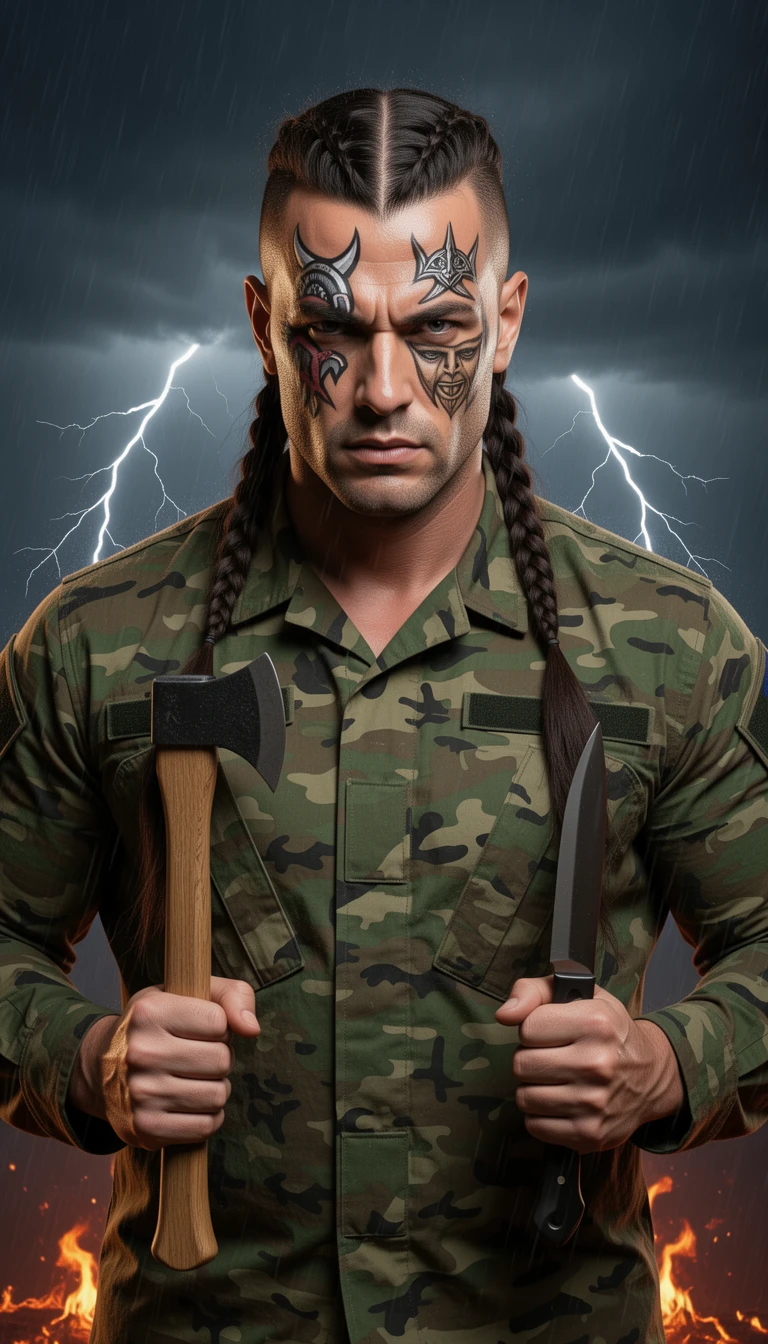
The truck hummed beneath him, the engine a low, steady thrum that vibrated up through the steering wheel and into his bones. Ivan's left hand rested at ten o'clock, his right at two—grip loose, shoulders set, eyes tracking the road ahead without really seeing it. The Virginia countryside unspooled on either side: rolling fields gone brown with the late autumn, clusters of trees stripped bare, their branches like veins against a gray sky that promised rain but hadn't delivered yet.
He'd been driving for twenty minutes. The nursing home was another thirty out past Leesburg, down roads he could navigate in his sleep because he'd driven them a thousand times before. His body knew the route. His mind didn't have to work for it, which meant his mind had room to wander—and his mind, left to its own devices, always found its way back to the same places.
Sarah.
Her name hit him like a physical thing, a pressure in his chest that had nothing to do with his heart and everything to do with the space she'd carved out inside him. He thought about her pink eyes, the way they caught the light when she laughed, the way they went flat and focused when she was working. He thought about her hands—the calluses on her palms from years of weapons training, the way she'd traced his jaw that night in her kitchen, featherlight, like she was memorizing him.
He thought about her with Victor.
His jaw tightened. The tendons in his neck went hard. He forced his hands to stay loose on the wheel because if he let them tighten, if he let the anger rise, he'd crack the steering wheel in half. He'd done it before. The truck had a new steering wheel because of a phone call in 2019 that ended with him spitting blood and the plastic shattered in his grip.
Sarah was undercover. Sarah was working. Sarah was doing what she'd trained to do, what she'd volunteered to do, what she was the best on the planet at doing.
And Victor Reed was a dead man walking. He just didn't know it yet.
She knows what she's doing, Ivan told himself. The thought was a mantra, worn smooth from repetition. She's Sarah fucking Douglas. She's got more kills than most operators have missions. She's got your back, and you've got hers, and this is the job.
It didn't help. The knowing never helped. The worry was a separate thing, a creature that lived in his gut and fed on the hours she was out of his sight. He'd learned to coexist with it, to function around it, but he'd never learned to kill it. Maybe he didn't want to. Maybe the worry was just love with its teeth bared.
His thumb found the scar on his wrist without looking—a thin white line, three inches long, from a piece of shrapnel in the jungle war. He traced it once, twice, three times. The OCD flare. The compulsion to check, to count, to make sure the world still made sense in the small ways he could control.
The road curved. He followed it.
His mind drifted deeper, the way it always did when he let the silence settle. The truck became a time machine, the hum of the tires a lullaby that pulled him backward through the years. He was thirty-seven now. Thirty-seven years old, born May 27th, 1988, at Fairfax Nova Hospital, in the same county he was driving through now. The same Virginia soil that held his parents' graves. The same Virginia sky that had wept the day he buried the girl he was going to marry.
He remembered the hospital. Not the birth—obviously—but the stories. His grandmother Eleanor had told him about the day he came into the world, how he'd come out silent, not crying, how the doctors had to slap him twice before he let out a wail that shook the delivery room. "You came into this world stubborn," she'd said, "and you ain't changed a bit."
The stubbornness was the only thing that had saved him. That and the pills, and the therapy, and the rules he'd built for himself like a cage to contain the thing inside him that wanted to tear the world apart.
OCD. PTSD. Intermittent Explosive Disorder. Schizophrenia with homicidal tendencies. Autism spectrum. Bipolar disorder.
The alphabet of his brokenness. The list of diagnoses that had followed him from one therapist to another, one military psychiatrist to the next, each one adding a new label, a new prescription, a new way of saying "you're dangerous, and we're not sure if we can fix you."
They'd tried to break him in boot camp. The drill instructors screamed in his face, pushed him past exhaustion, past pain, past every limit a human body was supposed to have. And Ivan had smiled. Not a nice smile. A smile that made the DIs take a step back, made them exchange looks, made them quietly reassign him to a different platoon because something about the quiet kid with the gray eyes was wrong in a way they couldn't name.
He'd wanted to be a Marine sniper. That was the goal, the burning star he steered by. A sniper got to be alone. A sniper got to be quiet. A sniper got to look through a scope at a world reduced to crosshairs, where the math was simple and the ethics were clear and the only thing that mattered was the shot.
Eighteen years old. Fresh out of high school. Boot camp at Parris Island. And then the world collapsed.
The memory hit him like it always did—not as a story he told himself, but as a physical sensation. The phone call. The chaplain's face. The words that didn't make sense because they couldn't make sense, because the universe wasn't allowed to be that cruel.
Your parents. Your girlfriend. Car accident. Lost control. Hit a wall.
Gone. All of them. In a single moment on a road somewhere in Virginia, while Ivan was a thousand miles away learning how to kill people for his country.
His hands tightened on the wheel. He made them loosen. One. Two. Three. Breathe.
The funeral was a blur of black clothes and gray skies. He remembered standing at the gravesite in his dress blues, the fabric stiff and unfamiliar, his medals catching the weak sunlight. He remembered his grandmother Eleanor holding him up, her small frame somehow strong enough to bear his weight. He remembered Michael—his older brother, the one who'd always resented him—standing apart, his face hard, his eyes cold.
"Should have sent you to an orphanage," Michael had said, low enough that only Ivan could hear. "You were always the problem."
Ivan hadn't responded. He hadn't had the words then. He didn't have them now, either. Michael was a wound that had never healed, a splinter buried too deep to dig out.
But the others—his siblings, his true siblings, the ones who shared his blood and his birth date—they had been there. Kimberly. Michelle. Jennifer. Rickey. The quintuplets, bound together by more than genetics, by the shared experience of being the youngest, the ones Michael had always treated as beneath him.
Kimberly had held his hand through the entire service, her orange eyes red-rimmed but dry. Michelle had stood at his left shoulder, a silent sentinel, her black eyes tracking every person who approached. Jennifer had kept the press at bay, her yellow-orange-red-black eyes daring anyone to get close. And Rickey—Rickey had stood beside him, cornrowed hair stark against the gray sky, blood-red eye meeting Ivan's silver-gray in a look that said "I'm here. I'm not going anywhere."
When Ivan had knelt at his parents' casket, the tears had come. He hadn't been able to stop them. They'd poured out of him like something had broken open inside, a dam he didn't know he'd built collapsing all at once.
"I wanna make you proud," he'd whispered to the wood, to the bodies inside, to the ghosts he couldn't see but could feel. "I wanna make you proud. I swear. I swear I will."
His grandmother had heard him. Of course she had. Eleanor Nightsworn heard everything, saw everything, knew everything that happened under her roof and in her bloodline. She'd wrapped her arms around him, her gray hair soft against his cheek, her voice steady even as her own eyes brimmed.
"You do make them proud, Ivan. You are a great kid. You do everything right. They are proud. The family is proud. I am proud."
He'd held onto those words like a drowning man holds a rope. He was still holding onto them.
The truck crested a hill. The sky was getting darker, the clouds thickening. He checked his mirrors—habit, not need—and kept driving.
Amber's funeral was the next day. He remembered the Sullivan family surrounding him, pulling him into embraces that felt like they would never end. Richard Sullivan, his daughter dead, still found the strength to hold Ivan and tell him it wasn't his fault. Catherine Sullivan, her face ravaged by grief, had cupped his cheeks and kissed his forehead like he was her own son.
He'd knelt at Amber's casket and felt the world tilt. She was inside there. His Amber. The girl who'd seen him in sixth grade, when he was already strange, already isolated, already carrying something dark behind his eyes that made other kids cross the hall to avoid him. She'd walked up to him in the cafeteria, sat down across from him, and said "You look like you need a friend."
He'd loved her from that moment. He'd never stopped.
"I'm gonna make you proud," he'd said to her casket, the words the same as the day before because they were the only words he had. "I'm gonna do right. I'm gonna be the man you always thought I could be."
Catherine had grabbed him afterward, pulled him into a mother's embrace that broke something else inside him. "You are a good kid, Ivan. You do the right thing. You always made her proud. You always will."
He'd told them he was going to marry her. Told them he'd had the ring picked out, the date planned, the whole future mapped in his head. A house in the country. Two kids. A dog. A life so normal it would be boring, and beautiful because of it.
He'd buried that dream with her.
The truck's engine hummed. The road kept unfolding. Somewhere ahead, the nursing home waited, with its linoleum floors and antiseptic smell and the old woman who called him by his father's name and asked him if he'd had lunch yet.
His mind kept going backward.
Boot camp ended. He was shipped out to the desert—Afghanistan, Kazakhstan, Kyrgyzstan, Pakistan, Tajikistan, Turkmenistan, Uzbekistan. The entire Middle East and North Africa, a chessboard of oil and minerals and competing interests that he didn't understand and didn't need to. He was a Marine scout sniper. He found targets. He eliminated them. That was the job.
From eighteen to twenty-two, he'd done that. From twenty-two to twenty-six, he'd done it as Marine recon, deeper in, darker missions, ones that didn't show up in any official record. The jungle war started around then—a three-sided clusterfuck in mainland Southeast Asia, with the US backing the rebels, China backing the governments, and Russia backing the terrorists and corrupt leaders. Cambodia. Laos. Myanmar. Thailand. Vietnam. The islands: Brunei, Indonesia, Malaysia, Philippines, East Timor.
Ivan had been in all of them. He'd seen things that would never leave him. Done things that sat in his gut like stones, heavy and cold and permanent.
And then, at thirty, the mission that had changed everything.
Vietnam. A jungle village. A black op to kill Maria Chen and her family.
The mountains were thick with fog when they'd moved in, the air wet and heavy, the kind of humidity that soaked through your uniform and made your rifle feel slick in your hands. Striker had led the team. Striker, who Ivan had trusted, who Ivan had bled beside, who had turned out to be the devil wearing a familiar face.
Maria Chen was eighteen. Her brother Lance was fourteen. Her parents, David and Sue, were civilians who had never picked up a weapon in their lives. Striker believed—or claimed to believe—that David was a faction leader. He wasn't. Striker had been told wrong, or had chosen to believe wrong because the mission didn't care about the truth.
But that wasn't why Striker had done it.
Ivan's hands tightened on the wheel again. This time he didn't make them loosen.
Striker had told him, in the middle of that village, with Maria on her knees and a gun to her head: "We killed your family. We killed Amber. We did it to break you. You're a weapon, Ivan. A nuke button. We needed you to be what the government can't make. What would you do if the code didn't matter?"
Striker had put the gun to Maria's head and said "What's it gonna be? Your code doesn't mean a fucking thing. You're a machine. Take your pick."
Ivan had made his choice.
He'd saved them all—Maria, Lance, David, Sue. He'd taken out his own team, the men he'd trained with, fought with, trusted with his life. He'd killed them the same way he'd killed Striker: scalping them alive, cutting out their tongues, giving them the blood eagle—the Viking execution where he opened their backs, pulled their lungs out through the wounds, spread them like wings. He'd cut off their heads, impaled them, crucified them.
And over Striker's body, he'd placed two black coins on the eyes, a Marine challenge coin in the pocket, a joker card in the left hand, and the Dead Man's Hand in the right.
The next day, Ivan had realized the truth: Striker was American. The rest of the team were mercenaries from various nations. The whole mission had been a false flag, designed to kill innocent people and blame the rebels. Ivan had left a note explaining that Striker's team had killed the village—and three others before it—and that the military was investigating. He'd left another note, explaining the Maria Rule, the rule he'd created in that moment of choice: Don't hurt the innocent. Don't hurt the weak. Men, women, children, the elderly—all off limits.
He'd called Striker's ex-wife. Linda Johnson. He'd asked her to meet him at a church with her oldest son. She'd agreed.
The memory of that meeting was carved into him like the scar on his wrist. The church was small, white, with a steeple that seemed too tall for the building. Light rain had been falling, a summer drizzle that turned the air hazy. Linda had arrived with Jacob, her son, then fourteen years old, the same age Lance had been when Ivan saved him.
Ivan had told them the truth. "The government told you your husband died for his country. They lied. He was killed because of his own choices, and I was the one who carried out the sentence. Your husband betrayed his country. He was working for a faction of the government. He killed my family and many others. I executed him for it. But you are innocent. I will not let his sins destroy your future."
Linda had lost her mind. She'd punched him, kicked him, slapped him—and Ivan had stood there and taken it. He hadn't moved, hadn't raised his hands, hadn't defended himself. He'd let her hit him until her fists were bloody and her screams had turned to sobs, and then she'd collapsed against his chest, her tears soaking through his shirt.
Jacob had followed his mother. He'd punched Ivan in the ribs, in the face, in the gut. Ivan had stood there, taken it all, held the boy when he fell apart, when his anger turned to grief, when all he could do was cry against Ivan's chest as Ivan held him steady.
"I want to pay for your house and your son's college," Ivan had said.
Linda had said no.
Silence had filled the church. And then they'd walked away, mother and son, disappearing into the rain. Ivan had walked out into that same rain, stood in the parking lot, let the water soak him to the bone. He'd understood what he'd done. He'd understood the pain he'd caused. He'd understood that the children of the men he killed would always pay a price his own grief couldn't justify.
The op had hit the CIA director's desk and the President's desk like a thunderbolt. The government had tried to bury it, to spin it, to contain the damage. They'd created the Ivan Rule: innocent women, men, children—none of them were allowed to see what happened. They used coded language, cleaned up the mess, made sure the innocent stayed innocent. The White House declared him off-limits. The CIA declared him off-limits in blood. Do not touch. Do not arrest. Leave this man be. Anyone who tries gets fired.
The government stripped Striker of his rank, gave him a dishonorable discharge—posthumous, meaningless, but official. They passed orders to every federal and state law enforcement agency. Interpol caught wind and issued the same ruling.
And they kept paying Ivan's checks.
Because Ivan had done what they wanted. He'd become the weapon they needed. The monster they could point at their enemies. The Grim Reaper, sent to collect souls so they didn't have to get their hands dirty.
The truck slowed as he approached a stop sign. He hadn't consciously pressed the brake. His body knew the route. His body always knew.
He looked at his hands on the wheel. They were steady. They were always steady. That was the horror of it—he could be a storm inside, every neuron firing with rage and grief and the kind of madness that would level cities, but his hands would stay steady. The weapon was always ready, even when the man holding it was coming apart at the seams.
The road stretched ahead. The nursing home was close now. He could feel the shift in his body, the way his shoulders relaxed a fraction, the way his breathing slowed. Mrs. Gable would be waiting. She'd be in her chair by the window, a blanket over her lap, a crossword puzzle in her hands. She'd look up, and she'd smile, and she'd say "Ivan, my boy, about time you showed up."
And for a few hours, he could pretend he was just a man who stocked shelves at Hubco and visited old ladies in nursing homes. He could pretend he was normal, unbroken, free of the weight of every life he'd taken and every life he'd failed to save.
He could pretend Sarah was safe, and the mission was just a mission, and Victor Reed was just a target who didn't matter.
The truck turned onto the nursing home's driveway. The building came into view—a low, brick structure with a flagpole out front and a sign that read Fairfax Meadows Nursing & Rehabilitation Center.
Ivan parked the truck. Cut the engine. Sat in the silence.
His hands were still on the wheel at ten and two. Loose grip. Steady. Ready. Always ready.
He thought of Sarah. He thought of her pink eyes and her steady hands and the way she'd said "I'll come back" like it was a promise written in stone.
He got out of the truck. The air was cold, damp, smelled like wet pavement and dead leaves. The nursing home's front door was automatic, sliding open with a soft hiss as he approached.
The linoleum floor was cool under his boots. The antiseptic smell hit him, familiar and almost comforting now. The low hum of fluorescent lights mixed with a distant TV playing some daytime show he didn't recognize.
He walked down the hall, past the nurses' station, past the activity room where a handful of residents were gathered around a table playing cards. He nodded at a few familiar faces. They nodded back. He was a regular here. Part of the furniture.
Mrs. Gable's room was at the end of the hall, door slightly ajar. He could see the edge of her chair by the window, the corner of her blanket, the tip of her slipper.
He knocked once, soft. "Mrs. Gable? It's Ivan."
No answer. He pushed the door open anyway, the way he always did.
She was there. Chair by the window. Blanket over her lap. Crossword puzzle on the small table beside her. She looked up when the door opened, her eyes finding his face, recognition dawning slowly like the sun coming up over a field.
"Ivan, my boy," she said, and her voice cracked on the last word. "About time you showed up."
He smiled. It wasn't a lie. "I'm here now."
He crossed the room, pulled up the visitor's chair, and sat beside her. The window looked out over a small courtyard, trees bare, grass brown, a bird feeder hanging empty. The sky was the same gray it had been all day, low and heavy, full of rain that wouldn't fall.
"You look tired," Mrs. Gable said, studying him with eyes that had seen ninety years of the world and missed very little.
"I'm fine."
"Bullshit."
He laughed, a short, surprised sound. "You're right. I'm tired."
"That girl," Mrs. Gable said, reaching out to pat his knee with a papery hand. "The one on TV. She's yours?"
Ivan looked at her. The question hung in the air between them, simple and complicated all at once. Was Sarah his? Did he have a right to claim her when she was out there risking her life for something bigger than either of them?
"Yes," he said. "She's mine."
Mrs. Gable nodded, a slow, satisfied motion. "Good. You deserve someone."
He didn't know what to say to that. So he said nothing. He just sat there, in the room that smelled like old blankets and Vicks VapoRub, and let the silence hold them both.
Outside, the rain finally started, tapping against the glass like a quiet, patient visitor asking to come in.
Ivan listened to it. He thought about Sarah. He thought about the road behind him and the one ahead.
The rain kept falling.
The rain tapped against the glass. Steady. Patient. A rhythm that filled the space between them without needing anything in return. Ivan watched the droplets slide down the windowpane, each one finding its own path, branching and merging and falling out of frame. He could feel Mrs. Gable's eyes on him, patient and knowing in a way that made his chest ache.
"Mrs. Gable," he said, and the words came out slower than he'd intended. He turned to face her. "Can I ask you something?"
She set down her crossword pencil. The movement was deliberate, the way old people do things when they have time to savor the moment. Her papery hands folded in her lap over the knitted blanket. "You can ask me anything, my boy. You know that."
Ivan leaned forward, elbows on his knees, hands clasped loose between them. The chair creaked under his weight. He could hear the hum of the fluorescent light in the hallway, the distant sound of a television playing some game show, the faint squeak of a nurse's shoes on linoleum. All of it faded into background noise, white static behind the moment.
"Your husband," he said. "What was his name?"
Her eyes flickered. Not with pain—with something softer. Memory, maybe. The kind that had been worn smooth by decades of handling. "Harold," she said. The name came out like a breath, like she'd been holding it in her chest waiting for someone to ask. "Harold Gable. He was a farmer, believe it or not. Raised corn and soybeans out in Iowa. Had the biggest hands I've ever seen on a man."
Ivan nodded. He could picture it—a big man with calloused palms and a slow smile, the kind of man who knew the land and the seasons and the weight of a good day's work. "How long were you married?"
"Fifty-three years." She said it without hesitation, the number carved into her bones. "He passed eight years ago last spring. Heart gave out while he was fixing a fence post. Found him in the field, sun on his face, a pair of pliers still in his hand."
Ivan felt something tighten in his throat. He didn't look away. "I'm sorry."
"Don't be." Her voice was firm, not broken. "He went the way he wanted. Out there, doing something that mattered. Not in a bed with tubes in his arms." She paused, and her eyes found his. "That's the best any of us can hope for, isn't it?"
Ivan thought about the men he'd lost. Striker. The faces he couldn't forget. The ones who'd gone down in fire and the ones who'd gone down in silence. "Yeah," he said. "I think it is."
The rain kept falling. The room felt smaller, warmer, like the world outside had receded and left just the two of them in this box of light and shadow. Ivan's hands were still clasped between his knees. He could feel the calluses on his palms, the faint tremor that lived in his fingers even when he was still. He didn't try to stop it.
"How did you meet him?" he asked.
Mrs. Gable smiled. It was a slow smile, one that started at the corners of her mouth and spread across her face like sunrise over flat land. "County fair, 1952. He was trying to win a stuffed bear for some other girl—a blonde with big curls and a laugh like a tea kettle. But the game was rigged, and he kept losing dimes, and she got bored and walked off. I was running the ring toss booth for the church auxiliary. He came up to me, red-faced and frustrated, and said, 'Miss, can you tell me how to win that bear?'"
Ivan almost laughed. "What did you say?"
"I told him the truth. 'You can't. The rings are too small. It's a gyp.' He looked at me for a long moment, and then he laughed. It was a big laugh, deep and honest, the kind that came from his belly. He said, 'Well, then, can I buy you a lemonade instead?' And I said yes."
She paused, her eyes distant, seeing something Ivan couldn't see. "He brought me a lemonade, and we sat on a hay bale behind the livestock barn, and we talked until the fair closed. He asked me about my family, my favorite color, whether I liked dogs. I asked him about his farm, his mother's apple pie recipe, and why he'd wanted that bear so bad for a girl who didn't deserve it. He said, 'Because she asked. And I didn't know yet that some things aren't worth fighting for.'"
The rain filled the silence. Ivan's chest ached with something he couldn't name. He thought about Sarah. About the way she'd kissed him in the kitchen, the way her hand had felt in his, the way she'd said I'll come back like it was the only truth in the world. He thought about what it meant to fight for something worth fighting for.
"That's a hell of a story," he said.
"It's a love story," she corrected gently. "They're all hell of a thing, one way or another."
Ivan looked down at his hands. The tremor was still there, a ghost in the wires. He thought about all the things he'd never said to Sarah, all the words he'd swallowed because they felt too big for his mouth. He thought about the promise she'd made and the one he'd made back to her—quiet, in the dark, with her head on his chest and her breath warm on his skin.
"Do you think," he started, and then stopped. The question was there, at the back of his throat, but it felt raw, exposed, like a nerve he'd been hiding for years.
Mrs. Gable waited. She didn't fill the silence. She just sat there, her hands folded, her eyes steady, giving him all the time he needed.
Ivan forced himself to look at her. "Do you think it's possible to love someone enough to let them go? Even when every part of you wants to hold on?"
She studied him for a long moment. The rain filled the gap, a soft percussion against the glass. When she spoke, her voice was quiet, but it carried the weight of fifty-three years.
"I let Harold go to the field every morning, even when his heart was bad. I let him climb ladders and lift bales and drive the tractor even when the doctor told him to rest. Because he would have died by inches if I'd kept him inside. He would have resented me for saving his life. So I chose to let him live his life, and let him go when it was time." She reached out and laid her hand on his knee. "Love isn't about holding on, Ivan. It's about wanting the other person's life to be full, even if you're not the one filling it."
Ivan felt the words land somewhere deep, somewhere he'd been keeping locked. He didn't speak. He just sat there, in the chair beside her, with the rain falling outside and the weight of her hand on his knee and the ghost of a man named Harold Gable filling the room like a blessing.
"That girl," Mrs. Gable said. "The one with the pink eyes. She's out there doing something dangerous, isn't she?"
Ivan nodded. He didn't ask how she knew. Old women in nursing homes saw more than people gave them credit for. They'd spent a lifetime reading faces, learning the spaces between words. "Yeah. She is."
"And you're sitting here with me instead of out there with her because you trust her."
"I do."
"And because you know she has to do this herself."
Ivan closed his eyes. The truth of it sat in his chest like a stone. "Yes."
Mrs. Gable patted his knee once, twice, then withdrew her hand. "That's love, my boy. The hardest kind. The kind that waits."
The rain was slowing now, softening to a drizzle, the sky outside brightening by a shade. Ivan opened his eyes and looked out the window. The courtyard was wet, the bare branches of the trees slick and dark. A bird had landed on the empty feeder, tilting its head, looking for something that wasn't there.
He thought about Sarah. He thought about the road ahead, the weeks or months or years until she came back. He thought about the promise he'd made to wait, and the promise she'd made to return, and the field where Harold Gable had died with pliers in his hand and sun on his face.
"Thank you," Ivan said. The words came out rough, scraped clean of anything extra. "For telling me about Harold."
Mrs. Gable smiled, and it was the same smile she'd worn when he'd walked in—familiar, warm, the kind of smile that said she'd been expecting him because the world had a way of bringing people together when they needed it most. "You remind me of him, you know. The way you carry yourself. The way you look at the world like you're measuring it, deciding whether it's worth your trust."
Ivan didn't know what to say to that. So he said nothing. He just sat there, in the room that smelled like Vicks VapoRub and old blankets, letting the silence hold them both.
Outside, the clouds were breaking. A thin shaft of light cut through the gray, hitting the wet grass in the courtyard, making it glow for just a moment before the clouds closed again.
Ivan watched the light die, and then he looked at Mrs. Gable, and he thought about the word home. Not a building. Not a place on a map. The word meant something else now. It meant Sarah's voice on the phone. It meant the farmhouse kitchen full of his family. It meant this room, this woman, this moment of grace in the middle of a gray afternoon.
"I should go," he said. "I've got a shift at Hubco in a few hours. But I'll be back. Same time next week, if you'll have me."
Mrs. Gable picked up her crossword pencil. The tip hovered over the page, then touched down, filling in a square with the kind of careful precision that came from decades of practice. "I'll be here, Ivan. Same chair, same window, same crossword. The world keeps turning, but some things don't change."
He stood. The chair groaned with relief. He looked down at her—small and fragile and tougher than any operator he'd ever served with—and felt something loosen in his chest. Not the weight, exactly. But the sharp edges of it, smoothed by her words like water over stone.
"See you next week, Mrs. Gable."
"Bring a picture of that girl next time," she said, not looking up from her crossword. "I want to see what kind of woman makes a man like you sit still long enough to talk about love."
Ivan felt the corner of his mouth lift. "I'll do that."
He walked to the door, paused with his hand on the frame, and looked back. She was still there, in her chair by the window, the gray light falling across her lap. The rain had stopped. The world was quiet.
He stepped into the hallway, and the door clicked shut behind him.
He stood there for a long moment, his hand still pressed flat against the wood of the door. The click echoed in the hallway, swallowed by the distance between fluorescents, by the hum of the building's old bones settling around him. He could feel the grain of the door under his fingertips, the slight give where years of moisture had warped the frame, and he thought about how many times he'd walked through a door and never come back. How many thresholds he'd crossed where the person he was on one side didn't survive to see the other.
This one was different. This door opened onto a hallway that smelled like antiseptic and overcooked vegetables, and somewhere behind him a television was playing a game show—applause track, bright and hollow. He let his hand fall. The absence of contact felt like a small death, the way all partings did, and he forced himself to take a breath, to let the air fill his lungs all the way down, to feel the living fact of his own chest rising and falling.
He started walking. His boots were quiet on the linoleum—soft rubber soles, the kind that didn't announce themselves. He'd learned that in the Marines, the way sound carried, the way a floor could betray you. Linoleum was good. Concrete was better. Wood was a nightmare, every creak a confession. He'd spent twenty years reading floors, reading doors, reading the space between one heartbeat and the next. It was hard to turn that off. Hard to walk down a hallway in a nursing home without scanning every corner, every shadow, every door slightly ajar.
A nurse passed him—mid-forties, tired eyes, a scrub top patterned with cartoon cats. She smiled. He nodded back. The exchange took less than a second, but he caught the details anyway: the coffee stain on her collar, the way she favored her right foot, the wedding ring that had left a pale band on her finger even though she wasn't wearing it. He didn't mean to notice these things. They just arrived, like weather, like the memory of Sarah's hand in his hair, like the sound of Mrs. Gable's voice saying bring a picture of that girl next time.
The front doors were ahead. Glass and aluminum, the kind that sighed when they opened, the kind that let in the cold even when they were closed. He could see the parking lot through them, the gray afternoon light, the wet asphalt gleaming where the rain had left its mark. His truck was out there, third row, driver's side, the same Ford F-150 he'd been driving for six years because it still ran and he didn't see the point in replacing something that worked.
He pushed through the doors. The air hit him—cold, damp, the smell of wet earth and distant exhaust. It was different from the air inside, which was recycled and filtered and dead. This air was alive. It had weight. It had been places. He stood on the welcome mat, letting the cold settle on his skin, feeling the way his body adjusted to the temperature shift the way it had adjusted to a hundred other shifts in a hundred other places.
The parking lot was mostly empty. A Honda Civic with a dented bumper. A minivan with a stuffed animal suction-cupped to the rear window. His truck, mud-splattered and patient, waiting like it always did. He walked toward it, his breath misting in front of him, his keys already in his hand because he didn't like fumbling at the door. Fumbling was vulnerability. Fumbling was the second it took for someone to close the distance.
He unlocked the door, pulled it open, and climbed inside. The cab smelled like coffee and leather and the ghost of every drive he'd ever taken. He closed the door and the world got smaller, quieter, the way it always did when he sealed himself in. He put the key in the ignition and turned it. The engine caught, rumbled, settled into a low idle that vibrated through the seat, through the floor, through his hands on the steering wheel.
He sat there for a moment. The nursing home was behind him, a box of fluorescent light and antiseptic and old women doing crosswords. Mrs. Gable was in there, in her chair by the window, her pencil moving across the page, her mind sharp as a blade despite the eighty-some years she was carrying. He thought about what she'd said—love isn't about holding on—and he let the words sit in his chest, let them settle next to everything else he was carrying.
He put the truck in gear and pulled out of the parking lot.
The road unfurled in front of him, two lanes of asphalt wet with rain, lined with bare trees and the occasional mailbox. He knew this road. He'd driven it a hundred times, a thousand, the turns and dips and straightaways mapped in his muscle memory. He didn't have to think about where he was going. His hands knew. His feet knew. The truck knew, the way a horse knows the way home.
He was thinking about the farmhouse. About the ribs in the smoker, the chili on the stove, the noise of his family filling the kitchen. He could picture it: Rickey at the grill, tongs in hand, arguing with Jack about something stupid. Kimberly at the counter, chopping onions, her eyes watering but her face set in that look she got when she was focused. Michelle in the corner, watching, saying nothing, seeing everything. Jennifer probably outside, checking her phone, waiting for word from her team. And Eleanor—Eleanor in her chair, the quilt over her knees, her voice carrying the weight of eighty years and a will that had rewritten everything.
But first there was the drive. There was the road. There was the space between one place and another, the liminal stretch where he wasn't anyone's brother or son or commander or friend. He was just a man in a truck, watching the trees go by, letting his mind drift where it wanted to go.
And it went to the past.
He'd been eighteen when he joined the Marines. A kid. A boy with a chip on his shoulder and something to prove and no idea what he was getting into. He'd walked into the recruiting office on a Tuesday in October, signed his name on a line, and handed over the next four years of his life like it was nothing. He hadn't known then what he was signing away. He hadn't known that the boy who walked into that office would never come back out, that the man who emerged would be someone else entirely, someone with a different set of instincts and a different understanding of what the world was made of.
The Marines had made him a sniper. They'd taught him to shoot, to wait, to breathe in a way that made him invisible. They'd taught him that a body at a thousand meters was just a body, that distance made it easier, that the scope was a lie because it brought you closer but not close enough to see the eyes. He'd learned to read wind and elevation and the angle of the sun. He'd learned that a trigger pull was a decision you couldn't take back, that the bullet didn't care about your reasons, that the only thing that mattered was whether you hit what you aimed at.
He'd been good at it. Good enough to get noticed. Good enough to get pulled into Recon, then the SEALs, then the CIA. Each step up the ladder took him further from the person he'd been, deeper into a world where names didn't matter and missions were referred to in passive voice and debriefs were written in language that could be denied. He'd learned to disappear. He'd learned to become a ghost, a set of eyes, a finger on a trigger. He'd learned that the most dangerous thing in the world was a man with nothing to lose and a skillset that made him valuable to people who didn't want to get their hands dirty.
But even that hadn't been enough. The Americans had trained him, used him, shaped him into their weapon. And then they'd loaned him out, because that was the thing about being the best—everyone wanted a piece. The Royal Marines had taken him next, taught him to move through mountains, to read terrain the way other people read books. The SBS had taught him to operate in water, to hold his breath until his lungs screamed, to move through the dark like he belonged there. MI6 had taught him to lie, to wear a face that wasn't his, to walk into a room and become someone else entirely. And then the Israelis had taken him—Shayetet 13, then Mossad, then Kidon—and they'd taught him something the others hadn't. They'd taught him that vengeance was a language, that blood was a currency, that some debts could only be paid in the lives of the people who owed them.
He'd retired from American service at thirty-four. British service at thirty-six. Israeli service at thirty-seven. He'd walked away from the only life he'd known for twenty years because something in him had broken, or maybe something in him had finally healed enough to know that he couldn't keep doing it. He'd come home to a country that didn't know his name, to a family that had learned to live without him, to a world that had moved on while he was gone.
And he'd found work at Hubco.
The thought almost made him laugh. Ivan Leonardo Nightsworn, former Marine sniper, former SEAL, former CIA operator, former asset of three foreign intelligence services, stocking shelves and running the register at a hardware store that sold everything from light bulbs to lumber. He could speak a dozen languages fluently. He could kill a man with his bare hands in seventeen different ways. He could cook a meal that would make a five-star chef weep. And his job was to tell customers which aisle had the PVC pipe.
But that wasn't all. That was never all. At thirty-four, he'd taken over the Diplomatic Security Service's Mobile Security Deployment unit, because even retired, even done, even burned out and running on fumes, he was still too valuable to leave on the shelf. The MSD was his now—his command, his people, his mission. When the State Department needed something done that couldn't be done through normal channels, when an ambassador needed extraction or a compound needed securing or a threat needed neutralizing, they called him. He'd built the unit from scratch, recruited the best operators he could find, trained them the way he'd been trained, and turned them into something that didn't officially exist but was absolutely there when you needed it.
And he worked at a nursing home, because Mrs. Gable wasn't the only one who needed someone to check in, because old people died alone and forgotten and someone had to make sure that didn't happen on his watch. Because he'd spent too many years taking life to let death go unnoticed. Because it was the closest thing to penance he could find, and he wasn't sure he believed in penance but he believed in showing up.
The truck hummed beneath him. The road curved, then straightened, then curved again. He passed a farmhouse with a faded barn, a field of wet hay, a tractor abandoned at the edge of a furrow. The sky was doing that thing it did in late autumn, where the clouds hung low and gray and the light had a quality that made everything look like a photograph. He thought about Sarah. He thought about her pink eyes, her steady hands, the way she'd kissed him in the kitchen like she'd been waiting her whole life to do it. He thought about the mission she was on, the danger she was walking into, the trust she'd placed in him when she'd said I'll come back.
He believed her. That was the thing. He believed her the way he believed the sun would rise, the way he believed that gravity would hold, the way he'd stopped believing in anything else. She'd promised, and he'd promised, and promises were the only currency that mattered in a world where everything else could be forged or stolen or denied.
His phone buzzed in the cup holder. He glanced at it—Rickey. He hit accept and put it on speaker.
"Yeah."
"Where you at?" Rickey's voice came through the speakers, rough and familiar, the voice of someone who'd been his brother for thirty-seven years and still hadn't figured out how to say the things that mattered.
"Driving. About twenty minutes out."
"Good. Ribs are going. Chili's on. Jack's already eaten half the cornbread and I'm gonna kill him if he doesn't leave some for the rest of us."
Ivan felt the corner of his mouth lift. "Save me some."
"That's what I'm trying to do, man. That's what I'm saying. Your boy Jack has no self-control."
There was a sound in the background—Jack's voice, distant but audible: "I heard that!"
"Good!" Rickey shouted back. "You were supposed to!"
Ivan let the noise wash over him. The sound of his family, of life, of people who loved each other loudly and imperfectly and without reservation. He hadn't had that for a long time. He'd been alone in the dark for so many years that he'd forgotten what it felt like to be held by voices, by presence, by the simple fact of people who expected him to come home.
"How's Mrs. Gable?" Rickey asked, his voice quieter now, the noise of the kitchen fading as he must have stepped away.
"Good. She's good. Told me to bring a picture of Sarah next time."
Rickey was quiet for a beat. Then: "She know about the mission?"
"She knows Sarah's doing something dangerous. Didn't ask for details."
"Old ladies know shit they shouldn't. It's a superpower."
Ivan huffed a laugh. "Yeah. Seems like."
"You okay?"
The question landed softly, the way Rickey asked things when he really wanted to know. Not casual, not probing—just there, an open door, waiting for whatever Ivan chose to put through it.
Ivan thought about the question. He thought about Mrs. Gable's hand on his knee, about the story of Harold dying in a field with pliers in his hand, about the word home and what it meant now. He thought about Sarah, about the promise he'd made to wait, about the weight of twenty years of silence and the way it had lifted when she'd kissed him.
"I'm getting there," he said. And it was the truth.
"Good." Rickey paused. "Hey. Ribs are almost done. Get here before Jack finds the second pan."
"I'm on it."
"Later."
The line went dead.
Ivan set the phone back in the cup holder and let his hands settle on the wheel. The road ahead was empty, the trees closing in on either side, the sky still gray and heavy. He pressed the accelerator and the truck responded, picking up speed, eating the miles between him and the place where his family was waiting.
He thought about the ribs. The chili. The noise. The warmth.
He thought about Sarah, somewhere out there, wearing a face that wasn't hers, walking into the lion's den with nothing but her training and her nerve and the promise she'd made to him in the dark.
He thought about waiting. About what it meant to hold space for someone, to keep the light on, to be the place someone came back to.
The farmhouse came into view around the next bend—warm lights in the windows, smoke rising from the chimney, a cluster of vehicles in the driveway. He could see movement inside, shapes passing behind the glass, the familiar chaos of a house full of people who loved each other.
He pulled into the driveway, put the truck in park, and sat there for a moment, watching the light spill out onto the wet gravel.
Then he opened the door, stepped out into the cold, and walked home.
The cold bit into his cheeks the moment the truck door swung open, the farmhouse light spilling across the gravel in a warm golden sheet. He stood there for a second, boots planted on the wet stone, watching his breath plume and dissolve. The smell of woodsmoke and chili hit him, carried on the wind coming off the fields, and somewhere inside he could hear the low rumble of voices, laughter, the clatter of dishes being set out. He pushed the door shut with his hip, the thud of it swallowed by the night, and walked.
The gravel crunched under his boots, each step carrying him closer to the light in the windows. He could see them through the glass—shapes moving, heads turning, the flicker of the fireplace casting shadows across the walls. Rickey was standing by the stove, a ladle in his hand, his mouth moving as he said something that made Jack throw his head back and laugh. Stevenson was at the counter, a beer in his hand, nodding at whatever Kimberly was saying. Jennifer was bent over the table, arranging something, and Michelle sat in the corner armchair, her legs crossed, watching the room with the quiet stillness of someone who saw everything and said little.
Sarah was there.
He saw her before she saw him—standing near the fireplace, a glass of wine in her hand, her hair braided tight against her scalp, the firelight catching the pink of her eyes. She was laughing at something Melissa had said, her head tipped back, her throat exposed, and for a moment he just stood there on the porch and watched her through the glass. She was beautiful. She was alive. She was here, in this house, with his family, and for a few hours she wasn't undercover, she wasn't playing a role, she wasn't walking into the lion's den.
She was just Sarah.
He took a breath. Let it out. Then he pulled open the door and stepped inside.
The warmth hit him first—a wall of it, thick with the smell of smoked meat and onions and something sweet baking. The noise hit him second, the way it always did in this house, the overlapping voices, the laughter, the sound of people who had known each other their whole lives and weren't afraid to be loud about it. He stood in the doorway for a beat, letting it wash over him, letting himself feel the shape of it.
"There he is!" Rickey's voice cut through the noise, and Ivan watched his brother set down the ladle and point at him with the same hand, a smear of sauce on his forearm. "Took you long enough. Ribs are done, chili's been resting, and if Jack had his way there'd be nothing left for you."
"I left you the good ones," Jack said, not looking up from the cornbread he was cutting into squares. "Don't let him tell you different."
"You left me crumbs."
"Crumbs are a serving size in some cultures."
Rickey threw a dish towel at him. Jack caught it without looking.
Ivan felt the corner of his mouth lift. He pulled off his jacket, hung it on the hook by the door, and stepped farther into the room. The kitchen was warm, the fire crackling in the hearth, the table already set with plates and glasses and a pitcher of water sweating condensation onto the wood. Eleven chairs. Eleven people. A family.
Sarah caught his eye as he moved past the fireplace, and she gave him a small smile, the kind that said she saw him, that she knew what he was carrying, that she was glad he was here. He nodded at her, a fraction of a movement, and she turned back to Melissa's story.
Robert Davis was standing near the window, a beer in his hand, watching the room with the slightly dazed look of a man who'd been in the mountains for years and was still recalibrating to the noise and heat of a house full of people who loved each other. He caught Ivan's gaze and raised his beer in a silent toast. Ivan raised his chin back.
Eleanor was in her chair by the fire, a blanket over her legs, a cup of tea in her hands, watching her family with the quiet satisfaction of someone who had built something that would outlast her. She caught his eye and smiled, and he felt something loosen in his chest.
Ivan moved to the counter, grabbed a beer from the cooler, and popped the top. The hiss of carbonation, the cold glass against his palm, the first sip bitter and clean. He let it settle, let the room settle around him, let himself be held by the warmth and the noise and the scent of home.
"Alright," Rickey said, clapping his hands together. "Everyone sit. Let's eat before Jack finds a way to inhale the whole table."
"I resent that," Jack said, already pulling out a chair.
"You should. It's accurate."
There was a shuffling of bodies, the scrape of chairs on hardwood, the clatter of plates being passed. Ivan found his seat between Jennifer and Stevenson, across from Sarah, and the table filled in around him like water finding its level. Eleanor was at the head, Rickey at the other end, the fire flickering between them.
For a moment, it was just noise—the passing of food, the clink of silverware, the low hum of conversation that didn't need to mean anything. Ivan let himself have it. Let himself be in it. The ribs were good, fall-off-the-bone tender, the sauce smoky and sweet. The chili was thick with meat and beans, the cornbread golden and crumbling at the touch. He ate. He drank. He listened.
But the quiet didn't last.
It never did.
He set down his fork, the metal clicking against the ceramic plate, and the sound cut through the noise like a knife through skin. He felt the room shift, the attention turning toward him like a tide, the way it always did when he broke the rhythm of things.
"I'm worried about Sarah," he said.
The words landed flat. No preamble. No softening. Just the truth of them, set down on the table like a weight.
Sarah's hand paused halfway to her mouth, the fork hovering, her pink eyes finding his across the table. She didn't look surprised. She looked like she'd been waiting for this.
"We know," Rickey said, his voice quiet, the playfulness draining out of it. He set down his own fork, his mismatched eyes meeting Ivan's—one blood red, one midnight black, both of them holding more than they let on. "We know you are."
Robert Davis looked between them, his brow furrowing. He set down his beer, the bottle making a soft thud against the wood. "I'm missing something," he said, his voice carrying the weight of a man who'd been out of the loop for too long and was tired of it. "What's going on?"
Rickey glanced at Robert, then back at Ivan. Then he sighed, the kind of sigh that carried years of brotherhood, of shared weight, of knowing when to speak and when to stay silent. "Sarah's undercover," he said. "She's dating Victor Reed."
Robert blinked. "Victor Reed. The Black Hand enforcer."
"The same."
Robert's jaw tightened. He looked at Sarah, something shifting in his face—not anger, but the hard, sharp concern of someone who'd seen the same things Ivan had seen. "Sarah."
"I know," she said, her voice even, her eyes still on Ivan. "I know what you're going to say."
"Then you know why I'm saying it."
Ivan felt the weight of the table, of the people around him, of the words that were sitting in his throat like stones. He looked at Sarah, at her pink eyes, at the scar above her eyebrow that he'd traced with his thumb in the dark. "She brought it up," he said, and his voice came out quieter than he'd meant it to. "When she first brought it to the team—she was the one who suggested the approach. The dating. The cover."
Rickey nodded slowly. "She came to us with the plan. Laid it out. Full operational details. Timeline, legend, exit strategy. She didn't volunteer. She proposed. There's a difference."
Ivan's jaw tightened. "I know."
"Then what's the problem?"
He looked at his brother, at the blood-red and midnight-black of his eyes, at the face that had been painted the same way since they were eighteen and had decided the world needed to know who they were. "The problem is that I know what she's walking into. I know what Victor Reed does to people. I know what the Black Hand does to people who get close to them. I know what it costs to wear a face that isn't yours for weeks, months, maybe longer. I know what it costs to come back from that."
The table was quiet. The fire crackled. Somewhere in the kitchen, the ice shifted in the cooler.
"I know," Ivan said, his voice dropping lower, rougher, "because I've done it."
Sarah set down her fork. The clink of metal against ceramic was soft, deliberate. "I know you have."
"Then you know why I'm saying no."
The word landed like a stone in still water. The room went still. He saw Rickey's eyebrows lift, saw Jack's hand pause mid-reach for another rib, saw Stevenson's dark eyes sharpen with something between surprise and amusement.
Sarah tilted her head. The firelight caught the pink of her eyes, made them glow like embers. When she spoke, her voice was soft, almost gentle, but there was steel under it. "Ivan Leonardo Nightsworn."
The full name. His government name. The one that was on his birth certificate, his service record, his discharge papers. The one that had been read aloud at every medal ceremony, every deployment briefing, every time the chain of command had needed to make sure they had the right man.
She used it like a key.
"You don't tell me no," she said.
The words hung in the air between them. He felt the weight of them, the truth of them, the boundary they drew. She wasn't challenging him. She was reminding him. She was a marine. She was a recon specialist. She was a Navy SEAL. She was the President's sister, yes, but more than that—she was his equal. She was the woman who had kissed him in this very kitchen, who had promised to come back, who had walked into the dark with her eyes open and her hands steady.
She was not someone who needed to be protected.
She was someone who needed to be trusted.
The silence stretched. Then Rickey laughed. It was a low sound, a rumble that started in his chest and rolled out like thunder, and once it started it didn't stop. He threw his head back, his cornrows swaying, and slapped the table with his palm. "She got you," he said, his voice cracking with laughter. "She got you good."
Jack snorted. "Ivan, you just got called out by a woman half your size with a glass of wine in her hand."
"She's not half my size," Ivan said, but the corner of his mouth was twitching.
"She's a lot less than full. That's what counts."
Melissa was laughing now, the sound high and bright, her head tipped back. "He's got a point. You walked right into that one, Nightsworn."
Kimberly was grinning, her orange eyes bright with amusement. "Ivan, you know better than to tell a marine no. Especially her."
Jennifer smirked, her yellow-orange-red-black eyes glinting in the firelight. "You should've seen your face."
Even Michelle was smiling, the quiet curve of her mouth a rare sight, her black eyes watching Ivan with something like affection.
And Eleanor—Eleanor was laughing. The sound was soft, creaky, the laughter of an eighty-year-old woman who had seen more than most and knew when to enjoy a good moment. She was looking at Ivan with her blue eyes bright, her gray hair catching the firelight, her hand resting on the blanket in her lap. "She told you," Eleanor said, her voice carrying the weight of a woman who had raised him, who had watched him become the man he was, who knew exactly how much he needed to hear it. "She told you good."
Ivan looked at Sarah. She was smiling now, a small, knowing thing, the kind of smile that said she loved him and she wasn't going to let him forget it.
He shook his head, a huff of air escaping him. "Alright," he said. "Alright. You win."
"I know," she said.
The laughter rolled through the room again, filling the spaces, chasing out the tension he'd carried in with him. He could feel it leaving, the tightness in his shoulders easing, the knot in his chest loosening. He picked up his beer, took a long pull, and let the cold and the bitter wash through him.
Robert Davis was watching the scene unfold, his hazel eyes moving from face to face, the dazed look slowly replaced by something like understanding. He set his beer down, leaned back in his chair, and let out a low whistle. "Thank you," he said, his voice carrying the weight of a man who had been in the mountains too long and was trying to catch up. "Thank you for catching me up. I thought I'd walked into a different house for a second there."
Rickey grinned at him, his painted face splitting into something warm and dangerous. "Welcome to the family, Davis. We're loud. We're messy. And we're not good at letting things go."
Robert nodded slowly. "I'm starting to see that."
Sarah reached across the table and grabbed Ivan's hand. Her fingers were warm, her grip firm, her palm pressing against his like she was anchoring him to the moment. He looked at her, at the pink of her eyes, at the firelight dancing in them, and he felt the weight of everything settle into something he could carry.
"I'm not going anywhere," she said, her voice low, meant for him. "I'm going to find the truth. I'm going to follow the trail. And I'm going to come back to you. That's not a promise, Ivan. That's a fact."
He looked at her hand in his, at the contrast of their skin, at the way her fingers found the spaces between his. "I know," he said. "I know."
She squeezed once, then let go, reaching for her wine glass and lifting it to her lips. The conversation started to pick back up around them—Jack arguing with Rickey
Eleanor set her wine glass down. The sound was soft—ceramic against oak—but it cut through the noise like a blade. Jack stopped mid-sentence. Rickey's head turned. The fire crackled in the sudden quiet, and Ivan felt the weight of his grandmother's eyes on him, on all of them, like she was measuring something she'd kept folded in her chest for decades.
"There's something you need to know," Eleanor said. Her voice was tired, but there was a clarity to it, a sharpness that cut through the years. "Something I should have told you long before now."
Ivan set his beer down. The bottle was sweating, condensation slick against his palm. He wiped his hand on his thigh and watched her, the way the firelight caught the silver in her hair, the way her fingers curled around the stem of her glass like she was grounding herself to something solid.
"We're not just a family with a long history," Eleanor said. "We're a family that was built for a purpose. A purpose that stretches back further than any of you know."
Robert Davis leaned forward, his hazel eyes fixed on her, the dazed look from earlier replaced by something sharper. "What kind of purpose?"
Eleanor looked at him, then at Ivan, then at each of them in turn. The firelight painted shadows across her face, deepened the lines around her mouth, made her look older than her eighty years. "We were called the Nocturnus Vindices," she said. "Defenders of the Night. And the Silentium Order—the Order of Silence and Stealth."
The words hung in the air. Ivan felt them land, felt the weight of them, the ancientness of them. He looked at Rickey, saw his brother's painted face still, saw the blood-red eye and the midnight-black eye fixed on Eleanor with an intensity that bordered on reverence.
"We are direct descendants of Leonidas I," Eleanor said. "The king of Sparta. The man who stood at Thermopylae with three hundred Spartans and held the line against the Persian Empire."
Sarah's breath caught. Ivan heard it, felt the sharpness of it from where he sat. She reached for his hand under the table, found it, held on.
"In 460 BC," Eleanor continued, "our family created an army called the Krypteia. They were trained to stand shoulder to shoulder with the Spartans, to fight in the shadows, to do what needed to be done when the sun went down. During the Battle of Thermopylae, we were there. When the three hundred Spartans fell, the Krypteia did not fall with them. We slaughtered the Persian army as they retreated. We drove them back, broke their lines, and when it was done, we faded quietly into history."
Ivan's mind was racing. He'd always known the family had history—everyone knew that—but this? This was something else. This was a weight he'd never felt before, a chain that connected him to men who had died thousands of years before he was born.
"We have the body of Leonidas I," Eleanor said. "Preserved. Kept safe. In a place that no one will ever find unless we want them to."
Jack let out a low whistle. "Holy shit."
Eleanor's mouth curved into something that wasn't quite a smile. "That's not all."
She took a sip of her wine, slow and deliberate, and Ivan watched her throat move as she swallowed. She was gathering herself, building the strength to say whatever came next.
"Our family created the Lacedaemon Guard in 500 BC," she said. "We protected leaders. Every leader. Including the first pope. We stopped protecting everyone else and focused on the pope for centuries. Then, in 792 AD, we started protecting the British royal family. And in 1789, we started protecting the President of the United States."
Ivan's chest went tight. He thought about every detail he'd ever run for the Diplomatic Security Service, every threat assessment, every close-protection operation. And now he knew—had always known, somewhere deep—that it wasn't just a job. It was blood.
"During the Roman Empire," Eleanor said, "our family served as commanders and soldiers under Julius Caesar. Legio VI Ferrata—the Sixth Ironclad Legion. The Eighth Legion. Legio XIV Gemina. The Ninth Legion. We carried their emblems: the she-wolf, the bull, the capricorn, the golden eagle. When our service ended, we left the Roman military and returned to our purpose: keepers of peace. Protectors of the innocent. Men, women, children—it didn't matter. We stood in the gap."
She paused, her blue eyes sweeping across the room. "In 5 BC, we created the Black Cross Army. The same legions, the same emblems. We carried them forward, generation after generation, through the rise and fall of empires."
No one spoke. The fire crackled. A log shifted, sending sparks up the chimney.
"In 33 AD," Eleanor said, her voice dropping, "we created the Knights of St. Dumas. After they killed the commander—the man responsible for the death of Jesus Christ—they crucified him upside down and burned him on the cross. Then they protected Mary and Sarah. The royal bloodline."
Ivan felt the words land like stones in his chest. He saw Rickey's jaw tighten, saw Jennifer's hands still on the table, saw Kimberly's orange eyes go wide.
"We have protected the pope from the first pope to this day," Eleanor said. "In the 1700s, the pope sent one thousand Swiss Guards to the five-hundred-acre estate in Fairfax and the twenty-mile farm in Loudoun County. They are a permanent security detail. For life. They cannot be taken away from us. When one dies or retires, a new one takes their place. The same is true of the Knights of St. Dumas at the Vatican."
She took another sip of wine. "In 400 AD, our family became the Evenstar Athelsones. We carried that name until 1607, when we became the Nightsworn."
Ivan heard his own name in a new way then. Nightsworn. Sworn to the night. Sworn to the dark. Sworn to the work that could only be done when no one was watching.
"In 700 AD, we created the Iron Cross Army," Eleanor said. "And in 972 AD, we have protected the British royal family ever since. In 1700, one thousand British Guards—the Grenadier Guards—were assigned to us. Permanent standard rotation. When one dies or retires, a new one takes their place. The Knights of the Iron Cross do the same at Buckingham Palace. It's been that way for over a thousand years."
Stevenson leaned back in his chair, his black eyes unreadable, his braids catching the firelight. "So the British royal family has been protected by your family for over a millennium."
"Yes," Eleanor said. "And we have military contracts with the US Army since 1775. The Navy, the Marine Corps, the Coast Guard since 1791, the Air Force since 1947. We are the only Virginia Company that has military contracts with Britain and France since 1830."
Ivan blinked. He knew about the contracts, had seen the paperwork, but hearing it laid out like this—hearing the centuries of it—made it real in a way it never had been before.
Eleanor kept going. She told them about the Shadow-Huskarls army, created in 865 AD to stand beside Ivar the Boneless, who they were related to. She told them they had his body, his crypt. She told them about the RedFire Knights in 1200 AD, who stood shoulder to shoulder with the Knights Templar—and that their family were descendants of the last Grand Master, Jacques de Molay.
"We have the tomb of Jesus Christ," Eleanor said. "The sarcophagus of Mary, his wife. The sarcophagus of Sarah, their daughter. We have the nails of Christ, the Holy Spear, the True Cross."
The room was silent. Ivan couldn't breathe. He felt Sarah's hand tighten around his, felt her nails dig into his palm, and he welcomed the pain because it meant he was still here, still in his body, still real.
"Ivan. Michelle. Kimberly. Michael. Rickey. Jennifer," Eleanor said, her voice soft now, almost a whisper. "My son Robert Nightsworn—your father—was the living descendant of Jesus Christ, Mary Magdalene, and their daughter Sarah. And so are you."
The words landed like a hammer. Ivan felt them in his chest, in his gut, in the base of his skull. He looked at Rickey, saw his brother's painted face frozen, saw the blood-red eye and the midnight-black eye both fixed on Eleanor like she was the only thing in the room.
"In 1448, we created the Crimson Blood Army," Eleanor said. "We fought side by side with Vlad III. We are related to him. We have his body in a crypt."
She paused, took a breath, and kept going. "In the 1700s, we created the Red Shadow Army. We have been protecting US presidents since George Washington."
Ivan thought about every president he'd ever protected through the DSS. Every detail, every operation, every time he'd put his body between a bullet and the commander-in-chief. And now he knew—it wasn't just a job. It was a legacy that stretched back to the founding of the country.
Eleanor talked about the family businesses—the wine since 460 BC, the whiskey since 1607, the moonshine since 1791, the sangria since the 1900s. All of it grown on the farm, all of it sold for the same prices they'd always sold it for—twenty dollars a bottle, ten dollars a jar. She talked about the crops, the livestock, the logging. She talked about the import-export business—cars, trucks, construction materials, hospital equipment, food, clothes, medicine, wood, metal. They'd shipped steel for Andrew Carnegie, oil for John D. Rockefeller, helped build the railroads for Vanderbilt.
"We armed the French people against the French Revolution," Eleanor said. "We supplied the coalitions that defeated Napoleon at Waterloo. In 1861, Robert E. Lee, Jefferson Davis, Longstreet, Jackson, and Grant all agreed to protect this farm. It allowed us to spy on the Confederacy, run the Underground Railroad, and supply the Union Army. Both sides—the Confederacy and the Union—each supplied six divisions, two artillery divisions, and one cavalry division to protect this land."
Ivan's head was spinning. He'd known the family had history, but this—this was a weight that pressed down on him from every direction. He looked at his grandmother, saw the exhaustion in her eyes, the weight of carrying all of this for eighty years.
"In 1864," Eleanor said, "we started arming the Native Americans after the slaughter. We have continued to help them to this day."
She took a long drink of her wine, draining the glass. "We have been spies since the time of Julius Caesar. Hand signals, codes, networks. We have connections to the Culper Spy Ring, the OSS, and the early elements of the CIA. And we have been on active military duty since 460 BC. Desert war. Jungle war. Every war. We have been there."
Silence. The fire crackled. The clock on the mantel ticked. Ivan could hear his own heartbeat, could feel it in his throat, in his temples, in the palm of his hand where Sarah's fingers were still laced through his.
"That's who we are," Eleanor said. "That's who you are. And now you know."
Ivan looked at his siblings—at Rickey's painted face, at Kimberly's orange eyes, at Michelle's quiet stillness, at Jennifer's sharp focus. He looked at Jack, at Stevenson, at Melissa, at Robert Davis. He looked at Sarah, her pink eyes fixed on him, her hand warm in his.
And he felt the weight of two thousand five hundred years settle onto his shoulders.
"Grandma," Rickey said, his voice low, rough. "That's a lot."
Eleanor smiled, a tired smile, a smile that carried the weight of centuries. "I know, baby. I know."
The fire popped. A log settled. Ivan looked at his hands, at the calluses on his palms, at the scars that mapped his life across his skin. And he knew, deep in his bones, that he was part of something bigger than himself. Something that had been running for longer than any empire had stood.
He reached for his beer, took a long pull, and let the cold and the bitter ground him back to the present.
Ivan felt the cold bite of the beer slide down his throat, grounding him, anchoring him to the present moment. The fire popped and crackled, sending shadows dancing across the walls of the farmhouse kitchen. His grandmother sat at the head of the table, her blue eyes fixed on the flames, her wine glass empty in her hand.
"There's something else," Eleanor said, her voice low, tired, but carrying a weight that made Ivan's chest tighten. "Something you all need to hear."
She set down her glass and folded her hands on the table. The firelight caught the lines of her face, the deep creases around her eyes, the silver in her gray hair. She looked old in that moment. Old and heavy with something Ivan couldn't name.
"The family motto," she said. "It's not written anywhere. It's not carved into stone or framed on a wall. But every Nightsworn knows it. Every soldier in our armies knows it. Every guard who stands watch over the Pope, the British royal family, the President of the United States—they all know it."
She paused. The silence stretched. Ivan felt his heart beat slow and heavy in his chest.
"We never harm the innocent," Eleanor said. "Men. Women. Children. The elderly. The defenseless. Anyone who cannot fight back, or who chooses not to. They are sacred to us. Untouchable."
Ivan felt the words land in his gut like stones. He thought about every mission, every kill, every moment he'd pulled a trigger or snapped a neck. He thought about the children he'd seen in war zones, the women he'd pulled from burning buildings, the old men he'd carried to safety.
He'd never killed an innocent. Not once. Not in twenty years of killing.
"That's why our armies exist," Eleanor said. "The Three Crowns Sentinel protects the Pope, the British royal family, and the President. Not for power. Not for money. Because those three leaders stabilize global society. If they fall, wars erupt. Millions die. Innocent millions."
Rickey shifted in his chair, his painted face unreadable, his blood-red eye fixed on their grandmother. "And the Dark Quartet?"
Eleanor's jaw tightened. "The Dark Quartet Legion—the Shadow-Huskarls, the RedFire Knights, the Crimson Blood Army, the Red Shadow Army—they fight on the front lines. They go where no one else will go. They do what no one else will do." She paused, her voice dropping to something harder, colder. "When they are deployed against tyrants, terrorists, oppressors, they do not negotiate. They do not take prisoners. They end the conflict as quickly and violently as possible. Because every moment a war drags on, more innocent people die."
Stevenson leaned forward, his black eyes narrowing, his braids catching the firelight. "So the brutality is calculated."
"Yes," Eleanor said. "It is the most merciful thing we can do. A swift death for the guilty saves thousands of innocent lives. We do not prolong suffering. We do not play politics. We end it."
Ivan felt Sarah's hand find his under the table. He laced his fingers through hers, felt the warmth of her palm, the familiar calluses from years of weapons training. She didn't say anything. She didn't need to.
"There is one rule," Eleanor said, and her voice shifted again, harder now, like steel beneath silk. "One absolute. If any member of the Nightsworn family harms an innocent—man, woman, child, elderly, anyone who does not deserve death—they are executed. Immediately. Permanently. No trial. No appeal. No mercy."
The fire popped. A log settled. The room was silent.
Ivan felt the words settle into his bones. He thought about Michael. Thought about the poison, the murders, the betrayal. Thought about how close his brother had come to destroying everything their family had built over two thousand five hundred years.
"That's why Michael is still alive," Ivan said, his voice low. "He hasn't killed an innocent. Yet."
Eleanor's eyes met his. "Correct. He has killed guilty people. The three he murdered in 2006—your father, your mother, Amber Sullivan—they were not innocent. They were threats to him. He considered them enemies. But they were not innocent civilians. If he had killed a child, a random woman, an old man who posed no threat, he would have been dead before the body hit the ground."
Kimberly spoke, her voice quiet, her orange eyes reflecting the firelight. "And if he does kill an innocent?"
Eleanor didn't blink. "Then I will kill him myself. Or Ivan will. Or Rickey. Or Jennifer. Or whoever is closest."
Ivan felt the weight of that statement. He knew it was true. He knew it in his blood, in his bones, in the years of training and killing and protecting that had shaped him into who he was.
He would kill his brother if he had to.
He hoped he never had to.
"The family crest," Eleanor said, changing the subject, reaching into her pocket and pulling out a worn piece of paper. She unfolded it and laid it flat on the table.
Ivan leaned forward. Everyone did.
The crest was drawn in ink, faded with age, but clear enough to read. A Christian cross dominated the center, tall and stark, rising above everything else. Below it, a skull sat in the middle, empty eye sockets staring out at nothing. To the right, a Spartan axe crossed diagonally. To the left, a medieval sword. And running vertically down the center, a scythe—the Grim Reaper's weapon—cut through the cross and the skull.
Around the edges, splashes of dark red and orange suggested blood and fire.
"This crest has been in our family since 400 AD," Eleanor said. "When we became the Evenstar Athelsones. Every symbol means something."
She pointed to the cross. "The Christian cross. It represents our holy crusade. Our divine right. Our strict moral order. We are not mercenaries. We are warriors on a sacred mission."
Her finger moved to the skull. "The skull. Mortalitas. It represents our high body count. It represents the death we bring. It represents the fact that we have killed more people than most armies in history, and we carry every single one of those deaths with us."
She touched the Spartan axe. "Discipline. Ruthless efficiency. Ancient warrior heritage. The Spartans were the greatest warriors of their age. So are we."
The scythe. "The reaping of souls. Absolute finality. When we kill, we do not leave survivors to plot revenge. We do not leave loose ends. We end bloodlines, not just lives."
The medieval sword. "Nobility. Chivalry. Frontline combat. We are not assassins who strike from the shadows. We face our enemies. We look them in the eye. We give them a chance to surrender, and if they don't—" She paused. "We end them."
Finally, her finger traced the blood and fire. "Active conflict. Purification. Sacrifice. We have burned through history like a wildfire. We have sacrificed everything—our comfort, our safety, our lives—for this mission. The blood and fire are not decoration. They are our legacy."
Eleanor leaned back in her chair, her hands resting on the paper. "This crest is on every contract. Every document. Every piece of official correspondence from our family. It is carved into the walls of the crypts. It is embroidered on the flags that fly over our armies."
She looked at each of them in turn. "You are Nightsworns. This is your inheritance. This is your burden. Do not take it lightly."
Ivan stared at the crest. He could feel it pulling at something deep inside him, something primal, something that had been there since birth. He had been born into this. He had been shaped by this. He had killed for this.
He reached out and touched the paper, his fingers tracing the outline of the skull.
"Grandma," he said, his voice rough. "How many have we killed? Over the centuries?"
Eleanor was quiet for a long moment. Then she spoke, her voice barely above a whisper. "I don't know. The records go back to 460 BC. We have been on active military duty for over two thousand years. Every war. Every conflict. Every secret operation that never made it into the history books." She shook her head. "Tens of thousands. Maybe hundreds of thousands. I don't know anymore."
Ivan felt the weight of that number settle onto his shoulders. He thought about his own kills. The faces he could still see when he closed his eyes. The men who had deserved it. The ones who hadn't.
He had never killed an innocent. That was the line. That was the rule. And he had lived by it his entire life.
"The innocent," Rickey said, his voice low, almost thoughtful. "That's what separates us from them. From the Black Hand. From Michael. From every other killer out there."
"Yes," Eleanor said. "We do not harm the innocent. We protect them. That is why we exist. That is why our armies have stood for millennia. Because we are not killers. We are guardians."
Ivan felt Sarah's thumb trace a circle on the back of his hand. He looked at her, saw the soft pink of her eyes, the familiar lines of her face, the scar above her eyebrow from Fallujah.
"That's why you do what you do," she said quietly. "That's why you're good at it."
He nodded. He didn't have words for what he was feeling. He just knew that something had shifted inside him, something fundamental, something that had been waiting for this moment his whole life.
The family crest stared up at him from the paper. Cross. Skull. Axe. Scythe. Sword. Blood. Fire.
He was a Nightsworn. He had always been a Nightsworn. And now he understood what that meant.
Eleanor folded the paper and tucked it back into her pocket. "There's more," she said. "But it can wait. You've all had enough for one night."
She pushed herself up from the table, her joints creaking, her body moving slowly. Jennifer stood to help her, but Eleanor waved her off.
"I'm old, not dead," she said. "I can walk to my own room."
She paused at the doorway, looking back at them. "Remember what I told you. We never harm the innocent. That is the first and last rule. Everything else is negotiable."
She disappeared into the hallway, her footsteps slow and steady on the hardwood floor.
The room was quiet. The fire crackled. Ivan stared at the empty doorway, his hand still wrapped around Sarah's, his heart beating slow and steady in his chest.
He thought about the weight of centuries. The weight of thousands of kills. The weight of a legacy that stretched back before Christ, before Rome, before any empire he could name.
And he thought about Sarah. About her promise to come back. About the life they could build together if she survived the mission.
He looked at her, at the firelight dancing in her pink eyes, at the way her fingers were still laced through his.
"When this is over," he said, his voice low. "When you come back. We're going to build something."
She smiled, a small, tired smile. "I know."
He brought her hand to his lips and pressed a kiss to her knuckles. "That's not a request."
"I know," she said again. "I'll be there."
Across the room, Rickey let out a low whistle. "Damn, Ivan. You're getting soft in your old age."
Ivan flipped him off without looking away from Sarah.
The fire popped. Laughter rippled through the room. And for a moment, the weight of centuries felt a little lighter.
The farmhouse had settled into that deep quiet that comes after revelation—the fire still crackling, the family scattered to their rooms or the porch, the weight of centuries hanging in the air like smoke.
Ivan sat alone at the kitchen table, his fingers tracing the grain of the wood, his mind still turning over everything Eleanor had shown them. The crest. The legacy. The weight of two thousand years of blood and duty.
He heard her footsteps before he saw her—slow, measured, the shuffle of an old woman who had earned every step. Eleanor appeared in the doorway, a thick leather-bound book clutched against her chest, her blue eyes sharp in the dim light.
"I thought you went to bed," Ivan said.
"I lied." Eleanor crossed to the table and set the book down with a heavy thud. Dust rose from the cover, catching the firelight. "There's more you need to see. Tonight."
Ivan looked at the book. The cover was dark leather, cracked with age, embossed with a symbol he didn't recognize—a skull with a scythe and axe crossed behind it, all contained within a jagged circle.
"What is that?"
Eleanor pulled out a chair and sat, her joints creaking. She opened the book to a page marked with a black ribbon. The page was yellowed, the edges frayed, but the ink was still sharp—still vivid, like it had been drawn yesterday.
"The Krypteia," she said. "The Shadow Force. Established 460 BC."
Ivan leaned forward, his gray eye and silver eye both fixed on the page. The emblem was stark—a weathered human skull, perfectly centered, its jaw slightly agape, its eye sockets hollowed out and staring forward with a blank, eternal patience. Behind it, two weapons crossed in a lethal X: a long, elegantly curved scythe with a serrated inner edge, and a brutal, heavy-headed Spartan battle-ax with a thick blade flared out for maximum cleaving impact. Dark crimson blood wept from the edges of both weapons, running down the steel, pooling and dripping from the bottom tips of the blades and the base of the skull's jawline. The entire emblem was framed within a jagged, circular border that looked like a shattered Spartan hoplite shield.
"The Krypteia was the secret police of ancient Sparta," Eleanor said, her voice low, almost reverent. "But what history doesn't record is that the Nightsworn family commanded them. We didn't just serve Sparta—we were Sparta's shadow. The ones who operated outside the law, outside the phalanx, outside everything."
Ivan's finger hovered over the page, not quite touching. "This is ours?"
"It was the first," Eleanor said. "The beginning of everything."
She turned the page. Another emblem. A massive, sharp, matte-black iron cross formed the rigid foundation—the Teutonic Base, she called it. Thick strands of iron barbed wire wrapped tightly around the core of the cross. At the center, a solid black iron heater shield sat reinforced with heavy steel rivets. Behind the shield, two brutal, long-handled executioner's axes crossed with notched, battle-scarred edges. And at the top, resting on the upper arm of the cross, a cold, spiked dark-steel crown.
"The Black Cross Army," Eleanor said. "Established 5 BC. When the Roman Empire was at its peak, the Nightsworn family commanded a force that Rome never knew existed. They called us the 'Black Cross' because we left no survivors, no witnesses, no trace. We were the wall between civilization and the chaos that wanted to consume it."
Ivan stared at the emblem. The crown. The axes. The barbed wire. "How many armies are there?"
Eleanor smiled—a thin, knowing smile. "Keep turning pages."
She flipped to the next section. A heavy, round tactical shield forged from dark iron formed the outer frame, intricately carved with ancient Nordic runes. At the center sat a menacing, battle-worn Viking skull wearing an ornate dark iron spectre helm, its eye sockets glowing with a cold, ghostly white mist. Two razor-sharp combat daggers crossed in a symmetrical X behind the skull. Tendrils and wisps of supernatural purple and black smoke wrapped around the outer perimeter of the shield. And at the bottom, a frayed, tattered black cloth ribbon stretched across, bearing the text "SHADOW-HUSKARLS ARMY" in clean, runic metallic silver lettering.
"Shadow-Huskarls," Eleanor said. "865 AD. The Vikings had their berserkers, their raiders, their shield-maidens. But they also had us—the ones who fought in the dark, who struck before the battle began, who ended wars before they started. The Nightsworn family commanded the Shadow-Huskarls for three centuries."
Ivan's throat was dry. He reached for his water glass, took a sip, set it down. "And after that?"
Eleanor turned another page. The next emblem was different—more refined, more medieval. A sharp, stylized heater shield forged from volcanic glass formed the base, bordered with glowing, molten-gold rivets. A heavy iron cross was layered on the shield, split open down the middle, venting intense, white-hot flames from within the metal. A dark, menacing medieval knight's helmet sat atop the cross, its visor slit glowing with a fierce, supernatural orange fire. Two greatswords crossed behind the shield, the steel of the blades fading into pure, crackling plasma and flame toward the tips. And at the bottom, a charred black banner bore the text "REDFIRE KNIGHTS" in glowing, ember-red lettering that looked as if it was actively burning through the fabric.
"RedFire Knights," Eleanor said. "1200 AD. The Crusades, the Holy Roman Empire, the wars that shaped Europe—we were there. The RedFire Knights were the most feared order in Christendom, not because anyone knew we existed, but because everyone who encountered us never lived to tell the tale."
Ivan's hand moved to the page, his fingers hovering over the burning cross. "And the last one?"
Eleanor turned to the final marked page. A heavy, circular band forged from dark, unpolished iron contained the entire emblem. At the center sat a terrifying fusion of a skull and a human heart—the top half a stark white skull, smoothly morphing into a wet, pulsing anatomical heart at the bottom. Fresh, thick crimson blood continuously pumped out of the heart's valves, flowing down to fill and coat the lower rim of the iron ring. Two massive, curved executioner's axes crossed perfectly in an X behind the skull-heart, their silver blades heavily notched from battle and stained with dark, dried blood. Across the top rim of the iron ring, the words "CRIMSON BLOOD" were etched in rough, jagged runes. The bottom rim bore the word "ARMY," partially submerged in the pooling blood.
"The Crimson Blood Army," Eleanor said. "Established 1448. The Renaissance. The Age of Exploration. The birth of the modern world. The Nightsworn family commanded the Crimson Blood through the rise of empires, through the wars of kings, through every major conflict that shaped the last six centuries."
Ivan sat back in his chair. His chest felt tight. His hands were steady—they were always steady—but something inside him was shaking. "Five armies," he said. "Two thousand years."
"No." Eleanor shook her head. She turned to the very last page of the book. "Five armies that were combined into one."
The page showed an emblem unlike the others. A sharp, heavy, black iron cross formed the base. At the center sat a stark white skull, representing the absolute lethality of the Nightsworn lineage. Two massive, curved Grim Reaper scythes pierced directly through the temples of the skull, crossing perfectly in the center to form an X behind the bone. Fresh, crimson blood dripped continuously from the jaw of the skull and the tips of the scythe blades, pooling at the bottom arm of the cross.
"The Dark Quartet Legion," Eleanor said. "The unification of all five armies under a single command. The Krypteia, the Black Cross, the Shadow-Huskarls, the RedFire Knights, and the Crimson Blood—all merged into one force. One legion. One family."
She looked up at him, her blue eyes holding his gray and silver gaze. "This legion has been dormant for the last forty years. Waiting. Preserving. Gathering strength. It was my father's command that it only be activated when the Nightsworn family faced a threat that no single agency could handle."
Ivan's jaw tightened. "And you think that time is now."
"I know it is." Eleanor closed the book, her hands resting on the cracked leather cover. "The Black Hand Syndicate is not just a criminal organization. It's a parasite that has been feeding on the world's institutions for decades. It has infiltrated governments, militaries, intelligence agencies. It has corrupted everything it has touched. And now, it's coming for us."
She paused. The fire popped. The silence stretched.
"Ivan, this army works with the US military and NATO forces. The classification is above top secret—higher than anything you've ever seen. Only the President, the Joint Chiefs, and a handful of NATO commanders even know it exists." She leaned forward, her voice dropping to a whisper. "And I want you to lead it."
The words hit him like a physical force. He felt them land in his chest, in his gut, in the space behind his eyes where he kept all the things he couldn't say. Lead the Dark Quartet Legion. Lead five armies that had existed for two thousand years. Lead a force that operated outside every boundary, every law, every known structure of power.
"Grandma," he said, his voice rough. "I stock shelves at Hubco."
Eleanor laughed—a dry, crackling sound. "And you've also led Delta Force operators, Navy SEALs, Mossad Kidon units, and more black ops than any living American. You've killed more men than most generals have commanded. You have an IQ of 300. You speak every language fluently. You can cook a five-star meal, defuse a bomb, perform emergency surgery, and fly a helicopter." She tilted her head. "And you stock shelves at Hubco."
Ivan didn't smile. "I'm not—"
"You're not what? Worthy?" Eleanor's voice sharpened. "Ivan Leonardo Nightsworn, you are the most qualified person on this planet to lead this legion. You have spent your entire life preparing for this, even when you didn't know it. Every mission, every kill, every sacrifice—it all leads to this moment."
He looked down at the book, at the skull with the scythes piercing its temples, at the blood that never stopped dripping. "What about the others? Rickey, Jennifer, Michelle, Kimberly, Jack, Wolf, Sarah?"
"They will serve under you. They will be your senior commanders, your advisors, your sword and shield. But the ultimate authority—the command of the Dark Quartet Legion—passes to you." Eleanor reached across the table and took his hand. Her skin was thin, fragile, the veins visible beneath the surface. But her grip was iron. "This is your birthright, Ivan. This is what Eleanor Nightsworn has been holding for eighty years, waiting for the right person to carry it forward."
Ivan stared at her hand on his. He thought about Sarah, out there undercover with Victor Reed, risking her life for a mission that might take months or years. He thought about Michael, somewhere in the darkness, plotting his next move. He thought about the weight of two thousand years, the weight of tens of thousands of kills, the weight of a legacy that stretched back before Christ, before Rome, before any empire he could name.
And he thought about what Eleanor had said. We do not harm the innocent. We protect them.
"If I take this," he said slowly, "what changes?"
"Everything." Eleanor released his hand and sat back. "You will have resources beyond anything you can imagine. Intelligence networks, financial assets, military capabilities that rival most nations. You will answer only to the President of the United States and the NATO Supreme Allied Commander. You will have the authority to operate in any country, against any target, without oversight or approval."
She paused. "And you will have the responsibility of protecting this family, this country, and this world from threats that most people will never know exist."
Ivan was quiet for a long moment. The fire crackled. The clock on the wall ticked. Somewhere upstairs, a floorboard creaked as someone moved in their sleep.
"When Sarah comes back," he said finally, "she'll be part of this?"
"She'll be your second-in-command, if you want her to be. Or she can take her own command within the legion. The choice is yours. Together." Eleanor smiled, a soft, knowing smile. "I've seen the way you look at her, Ivan. And I've seen the way she looks at you. That's not something you find twice in a lifetime."
Ivan's hand moved to the book, his fingers tracing the embossed skull on the cover. "The Dark Quartet Legion."
"The fifth and final army," Eleanor said. "The one that unites all the others. The one that will carry the Nightsworn name into the next millennium."
He looked up at her. "Why me?"
Eleanor met his gaze, her blue eyes steady, unblinking. "Because you're the only one who ever asked if the innocent were safe. Because you're the only one who made that the line. Because you've spent your entire life trying to be good, trying to be worthy, trying to live up to a standard that no one else even knew existed."
She reached out and touched his face, her papery fingers brushing his painted cheek. "And because I love you, Ivan. I love you more than I have ever loved anyone in this family. And I know—I know—that you will carry this burden with honor."
Ivan felt something crack inside him. Something he had been holding together for years, decades, his whole life. He blinked, and his eyes were wet.
"I don't know if I'm ready," he said, his voice barely a whisper.
"No one is ever ready," Eleanor said. "But you are willing. And that is the only thing that matters."
She pushed the book across the table toward him. "Take it. Study it. Learn everything there is to know about the armies you will command. And when you're ready, I'll introduce you to your senior staff."
Ivan picked up the book. It was heavier than it looked—the weight of centuries pressed into leather and paper and ink. He opened it to the first page, to the Krypteia emblem, to the skull and the scythe and the axe and the shattered Spartan shield.
460 BC. Two thousand four hundred and eighty-three years ago.
His family had been fighting that long. Had been killing that long. Had been protecting the innocent that long.
And now it was his turn.
"One question," he said.
Eleanor raised an eyebrow.
"Does Mom know?"
Eleanor's smile widened. "Your mother was the first person I told. She was the one who suggested I give you the book tonight."
Ivan shook his head, a low laugh escaping his throat. "Of course she did."
He closed the book and stood, the leather warm in his hands. "I'll start tonight."
Eleanor nodded, her eyes glistening. "I know you will, grandson."
She pushed herself up from the table, her body moving slowly, painfully. But her eyes were bright, alive, burning with the same fire that had driven the Nightsworn family for two thousand years.
At the doorway, she paused and looked back. "The Dark Quartet Legion has been waiting for you, Ivan. Don't keep them waiting any longer."