
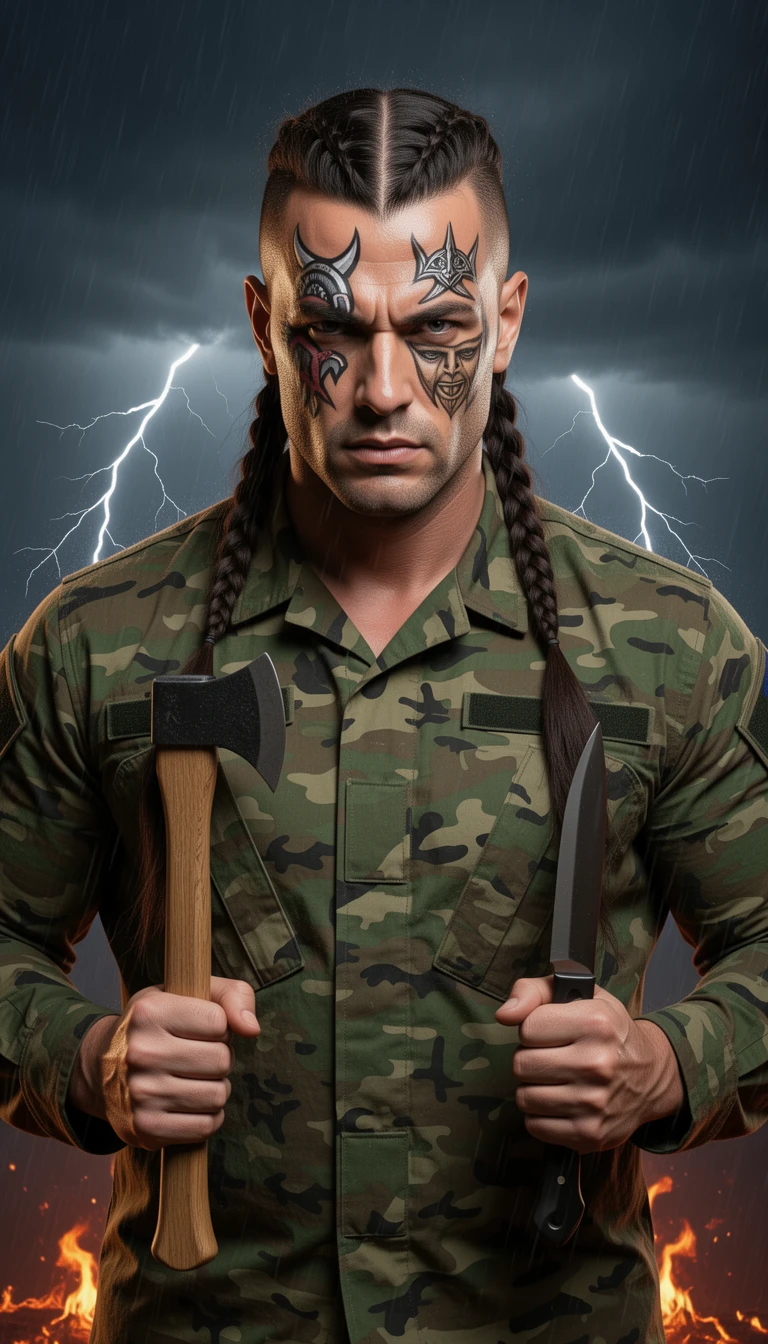
The Loudon County courthouse smelled like every government building Ivan had ever stepped foot in—floor wax and stale coffee, recycled air that had been breathed by too many people making too many bad decisions. Fluorescent lights hummed overhead, casting everything in that flat, unforgiving white that made even the innocent look guilty. He sat in the second row of wooden benches, Sarah's hand in his, her fingers cold against his palm.
The family had taken up an entire section of the courtroom like they were claiming territory. Ivan on the aisle. Sarah beside him, her bubblegum pink eyes fixed forward, jaw tight. Jennifer and Robert next to her, Jennifer's yellow-orange-red-and-black eyes scanning the room with the patience of someone who'd spent years reading threats in empty spaces. Kimberly flanked Jennifer, her orange eyes burning. Michelle sat silent on Ivan's other side, black eyes unreadable, hands folded in her lap like she was in church. Rickey, Jack, Stevenson, and Melissa filled out the row behind them, a wall of painted faces and coiled tension.
Eleanor sat in the front row with Jonas Smith, her gray hair neat, her blue eyes clear. She looked like she was waiting for tea, not dismantling her eldest grandson's last play for power. Jonas—silver-haired, crisp in a charcoal suit that cost more than most cars—sat beside her with a leather briefcase at his feet that looked heavy enough to anchor a boat.
Michael stood at the defendant's table with his lawyer, a man in a cheap blue suit whose tie was too short. Michael's blue eyes were hard, his jaw set, his hands gripping the table like he was trying to strangle it. He hadn't looked at the family once since they walked in. Ivan had watched him try. Watched him fail.
The bailiff stepped forward. Middle-aged man, crew cut, a belly that strained his uniform shirt. He rapped the floor with something—not a gavel, just the flat of his hand against the wood. "All rise for the Honorable Judge Thomas Whitaker."
Ivan stood. The family stood. The scrape of wood against floor filled the room like a wave. Sarah's hand slipped from his as they rose, and he felt the absence like a pulled thread.
The judge entered from a side door—gray robe, gray hair, gray eyes behind wire-rimmed glasses. He moved like a man who'd been doing this for thirty years and had run out of patience somewhere around year twelve. He settled into his chair, arranged his robes, and looked out at the courtroom with the flat assessment of a man who'd seen every angle and wasn't impressed by any of them.
"You may be seated."
The room sat. Wood creaked. Fabric rustled. Someone in the back coughed.
Judge Whitaker shuffled papers, glanced at the docket, then looked up. "This is the matter of the Estate of Eleanor Nightsworn. Challenge to the will filed by Michael Nightsworn." He looked at the defendant's table. "Mr. Nightsworn. You may proceed."
Michael's lawyer stood. His name was Gerald Pines—Ivan had looked him up the night before. Thirty-seven years old, University of Richmond law, seventeen cases contested in probate court. Won twelve. Lost five. The kind of lawyer who wore a wedding ring but no watch, who smiled too much in deposition and not enough in court.
"Your Honor," Pines began, voice smooth, practiced, "we are here today because Eleanor Nightsworn's last will and testament was executed under conditions that raise serious questions about the testator's mental state and the presence of undue influence." He turned, gestured vaguely toward the family section. "Specifically, my client believes that his grandmother was coerced into signing a document that disinherits him unjustly and places control of a multi-trillion-dollar family enterprise into the hands of individuals with clear conflicts of interest."
Ivan didn't move. Didn't blink. His training had taught him that stillness was its own kind of weapon. He watched Pines the way he'd watched targets through a scope—patient, waiting for the twitch that would tell him everything.
"Your Honor, the court should also consider who sits on this proposed board." Pines straightened his tie, the gesture deliberate. "Sarah Douglas. Sister of the current President of the United States, Mark Douglas. A sitting board member with access to classified military contracts, international intelligence briefings, and government trade secrets. This is not a question of competence—it is a question of constitutional separation of powers. No family member of a sitting president should hold a position that provides oversight of multi-billion-dollar defense contracts."
Ivan felt Sarah shift beside him. Not much—just a fraction of an inch. He knew that movement. He'd seen it a hundred times in the field, the moment before she engaged. He reached under the table, found her hand, squeezed once. She didn't squeeze back, but she didn't pull away either.
Judge Morrison turned his gaze toward the family table. "Ms. Douglas. I'd like to hear from you directly."
Sarah stood. She didn't hurry. She didn't adjust her jacket or smooth her hair. She just stood, the courtroom's fluorescent light catching the pink of her eyes, the Viking braids tight against her scalp. Her face paint was muted today—just the ghost of it, a soft charcoal line at her temples where she'd scrubbed most of it off before coming to court. The judge didn't know what to make of her, and she knew it.
"Your Honor," she said, her voice steady, no tremor in it, "I have never once used my brother's position to advantage myself, my career, or any organization I've been part of. Not once. In twenty years of service, not a single ethics complaint, not a single conflict of interest filing, not a single phone call made from the White House on my behalf." She paused, let that sit. "I love this family. I've bled with them. I've buried friends with them. I've spent more nights in the Nightsworn farmhouse than I have in my own apartment. The company isn't a political stepping stone to me. It's family."
Judge Morrison leaned back in his chair, fingers steepled. "And the military contracts? Your brother's administration oversees Department of Defense spending."
"I've already addressed that with the family and with counsel." Sarah's chin lifted. "If I'm seated on the board, I will recuse myself from any vote involving military or government contracts. Period. No input. No vote. No influence. I will not even be in the room for those discussions. The family has a governance structure that's been in place since before my brother was born. That structure doesn't change because of my last name."
Judge Morrison nodded slowly. "I see no legal basis to disqualify Ms. Douglas from board service. The court finds no constitutional conflict. Next argument."
Pines opened his mouth, closed it. The judge's gavel hadn't moved, but the dismissal was already there, written in the set of his shoulders. Ivan watched the lawyer's jaw tighten, the calculation behind his eyes shifting, recalibrating.
Jonas Smith rose from the family's table. He was an old man—seventy-three, Ivan remembered, maybe seventy-four—with silver hair oiled back and a face that had seen too many of these fights to bother with pretense. He wore a charcoal suit that cost more than most cars and moved with the unhurried confidence of a man who'd never lost a case he cared about.
"Your Honor, may I approach?"
The judge waved him forward.
Jonas carried a leather briefcase to the bench. He didn't open it theatrically. He just set it down, undid the latches, and began pulling out documents. Not copies. Originals. Ivan could see the edges of them—yellowed, cracked, some held together with linen tape and prayer.
"Your Honor, the petitioner's counsel would have you believe that this will was executed under duress or undue influence. They have provided zero evidence of that claim. Zero medical evaluations. Zero witness statements. Zero documented history of mental decline. What they have is a grandson who didn't get what he wanted."
"Objection," Pines said, but there was no heat in it.
"Overruled." The judge's eyes hadn't left the documents.
Jonas continued, his voice carrying the weight of someone who'd waited his whole career for this moment. "I have here contracts between the Nightsworn family and the United States Army, Navy, and Marine Corps, dating back to 1775. I have contracts with the United States Coast Guard dating to 1791. The United States Air Force, 1947. I also have military contracts with the British and French governments dating to the 1830s." He paused, letting the pages whisper as he turned them. "And I have royal contracts with the British monarchy and the Vatican, both dating to 1607."
The judge leaned forward, his fingers spreading across the contracts like he was touching something sacred. The fluorescent lights caught the edges of the parchment, yellowed and crackling with age, and Ivan watched the old man's face change — the skepticism melting into something else. Awe, maybe. Or the weight of history pressing down on a Tuesday morning in Loudon County.
The courtroom had gone quiet. Not the kind of quiet that comes before something. The kind that comes after — after the last card hits the table, after the bluff gets called, after everyone realizes the game was rigged from the start. Ivan felt it in his chest, that stillness, and he let his eyes drift across the room.
Michael sat at the plaintiff's table with his shoulders tight, his lawyer half-turned toward the bench with his mouth open, words dying on his tongue. Michael's hands were flat on the table, fingers spread, and Ivan recognized the posture — the way a man holds himself together when he knows he's already lost. There was something almost sad about it. Almost.
Sarah's hand found his under the table. Her fingers slid between his, cold and steady, and she squeezed once. He squeezed back without looking at her. He didn't need to. He could feel her beside him, a solid warmth in the sterile chill of the courthouse, and that was enough.
The judge cleared his throat. "Mr. Pines, I assume you have something to say about these documents?"
Mr. Pines stood slowly, adjusting his tie like he was buying time. His face had gone a shade paler, the confidence bleeding out of him in thin, invisible increments. "Your Honor, these documents — even if authentic — do not address the core issue. The testator, Eleanor Nightsworn, was unduly influenced by her grandchildren. Specifically, by Ivan Nightsworn and his siblings, who have a documented history of coercive behavior. Furthermore, the inclusion of Sarah Douglas on the board raises serious questions of political influence, given that her brother is the sitting President of the United States."
Ivan felt the words land like stones in still water. He kept his face neutral — years of training made that automatic — but his jaw tightened. *Coercive behavior.* That was rich. Michael had spent forty-four years taking whatever he wanted, and now he was the one crying foul.
Eleanor sat perfectly still in the row ahead of him. Her gray hair was neat, her hands folded in her lap, her blue eyes fixed on the judge like she was the only person in the room who mattered. She didn't flinch at Michael's lawyer's words. Didn't react. Just sat there, bedrock and bone, the same woman who'd raised him through every war and every wound.
The judge turned to Sarah. "Ms. Douglas, would you care to respond?"
Sarah rose. She didn't hurry. She didn't fidget. She stood with the same economy of motion Ivan had watched her use on a hundred ranges and a thousand operations — no wasted energy, no visible nerves. Her pink eyes were clear, her voice steady when she spoke.
"Your Honor, I've spent twenty years in this family. Not as a politician's sister. As a soldier. As a friend. As someone who's bled beside these people and watched them bleed for me." She paused, letting that land. "I would never use my brother's position for personal gain. Neither would he offer it. We govern ourselves. When it comes to military contracts — and this family has many — I will recuse myself from any vote that touches them. But on every other matter, I will vote my conscience, the same way I've lived my entire adult life."
Her voice didn't waver. It was the same voice Ivan had heard in the dark of a safe house in Istanbul, talking him down from a kill he didn't need to make. The same voice that had whispered his name four nights ago in his apartment, raw and honest and afraid. She sat down, and the silence that followed was the kind that meant something.
The judge nodded. "I see no issue with that. Ms. Douglas has clearly stated her boundaries and her intentions. The court accepts her position."
Michael's lawyer opened his mouth, but the judge held up a hand. "I wasn't finished, Mr. Pines." The lawyer closed his mouth. The judge turned to Jonas Smith. "Counselor, your documents?"
Jonas Smith rose, an older man in a tailored suit with silver hair and the kind of calm that came from winning more cases than he'd lost. He picked up a stack of bound documents and held them out like a priest offering scripture. "Your Honor, I have here contracts between the Nightsworn family and the United States military dating back to 1775 — the Army, Navy, and Marine Corps. I also have the family's contract with the Coast Guard, signed in 1791. The Air Force contract, signed in 1947. And military contracts with the British and French governments dating back to the 1830s."
He set each document on the clerk's desk as he named it, the stack growing thicker with every sentence. The judge leaned forward, reading the coversheets with visible interest.
"I also hold," Jonas continued, pulling out two more bound volumes, "royal contracts with the British Crown and the Vatican, both dating to 1607. These contracts predate the United States Constitution. They predate the founding of this nation itself. And they are still in full force."
The judge took the documents, flipping through them slowly. The courtroom was silent except for the rustle of paper. Ivan watched Michael's lawyer, saw the calculation happening behind his eyes, the desperate search for an angle that wasn't there.
"Your Honor," Mr. Pines said, recovering, "constitutionally, the contracts with the Vatican and the British royal family should be voided. The Constitution is the supreme law of the land. No foreign contract — regardless of its age — can supersede it."
The judge looked up from the documents. His eyes were sharp, patient, the eyes of a man who'd heard every argument twice. "Mr. Pines, that's where you're wrong. These contracts predate the Constitution. They predate the United States as a sovereign nation. Under established legal precedent, pre-existing international agreements are honored as long as they don't conflict with domestic law. And nothing in these contracts conflicts with American law. They simply establish a business relationship."
Michael's lawyer straightened his tie, the gesture mechanical, a man trying to buy time his argument didn't have. "Your Honor, with respect—the Constitution is the supreme law of the land. No contract, regardless of its age, can supersede it. These documents may be historically interesting, but they have no legal standing against the foundational framework of this nation."
Ivan watched the judge's face. There it was—the slight tightening around the eyes, the almost invisible shift in posture that meant the patience was thinning. Whitaker had been on the bench long enough to know when a lawyer was repeating himself, hoping volume would substitute for substance.
"Mr. Pines, I'm going to ask you a question, and I want you to think carefully before you answer." The judge leaned forward, his elbows resting on the bench, his fingers interlaced. "Every president since George Washington has honored these contracts. Every. Single. One. That includes the men whose faces are on the currency, the men who wrote the very documents you're citing, the men who fought and died to establish this nation. Are you telling me they were all wrong?"
The silence in the courtroom was absolute. Ivan heard the hum of the fluorescent lights above, the distant tick of a clock somewhere down the hall, the soft exhale of air through the vents. He heard his own heartbeat, steady and slow, a sniper's rhythm.
"I'm not—" Pines started.
"Because if you are," the judge continued, cutting him off without raising his voice, "you're going to need more than a law degree and a good suit to prove it. These contracts predate the United States. They predate the Constitution. They were signed when this land was still a collection of British colonies, and they have been honored continuously for over four hundred years. Under established legal precedent—the same precedent this nation has followed since its founding—pre-existing international agreements are honored as long as they don't conflict with domestic law. And nothing in these contracts conflicts with American law."
He paused, letting that sink in. The fluorescent light caught the edges of the documents on his bench, the yellowed parchment looking almost sacred in the sterile air.
"They simply establish a business relationship. A business relationship that has been renewed and reaffirmed by every administration since the first. So I'll ask you again, Mr. Pines—what is your problem?"
Ivan felt Sarah's hand tighten around his. He didn't look at her. He didn't need to. He could feel the tension in her fingers, the small victory singing through her bloodstream. Twenty years of watching Michael take whatever he wanted, and now—finally—someone was saying no.
Pines stood frozen for a long moment. His mouth opened, closed, opened again. The words weren't coming. Ivan had seen that look before, on a hundred ranges and a thousand operations—the moment when a man realizes he's out of options, out of time, out of luck. The calculation behind the eyes, searching for an angle that wasn't there.
Pines's hand found the edge of the table, gripping it like a lifeline. The fluorescent lights hummed overhead, filling the silence that stretched between the judge's question and whatever answer the lawyer could scrape together. Ivan watched the man's throat move as he swallowed, watched the sweat bead at his hairline despite the courthouse's chill.
Pines's throat worked. He was a good lawyer—Ivan could see that, could see the gears turning behind his eyes, searching for a way to salvage something from the wreckage. But there was nothing. The judge had already handed down the ruling, and the only thing left was the accepting of it.
"Your Honor," Pines said, his voice thinner than it had been at the start, "I—I need a moment to consult with my client."
The judge waved a hand. "Take your moment."
Pines turned to Michael, and Ivan watched the two of them lean together, voices low, shoulders tight. Michael's face had gone a deep, mottled red, the kind of red that came from somewhere deep—humiliation, rage, the slow burn of watching something slip through fingers that had always been able to hold onto anything they wanted. His blue eyes were fixed on the table in front of him, his jaw working like he was chewing glass.
Ivan let his gaze drift across the courtroom. Jack sat three rows back, his blue eyes flat and unreadable, his arms crossed over his chest. Stevenson was beside him, dark hair pulled back, black eyes tracking the scene with the patience of a man who'd spent years learning to wait. Wolf leaned forward slightly, his hand resting on the bench beside him, fingers drumming a slow, arrhythmic beat against the wood.
Melissa sat next to Stevenson, her mismatched eyes fixed on Michael's back. There was no triumph in her face. No satisfaction. Just the flat, watchful stillness of a woman who'd seen too many fights to celebrate one that wasn't over yet. Her short mohawk caught the fluorescent light, the shaved sides gleaming, and Ivan caught the slight tension in her jaw—the only tell that she was feeling anything at all.
Kimberly, Michelle, and Jennifer sat in the row behind Eleanor. Kimberly's orange eyes were locked on Michael, her face unreadable. Michelle sat with her hands folded in her lap, her black eyes fixed on some point in the middle distance, her body completely still. Jennifer's yellow-orange-red-black eyes were flickering, catching the light, and Ivan saw her hand resting on Robert's knee beside her. Robert sat rigid, his hazel eyes fixed on the scene in front of him, his face a careful mask of neutrality.
Rickey sat at the far end of the row, his blood-red and midnight-black eyes fixed on Michael with an expression that might have been pity. Might have been. Hard to tell with Rickey.
Pines straightened, turning back to the bench. "Your Honor, my client wishes to withdraw the challenge."
The words landed like a stone in still water. Ivan heard the ripple pass through the courtroom—the bailiff shifting his weight, the clerk's pen pausing, the rustle of fabric as someone in the gallery leaned forward.
Michael didn't look up. His hands were flat on the table, fingers spread, his shoulders rounded forward. He looked smaller than Ivan had ever seen him. Not defeated, exactly. Something worse. Something that had curled in on itself and gone quiet.
Eleanor's hand found Ivan's shoulder. He turned, looked up at her, and saw the barest hint of something in her blue eyes. Not triumph. Relief, maybe. Or the quiet satisfaction of a woman who had spent eighty years learning that patience was the sharpest weapon she carried.
"Are you sure, Mr. Pines?" the judge asked, his voice carrying a weight that made the question feel less like a request and more like an opportunity.
Pines didn't look at Michael. He didn't need to. "Yes, Your Honor. My client withdraws the challenge. We accept the will as written."
The judge nodded slowly, his eyes moving from Pines to Michael, then to Eleanor, then to Ivan. He seemed to be taking the measure of the room, reading the invisible lines that connected every person in it. "Very well. The court accepts the withdrawal. The will of Eleanor Nightsworn is upheld in its entirety. This case is dismissed."
The gavel came down. The sound was sharp, final, a door closing on something that had been open for twenty years.
Ivan let out a breath he hadn't realized he was holding. Beside him, Sarah's hand relaxed in his, her fingers loosening their grip. He turned to look at her, and she was already looking back at him, her bubblegum-pink eyes soft, the tension bleeding out of her shoulders.
"It's over," she said. Not a question. A statement. Like she needed to hear it out loud to believe it.
"It's over," he repeated. And he meant it.
Eleanor rose from her seat, her movements slow and deliberate, the way she'd done everything for the last eighty years. She turned, her blue eyes finding Ivan's, and there was something in them that he hadn't seen in a long time. Something warm. Something almost like pride.
"Let's go home," she said. Her voice was steady, the same voice that had told him to stand up straight when he was six, the same voice that had held him together when he was twenty and shattered. "We have work to do."
The family rose as one, a movement that was almost choreographed, almost military, the way they'd learned to move together across a hundred battlefields and a thousand family dinners. Jack and Stevenson fell in behind Eleanor, flanking her like the bodyguards they'd once been. Melissa and Robert moved to either side of Jennifer, their hands brushing hers as they passed.
Kimberly caught Ivan's eye as she stood, her orange eyes holding his for a long moment. She didn't say anything. She didn't need to. The look was enough—a shared understanding, a recognition that something important had just happened, something that would ripple outward for years to come.
The Supreme Court chamber was a cathedral of silence and mahogany, nine black-robed figures seated behind a bench that had witnessed two centuries of American history. The air was thick with the weight of precedent, the kind of gravity that settled into bones and stayed there. Ivan stood behind the family's table, his gray and silver eyes tracking the room with the patience of a sniper who'd learned to read spaces before they read him.
Jonas Smith stood at the family's table, a stack of documents arranged in front of him with the precision of a man who knew exactly what he was holding. He was in his seventies, silver-haired and sharp-eyed, the kind of lawyer who'd spent forty years learning that the truth was simpler than any argument you could build around it. His hands rested on the table, still and patient, as Michael's lawyer—Mr. Pines—stepped forward to address the bench.
Pines was a good lawyer. Ivan could see that. The cut of his suit, the angle of his jaw, the way he positioned himself exactly in the center of the floor—he'd done this before, many times, in many rooms. But this wasn't a room he'd ever been in. And the weight of nine justices staring down at him was a weight that no suit could deflect.
"Your Honors," Pines began, his voice carrying the practiced confidence of a man who'd learned to project certainty even when he didn't feel it, "we are here today to challenge the validity of Eleanor Nightsworn's will on the grounds that she was not of sound mind when it was executed."
Ivan felt Sarah's hand find his under the table. Her fingers were cold, steady, the same hand that had pulled a trigger beside him on a dozen continents. He didn't look at her. He kept his eyes on the bench, on the Chief Justice—a woman in her sixties with steel-gray hair and eyes that had seen every kind of argument, every kind of lie, every kind of truth.
"My client, Michael Nightsworn, believes that his grandmother was unduly influenced by certain members of the family," Pines continued, his voice smooth, practiced. "That her advanced age and declining health made her susceptible to manipulation. That the will she signed does not reflect her true wishes, but rather the wishes of those who stood to benefit from it."
The Chief Justice's eyes flickered to Jonas Smith. "Mr. Smith. Your response."
Jonas rose slowly, deliberately, the way a man rises when he knows he doesn't need to hurry. He picked up a stack of documents and held them up, letting the weight of them speak before he did.
"Your Honors, I have here medical evaluations from three separate physicians, all conducted within the month before Eleanor Nightsworn executed her will." His voice was steady, unhurried, the voice of a man who'd spent forty years learning that the truth didn't need embellishment. "Each evaluation confirms that Mrs. Nightsworn was of sound mind, fully competent, and acting of her own free will. I also have sworn affidavits from two independent witnesses who were present when the will was signed, both of whom confirm that Mrs. Nightsworn understood the document she was signing and expressed no hesitation or confusion."
He set the documents down and picked up another stack. "Additionally, I have a video recording of Mrs. Nightsworn discussing the contents of her will with her attorney, recorded three days before execution. In the recording, she demonstrates a clear understanding of her assets, her family relationships, and the reasoning behind each bequest."
Pines's jaw tightened. Ivan watched the man's throat move as he swallowed, watched the calculation behind his eyes shift, searching for an angle that wasn't there.
The Chief Justice turned to Pines. "Mr. Pines, do you have any evidence to contradict these evaluations? Any independent medical opinion, any witness testimony, any documentation that suggests Mrs. Nightsworn was under duress or suffering from diminished capacity?"
Pines stood at the podium, his hands gripping the edges like a man trying to keep himself upright in a storm. The fluorescent lights of the Supreme Court chamber caught the sweat on his forehead, and Ivan watched the lawyer's throat work as he searched for something—anything—that might salvage the case he'd built on sand.
"Your Honor," Pines said, his voice thinner now, carrying a strain that hadn't been there an hour ago, "the petitioner would also note that the board of the Nightsworn company includes Sarah Douglas—the sister of the President of the United States. This represents a fundamental conflict of interest that should invalidate the will's provisions regarding board composition."
Ivan felt the air shift in the chamber. Beside him, Sarah's hand tightened on his, her fingers cold despite the warmth of the room. He didn't look at her. He kept his gray and silver eyes fixed on the bench, watching the Chief Justice's expression shift from judicial neutrality to something sharper, more attentive.
The Chief Justice leaned forward slightly, his robes rustling with the movement. "Mr. Pines, are you alleging that the President of the United States has exerted improper influence over this matter?"
"No, Your Honor." Pines straightened, adjusting his tie, finding his footing again. "I'm alleging that the mere presence of the President's sister on a privately held company's board creates an appearance of impropriety that undermines public confidence in the integrity of both the company and the office of the presidency. It's a matter of perception, not action. The perception alone is damaging enough to warrant the board's reconstitution."
The Chief Justice's eyes moved from Pines to Sarah, then back again. His face betrayed nothing — decades on the bench had carved his features into something almost granite, unreadable and patient. "Ms. Douglas, would you care to respond?"
Ivan felt Sarah's fingers tighten around his once more, a brief squeeze before she let go. She stood slowly, deliberately, the way she'd stood before a hundred commanding officers and a thousand mission briefings. The chamber's fluorescent light caught the braids in her hair, the shaved sides gleaming, and Ivan watched her shoulders settle into that particular stillness he'd seen on a rooftop in Fallujah, in a safe house in Damascus, in the back of a cargo plane somewhere over the Atlantic at three in the morning. The stillness of a woman who had made peace with whatever came next.
"Your Honor," Sarah said, and her voice carried through the chamber like a blade — clean, sharp, unafraid. "I've spent twenty years in this family. Not as a politician's sister. As a soldier. As a friend. As someone who's bled beside these people and watched them bleed for me."
She paused, letting that land. Ivan watched Pines shift his weight, watched Michael's jaw tighten, watched the justices lean forward almost imperceptibly, pulled into her gravity.
"I would never use my brother's position for personal gain," Sarah continued. "Neither would he offer it. We govern ourselves. When it comes to military contracts — and this family has many — I will recuse myself from any vote that touches them. But on every other matter, I will vote my conscience, the same way I've lived my entire adult life."
Another pause. She turned slightly, not enough to face the gallery, but enough that Ivan could see the profile of her face, the hard line of her jaw, the way her bubblegum-pink eyes had gone flat and focused.
"If I'm seated on the board, I will recuse myself from any vote involving military or government contracts. Period. No input. No vote. No influence. I will not even be in the room for those discussions. The family has a governance structure that's been in place since before my brother was born. That structure doesn't change because of my last name."
She let that sit. The chamber was silent except for the hum of the lights and the distant shuffle of papers from a clerk's desk. Ivan watched the justices exchange glances — quick, almost imperceptible, the kind of communication that happened in the space between breaths.
"I have never once used my brother's position to advantage myself, my career, or any organization I've been part of," Sarah said, and her voice dropped slightly, carrying a weight that made the words feel like testimony. "Not once. In twenty years of service, not a single ethics complaint. Not a single conflict of interest filing. Not a single phone call made from the White House on my behalf."
She paused again, longer this time, and Ivan saw her throat move as she swallowed. When she spoke again, her voice was quieter, but somehow it carried further.
"I love this family. I've bled with them. I've buried friends with them. I've spent more nights in the Nightsworn farmhouse than I have in my own apartment. The company isn't a political stepping stone to me. It's family."
She stood there for a long moment, letting the silence do its work, then turned and sat back down. Her hand found Ivan's again under the table, her fingers cold but steady, and he squeezed once, a silent acknowledgment of what she'd just done.
The Chief Justice's eyes lingered on Sarah for a moment longer, then swept across the bench, gathering the silent consensus of his colleagues. When he spoke, his voice carried the weight of finality.
"Mr. Pines, we rule nine to zero against you on that argument. The court finds no credible evidence of impropriety, no conflict of interest that cannot be adequately managed through the recusal procedures Ms. Douglas has described, and no basis for disturbing the will's provisions regarding board composition. This argument is dismissed."
Ivan watched Pines's shoulders drop — a fraction of an inch, barely visible, but there. The man was running out of ammunition, and he knew it. Ivan could see it in the way his hands found the edge of the table again, the way his eyes flickered across the bench, searching for an angle that wasn't there.
Pines took a breath, straightened his spine, and tried again. "Your Honor, the petitioner also contests the validity of the contracts held by the Nightsworn company with the British royal family and the Vatican. These contracts represent a significant portion of the company's value, and we argue that they are unconstitutional — that no private entity should hold binding agreements with foreign sovereigns that predate the United States itself."
Jonas Smith rose before Pines had finished speaking, his movements unhurried, almost leisurely. The old man's hands were steady as he lifted a stack of bound documents from the table, the pages yellowed and cracked at the edges, some of them held together with nothing more than gravity and the faded string that bound them.
"Your Honor," Jonas said, his voice carrying the easy authority of a man who had been doing this since before most of the justices had passed the bar, "I have here the original contracts between the Nightsworn family and the Vatican, signed in 1607. I also have the contracts with the British royal family, signed the same year. These documents have been attested to by every monarch and every pope since that date. They have been honored continuously — without interruption — for over four hundred years."
He held up the documents, letting the justices see the seals, the faded signatures, the careful calligraphy that had been inked onto parchment centuries before the first stone of the Capitol was laid.
"The United States government," Jonas continued, "has recognized and honored these contracts since 1791, when the first Treasury Department review affirmed their validity. Every administration since has done the same. The contracts predate the Constitution. They predate the Declaration of Independence. They predate the United States as a nation." He paused, letting that land. "So I ask Mr. Pines — what exactly is his problem with them?"
The Chief Justice turned to Pines, his eyebrows raised slightly. "Mr. Pines? The court would like to hear your answer."
Pines opened his mouth. Closed it. Opened it again. The words weren't coming. Ivan watched the lawyer's face cycle through a dozen expressions in the space of a heartbeat — frustration, anger, calculation, defeat — before settling on something that looked almost like resignation.
"Your Honor," Pines said, his voice thinner than it had been at the start, "I — I need a moment to consult with my client."
The Chief Justice waved a hand. "Take all the time you need, Mr. Pines. But I will tell you now — this court finds no constitutional violation in contracts that have been lawfully and continuously honored for over four centuries. The argument is without merit. We rule nine to zero against you on this matter as well."
The gavel came down, and the sound was sharp, final, a door closing on something that had been open for twenty years.
The sound of the gavel hung in the air, vibrating through the marble walls, through the polished wood of the benches, through the bones of everyone in that room. Ivan felt it settle into his chest like a stone dropping into still water, the ripples spreading outward, slow and inevitable.
Michael didn't move. His hands were still flat on the table in front of him, fingers spread, shoulders rounded forward. His blue eyes were fixed on some point in the middle distance, unblinking, the way a man stares at something he's just realized he'll never touch again. His lawyer, Pines, stood beside him with his hands at his sides, his briefcase still open, papers scattered across the table like the aftermath of a small explosion.
Ivan watched his brother's throat move as he swallowed. Watched the way his jaw tightened, released, tightened again. Twenty years of watching Michael take whatever he wanted, twenty years of watching him maneuver and manipulate and always, always land on his feet. And now — now he was sitting in the Supreme Court of the United States, having lost everything, having been told by nine justices that he had no case, no claim, no angle left to play.
Sarah's hand found Ivan's under the bench. Her fingers were cold, trembling slightly, and when he looked at her, he saw the tears gathering in her bubblegum-pink eyes. Not spilling over. Just there, catching the light, a quiet testament to everything she'd just put on the line for his family.
"You did that," he said, his voice low enough that only she could hear. "You stood up there and you answered every question they had. You didn't flinch."
She shook her head, a small, almost imperceptible movement. "I told the truth. That's all."
"The truth," he repeated, and he felt something shift in his chest — something that had been knotted tight for twenty years, something that had wrapped itself around his ribs and squeezed every time he thought about what he felt for her. "The truth was enough."
Eleanor rose from her seat, her movements slow and deliberate, the way an old woman rises when she's learned that haste is a luxury she can no longer afford. But her blue eyes were sharp, sharp as they'd ever been, cutting through the stale air of the courtroom like a blade. She turned, looked at Ivan, and there was something in her face that he hadn't seen in years. Not relief. Not triumph. Something quieter. Something that looked almost like peace.
"Jonas," she said, her voice carrying across the room without effort, without strain, the voice of a woman who had spent eighty years learning exactly how much force to put behind every word she spoke. "Thank you."
Jonas Smith stood from the family's table, a thin man in an impeccable suit, his salt-and-pepper hair precisely combed, his wire-rimmed glasses catching the fluorescent light. He nodded once, a small, formal gesture that somehow conveyed more respect than a bow. "It was my honor, Eleanor. Your documents were thorough. Your wishes were clear. The court simply recognized what was already written."
He turned to look at Michael, and something flickered behind his glasses — not pity, not satisfaction, but the flat assessment of a man who had seen too many challenges fail to be surprised by one more. "Mr. Nightsworn. I would advise you not to pursue this further. The court has ruled. The will is settled. Any additional challenge would be considered frivolous and could result in sanctions."
Michael's head came up slowly, his blue eyes finding Jonas's face with an expression that made Ivan's hand tighten on Sarah's. It wasn't rage. It wasn't defeat. It was something hollow, something that had been scooped out and left empty, a shell of a man staring at the lawyer who had just dismantled everything he'd spent two decades building.
"I heard the ruling," Michael said, his voice flat, empty, the voice of a man who had run out of things to feel. "I'm not stupid."
"No one said you were," Jonas replied, his voice carrying no edge, no judgment. "But you pushed this to the highest court in the land, and the highest court in the land has spoken. Let it go, Michael. For your own sake. Let it go."
The silence that followed was the kind of silence that has weight, the kind that presses down on the chest and makes it hard to breathe. Ivan watched his brother's face cycle through a dozen emotions in the span of three heartbeats — anger, shame, grief, something that looked almost like acceptance, then nothing at all. The mask came down, smooth and practiced, the way Michael had always been able to hide whatever was really going on behind those blue eyes.
Michael stood. Slow. Deliberate. He gathered his papers without looking at them, sliding them into his briefcase with the mechanical precision of a man who had done this a thousand times. When he closed the latches, the clicks were loud in the silent courtroom, sharp and final, like the last two rounds being chambered in a gun that had already been emptied.
He looked at Ivan. Just looked. And Ivan saw something in his brother's eyes that he couldn't quite name — not hate, not defeat, not the cold calculation Michael had worn like a second skin for as long as Ivan could remember. It was something naked. Something raw. Something that looked almost like a question.
Ivan didn't look away. He held his brother's gaze, steady, the way he'd held a thousand sight pictures across ten thousand yards of battlefield. He didn't speak. He didn't need to. The look was enough — a recognition that something had changed, that the lines had been drawn and crossed, that there was no going back to whatever they'd been before.
Michael looked away first.
He turned, walked toward the exit, his footsteps echoing against the marble floor. Pines followed a half-step behind, his briefcase clutched to his chest, his face carrying the pinched expression of a man who had just lost a case he'd been certain he would win. The doors opened, the light from the hallway flooding in, and then they were gone, the doors swinging shut behind them with a soft, hydraulic hiss.
The courtroom was quiet. The Chief Justice had already left the bench, his black robes disappearing through a side door, the other justices following in a silent procession. The clerk was gathering documents, the bailiff adjusting his stance, the small machinery of the court grinding back into motion after the interruption of a case that had consumed the attention of everyone in the room.
Jack stood first, his blue eyes finding Ivan's across the rows of benches. He didn't say anything. He didn't need to. He just nodded, once, the way soldiers nod when a mission is over and everyone is still standing. Stevenson rose beside him, his black eyes flat, his long braids catching the light, his face carrying the quiet satisfaction of a man who had watched an enemy walk into a trap and never seen it coming.
Wolf unfolded himself from the bench, his movement fluid, unhurried, the movement of a man who had never needed to rush. He looked at Michael's empty table, then at Ivan, and something flickered behind his dark eyes — something almost like pity, but not quite. "He'll come back at us," Wolf said, his voice low, carrying only to the family. "Maybe not in court. But he'll come back."
"I know," Ivan said. And he did. Michael had never been the kind of man who accepted defeat gracefully. The court had closed one door, but there were a thousand others, and Michael had spent twenty years learning how to open every single one of them.
"Then we'll be ready," Kimberly said, her voice cutting through the quiet, her orange eyes fixed on the doors where Michael had disappeared. She stood, her movements precise, controlled, the way she moved through every room she entered. "We've been ready for twenty years. Another twenty won't change anything."
Michelle rose beside her, her black eyes unreadable, her face a careful mask of neutrality. She didn't speak. She didn't need to. The set of her shoulders, the way she stood — close to Kimberly, close to the family, her body angled toward the door — said everything that needed to be said.
Jennifer stood next, her yellow-orange-red-black eyes flickering as she looked around the courtroom, taking in every detail, every exit, every face. Robert rose beside her, his hazel eyes scanning the room with the same practiced attention, the same quiet vigilance. They had both spent too many years in combat zones to let their guard down just because the court had ruled in their favor.
Melissa stood last, her mismatched eyes — ocean blue and emerald green — fixed on the empty door where Michael had exited. Her short mohawk caught the light, the shaved sides gleaming, and Ivan caught the slight tension in her jaw, the only tell that she was feeling anything at all. "He'll try something," she said, her voice flat, matter-of-fact. "He's not the type to go quietly."
"No," Eleanor said, and her voice carried across the room, drawing every eye to her. She stood at the head of the family, her gray hair catching the fluorescent light, her blue eyes holding a warmth that Ivan hadn't seen in years. "He's not the type to go quietly. But he's also not the type to win a fair fight. And we've just proven that we can beat him at his own game."
She paused, her eyes moving across each face in the family — Ivan, Sarah, Kimberly, Michelle, Rickey, Jennifer, Jack, Stevenson, Wolf, Melissa, Robert. She looked at each of them the way a general looks at soldiers before a battle, the way a grandmother looks at grandchildren before a holiday dinner, the way a woman who has lived eighty years looks at the legacy she's about to leave behind.
"We have six months," she said, her voice steady, sure, the voice that had held this family together through every storm it had ever weathered. "Six months to prepare. Six months to build. Six months to make sure that everything I've spent my life creating doesn't crumble the moment I'm gone."
She looked at Ivan, and something passed between them — something that had been building for thirty-seven years, something that had started when he was a boy learning to stand on his own two feet and had grown into something unbreakable, something that would outlast marble and steel and the memory of every enemy they'd ever faced.
"Let's go home," she said. "We have work to do."
The family moved as one, a unit that had been forged across decades of combat and conversation, of blood and laughter and grief and joy. They filed out of the courtroom in a loose formation, the kind of formation that looked casual to anyone watching but was actually precise, rehearsed, the way people move when they've learned to cover each other without being told.
Ivan took Sarah's hand as they walked, feeling her fingers thread through his, feeling the warmth of her palm against his. She looked at him, her bubblegum-pink eyes soft, the tears still gathered but not yet fallen, and she smiled — a real smile, the kind that reached her eyes and made her face younger, lighter, freer than he'd seen her in years.
"We did it," she said, her voice barely above a whisper, as if saying it too loud might make it untrue.
"We did it," he repeated, and he felt the truth of it settle into his bones, into the spaces that had been hollow for so long he'd forgotten they were there. "Now we build."
They stepped through the doors of the Supreme Court, out into the cold Virginia air, the winter sunlight cutting through the bare branches of the trees that lined the plaza. The marble steps stretched before them, wide and white and immaculate, and beyond them, the city hummed with the noise of a million lives being lived, a million stories being written, a million battles being fought and won and lost.
Ivan looked up at the sky — gray and heavy, the kind of sky that carried the promise of snow — and he felt something settle in his chest. Not peace. Not victory. Something harder. Something sharper. Something that felt like the beginning of something he couldn't yet name.
Eleanor stood at the bottom of the steps, her hand resting on Rickey's arm, her blue eyes fixed on the family gathering around her. She looked at them — all of them, every face, every scar, every story — and she smiled. Not the smile of a woman who had won. The smile of a woman who had built something that would last.
"Let's go," she said, and her voice carried across the plaza, steady as bedrock, warm as hearthfire. "We've got a farm to run. A company to lead. And a family to hold together."
She turned, and the family turned with her, a single organism moving in a single direction, a tribe that had just won its first battle in a war that was only beginning.
Behind them, the Supreme Court stood silent and gray, its columns rising toward the winter sky, its doors closed on a case that would be remembered for years to come. The ruling was carved into the record now, unshakeable, final, a stone that could not be moved by any force Michael could muster.
But Michael wasn't the only threat. He wasn't even the biggest threat. And as Ivan walked down the marble steps, Sarah's hand in his, the cold air biting at his cheeks, he felt the weight of everything that was coming — not as a burden, but as a promise.
They were the Nightsworn family. They had survived wars and assassins and the slow decay of time itself. They had built an empire from nothing, held it together through decades of chaos, and passed it down through generations of hands that had never let go.
And they weren't done yet.
The cars were waiting at the curb, black and sleek, the engines idling in the cold air. Doors opened. Family filed in. The convoy pulled away from the curb, merging into the flow of Washington traffic, carrying the Nightsworn family away from the courtroom and toward the farm, toward the work, toward the future that Eleanor had spent eighty years building.
Ivan watched the Supreme Court shrink in the rearview mirror, its marble facade growing smaller and smaller until it was just a white blur against the gray sky. He watched until it disappeared entirely, swallowed by the city, by the distance, by the forward motion of a family that had never learned how to look back.
Beside him, Sarah leaned her head against his shoulder, her breath warm against his neck. He felt her relax, felt the tension drain out of her muscles, felt the weight of her trust settling against him like something precious and fragile and infinitely worth protecting.
"I love you," she said, her voice soft, almost lost in the hum of the engine and the rush of traffic.
Ivan looked down at her, at the curve of her cheek, the sweep of her lashes, the way the winter light caught the edges of her braids. He thought about everything they'd been through — the years of silence, the years of wanting, the years of pretending that what they felt was just friendship, just loyalty, just the bond of soldiers who had bled together.
He thought about how wrong they'd been. And how right it felt to finally stop pretending.
"I love you too," he said, and the words felt like a door opening, like a future unfolding, like a promise that would carry them through whatever came next.
The convoy drove on, carrying the Nightsworn family home.
The convoy drove on, carrying the Nightsworn family home.
Ivan watched the Virginia countryside roll past the window — bare trees and frozen fields, the winter sky hanging low and gray like a promise he couldn't quite read. The highway stretched ahead, empty this far out from the city, and the hum of the tires against the asphalt was the only sound in the cabin. Sarah's hand was still in his, her fingers warm against his palm, and he felt the weight of her head against his shoulder, felt the slow rhythm of her breathing as she let herself rest.
He should have felt victory. Should have felt the clean burn of a battle won, the satisfaction of watching Michael's case crumble under the weight of a contract that couldn't be broken. The British judge had dismissed it in minutes. The Roman judge hadn't even let Michael's lawyer finish his opening statement before ruling against him. Two courts, two dismissals, two doors slammed in Michael's face.
But Ivan didn't feel victory.
He felt the quiet before something broke.
"You're thinking too loud," Sarah said, her voice soft, muffled against his shoulder. She didn't open her eyes. Just shifted, her fingers tightening around his. "I can hear you grinding your teeth from here."
Ivan let out a breath, forced his jaw to relax. "Just running through it."
"Through what?"
"The cases. The judges. The way Michael walked out of that courtroom." He paused, watching a farmhouse blur past, its windows dark, its chimney smoking. "He didn't look defeated. He looked like he was waiting for something."
Sarah opened her eyes, lifted her head, looked at him with those bubblegum-pink irises that had always seen through him. "Waiting for what?"
"I don't know. That's what bothers me."
She studied him for a long moment, her face unreadable, and then she reached up and touched his jaw, her thumb tracing the line of his cheekbone where the Viking paint met skin. "You've been waiting for the other shoe to drop your whole life, Ivan. That's not strategy. That's reflex."
"Maybe." He turned his head, caught her hand, pressed a kiss to her palm. "But reflexes keep you alive."
In the front seat, Rickey glanced back at them, his blood-red eye catching the light as he turned. "We're about twenty minutes out. Eleanor called ahead — kitchen's already firing up. Said she wanted everyone together for a meal before we start planning the next move."
"Planning?" Jack King's voice came from the SUV behind them, crackling through the intercom. "We just won. What's there to plan?"
"Michael," Rickey said, his voice flat. "He's not done. You saw his face when the Roman judge ruled against him. That wasn't surrender. That was a man recalculating."
Ivan felt the weight of those words settle into the cabin. He looked out the window again, watched the trees thicken as they approached the property line, the familiar turnoff that led to the farm. The gates were already open, the long gravel driveway stretching ahead like a thread pulling them home.
And somewhere behind them, in the rooms of courts that had already closed their doors on him, Michael was still standing. Still thinking. Still planning.
Ivan didn't know what came next. But he knew it wasn't over.
The convoy pulled through the gates, the gravel crunching under the tires as the cars lined up in front of the farmhouse. The building stood warm and solid against the gray sky, smoke rising from the chimney, light spilling from the kitchen windows. The smell of woodsmoke and earth hit Ivan as he stepped out of the car, the cold air biting at his cheeks, and he stood there for a moment, just breathing.
Home.
The word felt strange in his chest. Not because it wasn't true — it was, had always been, would always be. But because he'd spent so many years thinking of this place as something he visited, something he returned to between deployments, between missions, between the long stretches of silence that had defined his life before Sarah. Before the confession. Before everything shifted.
Sarah stepped out beside him, her boots crunching on the gravel, and she didn't say anything. Just stood close, her shoulder brushing his, her breath curling in the cold air. She didn't need to speak. The weight of her presence was enough.
The others filed out of the cars — Kimberly and Wolf, Michelle and Jack, Jennifer and Robert, Rickey and Melissa. They moved with the quiet efficiency of people who had spent their lives in formation, their bodies naturally orienting toward each other as they gathered in front of the farmhouse.
Eleanor stood at the top of the porch steps, her gray hair catching the light, her blue eyes warm as she watched them. She had changed out of the suit she'd worn to court, had pulled on a thick wool sweater and jeans, and she looked smaller somehow, softer, like the fight had taken something out of her that she was letting herself feel now that it was over.
"Come inside," she said, her voice carrying across the yard. "Soup's on. Bread's fresh. And there's whiskey if anyone needs it."
A low murmur of assent rippled through the group, and they moved up the steps one by one, each of them touching Eleanor's shoulder or arm as they passed, a silent acknowledgment of what she'd done, what she'd held together, what she'd won for them.
Ivan was the last up the steps. He stopped in front of her, looked into her blue eyes, and saw something there that he hadn't seen in years — not pride, not satisfaction, but peace. A quiet, settled peace that looked like it had been a long time coming.
"You did it," he said. "You beat him."
"We beat him," Eleanor corrected, her hand coming up to rest on his cheek, her palm warm against his cold skin. "You, me, this whole family. Every single one of you stood beside me. That's what won the case. Not the lawyers. Not the contract. The family."
Ivan felt something tighten in his throat. He swallowed it down. "He's not done."
"I know." Eleanor's smile was soft, but her eyes were sharp. "And neither are we."
She turned, her hand dropping from his face, and led him inside.
The kitchen was warm and bright, the smell of chicken soup and fresh bread filling every corner. The fire crackled in the hearth, and the long wooden table was already set — bowls and spoons and glasses, a pitcher of water, a bottle of whiskey already open. The family moved around each other with the easy familiarity of people who had shared a thousand meals together, their voices overlapping, their laughter rising and falling like a tide.
Ivan found his seat at the table, Sarah beside him, and watched as the others settled in. Kimberly was already reaching for the bread, her orange eyes bright as she tore off a piece and dipped it in the soup. Michelle sat quietly, her black eyes moving across the room, taking in every detail with the same precision she brought to everything. Rickey was talking to Jack about something — logistics, probably, the kind of planning that never stopped even when the fighting was done. Jennifer leaned into Robert, their shoulders touching, and Ivan caught the way Robert's hand found hers under the table, a small gesture that spoke volumes.
Eleanor stood at the head of the table, her hands resting on the back of her chair, her blue eyes moving across each face in the room. She waited until the noise settled, until every eye was on her, and then she spoke.
"We won today," she said, her voice steady, sure. "Not because we were smarter. Not because we had better lawyers. We won because we were right. Because that contract was signed in good faith, because every legal challenge Michael could bring was built on nothing but spite and ego, and because the truth — the real truth — was on our side."
She paused, her eyes landing on Ivan, and something passed between them — something old, something deep, something that had been growing for thirty-seven years.
"But winning today doesn't mean the war is over. Michael will find another angle. He'll try to wear us down, try to break us apart, try to find the cracks in this family and drive a wedge through them. That's what he does. That's all he's ever done."
She straightened, her shoulders squaring, and Ivan saw the general rise in her, the woman who had built an empire from nothing and held it together through decades of chaos.
"And that's why we're going to do what we've always done. We're going to hold together. We're going to build. We're going to make sure that everything I've spent my life creating — everything we've all spent our lives building — doesn't just survive. It thrives."
She picked up her glass, raised it high. "To the Nightsworn family. To the ones who stayed. To the ones who fought. And to the future we're going to build together."
The family raised their glasses, the clink of glass against glass ringing through the kitchen like a bell, and Ivan felt something settle in his chest. Not peace. Not victory. Something harder. Something sharper. Something that felt like the beginning of a promise he was only beginning to understand.
They ate. They drank. They laughed. The conversation flowed from the courtroom to the farm to the bunker city to the future, each topic weaving into the next like threads in a tapestry that was still being woven. Ivan listened more than he spoke, his eyes moving across the table, watching the people who had been with him through everything — through war and peace, through loss and love, through the long years when he'd thought he was alone.
He wasn't alone. He never had been.
After the meal, the family scattered — some to the living room, some to the porch, some to the quiet corners of the farmhouse where they could breathe. Ivan found himself on the back porch, a cup of coffee warming his hands, the cold air cutting through the warmth of the kitchen. The fields stretched before him, bare and frozen, the winter sky darkening as the sun began to set somewhere behind the clouds.
Sarah found him a few minutes later. She didn't say anything. Just leaned against the railing beside him, her shoulder brushing his, her breath curling in the cold air.
"You're still thinking too loud," she said, her voice soft.
Ivan let out a breath, watched it dissipate into the cold. "I can't stop."
"Tell me."
He was quiet for a long moment, his eyes fixed on the horizon, on the line where the sky met the earth. "I keep thinking about what Eleanor said. Six months. Six months to get everything ready, to build something that can survive without her. And I keep thinking — what if it's not enough? What if Michael finds a way to tear it down before she's even gone?"
Sarah was quiet, her eyes following his gaze. "Then we rebuild."
"And if he tears it down again?"
"Then we rebuild again." She turned to look at him, her bubblegum-pink eyes soft but steady. "That's what we do, Ivan. That's what we've always done. We get knocked down, we get back up, and we build something stronger than before."
He looked at her, really looked at her, and felt something crack open in his chest. "I don't want to lose any of you."
"You won't."
Ivan felt the weight of her words settle into him, felt them find the cracks he'd been carrying for thirty-seven years and start to fill them. He looked at Sarah, at the way the winter light caught the edges of her face, at the strength in her jaw and the softness in her eyes, and he thought about all the years he'd spent alone, all the years he'd told himself he didn't need anyone, all the years he'd built walls so high and so thick that even he couldn't see over them.
She'd climbed them anyway. She'd found the handholds he didn't know he'd left, the gaps he hadn't realized were there, and she'd pulled herself up until she was standing beside him, looking out at the same horizon, breathing the same air, carrying the same weight.
"What happens now?" he asked, and the question wasn't about the farm or the company or the six months ticking down like a clock in Eleanor's chest. It was about them. About what came after the kiss, after the confession, after the words they'd finally said out loud.
Sarah's hand tightened on his, her fingers lacing through his, the pressure steady and sure. "We figure it out together," she said. "One day at a time. One conversation at a time. We don't have to have it all figured out right now, Ivan. We just have to keep moving forward."
He nodded, not because he understood, but because he trusted her. Because after twenty years of friendship, twenty years of watching her move through the world with the same quiet competence he'd always admired in himself, he knew that if anyone could help him navigate whatever came next, it was her.
The convoy moved through the streets of Washington, past monuments and government buildings and the ordinary flow of a city that had no idea what had just happened in that courtroom. To the world, it was just another case, just another ruling, just another day in the endless machinery of justice. But to the Nightsworn family, it was a door closing and another one opening, a verdict that would ripple through every decision they made for the next six months and beyond.
Ivan watched the city slide past the window, his silver eye and gray eye tracking the movement of cars and pedestrians and the occasional police cruiser, the old habits of a man who had spent too many years in combat zones to ever fully relax in transit. Beside him, Sarah's head rested against his shoulder, her breathing slow and even, the trust in that simple gesture hitting him harder than any declaration of love could have.
His phone buzzed in his pocket.
Ivan's phone buzzed again, insistent against his thigh, and he pulled it from his pocket with the same mechanical efficiency he'd used to clear rooms in Fallujah. The screen glowed with an international number—British country code, the +44 prefix burned into his memory from years of operations alongside the Royal Marines and SBS. He answered without speaking, pressing the phone to his ear, his silver eye and gray eye both fixing on a point in the middle distance where the Washington traffic blurred into streaks of red and white.
"Nightsworn." His voice was flat, professional, the operator's voice he'd worn like a second skin for two decades.
The voice on the other end was crisp, British, carrying the particular clipped efficiency of a clerk who'd spent too many years inside the machinery of the British legal system. "Mr. Nightsworn, this is Jonathan Pearce, senior clerk to Justice Aldridge at the Royal Courts of Justice. I'm calling to inform you that your brother's petition to challenge the jurisdiction of Eleanor Nightsworn's will has been denied. Justice Aldridge ruled that the contract was executed in full accordance with both British and international law, and that Mr. Michael Nightsworn's claims of undue influence and mental incapacity were unsupported by any credible evidence. The ruling also includes a finding of bad faith, and costs have been awarded against Mr. Nightsworn personally. A formal copy of the judgment will be transmitted to your legal counsel within the hour."
Ivan's thumb pressed into the edge of the phone, the pressure grounding him in the moment, keeping his breathing steady. "And Rome?"
A pause on the other end, the rustle of papers. "I understand you'll be receiving a similar call from the Italian authorities, but I can confirm that the Vatican court—acting through the Tribunal of the Roman Rota—has also rejected Mr. Nightsworn's petition on substantially similar grounds. The ruling was delivered approximately forty minutes ago. Justice Aldridge was in communication with his counterpart in Rome before issuing his own judgment."
Sarah's head lifted from his shoulder, her bubblegum-pink eyes finding his face, reading the shift in his jaw, the subtle tension that rippled through his shoulders. She didn't speak. She just watched, waited, her hand finding his where it rested on his thigh, her fingers lacing through his.
"Thank you, Mr. Pearce." Ivan's voice was steady, but there was something moving beneath it—a current he couldn't quite name. "I appreciate the call."
"Of course, Mr. Nightsworn. And if I may speak candidly—Justice Aldridge asked me to convey his personal respect. He read the full file, including the affidavits from your grandmother's physicians and legal counsel. He said it was one of the most thoroughly documented cases he'd ever encountered, and that he had no doubt the will reflected the genuine and informed intent of the testator."
Ivan's jaw worked. "Tell him thank you."
"I will. Good evening, Mr. Nightsworn."
The line went dead.
Ivan lowered the phone, staring at the screen for a long moment, the dark glass reflecting the passing lights of the city. The convoy moved through the streets, the armored SUV swaying slightly as it took a turn, the tires humming against the asphalt. Outside, the monuments of Washington slid past—the Lincoln Memorial, the Washington Monument, the Capitol dome glowing against the winter sky—and Ivan thought about how strange it was that the world kept moving, kept turning, kept doing its ordinary work while something fundamental had just shifted in the architecture of his family's future.
"Ivan." Sarah's voice was soft, but it cut through the noise in his head like a blade. "What happened?"
He turned to look at her, really look at her, and for a moment he forgot that there were other people in the SUV, forgot that Jack was driving and Wolf was riding shotgun and Michelle was in the back seat with her black eyes fixed on the window, forgot that he was supposed to be the unshakeable one, the one who didn't let emotion bleed through the cracks. He looked at Sarah—at her bubblegum-pink eyes that had seen him at his worst and stayed anyway, at the lines of her face that he'd memorized over twenty years of friendship, at the way she held herself like she was ready to catch him if he fell—and he felt something crack open in his chest.
"Michael went to Britain," he said, his voice low, almost hoarse. "And Rome. He tried to challenge the will in both jurisdictions. Had lawyers, had petitions, had the whole machine running." He paused, let the words settle. "Both judges shut him down. Ruled against him. Found bad faith. Awarded costs."
The silence in the SUV was absolute. Even the hum of the tires seemed to fade, the world narrowing to the space between the seats, the weight of what he'd just said pressing down on everyone inside.
Jack's eyes met his in the rearview mirror, his face unreadable. "Both?"
"Both."
Wolf let out a low whistle from the passenger seat, his long black hair brushing his shoulders as he turned to look back at Ivan. "That's... that's not nothing. That's two international courts telling him he's full of shit."
"It's more than that." Ivan's voice was flat, but there was something sharp underneath it, something that had been building for days, for weeks, for the thirty-seven years he'd been alive and watching Michael tear through the family like a force of nature. "It's a pattern. Britain and Rome both ruled against him on the merits. That means his case was weak. Not just procedurally weak—weak on the facts. Which means Eleanor was right. Which means she knew exactly what she was doing when she wrote that will."
Sarah's hand tightened on his, her thumb tracing a slow circle on the back of his hand. "And Michael knows that now."
"Michael knows that now," Ivan repeated, the words heavy in his mouth. "Which means he's going to be desperate. Which means he's going to do something stupid."
Michelle's voice came from the back seat, quiet and measured, the voice of someone who had spent years learning to be invisible and had learned to use that invisibility to hear things others missed. "He already did something stupid. He went to Britain and Rome and burned his legal credibility in two major jurisdictions. Whatever he does next is going to be worse."
Ivan's eyes found hers in the rearview mirror, her black eyes steady and unblinking, the face paint that covered the left side of her face catching the light from a passing streetlamp. She was right. She was always right. Michelle didn't speak often, but when she did, her words landed like surgical strikes—clean, precise, impossible to ignore.
"We need to get back to the farm," Ivan said, his voice hardening, the operator's voice sliding back into place. "We need to talk to Eleanor. Need to figure out what Michael's next move is going to be before he makes it."
Jack took the next exit, the SUV surging onto the highway that would take them out of the city, past the suburbs, past the sprawl of development that had crept closer to the farm's borders over the decades. The lights of Washington receded in the rearview mirror, replaced by the dark expanse of the Virginia countryside, the bare trees and frozen fields stretching out under a sky that was the color of bruised iron.
Ivan's phone buzzed again. Then again. Then again.
He looked at the screen. A string of messages from the family group chat, each one landing like a stone dropped into still water.
Kimberly: Just got a call from Jonas. Britain and Rome both ruled against Michael. What the actual fuck.
Rickey: I heard. My source at the DOJ said the British ruling includes a referral for potential perjury charges.
Jennifer: Perjury? For what?
Rickey: Michael's affidavit claimed Eleanor was 'of unsound mind' when she signed the will. The British judge found that claim was 'knowingly false and made in bad faith.' That's perjury in the UK if they can prove he knew it was false when he signed it.
Kimberly: Jesus Christ.
Melissa: He's going to come at us sideways now. Legal route is dead. He's going to try something else.
Wolf: Agreed. We need to tighten security at the farm. Full rotation. No gaps.
Ivan typed back a single message, his thumbs moving with the same deliberate precision he applied to everything: Already on it. Be there in thirty.
He locked the phone and slipped it back into his pocket, his eyes fixed on the road ahead, on the dark ribbon of asphalt that would carry them home. Sarah's hand was still in his, her warmth a constant presence against the cold that seemed to have settled into his bones. He didn't let go. He didn't think about letting go. He just held on, the way he'd been holding on to her for twenty years, the way he planned to hold on for the rest of his life.
"You're thinking too loud again," Sarah said, her voice soft, her thumb still tracing those slow circles on the back of his hand.
"I'm always thinking too loud," Ivan said, and there was something almost like humor in his voice, something that surprised him. "It's the curse of having a brain that never shuts up."
"Tell me what you're thinking."
The phone buzzed again, and Ivan pulled it from his pocket, his silver eye and gray eye scanning the screen with the automatic precision of a man who'd learned to process information in fractions of a second. The message was from Jonas Smith, the family lawyer, and it was short — three words that shouldn't have hit as hard as they did.
Britain ruled against.
Ivan read it twice, the words settling into his chest like stones dropped into still water. Beside him, Sarah shifted, her head lifting from his shoulder, her bubblegum-pink eyes finding his face in the dim light of the back seat.
"What is it?"
He handed her the phone without a word. Watched her read it. Watched her jaw tighten, just a fraction, just enough for someone who knew her to catch.
"That's one," she said quietly. "He's got Rome left."
Ivan nodded, his mind already moving through the implications. Michael had flown to Britain first, challenging the will through the international courts, arguing that the assets held overseas — the properties, the accounts, the holdings that spanned continents—had been improperly transferred. Eleanor had anticipated this. Jonas had prepared for it. But knowing it was coming and watching it land were two different things.
"He's burning through his options," Ivan said, his voice flat, controlled. "Britain was his strongest play. If he lost there, Rome's gonna be worse."
Sarah's hand found his, her fingers lacing through his, the pressure steady and sure. "She knew he'd try this. She planned for it."
"I know." Ivan stared out the window, watching the lights of Washington slide past, the monuments and government buildings and the ordinary flow of a city that had no idea what was happening inside the Nightsworn family. "I just didn't think it would feel like this."
"Like what?"
"Like watching someone drown and knowing you're not supposed to throw them a rope."
Sarah was quiet for a long moment, her thumb tracing slow circles on the back of his hand. "He made his choices, Ivan. Every single one of them. You didn't push him into that water. You didn't tie the weight around his ankles. He did that himself."
"I know." He said it again, and this time it sounded almost like he believed it. "But he's still my brother."
Sarah didn't answer right away. She just stood there, her shoulder pressed against his, the cold air curling around them both like a second skin. The farmhouse lights spilled yellow across the frozen grass, casting long shadows that stretched toward the dark line of the treeline. Somewhere inside, he could hear the low murmur of voices — Jack's laugh, Kimberly's sharp retort, the clink of a glass being set down on the counter.
"He's your brother," Sarah said finally, her voice quiet, steady. "I know. I've watched you carry that weight for twenty years, Ivan. Watched you bend under it and never break. But there's a difference between carrying it and letting it crush you."
Ivan's jaw tightened. He wanted to argue, wanted to tell her she didn't understand — but she did. She'd been there. She'd seen the letters Michael never answered, the calls he never returned, the way he'd looked at Ivan across the courtroom like he was already dead. Sarah had watched all of it, and she'd never once told Ivan to stop caring. She'd just stood beside him, waiting for him to figure out what she already knew.
"What am I supposed to do?" he asked, and the question came out rougher than he'd intended. "Just let him burn?"
"Let him choose," Sarah said. "That's all you can do. You can't save someone who doesn't want to be saved, Ivan. You know that better than anyone."
He did know it. He'd learned it in mountains and deserts and the dark corners of the world where men went to die for causes they barely understood. He'd learned it in the faces of men he couldn't reach, couldn't pull back from the edge, couldn't bring home. But none of those men had been his brother. None of them had shared his blood, his name, the same set of memories that stretched back to childhood — to tree forts and scraped knees and the way Michael used to laugh before the world got its hooks into him.
"I keep thinking about when we were kids," Ivan said, his voice low, almost to himself. "Before everything got complicated. Before the company, before the money, before our father started looking at Michael like he was the only one who mattered. We used to race across these fields, you know. Me and him. Michelle and Kimberly and Rickey trailing behind, trying to keep up. He was always faster than me. Always."
Sarah didn't say anything. She just waited.
"I don't know when that changed," Ivan continued, his gray eye fixed on the dark horizon, his silver eye catching the faint glow from the kitchen window. "When he stopped being my brother and started being... whatever he is now. When the competition turned into something uglier. When he started looking at me like I was the enemy instead of just the kid who was always a step behind."
"It wasn't you," Sarah said. "It was never you, Ivan. Michael made his choices. He chose the money. He chose the power. He chose to see you as a threat instead of a brother. That wasn't something you did — that was something he decided, one day at a time, year after year, until it became who he is."
Ivan let out a long breath, watched it plume in the cold air, watched it dissolve into nothing. "Eleanor said he'll have nothing left but the hole he dug himself. I keep thinking about that. What does a man do when he's standing at the bottom of a hole he spent forty-four years digging? Does he climb out? Does he just... sit there and wait for the dirt to cover him?"
"That's up to him," Sarah said. "You can't climb down there and carry him out. You can't throw him a rope he won't grab. All you can do is make sure you're not standing at the edge of the same hole when it's your turn to fall."
Ivan turned to look at her. The light from the kitchen caught the edge of her face, the curve of her jaw, the bubblegum pink of her eyes that had always seemed too soft for a woman who'd spent as many years in combat as he had. He thought about all the times she'd pulled him back from edges he hadn't even known he was standing on. All the nights she'd sat with him in silence, letting him bleed out the words he couldn't say. All the years she'd waited for him to be ready to hear what she'd been trying to tell him since the beginning.
"How do you do that?" he asked, his voice barely above a whisper.
"Do what?"
"See through me like I'm made of glass."
Sarah's lips quirked, the faintest ghost of a smile. "Twenty years of practice. And a lot of patience."
The estate's study was cold despite the fire roaring in the marble hearth, the flames casting long shadows that danced across the oak-paneled walls like spirits Michael Nightsworn had long since stopped believing in. He stood with his back to the room, his hands gripping the edge of the mantel, his reflection fractured in the brass andirons—a man split into a dozen pieces, none of them recognizable as the boy who'd once raced across the Virginia fields with his brother at his side.
The fire popped. A log shifted, sending a shower of sparks up the chimney.
Michael watched them rise and die, and he thought about how easy it was to make something beautiful disappear.
His phone buzzed in his pocket. He ignored it. It had been buzzing all day—London, then Paris, then the lawyers in Rome asking if he still wanted to proceed with the challenge, if he understood the cost, if he was prepared for the inevitable. He'd told them to push forward. Told them to burn through whatever remained of his credibility, his reputation, his name. What did any of it matter now? Eleanor had stripped him bare in front of the only people who'd ever mattered, and he'd spent the flight back from Britain replaying the moment in his head—the way her blue eyes had cut through him like winter light through glass, the way she'd said his name like it tasted bad in her mouth.
Michael.
Just that. No warmth. No regret. Just the sound of a door closing for the last time.
He reached into his jacket pocket and pulled out a small leather case. Flipped it open. Inside, two glass vials sat nestled in velvet—one filled with a silver liquid that caught the firelight and scattered it like mercury, the other dark as ink, nearly black, absorbing the light instead of reflecting it.
Silverdrop and nigshade.
He'd been using them for four years now. A few drops in her tea, her coffee, the wine she sipped on cold nights when she thought no one was watching. Slow. Invisible. Untraceable to anyone who didn't know what to look for. The doctors called it age-related decline. They called it natural. They called it the gentle slide of an eighty-year-old body toward its inevitable end.
They didn't know what Michael knew.
He closed the case and slid it back into his pocket, his fingers lingering on the worn leather. His grandmother's life had become a matter of chemistry—a titration of dosage and time, a careful balancing act between enough and too much. He'd learned to read her the way a chemist reads a reaction: the slight tremor in her hand that meant the nigshade was building in her system, the pale cast to her skin that signaled the silverdrop was doing its work. He'd learned to smile at her across the dinner table while she complained about the cold, about the ache in her bones, about the way the world seemed to be slipping away from her a little more each day.
And every morning, he'd put the drops in her tea, and he'd watched her drink them down, and he'd felt nothing.
"You think I don't know what you're doing, Eleanor?" he said aloud, his voice low and rough, the words swallowed by the crackling fire. "You think I don't see the game you're playing?"
No answer. The room was empty. The estate was quiet—the staff dismissed for the night, the security cameras he'd had installed monitoring the gates and the driveway and every door that led into this house that should have been his.
His.
The word felt hollow in his chest, a shell where something solid should have been. He'd spent forty-four years building toward this—toward the moment when he would finally step out of Ivan's shadow, finally claim what was owed to him, finally prove to everyone who'd ever looked past him that he was the one who mattered. And Eleanor had taken it all away in a single morning. The company. The inheritance. The future he'd mapped out in his head since he was old enough to understand what the Nightsworn name meant.
She'd given it to Ivan. To the golden child. The prodigal son. The one who'd never wanted it, never deserved it, never understood what it cost to carry the weight of a legacy.
Michael's jaw tightened. He could feel the pressure building behind his eyes, the heat crawling up his throat—a rage so old and so familiar that it felt like a second skeleton, the bones beneath his bones, holding him up when everything else had fallen away.
"You think I'm done," he said, the words soft, almost tender. "You think the Britain loss means I'm finished. That I'll slink back to whatever corner you've left me and wait to die like a good little dog."
He laughed. It was a dry, hollow sound, more exhale than humor.
"You don't know me at all."
He turned from the fire and walked to the bar in the corner of the study—a monolithic slab of dark wood, stocked with bottles older than most of the people who worked for him. He poured himself a glass of single malt, didn't bother with ice, and took a long drink that burned all the way down.
The heat settled in his chest, and for a moment, he let himself breathe.
The will challenge had been a gamble. He'd known that going in. Britain had been his strongest play—the international courts had jurisdiction over the overseas holdings, and he'd assembled a legal team that had won cases against sovereign governments. But Eleanor's lawyers had been better. Jonas Smith, that silver-haired bastard, had dismantled his arguments piece by piece, citing precedents Michael had never even heard of, clauses in the original trust that predated the Magna Carta. He'd walked out of that courtroom with nothing but the weight of the loss pressing down on him like a stone.
Rome would be worse. He knew that too. But Rome wasn't the point.
The point was the signal.
Michael set down his glass and walked to the window. Outside, the grounds of the estate stretched away into the darkness—rolling lawns and manicured hedges, a fountain that had been running for three generations, the distant lights of the tenant cottages where the families who worked the land had lived since before the Civil War. This was his world. His inheritance. His birthright.
And he would burn every inch of it before he let Ivan have it.
His phone buzzed again. He pulled it out, glanced at the screen. A text from one of his contacts in the intelligence community—a man who owed him favors from a dozen different deals, a man who knew things that could bring down governments if he chose to speak them.
The message was short. Three words.
They're gathering at the farm.
Michael stared at the screen for a long moment, his thumb hovering over the keyboard. He'd known they would. Eleanor had called them home, and they'd come running like dogs to a whistle—Ivan and his squad of painted freaks, the President's sister, the alphabet soup of federal agents and special operators who'd sworn loyalty to the Nightsworn name. They thought they were safe. Thought the walls of that farmhouse could protect them from anything.
They didn't know what was coming.
Michael typed a single word in response—When—and hit send.
Then he put the phone away, picked up his glass, and walked back to the fire.
The flames had settled into a steady burn, the logs glowing orange and red, the heat pressing against his face like a hand. He thought about his parents. About the car that had wrapped around the oak tree on Route 7 in 2006. About the girlfriend Ivan had been so in love with—Sarah's sister-in-law, Amber Sullivan, who'd been killed in that same crash, her body so mangled they'd had a closed casket at the funeral.
He'd watched Ivan stand at the grave with that empty look in his mismatched eyes, watched the man he'd once called brother crumble into something smaller, something broken, and he'd felt nothing.
Nothing but the quiet hum of satisfaction that came from a job well done.
It had been easy. Easier than anyone would ever believe. A phone call to the right person. A payment made through an account that didn't exist on any ledger. A simple mechanical failure—the brake line cut clean through, just enough to hold until the car hit the curve at seventy miles per hour.
Michael had driven past the wreckage the next morning. Had seen the twisted metal, the glass glittering on the asphalt like diamonds, the blood that had dried to a dark rust on the torn seats. He'd felt the weight of what he'd done settle into his bones, and he'd waited for the guilt to come, for the horror to find him in the dark hours of the night.
It never did.
He finished his drink and set the glass down on the mantel, the crystal clinking against the marble. The fire cracked and settled, and the shadows danced, and Michael Nightsworn stood alone in the study of the estate that should have been his and thought about what came next.
The will challenge was a hiccup. A distraction. A way to keep Ivan and the others busy while he worked the real angles—the ones that didn't involve courtrooms or lawyers or the slow machinery of the law. Eleanor had made her move, but she'd also made a mistake. She'd shown him her hand too early, revealed the shape of the battlefield before he was fully committed.
He'd learned from her. He'd learned from Ivan. He'd learned from every man who'd ever underestimated him and lived long enough to regret it.
Michael reached into his pocket and pulled out the leather case again. Held it in his palm, feeling the weight of the poison, the weight of four years of patience, four years of watching Eleanor decline, four years of waiting for the moment when her body would finally give out and the path would be clear.
He thumbed open the case. Stared at the vials.
"Something to push," he murmured, the words barely audible over the crackling fire. "Something to shove."
He thought about the gathering at the farm. Thought about Ivan and Sarah, about the love he'd seen flickering in his brother's eyes—that soft, vulnerable thing that Ivan had never been able to hide, no matter how many wars he'd fought or how many men he'd killed. It was the same look he'd given Amber Sullivan all those years ago. The same look that had made Michael understand, for the first time, what it meant to hate someone enough to destroy everything they loved.
The thought was forming in his mind, still half-shaped, still not fully committed to language. But it was there. A seed. A possibility.
Michael turned from the fireplace, the heat of the flames painting his back as he faced the empty study. The room was a museum of his grandmother's taste—mahogany shelves lined with leather-bound books no one had opened in decades, oil paintings of ancestors whose names he'd already forgotten, a Persian rug that had cost more than most people's houses. Everything in this room was a lie dressed up as legacy. Everything in this house was a monument to the Nightsworn name, and Michael had spent the last four years systematically poisoning the woman who'd built it.
He crossed to the decanter on the sideboard, poured himself three fingers of Scotch, and didn't bother with ice. The liquid burned going down, but he welcomed it—the heat, the sharpness, the way it focused his thoughts into something sharp and clean. His phone buzzed in his pocket. He ignored it. Let them call. Let them wonder where he was, what he was planning, whether he'd already made his next move. Let Ivan stand on that porch with Sarah Douglas and play the wounded brother, the loyal grandson, the man who'd somehow inherited everything Michael had spent forty-four years building.
"You think you've won," Michael said aloud, the words tasting like ash and smoke. "You think because Britain fell, everything falls. You think because Grandma wrote her little letter and Jonas waved his legal wand, it's over."
He took another drink, letting the Scotch sit on his tongue before swallowing.
"You don't know what I've done. You don't know what I'm capable of. You never did."
He set the glass down and walked to the window, his reflection staring back at him from the dark glass—a man in his prime, blue eyes sharp, medium build still carrying the ghost of the athlete he'd once been. The firelight behind him made his silhouette look larger than life, a shadow king ruling over an empty kingdom. The estate stretched out before him, fifty acres of Virginia countryside that should have been his. That would be his, once he figured out how to take it back.
The memory surfaced unbidden—the night of July 14, 2006. The rain hammering against the windshield of his BMW, the headlights cutting through the downpour as he followed his father's sedan at a careful distance. His mother in the passenger seat beside his father. Amber Sullivan in the back, her blonde hair wet from the few steps she'd taken from the restaurant door to the car. Ivan's girl. Ivan's future. Ivan's everything.
Michael's hands tightened on the window frame.
He remembered the brake lines. The careful work he'd done two days earlier, crawling under his father's car in the garage while the family slept, his hands steady, his breathing even. A nick here. A cut there. Nothing dramatic—just enough to weaken the line, just enough to make the pedal feel spongy, just enough to turn a routine drive into a death sentence. He'd worn gloves. He'd worn a hat. He'd left no trace, no evidence, nothing that could ever be tied back to him. And when the news came the next morning—the overturned sedan, the three bodies pulled from the wreckage, the rain that had washed away any forensic evidence that might have lingered—Michael had sat at the breakfast table and wept with the rest of them. He'd held Ivan's hand during the funeral. He'd stood beside his grandmother and told her they would get through this together.
He'd been twenty-six years old. He'd just killed three people, and no one had ever suspected a thing.
"Because I'm smarter than them," Michael whispered, his breath fogging the glass. "Because I've always been smarter than them."
He turned from the window and paced back toward the fireplace, his footsteps muffled by the thick Persian rug. The flames had died down to a bed of glowing coals, their heat radiating outward in waves that made his face feel flushed. He picked up a poker and stabbed at the logs, sending a shower of sparks up the chimney. The fire caught, flared, roared back to life.
He'd started poisoning Eleanor in 2020. Silverdrop and nigshade—two compounds that, when administered together over time, mimicked the symptoms of advanced dementia. Memory loss. Confusion. Moments of lucidity followed by hours of fog. It was slow, methodical, and nearly impossible to detect unless someone was specifically looking for it. And who would look? She was eighty years old. Her husband had died a decade ago. Her son had died in a car accident fourteen years before that. If she started forgetting things, if she started losing time, no one would think poison. They'd think age. They'd think grief. They'd think the natural erosion of a mind that had carried too much for too long.
But Eleanor had been stronger than he'd anticipated. Even with the poison eating away at her synapses, she'd held on. She'd held on long enough to rewrite her will. Long enough to summon Ivan and the others. Long enough to strip him of everything he'd spent his life building.
Michael drove the poker into the fire, sparks scattering across the hearth.