
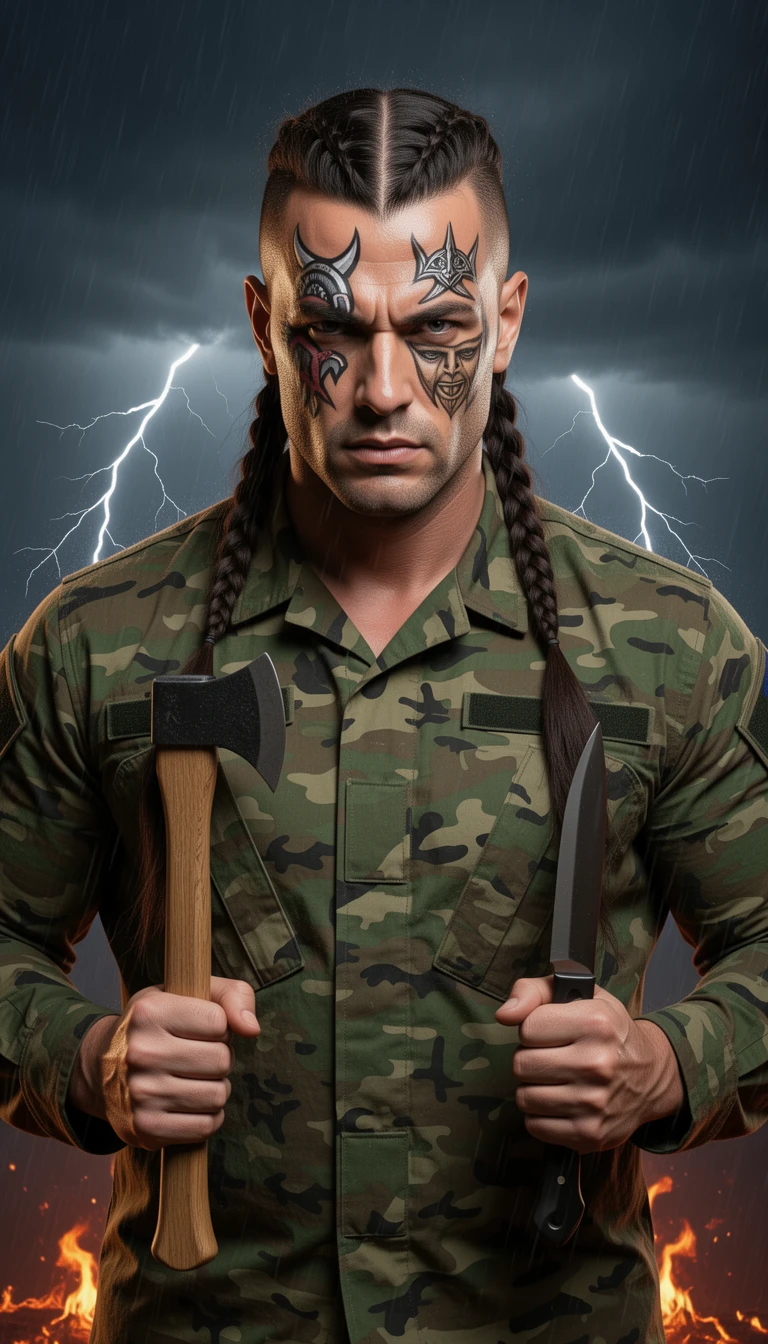
Linda stood at the kitchen window, a coffee mug warming her palms, watching the sun climb over the ridge. The rooster had crowed three times now—each one closer, louder, more insistent. Tia was at the stove, scrambling eggs in a cast iron pan that must have weighed ten pounds, purple and pink hair catching the morning light through the glass.
"So," Linda said, turning from the window. "How many animals are actually on this farm?"
Tia didn't look up from the eggs. Her spatula moved in steady, practiced arcs. "Horses. Ninety of them. Thirty Mustangs, thirty Arabians, thirty Tennessee Walkers."
Linda's eyebrow went up. "Ninety horses."
"That's just the horses." Tia's voice carried a grin she wasn't showing. "Cows. Four hundred head. Splits are a hundred each—Angus, Holstein, Jersey, Hereford."
"Four hundred." Linda set her mug down. "That's... that's a lot of cows."
"Donkeys. Four hundred. Two hundred Mammoth, two hundred guard jennies."
Linda blinked. "What's a guard jenny?"
"Donkey that kills coyotes. They're big—horse-height. They patrol with the sheep and goats. Coyotes don't stand a chance."
She kept counting on her fingers. "Sheep. Four hundred—two hundred Hog Island, two hundred Merino. Chickens. Also four hundred. Anconas, Australorps, Rhode Island Reds, White Leghorns. A hundred each."
Linda was doing the math in her head, the numbers stacking like bricks.
"Pigs," Tia said, and finally looked up. "Three hundred. Berkshire, Tamworth, Duroc. A hundred each. That's"—she paused, counting—"ninety, four hundred, four hundred, four hundred, four hundred, three hundred. Nineteen hundred and ninety animals. Give or take."
"Wow," Linda said. It came out flat, inadequate. She tried again. "Wow."
"I know." Tia turned back to the eggs. "Three weekends ago, me and Lance, his parents David and Sue, his sister Maria and her husband John, and their little boy Ian—we all came down here. Ivan showed us the whole farm. The whole thing. Started at dawn, ended after dark."
She shook her head. "We walked the Central Citadel first. The sibling neighborhood—those houses are massive, custom-built, every bedroom has a biometric elevator that drops straight through bedrock into the bunker town below."
Linda picked up her mug again, just to have something to hold.
"Then the museum. Revolutionary War wing, Civil War gallery, the Royal Guard displays, the distilling exhibit..." Tia laughed. "They have the original moonshine still from 1791. Behind glass. With the handwritten recipe."
"The what?"
"The family's been making whiskey and wine since 1607. Selling it since 1791. It's a whole operation."
Linda stared at her.
"Then the zones. Zone one is a hundred and twenty square miles of rural and trails—logging, ATV tracks, horse trails. All sound-isolated so the dirt bikes don't spook the horses. Zone two is crops and distilleries—grain fields, vineyards, orchards, the fermentation vaults. Zone three is livestock—all the animals, the grazing rotations, the automated milking parlors."
Linda's head was spinning. She sat down at the kitchen table, the chair creaking under her.
"Ivan knocked on Eleanor's door," Tia said, her voice softening. "She said come in. He stood there in her room and said, 'All our guards and their families are settling in nicely. We've got the police station fully staffed. Fire station fully staffed. Hospital—clinic, sorry—fully staffed. The stores are fully staffed. Everybody's getting along.'"
She turned off the burner. "And Linda asked him. How many people?"
"And he said..."
"Almost thirty thousand," Tia said. "Thirty thousand people."
Linda blinked at the number. It sat in her chest like a stone dropped in still water, ripples spreading outward. Thirty thousand people. Living on this farm. Protected by this family.
"Here," Tia said, sliding a plate of eggs in front of her. "Eat. We've got a long day."
Linda looked down at the eggs. Scrambled perfectly, flecked with black pepper and what looked like fresh chives. Steam rose off them. She picked up her fork.
"Thank you," she said.
"Don't thank me yet. We still have to get through morning meds."
They ate in comfortable silence, the farmhouse waking around them. Through the window, Linda could see movement near the main barn—two figures, one broad-shouldered and deliberate, the other lean and quick, moving in the easy rhythm of people who had worked together for years. Ivan and Sarah. Their hands touched briefly, a passing connection, before they split to different tasks.
Linda watched them for a long moment. The way Sarah's hand found Ivan's shoulder. The way he leaned into it, almost imperceptibly, like a man who had spent decades learning not to need contact and was finally allowing himself to have it.
"They're good together," Tia said, following her gaze.
"Yeah." Linda took another bite of eggs. "Yeah, they are."
She finished her plate, rinsed it in the sink, and dried her hands on the dish towel. "Alright. Let's go check on Eleanor."
The hallway was quiet, morning light slanting through the windows in long golden rectangles. The farmhouse smelled of old wood and coffee and the faint floral note of the dried lavender hanging in bunches from the ceiling beams. Linda's footsteps were soft on the hardwood, but the floor still creaked in familiar places—third board from the door, the spot just past the grandfather clock.
Eleanor's door was cracked open. Linda pushed it gently, the wood whispering against the frame.
The room was dim, curtains drawn. The hospital bed sat in the center, surrounded by monitors that beeped in slow, steady rhythms. Eleanor lay propped against pillows, her gray hair fanned out like silver thread. Her eyes were closed, but her chest rose and fell with the slow patience of someone who had spent eighty years learning to breathe.
Tia moved to the window, pulled the curtain back an inch. Light fell across Eleanor's face.
Her eyes opened.
"Morning," Linda said softly.
Eleanor's gaze found her, slow and searching, like a diver surfacing from deep water. Then her mouth curved, the faintest smile.
"Linda." Her voice was dry, cracked, but there was iron in it. "You're still here."
"I am." Linda pulled a chair close to the bed and sat. "Made you eggs, but Tia ate them all."
"Lies," Tia said from the window. "I left her a whole plate."
Eleanor's smile widened, just a fraction. "My girls."
Linda reached out and took Eleanor's hand. The skin was paper-thin, veins blue beneath, but the grip that returned was surprising—firm, deliberate, the hand of a woman who had never let go of anything she meant to keep.
"How are you feeling?" Linda asked.
"Like I've been fighting a war for four years." Eleanor's eyes drifted to the ceiling. "And I'm tired, Linda. I'm so tired."
Linda squeezed her hand. "I know."
"But I'm not done yet." Eleanor's gaze sharpened, found Linda's face. "I still have things to do."
"What things?"
Eleanor was quiet for a moment. Outside, a horse whinnied—high and clear, cutting through the morning air. Then another answered, deeper, from farther away.
"I need to see them," Eleanor said. "All of them. Ivan. Sarah. The kids. Robert." Her voice caught on the name. "I need to see them together, one more time."
Linda nodded. "We can make that happen."
"And I need to tell Ivan something." Eleanor's eyes closed, just for a moment. "Something I should have told him years ago."
"What is it?"
Eleanor didn't answer. Her hand tightened on Linda's, once, then relaxed.
The monitors beeped. The curtains stirred in a draft from somewhere. The house settled around them, creaking and sighing like an old animal breathing.
"He's out there," Eleanor said, not opening her eyes. "With Sarah. Working."
Linda looked toward the window. "He is."
"He's always working." A ghost of a laugh. "That boy doesn't know how to stop."
"He learned it from you."
Eleanor's eyes opened. She looked at Linda with something like surprise, something like recognition.
"Maybe," she said. "Maybe he did."
Tia came to the other side of the bed, checked the IV drip, adjusted the pillow behind Eleanor's head. Her movements were efficient, practiced—but gentle, too. The way you touch something fragile.
"Do you want me to get him?" Tia asked.
Eleanor considered it. Her eyes drifted to the window, to the light, to the sound of hooves and distant voices.
"Not yet," she said. "Let him work. He'll come when he's ready."
She settled deeper into the pillows, her hand still in Linda's.
"Let him come to me."
The morning stretched. The sun climbed higher, the shadows shortening, the farm coming fully alive around them. Linda heard the rumble of a truck, the distant clang of metal, the low murmur of voices carrying across the yard. Through the window, she watched a group of men on horseback ride past—broad-shouldered, alert, rifles slung across their backs. Guards, making their rounds.
Tia left to refill the water pitcher, and Linda sat alone with Eleanor, listening to her breathe. The rhythm was steady, but there was a catch in it now—a hesitation at the end of each exhale, like her body was relearning the motion every time.
"Linda."
She leaned closer. "I'm here."
"Ivan told me," Eleanor said, her eyes still closed, "about your ex-husband. Striker."
Linda's chest tightened. She didn't speak.
"He told me what happened. In the jungle. What your ex did. What Ivan did." Eleanor's hand found hers again. "I'm sorry, Linda. I'm sorry you had to live through that."
The words sat between them, heavy and warm, like stones pulled from a river.
"He saved me," Linda said. Her voice was quiet. "Ivan. He saved me and my son. And I spent years hating him for it, because I didn't know the truth."
"But now you do."
"Now I do."
Eleanor nodded, a small, slow movement. "Good." She opened her eyes and looked at Linda with a clarity that cut through the dim light. "That's good, Linda. Because hatred is a weight, and you've carried it long enough."
Linda felt her throat tighten. She blinked, hard, and looked away.
"I know," she managed. "I know."
They sat in silence until Tia returned, the water pitcher full and dripping condensation. She set it on the nightstand, checked Eleanor's vitals, adjusted the flow on the morphine drip.
"She's stable," Tia said quietly, to Linda. "Her vitals are holding. But she's tired, Linda. Really tired."
"I know."
"We should let her rest."
Linda nodded, but she didn't let go of Eleanor's hand. She stayed another minute, two, three—watching the rise and fall of that weathered chest, the flutter of eyelids dreaming behind closed lids.
Then she gently released Eleanor's hand, stood, and followed Tia out of the room.
The hallway was cooler, the air less heavy. Linda leaned against the wall and let out a breath she hadn't realized she'd been holding.
"She's dying," she said. Not a question.
Tia's eyes met hers. "Yes."
"How long?"
"Days. Maybe a week. The cancer's everywhere now. The morphine is keeping her comfortable, but—" Tia shook her head. "She's fighting. I've never seen anyone fight so hard."
"She has a reason to fight."
"We all do."
Linda pushed off the wall. "I'm going to find Ivan. He needs to know."
Tia nodded. "I'll stay with her."
Linda walked down the hallway, through the kitchen, out onto the porch. The air hit her—warm, thick with the smell of hay and horses and turned earth. She stood there for a moment, letting it fill her lungs, letting the sun warm her face.
Then she stepped off the porch and walked toward the barn.
Ivan was exactly where Eleanor had said he would be—working. He was hauling a bale of hay off the back of a flatbed truck, his shoulders straining against the weight, the muscles in his arms standing out like steel cables. Sarah was beside him, handling the other end, their movements synchronized like they'd been doing this together for decades.
Linda stopped at the fence and waited.
Ivan saw her. He set down the bale, wiped his forehead with the back of his hand, and walked over. Up close, she could see the exhaustion in his eyes—not physical, but something deeper, something that had been accumulating for years.
"Linda." His voice was rough. "Is it Eleanor?"
"She's resting," Linda said. "She's stable. But Ivan—" She paused, finding the words. "She asked for you. She said she needs to see you. All of you. Together."
Ivan's jaw tightened. He looked past her, toward the farmhouse, his silver and gray eyes unreadable.
"She said she has something to tell you," Linda added. "Something she should have told you years ago."
He didn't move for a long moment. Then he nodded, slow and deliberate.
"Okay."
Sarah appeared at his side, her hand finding his. She didn't say anything. She didn't need to.
"I'll call the others," she said quietly.
Ivan nodded again. He looked at Linda, and for a moment, she saw something flicker in his eyes—gratitude, maybe, or recognition. The acknowledgment of someone who understood, who had been through their own war and come out the other side.
"Thank you," he said. "For being here. For her."
Linda smiled, small and tired. "She's my family now, Ivan. That's what we do."
He held her gaze for a long moment. Then he turned and walked toward the farmhouse, Sarah's hand still in his, the morning light casting their shadows long across the grass.
Ivan's boots hit the porch boards in a rhythm he didn't consciously set—three steps, pause, three steps. Sarah's hand stayed in his, her palm warm against his calluses, her fingers threaded through his like they'd always belonged there.
The farmhouse door swung open before he reached it.
Tia stood in the frame, her phone pressed to her ear, her light blue eyes finding Ivan's immediately. She held up one finger—wait—and spoke into the phone in rapid Vietnamese, her voice gentle but insistent.
". . . phải, Lance. Tất cả mọi thứ. Ngay cả những hộp trong gara." She paused, listening, then laughed—a sound that seemed to surprise even her. "Không, anh ấy nói chúng tôi có một ngôi nhà. Một ngôi nhà thực sự, Lance. Trên một trang trại."
Ivan stood in the doorway, Sarah beside him, the morning sun cutting across the porch floorboards in long golden rectangles. He didn't interrupt. He watched Tia's face shift through a dozen emotions in the space of ten seconds—disbelief, joy, fear, hope, that same disbelief again—and felt something crack open in his chest that he'd been holding closed for years.
Tia's voice dropped. "Em yêu anh. Gọi cho anh khi anh đóng gói xong." She hung up, looked at Ivan, and her eyes were wet.
"He was worried," she said, her voice steady but thin. "About the move. About—" She shook her head. "About everything."
Ivan nodded. "He has a house. Three bedrooms. Two baths. Porch. Backyard. Your own kitchen. Your own door." He paused. "It's a mile from here. You can walk to the main house in fifteen minutes."
"Ivan."
"There's a school bus stop at the end of the lane. For when you have kids."
Tia's breath caught. She pressed her hand to her mouth, her shoulders shaking once, twice, before she got herself under control. "You barely know us."
"I know enough."
Sarah squeezed his hand. He felt it—the pressure, the warmth, the silent message: this is who you are. This is who you've always been.
Tia stepped forward and hugged him. It was quick, fierce, and over before he could react—but he felt it. The press of her arms around his ribs, the whisper of her hair against his shoulder, the way she said "thank you" into his collar like it was a prayer.
Then she pulled back, wiped her eyes, and laughed. "I'm going to check on Eleanor. She asked for tea."
"She's awake?"
"She's awake. She's—" Tia's smile flickered. "She's weaker than yesterday. But she's fighting."
Ivan nodded again, his jaw tight. "Tell her I'll be there soon. I have to make some calls first."
Tia disappeared into the farmhouse. The screen door clattered shut behind her.
Ivan stood on the porch, Sarah beside him, and pulled out his phone.
The screen was bright in the morning light. He scrolled to Maria's contact—the name he'd saved seven years ago and never deleted, even when he thought he'd never see her again—and pressed dial.
It rang twice.
"Ivan?" Maria's voice was warm, surprised, with that slight accent she'd never quite lost. "Is everything okay?"
"Everything's fine." He leaned against the porch railing, the wood rough under his elbow. "I'm calling to check in. About the move."
A pause. He heard her exhale. "We're still coming. Ian is—" Her voice softened. "He asks about you every day. 'When are we going to Uncle Ivan's farm? When can I see the horses?'"
Ivan felt something twist in his chest. "Soon."
"That's what I told him. But we want to finish the school year first. He's doing so well, Ivan. His teachers say he's reading at a second-grade level. He's making friends. I don't want to—" She stopped, searching for words. "I don't want to pull him out of something good."
"Don't."
"What?"
"Don't pull him out. Finish the school year. The farm will be here." His voice was steady, certain, the voice of a man who had waited twenty years for what he wanted. "You're not on a deadline, Maria. You're family. Family doesn't have deadlines."
She was quiet for a long moment. When she spoke again, her voice was thick. "You mean that."
"I don't say things I don't mean."
"I know." She laughed, wet and raw. "I know you don't. That's—God, Ivan, that's why I love you. You say what you mean, and you mean what you say, and you've never once lied to me."
He didn't know what to say to that. So he said nothing.
"We'll be there in June," Maria said finally. "After Ian's last day of school. John already put in notice at his job. We sold most of our furniture. We're—" She laughed again. "We're ready."
"Good."
"Ivan?"
"Yeah."
"Thank you. For saving us. For—" Her voice cracked. "For everything. Every single thing."
He stood there, phone pressed to his ear, watching the morning light crawl across the fields. A hawk circled somewhere overhead. The horses were grazing in the far pasture, their heads low, their tails switching lazily.
"You don't have to thank me," he said. "That's what family does."
He hung up and stood there for a long moment, the phone warm in his hand, Sarah's shoulder pressed against his arm.
Then he turned and walked into the farmhouse.
Linda was in the kitchen, sitting at the table with a cup of coffee, her hazel eyes fixed on the window. She looked up when he walked in, and something in her face shifted—recognition, maybe, or readiness.
"Ivan."
"Linda."
He sat down across from her. Sarah leaned against the counter, her pink eyes watching him, her arms crossed loose and easy.
Ivan folded his hands on the table. "I have an offer for you."
Linda raised an eyebrow. "An offer."
"Move to the farm. You, James, Tommy, Jacob." He said it flat, direct, the way he said everything. "There's a house for you. Four bedrooms. Enough land for a garden if you want one. Jacob can have his own place—a smaller house, a quarter mile down the road. His own door. His own key. His own life."
Linda stared at him.
"You're serious."
"I don't joke about housing."
She let out a breath, half laugh, half something else. "Ivan, I have a job. James has a job. Tommy's in school. Jacob is—" She shook her head. "Jacob is trying to figure out who he is. I can't just uproot everyone."
"You can."
"I can't just—"
"Linda." His voice was quiet, but it cut through her words like a blade. "You're a psychiatrist at the Forward Base. You know what's coming. You've seen the reports. The world is getting worse, not better. And when it falls apart—" He leaned forward. "When it falls apart, this farm will be the safest place in the country. Maybe the world."
Her jaw tightened. "That's a lot of weight for one piece of land."
"It's not one piece of land. It's a thousand pieces of land, all connected. Underground bunkers. Food stores. Water purification. A hospital. A school. A community." He held her gaze. "And a place for Jacob to start over. Away from the memories. Away from the ghost of his father."
Linda's eyes went wet. She looked down at her coffee, her fingers wrapped around the mug, her knuckles white.
"You don't have to decide right now," Ivan said. "Talk to James. Think about it. But the offer is real. The house is real." He pulled a pen from his pocket—cheap, plastic, the kind you get at a hotel—and wrote an address on a napkin. "This is the farm address. Give it to James. Give it to Jacob. Tell them to drive out here. See it for themselves."
Linda took the napkin. Her hand trembled slightly.
"33820 Snickersville Turnpike," she read aloud. "Bluemont, Virginia."
"That's the gate entrance. Someone will be there to let you in."
She folded the napkin carefully, precisely, like it was made of gold leaf. "I'll talk to James tonight."
"That's all I ask."
Sarah moved behind him, her hand settling on his shoulder. He felt the warmth of her palm through his shirt, the weight of her presence, the steadiness she brought to every room she entered.
"Ivan." Linda's voice was soft. "Why are you doing this? For us, I mean. For me. After everything—"
"You forgave me."
She blinked. "What?"
"For killing your ex-husband. For taking your son's father away. You forgave me." His voice didn't waver. "That's not nothing, Linda. That's—" He stopped, searching for the word. "That's everything."
She stared at him for a long moment. Then she nodded, slow and deliberate, and wiped her eyes with the back of her hand.
"Okay," she said. "Okay."
Ivan stood. "I have to see Eleanor."
Linda nodded again, still holding the napkin, still staring at the address written in cheap blue ink.
Ivan walked out of the kitchen, Sarah beside him, their footsteps synchronized on the hardwood floor.
The hallway was dim, the morning light filtered through lace curtains. He passed the living room, where Jack and Stevenson were sitting on the couch, talking in low voices. He passed the study, where Rickey was on the phone, his blood-red eye narrowed, his voice hard and professional. He passed the stairs, where Tommy was sitting on the bottom step, holding a toy truck, watching the adults move around him like ships in a storm.
Ivan stopped.
He crouched down, bringing himself to eye level with the seven-year-old.
"Hey, Tommy."
The boy looked up, his blue eyes wide and curious. "Hi, Ivan."
"You okay?"
Tommy nodded, but his grip on the toy truck tightened. "Mom said we might move here. To the farm."
"She's thinking about it."
"Do you have horses?"
Ivan felt something crack open in his chest again. "Yeah. We have horses."
"Can I ride one?"
"If your mom says it's okay, I'll teach you myself."
Tommy's face lit up. "Really?"
"Really."
The boy looked down at his truck, then back up at Ivan. "My dad says you're a hero."
Ivan's breath caught. "He said that?"
"Yeah. He said you saved a lot of people. And that you're a good man." Tommy tilted his head. "Are you a good man, Ivan?"
He didn't know how to answer that. He looked at the boy—seven years old, blue eyes, a toy truck clutched in small hands, a world of possibility in front of him—and felt the weight of everything he'd done, everything he'd failed to do, everything he still had to do.
"I'm trying to be," he said finally. "Every day. I'm trying."
Tommy nodded, satisfied with the answer. "Okay." He stood up, clutching his truck, and walked toward the kitchen. "I'm gonna go find my mom."
Ivan watched him go.
Sarah's hand found his. She pulled him up, her fingers warm and steady, her pink eyes soft.
"You're good with him," she said.
He shook his head. "I don't know what I'm doing."
"That's the first sign."
He looked at her—her face paint, her eyes, the way the morning light caught the Viking patterns on her cheeks—and felt something settle in his chest. Not peace. Not resolution. Something quieter. Something that felt like permission to keep going.
He walked to Eleanor's room.
The door was cracked open. He pushed it gently, the wood swinging inward on silent hinges.
She was in the bed, propped up on pillows, her gray hair loose around her shoulders, her blue eyes fixed on the window. The morning light fell across her face, illuminating the lines and creases and the maps of eighty years of living.
She looked small. Smaller than he remembered. The cancer had eaten away at her, hollowed her out, left her a version of herself that seemed to belong to a different world.
But her eyes—her eyes were still sharp. Still present. Still her.
"Ivan." Her voice was a whisper, but it carried the same weight it always had. "Come here."
He crossed the room, pulled up the chair beside her bed, and sat. Sarah stayed in the doorway, giving them space, her presence a quiet guard at the threshold.
Eleanor reached out. Her hand was thin, the skin papery, the veins visible beneath. She found his hand and held it.
Her grip was still strong.
"I need to tell you something," she said. "Something I should have told you years ago."
Ivan leaned forward. "I'm listening."
She looked at him—really looked at him, her blue eyes searching his face, tracing the lines of his face paint, the silver of his left eye, the gray of his right—and smiled.
"Your mother," she said, "was the bravest person I ever knew."
Ivan didn't speak. He waited.
Eleanor's gaze drifted to the window. "When she found out she was pregnant with you and your siblings, she was terrified. Not of childbirth. Not of raising children. She was terrified that she wouldn't be able to protect you. That the world would take you from her." Her voice was soft, distant, like she was reading from a book only she could see. "She made me promise her something. She made me promise that if anything ever happened to her, I would keep you safe. All of you. No matter what it cost."
She turned back to him. Her eyes were wet.
"I made that promise, Ivan. And I kept it. For thirty-seven years, I kept it. But there's something I never told you. Something I should have told you the day you turned eighteen."
Ivan's chest tightened. "What?"
Eleanor took a breath—shallow, rattling, the breath of a woman who was running out of time.
"Your mother didn't die in that car crash," she said. "She was murdered. But you already know that."
Ivan nodded.
"What you don't know," Eleanor said, "is that she knew it was coming. She had a premonition. A vision, she called it. She woke up three days before the crash and told me she had seen her own death."
Ivan's blood went cold. "She saw it?"
"She saw it. She saw the car. She saw the brake line cut. She saw—" Eleanor's voice cracked. "She saw Amber in the passenger seat. She saw both of them, together, in the moment before impact."
Ivan's hand tightened around hers. His throat was closed. His chest was full of glass.
"She didn't run," Eleanor said. "She didn't hide. She didn't call the police or ask for protection. She told me—" Eleanor's eyes spilled over, tears tracking down her cheeks. "She told me that if she ran, Lionel Price would come after you. After the family. She said it was better that she go. That she could protect you more in death than she ever could in life."
Ivan couldn't breathe.
"She chose to die, Ivan. She chose to die so you could live. So all of you could live." Eleanor's hand tightened around his, her grip fierce despite her frailty. "I've carried that secret for twenty-one years. And I'm sorry. I'm so sorry I didn't tell you sooner."
Ivan sat there, frozen, the words echoing in his skull.
She chose to die.
His mother. His mother had known. She had seen the trap, understood the cost, and walked into it anyway. For him. For his siblings. For the family.
He thought of her face—the one he barely remembered, the one he'd spent years trying to reconstruct from old photographs and fragmented memories. He thought of her voice, the sound of her laugh, the way she used to hold his hand when crossing the street.
He thought of the car. The brake line. The moment of impact.
And he thought of what it must have taken—the courage, the love, the fucking steel—to look at death and say yes.
His hand was shaking.
Eleanor saw it. She pulled his hand to her chest, pressing it over her heart, letting him feel the weak but steady rhythm of her pulse.
"You are her legacy, Ivan. You are everything she died to protect. And I needed you to know that before I go."
He looked at her—his grandmother, the woman who had raised him, who had carried the weight of a family and a kingdom and a thousand years of secrets on her shoulders—and felt the tears come.
He didn't fight them.
He leaned forward, pressing his forehead to her hand, and let himself break.
The farmhouse kitchen had become a medical station—IV poles and monitor leads and the sharp chemical smell of antiseptic cutting through the smell of old wood and Eleanor's lavender sachets. Ivan sat in the chair beside his grandmother's bed, her hand still pressed to his chest, her pulse a weak metronome against his ribs. He had stopped crying. There was nothing left. Just the hollow ache of a truth that had rearranged his entire understanding of the woman who had given him life.
The door swung open.
Tia came through first—purple and pink hair catching the dim light, her light blue eyes wide and fixed on something in her hands. A piece of paper. A printout. Linda followed close behind, her hazel eyes dark with something Ivan had seen before. The look of a professional who had found something she was not supposed to find.
"Ivan." Tia's voice cracked the silence like glass. "We need to talk. All of you."
Rickey straightened from where he was leaning against the wall near the window. Kimberly set down the rag she'd been wiping her hands with. Jennifer looked up from the corner where she'd been sitting with Michelle, both of them rising in unison. Jack and Stevenson came in from the porch, boots heavy on the hardwood. Melissa was already there, sitting on the arm of the couch, her mismatched eyes tracking Tia's face like she was reading a threat assessment.
Sarah crossed the room and took Ivan's hand, her fingers cold, her grip sure. Robert stood in the doorway, his hazel eyes flicking between Tia and Linda, reading the room the way they had all been trained to read rooms—for exits, for weapons, for the truth no one was saying yet.
"What is it?" Ivan's voice was raw, scraped clean by grief. He didn't let go of Eleanor's hand.
Linda stepped forward. She held up the printout—a lab result sheet with highlighted rows, numbers circled in red ink. Her hand was steady. Her voice was not.
"We were running comprehensive blood work on Eleanor. Everything. Tox screens, metabolic panels, heavy metals, the works. Standard protocol for a patient with unexplained neurological decline." She paused, her jaw tightening. "We found two alkaloid compounds in her bloodstream at therapeutic-to-toxic concentrations. Nightshade Extract. And Silverdrop."
The room went still.
Ivan's blood turned to ice.
Rickey stepped forward, the red side of his body catching the light like he was bleeding from the soul out. "Say that again."
Linda didn't flinch. "Nightshade Extract. Atropa belladonna derivatives. Causes confusion, memory loss, hallucinations, respiratory depression. And Silverdrop—a heavy-metal chelate that accumulates in neural tissue over time. Slow. Targeted. Almost impossible to detect in standard panels unless you're specifically looking for it." She set the paper on the kitchen table, smoothing it flat. "Someone has been poisoning her. Consistently. For at least three to four years."
Kimberly's orange eyes burned. "Four years." Her voice was low and sharp as a scalpel. "That's exactly when her health started declining. When the doctors said it was dementia. When Michael started 'helping' with her appointments."
Ivan's grip on Eleanor's hand tightened. The old woman's eyes were closed, her breathing shallow and even. She was asleep. Or she was pretending to sleep. He didn't know which was worse.
"The compounds," Ivan said. His voice was flat. Controlled. The voice of the sniper, not the grandson. "Where do they come from? How are they administered?"
Tia stepped forward, her hands clasped in front of her, her voice trembling but determined. "The Nightshade Extract can be synthesized. But Silverdrop is rare. It's derived from a fungus that only grows in specific conditions—high altitude, limestone caves, specific humidity ranges. There are only three sources in the world that produce it commercially. Two of them are in Eastern Europe. The third is in Southeast Asia." She swallowed. "We traced the batch markers. It's from a supplier in the Golden Triangle. The same region the Black Hand Syndicate uses for their opium routes."
Sarah's grip on Ivan's hand turned to iron. "Victor Reed."
"No," Ivan said, his voice still flat, still controlled. "Reed is a mule. He answers to Mendoza. But this has Michael's fingerprints all over it." He looked at the printout on the table. "Michael was the one who brought her coffee every morning. For years. He made a production of it—'Grandma's special blend,' he called it. Single-origin. Fresh-ground. Made a whole ritual out of it so no one would question it."
Rickey's jaw was a line of granite. "I remember. He always brought it to her in that ceramic mug. The one with the painted flowers. Said it was 'their thing.'" He spat the last two words like they were poison in his mouth. "Son of a bitch was dosing her the whole time."
Jennifer's voice came from the corner, low and dangerous. "Tia. Does Eleanor have a favorite coffee?"
Tia blinked. "What?"
"Think. Ivan said Michael made her a special blend. But if he was poisoning her, he wouldn't risk making the coffee himself where someone might see him add something. He'd need a vector. A delivery system that was consistent and deniable. So I'll ask again—does Eleanor have a favorite coffee?"
Tia's face went pale. She looked at Linda. Linda's expression said she had already made the same connection.
"She does," Tia said slowly. "A single-origin Ethiopian Yirgacheffe. Light roast. She gets it shipped directly from a roaster in Addis Ababa. She has for years. Two pounds every two weeks, delivered to the farmhouse. She keeps it in the pantry in a sealed tin."
Melissa stood up. "Show us the tin."
The entire family moved as one—a coordinated shift of bodies that would have been beautiful if it wasn't driven by the cold, sick certainty that they had been blind for years. Ivan held up a hand.
"Wait."
They stopped. Turned.
Ivan looked at Eleanor's sleeping face. The way her chest rose and fell. The way her fingers were curled around his hand even in sleep, like she was still holding on to him. He thought about what she had told him tonight. About his mother. About the choice she had made.
He thought about Michael. His brother. The man who had killed their parents. The man who had poisoned their grandmother for four years while pretending to care for her.
He thought about the coffee tin in the pantry.
"Whoever is doing this," he said, his voice quiet enough that the others had to lean in to hear, "doesn't know we found it. If Michael knew we had his blood work, he would have destroyed the evidence. He would have tampered with the supply chain. He would have covered his tracks." He looked up, his gray and silver eyes meeting each of theirs in turn. "That tin is still in the pantry. Untouched. Which means he thinks he's still getting away with it."
Jack stepped forward, his blue eyes sharp. "So we don't tip our hand. We leave the tin exactly where it is. We don't touch it, don't test it, don't breathe a word about it outside this room. We let him think his plan is working."
"And we trap him," Stevenson said, his native American braids catching the light as he nodded slowly. "We let the poisoner come to us. Let him bring the next dose. And we catch him in the act."
Robert spoke for the first time, his voice rough from disuse. "It was Michael. We all know it was Michael. But knowing and proving are two different things." He looked at Ivan. "What do you want to do?"
The question hung in the air like a blade.
Ivan looked down at his grandmother. Her face was peaceful in sleep, the lines of pain smoothed away by whatever morphine Tia had given her. She looked small. Fragile. Nothing like the woman who had led a family of warriors for eighty years, who had built an empire from blood and steel, who had carried the weight of a thousand years of history on her shoulders.
She looked like a woman who had been dying slowly for four years, and no one had seen it.
"We leave the tin," Ivan said. "We tell no one outside this room. We keep living exactly the way we have been living, so that whoever is doing this doesn't get spooked and change their method." He looked up. "And we set a watch. Tia, Linda—I need you to document everything. Every test result. Every batch of coffee she drinks. Chain of custody on every sample. When we bring this to the authorities, I want it to be airtight."
Tia nodded. "I'll start a log tonight."
"Good." Ivan stood up, still holding Eleanor's hand, then gently laid it on the blanket beside her. "Rickey, I need you on the coffee tin. Pull it, test it, put it back, and make sure no one sees you do it. We need to confirm the poison is in the beans, not just in her system."
Rickey nodded once. "On it."
"Kimberly, Michelle—I need eyes on Michael. Not close. Not obvious. But I need to know where he is every hour of every day. If he flinches, I want to know before his muscle twitches."
"Done," Kimberly said. Michelle nodded silently.
"Jack, Stevenson—I need a secure line to Mark. No encryption that goes through any agency network. I want to tell him what we found, but I want to do it in person. Face to face. Tomorrow."
Jack's eyes widened. "You want to fly to D.C.?"
"No." Ivan's voice was granite. "I want him to come here. To the farm. To see his sister, to see Eleanor, to see what Lionel Price and Michael Nightsworn have done to this family. I want him to witness it with his own eyes."
Stevenson let out a low breath. "That's a big ask. The President doesn't just leave the White House without a full security apparatus."
"Then we provide the security apparatus." Ivan looked around the room—at his siblings, his friends, the family he had built from the ashes of the one he lost. "This is the Nightsworn farm. Thirty thousand people live on this land. We have a bunker that can withstand a nuclear strike, a military garrison in the third layer, and a tactical unit that answers to no one but us. If the President of the United States wants to be safe, he can be safe here."
Sarah squeezed his hand. "I'll call Mark. He'll come."
"Make sure he understands," Ivan said, his voice dropping low. "This isn't a social visit. This is a briefing on the assassination of the Nightsworn family. Because that's what this is. Michael didn't just poison Eleanor. He killed our parents. He killed Amber. He has been systematically eliminating this family for twenty-one years."
The silence that followed was absolute.
Melissa broke it, her voice quiet and steady. "And when we catch him? When we have the proof?"
Ivan looked at Eleanor. At the peaceful rise and fall of her chest. At the way her hand still searched for his in her sleep.
"Then we end it," he said. "The way our mother would have wanted it ended. Clean. Final. And we make sure no one ever touches this family again."
He turned to face them fully—his face painted in three styles, his eyes mismatched and burning, his body coiled with the tension of a man who had spent his entire life fighting for the people he loved.
"We have a poisoner in our house. We have a traitor in our blood. And we have a Vice President who has been using our family as pawns for two decades." He let the words land. "This stops now. Tonight. This family stops bleeding."
No one spoke. No one needed to.
Rickey was the first to move. He walked to the kitchen pantry, opened the door, and carefully lifted out a ceramic tin with a hand-painted label that read GRANDMA'S SPECIAL BLEND. He held it like it was made of glass—or like it was made of acid, eating through his hands.
"I'll have the results in an hour," he said. "If it's in here, we'll know."
Ivan nodded. "Do it. And bring me the answer before you put it back."
Rickey was already gone, the tin tucked under his arm, his footsteps heavy on the stairs to the basement lab.
Ivan turned back to Eleanor. He sat down beside her bed and took her hand again. The warmth of her skin against his was the only thing keeping him tethered to the ground.
Sarah sat beside him, her shoulder pressed against his, her hand covering his where it held Eleanor's.
"We're going to get through this," she said. "Together."
Ivan didn't answer. He watched his grandmother's face, the slow rhythm of her breathing, the way her lips moved slightly in sleep like she was having a conversation only she could hear.
He thought about his mother. About her choice. About the legacy of love and sacrifice that had brought him here.
He thought about Michael. About the brother who had traded his family for money and power, who had sat at Eleanor's bedside for four years, who had smiled and laughed and played the devoted grandson while slowly killing her.
He thought about what he would do when he had the proof.
The answer came easily. The way it always did when Ivan Nightsworn was faced with a threat to his family.
He would end it.
Whatever it took. However long it took. Whoever stood in his way.
He would end it.
The farmhouse settled into its watch. The family moved through the rooms like ghosts, each one carrying the weight of the discovery. In the basement, Rickey worked with a chemist's precision, running samples through a mass spectrometer he had built himself. In the kitchen, Tia and Linda documented every detail of Eleanor's medical history, creating a chain of evidence that would stand up in any court in the world. In the living room, Jack and Stevenson made a call on a secure line that bounced through three satellites before reaching the White House switchboard.
And in the bedroom, Ivan sat beside his grandmother, holding her hand, watching her breathe, waiting for the proof that would change everything.
The hour stretched into ninety minutes. Then two hours.
The basement door opened. Rickey came up the stairs, his face unreadable, a piece of paper in his hand. He walked through the living room, past the kitchen, to the bedroom door. He held up the paper.
"It's in the beans," he said. "Concentrated in the bottom third of the tin. Enough to kill a horse." He let that sink in. "Whoever is doing this is patient. They've been contaminating the bottom of each batch, knowing that's what she'll brew last. By the time she gets to the poisoned beans, the top two-thirds are already gone. No one notices. No one thinks to check the bottom of the tin."
Ivan closed his eyes.
When he opened them, they were dry. Clear. Cold as the winter sky over Thermopylae.
"Send the evidence to Mark," he said. "Every page. Every test result. Every photograph. Let him see what his Vice President has been doing to my family." He looked at Rickey. "And put the tin back. Exactly where you found it."
Rickey's blood-red and midnight-black eyes met his brother's. "You're sure?"
"I'm sure." Ivan stood up, still holding Eleanor's hand. "The poisoner doesn't know we know. We keep it that way until we have them in the room, with the evidence, and no way out."
He looked down at Eleanor. At the woman who had raised him, who had carried the family's secrets for eighty years, who was dying in front of him and still trying to protect him from the truth.
"We're going to end this," he said, quiet enough that only she could hear. "I promise you. We're going to end this."
Eleanor's eyes fluttered open. For a moment, they were clear—sharp, focused, the eyes of the woman who had commanded armies and built empires and loved him with a ferocity that had never wavered.
She squeezed his hand.
"I know you will," she whispered. "You're a Nightsworn."
Then her eyes closed again, and she slipped back into sleep, her breathing steady, her grip still firm around his fingers.
Ivan sat there for a long moment, feeling the weight of her trust, the weight of the family's legacy, the weight of everything that was coming.
Then he stood up, squared his shoulders, and walked out of the bedroom to join his family.
They had work to do.