
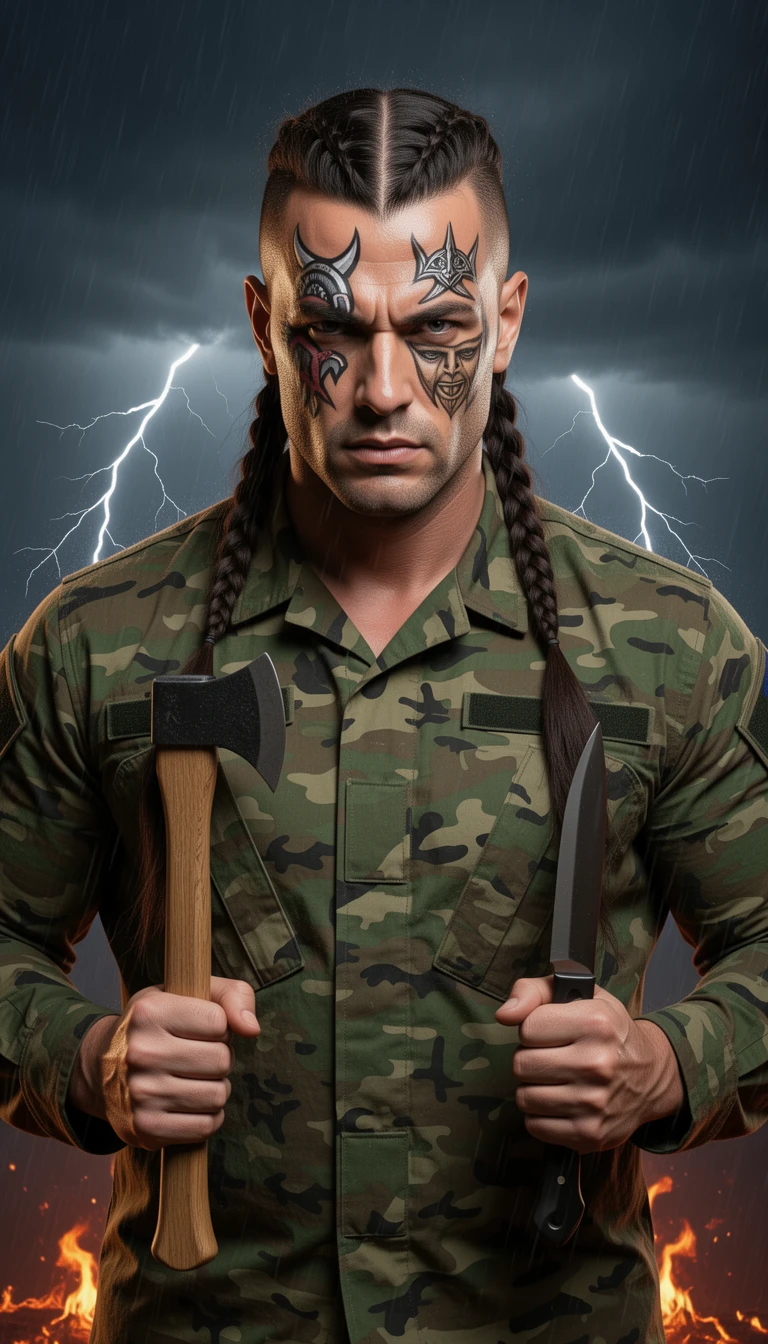
The forward base sat at the end of a long gravel road, a two-story brick building that looked like it had been standing since the 1950s. Ivy climbed the east wall, thick and green, and the American flag hung limp in the still morning air. Ivan parked his truck in the lot, killed the engine, and sat for a long moment with his hands on the wheel. His left hand tapped the leather — one, two, three, four, five — then stopped, then started again. The gravel lot had maybe fifteen cars scattered across it. A sign above the door read FORWARD BASE VETERANS CENTER — EST. 1968.
He got out. The door swung open into a common room that smelled like coffee and old wood and the faint, clean tang of floor wax. Fluorescent lights hummed overhead, and the place was alive with noise — the clack of chess pieces, the shuffle of cards, the low murmur of men and women talking over mugs. A dozen veterans sat scattered across the room. Two older men in leather vests hunched over a chessboard near the window, one of them muttering something about "a goddamn fool's move." Three women sat on a worn couch watching a morning news show, the volume low. A table near the back had four guys playing spades, slamming cards down and laughing.
Ivan stood just inside the doorway and took it in. His right hand found the edge of his jacket and smoothed it once, twice, three times. Then he walked to the front desk.
The woman behind it looked up and smiled. She was maybe fifty, gray-streaked hair pulled back, reading glasses on a chain around her neck.
"Morning," she said. "Help you?"
"I'm here to see Ms. Johnson." His voice came out flat, measured.
"Linda?"
"Yes."
"I'll go get her. Have a seat." She pointed toward the chairs near the chess table.
"Okay."
Ivan turned and walked to the seating area. He chose a chair against the wall where he could see the room — both doors, the window, the hallway that led deeper into the building. Old habits. He sat down, placed his palms on his thighs, and started counting. The tiles on the floor were twelve-inch squares, beige with brown speckles. He counted fifteen rows from the wall to the card table. Then he counted the ceiling tiles. Forty-two. Then he counted the number of people in the room. Fourteen veterans plus the desk lady. Three of them were women. Eleven men.
His right thumb pressed into his palm. Once. Twice. Three times.
"You waiting on Linda?"
Ivan looked up. One of the chess players — a man in his seventies with a gray beard and a leather vest covered in patches — had turned in his chair and was watching him.
"Yeah."
"She's good people." The man nodded. "You a vet?"
"Marines. Recon. SEALs."
The man's eyebrows went up. "You been around."
"A little."
"You want coffee? There's a pot by the window."
Ivan thought about it. "Okay."
He stood and walked to the side table where a large metal coffee urn sat next to a stack of styrofoam cups. He poured himself a cup, black, and took a sip. It was good — strong, dark, fresh. Not the burned sludge he'd expected. He stood there for a moment, holding the cup with both hands, letting the warmth bleed into his palms.
"You play chess?" The man with the beard had followed him.
"I know how."
"Want a game while you wait?"
"Sure."
They sat at the chessboard. The man reset the pieces while Ivan took another sip of coffee. The black pieces. He always played black. Always.
"I'm Earl." The man extended his hand across the board.
Ivan shook it. "Ivan."
"Ivan," Earl repeated. "That Russian?"
"Nightsworn."
"Nightsworn," Earl said, testing the weight of it. "That sounds like something out of a book."
"It's old."
Earl opened with e4. Ivan responded without thinking — c5. Sicilian Defense. His fingers moved the piece, and then his hand came back to his cup, and his thumb started tapping the ceramic. One-two-three. One-two-three.
"You got a tell," Earl said.
"I know."
"You nervous about something?"
Ivan looked at the board. "Always."
They played in silence for a few minutes. Earl was good — not brilliant, but solid, experienced, the kind of player who'd been doing this for decades and had developed a feel for the board. Ivan took his time. His mind worked in patterns, and chess was just patterns. Threats and counters. Angles of attack. What the other player didn't see coming.
He was thinking about Sarah. About the way she'd felt in his arms that night. About the look in her eyes when she'd said she'd come back. About the mission she was on right now, somewhere out there with Victor Reed, playing a role that could get her killed.
His hand came up and smoothed the collar of his jacket. Once. Twice. Three times.
Earl didn't comment.
By the time Linda Johnson appeared in the doorway, Ivan had taken his knight and was pressing into Earl's kingside. He looked up when he heard footsteps, and there she was — medium height, gray-striped hair, hazel eyes that held a quiet gravity. She wore a simple blouse and slacks, and she carried a folder in one hand.
"Ivan?"
He stood. "Ms. Johnson."
"Thank you for coming." Her voice was warm but professional. "Follow me this way, please."
Ivan turned to Earl. "Resign."
Earl blinked at the board. "What? I'm not done yet."
"You will be in four moves. Knight takes bishop, queen's trapped, I take your rook, and then it's over."
"You sure?"
"Yes."
Earl stared at the board for a long moment, then let out a low whistle. "Goddamn."
Ivan set down his coffee cup and followed Linda down the hallway. The floor changed from tile to carpet, and the walls were lined with framed photos — military units, deployment groups, men and women in uniform standing in front of helicopters and Humvees and desert sunsets. Ivan recognized some of the patches. 101st Airborne. 3rd Infantry. A Marine Recon unit insignia that made his chest tighten.
Linda's office was at the end of the hall. She opened the door and stepped aside, gesturing for him to enter. The room was small but well-kept — a desk with a computer, two chairs facing it, a window that looked out onto the parking lot. A bookshelf held binders and a few framed certificates. No personal photos that Ivan could see.
"Have a seat," she said.
Ivan sat. The chair was comfortable, padded, and he realized he'd been braced for something harder. He placed his hands on his thighs and waited.
Linda closed the door and sat behind her desk. She opened the folder, glanced at it, then set it aside. When she looked at him, her eyes were steady.
"I want to thank you for coming in today," she said. "I know this isn't easy."
"It's fine."
"Is it?"
Ivan didn't answer. He looked past her, out the window, at a bird landing on the edge of a trash can.
"I read your file," Linda said. "Or what the military was willing to share. Which isn't much." She paused. "Most of what I know about what happened in 2018 comes from the after-action reports and the rumors that followed. But I want to hear it from you. If you're willing to tell me."
Ivan's jaw tightened. His thumb pressed into his thigh, once, twice, three times.
"You want to know about the village."
"I want to know what happened. What Striker did. What you did. Why."
Ivan exhaled slowly. The air in the room felt thick, heavy, like the pressure before a storm. He'd told this story once, to Sarah, in pieces. He'd never told the whole thing. Never said all of it out loud.
"I was 30 years old," he said. His voice came out flat, distant, like he was reading a report. "Vietnam. Jungle village. Black op mission. Orders were to kill Maria Chen and her family."
Linda didn't write anything down. She just watched him, her hands folded on the desk.
"It was during the mountain raids of the jungle wars," Ivan continued. "She was 18 at the time. Her brother Lance was 14. Her parents were David and Sue Chen. Striker believed her father was the leader of the faction. He wasn't. He was a farmer."
Ivan paused. The memory was coming up now, rising like something from deep water, and he could feel the heat of the jungle, the weight of his rifle, the stench of smoke and wet earth.
"Striker told me that he and the government killed my family. They killed Amber." His voice cracked on her name, just slightly. "They did it to break me. To make me a weapon. A perfect weapon. A nuke button. Something that would do what the government couldn't do. Things they couldn't be seen doing."
He looked at Linda. "You know what a blank slate is?"
"A mind wipe. A fresh start."
"Yeah. They wanted to erase everything I was and rebuild me as a machine. Striker thought he was the hammer. Thought he could forge me."
Ivan's hand came up and smoothed his collar. Once. Twice. Three times.
"He put a gun to Maria Chen's head. She was 18 years old, crying, begging. Her brother was on his knees in the dirt. Her parents were tied to chairs inside the hut. And Striker looked at me and said —"
Ivan stopped. The words were there, in his throat, and he had to push them out.
"He said, 'What's u gonna do? Ur code doesn't mean a fucking thing. You're a machine. Take ur pick.'"
Linda's face was still, but something flickered in her eyes.
"I saved them," Ivan said. "All of them. Maria. Lance. David. Sue."
"But you killed Striker."
"I killed all of them."
Silence.
Ivan's gaze drifted to the window. The bird was still there, picking at something on the ground.
"I took out my own team," he said. "Every single one. I killed them the same way I killed Striker. The same way Striker would have killed them if he'd had the chance. To satisfy the reaper."
"Tell me," Linda said quietly.
And Ivan did.
He told her about the blade. How Striker was still smirking when Ivan took the knife from his belt and moved faster than Striker could react — faster than anyone there could react. How Striker had trained him, shaped him, and how Ivan used every lesson against him. The scalp came off first, a single clean cut around the crown, and Striker screamed. Ivan remembered the sound — high and wet, like an animal caught in a trap. He cut out the tongue next, because Striker had lied to him, had twisted the truth into a weapon, and the tongue was the source of those lies. Then the blood eagle — the ancient Norse execution, ribs opened from the spine, lungs pulled through and spread across the shoulders. Striker was still alive for most of it. Ivan made sure of that.
"I wanted him to feel it," Ivan said, his voice flat. "Every second of it. I wanted him to know, in the last moments of his life, that he had failed. That his perfect weapon had turned on him."
He sawed off the head after Striker was dead. Impaled it on a stake at the edge of the village. Crucified the body — arms stretched, nailed to a wooden frame that Ivan built with his own hands. Two black coins on the eyes. A Marine challenge coin in the pocket. A joker card in the left hand. The Dead Man's Hand — aces and eights — in the right.
Then he did the same to the rest of the team.
"Seven men," Ivan said. "All of them non-American. I killed them one by one, same method, same positioning. I left them in a line at the edge of the village. Laid them out like a message."
He paused. His hands were trembling. He pressed them flat against his thighs.
"After that, I figured it out. Striker was American. The rest of the team were not. He'd been running a rogue operation, using non-nationals to do the work, burying the bodies in the jungle where no one would find them."
Ivan's jaw tightened. "I left a note. Said Striker and his team killed the village. Said they'd killed three other villages before that one. That the military was investigating. That the first two men who complained about Striker had disappeared. That the new team was not American."
He looked at Linda. "I left another note. Said Striker broke my number one rule. The Maria Rule."
"The Maria Rule," Linda repeated.
"Don't hurt the innocent. Don't hurt the weak. Innocent men, women, children, elderly." Ivan's voice dropped. "That's the only rule that matters. Everything else is negotiable."
The room was silent. The clock on the wall ticked. Somewhere in the building, someone laughed, the sound muffled by the walls.
Linda sat very still. When she spoke, her voice was careful, measured. "You killed seven men. You executed them."
"Yes."
"You killed Striker in a way that was designed to send a message."
"Yes."
"And then you left."
"I took Maria and her family to a safe location. I made sure they got out of the country. I gave them new identities." Ivan's fingers tapped on his thigh. "I've been watching over them ever since."
Linda nodded slowly. She picked up a pen, turned it over in her hands, set it down again.
"You told me you have several diagnosed conditions," she said. "Including schizophrenia with homicidal tendencies."
"Yes."
"What else?"
Ivan listed them like he was reading a file. "ADHD. OCD. IED. PTSD. Autism spectrum disorder. Bipolar disorder."
"That's a lot."
"I know."
"And you're still standing."
Ivan looked at her. "Some days I'm not sure why."
Linda leaned forward, her hazel eyes sharp and direct. "You saved an innocent family. You killed the men who were going to murder them. You broke your orders, disobeyed direct command, and committed what the military would call treason and murder." She paused. "And you've been carrying the weight of that alone for seven years."
"Eight," Ivan said. "Almost eight."
The canvas walls of the forward base pressed in around them, slick with condensation that beaded and ran in slow rivulets. Somewhere in the distance, a generator hummed its endless mechanical heartbeat, and the fluorescent lights above cast everything in that particular shade of harsh white that made faces look hollowed out, ancient.
Ivan leaned back in his chair. The metal legs scraped against the packed dirt floor. He could feel the weight of the years pressing down on his shoulders, the accumulation of all the things he'd never said to anyone, stacking up like corpses in a mass grave.
"You want to know how it started," he said. Not a question.
Linda nodded. She'd set down her pen. Her hands were folded on the table, fingers interlaced, patient. The gray stripes in her hair caught the fluorescent light. "I want to understand," she said. "The full picture. Not just the end of it."
Ivan stared at a crack in the far wall. It ran from the floor to the ceiling, a jagged line that looked like a river on a topographical map. He'd been staring at it for the last ten minutes without really seeing it.
"I was eighteen," he said. "Fresh out of boot camp. They put me on a C-130 with fifty other kids who thought they were invincible. We flew into Bagram Airfield at 0200 hours. The heat hit you first — dry, suffocating, like opening an oven. Then the smell. Jet fuel, diesel, sweat, dust. That dust got into everything. Your clothes, your skin, your lungs. You never really got it out."
He paused. His left hand found his right forearm, fingers pressing into the skin. A self-soothing gesture he'd never been able to break.
"The desert war," Linda said.
"Yeah." Ivan's voice dropped. "The entire Middle East and North Africa. Afghanistan, Kazakhstan, Kyrgyzstan, Pakistan, Tajikistan, Turkmenistan, Uzbekistan — and everything south of that. Iraq, Syria, Yemen, Libya, Mali, Niger, Chad, Somalia. All of it. A giant fucking chessboard with oil and minerals as the prize."
He looked at her. His left eye — that entirely silver thing that seemed to catch the light differently than his gray right eye — held her gaze.
"You ever read about the Great Game?"
"The 19th century rivalry between the British and Russian empires," Linda said. "For control of Central Asia."
"Same game. Different players. The US, China, Russia, Iran, Turkey, Saudi Arabia — all of them fighting for the same resources, using local militias and insurgent groups as proxies." Ivan's jaw tightened. "And they put eighteen-year-old kids with rifles in the middle of it."
He was quiet for a long moment. The clock on the wall ticked. Tick. Tick. Tick. Each second a small death.
"I was a Marine scout sniper from eighteen to twenty-two," Ivan said. "My first deployment was to Helmand Province. I was assigned to a recce team that operated in the mountains along the Pakistani border. Our job was to observe, report, and occasionally — when the order came down — eliminate high-value targets."
He tapped his thigh three times. Left hand. Three taps. A ritual he couldn't explain.
"My first kill was a man named Abdul Rahman. He was forty-three years old. He had a wife and four children. He was also a mid-level Taliban commander who coordinated IED attacks against coalition convoys." Ivan's voice was flat, clinical. "I shot him from 800 meters. One round, center mass. He was dead before he hit the ground."
He looked down at his hands. Turned them over. Studied the calluses, the scars, the network of fine lines that mapped a life spent holding weapons.
"I thought about him for years. Still do. I know his name, his face, how he looked through my scope in that split second before the round hit. I know how his body jerked, how his arms flew out, how the blood spread across his chest." He paused. "I know what his wife's scream sounded like. I heard it over the radio after we confirmed the kill. Someone had tapped into a local frequency."
Linda's face was unreadable. But her fingers had tightened around each other.
"That was the desert war," Ivan said. "Four years of that. Four years of watching through a scope, waiting for the shot, taking it, and moving to the next position. I got good at it. Real good. By the time I rotated out, I had forty-seven confirmed kills. Unconfirmed was probably double that."
He looked at the crack in the wall again. Followed it from floor to ceiling with his eyes.
"Then the jungle war started."
"The jungle war," Linda repeated.
"Twenty-two to twenty-six. I was Marine recon by then. They needed people who could operate in close terrain, dense vegetation, limited visibility. The desert was wide open — you could see a target from a mile away. The jungle was different. Everything was up close. Personal." Ivan's voice went quieter. "You could smell the man you were about to kill."
He leaned forward, elbows on his knees, hands hanging between them.
"It was a three-sided war. The United States backed rebel forces fighting against Chinese-backed governments and Russian-backed terrorist organizations. Three superpowers, fighting through proxies, using Southeast Asia as their playground." He shook his head slowly. "Mainland — Cambodia, Laos, Myanmar, Thailand, Vietnam, Singapore. Maritime — Brunei, Indonesia, Malaysia, Philippines, East Timor. Every country, every island, every river and mountain range was a battleground."
"How did you survive?" Linda asked.
Ivan was quiet for a long moment. When he spoke, his voice was barely above a whisper.
"I don't know. Luck. Training. The fact that I was too stubborn to die." He looked up at her. "And I had people watching my back. Good people. Some of them didn't make it."
The silence stretched. The generator hummed. Somewhere in the compound, a door slammed, and the sound carried through the walls like a gunshot.
"After the jungle war, I thought I was done," Ivan said. "I thought I'd served my time, paid my dues, and could walk away. But the military doesn't let go of people like me. Not easily."
He straightened up. Rolled his shoulders. The joints cracked audibly.
"My military career went international," he said.
Linda's eyebrows rose. "What do you mean?"
"I am the only US American to have been trained and attached to foreign militaries. Five of them, across three continents, over the course of a decade." Ivan's voice was flat again, matter-of-fact. "Twenty-eight to thirty, I served with the Royal Marines — Mountain Leaders and the Special Reconnaissance Squadron. The British version of Marine recon. We trained in Norway, Scotland, the Falklands. Cold weather operations, mountain warfare, Arctic survival."
He paused, letting that sink in.
"Thirty to thirty-two, I was with the Special Boat Service. SBS. The British equivalent of the Navy SEALs. Maritime counterterrorism, direct action, special reconnaissance. We operated out of Poole, England, and deployed to the Mediterranean, the South China Sea, the Horn of Africa."
Linda was leaning forward now. Her professional detachment had cracked, just slightly, and what showed through was genuine human curiosity.
"How did that work?" she asked. "Logistically, I mean. You're an American, serving in foreign special forces."
"Joint operations agreements. Quiet ones. Things that don't make the news." Ivan's lips twitched. "The US and UK have a long history of exchanging personnel. I was one of the few who got the full cross-training package. Mountain Leaders, SBS, then MI6 from thirty-two to thirty-six."
"MI6," Linda said. "Intelligence."
"Yeah. They needed someone with operational experience who could move between worlds. Someone who could be a spy, but also pull a trigger when necessary. I did two years of field work in Eastern Europe and the Middle East, then shifted to analysis and operations planning."
He paused. Fingers tapped his thigh. Three taps.
"But that was running concurrently with other work."
"Concurrently?"
"Twenty-nine to thirty-three, I was with Shayetet 13. Israeli naval commandos. Same deal — exchange program, quiet agreements, off-books operations. We ran missions out of Haifa, operating in the Eastern Mediterranean, the Red Sea, and occasionally deeper into the Middle East."
Linda's eyes widened slightly. "You were in the Israeli special forces at the same time as MI6?"
"Overlapping, yeah. The timelines weren't clean. I'd do a six-month rotation with Shayetet, then a six-month rotation with MI6, then back to Shayetet. It was... complicated." Ivan's voice was dry. "Lots of different passports. Lots of different names."
"And then?"
"Thirty-three to thirty-seven, I was with Mossad — the Keadon Unit. That's their direct action arm. Assassinations, sabotage, paramilitary operations. I was one of their primary operatives for the last four years of my active service."
He looked at her. His mismatched eyes held hers, unblinking.
"I retired from US military service at thirty-four. Retired from British military service at thirty-six. Retired from Israeli military service this year, at thirty-seven."
Linda's pen had been sitting on the table, untouched, for the last ten minutes. She picked it up now, turned it over in her fingers, set it down again.
"That's... a lot of service," she said carefully.
"Twenty years of active combat and intelligence operations across four continents." Ivan's voice was quiet, measured. "I've killed more people than I can count. I've seen things that would break most people. I've done things that should have broken me."
He paused. The clock ticked. The generator hummed.
"And through all of it, since I was thirty years old, I've been working at Hubco and the nursing home."
Linda's head tilted. "You've been working retail and elder care this whole time? While you were a spy and a special forces operative?"
"Yeah." The corner of Ivan's mouth twitched. "It's grounding. Stocking shelves, helping old people eat their dinner, listening to Mrs. Gable tell me about her late husband for the hundredth time. It keeps me human."
"And the Diplomatic Security Service?"
"Since thirty-four. I lead the DSS's Mobile Security Deployments unit. MSD. We provide tactical security for diplomatic missions in high-threat environments. Protective details, advance work, crisis response." Ivan's voice shifted, taking on a professional edge. "It's a part-time command, but it keeps my skills sharp and gives me a legitimate reason to be armed and mobile."
Linda was quiet for a long moment. Processing. The fluorescent light hummed above them, casting shadows that seemed to breathe.
"You've been running five parallel lives for the better part of a decade," she said. "Soldier, spy, assassin, retail worker, nursing home aide, tactical commander."
"Seven parallel lives, if you count the nursing home and Hubco separately." Ivan's voice was dry. "And that's not counting the family stuff."
"And you're still standing."
"Some days I'm not sure why."
The words hung in the air between them. Heavy. True.
Linda leaned back in her chair. Her hazel eyes were sharp, assessing, but there was something else in them now. Something softer.
"I asked you to tell me the full story," she said. "And you've given me the timeline. But I have a feeling there's more."
Ivan was silent. His hands rested on his thighs, palms down. The fingers of his left hand twitched, wanting to tap, but he forced them still.
He looked at the crack in the wall. Then at the floor. Then at Linda.
"There's something I need to say," he said. "Something I should have said the moment we sat down."
Linda's eyebrows rose slightly. "What?"
Ivan took a breath. Held it. Let it out slow.
"I am sorry I killed your husband."
The words landed like stones dropped into still water. Ripples spread outward, silent and invisible.
Linda's face didn't change. Her hands stayed folded on the table. But her eyes — her eyes flickered with something. Grief. Memory. Something deeper.
"Striker," she said. Not a question.
"Yes." Ivan's voice was rough. "I killed him. Impaled his head on a stake. Crucified his body. Left him in the jungle as a message." He didn't look away. "I am sorry for what that did to you. To Jacob. I am sorry that you had to live with the aftermath of what I did."
The clock ticked. Tick. Tick.
Linda was very still. Her fingers had interlaced again, knuckles white with the pressure she was applying.
When she spoke, her voice was careful. Measured. But there was steel underneath it. "Tell me why you did it."
"I already told you. He was going to kill an innocent family. A village of innocent people. He had already killed three other villages."
"I know that part." Linda's voice sharpened. "Tell me why you did it the way you did it. The head on the stake. The crucifixion. The message."
Ivan met her eyes. His gray and silver eyes held hers without flinching.
"Because I wanted him to feel it. Every second of it. I wanted him to know, in the last moments of his life, that he had failed. That his perfect weapon — the monster he had become — had been turned against him." He paused. "And I wanted everyone else who was like him to see what happens when you break the rule."
"The Maria Rule," Linda said.
"Don't hurt the innocent. Don't hurt the weak." Ivan's voice dropped to something almost gentle. "That's the only rule that matters. Everything else is negotiable."
Linda sat back. Her hands relaxed, just slightly. The white in her knuckles faded.
"I know what Striker was," she said. "I lived with him for eleven years. I know what he did in the military. I know what he was capable of. I know that he was a monster long before you put a bullet in his skull."
She paused. Picked up her pen. Set it down again.
"When I heard he was dead, I felt relief. Not grief. Relief. And guilt for feeling relieved." Her voice was quiet. "I spent years wondering if that made me a bad person."
"It doesn't," Ivan said.
"I know." Linda looked at him. "I know it doesn't. I've done enough therapy to understand that survival isn't betrayal."
She leaned forward, her hazel eyes suddenly intense.
"Don't be sorry that you killed him, Ivan. You had to stop my ex-husband because he was a monster. If you hadn't stopped him, he would have killed a lot more people. Including Maria and her entire family." She paused. "And maybe — eventually — me and Jacob."
Ivan's breath caught. Just slightly. A hitch in the rhythm.
"He threatened you?" he asked.
"Not directly. But I knew him. I knew what he was capable of. And I knew that, eventually, his rage would circle back to me and our son." Linda's voice was bitter. "He couldn't stand the idea of me leaving him. Couldn't stand the idea of me being happy. He would have come for me eventually."
She reached across the table and touched Ivan's hand. Her fingers were warm against his skin.
"You didn't just save that village. You saved me. You saved Jacob. Maybe not in that moment, but you set the chain of events in motion that let us walk away and build a new life."
Ivan stared at her hand on his. The contact was unexpected. Human.
"I don't know what to say," he said.
"You don't have to say anything." Linda pulled her hand back. "But I need you to understand something. We cannot tell Jacob the truth about his father's death. He's 22 years old. He's angry and confused and looking for someone to blame. If he finds out that you killed his father — even if he understands why — it will destroy him."
Ivan nodded slowly. "I agree. Jacob doesn't need to know."
"He knows his father died in combat. That's all he needs to know." Linda's voice was firm. "When he's older, when he's had time to process, maybe we can tell him more. But not now."
"I won't say anything."
"I know you won't." Linda smiled, a tired, genuine smile that didn't quite reach her eyes. "That's why I trust you."
She leaned back in her chair. The fluorescent light caught the gray stripes in her hair, turning them silver. She looked older than she had when they started this conversation. More worn. But there was something steady in her eyes. Something that had been forged through grief and come out the other side.
"I have one more question," she said.
Ivan waited.
"After everything you've done — all the killing, all the missions, all the years of service — do you think you're a good man?"
The question hit him like a physical blow. He felt it in his chest, in his gut, in the sudden tightness of his throat.
He thought about Abdul Rahman, falling in the dirt 800 meters away.
He thought about Striker's head on a stake, eyes still open, mouth frozen in a silent scream.
He thought about Mrs. Gable, reaching for his hand in the nursing home, her papery skin warm against his.
He thought about Sarah. Her bubblegum pink eyes. The way she'd looked at him that morning, before she'd left for her undercover mission, like he was something worth coming back to.
"I don't know," he said finally. "I'm trying to be. Some days I think I'm getting closer. Other days I think I'm fooling myself."
He looked at Linda. His mismatched eyes held hers.
"But I keep trying. That has to count for something."
Linda nodded. Her hazel eyes were soft, but there was something sharp underneath. Something assessing.
"It counts," she said. "It counts for a lot."
The generator hummed. The fluorescent lights flickered, just slightly, and in that brief darkness, the shadows seemed to move.
Outside, the night pressed in against the canvas walls, heavy and silent. Somewhere in the distance, a dog barked, the sound carrying through the darkness like a question with no answer.
Ivan sat in the harsh white light, his hands resting on his thighs, his breathing slow and even. The weight of twenty years of service pressed down on his shoulders. But for the first time in a long time, it didn't feel like it was crushing him.
It felt like armor.