
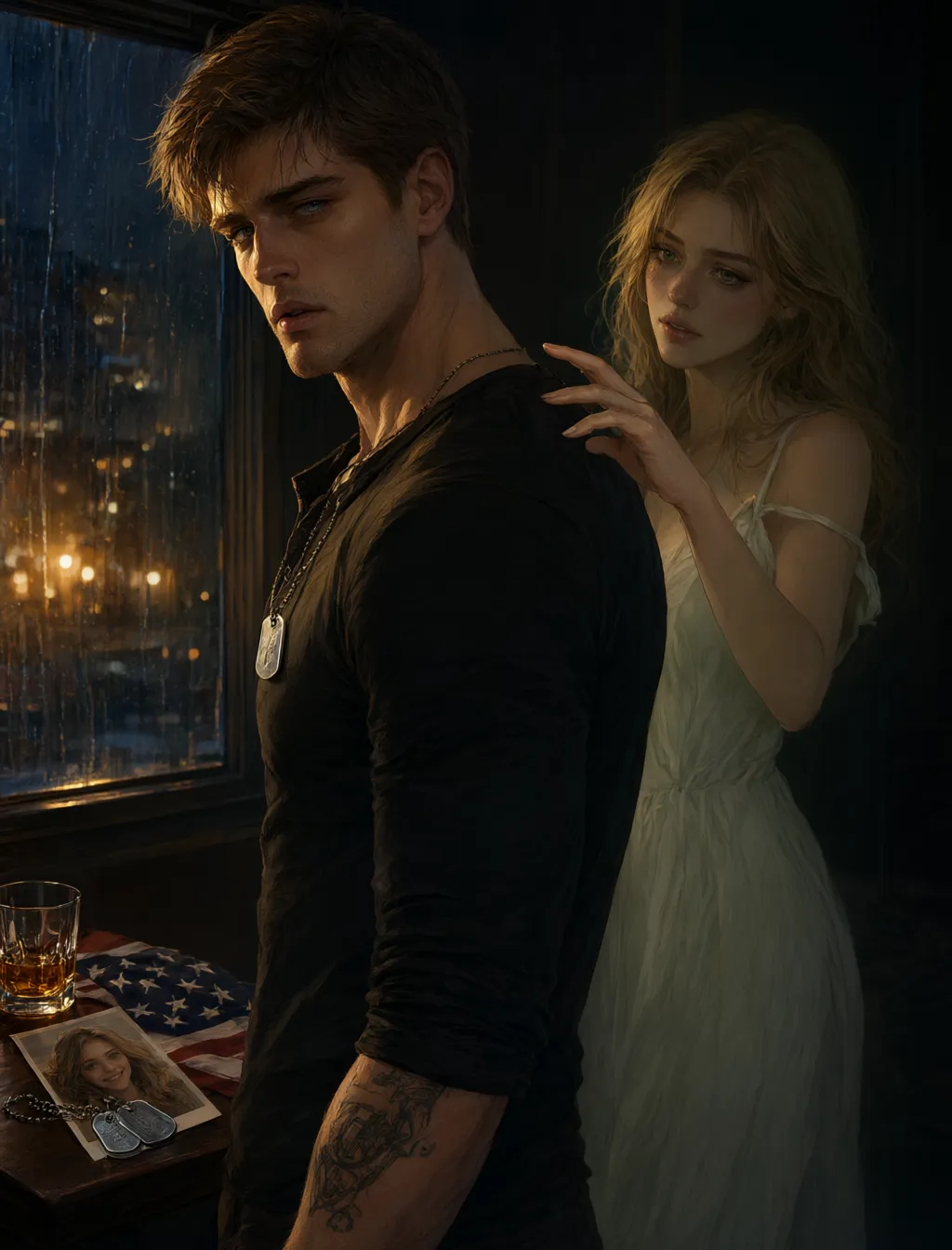
He found Linda Johnson by the coffee urn, her back to the room as she refilled a carafe with hot water. The fluorescent light buzzed and flickered above her head. Ivan stopped a few feet away, his hands at his sides. He waited until she turned, her eyes widening slightly in recognition.
“Thank you,” he said. The words were low, deliberate. “For the card. For letting me stay.”
She studied him, the carafe held between them like a shield. Her gaze was clinical, searching for the lie or the threat. She must have seen neither. She gave a single, slow nod. “You’re welcome, Ivan.”
He didn’t know what else to say. The gratitude felt foreign in his mouth, a currency he hadn’t used in years. He gave a curt nod of his own, then turned toward the empty chairs.
The room was a converted ranch house living room. Worn beige carpet, wood-paneled walls dotted with framed certificates and faded flags. The air held the twin scents of stale coffee and lemon-scented floor polish, a smell that existed in every institutional waiting room he’d ever known. He chose a chair in the corner, its upholstery cool and cracked under his forearms. He aligned his posture, spine straight, feet flat. A perimeter scan: five other men in the room. One stared at a muted television playing a daytime talk show. Two played chess on a battered board, moving pieces without speaking. Another simply looked at his hands, turning them over and over as if checking for cracks.
No one looked at him. He didn’t look at them. They shared the quiet like a shared defensive position, each man in his own foxhole of memory.
From his corner, Ivan could see the whole room. The front door. The hallway to what was probably an office. The kitchenette where Linda now wiped down the counter. Exits: two. Windows: three, all locked. His mind, wired for a decade to assess and categorize, did its work automatically. Civilian clothes. Civilian postures. Civilian problems. He felt like a weapon disassembled on a kitchen table, parts laid out for inspection but belonging nowhere.
A pamphlet on the small table beside his chair read, “Reintegrating: Your First Steps.” He didn’t touch it. He watched the chess game. The older man, grizzled and missing two fingers on his right hand, moved a bishop. His opponent, younger with a nervous tic in his jaw, captured it with a pawn a moment later. The move was clumsy, obvious. Ivan saw the counter in three moves. He looked away.
His grandmother’s hand had been cool and papery under his. The memory was an anchor, a fixed point in the drifting debris Mr. Gable had spoken of. *Let the ghosts stand in the wreckage. You hold your one good piece.* He held it now, in this sterile room. He held the feeling of her skin, the absolute absence of fear in her touch. It was a different kind of stillness than the sniper’s freeze. This stillness was about being held, not holding.
Linda moved through the room, offering coffee refills. She paused by the chess players, said something too low for Ivan to hear. The older man grunted. She moved on. When she reached his corner, she didn’t ask. She simply tipped the carafe over his empty Styrofoam cup. The coffee was thin, the color of weak mud. It steamed.
“First one’s always the hardest,” she said, her voice quiet. She wasn’t looking at him. She was looking at the cup as it filled.
“Is it.”
“Sitting still is.” She finished pouring and met his eyes. “The body remembers being somewhere else. It wants to be useful. It doesn’t know what to do with quiet.”
He held her gaze. She’d been a cop’s wife. She knew the language. “It knows what to do,” he said. “It just can’t do it here.”
A faint, understanding sadness touched her mouth. Not a smile. “Then you learn new things.” She moved away, leaving him with the bad coffee and the truth.
He brought the cup to his lips. The taste was bitter, burnt. He drank it anyway. The heat was a focal point, a small, contained burn in his gut. He drank slowly, methodically, turning the cup a precise quarter-turn on his knee after each sip. A ritual. A way to be useful with his hands.
The quiet of the room was a living thing. It wasn’t the silence of a hide, pregnant with imminent violence. It was the silence of held breath. Of men trying not to listen to the echoes in their own skulls. Ivan heard the buzz of the lights, the click of a chess piece, the distant hum of a refrigerator. Beneath it, his own pulse. Steady. Sixty beats per minute. A sniper’s resting heart rate.
He thought of the nursing home. The dry, clean smell of Mrs. Gable’s room. The weight of the Tennyson book in his hands. *To strive, to seek, to find, and not to yield.* He had striven. He had sought. He had found nothing but more empty space. The not yielding was all he had left.
But Eleanor’s hand. That was a finding. A piece of ground that wasn’t sand.
The young man with the tic lost his queen. He stared at the board, his jaw working. The older man sat back, his maimed hand resting on the table. He didn’t gloat. He just waited.
Ivan looked down at his own hands. They were resting on his thighs, palms down. No tremor. They were the hands that had cradled a rifle that killed men whose faces he never saw. They were the hands that had failed to hold Amber. They were the hands that had placed a blanket over Mrs. Gable’s legs. They were the hands that had covered his grandmother’s.
A contradiction. A crack.
The front door opened. A new man walked in, maybe fifty, with a stiff back and eyes that darted to every corner before settling. He nodded to Linda, who nodded back, and took a seat near the window. He didn’t get coffee. He just sat, his hands clasped tightly in his lap, and stared at the floor between his boots.
Ivan recognized the posture. The hyper-vigilance of the first five minutes in a new FOB. The body braced for the unknown attack. He watched the man’s shoulders, saw the minute tension in the trapezius muscles. He was holding his breath.
Without thinking, Ivan took a slow, audible breath in through his nose. He held it for a four-count. Let it out through his mouth. A controlled exhale. The man by the window didn’t look up, but Ivan saw his own clasped hands loosen, just a fraction. The shoulders dropped a millimeter.
Ivan looked away. He hadn’t meant to do that. It was instinct. A fireteam member regulating breathing before a patrol. Here, it felt like an intrusion.
His coffee was gone. He crushed the empty cup in his fist, the Styrofoam crackling loudly in the quiet room. The man watching TV flinched. Ivan stood, the movement fluid and silent. He walked to the trash can by the kitchenette, deposited the cup. He stood there for a moment, considering the urn. The bad, bitter coffee.
He took a second cup. He filled it himself.
When he turned, Linda was watching him from the doorway to the office. She didn’t smile. She gave that same, slow nod. An acknowledgment. He had taken the first thing. He had come back for a second.
He returned to his chair. The cold crackle of the upholstery was familiar now. He took a sip. The coffee tasted exactly the same. Burnt. Bitter. Warm.
He stayed.
Ivan watched the man by the window from the corner of his eye, a peripheral study. The man’s hands were clasped again, but not as tightly. The white-knuckle grip had eased. Ivan took another slow sip of his coffee, letting the bitter warmth sit on his tongue before swallowing. He timed his next breath, making it just audible enough—a deliberate in-through-the-nose, a four-count hold, a soft release through parted lips.
The man’s shoulders dropped another degree. His own breath hitched, then settled into a slower, deeper rhythm. He didn’t look at Ivan. He stared at the scuffed toe of his boot. But he was breathing with him now, two engines idling down in tandem, syncing to a calmer frequency.
Ivan looked away, granting the man the privacy of the connection. It wasn’t friendship. It was coordination. A silent agreement that in this room, for this hour, the alarms could be set to standby. The vigilance didn’t leave; it just stopped screaming.
The chess game ended. The younger man with the tic stood up abruptly, his chair scraping the floor. He walked to the kitchenette, filled a cup with water, and drank it in one long pull. The older man with the maimed hand began resetting the pieces, placing each one in its starting square with a soft, definitive click. Pawn. Pawn. Pawn. The ritual of it was soothing. A world put back in order.
Ivan’s own hands felt empty. He curled his fingers around the warm Styrofoam, focusing on the heat transfer, the slight give of the cup. He thought of the rifle stock, the grain of the wood worn smooth by his cheek. That, too, had been a ritual. A communion. The coffee was a poor substitute, but it was a focal point. A reason for his hands to be still and occupied.
Linda emerged from the office with a stack of folded towels. She carried them to a hall closet, moving with a quiet efficiency that wasn’t quite civilian. It was the efficiency of someone who managed chaos, who knew where everything belonged. She didn’t hover. She didn’t make comforting, empty chatter. She just existed in the space, a steady, neutral presence. After putting the towels away, she paused by the man watching TV.
“Generator’s acting up again in the back shed, Tom. You feel like taking a look?”
The man—Tom—blinked, pulled from whatever distant place the game show on the screen had taken him. He looked at Linda, then nodded slowly. “Yeah. Yeah, I can do that.”
He stood, his movements stiff, and followed her out through the kitchenette to a back door. A task. Something to do with his hands. Ivan understood the gift she’d given him.
The room settled again. The reset chessboard sat between the two players, a silent invitation. The older man waited, his damaged hand resting on the table. The younger man stayed by the sink, looking out the window above it. The man by the window breathed, his chest rising and falling in a steady, quiet rhythm that now matched Ivan’s own.
Ivan let his gaze drift to the certificates on the wall. They were generic, thanking various organizations for their support. One flag was for Desert Storm. Another was newer, faded at the edges. There were no unit patches. No photos of men in uniform. This place was a waystation, not a memorial. It was for the living who felt half-dead.
He thought of Mr. Gable’s words in the nursing home parking lot. *You let the ghosts stand in the debris. You don’t live there with them. You find your one good piece of ground, and you stand on it.* This chair, this cracked upholstery, this cup of bad coffee—was this a piece of ground? It wasn’t the firm soil of his grandmother’s porch. It was more like packed dust. But it was ground. He was sitting on it. He wasn’t running.
The back door opened and closed. Tom came back in, wiping his hands on a rag. “Carburetor was gunked up,” he said to no one in particular. “Cleaned it. Should run.”
Linda followed him in. “Thank you, Tom.”
Tom just grunted and returned to his chair, picking up the TV remote. He didn’t turn the volume on.
The man by the window shifted. He unclasped his hands and rubbed his palms on his thighs. Then, slowly, he stood. He didn’t look at anyone. He walked to the coffee urn, took a cup, and filled it. He stood there for a moment, staring into the dark liquid as if reading tea leaves. Then he returned to his seat by the window. He took a sip. His face didn’t change. The coffee was still bad. But he’d gotten it himself.
Ivan felt a strange, hollow echo in his chest. Not pride. Recognition. He watched the man settle back into his chair, the cup held in both hands, mirroring Ivan’s own posture. A silent mimicry of comfort. It was the most intimate thing that had happened in the room all day.
The older chess player cleared his throat. “Your move,” he said, his voice a gravelly rumble.
The younger man turned from the window. He looked at the board, at the pristine lines of white and black. He walked over and sat down. He reached out, hesitated over his king’s pawn, then moved it forward two spaces. A standard, opening move. A beginning.
The older man nodded, almost imperceptibly, and moved his own pawn to meet it.
Ivan finished his second cup. The warmth had faded to a tepid bitterness. He didn’t crush this one. He stood, walked to the trash, and let it drop in. He stood at the kitchenette counter, his palms flat on the cool laminate. He could leave now. The horizon of the chapter, the simple act of staying, had been met. He had taken the second cup. He had stayed.
But leaving felt like a retreat. Like abandoning a post that, while not his, had been entrusted to him by the simple act of his presence. The man by the window was breathing easier. The chess game was playing on. Tom had fixed a generator. Small, vital repairs.
Linda was in the office doorway again, leaning against the frame. She watched him, her expression unreadable. Waiting to see what he would do.
Ivan turned. He didn’t walk toward the front door. He walked to the bookshelf near the muted television. It held a disarray of paperbacks—thrillers, westerns, a few war memoirs with cracked spines. He let his fingers trail over them, not seeing the titles. He was performing an action for its own sake. A man in a room, looking at books.
He selected one at random. A thick historical novel about D-Day. He turned it over in his hands. The cover was cool. He walked back to his chair.
He sat down. He didn’t open the book. He just held it. Its weight was different from a rifle. Different from a coffee cup. It was the weight of someone else’s story, of time that wasn’t his. He rested it on his knees.
From his chair, he could see the window, the street outside. A car passed. A bird landed on the power line. Normal things. The man by the window saw them too. Ivan knew he did. Their breathing, once synced, had drifted apart now into their own natural rhythms. But the echo of the coordination remained. A thread, thin as spider silk, connecting two points in the quiet room.
Ivan Nightsworn sat in the Veterans Center. He held a book he would not read. He watched the ordinary world through a pane of glass. And he held his ground.
He felt Linda’s gaze from the office doorway like a soft pressure on the side of his face. He didn’t turn to meet it. He kept his eyes on the street, on the bird adjusting its feet on the wire. Acknowledging her observation would break the fragile, unspoken treaty of the room. It would make this something it wasn’t—a performance for an audience. So he let her watch. He held the book, he breathed, and he occupied the space he’d claimed.
After a minute, or maybe five, the pressure lifted. He heard the soft scuff of her shoes on linoleum as she moved back into her office. The door didn’t close. The invitation to her space remained open, but the scrutiny had ended. She’d seen what she needed to see: he was still there.
The chess game progressed in near silence. The click of pieces, the rustle of a sleeve, an occasional grunt. The younger man was losing, but he was fighting for every square. The older man’s ruined hand moved the pieces with a gentle, inexorable certainty. It was a kind of violence, Ivan thought. A bloodless siege.
The man by the window shifted. He set his empty cup on the floor beside his chair. Then he did something Ivan hadn’t seen him do before. He leaned his head back against the wall and closed his eyes. His breathing deepened. Not asleep. Resting. A conscious, deliberate lowering of the guard. It was an act of profound trust, deposited in this room of strangers.
Ivan looked down at the book in his hands. The D-Day novel. The cover showed a grainy, black-and-white photo of soldiers wading through surf. He traced the embossed title with his thumb. He didn’t open it. He knew the stories. The chaos, the noise, the metallic taste of fear. He had his own beaches. Fallujah. Ramadi. The rooftop in Karachi where he’d waited three days for a clean shot. Those were his invasions. He didn’t need to read about someone else’s.
But the weight was good. Solid. It gave his hands a purpose beyond fidgeting, beyond the phantom need to cradle a rifle stock. He thought of Amber, of how she’d always had a book in her bag. Dog-eared paperbacks with cracked spines, highlighted lines in the margins. She’d read to him sometimes, lying on her bed in her parents’ house, her head on his chest. Her voice was soft, a little husky. She’d get to a passage she loved and her finger would tap the page. “Listen to this,” she’d say. And he’d listen, not to the words, but to the wonder in her voice. He’d watch the pulse in her throat. He’d feel the vibration of her speech through his ribs.
The memory was a sudden, physical ache. It wasn’t a ghost standing in debris. It was a ghost sitting in his lap, its weight exactly the weight of this book. He inhaled sharply through his nose, a controlled sip of air. He held it. Let it out slowly.
Across the room, the man by the window opened his eyes. He didn’t look at Ivan. He looked at his own hands, flexing his fingers slowly, studying them as if confirming they were still his. Then his gaze drifted to the window again. The bird was gone. The wire bounced gently in the breeze.
Tom, from his chair by the TV, spoke without turning his head. “Rain’s coming.” His voice was a dry rasp. “Can feel it in my knee.”
The older chess player nodded, moving his bishop. “Always does.”
Ivan glanced at the window. The sky was the same flat, pale gray it had been all afternoon. He felt no change in pressure, no dampness in the air. But he believed Tom. The body kept its own meteorology. His own shoulder, where a ricochet had torn through muscle a lifetime ago, throbbed before a storm. It was throbbing now, a dull, familiar heat. He hadn’t noticed until Tom mentioned it.
He shifted in his chair, rolling the shoulder slightly. The movement made the upholstery crackle. The sound was loud in the quiet. The younger chess player glanced over, his eyes flicking to Ivan’s face, then back to the board. Assessing. A harmless sound, but it had registered as a potential threat. Ivan saw the calculation in his eyes: source identified, no hostile intent, return to primary task. It was a micro-second process. Ivan had run it a million times himself.
He made his next movement deliberately slow. He lifted the book, turned it over, and set it back on his knees. A non-threat. A signal. The younger man’s shoulders relaxed a fraction.
Linda emerged from the office again, this time with a clipboard. She walked to the man by the window. She didn’t stand over him. She knelt, bringing herself to his eye level, and rested the clipboard on her thigh. “Hey, Marcus. Got the form from the VA. Just need a signature on page three.”
The man—Marcus—looked at the clipboard as if it were a complex piece of machinery. He took the pen she offered. His hand trembled, just a faint tremor. He stared at the line where he was meant to sign.
“Right there,” Linda said, her voice low and matter-of-fact. She pointed with a blunt, unpainted fingernail.
Marcus signed. The signature was a jagged, childlike scrawl. He handed the clipboard back, his eyes already returning to the window, seeking the anchor of the outside world.
“Thanks,” Linda said. She stood, her knees popping softly. She didn’t offer empty praise. She just took the clipboard and walked toward her office. On her way, she paused by Ivan’s chair. She didn’t kneel. She just looked down at the unopened book in his hands.
“Heavy reading,” she said, her tone neutral.
Ivan looked up at her. Her face was lined, tired. But her eyes were clear. They held no pity. Just a frank assessment. “It’s a paperweight,” he said, his voice rough from disuse.
A faint, almost imperceptible smile touched the corner of her mouth. “Sometimes that’s what you need.” She glanced toward Marcus, then back to Ivan. “First time he’s closed his eyes in here.”
Ivan said nothing. He hadn’t done anything. He’d just breathed.
“You don’t have to,” Linda said, as if reading the thought. “It just helps if someone else is holding the perimeter.” She tapped the clipboard against her leg. “You staying a while longer?”
It wasn’t pressure. It was a request for intel. He nodded once. “Yeah.”
“Good.” She continued to her office. This time, she pulled the door halfway closed.
The room settled into a deeper quiet. The chess game reached its inevitable conclusion. Checkmate. The younger man stared at the board, then nodded. He reached out and shook the older man’s good hand. No words. The older man began resetting the pieces. Click. Click. Click.
Tom turned the TV on. The volume was low, a murmur of a game show audience. He didn’t watch it. He stared at the screen, his eyes unfocused.
Marcus closed his eyes again.
Ivan looked out the window. The first fat drop of rain hit the glass. Then another. They slid down, leaving slow, winding trails. Tom was right. The sky darkened from pale gray to slate. The rain began in earnest, a steady, soothing patter on the roof.
The sound was a blanket. It muted the edges of the room. Ivan felt his own breathing deepen, syncing with the rhythm of the rain. His shoulder still ached, but the pain was distant, a weather report from a far-off country.
He thought of Eleanor’s hand under his on the porch. The one good piece. This wasn’t that. This was different. This wasn’t love. It was coexistence. A shared, silent burden. It was the weight of other men’s ghosts in the room with his, all of them standing in their own debris, not touching, but not alone.
He opened the book.
The pages smelled of dust and old glue. The print was small, dense. He didn’t read the words. He let his eyes drift over them, absorbing nothing but the pattern of black on white. It was a landscape. A terrain of someone else’s memory. He turned a page. The sound was loud in the rain-hushed room.
He turned another.
Across from him, Marcus opened his eyes. He watched the rain for a long moment. Then he looked at Ivan. Not a glance. A direct, quiet look. Ivan met it. Held it. No nod. No smile. Just an acknowledgment of presence.
Marcus looked away first. He reached down, picked up his empty cup, and stood. He walked to the kitchenette, filled the cup with water from the tap, and drank it. He filled it again and brought it back to his chair.
Ivan turned another page. A paragraph caught his eye. *“The waiting was the war. The charge was just the punctuation.”* He stared at the sentence. His throat tightened. He closed the book, the sentence trapped inside.
The rain fell. The chess pieces were reset. The game show audience murmured. Tom’s head nodded forward onto his chest.
Ivan Nightsworn sat in the Veterans Center. He held a closed book. He watched the rain erase the world outside. And he held his ground.
Ivan stood up. The movement was fluid, practiced—rising from a crouch in a hide site. His knees didn't pop. His boots made no sound on the thin industrial carpet. He walked to the window.
The rain had intensified. It wasn't a storm, just a steady, gray downpour that turned the parking lot into a shimmering black mirror. The world beyond the glass was soft and blurred, edges dissolved. He could see his own reflection superimposed over the wet asphalt—a tall, broad-shouldered ghost with winter eyes, standing in a room full of other ghosts.
He placed his palm flat against the cool glass. The vibration of the rain traveled through the pane, a faint, constant tremor. He remembered the feel of a desert wind shaking a hide, the grit against his cheek. Different weather. Same waiting.
Behind him, the room held its breath. The click of chess pieces had stopped. The game show murmur was a distant insect hum. He could feel the weight of their collective stillness—Tom’s dozing, Marcus’s watchful silence, the chess players’ suspended game. He was part of that stillness now. His movement to the window had been noted, assessed, and filed as non-threatening. A change in the perimeter, but not a breach.
Linda’s office door was still half-closed. A slice of yellow light cut across the floor. He could see the edge of her desk, a stack of files, the green glow of a computer monitor. She was in there, doing paperwork in the sanctuary of her own quiet. Holding the perimeter from a different angle.
“Waiting was the war.” The sentence from the book echoed in the hollow of his chest. He hadn’t realized, for ten years, that he was still at war. The firefights had ended. The missions were classified files in a vault somewhere. But the waiting—the hyper-vigilance in a coffee shop, the threat-assessment of a family dinner, the silent stand-off with his own reflection in a bathroom mirror at 3 a.m.—that had never ceased. That was the eternal occupation.
His shoulder gave a deep, hot throb. The rain had settled in for the long haul. He didn’t roll it. He just accepted the signal, a biological weathervane confirming what his eyes could see.
A car pulled into the lot, headlights cutting twin cones through the gray. It parked near the door. A man got out, hunched against the rain, and jogged toward the entrance. Ivan tracked him without turning his head, using the reflection in the window. Late thirties. Civilian clothes, but the haircut was high-and-tight, recent. The jog was economical, shoulders tight, as if expecting incoming fire.
The outer door opened and closed. A pause. Then the inner door to the main room swung inward. The man stood on the threshold, dripping, his eyes doing a rapid scan of the space. They flicked over Tom, the chessboard, Marcus, and landed on Ivan’s back at the window. Assessing the biggest potential threat first.
Ivan kept his palm on the glass. He didn’t turn. He made himself a part of the window, a fixture. Non-threatening. After a three-count, the new arrival’s shoulders dropped a millimeter. He stepped fully inside.
Linda emerged from her office. She had a towel in her hands. “Jason. You’re a drowned rat.”
“Forgot my umbrella,” the man—Jason—said, his voice tight. He took the towel and scrubbed at his hair.
“Coffee’s fresh. Sort of.” Linda nodded toward the kitchenette. “Grab a cup. Sit down. The sky isn’t falling.”
Jason moved to the coffee pot. His movements were jerky, caffeinated even without the coffee. He filled a cup, didn’t bother with cream or sugar, and turned. He surveyed the chairs. His gaze landed on the empty one next to Ivan’s by the window. He seemed to calculate the risk: proximity to an unknown male, but access to the exit route and a sightline to the door. He chose it.
He walked over and sat. He didn’t look at Ivan. He held the coffee cup in both hands, staring straight ahead at the bookshelf as if it were a briefing screen. Ivan could feel the nervous energy radiating from him, a high-frequency buzz that set his own teeth on edge. It was the energy of a man whose engine was redlined in neutral.
Ivan finally took his hand from the glass. He turned and settled back into his own chair. The movement was slow, deliberate. He picked up the closed book from where he’d left it on the seat and rested it on his knees again.
Jason flinched at the motion. Just a tiny twitch in the jaw. His knuckles were white on the coffee cup.
The room was too quiet now. The rain wasn’t enough to cover the new tension. Tom snored softly. The chess players had not resumed their game. They were watching, waiting to see if the new variable would destabilize the equilibrium.
Ivan looked at the bookshelf Jason was staring at. It was mostly paperbacks—westerns, thrillers, a few war histories. One spine was cracked and faded. *“On Combat.”* He’d read it. Everyone had.
“The chapter on breathing,” Ivan said. His voice was low, gravelly. He didn’t look at Jason.
Jason went very still. “What?”
“The book you’re looking at. The chapter on breathing. It’s the one they skip. But it’s the one that matters.”
A long silence. Jason’s eyes flicked toward Ivan, then back to the shelf. “Yeah.”
“In for four,” Ivan said, looking out the window at the rain. “Hold for four. Out for four.”
“I know the drill.” Jason’s voice was defensive, brittle.
“Do it anyway.”
Ivan fell silent. He didn’t breathe loudly. He just did it. In. Hold. Out. A steady, metronome rhythm. He focused on the rain streaking the glass, counting the drops sliding down a single track.
Next to him, he heard Jason take a sharp, ragged breath in. Then a shuddering hold. A forced, shaky exhale. It wasn’t synchronized. It was desperate.
Ivan kept his rhythm. Four. Four. Four.
On Jason’s third cycle, the exhale was longer. Less forced. On the fifth, it almost matched Ivan’s pace. The high-frequency buzz in the air began to dampen. The white knuckles on the coffee cup relaxed, just a shade.
Marcus, from his chair by the other window, shifted. He uncrossed his legs, then recrossed them the other way. A quiet signal. *I hear it. It’s working.*
Jason finished his seventh cycle and let out a long, slow breath. He sagged back into his chair. The rigid line of his spine softened. He took a sip of the coffee, made a face, and set it on the floor beside his foot.
“Tastes like motor oil,” he muttered.
“Always does,” Ivan said.
Another silence, but this one was different. The tension hadn’t gone, but it had been metabolized. Shared. Jason picked up the coffee again, took another resigned sip. “First time here?”
“Yeah.”
“Me too.” Jason rubbed a hand over his face. “My wife. She… left the brochure on the counter. For a month. I finally ran out of excuses.”
Ivan nodded. He understood excuses. His own were named duty, vengeance, and ghosts.
“It’s just a house,” Jason said, echoing Linda’s words from the card, testing them out loud.
“It’s a forward post,” Ivan said. The words came out before he could filter them. They felt true.
Jason considered that. He looked around the room again, seeing it with new eyes—not as a therapy waiting room, but as an observation post. A place to watch the weather from. A place where others held the perimeter so you could, for a moment, stand down. “Yeah,” he said finally. “Okay. I can see that.”
Linda came out of her office. She had a fresh clipboard. She didn’t go to Jason. She went to Tom and gently shook his shoulder. “Tom. Your ride’s here.”
Tom snorted awake, blinking. “Right. Right.” He heaved himself up, gave a general, vague nod to the room, and shuffled out.
The chess players started a new game. The first move was a pawn to king four. Classic.
Jason leaned his head back against the chair. He closed his eyes. Not sleeping. Just resting them. The wariness in his posture was still there, but it was on a lower setting. Guard duty, not red alert.
Ivan looked at the book on his knees. He opened it again, not to the page about waiting, but to a random one in the middle. The words were just shapes. He didn’t need to read them. He just needed the anchor of the object, the texture of the page under his thumb.
The rain began to lighten. The steady drumbeat on the roof faded to a patter, then a whisper. The world outside the window sharpened, details returning—the cracks in the asphalt, the neon sign of the convenience store across the street, a lone bird shaking water from its feathers on a power line.
The storm was passing. The pressure in his shoulder eased from a throb to an ache.
He didn’t know how long he sat there. Time had lost its meaning in the forward post. It was measured in breath cycles, in the turning of pages he didn’t read, in the completion of chess games across the room.
Eventually, Jason stood up. He stretched, his back cracking. He looked down at Ivan. “I’m gonna… go. Before the next wave hits.”
Ivan looked up and met his eyes. He gave a single, slow nod. It wasn’t friendship. It was an acknowledgment of shared coordinates. “See you.”
“Yeah.” Jason headed for the door. He paused with his hand on the knob and looked back at the room. At Marcus, at the chess players, at Linda who stood in her office doorway watching. He gave a short, awkward wave, then left.
The door sighed shut behind him. The room absorbed his absence. The silence felt deeper, more settled. It was the silence of a post after a watch change.
Ivan closed the book for the final time. He stood, placed it back on the shelf exactly where he’d found it, aligning the spine with the others. He picked up his empty cup and Jason’s abandoned one and carried them to the kitchenette. He rinsed them and placed them in the drying rack.
Linda was leaning against her door frame, arms crossed. “You held the line today.”
He turned, drying his hands on his jeans. “I sat in a chair.”
“Same thing.” She pushed off the frame. “You coming back?”
He looked at the room. The worn chairs. the window with its view of the parking lot. The chessboard where two men communicated in moves, not words. The space where Marcus sat, now watching him, waiting for his answer.
It was just a house. The coffee was bad. The other men in the room didn’t look at him, and he didn’t look at them. They shared the quiet like a perimeter.
“Yeah,” Ivan said. “I’ll be back.”
Linda nodded, that same faint, knowing touch at the corner of her mouth. “Good.”
Ivan walked to the door. He didn’t look back. He didn’t need to. He could feel the perimeter holding behind him. He stepped out into the cool, rain-washed air.
The world was clean and sharp, every color vivid. He took a deep breath, filling his lungs with the scent of wet pavement and damp earth. It was the smell of something ending, and something else, not yet begun, waiting just over the horizon.
He got into his car. He didn’t start it right away. He sat behind the wheel, hands resting at ten and two, and watched the Veterans Center through the windshield. The light in the window was a warm, yellow square in the gathering twilight.
A forward post. A place to stand his ground. Not the one good piece. But a piece of the ground itself.
He started the engine and drove home.