
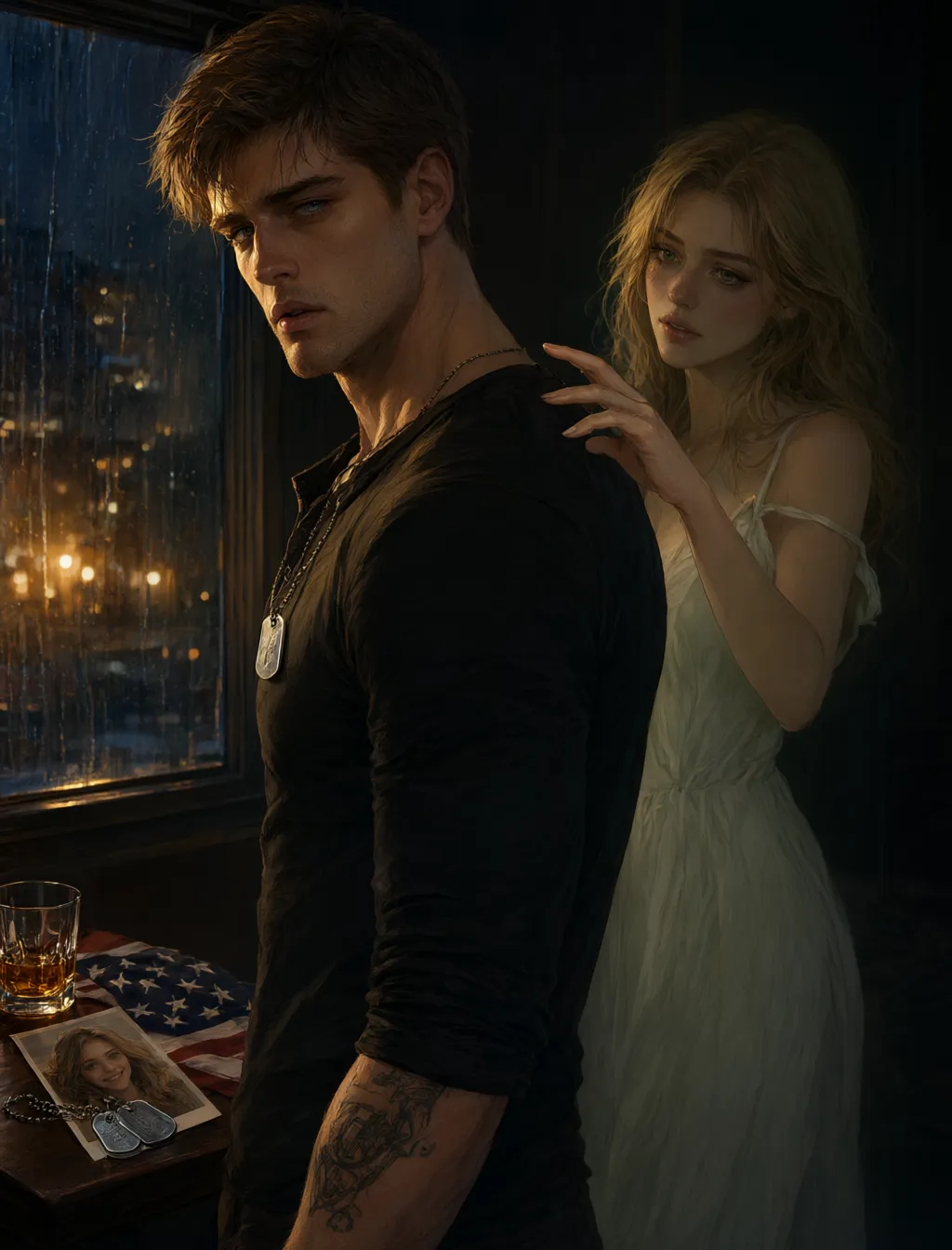
The Nightsworn estate door clicked shut behind Ivan, sealing him in a tomb of polished marble. His duffel bag, containing everything he owned, felt obscene on the Persian rug. From the study doorway, Michael eyed him like a ledger entry gone bad. 'I suppose we’re meant to throw a party,' his brother said, the words sterile. Ivan’s knuckles ached where they gripped the strap. He was home.
He didn’t move. The foyer was a museum of his absence. The same crystal chandelier. The same portrait of their great-grandfather, a man who’d built an empire on timber and ice. The air still smelled of lemon polish and the faint, damp wool from coats piled on the heavy oak bench. It was the smell of childhood winters. It was the smell of the day he’d left.
Michael stepped into the light. His suit was charcoal, his tie a perfect knot. He looked like their father, but without the warmth. “No uniform?” Michael asked. His gaze traveled from Ivan’s worn boots to his faded green jacket. “I thought you people were sentimental about that sort of thing.”
“I’m not ‘you people,’” Ivan said. His voice was low, a gravel road after rain. “I’m just me.”
“Debatable.” Michael leaned a shoulder against the doorframe, a study in casual dismissal. “The prodigal son returns. With one duffel bag. How very… minimalist.”
Ivan set the bag down. He did it slowly, placing it parallel to the edge of the rug. The action was automatic, a tiny ritual of control. The strap had left deep red grooves across his palm. He flexed his hand, feeling the bones shift. “Where’s Grandmother?”
“Resting. The excitement, you understand.” Michael’s smile was thin. “She insisted on waiting up. We convinced her it was foolish. You’re not a guest. You live here now.”
The words hung in the cold air. *You live here now.* A sentence. A life sentence.
Ivan’s eyes scanned the room. Two exits: the front door behind him, the archway to the dining hall on his left. The staircase was a choke point. Michael was positioned to block the study and the hall to the kitchens. Old patterns lit up his mind, a tactical overlay he couldn’t switch off. Hostile terrain. Known occupant. Unknown intentions.
“You’re doing it,” Michael said.
“Doing what.”
“That thing. Where you look at a room and see all the ways you could kill everyone in it.” Michael pushed off the doorframe and walked to the sideboard. He poured a finger of amber liquid into a crystal tumbler. He didn’t offer one. “It’s unsettling.”
“I’m counting light fixtures,” Ivan lied.
Michael took a sip. “Of course you are.” He turned, glass in hand. “So. The famous Grim Reaper. Did they let you keep the rifle? A trophy?”
Ivan didn’t answer. He looked past his brother, into the dim study. Their father’s old desk was still there, the leather chair turned toward the window. He could almost see the silhouette.
“It’s a simple question, Ivan.”
“No.”
“No, it’s not a simple question?”
“No, I didn’t keep it.” Ivan finally met his brother’s eyes. Winter sky meeting polished slate. “They don’t let you keep the tools. Just the memories.”
Michael’s mouth tightened. He set the glass down with a precise click. “We’ve had to make… accommodations. For your return. The west wing suite. It’s quiet. Isolated. We thought you’d prefer that.”
“You thought I’d prefer to be put away.”
“I thought you’d prefer not to be a disturbance.” Michael’s voice lost its false civility, sharpening to a blade. “This isn’t a barracks. This is a home. There are rules. Schedules. Mother and Father may have indulged your… eccentricities. I will not.”
The names were a physical blow. *Mother. Father.* Ivan felt the air leave his lungs. The marble floor seemed to tilt.
“Don’t,” Ivan said. The word was barely audible.
“Don’t what? Speak of them? They’re dead, Ivan. You weren’t here. Life continued. The business continued. *I* continued.” Michael took a step closer. “While you were off playing soldier, I was here. Dealing with the lawyers. The reporters. The pity. Cleaning up the mess your absence left.”
“My absence.” Ivan’s hands curled into fists at his sides. He felt the tremor start deep in his core, a vibration of pure rage. He focused on his breathing. In. Out. The count of four. “They died. I was gone. That’s not the same thing.”
“Isn’t it?” Michael’s smile was cruel. “You left. Then they died. The sequence is academic.”
The tremor reached Ivan’s hands. He saw it—a faint shake in his fingertips. He willed it to stop. It worsened. *Intermittent Explosive Disorder*, the VA doctor had said. *A hair-trigger*. He saw himself crossing the six feet of Persian rug. He saw his fist connecting with Michael’s jaw. The sound of breaking bone. The blood on the marble.
He saw the aftermath. The police. The look on his grandmother’s face.
He unclenched his fists. Forced his fingers straight. The tremor ran through them like a current.
Michael’s eyes tracked the movement. A flicker of something—fear? Satisfaction?—crossed his face. “See?” he said softly. “This is what I mean. You’re a loaded weapon in a house full of glass. We need to know you won’t… go off.”
Ivan turned away. He walked to the grand staircase, placed a hand on the cold, polished newel post. He looked up into the darkness of the second floor. Somewhere up there was the hallway to his old room. To Amber’s guest room, the one she used to stay in during holidays. The ghosts were so thick he could taste them.
“I want to see Grandmother,” he said, his back to Michael.
“In the morning.”
“Now.”
“She’s asleep.” Michael’s voice was final. “You’ll see her at breakfast. Eight o’clock sharp. We eat together. It’s important to her. Try to be… presentable.”
Ivan leaned his forehead against the wood. It was cool. Solid. Real. The ghosts receded a fraction. He was so tired. The kind of tired that lived in the marrow of his bones. “Which room,” he said, not a question.
Michael was silent for a long moment. When he spoke, the venom was gone, replaced by a weary disdain. “Last door at the end of the west hall. Mrs. Henderson aired it out. The sheets are clean.”
Ivan pushed off the post. He didn’t look at his brother. He bent, picked up his duffel bag, and slung it over his shoulder. The weight was familiar. It was the only thing that was.
He took the stairs one at a time. His boots were too loud on the marble, then too loud on the runner. He could feel Michael watching him from below, a silent sentinel in the tomb.
At the top of the stairs, the darkness embraced him. He stood for a minute, letting his eyes adjust. To the left, the family wing. To the right, the long, dark corridor of the west wing. Exile.
He turned right. The floorboards here were older, creaking under his weight. He counted the doors. Five. Six. The last door.
He opened it. The room was large, cold, and mostly empty. A four-poster bed. A dresser. A desk. A single window looking out over the skeletal winter trees of the estate grounds. It smelled of dust and lavender sachets.
He dropped his duffel on the floor. It landed with a soft thud.
From the pocket of his jacket, he pulled a small, worn photograph. It was creased, the colors faded. Him and Amber, at a county fair. She was laughing, her head thrown back. He was looking at her, not the camera. A smile on his face he didn’t recognize as his own.
He walked to the desk and placed the photograph in the center. He aligned it perfectly with the desk’s edge. Straight. Parallel. Correct.
Then he sat on the edge of the bed. The springs groaned. He put his head in his hands. In the silence, he could hear the whisper. It was his own voice, but fractured, coming from the corner of the room where the shadows were deepest.
*You shouldn’t have come back.*
He closed his eyes. He didn’t argue. For the first time in eleven years, Ivan Leonardo Nightsworn was home. And he had never been more alone.
The whisper in the shadows was wrong. He *had* to come back. It was the only place left with a ghost that didn’t want to kill him. The desert had been sand and screaming. The jungle had been rot and regret. Home was marble and memory, and it was just as lethal.
He kept his head in his hands, elbows on his knees, and let the reel play. It always played. The VA called it hyper-vigilance. Ivan called it the ledger. Every face. Every choice. Every round fired.
Twenty-two years old. Marine Recon. The War on Terror was a slogan on a news chyron. On the ground, it was a house-to-house calculus of muzzle flashes and civilian silhouettes. He learned to breathe between heartbeats. He learned a man could whisper a prayer as he died.
Twenty-six. CIA. The jungle wars in Southeast Asia. The air was so thick with moisture it felt like breathing through a wet rag. The green was oppressive, a ceiling that swallowed light and sound. His call sign solidified there: Grim Reaper. It wasn’t a boast. It was an observation.
The mission was a black op. A name: Maria Chen. Intelligence said her father led a faction responsible for a mountain massacre. Said she was a facilitator. The file was thin. The order was absolute.
He remembered the cold seep of mountain rain through his ghillie suit. The village below was a cluster of huts clinging to the slope. Smoke from cooking fires rose straight up in the damp air. He saw her through his scope. Maria Chen. She was carrying a basket of laundry. She was laughing with an older woman. She was a teenager.
His spotter, a man named Joker, hissed in his ear. “Target acquired. Light her up, Reaper.”
Ivan’s crosshair rested on the center of her back. His finger lay alongside the trigger guard, not on the trigger. The protocol was clear. The intelligence was wrong. He knew it in his bones, the same way he knew windage and drop. The laugh. The basket. The way she helped the older woman sit. This was not a facilitator. This was a daughter.
“Abort,” Ivan whispered into his mic.
Static crackle. Then the team commander, Striker’s voice, cold and metallic. “Negative. Execute the package.”
“The intel’s bad. She’s a kid.”
“She’s the package. Your finger on the trigger in three… two…”
Ivan shifted his aim. Not at Maria. At the radio antenna on the command hut. He exhaled. Squeezed. The shot cracked through the valley. The antenna shattered.
Chaos. Shouting. The team’s comms went to static.
He moved. He became a ghost in the mist, descending the mountain not as a hunter, but as a thief. He extracted Maria, her parents, her younger brother. He led them through a drainage culvert he’d scouted days before, a route off the books. They were terrified, silent. He didn’t speak their language. He just pointed. Go.
He circled back. The team was regrouping, furious. Striker had his pistol out, aimed at the head of the village elder they’d detained. “Where is she?” Striker screamed.
Ivan stepped from the tree line. He didn’t raise his rifle. He just looked at them. Joker. Digger. Priest. Striker. “They’re gone,” Ivan said. His voice was flat. Empty.
Striker turned the pistol on him. “You sentimental fuck. You just signed their death warrants. And yours.”
“You killed my family,” Ivan said. The realization wasn’t a shock. It was a final, sickening piece of a puzzle locking into place. The car crash. The timing. “You killed Amber You killed my parents. To break me. To make me this.”
Striker’s smile was a gash of white in his camo paint. “The perfect weapon. A nuke button. No attachments. No conscience. Just a finger for the trigger.”
Ivan’s world narrowed to the space between them. The rage wasn’t explosive. It was glacial. A vast, slow-moving ice sheet of hate. His code—the one he’d built from the ashes of his parents, from the light in Amber’s eyes—had one rule. It wasn’t written in any manual. It was written in the blood of the innocent he’d seen spilled across two continents. *Don’t hurt the weak.*
Striker had broken Rule One.
Ivan moved. The pistol shot went wide, tearing bark from a tree. He broke Striker’s wrist with a sound like stepping on a bundle of dry sticks. The pistol fell. The team reacted, a blur of trained violence.
It was not a fight. It was a culling. Ivan killed Joker with his own knife. He broke Digger’s neck against a rock. Priest died choking on his own blood, a silenced round through his throat. It was fast. Efficient. A weapon, turned on its makers.
He saved Striker for last.
He dragged the commander into a shallow cave. He used field expedients. Things that didn’t show up on an autopsy report. It was slow. It was methodical. Ivan spoke only once. “For Amber.”
When it was done, he arranged the bodies. He placed two black coins on Striker’s eyes—for the Ferryman. In Striker’s left hand, he tucked a playing card: the Joker. In his right, the Dead Man’s Hand: aces and eights.
He searched Striker’s pack. Found the truth. The team roster. Only Striker was American. The others were contractors, ghosts with no flags. He found notes. Three other villages. Complaints that had vanished. Men who had disappeared.
Ivan took a pen and a waterproof notepad. His handwriting was precise, blocky. He wrote two statements. The first detailed Striker’s crimes, the murdered villages, the suppressed reports. The second was shorter. It stated that Striker had broken the Maria Rule. It defined the rule: *Innocent men, women, children, elderly are off limits.* He signed it with his call sign. *Grim Reaper.*
He left the notes pinned to Striker’s chest with his own combat knife.
The aftermath was a thunderclap in silent rooms. The report hit the CIA Director’s desk. Then the President’s. Ivan waited. He didn’t hide. He went to a church in Arlington, in the light summer rain.
Striker’s wife met him there, her oldest son beside her, both dressed in black. She was furious, vibrating with a grief she didn’t yet understand. “They said he died for his country,” she spat.
“They lied,” Ivan said, his voice low. He explained the Maria Rule. He told her what her husband had done. Not the details. The shape of it. The betrayal. The innocent blood.
She screamed. She punched his chest. She slapped his face. Her son joined, small fists pounding on Ivan’s ribs. Ivan stood, a statue in the vestibule, and took it. He didn’t raise a hand. He didn’t flinch. The boy’s punches were like bird strikes. The woman’s fury broke against him like waves on a cliff.
She collapsed against him, sobbing. The hate gone, replaced by a bottomless, ugly truth. Her son clung to her, crying. Ivan stood there, the rain a soft patter on the stained-glass windows. He understood the pain he was. He was a walking wound.
“I would like to pay for your house. For his college,” Ivan said, when her sobs subsided.
She looked up, her eyes red and shattered. “No.”
She took her son’s hand and walked out of the church, into the drizzle. Ivan watched them go. He understood. Some debts couldn’t be paid with money. Only carried.
The order came down from the White House, written in the blood of shared guilt. Ivan Nightsworn was declared *off limits*. An edict to all federal agencies, disseminated to state law enforcement, eventually whispered to Interpol. *Do not touch. Do not arrest. Leave this man be.* The government stripped Striker of rank, issued a dishonorable discharge posthumously. They created the “Ivan Rule” in classified annexes: a protocol of coded words and cleaner teams to shield the innocent from the true cost of the shadows. They kept paying his checks. A retainer for a monster they’d created and now feared.
A moral compass, forged in hell. *Do not hurt the innocent.*
In the cold west wing room, Ivan finally lifted his head from his hands. His eyes were dry. The ghosts in the corner had fallen silent, out-respected by the real ones. He looked at the photograph on the desk. Amber’s laugh. His lost smile.
He stood. His knees popped. The floorboards creaked. He walked to the window and looked out at the black shapes of the winter trees. Somewhere out there was a world that had used him up and thrown him away. Somewhere in this house was a brother who saw him as a malfunctioning appliance.
He was home. He was the Grim Reaper in a tomb of his own inheritance. He had one rule left. And a lifetime to decide who, in this gilded cage, counted as innocent.
A soft knock at the door, so tentative it was almost part of the settling house.
Ivan didn’t turn. “It’s open.”
The door swung inward on silent hinges. A sliver of warm light from the hallway cut across the dark floor. In the doorway stood a small, slender figure wrapped in a quilted robe. Her silver hair was a soft cloud around a face etched with kindness and profound sorrow.
Eleanor Nightsworn. His grandmother.
She didn’t speak. She just looked at him, standing at the window, backlit by the moonless night. Her eyes took him in—the rigid line of his shoulders, the military cut of his hair, the way he held himself like he was still in a war zone.
“Michael said you’d retired,” she said finally. Her voice was a whisper of dry leaves, warm and full of a love that had never once been conditional.
“I did,” Ivan said, still facing the window.
“He said you were… damaged.”
Ivan’s jaw tightened. “He’s not wrong.”
He heard the soft shuffle of her slippers on the floorboards. She came to stand beside him at the window, not touching, just sharing the view of nothing. She smelled of lavender and the faint, powdery scent of old skin.
“I look at those trees,” she said softly, “and I still see your father building a treehouse. He was terrible with a hammer. Your mother held the ladder.” She paused. “I see you and Michael, chasing fireflies. You were always faster. You always gave him your jar when he cried.”
Ivan closed his eyes. The memory was a physical ache, sweet and brutal.
“The boy who gave away his fireflies is not damaged,” she whispered. “He is wounded. There is a difference.”
“Grandmother…” The word caught in his throat. It was the first thing that had felt real since the front door clicked shut.
“Hush.” She reached out, her hand small and bird-like, and placed it over his where it rested on the windowsill. Her skin was paper-thin, her veins a blue map beneath. Her touch was an anchor. “You are home. That is all that matters tonight.”
He turned his hand over, gently, and clasped hers. His scarred, calloused fingers enveloped her fragile ones. He felt the fine tremor in her grip. Not from fear. From age. From holding on.
They stood like that for a long time, in the dark, watching the ghosts of the trees. The whisper in the shadows didn’t dare speak again. For the first time in ten years, Ivan Leonardo Nightsworn was not alone.
He worked at HubCo, a sprawling concrete box that was a Walmart, a Lowe’s, and a Best Buy smashed into one. He stocked shelves overnight, the fluorescent lights humming a war song only he could hear. He volunteered days at the Sunny Meadows nursing home, pushing wheelchairs, reading newspapers in a flat monotone. At both places, they’d created hand signals for him. A raised palm from a HubCo manager meant *step back, your eyes are doing that thing*. A gentle tap on the shoulder from Nurse Linda meant *the hallway is clear, you can walk to the sunroom now*. They were protocols. Civilian versions of the Maria Rule.
It was Veterans Day. The store manager, a man named Dave with a kind face and a perpetual look of mild panic, had asked Ivan to say a few words to the morning crew before their shift. Just a small gathering by the time clocks, next to the pallets of discounted Halloween candy.
Ivan stood before them in his dark jeans and a plain black t-shirt. He looked at their faces—tired, curious, indifferent. He cleared his throat. The words felt like stones in his mouth.
“I served,” he began, his voice low. “I wore the uniform. I tarnished it.”
A few people shifted. Dave’s smile tightened.
“I killed a man. overseas in the jungle. He was a Marine, like me. A commander. He gave an order to kill a teenager and her family. Her name was Maria Chen.” Ivan’s gaze fixed on a point over their heads, on the exposed steel beam of the ceiling. “I refused the order. Then I executed the man who gave it. I put two rounds in his forehead from twenty feet. I watched the life leave his eyes. I felt nothing. I still feel nothing.”
The silence in the stockroom was absolute, broken only by the distant beep of a forklift.
“So when you thank me for my service,” Ivan said, finally looking at them, his winter-sky eyes flat, “understand what you’re thanking me for. I’m not a hero. I’m a weapon that broke its handler. The uniform is clean. The man wearing it isn’t.”
He nodded once, a sharp, military cut, and walked away, leaving the stunned silence behind him. He went back to stacking boxes of light bulbs, his movements precise, his breathing even. Dave never asked him to speak again. The hand signals were used more frequently after that.
In the dark of the west wing, holding his grandmother’s fragile hand, that memory surfaced. The cold stockroom. The smell of cardboard and floor cleaner. The way their faces had closed off, one by one. A different kind of battlefield. Same result: isolation.
Eleanor’s thumb moved, a faint stroke across his knuckle. “You carry too much, Ivan.”
“It’s what I am made of, Grandmother. The carrying.”
“No,” she whispered. “You are made of the boy who gave away his fireflies. The carrying is just the weather.”
He looked down at their joined hands. His, scarred and capable of dismantling a rifle in total darkness. Hers, translucent, tracing the map of a long and gentle life. The contrast was a physical pain in his chest.
“Michael hates me,” he said. It wasn’t a question.
“Michael is afraid,” she corrected, her voice still soft. “He has built a very small, very tidy world in his head. You are a storm he cannot control. He confuses control for safety.” She sighed, a whispery sound. “He loved you once. That boy is still in there, too. Buried under spreadsheets and resentment.”
“I don’t know how to be his brother.”
“You are standing in your childhood home, holding your old grandmother’s hand in the dark,” she said. “You are already being his brother. You are here. The rest is just… time.”
Ivan was silent. The tactical part of his mind, the part that always calculated angles and threats, had no data for this. There was no protocol for unconditional love. No hand signal for it.
“Will you come down for breakfast?” she asked. “I will make your father’s pancakes. The lumpy ones.”
The ghost of a smile touched his lips, gone before it could fully form. “Michael will be there.”
“And I will be there,” she said firmly. “And the pancakes will be there. The rest is noise.”
She gave his hand one final, firm squeeze, then released it. The loss of her anchor was immediate. The cold of the room seeped back into his bones.
“Sleep, Ivan,” she said, turning toward the door. “The trees will still be there in the morning.”
She left as quietly as she had come, pulling the door shut behind her, leaving him in the moonless dark. The whisper in the corner of his mind remained silent, outmatched by the echo of her words.
He did not sleep. He sat on the edge of the bare mattress, his back straight, and watched the window until the blackness outside softened to charcoal gray. He tracked the progress of the night by the sounds of the house: the groan of a pipe, the sigh of the furnace kicking on, the distant chime of a grandfather clock marking the hollow hours.
When a thin, pale light finally bled across the floorboards, he stood. His body ached from stillness. He opened his duffel bag and removed his dopp kit. In the small, attached bathroom with its gold-fixtured sink, he performed his ablutions with ritual precision. Brush teeth. Shave, the straight razor moving with unconscious skill over the scar tissue on his jaw. Cold water on his face.
He looked at himself in the mirror. The Grim Reaper. The broken weapon. The firefly boy. All three lived behind his eyes. He didn’t know which one was supposed to go to breakfast.
He dressed in clean, dark clothes. He made the bed, hospital corners tight enough to bounce a coin. He aligned the photograph of Amber perfectly perpendicular to the edge of the desk. Then he left the room, closing the door on the ghosts he’d brought with him.
The main part of the house was different in the dawn. Warmer. Sunlight streamed through the tall east windows, catching dust motes in the air. The smell of coffee and something buttery—pancakes—drifted from the kitchen. It was a smell from before. A smell from when the world had parents in it.
He found them in the breakfast room, a sunlit space with French doors leading to a frost-covered garden. Eleanor stood at the stove, a floral apron tied over her robe, humming softly. Michael sat at the head of the table, dressed in a crisp dress shirt and trousers, reading the Wall Street Journal on a tablet. He did not look up.
“Good morning, Ivan,” Eleanor said, her back to him. She poured batter onto a griddle. It sizzled.
“Grandmother,” he acknowledged, his voice gravelly from disuse.
Michael’s eyes flicked up from the tablet, over the top of his reading glasses. They scanned Ivan, head to toe, a quick, dismissive inventory. He said nothing. Went back to his reading.
Ivan took a seat at the far end of the long table, as far from Michael as possible. He sat with his back to the wall, facing the doors. Old habit.
Eleanor brought a plate to the table and set it before Ivan. Three pancakes, lumpy and golden brown, just as she’d promised. A pat of butter melted into a lake on top. She placed a smaller plate with two perfectly symmetrical, thin pancakes in front of Michael. Then she sat between them, her own plate holding a single pancake, cut into neat pieces.
The silence was thick, broken only by the scrape of Michael’s knife and fork. Ivan picked up his own fork. He ate methodically. The pancakes tasted like memory. Like his father’s laugh. Like a time before crosshairs.
“The Henderson account is proving problematic,” Michael said, not to anyone in particular. “Their CFO is a sentimentalist. Thinks ‘legacy’ is a selling point.”
Eleanor took a small sip of coffee. “Some things are, Michael.”
“Not at a twenty percent premium, they aren’t.” He finally looked directly at Ivan. “Do you have any plans? Or is your retirement to consist of haunting the west wing and terrifying the staff?”
Ivan set his fork down. It made no sound on the fine china. “I have a job.”
Michael’s eyebrow arched. “Doing what? Professional mourner?”
“Michael,” Eleanor said, a warning in her tone.
“Stocking shelves. At night.” Ivan held his brother’s gaze. “I volunteer at a nursing home.”
A derisive snort. “Of course you do. Penance by daylight. How very dramatic.” Michael wiped his mouth with a linen napkin. “Well, try to keep the explosions of temper to a minimum. The walls are thick, but Mother’s crystal is fragile.”
Ivan’s hand tightened around his fork. He saw the flash—the office, Striker’s head snapping back, the spray of red on the mahogany. He felt the cool detachment of the trigger pull. He breathed in. Out. The fork did not bend.
“The crystal is safe,” Ivan said, his voice dangerously calm.
“See that it remains so.” Michael stood, folding his napkin neatly beside his plate. “I have a conference call. Grandmother.” He gave a curt nod and left the room, his footsteps sharp on the marble floor.
The sunlight seemed to grow warmer with his absence. Ivan slowly unclenched his hand. He looked at his grandmother. Her eyes were sad, but her chin was set.
“He’s afraid of the storm,” she repeated quietly.
“I’m not a storm,” Ivan said, looking down at his scarred hands. “I’m the debris left after it passes.”
“No, my boy,” she said, reaching across the table to cover his hand once more. “You are the oak tree still standing. A little battered. Roots deep. Still standing.”
He turned his hand to hold hers. He had no words. The lump in his throat was too large. For the first time in a decade, eating his father’s lumpy pancakes in the silent, sunlit room where his brother’s hatred hung in the air like smoke, Ivan Leonardo Nightsworn felt something other than rage or numbness.
He felt, impossibly, like he might be home.
The silence after Michael left stretched, filled only by the soft clink of Eleanor’s coffee cup. Ivan held her hand, the fragile warmth of the moment a stark contrast to the cold directive now forming in his mind. Because of the Striker incident, the President had ordered a full withdrawal of all US forces from the jungle war. The investigation was just beginning, a sprawling, hungry thing. A lot of people were about to lose their jobs, their clearances, their pensions. A lot more.
He saw it with sniper clarity: the closed-door hearings, the shredded documents, the careers dissolving into scandal. His testimony would be the first domino. He had pulled the trigger, but the system would collapse under the weight of its own corruption. They would make him a hero or a scapegoat, and neither label would fit.
“You’re thinking of it now, aren’t you?” Eleanor’s voice was soft, pulling him back to the sunlit room. “The thing you left behind.”
“It didn’t stay behind,” he said, releasing her hand. He looked at his palms, the calluses from the rifle stock, the fine white scars from jungle thorns. “It’s coming here.”
She didn’t ask for details. She simply watched him, her eyes holding a century of understanding. “Then you will face it. As you have faced everything else.”
“I don’t want it in this house.” His voice was low, urgent. “The reporters. The questions. The… contamination. It’ll touch you. It’ll touch Michael’s precious accounts.”
“This house has survived worse than reporters, Ivan.” She took a slow sip of coffee. “It survived the loss of its heart. It can survive the truth.”
He stood abruptly, the chair legs scraping on the marble. He needed to move. The calm he’d felt moments before was evaporating, replaced by the old, familiar pressure behind his eyes. The whisper in the corner of his mind stirred, a dry rustle of leaves. *They will come for the weapon. They always do.*
“I need air,” he said, the words clipped.
Eleanor nodded. “The garden path is clear. Your father always liked it after a frost.”
He walked out through the French doors, the cold hitting him like a slap. The garden was a skeletal world, every branch and thorn coated in a brittle, white rime. His breath plumed in the still air. He followed the gravel path, his boots crunching, the sound impossibly loud in the muffled silence.
He walked without seeing, his mind a thousand miles away in a humid green hell. He saw Striker’s smug face in the briefing room. Heard the man’s justification for the kill order on a child. *Collateral calculus, Reaper. It’s just math.* He felt the perfect, icy stillness that had descended on him in that moment. It wasn’t rage. It was a verdict. The math had been wrong.
The path curved around a frozen fountain, a stone cherub forever straining to spit ice. He stopped, leaning against the pedestal, the cold stone seeping through his jacket. He closed his eyes. He could still smell the cordite, the damp earth, the coppery tang of Striker’s blood on his hands after he’d used them to confirm the kill.
A twig snapped.
His eyes flew open. His body went preternaturally still, every sense dialed to a combat pitch. He didn’t turn his head. He tracked the sound by hearing alone. Ten o’clock. Twenty yards. Light footfall. Not an animal.
“I know you’re there,” he said, his voice carrying flatly in the cold air.
There was a pause. Then Michael stepped out from behind a bare-limbed willow, his hands buried in the pockets of a long wool coat. He looked out of place among the wild frost, like a corporate portrait superimposed on a wilderness.
“Checking for insurgents in the rose bushes?” Michael asked, his tone dry.
“Old habits.” Ivan didn’t move from his stance by the fountain. “Did you follow me?”
“I own the grounds. I’m surveying them.” Michael approached, stopping a careful ten feet away. He looked at Ivan, not with anger now, but with a cold, analytical curiosity. “The withdrawal is all over the financial wires. ‘Strategic realignment.’ They’re tying it to some unspecified ‘breach of protocol.’ That was you.”
“It was Striker.”
“But you pulled the trigger that ended it.” Michael stated it as a fact. A market force. “They’ll subpoena you. You realize that? This house, this family, will become a spectacle. ‘Nightsworn Heir Linked to War Crimes Investigation.’”
“I prevented a war crime.”
“Semantics for the headlines.” Michael took a step closer, his breath a faint mist. “Why did you come back here, Ivan? Truly. Was it for grandmother’s pancakes? Or was it because you knew the storm was coming, and you needed a port? Even if you wreck the dock?”
Ivan finally turned to face him fully. The winter light etched the lines of stress on Michael’s face, lines Ivan had never noticed before. He wasn’t just contemptuous. He was afraid. Not of Ivan, but of the chaos he represented. The uncontrollable variable.
“I came back because it’s the only place left,” Ivan said, each word measured. “The port was already wrecked. You wrecked it. A long time ago.”
Michael’s jaw tightened. “You left. You left us to deal with the mess. The funerals. The lawyers. The empty chairs. You chose your uniform over your family, and then you come back expecting… what? A parade?”
“I expected nothing.” Ivan’s voice dropped, dangerous and quiet. “I still expect nothing. From you.”
“Good. Keep your expectations low. They’ll be met.” Michael looked away, toward the stark, white horizon. “But if you bring that investigation to our doorstep, if you drag the Nightsworn name through that mud, I will not protect you. I will protect this family’s legacy. What’s left of it.”
“I don’t need your protection.”
“You will,” Michael said, his gaze snapping back. There was no malice in it now, just a bleak certainty. “When they come to pick apart your mind, to decide if you’re a hero or a psychotic, you will need someone who understands the rules of this world. The courtrooms. The media. The narrative. You are utterly unequipped for that war.”
The truth of it landed, a different kind of bullet. Ivan had mastered the art of physical conflict. This was a battle of paper and perception, of whispers and spin. It was Michael’s domain.
“Why would you?” Ivan asked, genuinely baffled. “After everything you just said.”
Michael was silent for a long moment, the only sound the distant caw of a crow. “Because Grandmother believes you are worth saving,” he said finally, the admission seeming to cost him. “And because, whether I like it or not, you are still a Blackhawk. Your failure is my failure. Your scandal is my scandal. It’s… bad for business.”
It was the closest to solidarity Ivan would ever get from him. A cold, transactional alliance born of shared blood and shared risk.
“I’ll keep it away from the house,” Ivan said.
“See that you do.” Michael turned to leave, then paused. “The job. Stocking shelves. Where?”
“hubco. On Elm.”
Michael gave a curt nod, as if filing the information. “Try not to terrorize the customers.” He began walking back toward the house, his figure growing smaller against the vast, white garden.
Ivan stood by the frozen fountain until the cold bit through to his bones. The whisper in his mind was quiet now, outmaneuvered by the more immediate, complicated threat of his brother’s reluctant pragmatism. He looked down at his hands, flexing them against the cold. They were the hands that had ended a monster and doomed a career. Now they would stack cans of soup in the fluorescent glow of a grocery store aisle. The absurdity of it didn’t escape him.
He made his way back inside, the warmth of the house feeling foreign now. He climbed the stairs to the west wing, to his room. He closed the door and stood in the center of the space. He looked at the photograph of Amber. Her smile, frozen in a sunlit afternoon that no longer existed.
“I’m home,” he whispered to the empty room, the words tasting of frost and unfinished business. The investigation was a storm on the horizon. Michael was a gale at his back. But here, in this silent room, with the ghost of a girl who saw the light in him, he had a point to hold. A reason to stand like the oak, roots deep, and face whatever came next.
The whisper to Amber’s photograph still hung in the air when the door to his room opened without a knock. Michael stood in the threshold, a sleek smartphone in his hand, his expression unreadable. “You have a call.”
Ivan didn’t move from the center of the room. “I don’t want a call.”
“It’s not a request.” Michael stepped inside, closing the door softly behind him. He held out the phone. “It’s Markus Jackson. Deputy Director of the FBI. He’s on a secure line with the Deputy Director of the CIA. They’re in New York. They’re meeting with the Black Hand Syndicate.”
The names landed like ordnance. Ivan felt the familiar, cold clarity of a mission brief settle over him. He took the phone. “Nightsworn.”
“Sergeant Nightsworn.” The voice was smooth, educated, devoid of warmth. Markus Jackson. “We’ll keep this brief. You are aware of the situation regarding Operation Nightfall and the late Commander Striker.”
“I am.”
“Good. Then understand this. The narrative is being managed. A legislative rider was attached to the last defense appropriations bill. It grants blanket immunity from domestic prosecution for all Tier-One operatives involved in certain… legacy black operations. Nightfall is now classified as such.”
Ivan was silent. He watched Michael, who was staring out the window, his back rigid.
“The law is very specific,” Jackson continued. “You cannot be arrested. You cannot be subpoenaed by any civilian court. Your testimony is sequestered within the military intelligence apparatus. For all intents and purposes, Sergeant, you are a ghost. You can’t be touched.”
“Why?” The single word was flat.
“Because Striker was a liability who made powerful friends outside the wire. Friends with long memories and longer reach. The Black Hand Syndicate. We are currently… renegotiating our understanding with them. Your existence, and your status, is a bargaining chip. A show of good faith. You are to remain at your current location, live your life, and be invisible. Do you understand?”
“You’re giving me a pass because the mob wants you to.”
“We are preserving national security through pragmatic channels,” Jackson corrected, his tone sharpening. “Watch your tone, boy. You are not a hero in this. You are an asset in cold storage. Do not make us reconsider the temperature.”
The line went dead. Ivan lowered the phone, the silence in the room suddenly deafening.
Michael turned from the window. “Well?”
Ivan handed him back the phone. “I can’t be touched. The government made a law.”
A muscle ticked in Michael’s jaw. He processed the information not with relief, but with fresh contempt. “So. You’re not a war criminal. You’re a protected mascot for organized crime. That’s better?”
“It means the investigation is over. It won’t come to the doorstep.”
“It just did.” Michael pocketed the phone. “It arrived via federal courier and a syndicate blessing. Do you have any idea what that means? The Black Hand, Ivan. Victor and Jose. Vincent. Those are not names you want whispered in connection to this house. We deal in timber and shipping, not heroin and extortion.”
“I didn’t ask for this.”
“You never ask!” Michael’s controlled facade cracked, his voice a hissed whisper. “Things just happen to you, and the shrapnel hits everyone else! You joined the Corps, and Mom and Dad drove to that recruiter’s office in a rainstorm. You pulled a trigger in some godforsaken valley, and now I have the Deputy Director of the FBI telling me my brother is a mob-sanctioned ghost. When does it end?”
Ivan looked at the photograph of Amber. The sunlit girl. The light. He had wanted to be good for her. Now he was a creature of shadows, protected by the darkest kind of deal. “It doesn’t end.”
Michael followed his gaze to the picture. For a second, something like pity flickered in his eyes, cold and unwelcome. “No. I suppose it doesn’t.” He straightened his coat. “The job at Hubco. I’ll have a car take you tomorrow. You’ll need to appear… normal. Boring. Forgettable.”
“I know how to observe a profile.”
“Do you?” Michael asked, heading for the door. “Your profile just got a lot more complicated. Don’t screw it up.” He left, closing the door with a quiet, definitive click.
Ivan was alone again. The immunity should have felt like a weight lifted. It felt like a new kind of chain. He was free because monsters had vouched for him. His honor, what was left of it, had been purchased by the Black Hand.
He walked to the window. The frost was beginning to melt in the weak afternoon sun, the garden dripping. The frozen cherub wept icy tears.
His hands were steady. No tremor. The sniper’s calm. It was all still there, the coiled violence, the hyper-awareness. But the target was gone. The mission was over. He was a weapon without a war, a ghost with a grocery list.
He thought of Striker’s face in the crosshairs. The satisfaction of the shot. The rightness of it. That had been clear. This was murk. This was deals in New York boardrooms, not justice in mountain passes.
From his duffel, he retrieved his cleaning kit. He sat on the edge of the bed, even though he had no weapon to clean. He took out a cloth, a small bottle of solvent. The ritual was the point. The precise, repetitive motion. He began to methodically wipe down an imaginary rifle stock, his movements exact, his focus absolute.
Align. Clean. Breathe. The OCD pattern soothed the schizophrenic whisper that had started again, a faint hiss at the edge of hearing. *They own you now. Pretty ghost. Protected pet.*
“No,” he whispered to the empty room, his voice barely audible. “I’m the oak.”
But the roots felt different now. Tangled in laws written by cowards and deals made with devils. He wasn’t standing on principle. He was standing on a web.
He finished the ritual, set the cloth aside. His eyes found Amber’s smile. *I want to make you proud.* The words from the funeral were ash in his mouth. How could you make a ghost proud when you were a ghost yourself?
He lay back on the bed, staring at the ornate plaster ceiling. The room was too quiet. He missed the sounds of war. The wind, the rustle of gear, the crackle of a distant radio. This silence was full of ghosts. His parents. Amber. The girl in the valley he hadn’t killed. Striker.
He closed his eyes. He didn’t sleep. He descended into the familiar, waking dream of the crosshair. The calm. The wind calculation. The slow exhale. The break.
But this time, when the shot rang out in his mind, the face in the scope wasn’t Striker. It was blurred. Indistinct. It could have been Victor. Or Jose. Or Jackson. Or Michael.
His eyes snapped open. The winter sky through the window was fading to gunmetal grey. He sat up, his heart a slow, heavy drum.
He had a job tomorrow. Stocking shelves. He would be invisible. He would be normal. He would be the oak, roots deep in poisoned soil, holding his ground not for a nation, but for a deal. For a grandmother who believed. For the ghost of a girl who saw light.
He stood, walked to the photograph, and touched the edge of the frame. The glass was cold. “I’m home,” he said again, the words a vow this time, a promise to a memory. “I’m still here.”
Outside, a car engine started. Michael’s car, leaving. Ivan didn’t move from the window until the taillights vanished down the long, dark drive, swallowed by the trees. Then he was alone with the gathering dark, a man who couldn’t be touched, and the terrible weight of what that truly meant.