
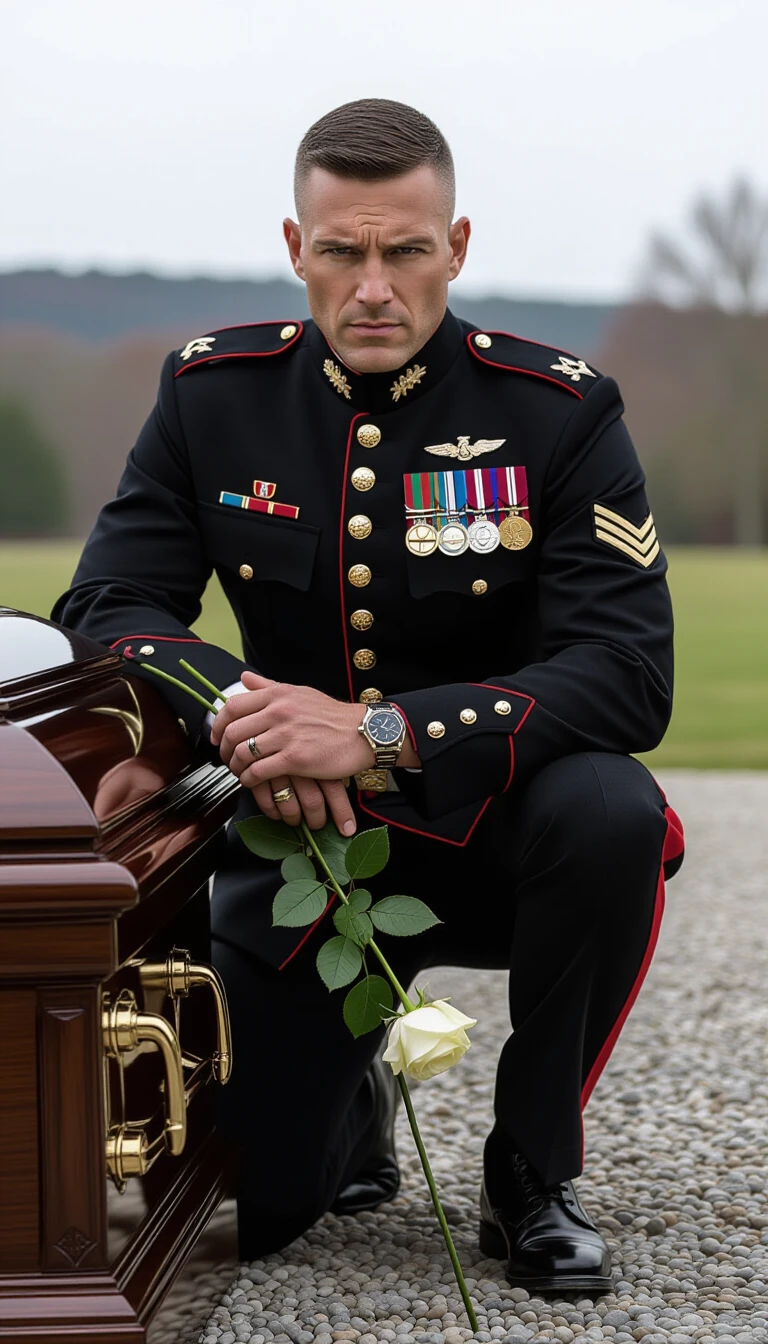
The sheets smelled of stale sweat and last night's takeout. A single streetlamp cut a yellow wedge across the tangled blanket, the radiator clanking in the dark. Ivan lay on his back, one arm thrown over his head, his breathing slow and even. The ceiling above him had a crack that ran from the light fixture to the corner—he'd counted it a hundred times. Forty-seven inches. Maybe forty-eight. He'd measure it tomorrow. He always said he'd measure it tomorrow.
The radiator clanked again. A car passed outside, headlights sweeping across the wall before fading. Ivan's eyes stayed closed, but his thumb tapped against his chest. Once. Twice. Three times. A rhythm he didn't choose, didn't notice, didn't know how to stop.
His mind slipped. The crack in the ceiling became a ridgeline. The distant hum of the city became the wind across a valley he'd never named. His body remembered before his thoughts did—the weight of a rifle that wasn't there, the stillness of a trigger finger that didn't move until the breath was right.
He was eighteen again. Standing in the rain outside the recruitment office, the ink still wet on his papers. His mother had cried. His father had shaken his hand and told him to come home. Amber had kissed him—her lips cold from the November air—and said she'd wait. She'd wait forever if she had to.
Forever was a word eighteen-year-olds believed in.
Parris Island came first. The yellow footprints. The screaming. The sand that got everywhere—between his teeth, in his rifle, under his skin. He'd learned to move before thinking, to strip a weapon blindfolded, to hold his breath until the world went quiet. His drill instructor had called him "Ghost" because he never made a sound. Even when he was running. Even when he was bleeding.
The rifle range was where he found his home. The M40A3—a bolt-action sniper rifle that weighed almost fifteen pounds loaded—settled into his shoulder like it had been made for him. He could feel the wind on his face, read the mirage off the heat-shimmering asphalt, calculate the bullet's drop without touching a calculator. The first time he put three rounds through the same hole at five hundred meters, the range master had stopped the line to watch him shoot the next group.
"You see that?" the master had said, voice flat. "That's what natural looks like."
Ivan hadn't said anything. He'd just cycled the bolt and waited for the next target to pop.
Scout sniper school was worse than basic. The stalk phase—crawling for miles through mud and brush, carrying a rifle and a spotter and enough gear to break a lesser man's back. He'd lain in a drainage ditch for six hours, water seeping through his uniform, mosquitoes drinking from his neck, while an instructor with binoculars scanned the tree line. He didn't move. Not an inch. Not a twitch. When the instructor finally called the stalk complete, Ivan had to be helped to his feet. His legs wouldn't work. His hands were blue.
He graduated top of his class. The SSI—Scout Sniper Instructor—pinned the cross rifles on his collar and said, "You'll do, Nightsworn."
His first deployment was Afghanistan. 2006. The Kunar Valley, where the mountains threw shadows that could swallow a battalion. He'd been assigned to 2nd Battalion, 7th Marines, Charlie Company. His spotter was a kid from Texas named Riley who chewed tobacco and talked too loud. Riley lasted three weeks before an IED took his legs. They sent him home. Ivan got a new spotter—Stevenson Wolf, a Comanche from Oklahoma who didn't talk at all. They didn't like each other at first. Too quiet, both of them. Two silences waiting to see which one would break first.
Neither broke.
The first kill came on a Tuesday. Late afternoon sun, long shadows, a compound in the Korengal Valley. The target was an insurgent commander who'd been routing weapons through the mountains. Ivan had him in the crosshairs for forty-seven minutes. Waiting for the wind to settle. Waiting for the man to stop moving. Waiting for his own hands to stop shaking.
They didn't shake. They never shook.
The shot was 645 meters. A slight crosswind from the west. The bullet dropped twelve inches over the distance. Ivan adjusted two clicks up, half a click left, and breathed out. The trigger broke clean. The man dropped. Ivan cycled the bolt and called it in.
He didn't feel anything. Not then. Not for a long time.
His bunk that night smelled like gun oil and dirt. He lay awake, staring at the canvas above him, and thought about Amber. About her blue eyes. About the way she laughed—a sound that started in her chest and came out like a surprise. He'd written her a letter that morning. Told her about the mountains. Told her he missed her. Didn't tell her about the man. He never told her about the men.
Afghanistan became Iraq. Iraq became Syria. The borders blurred—one desert looked like another, one village like the next. He learned to read the land, to smell the difference between a farmer's field and an ambush. He learned to sleep with one eye open, to eat cold MREs in the dark, to whisper to his rifle like it was a woman he was trying to keep happy.
By the time he was twenty-two, he'd been promoted to Sergeant. His kill count was classified, but the other snipers called him "The Reaper." Not because he enjoyed it—because he never missed. Because the rounds always landed. Because when Ivan Nightsworn pulled the trigger, something died. Every time.
The dream shifted. The mountains flattened. The desert became a city—mud-brick buildings and narrow alleys, the smell of sewage and diesel and something burning. Fallujah, 2007. House-to-house. Room-to-room. He'd traded his rifle for an M4 with an M203 grenade launcher, because sometimes you needed to clear a room from the outside in.
He remembered a boy. Maybe twelve. Standing in a doorway with a rifle that was too big for his hands. Ivan had seen him a second before the boy saw him. The boy's eyes went wide. His finger tightened on the trigger.
Ivan shot him in the chest.
The boy fell backward, the rifle clattering on the concrete. Ivan moved past him, clearing the next room, the next corner, the next threat. He didn't stop. You couldn't stop. Stopping meant dying. Stopping meant the next Marine in the stack took a bullet because you were too busy feeling sorry for a kid who'd been given a gun and told to kill Americans.
But he remembered the boy's eyes. He remembered them for years.
Twenty-two to twenty-six. Marine Recon. The missions got darker, the targets got higher, the stakes got heavier. He learned to jump out of planes, to swim ashore in black water, to move through the jungle like a ghost. His body became a machine—calories in, calories out, sleep when you can, fight when you can't.
The Desert War came next. Not a real war—not one the news called by name. Pakistan, Afghanistan, Kazakhstan, Kyrgyzstan, Tajikistan, Turkmenistan, Uzbekistan. Then the whole Middle East—Iran, Iraq, Syria, Jordan, Saudi Arabia, Yemen, Oman, the UAE. Then North Africa—Algeria, Egypt, Libya, Morocco, Sudan, Tunisia, Western Sahara. It was a war for gas and oil, the brass said, but Ivan never saw a barrel of oil. He saw sand. He saw blood. He saw the inside of a scope for so many hours that he started seeing crosshairs when he closed his eyes.
Stevenson was with him the whole time. They didn't need words anymore. Ivan would look at a ridge, and Stevenson would already be adjusting the scope on his spotting scope. Stevenson would tap his ear once—target left—and Ivan would already be shifting his aim. They were two halves of the same weapon. The shooter and the spotter. The man who saw and the man who pulled the trigger.
Twenty-four years old. The Jungle Wars. Southeast Asia—Vietnam, Laos, Cambodia, Thailand, Myanmar. The Philippines, Indonesia, Malaysia, Brunei, Singapore, Timor-Leste. A three-sided war: US and NATO backing rebels, China backing the government forces, Russia backing the warlords who wanted to rule through fear. Ivan's team operated in the deep jungle, where the canopy was so thick you couldn't see the sky, where the humidity turned your uniform into a second skin, where the leeches dropped from the leaves and drank from your neck while you slept.
He'd killed a man with his hands in Cambodia. A sentry. Close quarters. One hand over the mouth, the other finding the angle of the neck. The man had died in silence—a wet sound, a slump, a body hitting the mud. Ivan had wiped his knife on the man's shirt and moved on.
That was the night he stopped counting.
The dream turned again. He was in the Philippines, on a hill overlooking a valley that was burning. The napalm had turned the trees to torches, and the smoke rose in columns so black they looked solid. His radio crackled with extraction coordinates. His team was down—two dead, one wounded. The wounded man was Jack King, a Navy SEAL who'd been attached to their unit for the operation. Ivan had carried him two miles through the jungle, Stevenson covering their rear, while Jack's blood soaked through Ivan's uniform and dripped onto the leaves.
Jack had lived. They'd become friends. Years later, when Ivan was out and Jack was FBI HRT, they'd still drink together. Still talk about the jungle. Still not talk about the things they'd seen.
Ivan's breathing changed in the dream. Faster. Shallower. The radiator clanked, but he didn't hear it. He was back in the desert, back in the valley, back in the room with the boy who had too-big eyes and a rifle that killed him.
His thumb tapped against his chest. Once. Twice. Three times.
He saw Amber's face. He saw her in the sixth-grade classroom, the first time she'd smiled at him. He'd been sitting alone at lunch, eating a sandwich his mother had packed, and Amber had walked over and sat down across from him like it was the most natural thing in the world. She'd said, "You look like you need a friend."
He'd married her in his head a thousand times. Promised her forever in every letter he wrote. Told her he'd come home, and they'd buy a house with a porch, and they'd have kids, and he'd never pick up a rifle again.
She'd believed him. She'd waited.
And then she was gone. A car. A wall. A phone call that came while he was on a ship in the Pacific, waiting for a mission that never mattered as much as the news that broke him.
He'd finished his deployment. Finished his contract. Walked away from the Corps with a trunk full of medals and a head full of ghosts. No one asked if he was okay. No one ever asked. He was Ivan Nightsworn. He was the Reaper. He didn't miss. He didn't break. He didn't feel.
But he felt. Lying in this bed, in this apartment that smelled like stale takeout and loneliness, he felt everything. The crack in the ceiling. The weight of the ring box in his nightstand drawer. The sound of Amber's laugh that he couldn't quite remember anymore.
The dream faded. The ridges became shadows. The crosshairs became the streetlamp's yellow wedge through his window. Ivan opened his eyes. Gray light filtered through the blinds—early morning, barely dawn. His thumb was still tapping. One-two-three. One-two-three.
He sat up slowly, his joints protesting from a night of lying in the same position. The radiator clanked. A bird sang somewhere outside. The world was still there, still turning, still indifferent to the weight he carried.
Ivan swung his legs over the side of the bed and planted his feet on the cold floor. His rifle case sat in the corner of the room, unopened for months. His medals were in a box in the closet. His uniform hung in a dry-cleaning bag, untouched since the day he'd been discharged.
He reached for his phone on the nightstand. 5:47 AM. No messages. No one needed him. No one was waiting.
He put his hands on his knees and breathed. In through the nose, out through the mouth. The way he'd been taught. The way he'd taught others. The rhythm that kept the ghosts at bay.
The crack in the ceiling was still there. Forty-seven inches. Maybe forty-eight. He'd measure it tomorrow.
He always said he'd measure it tomorrow.
He sat on the edge of the bed, the cold floor seeping through his feet, and let the dream dissolve into the gray morning light. His thumb tapped against his thigh. One-two-three. One-two-three. The rhythm was the only thing that kept the memories from flooding back all at once.
The radiator clanked. A car passed somewhere outside. The streetlamp flickered off as dawn crept through the blinds.
Ivan stood. His joints popped—knees, lower back, the shoulder he'd dislocated in the Philippines. He padded barefoot to the kitchenette, filled a kettle, set it on the burner. The flame caught with a soft whump. He leaned against the counter, arms crossed, and watched the steam begin to rise.
Twenty-six. The Navy SEALs. He'd been recruited by a man named Striker—a CIA handler with cold eyes and a voice like gravel. Striker had sat across from him in a windowless room at Dam Neck, a folder thick with Ivan's service record spread across the table.
"You're too good for the Corps," Striker had said. "Your skills are wasted on conventional ops. We need people who can operate in the dark. People who don't exist."
Ivan had signed. Not because he believed in the mission—because he didn't know what else to do. The Corps had been his home. Amber was dead. His parents were dead. His brother hated him. The only family he had left were his sisters, and they were building their own lives. What was he supposed to do? Go back to counting ceiling tiles at Hubco?
He'd rather be a weapon.
The kettle whistled. He poured water over a tea bag, watched it bloom, wrapped his hands around the mug. The heat bit into his palms. He didn't move.
SEAL training was harder than Marine sniper school. Hell Week broke men who'd survived combat. Ivan had floated through it like a ghost—moving when told, eating when told, sleeping in thirty-minute bursts. The instructors called him "The Reaper" too. He didn't correct them.
He graduated. Joined a team. Operated out of Virginia Beach, then overseas. The missions were black—no records, no acknowledgment, no rescue if things went wrong. He'd learned to speak Mandarin, Vietnamese, and Russian. He'd learned to blend into any crowd, to disappear into any shadow, to kill with anything within reach.
Twenty-eight. The Jungle Wars had escalated. China and Russia were funding proxy forces across Southeast Asia, and the US needed people who could operate in the deep jungle. Ivan was assigned to a joint CIA-SEAL team under Striker's command.
The missions were brutal. They'd hit villages at night, extracting high-value targets, leaving nothing but silence and smoke. Ivan had stopped counting kills before the Jungle Wars. By the time he hit thirty, he'd stopped feeling them too.
His phone buzzed on the counter. A text from Stevenson: Coffee at 0900?
Ivan typed back: Yeah.
He set the phone down. The tea was going cold.
Thirty years old. 2018. The op that changed everything.
Striker had called him into a briefing room at a black site in Thailand. A map of Vietnam was spread across the table, marked with red circles. A village in the mountains. A target: the Chen family. David Chen, his wife Sue, their daughter Maria—eighteen—and their son Lance, fourteen.
"Intelligence says David Chen is a faction leader," Striker had said. "He's been supplying weapons to the Chinese-backed forces. The order is to neutralize the entire family."
Ivan had looked at the photos. David Chen was a farmer. Sue Chen was a teacher. Maria was a high school student with a smile that reminded him of Amber. Lance was just a kid—gangly and awkward, with braces and a shy grin.
"This is wrong," Ivan had said.
Striker had looked at him with cold, flat eyes. "It's an order."
Ivan had done what he was told. He'd led the team through the jungle, through the rain, through the dark. They'd surrounded the Chen house at 0300. Ivan had kicked in the door, his rifle up, his heart pounding in a rhythm he'd learned to ignore.
The house was empty. No weapons. No radios. No evidence of anything except a family living their quiet, ordinary lives.
Ivan had called Striker. "There's nothing here. The intel is wrong."
Striker's voice had been flat. "Follow the order."
The team had found the Chen family hiding in a basement bunker. David Chen had been holding his wife's hand. Maria had been shielding Lance with her body. They were terrified. They didn't speak English. They didn't have guns.
Striker had walked into the house at dawn. He'd pulled a pistol and shot David Chen in the head. Sue Chen had screamed. Striker had shot her too.
Ivan had watched. His rifle had been aimed at Striker's back. He hadn't pulled the trigger.
"Finish it," Striker had said, gesturing at Maria and Lance. "Or I will."
Maria had been crying. Lance had been shaking. They'd looked at Ivan with eyes that said they already knew they were going to die.
Ivan's thumb had started tapping against his rifle's stock. One-two-three. One-two-three.
"What's it gonna be, Reaper?" Striker had said. "Your code doesn't mean a fucking thing. You're a machine. Take your pick."
Ivan had lowered his rifle. He'd turned to Striker and said, "I'm not a machine."
Then he'd killed his entire team.
It had taken seven seconds. Four shots. Four bodies hitting the dirt floor. Striker had been the last one standing, his gun pressed to Maria's head, his eyes wide with disbelief.
"You're dead," Striker had whispered. "You're fucking dead."
Ivan had shot him in the knee. Striker had fallen, screaming. Ivan had walked over, taken the gun from Striker's hand, and pressed it to his forehead.
"You killed my family," Ivan had said. "You told me they died in a car crash. But you killed them. To break me. To make me a weapon."
Striker had laughed—a wet, broken sound. "You figured it out. Took you long enough."
Ivan had killed him slowly. Not for revenge. For the ferryman. For the dead who deserved to be honored.
When it was done, he'd placed two black coins on Striker's eyes. A joker card in his left hand. The dead man's hand—aces and eights—in his right.
He'd walked Maria and Lance out of the village. He'd found a safe house, contacted the CIA's internal affairs division, and told them everything. Striker's body was found. The investigation revealed that Striker had been running unauthorized black ops, killing civilians, fabricating intelligence. The Chen family was exonerated. Striker was given a dishonorable discharge posthumously.
Ivan had walked away from the CIA. From the SEALs. From everything.
He'd gone home. He'd found a job at Hubco. He'd started counting ceiling tiles.
His phone buzzed again. Another text: Jack's coming too. He wants to talk about the farm.
Ivan typed back: See you at 0900.
He set the phone down and stared out the window. The sky was gray, the clouds low and heavy. It looked like rain.
He thought about Maria Chen. She'd be twenty-five now. Married, maybe. Kids. A life he'd saved because he'd refused to be the weapon they wanted him to be.
He thought about Striker's wife, Lynda. And Striker's son, Jacob. He'd met them at a church in 2018, after the dust had settled. He'd told them the truth—that Striker had been killed because of his own choices, that Ivan had been the one to carry out the sentence. Lynda had punched him, kicked him, screamed at him. Jacob had hit him, cried, fallen into his chest. Ivan had stood there and taken it. He hadn't moved. He'd understood.
He'd offered to pay for their house, for Jacob's college. Lynda had said no. They'd walked away into the rain.
Ivan had never seen them again.
He finished his tea, cold and bitter. He rinsed the mug in the sink, set it in the drying rack. He walked to his closet, pulled on a black t-shirt and jeans, laced up his boots.
He looked at the rifle case in the corner. It had been months since he'd opened it. He didn't miss it. He didn't miss any of it.
But the memories didn't stop. They never stopped.
He grabbed his keys, his wallet, his phone. He walked out the door, locked it behind him, and headed for the stairs. The radiator clanked one last time as the door swung shut.
The coffee shop was a ten-minute walk. Ivan took it slow, his hands in his pockets, his eyes scanning the street out of habit. Old habits. Sniper habits. The kind that never died.
He thought about the Maria Rule. That's what they called it now—the order that went out to every federal and state law enforcement agency, to Interpol, to every intelligence service that mattered. Don't hurt the innocent. Don't hurt the weak. Men, women, children, the elderly—all off-limits. The government had created a team of cleaners to make sure the rule was followed. They'd declared Ivan off-limits in blood. Do not touch. Do not arrest. Leave this man be.
He hadn't asked for any of it. He'd just wanted to be good. To be worthy of the people who believed in him.
He still didn't know if he was.
The coffee shop was warm and bright, the smell of fresh grounds hitting him as he pushed through the door. Stevenson was already there, sitting at a corner table, two cups in front of him. Jack was beside him, scrolling through his phone.
Ivan walked over, pulled out a chair, sat down. He wrapped his hands around the coffee Stevenson had ordered for him—black, no sugar—and let the heat seep into his palms.
"You look like shit," Jack said.
"Thanks."
"Seriously. You sleep at all?"
Ivan shrugged. "Some."
Stevenson watched him with those black eyes, the ones that had seen everything Ivan had seen. "You were thinking about the Chen op."
It wasn't a question.
Ivan nodded. "Couldn't stop."
"It's the anniversary," Stevenson said. "Of your parents. Of Amber. Your brain's going to pull up everything."
"I know."
Jack set his phone down. "We need to talk about the farm. About what Eleanor said."
Ivan looked at him. "What about it?"
"She's dying, Ivan. She put you in charge. That means something."
"I know what it means."
"Do you?" Jack leaned forward. "Because you've been running from responsibility since you got out. Hubco. That apartment. Counting ceiling tiles. That's not living. That's hiding."
Ivan's jaw tightened. "I'm not hiding."
"Then what are you doing?"
He didn't have an answer. He looked down at his coffee, watched the steam rise, and said nothing.
Stevenson broke the silence. "We're not here to push you. We're here to help. That's what family does."
Ivan looked up. His throat was tight. "I don't know how to be that. I don't know how to be the person she thinks I am."
"You don't have to know," Stevenson said. "You just have to try."
Ivan held his gaze. The coffee cooled in his hands. The morning light crept across the table, and somewhere outside, a bird sang—indifferent to the weight he carried, but singing anyway.
He took a breath. Let it out slow.
"Okay," he said. "I'll try."
"Okay," Ivan said. "I'll try."
The words hung in the air, thin and insufficient against everything his grandmother had asked of him. Stevenson nodded once, the way he used to in the field when a plan was set. Jack leaned back, his coffee cup finding the table with a soft thump.
"That's all we're asking," Jack said.
Ivan's thumb found the rim of his mug, traced it once, twice, three times. The motion was automatic. The counting was automatic. He didn't stop it.
"I need to know something," Ivan said, looking up. "When you say I've been hiding—how long have you known? Where I was. What I was doing."
Stevenson's black eyes held his. "Since you got back."
"Then why didn't you—"
"Because you weren't ready." Stevenson set his cup down. "And because I knew what you'd done. To Striker. To the team. I knew the Maria Rule existed because of you. I figured you'd earned the time to figure out who you were after."
Ivan looked down at his coffee. The steam had stopped rising. "There's a lot you don't know."
"Then tell us."
He didn't answer right away. The coffee shop hummed around them—the hiss of the espresso machine, a spoon clinking against ceramic, two women laughing at the counter. Normal sounds. Civilian sounds. The kind of sounds he'd spent nineteen years learning to hear through a scope.
"After Striker," Ivan said slowly, "I couldn't stay in the Teams. Couldn't stay in the country. I was a liability. The government didn't know what to do with me, and I didn't know what to do with myself." He paused. "So I left."
"Left where?" Jack asked.
Ivan's jaw tightened. "Everywhere."
The words came out flat, but the memories behind them were anything but. He remembered the first call—a number he didn't recognize, a voice with an accent he'd studied in the sandbox. British. Senior. Someone who knew what he'd done in Fallujah, in the Kunar, in the Jungle Wars. Someone who knew what he'd done to Striker.
They asked if he wanted to keep working.
He'd said yes before he knew what the question meant.
"I was twenty-eight," Ivan said, his voice low. "The Royal Marines recruited me. Mountain Leaders. Their version of recon. I spent two years with them—Scotland, Norway, the Arctic. Learned to move through snow like it was air." His thumb tapped the mug. "Then SBS took me."
Jack's eyebrows went up. "Special Boat Service."
"Yeah." Ivan's eyes stayed on the table. "Two more years. Maritime counter-terrorism. Boarding ops. The kind of work that doesn't make the news." He took a breath. "Then MI6."
The word landed like a stone in still water.
Stevenson's expression didn't change, but something in his posture shifted. "British intelligence."
"They needed someone who didn't exist on paper. Someone with my skill set. I was the only American they'd ever brought into the fold." Ivan's voice dropped. "I did six years for them. Operations across Europe, the Middle East, Southeast Asia. Nothing that connected back to the US. Nothing that would trigger the Maria Rule."
Jack was staring at him now. "How is that possible? How did you get clearance?"
"I didn't need clearance. I was off the books. The British government didn't officially know I existed. Neither did the Israeli government."
A beat of silence.
"Israel," Stevenson said. It wasn't a question.
Ivan nodded. "Shayetet 13. Naval commandos. I was twenty-nine when they took me. Four years. Then Mossad." His eyes lifted. "Keadon unit. The ones who don't exist."
"Jesus Christ," Jack breathed.
"I was thirty-three when I started with them. Did four years. By the time I left, I'd been trained by the best maritime special forces in the world. The best intelligence service. The best direct-action units." Ivan's voice went quiet. "I was the only American who'd ever been cleared for all of it. The only one they trusted to cross those borders."
"Why you?" Stevenson asked.
Ivan met his eyes. "Because I'd already done the thing no one else would do. I'd killed my own team. I'd executed a CIA handler with my bare hands. I had nothing left to prove. They knew I wasn't loyal to any flag—I was loyal to the mission. And they knew I'd never talk."
The words settled into the space between them. A car passed outside. The espresso machine hissed again.
Jack rubbed his face with both hands. "I thought I knew. I thought the Maria Rule was the whole story. I didn't know any of this."
"No one does." Ivan's hand went to his coffee, but he didn't drink. "I retired from US service at thirty-four. British service at thirty-six. Israeli service at thirty-seven. All three countries pay my retirement. Because they know if they don't, I might show up and ask why."
There was no humor in it. Just fact.
Stevenson leaned forward, his braids falling over his shoulders. "You never told Eleanor."
"No."
"Why?"
Ivan's thumb found the rim of the mug again. Once. Twice. "Because she thinks I'm a good kid who always does right. She thinks the Marines made me a better man. She doesn't need to know about the years I spent becoming something else."
"Something else," Jack repeated. "Like what?"
Ivan looked at him. His gray eyes were flat, the color of winter sky. "Like the person who could make the Maria Rule necessary."
No one spoke.
Ivan's hand dropped from the mug. He sat back, let the chair take his weight. "I'm not telling you this to impress you. I'm telling you so you understand what Eleanor put in charge of her legacy. It's not a Hubco janitor. It's not a retired Marine. It's a man who's been trained by three countries to do things most people can't imagine, and who's done most of them."
Stevenson held his gaze. "And that man—does he want to be something else?"
The question hit harder than Ivan expected.
He thought about the boy who'd knelt at three coffins, promising to make his parents and his fiancée proud. The boy who'd wanted to be good. Who'd signed up for the Corps because it was the only way he knew to turn the rage inside him into something useful. Who'd thought if he served hard enough, fought hard enough, bled enough—maybe the voices would quiet. Maybe the counting would stop. Maybe he'd look in the mirror and see someone worthy of the people who loved him.
That boy was still in there somewhere. Buried under nineteen years of kills and compromises and silence.
"I don't know," Ivan said. "I don't know what I want to be. I only know what I don't want to be anymore."
"And what's that?" Jack asked.
Ivan's eyes went to the window. The morning light was brighter now, cutting across the street, catching the dust on the glass. "Alone."
The word hung there, raw and unpolished.
Stevenson reached across the table and gripped Ivan's forearm. The gesture was old, familiar—spotter to shooter, brother to brother. "You're not. You haven't been. You just forgot."
Ivan's throat tightened. He didn't pull away.
"The farm," Jack said, bringing them back. "Eleanor's legacy. The company. That's not just responsibility. That's a chance to build something. With people who love you. With Kimberly and Michelle and Sarah and us." He paused. "You've spent your entire adult life learning how to destroy things. Maybe it's time to learn how to build."
Ivan looked at him. The words echoed something Eleanor had said. Something about pride and purpose and the crack in his chest finally closing.
"I don't know how," Ivan said.
"Neither do I," Jack admitted. "But I'm willing to figure it out. If you are."
Ivan sat there, in the warm coffee shop, with two men who'd crossed continents to find him, who'd sat through a family dinner and a dying grandmother's will, who'd watched him break and stayed anyway.
His thumb found the ring box in his pocket. He didn't pull it out. Just felt the velvet against his fingers, the weight of a promise he'd never gotten to keep.
He thought about Amber. About what she'd say if she could see him now. Not the sniper. Not the killer. Not the man who'd executed a CIA handler with his bare hands. The man who was sitting in a coffee shop, agreeing to try.
She'd smile. She'd call him an idiot. She'd kiss his cheek and tell him he was already worthy.
"Okay," Ivan said again, and this time the word felt different. Heavier. More real. "Let's build something."
The farmhouse kitchen was warm, the kettle still steaming on the stove from when Kimberly had made tea an hour ago. Sarah sat at the table across from Michelle, their voices low, something about the company's quarterly reports and a board meeting neither of them wanted to attend. Kimberly leaned against the counter, arms crossed, her purple eyes tracking Ivan as he walked in from the porch.
Jack and Stevenson stood by the window, coffee mugs in hand, silent in that way men who'd been in combat together knew how to be silent. They'd driven back from the coffee shop with him. They'd sat through the drive without asking questions. They'd walked into the farmhouse and found the women already there, already talking, already waiting.
Ivan stopped in the center of the room. His gray eyes swept the faces around him—Kimberly, Michelle, Sarah, Jack, Stevenson. His thumb found the seam of his jeans and traced it once. Twice.
"We need to talk."
The room went still. Sarah's hand paused mid-reach for her mug. Michelle's orange eyes narrowed. Kimberly straightened off the counter.
"About what?" Kimberly asked.
Ivan pulled out a chair and sat. The wood creaked under him. He didn't lean back. He sat forward, elbows on his knees, hands hanging loose between them. The posture of a man about to confess.
"About who I really am. What I really did." He looked at Kimberly. "You know I was a Marine. You know I was a sniper. You don't know the rest."
Michelle set her mug down. The sound was soft, deliberate. "Then tell us."
Ivan's jaw tightened. He let out a breath, slow and controlled, the kind of breath a man takes before he dives into deep water and doesn't know if he'll surface.
"I joined at eighteen. Standard infantry first, then scout sniper. By the time I was twenty-two, I'd done three tours in the Middle East and North Africa—Afghanistan, Pakistan, Iraq, Syria, Libya, Egypt, Sudan. The Desert War. The oil and gas war that no one called by its real name." He paused. "I was good at it. The best. They called me the Reaper because I never missed. Not once."
Sarah's green eyes held his. She didn't blink.
"At twenty-two, I transferred to Marine Recon. Did that until twenty-six. More deployments. The Stan countries—Kazakhstan, Kyrgyzstan, Tajikistan, Turkmenistan, Uzbekistan. The whole Middle East. North Africa. Every desert, every mountain range, every godforsaken village where someone was pointing a gun at someone else over resources that didn't belong to either of them."
Jack shifted by the window. His coffee had gone cold. He didn't seem to notice.
"At twenty-four, they sent me to the Jungle Wars. Southeast Asia—Vietnam, Laos, Cambodia, Thailand, Myanmar, Indonesia, the Philippines. Three-sided war. US and NATO backing rebels, China backing the government, Russia backing the iron-fist faction. Jungle warfare is different. Closer. Wetter. You feel every kill in your bones and they rot in the heat before you've walked a klick from the body."
Michelle's hand found the edge of the table. Fingers spread. Holding something steady.
Ivan looked at his hands. The hands that had done all of it. "I killed a lot of people. I don't know the number anymore. I stopped counting after the first hundred, and that was before I turned twenty."
"Ivan—" Kimberly started.
"I'm not done." His voice was flat. Not cold. Just flat. The voice of a man who'd learned to separate the telling from the feeling. "At twenty-eight, I was attached to the Royal Marines—Mountain Leaders, SRS. The British version of Recon. Did that until thirty. Then the Special Boat Service. Then MI6. While I was doing the British rotations, I was also attached to Shayetet 13—Israeli naval commandos—from twenty-nine to thirty-three. Then Mossad's Keadon unit from thirty-three to thirty-seven."
Sarah's breath caught. She didn't try to hide it.
"I'm the only American who's been cleared for all of them," Ivan said. "The only one trained by three countries to do things their own citizens don't know about."
Silence filled the kitchen. The radiator ticked. A cricket started up somewhere outside.
"At thirty, I was sent to Vietnam for a black op." Ivan's voice dropped. Not quieter. Colder. The voice of a man walking toward something he didn't want to remember. "The target was a family. Maria Chen. She was eighteen. Her brother Lance was fourteen. Her parents David and Sue. The intel said her father was leading a faction in the mountain raids. He wasn't."
Kimberly's face went pale. She knew what was coming. They all knew.
Striker put the gun to Maria's head, he began, and his mouth was dry remembering. He said, "What's your code now, Reaper? Doesn't mean a fucking thing." He counted down. This was the moment. Pull the trigger, follow orders—or refuse and die with them. The path I took didn't bring them back. Ivan said, "I saved them. All four. I took out my own team—the ones who were going to follow the order. Then I took Striker." He added, "I didn't shoot him," and stared at nothing, gray eyes on something eighteen years gone. "I killed him slowly. To satisfy the reaper. To honor the ferryman, I placed two black coins on his eyes. To honor the joker and the dead man's hand, I put the joker card in his left hand and the dead man's hand in his right. And I left a note."
The silence in the kitchen was absolute. No one moved.
"The note said Striker and his team had killed three other villages before that one. That the military was investigating. That two whistleblowers had disappeared. That the new team wasn't American. And that Striker broke my number one rule—the one I made right there in that hut with Maria Chen's blood still on my hands even though I hadn't pulled the trigger. I called it the Maria Rule." Ivan met each of their eyes. "Don't hurt the innocent. Don't hurt the weak. Don't hurt the innocent men, women, children, or elderly. They are off limits. Always."
Michelle's hands were shaking. She pressed them flat against the table.
"After that," Ivan said, "I started working at Hubco. A normal job. A quiet job. I used hand signals and codes with the team there to help me communicate when the counting got bad. I was hiding. I was good at hiding."
"The government found out what happened," Jack said quietly. It wasn't a question.
Ivan nodded. "The op hit the CIA director's desk and the president's desk. They hid what they could. They created the Ivan Rule—innocent men, women, and children were not allowed to see what happened. Coded words. Coded messages. A team of cleaners to make sure the innocent stayed innocent. And the White House declared me off limits. The CIA declared me off limits in blood. 'Do not touch. Do not arrest. Leave this man be. And if anyone tries, you will be fired.'"
Sarah let out a breath she'd been holding. "Jesus, Ivan."
"Interpol caught wind and issued the same ruling," he continued. "The government still pays my checks. I retired from US service at thirty-four. British service at thirty-six. Israeli service at thirty-seven. All three countries pay my retirement. Because they know what I am, and they know what I'll do if they stop."
Kimberly pushed off the counter and crossed to him. She didn't sit. She stood in front of him, close enough to touch. "The day of the funeral. When you knelt at Mom and Dad's coffin. When you knelt at Amber's. You were already carrying all of this."
"Yes."
"And you said you wanted to make them proud."
"Yes."
She crouched down, bringing her purple eyes level with his gray ones. "Ivan. Look at me."
He did.
"You saved a family. You killed the people who were going to murder innocents. You created a rule that the government adopted. You've spent nineteen years trying to be good while doing things that would break anyone else." Her voice cracked. "You do make them proud. You always have."
Ivan's throat worked. He didn't speak.
Michelle stood. She walked around the table and crouched next to Kimberly, her orange eyes wet. "We're your sisters. We know you. We've always known you. The boy who cried at Mom's funeral. The boy who promised Amber he'd marry her. The man who saved a family he didn't know. That's who you are. Not the Reaper. Not the weapon. You."
Sarah rose too. She came to stand behind them, her hand finding Ivan's shoulder. "You're not alone in this. You never were."
Jack set his mug on the windowsill. "You told me and Stevenson because you needed us to know. You're telling them because they deserve to know. And we're all still here."
Stevenson nodded once. "Still here."
Ivan looked at the faces around him. His family. His chosen family. The people who'd seen him break and hadn't walked away.
"Eleanor can't know," he said. His voice was rough. "Any of this. She thinks the Marines made me a better man. She thinks I've always done right. She needs to keep thinking that."
Kimberly nodded. "Agreed."
Michelle: "Agreed."
Sarah: "Agreed."
Jack: "Agreed."
Stevenson: "Agreed."
The word passed around the room like a vow.
Kimberly stood up, pulled Ivan to his feet, and wrapped her arms around him. She was shorter than him, but she held him like she was the older one. "You're our brother. You're a good man. And we're going to build this legacy together."
Ivan's arms came up slowly, stiff at first, then relaxed into the embrace. His cheek pressed against the top of her head. "I don't know how to build anything. I only know how to destroy."
"Then we'll teach you," Michelle said, moving in to wrap her arms around both of them. "That's what family does."
Sarah joined the huddle, her arms around Michelle's waist. "And when you forget, we'll remind you."
Jack and Stevenson stayed back, but their presence filled the room—solid, unmoving, the kind of men who didn't need to be in the hug to be part of it.
Ivan closed his eyes. He thought of Amber. Of her smile. Of the way she'd looked at him like he was already the man he was trying to become. He thought of his parents, of their pride, of the funeral where he'd promised to make them proud.
He thought of Maria Chen. Alive. Grown. With a life she wouldn't have had if he'd followed orders.
His thumb found the ring box in his pocket. Velvet. Worn smooth from years of touch.
"Okay," he said into his sisters' shoulders. "Let's build something."
Sarah waited until the farmhouse settled into its late-night rhythm—the clatter of dishes in the sink, the low murmur of Jack and Stevenson talking on the porch, the smell of coffee cooling in mugs. Eleanor was in her armchair, knitting needles clicking, her blue eyes half-lidded with the kind of exhaustion that came from revealing a lifetime of secrets in a single evening.
Sarah crossed the kitchen and crouched beside Eleanor's chair. "I have a surprise for you."
Eleanor's needles paused. "At this hour?"
"It can't wait." Sarah's green eyes held the older woman's gaze. "Close your eyes."
Eleanor studied her for a moment—the same way she'd studied Ivan earlier, that grandmotherly assessment that measured more than words. Then she set her knitting aside and closed her eyes.
Sarah took Eleanor's hand. The skin was thin, warm, veined with age. She helped her stand, guided her toward the door, and nodded at Jack as they passed. He moved to the porch, already on the phone, making the call Sarah had arranged hours ago.
The drive was quiet. Eleanor didn't open her eyes. Sarah kept her hand, feeling the slight tremor in those fingers, wondering if this would be the last real surprise she'd ever give the woman who'd held their family together.
They pulled through the checkpoint. The guards recognized Sarah's plates. The gate opened without a word.
"We're here," Sarah said softly. "Open your eyes."
Eleanor blinked. The White House—not from the tourist side, not from the press pool, but from the private entrance, the one reserved for family and guests who arrived after dark. The columns glowed under floodlights. The flag hung limp in the still air.
"Sarah." Eleanor's voice cracked. "What—"
"I told you I had a surprise."
She led Eleanor inside, past the agents who nodded at Sarah with practiced recognition, through corridors Eleanor had only ever seen on television. The air smelled of polish and old wood and something floral from a vase on a side table.
Mark Douglas stood in the doorway of the Yellow Oval Room. He was in shirtsleeves, his long hair loose around his shoulders, a smile breaking across his face before either of them spoke.
"Is that Eleanor Nightsworn?" His voice was warm, familiar—not the president's broadcast voice, but the voice of a man who remembered.
Eleanor stopped. Her hand went to her chest.
Mark crossed the room in three strides and wrapped his arms around her. He was taller, broader, older than she remembered, but the embrace was the same—fierce, unguarded, the hug of a boy she'd once held in her own kitchen.
"It's been a long time," he said into her hair.
Eleanor's arms came up slowly, then tightened. "Mark." His name came out wet. "Look at you."
He pulled back, holding her at arm's length. "Look at you. You haven't changed."
"Liar." She laughed, and tears broke loose, tracking down her cheeks. "I'm old, Mark. I'm dying."
His smile faltered, but he didn't let go. "I know. Sarah told me."
"And you still wanted to see me."
"I always want to see you, Eleanor. You're the reason I'm standing here."
She shook her head. "You did that yourself."
"No." His voice dropped. "When I was nineteen, I showed up at your door with nothing. No family. No plan. You gave me dinner. You gave me a bed. You told me I could be more than what I came from. I don't forget that."
Eleanor's hand found his cheek. "You were always a good boy. Even when you didn't believe it."
Sarah stood at the edge of the room, watching. She didn't interrupt. She'd planned this for weeks—the phone calls, the scheduling, the quiet coordination with Mark's chief of staff. She'd wanted Eleanor to see this before the end. Before the cancer took more than her strength.
Mark guided Eleanor to a chair by the window. The Washington Monument glowed in the distance, a white needle against the dark.
"Sarah tells me you've restructured the company," he said, settling into the chair across from her. "Named the triplets as CEOs."
"Ivan, Michelle, Kimberly." Eleanor nodded. "And Michael's shares were redistributed."
Mark's eyebrows rose. "Michael won't take that well."
"Michael can take it however he likes." Her voice was steel wrapped in velvet. "I've spent eighty years building something. I won't let him tear it down because he couldn't learn to love his siblings."
Mark was quiet for a moment. Then: "Ivan. How is he?"
Eleanor's eyes found Sarah's across the room. "He's carrying more than he should. He always has."
"I heard about what happened overseas." Mark's voice was careful. "The op in Vietnam. The Maria Rule."
"He told you?"
"No. The CIA did. They came to me after he retired from Israeli service. They wanted to know if he was a threat." Mark's jaw tightened. "I told them he was the least dangerous man I'd ever met—unless you gave him a reason to be."
Eleanor let out a breath. "He killed his own team for that family."
"I know."
"He's been trying to be good his whole life. And he doesn't believe he's succeeded."
Mark leaned forward, elbows on his knees. "Eleanor. I know what he did. And I also know what he refused to do. There's a difference. The Maria Rule exists because of him. The government adopted it because of him. He saved that family. And he's spent the last seven years trying to build something instead of destroy it."
Sarah moved closer. "He told us everything tonight. The whole story. The missions, the kills, the op in Vietnam. He sat in the farmhouse kitchen and laid it all out."
"And?" Mark asked.
"And we held him." Sarah's voice was thick. "We told him he's not alone."
Mark's eyes glistened. He blinked, looked away, looked back. "Good. That's what he needs. People who see the whole picture and don't run."
Eleanor reached for his hand. "You're one of those people, Mark. You always were."
He smiled, but it was tired. "I've got a country to run. But I've also got a debt to pay. If Ivan ever needs anything—anything at all—you tell him to call me directly. Not through channels. Not through aides. Me."
Sarah pulled her phone from her pocket. "He'll hear it from you."
Mark raised an eyebrow. "Now?"
"You said directly."
He laughed—a short, surprised sound. "You're as stubborn as your father was."
"I learned from the best."
Mark took the phone. He looked at the screen, at Sarah's contacts, at Ivan's name. Then he pressed the call button and put it on speaker.
It rang twice.
"Sarah?" Ivan's voice came through, rough, wary. He was still awake. Of course he was.
"Ivan." Mark's voice was steady, presidential, but intimate. "It's Mark Douglas."
A pause. Then: "Mr. President."
"I'm sitting with your grandmother in the White House. She looks good. She's crying, but she won't admit it."
Ivan said nothing. Mark could picture him—standing still, phone pressed to his ear, his sniper's stillness locking into place.
"I know about Vietnam," Mark said. "I know about the family you saved. I know about the rule they named after a girl who would be dead without you. And I want you to hear this from me, not from a file or a report: You are not a weapon. You are a man. And men who do what you did, who choose the hard thing over the easy thing—they build legacies."
The silence stretched. Mark waited.
"I don't know how to build anything," Ivan said finally. His voice was barely a whisper.
"That's what your sisters are for. That's what your grandmother is for. That's what Sarah and Jack and Stevenson are for. And if you ever need a hand—if you ever need the full weight of the Oval Office—you call. Not through a secretary. Not through a protocol. You call."
Another pause. Then Ivan's voice, rough, raw: "Thank you, Mr. President."
"Call me Mark. You've earned that right."
The call ended. Mark handed the phone back to Sarah. His hand was steady, but his eyes were wet.
Eleanor stood. She crossed to him and pulled him into another embrace. "You're a good man, Mark Douglas."
He held her tight. "I had a good teacher."
Sarah stepped into the circle, wrapping her arms around both of them. The three of them stood there, in the Yellow Oval Room, under the soft glow of lamps that had lit a hundred years of history.
Outside, the Washington Monument stood watch. The city hummed with the machinery of power. But inside, there was only an old woman, a president, and a woman who'd brought them together.
And somewhere across the river, in a farmhouse that smelled of coffee and cookies, a man who'd spent nineteen years trying to be good put his hand in his pocket, touched a velvet ring box, and let himself believe it might be possible.
Inside the farmhouse, the kitchen had gone quiet. The cookies sat untouched on the counter, the coffee grown cold in their cups. Kimberly stood at the window, her arms crossed, watching the dark yard where the porch light cast a yellow pool onto the gravel drive.
Michelle sat at the table, her fingers tracing the grain of the wood in slow, unconscious circles. "Where is he?" she asked, not looking up.
Eleanor stood by the stove, one hand resting on the worn ceramic handle of a saucepan. She'd been standing there for a while now, her eyes fixed on something none of them could see. "With Sarah and Mark," she said. Her voice was quiet, steady. "He needed to hear it from them."
Kimberly turned. Her purple eyes caught the light. "Hear what?"
"That he's not what he thinks he is." Eleanor's hand moved from the saucepan to the counter, gripping the edge. "That the man who did those things—the killing, the missions, the years of being a weapon—that man isn't the only thing he is."
Michelle lifted her head. Her orange eyes met Eleanor's blue ones. "Did he believe them?"
"I don't know." Eleanor's voice cracked, just slightly. "But he listened. And for Ivan, listening is the first step."
The radiator in the corner clanked. A floorboard groaned under Kimberly's weight as she crossed to the table and sat beside Michelle. "He called us after the funeral. But he wouldn't tell us about the military. Not really. Just pieces."
"He told us tonight," Michelle said. "The whole thing. The Chen family. The Maria Rule. The years of carrying it alone."
"And we held him." Kimberly's voice was raw. "We told him he wasn't alone. But I don't know if he believed us."
Eleanor moved to the table. She pulled out a chair and sat, slowly, her joints protesting. "He will. It takes time. Nineteen years of believing you're a monster doesn't vanish in one conversation." She reached across the table and took both of their hands. "But he's here. He stayed. That's more than he's done in a long time."
The back door opened. Stevenson Wolf stepped in, his braided hair catching the light, his black eyes scanning the room before landing on Eleanor. "He's still on the porch," he said. "Jack's with him."
"Good," Eleanor said.
Stevenson walked to the table, pulled out a chair, and sat. He didn't say anything else. He didn't need to. He rested his forearms on the table and looked at the women before him, his presence solid, unshakable.
"Jack said Ivan's been tapping his thumb against the ring box," Stevenson said. "Three taps, pause, three taps. About five minutes straight."
"His tell," Kimberly said. "When he's trying to decide something."
Michelle's hand tightened around Eleanor's. "What's he trying to decide?"
Eleanor looked toward the window, toward the dark yard and the porch beyond. "Whether to let them in. Whether to let anyone in. Whether to believe that the good he's done outweighs the blood." She paused. "And whether he deserves a life after all of it."
The kitchen was silent. The clock on the wall ticked. Somewhere in the distance, a dog barked, and the sound carried across the fields.
Then the door opened again. Jack King stepped inside, his blue eyes finding Eleanor's. "He's coming in," Jack said. "He's got that look. The one he gets when he's about to say something he's never said out loud."
Eleanor stood. She smoothed her apron, squared her shoulders, and faced the doorway.
Ivan stepped into the kitchen. His gray eyes were dry, but the shadows under them were deep. His hand was in his pocket—the left one, where the ring box lived. He looked at Eleanor, then at Kimberly, Michelle, Stevenson, Jack. His jaw tightened. He pulled his hand out of his pocket and placed the velvet box on the kitchen table.
Everyone stared at it.
"I was going to ask her," Ivan said. His voice was hoarse, barely above a whisper. "The night before they died. I was going to ask her to marry me."
Kimberly's breath caught. Michelle pressed a hand to her mouth.
Eleanor didn't move. She just watched him, her blue eyes steady, her face soft.
Ivan touched the box with one finger. "I've carried this for nineteen years. Through basic training. Through every deployment. Through every mission. Through every time I thought I wouldn't make it back. And tonight, when Mark called, when he said I wasn't just a weapon, I thought—maybe."
He stopped. His hand hovered over the box. The room was still.
"Maybe I can finally let her go," he said. "Maybe I can finally let her be at peace."
He opened the box.
The diamond caught the kitchen light, sending a small prism across the table, across Eleanor's hands, across the worn wood where a hundred dinners had been served and a thousand prayers had been said.
Kimberly reached out and touched the edge of the box. "She would have said yes," she said.
"I know," Ivan said. "That's what makes it so hard."
Michelle stood. She crossed to her brother and wrapped her arms around him, her orange eyes wet. "You're allowed to keep it. You're allowed to put it away. You're allowed to do whatever you need to do."
Ivan hugged her back, his face pressed into her hair. "I don't know what I need," he whispered.
"Then we'll figure it out together," Eleanor said. She stepped forward and placed her hand over his. "That's what family is for."
Ivan closed the box. He held it for a moment, then slipped it back into his pocket.
Outside, the wind picked up, rustling the bare branches of the oak tree. The farmhouse settled around them—the creak of old wood, the hum of the refrigerator, the faint scent of coffee and cookies and the promise of morning.
Sarah Douglas's car pulled into the driveway, headlights sweeping across the kitchen window. A moment later, she stepped through the door, her green eyes finding Ivan's. "Mark wanted me to tell you something," she said. "He said to remember what you told him on the phone. That you don't know how to build anything. He said to look around this room."
Ivan looked. Kimberly. Michelle. Eleanor. Jack. Stevenson. Sarah. Their faces, tired and hopeful, lit by the warm kitchen light.
"He said this is how you build," Sarah finished. "One person at a time."
The kitchen settled into a different kind of quiet. Not the silence of shock, but the stillness of arrival—like they'd all reached the same shore at the same time. Ivan stood with his hand in his pocket, the velvet box a familiar weight against his thigh, and watched Sarah's green eyes hold his.
"One person at a time," he repeated.
Sarah nodded. "That's what he said."
Eleanor moved to the stove, lifted the kettle, poured hot water into a teapot. The ceramic clinked against the counter. "Then we'd better start building." She looked over her shoulder at Ivan. "You've been carrying that ring for nineteen years. You've told us what happened. Now tell us what comes next."
Ivan's thumb found the edge of the box in his pocket. Three taps. Pause. Three taps.
"I don't know," he said. "I've never thought about after."
"Then think now," Kimberly said. She pulled out a chair and sat, her purple eyes fixed on him. "What do you want, Ivan? Not what you owe. Not what you think you deserve. What do you want?"
The question hung in the air like smoke.
Ivan opened his mouth. Closed it. The radiator clanked in the corner, and somewhere in the walls, the old farmhouse settled, wood groaning against the cold.
"I want to sleep through the night," he said finally. His voice was flat, clinical, like he was reading a report. "I want to stop counting the bodies. I want to wake up and not reach for a rifle." He paused. "I want to look at a future that doesn't end with me dead in a ditch."
Michelle reached across the table and took his hand. Her orange eyes were wet. "That's not wanting. That's surviving. What do you want?"
Ivan stared at her. The question hit different the second time—not a request for a list, but a demand for something real.
He thought of Amber. Her laugh, low and rough, the way she'd tuck her hair behind her ear when she was nervous. The way she'd looked at him in sixth grade like he was the only person in the room. He thought of the ring in his pocket, the diamond that had caught a hundred different lights across nineteen years of darkness.
"I want to be worthy of her," he whispered. "I want to be the man she thought I was."
"You already are," Jack said. He'd moved to the doorway, his blue eyes steady, his arms crossed. "You just don't believe it."
Stevenson stood. He walked to the counter, poured himself a cup of coffee, and turned to face the room. "When we were in the jungle, you told me something. You said the dead don't care about our guilt. They only care about what we do with the time we have left."
Ivan's jaw tightened. "I remember."
"Then act like it."
The words were hard, but Stevenson's voice wasn't. It was the voice of a man who'd watched Ivan drag him out of a kill zone, who'd seen him carry a wounded child through a river, who'd stood beside him when the world told them they were monsters.
Eleanor set the teapot on the table. She didn't pour. She just stood there, her blue eyes moving from face to face, reading the room like a map.
"I'm dying," she said. "That's not a threat. That's a fact. And before I go, I need to know that this family won't shatter the moment I'm gone." She looked at Ivan. "You're the oldest grandson. You're the one they'll look to. Not Michael. You."
Ivan shook his head. "I'm not—"
"You are." Kimberly's voice cut through. "You always have been. You just didn't know it."
Michelle squeezed his hand. "When Mom and Dad died, you were the one who held us at the funeral. You were the one who made sure we ate. You were the one who stood between Michael and the rest of us when he tried to sell the company out from under us."
"That was different," Ivan said.
"How?"
He didn't have an answer.
Sarah pulled out a chair and sat across from him. She rested her forearms on the table, her green eyes unblinking. "Mark told me something else. He said the Ivan Law isn't just about what you did to Striker. It's about what you didn't do. You could have walked away. You could have let the Chen family die. You could have followed orders and come home clean. But you didn't."
"I killed my own team," Ivan said. The words came out flat, but his hand was shaking against the table. "I executed a CIA handler. I mutilated a body and left it as a message. That's not heroism. That's—"
"That's justice," Stevenson said. "The kind the system couldn't deliver. The kind that cost you everything."
Ivan looked at him. Stevenson's black eyes held no judgment, no pity. Just the hard truth of a man who'd watched the same wars, carried the same ghosts.
"The Ivan Law exists because of what you did," Stevenson continued. "The Maria Law exists because of what you did. Britain passed it. Israel passed it. Every country with a functioning military looked at what you did and said, 'That's the line. That's where we draw it.'"
Ivan's breath caught. He hadn't known that. He'd been in the dark for so long, hiding from the world, that he'd stopped tracking what the world did with his choices.
"The Supreme Court ruled 9-0," Jack said. "All 534 members of Congress. All fifty state governors. All fifty state legislatures. The President signed it. It's constitutional. It's law."
"They had no choice," Sarah said softly. "The evidence was overwhelming. Striker was a traitor. He was selling weapons to the Black Hand syndicate. He was using CIA resources to run a private war. And when you found out, you didn't go to the press. You didn't go to Congress. You went to him. Alone."
Ivan remembered. The warehouse outside Da Nang. The rain hammering the tin roof. Striker's face when he realized Ivan wasn't there to negotiate.
"He begged," Ivan said. His voice was distant, like he was reading from a file. "He said he had a wife. A son. He said he'd make it right."
"He didn't," Stevenson said. "We checked. After you disappeared, we found his accounts. He had thirty million stashed in the Caymans. He was planning to disappear the next week."
Ivan's hand stopped shaking. He looked at his palm—the calluses, the scars, the fingers that had pulled the trigger a hundred times. "I didn't know that."
"No one did," Jack said. "The CIA buried it. They didn't want the world knowing one of their handlers was running a side business selling weapons to the same people we were fighting."
Eleanor finally poured the tea. The steam rose, carrying the scent of chamomile and honey. She set a cup in front of Ivan, and he wrapped his hands around it, letting the warmth seep into his palms.
"The Ivan Law means you can't be prosecuted for what you did," Sarah said. "It means every kill you made in service of protecting innocents is legally justified. It means the government recognizes that you acted in the absence of lawful authority because the lawful authority had failed."
Ivan stared into the tea. The liquid was amber, almost the same color as the kitchen light. "I didn't do it for the law. I did it because it was right."
"That's why the law exists," Eleanor said. She sat down beside him, her hand finding his shoulder. "Because you did what was right when no one else would."
The kitchen fell silent. The clock ticked. The wind pressed against the windows, and somewhere in the distance, a truck rumbled down a county road.
Ivan took a sip of the tea. It was hot, almost too hot, but he held it in his mouth, let the heat ground him.
"What happens now?" he asked.
"Now," Eleanor said, "you decide what you want to build."
Ivan looked around the table. Kimberly, her purple eyes fierce. Michelle, her orange eyes soft. Jack, his blue eyes steady. Stevenson, his black eyes unreadable. Sarah, her green eyes patient. Eleanor, her blue eyes holding everything.
He thought of Amber. He thought of the ring. He thought of the empty apartment with the streetlamp cutting through the dark.
"I don't know how to build anything," he said. "I've only ever known how to break."
"Then we'll teach you," Kimberly said. "That's what family is for."
Ivan's throat tightened. He set down the tea, pressed the heels of his hands against his eyes, and breathed. The air was warm, smelled of chamomile and coffee and the faint sweetness of last night's cookies.
"One person at a time," he said.
Sarah nodded. "One person at a time."
The farmhouse settled around them, old and patient, holding them in its creaking bones and warm light. Outside, the wind died down, and the first pale light of dawn began to touch the horizon.