
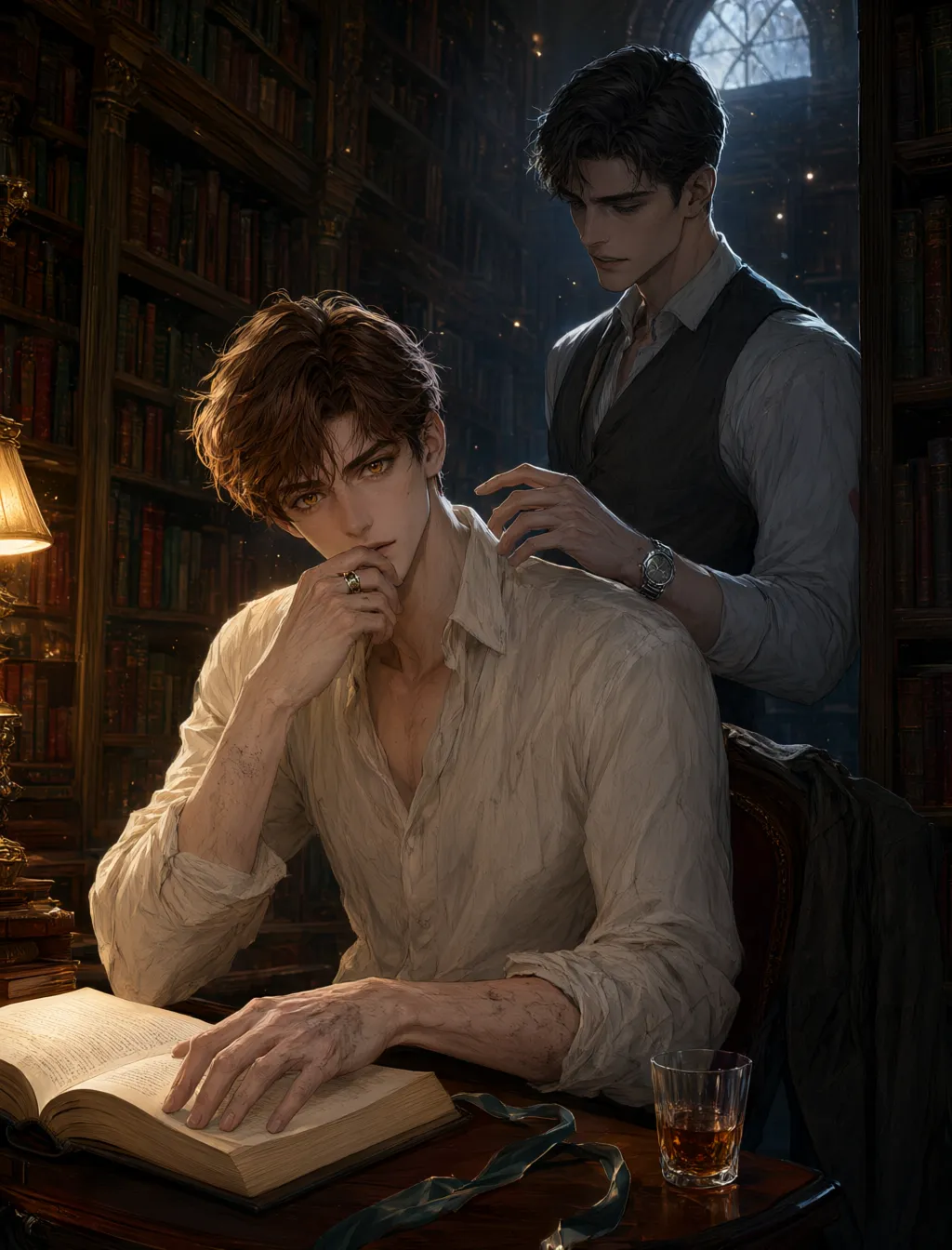
The words sat on the page like they'd been waiting for him all along. Topher traced the Meridian script with the tip of his finger, the ink of the seventh gate's riddle catching the morning light that fell through the high library windows. The voice that has forgotten its own name. He'd read it a hundred times. A thousand. He'd dreamed in its cadence, woken with the syllables still on his tongue, and every time the meaning had slithered away from him like water through a sieve.
But now, with Beck's knee pressed against his beneath the scarred oak table, with the bond-ink on his forearm pulsing warm against his sleeve, the words felt different. They felt like they were waiting for him to stop running long enough to hear them.
"The voice that has forgotten its own name," he murmured, and the ink on his forearm flared hot — Beck's words, Where are you going in such a hurry, Starfire? Slow down., burning against his skin like a brand. Not painful. Just present. A reminder that he wasn't alone in this anymore.
Beck looked up from the bibliography he'd been wrestling with, his storm-gray eyes sharpening. "Say it again."
Topher blinked. "What?"
"The riddle. Say it again." Beck's pen stilled, the nib hovering over the page, and there was something in his voice — a thread of tension, of almost-recognition — that made Topher's chest tighten.
"The voice that has forgotten its own name," Topher repeated, slower this time, letting each word land like a stone dropped into still water.
The bond pulsed between them. Not just on his arm — he felt it in his chest, a low hum that vibrated through his ribs and settled somewhere behind his sternum. Beck's hand found his across the table, warm and sure, and the contact grounded him.
"Say it again," Beck said, and his voice had gone soft, almost reverent.
"The voice that has forgotten—"
"No." Beck's grip tightened. "My name. Say my name."
Topher's throat went dry. "Beck."
The ink on his forearm flared again, hotter this time, and he watched Beck's jaw tighten, watched the way his grey eyes went dark and focused, like he was chasing something just out of reach.
"Again."
"Beckett."
The bond hummed, and Beck's breath caught. "Again."
"Beck." Topher's voice cracked on the syllable, and he didn't know why his hands were trembling, why the library's hush suddenly felt like a held breath around them. "Beck, what are you—"
"The voice that has forgotten its own name." Beck's eyes were blazing now, the grey gone bright and alive. He released Topher's hand and reached across the table, fingers finding the manuscript's edge, tracing the same script Topher had been staring at for weeks. "It's not about a word, Topher. It's about a name. The name someone gave you. The name you stopped answering to."
The library pressed in around them. Somewhere, a page turned. A chair scraped. The sounds were distant, underwater.
"I don't—" Topher started.
"Starfire."
The word hit him like a physical blow. His breath left him in a rush, and the ink on his arm blazed, and he felt it — the shape of something clicking into place, a key turning in a lock he hadn't even known was there.
Beck's voice was barely above a whisper. "You heard me say it. Months ago, in the east stacks. You heard me call you Starfire, and you ran. And I never said it again because I thought—" He stopped, swallowed. "I thought it was one-sided. I thought you didn't want it. But the riddle, Topher. The voice that has forgotten its own name. What if it's not a voice at all?"
Topher stared at him. The manuscript lay open between them, the seventh gate's riddle glowing faintly in the morning light, and he could feel the answer hovering just out of reach, a word on the tip of his tongue that he'd forgotten how to say.
"What if it's a name?" Beck said. "A name that was spoken once, and then never again. A name that the voice itself forgot."
Topher's translator's ring was cold against his finger. He twisted it, the familiar fidget, and the motion caught Beck's eye. Beck's gaze dropped to the ring, then rose again, and something shifted in his expression — a softening, a recognition.
"Who gave you that ring?" Beck asked.
The question came out of nowhere, and Topher's hand stilled. "My father. It was his. He—" He stopped. The watch. The nightstand. The face-down face of the thing that had dictated his life for as long as he could remember. "He was a translator too. Meridian script. He used to say—"
The words died in his throat.
Beck leaned forward, his elbows on the table, his grey eyes intent. "What did he say?"
Topher's fingers curled around the translator's ring, the metal warming against his skin. The library's morning light had shifted, slanting across the scarred oak table and catching the dust motes that hung in the air between them. He could feel Beck's patience like a physical thing, a held stillness that didn't push, didn't rush, just waited.
"He used to say that a name was a promise," Topher said, and his voice came out rougher than he'd intended. "That you carried it the way you carried a key. That it opened doors, but only if you remembered which lock it belonged to." He laughed, a short, hollow sound. "I thought it was just another one of his aphorisms. The sort of thing you say to a child to make them feel important."
Beck didn't look away. "And now?"
Topher's gaze dropped to the manuscript, to the riddle that had been eating at him for weeks. The Meridian script seemed to shimmer in the light, the characters shifting like water catching a current. "Now I think he was trying to tell me something. About the bond. About—" He stopped, the words catching in his throat.
"About you?" Beck finished, and his voice was gentle, so gentle it made Topher's chest ache.
Topher didn't answer. He couldn't. Because the shape of the thought was there, just out of reach, and every time he tried to grab it, it slipped away like the meaning of the riddle itself.
The silence stretched between them, filled with the soft rustle of pages and the distant murmur of the library's other occupants. Somewhere across the room, a cart creaked as someone shelved books. The clock on the far wall ticked, measuring out the seconds of Topher's four-day deadline.
"Beck," Topher said, and the ink on his arm flared, a warm pulse that matched the beat of his heart. "What if I've been reading it wrong? The whole time. What if the gate doesn't want a translation at all?"
Beck's brow furrowed. "What do you mean?"
"I mean—" Topher pushed his chair back, the legs scraping against the floor. He stood, pacing the short length of the table, his fingers running through his disheveled hair. "The seventh gate. Everyone who's tried to translate it has failed. Every scholar, every mage, every translator who's ever come near it. They all treat it like a puzzle. Like a code to be broken. But what if it's not a code?"
He stopped at the window, staring out at the quad below. Students crossed the grass, their heads bent together, their lives so ordinary and so far from this. "What if it's a door that only opens when someone speaks to it in the right voice?"
Beck rose from his chair, the motion slow and deliberate. He crossed the room until he stood beside Topher, close enough that their shoulders almost touched. "You think the gate is listening."
"I think the gate is waiting." Topher turned to face him, and the morning light caught Beck's face, illuminating the sharp lines of his jaw, the softening around his eyes. "Waiting for someone to call it by its name. The name it forgot."
Beck's hand found his, fingers threading through Topher's, warm and grounding. "And you think you know the name."
Topher's throat tightened. "I think I might be the voice."
The words hung between them, heavy with implication. The bond pulsed on his arm, a steady warmth that seemed to answer his confession, and Beck's eyes went wide, the grey brightening with something that looked like wonder.
"Say it," Beck said, and his voice was barely a breath. "Say the name."
Topher opened his mouth, but the word wouldn't come. It sat at the back of his tongue, a shape he knew but couldn't voice, a sound that belonged to a self he'd buried years ago. He closed his eyes, and the library dissolved around him, replaced by a memory: his father's study, the smell of old paper and pipe smoke, a child's voice reading aloud from a Meridian manuscript, stumbling over the syllables.
"You're not reading it right," his father said, and the memory was so vivid Topher could almost feel the weight of his father's hand on his shoulder. "Meridian isn't a language of words. It's a language of names. Every character is a name for something real. You have to speak it like you mean it."
"But I don't know what it means," the child in the memory said, and his voice was high and uncertain.
"Then find out. That's what translators do. We don't just move words from one language to another. We move meaning. We carry the voice of one world into another."
Topher's eyes snapped open. The library rushed back in, the light, the dust, the smell of old paper, and Beck's hand still warm in his, Beck's eyes still watching him with that fierce, patient attention.
"He called me by my name," Topher said, and his voice shook. "My real name. Not Christopher. Not Topher. The name he gave me when I was born, the one he used when he was proud of me, the one I stopped using after he died because it hurt too much to hear it in my own head."
Beck's grip tightened. "What was it?"
Topher opened his mouth, and the word came out like a stone dropped into still water, sending ripples through the silence. "Kaelen."
The ink on his forearm blazed, a searing heat that made him gasp, and Beck's hand flew to his own collarbone, his fingers pressing against the words inked there. The bond between them vibrated, humming like a plucked string, and the manuscript on the table began to glow, the Meridian script lighting up from within.
"Topher—" Beck's voice was strained, his eyes wide. "The gate. Look at the gate."
Topher turned, and the seventh gate's page was blazing, the characters shifting and rearranging themselves before his eyes, the script transforming into something new, something legible, something that had been waiting for this moment all along.
The words resolved into a single line, written in a hand he knew better than his own. His father's hand. The same hand that had taught him to read, to translate, to carry meaning from one world into another.
Kaelen. The voice that remembers. Open.
The library's hush deepened, and Topher felt the gate swing open inside him, a door he'd forgotten he'd locked, a room he'd been too afraid to enter. And standing in the doorway, watching him with eyes full of quiet pride, was the ghost of his father.
The ghost did not speak. He simply stood there in the spill of morning light, wearing the same worn cardigan Topher remembered from childhood—elbows patched with leather, the collar frayed from years of being tugged when his father was thinking. He looked exactly as he had the last time Topher saw him, which was to say: alive. Utterly, impossibly alive, standing in the doctoral library with dust motes drifting through him like he was made of the same light that fell through the high windows.
Topher's knees gave out. He didn't feel himself fall—one moment he was standing at the window, the next he was on the floor, the scarred oak table's edge pressing into his back, Beck's name on his lips in a voice he didn't recognize as his own. "Beck. Beck, do you see him?"
Beck was already there, dropping to his knees beside him, one hand finding the back of Topher's head, the other gripping his shoulder. "I see him," Beck said, and his voice was steady, so steady it anchored Topher to the present moment. "I see him, Topher. He's real."
The ghost took a step forward, and the floor didn't creak. That was what undid Topher—the absence of sound where there should have been the familiar groan of old boards, the weight of a man who had once filled every room he entered. His father moved like light through water, and when he stopped at the edge of the table, his gaze dropped to the manuscript, then rose to meet Topher's.
"You found it," his father said. His voice was exactly as Topher remembered it—warm, rough at the edges, the voice of a man who had read him bedtime stories in Meridian script until he fell asleep. "I knew you would. I always knew."
Topher's throat closed. The words wouldn't come. He was twenty-six years old, a doctoral translator, a star mage, a man who had spent years building walls around the name his father had given him—and he was five years old again, sitting on the floor of his father's study, watching the man who had taught him everything he knew about the world look at him with pride.
"Dad," he managed, and the word came out broken, cracked down the middle. "You're—you're not—"
"Dead?" His father smiled, and the expression was so familiar it hurt. "No. I'm not. But I'm not alive either, not the way you are. I'm what's left of a promise." He gestured at the manuscript, at the glowing line of script that bore his handwriting. "The seventh gate was never a riddle to be solved. It was a door I left open for you, son. A way back."
Beck's grip on Topher's shoulder tightened. "A way back from where?"
His father's gaze shifted to Beck, and something in his expression softened. "You must be Beckett. He wrote about you. Every letter, every page—he never stopped writing about you."
Beck's breath caught. "He—"
"The notebook," Topher said, and his voice was barely a whisper. "The one in my drawer. You—" He stopped, the shape of the thought clicking into place. "You knew. You knew before I did."
"I knew you were searching for something you couldn't name," his father said. "I knew the bond was there, waiting, and that you were too afraid to reach for it. So I left you a door. The seventh gate. The voice that has forgotten its own name." He took another step closer, and Topher could see the light moving through him, the edges of his form soft and luminous. "You forgot your name, Kaelen. You forgot the name I gave you, the one that meant you were mine. And you forgot the name you gave yourself, the one you wrote in every letter you never sent."
Topher's hand moved to his chest, pressing against the place where his heart was hammering. "I don't—"
"Beckett," his father said, and the name fell into the silence like a bell. "Say it. Say it the way you wrote it. The way you meant it."
Topher turned to Beck, and Beck was watching him with those storm-gray eyes, open and raw and waiting. The bond pulsed on his arm, warm and insistent, and he could feel it—the shape of the name on his tongue, the one he'd written a thousand times in his notebook, the one he'd whispered to himself in the dark when he thought no one was listening.
"Beckett Marlow," Topher said, and the ink on his forearm blazed. "My—" He stopped, the word catching. "My soulmate. My—"
"Say it," Beck whispered, and his voice cracked. "Please."
"My heart," Topher said, and the bond between them flared so bright he had to close his eyes. "My heart, Beckett. You're my heart. You've always been my heart. I just—I forgot how to say it out loud."
When he opened his eyes, his father was smiling, and there were tears on his face that didn't fall, just gathered at the corners of his eyes like morning dew. "There it is," he said softly. "There's my son."
The manuscript blazed brighter, the Meridian script shifting and rearranging itself one final time. The words resolved into a new line, written in his father's hand, and Topher read them aloud without meaning to, the syllables rising from his chest like they'd always been there:
" The voice that remembers its name opens the gate. And the gate opens to the one who was never lost. "
The light swelled, filling the library, and Topher felt the gate swing fully open inside him—not just a door, but a room, a whole house, a self he'd locked away years ago. And standing in the center of it, watching him with eyes full of quiet pride, was his father.
"I have to go," his father said, and his voice was growing fainter, the edges of his form beginning to dissolve. "But I'm not leaving you, Kaelen. I'm just—I'm going where I've always been. In the words. In the translations. In the name you carry."
"Dad—" Topher lunged forward, reaching for him, but his hands passed through empty air. His father smiled one last time, and the expression was so full of love it broke something open in Topher's chest.
"You were never lost," his father said. "You were just waiting to be found. And he found you. You found each other."
The light dimmed. The ghost faded, and the library rushed back in—the smell of old paper, the distant murmur of other patrons, the clock on the far wall ticking past the hour. Topher was on his knees on the floor, Beck's arms around him, Beck's voice in his ear, saying his name over and over like a prayer.
"I'm here," Beck was saying. "I'm here, Kaelen. I've got you."
Topher turned into him, burying his face in the hollow of Beck's shoulder, and the tears came—not the quiet, controlled kind he'd learned to shed in private, but the messy, desperate kind that shook his whole body. Beck held him through it, one hand in his hair, the other pressed flat against his back, and the bond between them pulsed steady and warm, a heartbeat that matched his own.
When the tears finally slowed, Topher pulled back just enough to look at Beck's face. The grey eyes were bright, wet at the corners, and there was a tenderness there that Topher had never let himself see before—or maybe he'd always seen it and just never believed it was real.
"The gate," Topher said, his voice hoarse. "It's open. I—I solved it."
Beck laughed, a wet, unsteady sound. "You didn't solve it, love. You remembered it." He pressed his forehead to Topher's, and the contact sent a shiver through them both. "You remembered your name. You remembered me."
Topher's hand found Beck's, their fingers threading together, and he looked down at the manuscript on the table. The seventh gate's page was no longer glowing, but the words were still there, written in his father's hand, a message from a man who had crossed the boundary between worlds to tell his son he was proud of him.
"He knew," Topher said quietly. "He always knew. About the bond. About you. About—" He stopped, the words catching. "He left the door open for me. All this time, he was waiting for me to walk through it."
Beck's thumb traced a circle on the back of Topher's hand. "What happens now?"
Topher looked at the manuscript, at the deadline still looming, at the three unsolved gates and the bibliography that wouldn't format. Then he looked at Beck, at the man who had been waiting for him for years, who had written his name in letters he never sent, who had called him Starfire in a whisper and then gone silent for months because he thought the love wasn't returned.
"Now," Topher said, and his voice was steady, sure, the voice of a man who had finally found his name. "Now I think we finish the translation. Together."
The bond pulsed between them, warm and alive, and Beck smiled—a real smile, the kind that reached his eyes and softened the sharp lines of his face. "Together," he echoed, and the word settled between them like a promise.
The manuscript lay open on the scarred oak table, the seventh gate's riddle resolved at last, and the morning light fell across the pages like a blessing. Topher's father's watch lay face-down on the nightstand in his apartment, a weight he no longer needed to carry. And on Topher's arm, Beck's words glowed steady and warm: Where are you going in such a hurry, Starfire? Slow down.
For the first time in years, Topher wasn't in a hurry. He had a name. He had a soulmate. And he had a gate that had finally, finally opened.