
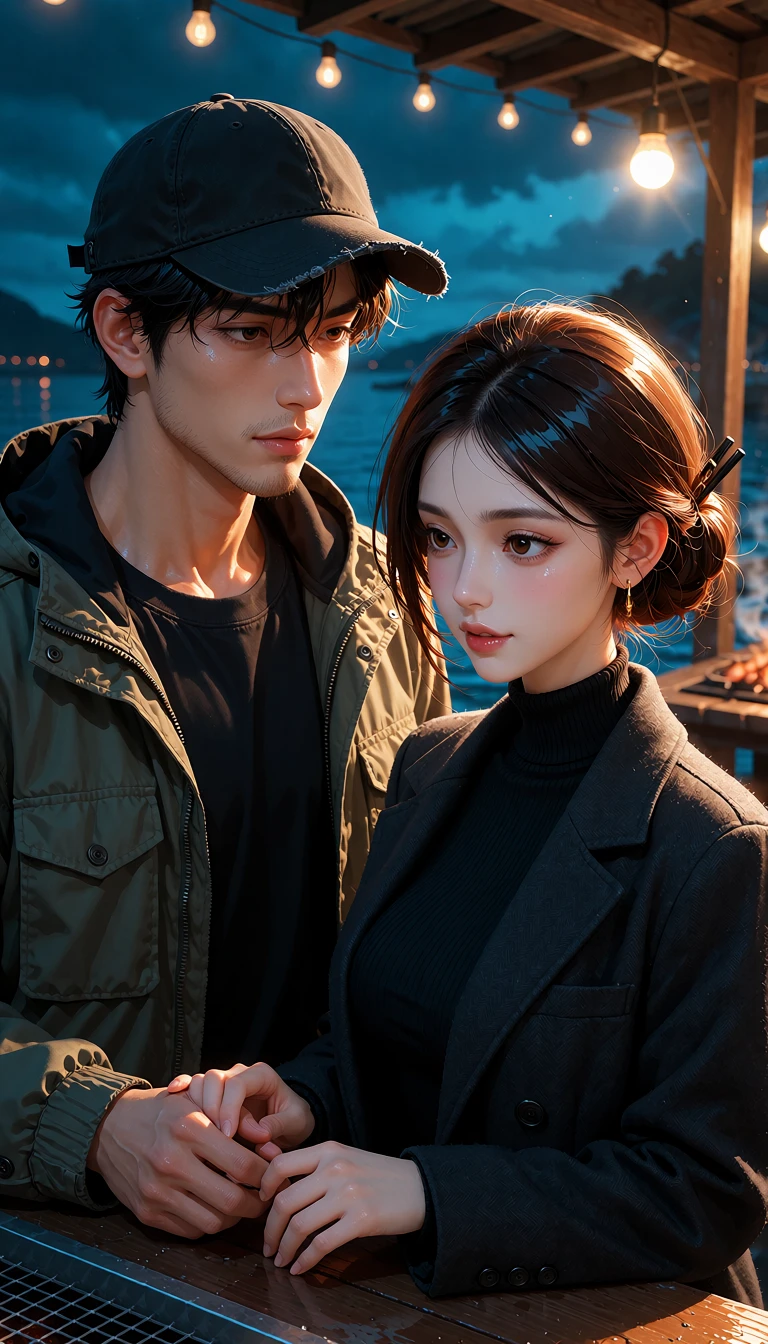
The air hung thick with stale pizza and hot electronics, the faint ozone tang of overheating PCs cutting through the humid musk of five bodies crammed into the windowless room. Kies had been in this chair for eleven minutes. He knew because the clock on the manager's desk — a cheap digital thing with a cracked face — sat angled just enough for him to read it without turning his head. Eleven minutes of listening to a man who hadn't once looked above his chin.
The contract lay between them on the desk, one page, the letterhead already curling at the corner from the humidity. Kies had read it twice. The number printed next to "Monthly Stipend" was smaller than what he'd made last month streaming from his bedroom, and he didn't stream much.
"It's a starting figure," the manager said. His name was Deng, or maybe Dang — Kies had stopped listening somewhere around the third time the man had said "opportunity." Deng wore a polo shirt with the org's logo stitched over the breast, a stylized fox that looked like it had been drawn in a free trial of some design software. "There's performance bonuses. Tournament winnings, we split sixty-forty. In your favor."
Kies didn't touch the contract. He looked at the manager's hands instead — the way Deng's fingers kept finding the edge of his keyboard, tapping it, retreating. A nervous habit. Or a lying one. Hard to tell in a room this small.
"Sixty-forty," Kies repeated. Flat. Not a question.
"In your favor," Deng said again, and this time his eyes flicked up — just to Kies's collarbone, no higher — before sliding back to the desk.
The room had one window, painted shut and covered by a poster of a team that had disbanded two years ago. Kies recognized two of the faces. One of them had signed with a Chinese org and never placed above top eight at a major. The other had quit to sell insurance. The poster's corners had gone yellow.
"What happened to them?" Kies asked, nodding at it.
Deng turned, glanced, turned back. "Roster changes. It happens."
"They were your team."
"They were a team."
Kies leaned back in the chair. It creaked — a cheap office chair, the kind with fake leather that peeled in the summer. He could feel the sweat starting at the small of his back, soaking into his t-shirt. The air conditioning unit in the corner rattled like it was dying, pushing out air that was barely cooler than the room. Somewhere beyond the door, a player was yelling at a monitor, something about a missing stun, his voice tinny through cheap headphones.
"You scouted me for three months," Kies said.
"We did."
"You watched my pubs. You messaged my Discord. You sent me that highlight reel, the one with the Invoker game against Solitude."
Deng's jaw shifted. "You're a talent. That's not in question."
"Then what's in question?"
"Nothing's in question. This is a standard entry offer for a player with no pro experience."
Kies picked up the contract. One page. He held it by the corner, let it dangle, let Deng watch him read the number again. Twelve thousand a month. For a top-fifteen Immortal midlaner in a region where the minimum salary for a Tier-2 org was forty. He'd checked. He'd checked before he walked in, because he wasn't stupid, and because a part of him had wanted to be wrong.
He set the contract back down. Slid it across the desk with two fingers. Didn't say anything.
The silence stretched. Deng's fingers stopped tapping the keyboard. He looked at the contract, then at Kies's hand still resting on it, then finally — finally — up at Kies's face. His eyes were pale, washed out under the fluorescent light, and they held for maybe two seconds before dropping again.
"That's your answer?"
Kies didn't move.
"You understand what you're turning down." Deng's voice had changed. The rehearsed warmth was gone, replaced by something flatter. "You're rank twelve. Congratulations. You're also twenty years old with zero LAN experience, zero official matches, zero anything that matters to a sponsor. You think orgs are lining up?" He laughed — a short, ugly sound. "I did you a favor bringing you in here. Most managers wouldn't waste the meeting."
Kies stood up. The chair scraped against the floor, a sound like a nail dragged across concrete. He was taller than Deng by half a head, and the manager had to tilt back to keep his eyes on him — which he didn't, actually. He looked at the contract instead, still lying on the desk between them, one corner curled up like it was trying to leave on its own.
"You're not the first," Kies said.
"What?"
"This month. You're the fourth."
Deng's mouth opened, closed. Behind him, the AC unit rattled and spat out a puff of warm air.
"Three other orgs," Kies went on, reaching for his cap on the corner of the desk. It was a plain black baseball cap, the brim frayed, the adjustable strap at the back held together with a safety pin. He'd had it since high school. He pulled it on, tugged the brim low. "All of them said the same thing. No pro experience. Take the entry offer. Prove yourself." He adjusted the strap without looking at it, the motion automatic. "None of them could tell me what proving myself would actually pay."
"That's how it works."
"No," Kies said. "That's how it works for people who don't have options."
He turned toward the door. The handle was loose — he could feel it shift under his palm before it caught, the whole mechanism wobbling like it had been repaired with tape and hope. The corridor beyond was narrow, lined with more posters, more dead teams. A kid in a hoodie walked past with a bowl of instant noodles, steam curling up into his face, and didn't look at Kies at all.
"Novak."
Kies stopped. Didn't turn around.
"You walk out that door, you're done. You understand me? Word gets around. Difficult player, no experience, thinks he's worth more than he is. Nobody's going to touch you."
Kies looked at the doorframe. There was a scuff mark on it, low down, like someone had kicked it. The paint was chipped. He thought about the number on that contract, about the way Deng's eyes had slid off his face every single time he spoke, about the poster of the disbanded team and the way Deng had said they were a team like it was a correction.
He didn't say anything. He pulled the door open and stepped through.
The corridor smelled like instant noodles and floor cleaner, the two scents layered on top of each other without ever mixing. Kies walked past a room with the door open — four setups, four kids, one of them yelling into his mic about a support who'd rotated too late. None of them looked up. The org's logo was stenciled on the wall in peeling vinyl, the fox's eye already gone.
At the end of the corridor, a glass door led out to the street. Kies pushed it open and the night hit him — cool, wet, the air heavy with the smell of rain that hadn't fallen yet. The sidewalk was slick with humidity, reflecting the orange glow of a streetlight. Across the road, a noodle stall was still open, steam rising off the pot in slow curls, the vendor ladling broth into a bowl for a customer who sat on a plastic stool with his back to the street.
Kies stood there for a moment. Let the door swing shut behind him. The glass rattled in its frame.
His phone buzzed in his pocket. He pulled it out — a notification from Discord, a DM from an account he didn't recognize. Hey man, saw your pubs. We're building a roster for the open quals, think you'd be a good fit. Offer attached. He didn't open it. He'd seen enough offers this month to know the shape of them. The number was always smaller than the respect.
He put the phone back in his pocket.
The street was quiet. A scooter hummed past, its headlight cutting a cone through the damp air. The noodle vendor called out to someone in the stall, his voice carrying across the road, and the customer on the stool laughed at something. Ordinary sounds. Ordinary night.
Kies pulled his cap lower. The brim cut a line across his vision, the street reduced to a strip of wet asphalt and orange light. He thought about the contract on the desk, one page, curling at the corner. He thought about Deng's pale eyes and the way they'd never quite landed. He thought about the poster of the disbanded team, the two faces he recognized, the one who sold insurance.
He started walking. He didn't know where, exactly. His apartment was a twenty-minute bus ride away, a one-room place above a convenience store with a window that faced a brick wall. The bus stop was to his left. He turned right instead.
The sidewalk stretched ahead, cracked and uneven, weeds pushing up through the seams. A cat sat on a low wall, watching him pass with the flat indifference of something that had seen worse. Kies walked past a closed convenience store, past a laundromat with one light still on, past a row of parked scooters slick with condensation. His shoes were wet by the time he reached the corner.
He stopped there, at the intersection, under a streetlight that flickered every few seconds. The phone buzzed again — another DM, probably, another offer he wouldn't open. He pulled it out anyway, thumb hovering over the screen. The notification was still there, the one from before. He could see the first line of the message in the preview. We're building a roster.
He looked at it for a long moment. Then he opened Discord and typed a reply. Who else you got?
The response came fast. Nobody yet. You'd be first.
Kies stared at the screen. The streetlight flickered. Somewhere behind him, the noodle vendor called out a last order. He thought about the four orgs, the four contracts, the four managers who'd looked at him and seen a pubstar with no pro experience. He thought about the number on that page, curling at the corner. He thought about the Aegis, the one he'd watched lifted every year since he was fourteen, the one that belonged to teams that had been built, not bought.
He typed: I'll call you tomorrow.
Then he pocketed the phone, turned left at the corner, and walked toward the bus stop. The rain still hadn't fallen. The air smelled like it might, eventually. His cap was wet at the brim. He didn't pull it off.
Behind him, the org's glass door opened and closed — someone leaving, or someone arriving. Kies didn't look back. He kept walking, one foot after the other, down the cracked sidewalk toward the light.
The bus came at 12:40 and dropped him four blocks from home. Kies walked the rest with his hands in his pockets, past the convenience store with its neon sign half-dead, the "n" flickering out and back like it couldn't decide. Above it, one window was lit. His. He'd left the desk lamp on again.
The stairs creaked under his weight — third step, sixth step, the rest silent. His apartment was one room pretending to be two, a fold-out couch that doubled as a bed, a kitchenette with a hot plate and a kettle that had never once boiled clean. The window faced a brick wall, and the brick wall faced nothing, and somehow that suited him fine.
He dropped his keys in the bowl by the door. Dropped his cap on the desk. Sat down.
The PC hummed to life before he'd even decided to turn it on. Old habit — his hand found the power button the way it found the spacebar in a teamfight, without asking permission. The fans spun up, a low steady drone that filled the room better than any silence could. His dual monitors blinked on, one bright, one dim, the second one permanently stuck at eighty percent brightness because the settings menu had frozen two years ago and he'd never bothered to fix it.
He opened Discord first.
The DM was still there, waiting at the top of his inbox like a bill he'd been avoiding. He clicked it. Read it properly this time.
The message was four lines long. A Discord handle he didn't recognize, a server invite, a roster of names he'd never seen on a leaderboard, and a number at the bottom — a monthly figure, in yuan, that was less than what he'd made last month streaming pubs to forty viewers. The sender had typed it all in lowercase. No punctuation. Like the offer itself didn't deserve the effort of a period.
Kies read it twice. The second time, he caught what he'd missed the first: we're building a roster for the open quals. Building. Present tense. As if there was a foundation already poured, as if there was a coach, a manager, a plan. There was a server invite and four names. He clicked through to the server. Eleven members. Nine of them offline. The general channel had three messages, all from the same guy, all posted in the last hour, all variations on we need a mid.
He closed the tab. Sat back. The chair creaked under him, one armrest loose since he'd bought it secondhand off a guy in the building next door.
Four orgs in a month. Four managers who'd looked at his rank, his replay count, his pub winrate, and decided he was worth a number that wouldn't cover his rent. Deng had been the worst of them, but he hadn't been the first. He'd been the fourth. The pattern was the thing that sat wrong in Kies's chest — not the money, not even the disrespect. The pattern. Every one of them had the same shape: a logo, a roster of players who'd been assembled by someone in an office, a manager who talked about the brand before he talked about the game. Every one of them wanted a midlaner to slot into a machine that was already built, already broken, already halfway to disbanding.
He reached for the drawer under the desk. Pulled it open. Inside, wedged between a dead mouse and a tangle of old USB cables, was a notebook. Black cover, spiral-bound, the corners soft from being carried around in a backpack for two years. He flipped it open to the first clean page and set it flat on the desk beside the keyboard.
The pages before it were dense with handwriting. Hero matchups, rune timings, ward spots, the names of players he'd laned against and what they did under pressure. A section near the back was different — a list, in columns, of handles and ranks and one-line notes. Plays scared when behind. Good smoke timing. Tilts after first death. Never calls missing. He'd started it as a habit, back when he was climbing from Divine to Immortal and every pub felt like an audition. He'd kept it because the notes were more honest than any scouting report he'd ever read.
He turned to a fresh page and wrote at the top, in block letters: ROSTER.
Under it, he wrote nothing for a while. The pen hovered. The fan on the PC cycled up, then down. Outside, a scooter passed, its engine fading into the wet night. He thought about what a team actually was — not the org's version, the logo and the salary and the branded hoodies, but the thing underneath. Five people who knew where each other would be before they got there. He'd felt it maybe a dozen times in pubs, that click, that moment when a support rotated without a word and arrived exactly when the enemy mid stepped out of position. It was rare. It was the whole point.
He wrote one word under ROSTER: Ren.
Then he opened the Dota client.
The queue popped at 1:14 in the morning. Rank 20 Immortal, the number in the corner of the screen a reminder of exactly how thin the margin was up here — a hundred players between him and the bottom of the ladder, all of them good enough to punish a single misstep. He'd queued mid. He always queued mid. The client loaded him into the draft and the familiar cold wash of the picking phase settled over him.
Radiant side. He was second pick. The enemy's first pick came through: Shadow Fiend. The portrait filled the slot, the hero's grin frozen mid-snarl, and Kies felt the corner of his mouth move before he decided to let it.
He knew whose SF that was. Rank 3. The handle in the enemy slot read Solitude, and the all-chat message came through before the draft had even finished loading.
novak. cute that you still queue this late. need the practice?
Kies didn't answer. He picked Invoker. The draft locked, the loading screen bloomed, and the game began with the usual burst of noise — the announcer, the creeps spawning, the first wave meeting in the middle of the river and beginning their slow mutual destruction.
Solitude's SF was on him before the first creep died. The shadow fiend's razes came in tight, aggressive, aimed at the exact spot where Kies's Invoker had to stand to last-hit. Kies gave ground. Took the hit. Last-hit anyway. The SF's damage was real — Solitude had the mechanics, everyone knew that, the man could land a triple-raze in his sleep — but the aggression was impatient. He wanted the kill in the first two minutes. He wanted Kies to flinch.
Kies didn't flinch. He dragged the creep equilibrium back toward his tower, one auto-attack at a time, and watched Solitude follow him into the wrong part of the lane. The SF's positioning was greedy. Always had been. He stood forward of his creeps because he trusted his damage to bail him out, and against most mids it did. Kies bought a second set of tangos off the courier and kept his health above the threshold where a raze combo could finish him.
At 4:30, the courier delivered his boots. At 5:00, he had a Null Talisman and a full wand. At 5:40, Solitude's SF hit level six and started pushing the wave, hard, trying to force Kies under his tower so he could take the rune uncontested.
The power rune spawned at six minutes. Both mids knew it. The whole game knew it — the enemy support had rotated toward the top rune spot, and Kies's own support was pinging the bottom one. Solitude wanted the top. He was walking toward it, his creeps pushed in, his health comfortable, his confidence written into every step.
Kies had a choice. Contest the rune and risk the SF's ultimate, or give it up and lose the tempo.
He contested it.
Not by walking to the rune. By walking past it — cutting behind the SF's creep wave, into the jungle, into the fog where Solitude couldn't see him. The SF reached the rune spot and found it empty. Kies was already halfway to the enemy's small camp, and the SF, realizing he'd been baited, turned to chase.
That was the mistake. Solitude chased into the fog with his ultimate still on cooldown and his escape spell burned from an earlier gank. Kies's Invoker turned at the treeline, dropped a Chaos Meteor on the choke point, and followed it with a Cold Snap. The SF's health bar dropped in chunks. Solitude tried to raze his way out, but the razes were aimed at where Kies had been a half-second ago, and Kies wasn't there anymore.
The kill notification rolled across the screen. Kies God has slain Solitude.
In the all-chat, Solitude typed: lucky.
Kies bought his Blink Dagger components and said nothing.
The game settled into the midgame grind. Kies's Invoker was online now — Sunstrike, Meteor, Defeaning Blast, the whole kit humming in his hands. He rotated top for a kill, rotated bottom for another, and the tempo of the match tilted toward Radiant. Solitude's SF was farming well, too well, and Kies could feel the enemy team starting to play around him, stacking camps, warding his jungle, giving him the space to come back into the game.
At 22 minutes, the enemy team smoked. Kies saw it coming — the support had been missing for forty seconds, the SF's positioning had shifted from greedy to cautious, the whole map had gone quiet in that specific way that meant something was about to happen. He pinged it. His team backed off. The smoke broke on an empty lane.
Solitude's SF came out of the fog anyway, alone, and tried to pick off Kies's support in the river. It was a bad play. It was the kind of play a player makes when he's tilted and doesn't want to admit it. Kies's Invoker was there in two seconds, and the SF died again, and this time the all-chat stayed silent.
The game ended at 31 minutes. Radiant took the ancient. Kies's KDA was 11-2-9. Solitude's SF was 6-7-4.
In the post-game lobby, a message came through. Private. From Solitude.
you're still nothing without a team. enjoy rank 20 while it lasts. i'll see you in quals if you even make it that far.
Kies closed the message without reading the rest. He didn't block the account. He didn't report it. He just closed it, the way you close a door on a room you're never going back into.
Then he opened his friends list.
Ren's handle was near the top, the little green dot beside it lit. Aura, the tag said, but Kies had played with him enough times to know the name behind it. He'd noted it in the notebook months ago, one line, the only note that had ever felt insufficient: rotates before you know you need it.
He typed: good game.
The reply came fast. you too.
Kies looked at the cursor blinking in the message box. He thought about the notebook open on the desk, the single word under ROSTER, the four orgs and the four managers and the shape of every offer he'd turned down. He thought about the way Ren's Earth Spirit had appeared out of the fog at 6:10 in that game, no ping, no call, just there, exactly where the SF's chase was going to end. He hadn't needed to say anything. Neither of them had.
He typed: you signed anywhere?
A pause. Longer than the last one. Then: no. just pubs.
stack?
no. i work nights. store near my place. play when i'm off.
Kies read that twice. The convenience store. The night shifts. The off-hours. It was the same shape as his own life, the same grind, the same narrow window between shifts where the game was the only thing that felt like it belonged to you.
He typed: i'm building something. no org. no manager. just players i trust. you'd be first.
He hit send before he could talk himself out of it.
The reply took a full minute. Kies watched the typing indicator appear, disappear, appear again. Outside, the rain finally started — a soft patter against the window, the brick wall across the way going dark and glossy in the wet.
Then: what's the plan.
Kies smiled. It was the first time all night. He pulled the notebook closer, turned to the page after ROSTER, and started writing.