
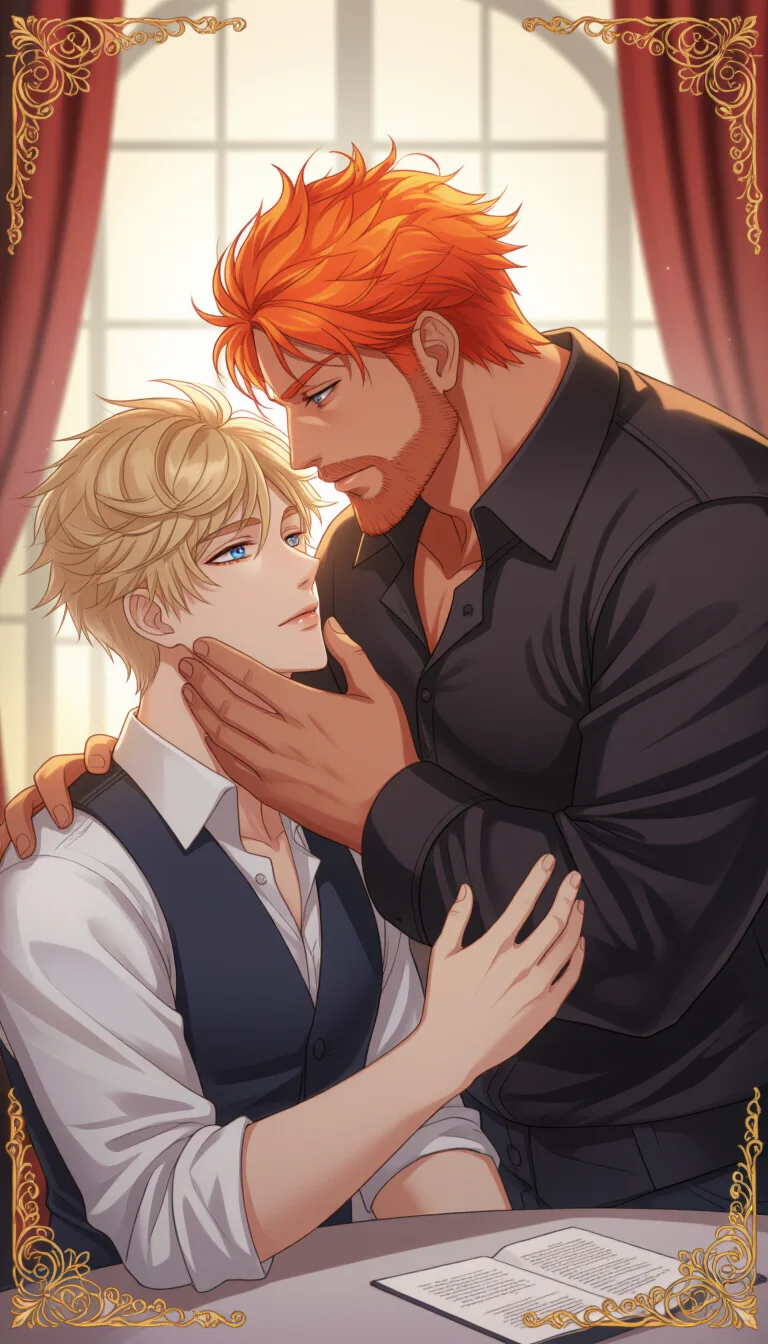
The silence in the dining room is a physical thing. It sits between the polished silver and the untouched water glasses, thick enough to choke on. Rei’s gesture hangs in the air, her hand still extended toward the two empty chairs in the middle of the long table. Enji feels Keigo’s fingers tighten around his own, a grounding pressure.
“Well,” Keigo says, his voice bright and incongruous. “Don’t mind if we do.” He tugs Enji forward, his steps confident on the hardwood, and pulls out a chair for Enji before taking the one beside him. The scrape of wood on wood is deafening.
Fuyumi, seated across from them, offers a strained smile. “I made soba. It was always… it’s ready.”
“Smells amazing,” Keigo says, leaning back as Rei begins to serve from the large platter. His knee presses against Enji’s under the table. Enji’s own leg is rigid, a column of stone.
Toya, at the far end, lets out a low, derisive snort. He hasn’t touched his utensils. His blue eyes, so like Enji’s, are fixed on Keigo with open hostility. “So. Angel. You a vegetarian or something? Or just watching your figure for the stage?”
Keigo accepts a bowl from Rei with a nod of thanks. He doesn’t look at Toya. “I eat everything. Work burns a lot of calories.” He picks up his chopsticks. “This looks incredible, Fuyumi. Thank you.”
Enji watches his children. Natsuo stares at his own bowl, jaw clenched. Shoto’s mismatched eyes flick between Enji and Keigo, unreadable. The weight of their judgment is a familiar ache in Enji’s chest, a cavity he’s carved out over decades. He picks up his own chopsticks, his large hands clumsy around the delicate wood.
“How is school, Shoto?” Rei asks, her voice a fragile thread trying to stitch the silence together.
“Fine.”
Another stretch of quiet, broken only by the clink of porcelain. Keigo eats with genuine relish, a small, approving hum in his throat. The normalcy of it is a shock to the system.
“You know,” Toya says, conversational, swirling his water. “I looked up your club. The reviews are something. ‘Angel gives a heavenly experience.’ That’s cute. You write that yourself?”
Keigo finally looks at him. He sets his chopsticks down with a deliberate click. “Nope. But I’m flattered you did your homework. Most people just throw a book and call it a day.”
Natsuo barks a short, surprised laugh, then schools his face into a scowl. Toya’s smile is all teeth.
“Toya,” Rei says, a warning.
“What? I’m making conversation. Dad’s got a new boyfriend. We should get to know him.” Toya leans forward, elbows on the table. “So, Keigo. What’s the endgame here? You fixing him up so you can retire from stripping? This,” he gestures vaguely at Enji, “a long-term investment?”
Enji’s fist clenches on his thigh. The old fury, the one that used to solve everything with a roar, heats his blood. But before it can find his tongue, Keigo speaks.
“The endgame,” Keigo says, his voice losing its easy cadence, turning flat and direct, “is that I love him. And he’s trying. That’s more than you’re doing right now.”
The air leaves the room. Fuyumi’s eyes go wide. Shoto stops chewing.
Toya’s face darkens. “You don’t know a goddamn thing about what I’m doing.”
“I know you’re hurting him because you’re hurt.” Keigo doesn’t blink. “I get it. I do. But you’re aiming at the wrong target. The man who did that to you isn’t sitting here. He’s gone.”
“Bullshit.”
“Is it?” Keigo’s gaze is relentless. “The Enji I know wakes up at five a.m. to make his meetings. He drinks shitty coffee and tries. He looks at me like I hung the moon, and he’s terrified of that, but he doesn’t run. That the guy you’re trying to burn down?”
Enji can’t breathe. He’s laid bare, not by an attack, but by a defense so precise it carves him open. He feels Keigo’s hand find his under the table, lacing their fingers together, holding tight to the tremble Enji can’t control.
The silence that follows Keigo’s words is absolute, a held breath. Enji feels the tremor in his own hand, anchored only by Keigo’s grip. It’s Shoto who breaks it. The boy sets his chopsticks down with a quiet, precise click. His mismatched eyes, one blue like Enji’s, one gray like Rei’s, lift from his bowl and land on Toya.
“He’s not wrong,” Shoto says, his voice monotone, factual. “The man here now is different.”
Every head turns. Natsuo stares at his younger brother, incredulous. Fuyumi’s hand flies to her mouth. Rei’s eyes are wide, searching Shoto’s placid face. Toya looks like he’s been slapped.
“What did you say?” Toya’s voice is dangerously low.
“I said he’s different.” Shoto doesn’t flinch. “He doesn’t yell. He doesn’t drink. He looks… scared. He never looked scared before. He just looks at Keigo.” Shoto’s gaze flicks to their joined hands under the table, then back to Toya. “Maybe we should try to know this version. Instead of fighting the ghost.”
Keigo’s thumb strokes the back of Enji’s hand. He doesn’t look surprised. He gives a small, almost imperceptible nod toward Shoto, a silent acknowledgment.
“You’re kidding me.” Natsuo finds his voice, thick with disgust. “After everything? You’re just going to—what, forgive him? Because he brought a stripper to dinner?”
“I’m not forgiving anything,” Shoto replies, his tone still flat. “I’m observing. The data has changed.”
Toya lets out a sharp, humorless laugh. “Data. You sound like a robot. He broke you, Sho. Don’t you remember?”
“I remember.” Shoto touches the scar on his face, a habitual, absent gesture. “But holding onto that anger… it doesn’t change the past. It just burns you now.” He looks at Enji directly, and Enji feels seen, truly seen, for the first time in this house. “He’s trying. That’s new. We can acknowledge that without saying what he did was okay.”
Rei’s breath shudders out. She looks from Shoto to Enji, her gray eyes shimmering. “Shoto…”
“It’s logical,” Shoto says, as if explaining a simple equation. “If someone shows new behavior, you assess the new behavior. Not just the old patterns.”
Keigo squeezes Enji’s hand once, then releases it to pick up his water glass. He takes a slow sip, his golden eyes watching the family over the rim. He looks… satisfied. Like a bet just paid off.
“The kid’s got a point,” Keigo says, setting the glass down. “You don’t have to like me. You don’t have to trust him. But you’re wasting a lot of energy yelling at a shadow. The real guy’s right here. And he’s listening.”
Enji’s throat is too tight to speak. He looks at Shoto, at the calm, analytical face of his youngest son, and feels a crack open in the bedrock of his guilt. It’s not forgiveness. It’s a door, left just slightly ajar.
Enji clears his throat. The sound is rough, like gravel dragged over stone. Every eye at the table turns to him. He doesn’t look at them. He stares at his own scarred knuckles, white where they press against the dark wood. “I need to say something.”
Keigo’s hand finds his knee under the table, a steadying pressure. Enji draws a breath that feels like broken glass.
“I’m not asking for forgiveness,” he says, the words low and deliberate. “I never will. What I did… it isn’t something that gets forgiven. It’s something you live with. And I have to live with it.” He finally lifts his gaze, meeting the shock in Rei’s eyes, the fury in Toya’s, the confusion in Natsuo’s. “All I want is to atone. To do everything in my power to be better than I was. That’s it.”
“Dad—” Fuyumi starts, but Enji shakes his head, a sharp, pained motion.
“I didn’t bring Keigo here to hurt you. Or on a whim.” His voice cracks. He pushes through it. “He’s my sponsor. He’s the reason I’m sober. The reason I’m trying. Before him, I was just… waiting to die. He saw something else. He made me look at it.” Enji turns his head, just enough to see Keigo’s profile. The man is watching him, golden eyes soft, unwavering. “He helps me. Every day. And I know… I know I’d be worse. Much worse. Without him.”
He looks back at his children, at the wife he broke. The shame is a physical weight, crushing his lungs. “I’m sorry. I was too weak to change on my own.”
The admission hangs in the warm, fragrant air. It’s not a plea. It’s a statement of fact, raw and ugly and true.
Toya leans back in his chair, crossing his arms. The anger is still there, but it’s banked, simmering under a new layer of scrutiny. “So what? He’s your savior? That’s the play?”
“No,” Keigo answers, his voice quiet but clear. “I’m just a guy who knows what rock bottom looks like. He’s doing the work. I’m just holding the flashlight.”
Rei’s slender fingers trace the stem of her wine glass. Her gray eyes are pools of quiet storm. “You love him,” she says, not to Enji, but to Keigo.
Keigo doesn’t hesitate. “Yeah. I do.”
“And you?” Rei’s gaze shifts to Enji. It’s not an accusation. It’s a question she seems to already know the answer to.
Enji’s throat works. He nods, once. “Yes.”
Natsuo scoffs, pushing his plate away. “Unbelievable.”
“It’s not about belief,” Shoto says, his monotone cutting through. “It’s observable. He stated his intent. Atonement, not forgiveness. That is a logically consistent position.” He looks at Enji. “It’s harder.”
Enji can only nod again, struck silent by his son’s cold, devastating understanding.
Fuyumi wipes at her eyes with her napkin. “I just want us to be okay,” she whispers, the peacekeeper’s plea.
“We’re not okay,” Toya says, but the heat is gone from it. It’s just a tired truth. “We might never be okay. But.” He glances at Keigo, a flicker of something that isn’t pure hatred. “You really a stripper?”
Keigo’s lips quirk. “Pay the bills and the tuition. Psychology major. Figured I should understand the messes I like to clean up.”
A startled, choked sound escapes Natsuo. It’s almost a laugh. He covers his mouth, looking furious with himself.
Rei stands, her chair whispering against the floor. “The food is getting cold,” she says, her voice regaining its gentle firmness. “We should eat. The talking… we can do more of that. Later.”
It’s not peace. It’s a ceasefire. Enji feels the difference in his bones. He picks up his chopsticks, his hands trembling only slightly. The first bite of food tastes like nothing and everything. Keigo’s thigh presses against his, a line of solid, living warmth. For now, it’s enough.
Toya pushes a piece of roasted carrot around his plate with his chopsticks. He doesn’t look up when he speaks, his voice stripped of its earlier venom, leaving something quieter, almost curious. “This sponsor thing. The meetings. What’s that actually like?”
Enji freezes, his chopsticks suspended halfway to his mouth. He sets them down carefully. The question isn’t an attack. It feels like a landmine disguised as a pebble. “It’s… a room,” he starts, his voice gravelly. “Folding chairs. Bad coffee. People telling the truth.”
“Sounds awful,” Natsuo mutters into his water glass.
“It is,” Enji agrees, which makes Natsuo glance up, surprised. “It’s humiliating. You sit there and listen to your own excuses coming out of other people’s mouths. You hear how pathetic they sound.”
Keigo watches Enji, his golden eyes soft. He nudges Enji’s foot under the table. A prompt. Keep going.
“And then?” Toya presses, his blue eyes fixed on his father. The chaos in them is still there, but it’s banked, focused. This isn’t for ammunition. He actually wants to know.
Enji’s right hand clenches on his thigh, then slowly unclenches. “And then you realize you’re not special. Your pain isn’t unique. Your reasons for drinking… they’re just reasons. Not excuses. Everyone in that room has a reason. And everyone chose to show up anyway.” He takes a slow breath. “It’s the first honest choice I made in twenty years.”
The admission hangs in the warm, garlic-scented air. Rei’s chopsticks stops moving. She looks at Enji, really looks, as if seeing the shape of that folding chair in the slump of his shoulders.
“How often?” Shoto asks, his tone purely clinical.
“Every day,” Keigo answers for him, his voice easy. “For the first ninety. Now it’s three, four times a week. He calls me every morning. Texts me before bed. It’s not about the drink. It’s about the pattern. Building a new one.”
“And you?” Toya shifts his gaze to Keigo. The scrutiny is intense, but not cruel. “You’re in recovery too?”
Keigo’s smile is a small, private thing. “Different vice. Same principle. You don’t get to be a guide unless you’ve been lost.” He leans forward, elbows on the table. “Your dad’s a stubborn bastard. Hardest case I ever took on. But he shows up. That’s the whole thing. He just… keeps showing up.”
Fuyumi’s eyes are bright again. She looks between Keigo and her father, seeing not a scandal, but a structure. A routine. Something holding him upright. “I’m glad,” she whispers, the words barely audible. “I’m glad you’re not alone.”
Enji feels those words lodge under his ribs, a sweet, sharp ache. He looks at his daughter and gives a single, slow nod. It’s all he can manage.
Toya leans back, crossing his arms over his chest. The movement is defensive, but his expression is contemplative. “So it’s just… talking. That’s what fixes it.”
“No,” Enji says, the word coming out harder than he intended. He softens his voice. “Talking is what keeps you from lying to yourself. The fixing… that’s everything else. That’s the hard part.” He meets Toya’s gaze, holds it. “That’s this.”
Toya stares back, his jaw working silently. Then he picks up his chopsticks. He doesn’t say anything else. He just takes a bite of rice.
The silence that follows isn’t comfortable, but it’s different. The air loses some of its electric charge. The clink of porcelain and the scrape of utensils become the dominant sounds.
“The chicken is good, Mom,” Fuyumi says, her voice deliberately bright. She offers a small smile to Rei, who returns it with a gentle nod.
“Thank you, dear. I used the mirin you brought.”
Natsuo grunts, still pushing food around. “It’s fine.”
Shoto chews methodically, his heterochromatic eyes scanning the table like he’s collecting data. “The texture is consistent. Well-prepared.”
Keigo nudges Enji’s thigh again, a silent signal to eat. Enji obeys, the food finally registering as flavor—soy, ginger, the sweetness of the glaze. It’s good. He realizes, with a dull shock, that he can’t remember the last time he tasted something Rei cooked.
“So, Keigo,” Fuyumi ventures, dabbing her lips with her napkin. “Psychology. That’s impressive. What year are you?”
“Junior,” Keigo says, swallowing a bite. “Mostly night classes. Makes the schedule… interesting.”
“I bet.” Fuyumi’s smile is genuine, curious. “What drew you to it?”
Keigo shrugs, a fluid, easy motion. “Spent a lot of time in systems that were supposed to help people. Foster care, mostly. Saw what worked and what just… patched holes. Figured I’d rather be one of the people holding the glue, not the band-aids.”
Rei watches him, her head tilted. “That is a very compassionate perspective.”
“Or a stubborn one,” Keigo counters with a grin. “I hate seeing things broken when I know how to fix them.”
Enji feels the words land in his chest. Keigo’s foot finds his under the table, a steady pressure.
When the plates are mostly cleared, Fuyumi stands, gathering a few. “I made cheesecake. With the berry compote you like, Shoto.”
She disappears into the kitchen, returning with a pristine white cake on a stand. She slices it with care, passing plates around the table. The sweet, tangy scent cuts through the lingering savory notes.
Enji accepts his plate. “Thank you, Fuyumi.”
She blinks, then nods, her eyes suspiciously shiny again. “You’re welcome.”
They eat dessert in a quiet that feels almost peaceful. The sugar, the shared act of something simple and sweet, does its work. Natsuo even finishes his slice. Toya eats his slowly, his gaze distant, lost in thought.
Keigo scrapes the last bit of compote from his plate and lets out a soft, content sigh. He leans his shoulder against Enji’s. “That was incredible. Thank you, Rei. Fuyumi.”
Rei offers a small, graceful incline of her head. “You are welcome here, Keigo.”
The sentence is simple. Its weight is monumental. It hangs in the air, a delicate, offered thread. Enji looks at his wife—soon to be ex-wife—and sees not forgiveness, but a fragile, staggering grace. His throat tightens. He looks down at his empty plate, at Keigo’s hand resting near his own on the tablecloth. The ceasefire holds. For now, it’s more than he dared to hope for.