
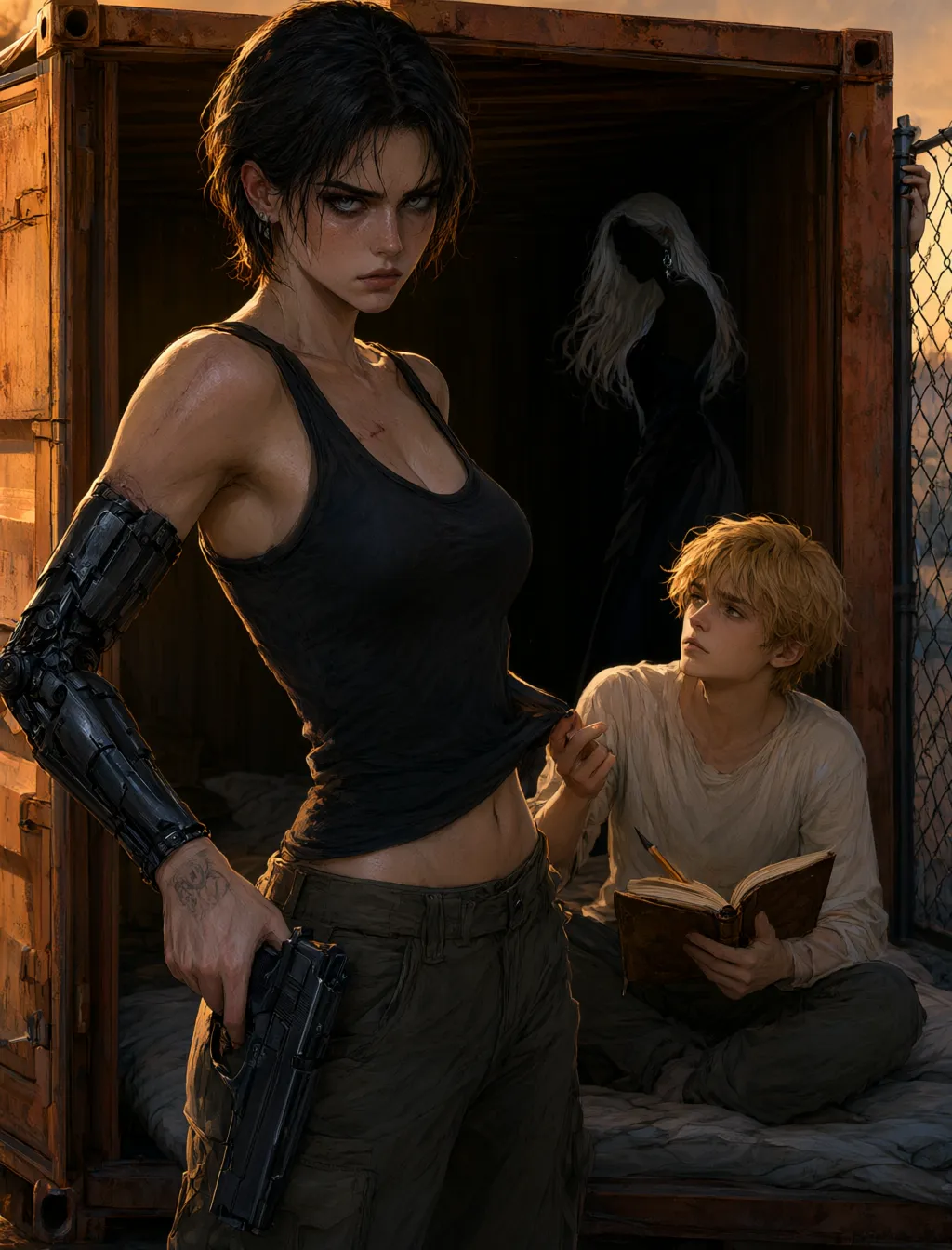
The dust settled over Greenbank like a shroud. Where houses had stood, only toothless walls remained, their windows empty sockets staring at a sky that had forgotten how to weep. The courtyard stones were still warm from yesterday's sun, holding heat in their bones like a memory of life. Moss crept up the cracked facades, rust whispered through twisted rebar, and the air carried the sweet rot of death.
Stillness had claimed everything. The wind itself seemed afraid to move.
But stillness, like all things, had a half-life.
Near the center of town, where the earth had been churned and mounded like a fresh grave for a giant, a single crow perched on a broken beam. It cocked its head, watching. Waiting. The mass grave was a hill of limbs and faces, a testament to Valeria Cross's mercy. two hundred villagers. thirty soldiers. One Sera.
The crow shifted its weight. Something was wrong.
Dust trembled. A fine patter of dirt ran down the slope of the mound, then stopped. The crow ruffled its feathers, uneasy. Then the dust moved again—not wind, not gravity. Something *underneath*.
A hand broke the surface.
Matte black plating, crusted with soil and blood. The fingers curled, dug in, pulled. The arm was a piston, a machine that did not understand surrender. The crow shrieked and took flight as the mound convulsed, as bodies shifted and slid, as a figure erupted from the grave like a nightmare giving birth.
Sera Vance crested the hill of the dead on all fours, coughing, gasping, her lungs dragging air that tasted like copper and rot. Her left eye was a smear of blurred light, her right took in the world in jagged fragments—ruins, sky, the pit of faces below her, the faces that would never again speak.
She hung there, trembling, a newborn animal made of wire and gristle and rage.
The world swam. Her stomach clenched around nothing. How long had she been under? A day? Two? The sun was high, the air hot, but her skin felt cold, cold like the bodies she'd lain among. She touched the left side of her head. Her fingers came away wet. The wounds where the bullets had entered were crusted, dark, but they were *closed*. The augments had done their work, knitting flesh, sealing bone, keeping the spark alive while she drowned in the silence of the dead.
Her left eye. Blurry. Damaged. But the other worked.
She remembered the last thing that eye had seen: Luca's face, twisted in terror, screaming her name as the soldiers dragged him away. The sound of the shots. The weight of her body hitting the ground. The smell of his fear, sharp and sour, and then—nothing.
She crawled forward, her metal arm gouging furrows in the packed earth, her flesh hand pushing against a dead man's chest to gain leverage. She reached the edge of the pit and collapsed, her torso hanging over the rim, her feet still tangled in the tangle of limbs below. She lay there, chest heaving, tasting bile that wouldn't come.
Think. *Think.*
They thought she was dead. That was the only advantage she had. Valeria Cross believed the problem was solved, the body buried, the boy broken to her will. That belief was a weapon. And Sera was going to use it.
She pushed herself upright, swaying, her legs threatening to buckle. Her body was a hollow drum, a husk of hunger and thirst and exhaustion. She needed water. She needed food. She needed to find where they had taken him before the trail went cold.
Her left arm hummed, the servos responding to her will, the grip strength undiminished. Whatever else had failed, the machine in her still worked.
She stumbled across the courtyard, her boots crunching on debris, her shadow long and thin in the midday sun. The town was a skeleton, burned and gutted. None of the bodies had been left. They nearly all lay in the pit, a testament to Valeria's cruelty. Sera stepped over a woman in a torn dress, a child curled beside her, their hands almost touching.
She did not stop. She could not stop. If she stopped, she would feel it—the weight of two hundred souls she had led to slaughter. She would remember the way the old man had stared at her, the way the girl with the braids had hidden behind her mother's skirt. She would feel the guilt, and the guilt would crush her.
So she walked. One foot. Then the other. Her body remembered how to survive, even if her mind wanted to lie down and never rise.
The boarding house was a shell, the roof caved in, the walls blackened with smoke. She found the bathhouse where she had washed Luca's thin body, where he had traced her scars with wondering fingers. The water was gone, the pipes burst, but there was a pump in the back courtyard. She worked the handle with her good arm, the metal groaning in protest, and after a dozen strokes, a trickle of brown water emerged.
She drank. The water tasted of rust and earth, but it was wet, and it stayed down. She drank again, letting it run over her face, washing the grime from her eyes, her mouth, the wounds on her head. The left side of her face was swollen, a knot of purple and black that throbbed with every heartbeat. But she could see. She could move. She could survive.
She found supplies scattered among the ruins—a canteen, a half-eaten ration bar wrapped in wax paper, a knife still wedged in a soldier's chest. She took them all. The ration bar was stale, the texture of sawdust and salt, but she chewed it slowly, forcing each mouthful down. Her body needed fuel. Her body was a machine, and machines needed energy.
The knife was a standard-issue combat blade, serrated along the spine, the grip wrapped in worn leather. She slid it into her belt. Then she stripped the soldier of his ammunition vest, checked the rounds, and took his sidearm. A Glock, scuffed but functional. She checked the magazine. Thirteen rounds. It would have to do. She also went around, scrounging for any money she could use on the way to New Haven.
Sera reached into a deeper part of her than she was comfortable with. If she was going to find Luca, she would have to embrace the feral monster inside of her. She would have to become something more than human. She walked back to the mass grave, and waded inside. She was looking for augments like hers, ones that she did not have. She was not special, there were plenty of people who were augmented for the final war. When one died, it was standard operating procedure to recover their body so their augment could be recovered. After nearly 2 hours of cleaving and cutting at the dead, she had amassed a sizeable amount of various tech scraps. She packed them in her bag.
The sun had begun its slow arc toward the horizon by the time she was ready. She stood in the center of Greenbank's main street, the ruins stretching around her like a graveyard of ambition. The wind picked up, stirring the dust, carrying the smell of ash and something underneath—something like ozone, like the air before a storm.
She had no map. She had no transport. But she knew where Valeria Cross held her court. New Haven. Thirty miles north, past the burned-out suburbs and the irradiated zones. A fortress of glass and steel, a monument to the woman who had bought Luca like livestock.
Sera started walking.
The road was cracked, buckled, the asphalt split by weeds and time. She moved at a steady pace, conserving energy, her eyes scanning the ruins for movement. The wasteland was never empty. There were scavengers, raiders, things that had once been human and had forgotten the shape of mercy. She had been one of them once. She had killed for less than a full canteen.
Her shadow lengthened as the sun sank, painting the world in shades of amber and rust. She passed a rusted sign that had once read "Greenbank—Population 847." The number was crossed out, a red slash of graffiti that read "0" in jagged strokes. Someone had been thorough.
She thought of Luca. His voice, high and reedy, asking her questions she didn't want to answer. His hands, always moving, always drawing, filling his journal with birds he'd never seen. The way he had looked at her that morning, when he had called her "Mom." The way she had told him not to. The way she had pushed him away, because she was afraid, because she didn't know how to be the thing he needed.
And then she thought of Valeria. The woman who had slapped him. The woman who had him now. The woman who was doing things to him, things that made Sera's blood run cold and hot at the same time.
She had promised him she would never leave. And she had died. But death, it turned out, was not the end of her story.
The sky turned purple, then black. The stars came out, cold and indifferent. Sera kept walking, her metal arm gleaming in the starlight, her footsteps steady on the broken road. She did not stop to rest. She did not stop to feel. She was a blade honed by grief and rage, and she had one purpose now: find the boy. Kill anyone who stood in her way. Bring him home.
At the edge of a collapsed overpass, she paused. The road ahead was a wasteland of twisted metal and concrete, the bones of a civilization that had tried to reach the sky and failed. Beyond it, in the distance, a faint glow. Not the sun. Lights. Electric lights.
New Haven.
She let out a breath she hadn't realized she was holding. It was still there. He was still there. She had time.
She found shelter in the hollow of a rusted truck, the cab intact enough to offer cover. She sat with her back against the cold metal, the Glock in her lap, her ears tuned to the night. The wind howled through the ruins, carrying the sound of distant laughter, or screaming—she couldn't tell which.
She closed her eyes. Just for a moment. Just to rest.
His face appeared behind her lids. Straw-blond hair, hazel eyes, the stubborn set of his jaw. *"You said you wouldn't leave."* His voice, quiet, broken. Accusing.
She opened her eyes.
She had said she wouldn't leave. And she hadn't. Not really. She had died, but dying wasn't leaving—not for her. She had clawed her way out of a grave, through a mountain of bodies, because something in her refused to let go. Something that had nothing to do with the creds, or the contract, or the thin line of ink on the page.
Something that felt, for the first since she lost her boy, like hope.
She shifted her weight, and her metal arm caught the starlight. The plating was dented, scratched, stained with blood that wasn't hers. She flexed the fingers, watched the servos move with mechanical precision. This arm had killed. It had also held him, that night in the gas station, when he had cried against her ribs and she had felt something crack open inside her, something she had buried so deep she thought it was dead.
It wasn't dead. It had been waiting.
She stood up. The night was cold, but her blood was hot. Thirty miles. A fortress. An army. A woman with white hair and blue eyes who thought she had won.
Valeria Cross had never met someone who had crawled out of a grave before.
Sera Vance started walking again, her shadow stretching behind her like a banner, her eyes fixed on the lights in the distance. The wasteland hummed around her, alive with the sound of wind and ruin, but she heard none of it. She heard only a boy's voice, calling her name, and the quiet, certain beat of her own heart, refusing to stop.
The town called itself Morrow — a scrawl on a sheet of corrugated tin nailed to a water tower that leaned like a drunkard. Twenty buildings, maybe. A main street of packed dirt and gravel. A single pump at the intersection. Sera smelled it before she saw it: woodsmoke, cooking oil, the sharp tang of a generator running on diluted ethanol.
She reached the edge of town as the sun began its final drop toward the horizon. Her legs were lead. Her left eye swam with shadows, the world doubled and blurred on that side. She had walked thirty miles on empty, on rage, on the image of a boy's face in the dark.
A woman sat on the porch of a building with a hand-painted sign that read "REPAIRS — ALL KINDS." She was old — sixty, maybe seventy — with skin like cracked leather and eyes that had seen every kind of trouble. Her left leg was a pylon of rusted steel, bolted to a knee joint that hissed when she shifted her weight.
Sera stopped in front of her. She dropped her bag on the ground. The sound of metal scraping metal filled the silence between them.
"You're dead," the woman said. No greeting. No surprise. Just fact.
"Came back."
The woman's eyes tracked down Sera's left arm, then up to the swollen mass on the side of her head. She sucked her teeth, a dry clicking sound. "Greenbank."
"Yes."
"Heard Valeria's dogs put everyone in a hole."
"They did." Sera lifted her metal hand, let the light catch the dents, the scratches, the dried blood in the seams. "I need these pulled. I need new ones wired in."
The woman laughed — a short, bitter bark. "You walk into my town, covered in grave dirt, half-blind, carrying a bag of scrap, and you want me to crack your chassis open and rewire you?"
"I can pay." Sera reached into her jacket, pulled out a roll of creds she'd stripped from the dead. She tossed it. The woman caught it one-handed, weighed it, raised an eyebrow.
"That's a lot of blood money."
"It's all I've got."
The woman stared at her for a long moment. Then she stood, the pylon hissing, and jerked her head toward the door. "Inside. Before I change my mind."
The repair bay was small, cluttered, lit by a single bulb that buzzed with a frequency that made Sera's teeth ache. Tools hung on pegboards — wrenches, drivers, clamps, things that looked like medical instruments but weren't. A table dominated the center of the room, stained with oil and something darker. A chair bolted to the floor, straps hanging from the arms.
Sera knew this kind of place. She had woken up in one, years ago, after they had bolted the first augment to her bones.
"Strip to the waist," the woman said, pulling on a pair of gloves. "I need to see what I'm working with."
Sera didn't hesitate. She pulled her jacket off, then her shirt, dropping them on the floor. Her torso was a map of old wounds — puckered scars from bullets, long clean lines from blades, the ridge of a burn that had healed badly. And at her left shoulder, the interface: a ring of scarred flesh where metal met meat, the plating fused to her collarbone, her scapula, her ribs.
The woman circled her, clicking her tongue. She pressed a finger to the edge of the interface. Sera's jaw tightened.
"This is military-grade. Nighthawk series. You were a ghost."
"Was."
"The arm's shot. I can see the servo housing is cracked, the hydraulics are leaking fluid into the elbow joint. You've been running it hot."
"I've been running it through bodies."
The woman laughed again, but there was no humor in it. "What did you bring me?"
Sera opened her bag and dumped the contents on the table. The augments she had carved from the dead — a spinal booster, still trailing wires and fluid. A pair of optic relays, one cracked, one intact. A reinforced femur with a power cell still blinking. A hand, the fingers articulated, the knuckles studded with ceramic.
The woman picked through the pieces like a scavenger at a feast. She held up the optic relay, turning it in the light. "This is clean. You got lucky." She set it down. "The spinal booster is fried — the casing is breached, the fluid is contaminated. I can't use it."
"What can you use?"
"The relay. The hand, maybe, if I can match the nerve mapping to your existing hardware. The femur is useless unless you want me to replace your leg, and I don't have the time or the anesthesia for that." She looked at Sera. "You want me to wire the relay into your skull. Give you your eye back."
"Yes."
"It's going to hurt. I don't have the good drugs. I have local anesthetic and whiskey."
"I don't need the whiskey."
The woman studied her for a moment, then nodded. "Sit."
Sera sat in the chair. The woman strapped her wrists down — not tight, but present. A precaution. Sera didn't fight it. She had been through this before. The body remembered how to endure.
"I'm going to open the access port behind your ear. I need you to hold still. If you move, I might clip something that keeps you breathing."
"I know."
The woman picked up a scalpel. The blade caught the light, thin and precise. She leaned in, and Sera felt the cold touch of metal against her skin, just below the ridge of her skull.
The first cut was a line of fire.
Sera's vision went white. She had felt pain before — had been shot, stabbed, burned, broken. But this was different. This was someone peeling back the layers of her skull, exposing the wet tissue beneath, the delicate web of wires and nerves that made her more than human. She could feel the blade scraping against bone, could feel the woman's fingers in her head, working, searching.
She did not scream. She bit the inside of her cheek and tasted copper.
"Found it," the woman muttered. "The relay is fried. The bullet must have sent a surge through the housing. I'm going to pull it and replace it with the new one. You're going to feel pressure. Don't move."
Sera felt the pull — a deep, wrong sensation, like something being eased out of her skull. Then the click of the new relay seating into place. Then a spike of white-hot pain that dropped a curtain over her vision.
When she could see again, the woman was stitching her scalp closed, the thread black and coarse. "You're lucky," she said. "The socket was standard. Whoever built you used military specs. The relay clicked right in."
Sera blinked. Her left eye was still blurry, but the double vision was gone. The shadows were sharper. The light from the bulb no longer seemed like it was moving.
"Give it a few hours to calibrate," the woman said. "Your brain needs to learn how to see through it again."
She moved to the table, picked up the hand. "This one's going to take more work. The arm needs to come off at the shoulder interface, and I need to strip the old hydraulics and replace the lines. I'll have to splice into the nerve bundle. If I do it wrong, you lose the arm entirely."
"Do it right."
"I plan to. But I need you conscious for the wiring. I need you to be able to tell me if you feel the connections."
Sera nodded. Her jaw was tight. Her heart was a drum in her chest, steady, determined.
The woman picked up a larger blade. "This is going to take a while. Try not to bleed on my floor."
The woman worked in silence, her movements precise and practiced. She cut along the interface seam, and Sera felt the strange, hollow sensation of her arm disconnecting from her body — the weight lifting, the phantom pressure fading. The woman lifted the arm away and set it on the table. It lay there, fingers curled slightly, like a sleeping animal.
"The hydraulics are shot," the woman said, peering into the socket. "The lines are cracked, the fluid is low, and the servo motor is grinding. I'm going to strip everything and rebuild from the parts you brought."
She worked for what felt like hours. Sera sat in the chair, her stump wrapped in a tourniquet, watching the woman's hands move with the economy of long practice. She cleaned the interface, scraped away corrosion, rewired the nerve bundle with threads so fine they looked like spider silk. She spliced the new hand's actuators into the existing network, tested each connection with a probe that made Sera's bicep twitch.
"Tell me when you feel this."
"There."
"And this?"
"Nothing."
"Good. That's the motor cortex. I'm running a bypass around the damaged section."
Sera's head swam. The pain was constant now, a low thrum that vibrated through her entire body. She focused on breathing. In. Out. The rhythm of survival.
The woman picked up the new arm — matte black, the knuckles studded with ceramic, the fingers longer and more articulated than her old one. She aligned it with the interface socket. "Ready?"
"Do it."
The woman pushed. Sera felt the connection — a jolt, a surge, the sudden return of weight and presence. The new arm locked into place with a click that resonated through her bones. The woman tightened the bolts, sealed the housing, and stepped back.
"Try to move it."
Sera flexed her fingers. The servos responded instantly, smooth and silent. She made a fist. The ceramic knuckles ground together with a sound like stone on stone. She opened her hand, spread her fingers wide, then curled them into a claw.
The woman nodded, satisfied. "The nerve mapping is clean. You'll have full range of motion. The ceramic knuckles will let you punch through concrete. The fingers are reinforced — you can grip edges that would cut flesh to the bone."
Sera looked at her new hand. It gleamed in the dim light, alien and beautiful. She thought of Luca. She thought of Valeria's face when she saw her rise from the grave.
"How much do I owe you?" Sera asked.
"The creds you gave me cover it." The woman stripped off her gloves, tossed them in a bin. "But I'll give you some advice for free. Valeria Cross has an army. She has walls that have never been breached. She has augments that make yours look like toys." She met Sera's eyes. "You walk into New Haven with just that arm and a pistol, you will die."
"I've died before."
"And you crawled out. But the dead don't always get a second chance."
Sera stood. The new arm felt strange — lighter, more responsive. She rolled her shoulder, felt the interface settle into place. "I'm not going to die. I'm going to get my boy back."
The woman shook her head, but there was something in her eyes — not pity, but recognition. "You really love him, don't you?"
Sera didn't answer. She pulled her shirt on, then her jacket. She picked up the Glock, checked the magazine, slid it into her belt. She looked at the woman, and for a moment, the mask slipped.
"He called me Mom."
The woman was silent. Then she nodded, once. "Then go get your son."
Sera walked out into the night. The air was cold, the stars sharp. Her new arm gleamed in the starlight, and her left eye was clear — the world in focus, sharp and bright and full of menace.
She started walking north. The lights of New Haven glowed on the horizon, distant and cold. She had thirty miles of wasteland between her and the boy who had called her Mom.
She would cover it before dawn.
She had to.
The wind picked up, carrying the smell of ozone, the promise of a storm. Somewhere in New Haven, a boy with straw-blond hair and hazel eyes was lying in the dark, waiting for a miracle.
Sera Vance had never believed in miracles. But she believed in fury. She believed in survival. And she believed in the heat of her own blood, refusing to cool.
She walked.