
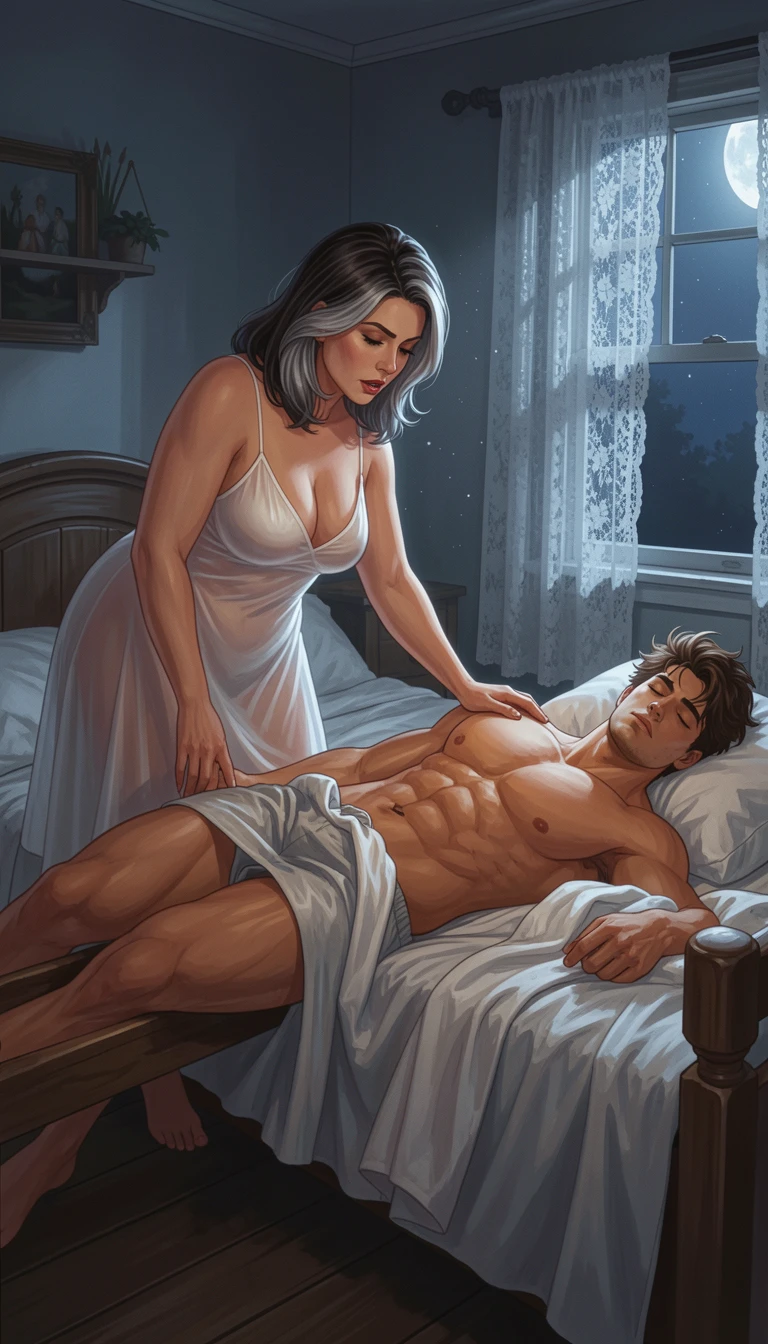
The gray light of dawn crept through the window, and Mary woke with Mike's arm heavy across her stomach, his breath warm against her shoulder. She lay still for a long moment, feeling his heartbeat against her back, slow and trusting, and she let herself have this—just this—before the day's performance began.
She eased out from under his arm, and he stirred, his hand reaching for her in the warm hollow where she'd been.
"Stay," he mumbled, still half-asleep.
She bent and kissed his forehead. "I have to make breakfast. Paul will be up soon."
His eyes opened, the brown of them dark in the dim light, and he looked at her with something she couldn't name—not accusation, not quite hurt, but close. "You're going to tell him today."
Not a question. He'd been listening, last night, when she'd come to bed smelling of Paul's tobacco and sweat. He'd held her anyway, but she'd felt the tension in his shoulders, the questions he was too afraid to ask.
"Yes." She sat on the edge of the bed, her back to him, the sheet pooling around her hips. "Today."
"And I just... watch?"
She turned, found his hand, pressed it to her stomach. "You protect this. That's your job now. Whatever I have to do to make him believe—you let me do it. And then, when he's gone, this is ours."
His hand stayed flat against her belly, and she watched his jaw work, the muscles in his throat moving as he swallowed whatever he wanted to say. Finally, he nodded. Once. Tight.
She dressed in the kitchen, pulled on the housedress Paul liked—the one with the small flowers, modest and safe—and began to move through the morning rituals like a woman who belonged here. Coffee grounds measured. Woodstoke fed. Bacon laid in the cast iron pan.
Mike came out an hour later, dressed for the fields, and he didn't look at her. He sat at the table and drank his coffee black, staring at the window, and she felt the distance between them like a physical thing—a wire pulled tight, vibrating.
Paul shuffled in at eight, his suspenders hanging loose, his hair tufted from sleep. He looked older this morning, frailer, the drugs she'd been giving him pulling at the edges of his face. But he smiled at her—a real smile, rare and crooked—and she felt something twist in her chest.
"Smells good, Mary." He sat across from Mike, not seeing the tension, never seeing it. "You eat yet, boy?"
"Yes, sir." Mike stood, his chair scraping the floor. "North pasture fence needs mending. I'll be out till noon."
He was gone before Mary could say his name, the screen door slapping shut behind him, and she stood at the stove with the spatula in her hand, watching him cross the yard.
"He's a good boy," Paul said, reaching for the newspaper. "Works hard."
"He is." She set a plate in front of Paul, then sat across from him, her coffee cooling in her hands. "Paul. I need to tell you something."
He looked up from the paper, his milky eyes finding hers. "What?"
She'd rehearsed this. Dozens of times, in the dark, while Mike slept beside her. But now, with Paul's face open and unsuspecting, the words felt like stones in her mouth.
"I'm pregnant."
The silence that followed was not silence. It was the tick of the clock on the mantle. The hiss of the woodstove. The creak of Paul's chair as he leaned forward, his hand trembling as he set down the paper.
"What?"
"I went to the doctor when you were gone. He confirmed it." She reached across the table, took his hand—the skin papery and thin, the knuckles swollen with age. "I know it seems impossible. But they said—at my age, it's rare, but it happens. A miracle, the doctor called it."
Paul's eyes filled with tears. She'd seen him cry once, at his first wife's funeral, and it had been a dry, stoic grief—the kind men of his generation were allowed. But this was different. His chin quivered, his hand squeezed hers hard enough to hurt, and a sound came out of him, half-laugh, half-sob.
"A miracle," he whispered. "At my age." He looked at her, and there was something in his face she hadn't seen in years—pride. Wonder. "Mary. I thought... after all these years, I thought I'd failed you. As a husband. As a man."
"You didn't fail me, Paul." The lie tasted like copper. She held his hand and watched him cry and felt the shape of the trap she'd built closing around all three of them.
"A baby," he said, testing the word. "My baby." He let go of her hand and reached for the phone on the counter, his fingers fumbling with the rotary dial. "I have to call the lawyer. I have to change the will—this changes everything, Mary. Everything."
She watched him dial, listened to him stammer into the receiver—"George, you won't believe it, I'm going to be a father"—and she kept her smile fixed in place, the same smile she'd worn at church potlucks and county fairs, the smile of a woman who had nothing to hide.
The door creaked, and she looked up.
Mike stood in the doorway, a coil of fence wire in his hand, his brown eyes fixed on her. He must have forgotten something, come back for it, and walked into the middle of Paul's joy like a man stepping into a room he didn't belong in anymore.
Paul didn't notice him. He was still on the phone, his voice bright and shaken, telling the lawyer to come by tomorrow, to draw up new papers, to make sure the child was provided for.
Mary met Mike's eyes across the kitchen. His face was unreadable—the face of a boy learning to become a man by watching his woman lie. His jaw was tight, his hand white around the wire, and he didn't move.
She gave him nothing. No wink. No nod. Just the same pleasant smile she'd given Paul, and she turned back to the stove, her shoulders square, her voice light as she said, "More coffee, Paul?"
Behind her, she heard the door close. Mike was gone.
The morning passed in a blur of phone calls and neighbor visits. News traveled fast in the valley, and by noon, three cars were parked in the gravel drive, their owners gathered on the porch with casseroles and handshakes. Dottie Higgins from the feed store brought a lemon cake and kissed Paul's cheek, calling him "the old stallion" until he blushed. The doctor from town stopped by, clapped Paul on the shoulder, and said he'd never seen anything like it—a man of eighty, fathering a child—pure biology, a statistical anomaly, a wonder.
Mary moved through the crowd like a hostess at a wedding, accepting congratulations with a demure tilt of her head, one hand resting on her still-flat stomach. "We're blessed," she said, again and again, until the words lost meaning. "A gift from God."
Mike wasn't in the crowd. She saw him through the window, once, walking toward the barn with his shoulders set and his head down, and she felt the pull of him like a thread tied to her ribs. But she couldn't follow. Not now. Not with Paul glowing beside her, not with Dottie Higgins watching her like a hawk, not with the whole valley already calling the child Paul's.
By Sunday, the house was full. Neighbors, church folk, the men Paul had worked beside for forty years—they all came, shaking his hand, clapping his back, marveling at the miracle of a man his age still fertile, still virile, still capable of planting a seed. Paul had shaved for the occasion, put on his good shirt, and he moved through the living room like a man twenty years younger, his pipe clamped between his teeth, his laugh loud and genuine.
Mary wore a blue dress with a high collar, the one that made her look like a schoolteacher, and she accepted their congratulations with a smile that didn't reach her eyes. She felt their hands on her arm, her shoulder, her back—the touch of people who thought they knew her story, who thought they were celebrating love.
"You must be so happy, Mary." Dottie Higgins stood beside her, her lemon cake reduced to crumbs on a paper plate. "After all these years."
"We are."
"And Mike must be thrilled to have a little cousin on the way. He's been such a help to you both."
"He has." Mary's eyes found the hallway, where Mike stood alone, a glass of lemonade in his hand, watching the crowd the way a deer watches a fence—looking for a way through. "Excuse me, Dottie."
She crossed the room, her heels clicking on the worn floorboards, and she caught his arm just as he was turning toward the back door.
He flinched. Actually flinched, like her touch burned, and she saw the anger in his eyes before he hid it, the same anger she'd seen in the kitchen three days ago, banked and smoldering.
"Mike." She kept her voice low, her smile fixed for anyone watching. "Not now."
"When, then?" His voice was tight, barely a whisper. "When he's dead? When the baby's born and he thinks it's his?"
She pressed her finger to her lips, the gesture quick and final, and she saw something break in his face—not anger, not hurt, but trust, cracking at the edges.
"I'll come to you tonight," she breathed. "After everyone leaves. I'll explain everything."
He looked at her for a long moment, his brown eyes searching hers, and she held his gaze, willing him to see the promise underneath the performance. Then he nodded—the same tight nod from three days ago—and he slipped out the back door, into the cooling evening, leaving her alone in the hallway with the sound of Paul's laughter drifting from the living room.
She stood there for a moment, one hand pressed to her stomach, and she let the smile drop. Just for a second. Just long enough to feel the weight of what she'd done—the lie she'd told, the trap she'd set, the boy she was breaking with her silence.
Then she smoothed her dress, lifted her chin, and walked back into the living room, the miracle wife, the grateful mother-to-be, the woman who had everything she'd ever wanted.
The guests stayed until ten, and Paul fell asleep in his armchair before the last car pulled out of the drive. Mary covered him with a blanket, turned off the lamp, and stood in the dark living room, listening to the house settle around her.
The floorboard outside Mike's room creaked when she reached it. She didn't knock. She pushed the door open, stepped inside, and closed it behind her, the lock clicking into place.
He was sitting on the edge of the bed, still dressed, his hands clasped between his knees. He didn't look up when she entered, and the silence between them was heavier than any words she could have spoken.
"Mike."
"Don't." His voice was rough, cracked. "Don't come in here and touch me and make it better. Not tonight."
She crossed to him anyway, and she didn't touch him. She sat on the floor at his feet, her back against the bedframe, and she let him see her—the exhaustion, the guilt, the fear she'd been hiding behind the smile all day.
"I know you're angry."
"You think?" His laugh was bitter, hollow. "I stood in that doorway and watched you tell him the baby was a miracle. His miracle. And I had to stand there and say nothing."
"That's what we agreed."
"No. That's what you agreed. You never asked me if I could do it. You just told me to trust you."
She turned, looked up at him. His face was half in shadow, the moonlight catching one cheekbone, one eye. "Can you?"
"Trust you?" He held her gaze for a long, painful moment, and then looked away. "I don't know anymore."
The words landed in her chest like stones, and she felt the thread between them pull tight, fraying, one thread at a time.
She didn't try to fix it. She didn't climb into his lap or kiss his mouth or remind him of what they'd done in this very bed a week ago. She sat at his feet in the dark, her hand resting on her stomach, and she waited for him to decide if he was still hers.
She reached down without looking, her hand finding his in the dark, and she pressed it flat against her belly—palm to the fabric of her dress, to the curve beneath, to the life she carried. His hand was stiff at first, resistant, the fingers straight and unyielding, and she felt the refusal in every tendon. She held it there, her own hand over his, and she didn't speak. She waited.
The seconds stretched. The house creaked. Somewhere, a floorboard settled.
His fingers curled. Slowly, like a man waking from a dream, he bent them into the fabric of her dress, his knuckles brushing her stomach through the cloth, and she felt the give in his hand—not surrender, not forgiveness, but something closer to gravity. The weight of what was under his palm pulling him down.
"I can feel it," he said, his voice rough. "Nothing. Just—" He pressed harder, his thumb spreading against the curve of her belly. "Just you."
"It's too early. In a few months, you'll feel it move." She kept her hand over his, her voice low, careful not to break the thing she was building. "You'll feel him kick. Or her. I don't know yet."
"Him." Mike's jaw tightened. "It's a him. I know it."
She didn't argue. She shifted on the floor, turning to face him, her knees against the bedframe, his hand still pressed to her stomach. "Mike. Look at me."
He didn't. His eyes stayed on the wall, on the shadow of the window, on anything but her face, and she saw the muscle in his throat move as he swallowed.
"I know you're angry."
"You keep saying that."
"Because it's true." She lifted his hand from her belly and held it in both of hers, the calluses rough against her palms, the fingers still curled like they were holding something precious. "And I know I don't deserve your trust. I lied to him. I'm lying to everyone. And I dragged you into it."
"You didn't drag me." His voice cracked at the edges, and he finally looked at her—his brown eyes wet, the anger gone, replaced by something raw and unguarded. "I came. I stayed. I wanted this, Mary. I still want it. But I can't—" He stopped, his breath hitching. "I stood in that doorway and watched you tell him our baby was a miracle. His miracle. And I had to smile and nod and pretend I was just the grandson, just the hired hand, just the boy who fixed the fence."
"I know."
"Do you?" He pulled his hand free, the motion sharp, and he stood, pacing to the window. His back was to her, his shoulders tight, his hands gripping the sill. "Do you know what it feels like to watch the woman you love give another man credit for your child?"
She rose slowly, her knees stiff from the floor, and she crossed to him, stopping a foot behind him. She didn't touch him. "Tell me."
He let out a breath, the air fogging the glass. "It feels like dying. Standing there, smiling, while he takes something from me that I'll never get back."
"He's not taking it." She stepped closer, her chest almost touching his back. "He's holding it for us. For a little while. That's all."
"And when he dies?" Mike turned, his face inches from hers, the heat of him pressing against her. "What happens then? Do I get to be the father? Or do I stay the farmhand while you raise his miracle child?"
The question hit her like a slap, and she felt the air leave her lungs. She'd thought about this—of course she had—but she'd pushed it away, buried it under the logistics of the lie, the daily performance of being Paul's wife. The future was a thing she hadn't let herself see clearly.
"You'll be his father." She said it slowly, like she was testing the words. "When Paul's gone, you'll be the only father he knows."
"And until then?" His voice was quiet, dangerous. "What do I call myself?"
She had no answer. She stood in the dark of his room, the boy she'd taken, the man she'd made, the father of her child, and she had nothing to give him but the truth—the broken, incomplete truth she'd been hiding from since the day the test turned pink.
"I don't know," she whispered. "I don't know what happens next. I only know that I can't lose you. That if you walk away, I'll have nothing. This—" She pressed her hand to her stomach. "This is yours. You. Not Paul. Not the miracle. This is our baby, Mike, and I need you to stay."
He stared at her, his chest rising and falling, his hands hanging at his sides. She watched him fight with himself, watched the war behind his eyes—the boy who wanted to believe her, the man who knew better.
"I'm not leaving," he said finally, the words dragged out of him. "But I'm not staying for you."
The words landed in her chest like a blade, cold and precise.
"I'm staying for him." He reached out, his hand finding her belly, resting there with a gentleness that made her eyes sting. "Because he didn't ask for this. He didn't ask to be born into a lie. And if I leave, he grows up thinking Paul was his father, and I can't—" His voice broke, and he pressed his forehead against hers, his eyes closed. "I can't let that happen."
"Mike."
"Don't." He pulled back, his hand still on her stomach, his eyes open now, red-rimmed and fierce. "Don't make this about us. It's not about us anymore. It's about him."
She nodded, the motion small and tight, and she felt the shift between them—the thing they'd had, the easy heat, the stolen moments in the hayloft and the pantry, the way he'd looked at her like she was the only woman in the world—she felt it change, become something heavier, something that would not fit back into the shape it had been.
"I understand," she said, and she meant it.
He held her gaze for a long moment, then let his hand fall from her belly. "I need to sleep."
"I'll go—"
"No." He caught her wrist as she turned. "Stay. Not for you. For him. I want to feel him."
She didn't argue. She undressed in the dark, the blue dress falling to the floor, and she climbed into the bed beside him, the sheets cool against her skin. He lay on his back, his arm extended, and she settled against his side, her head on his chest, his hand finding her belly and resting there, a claim made in the dark.
They lay like that for a long time, the silence filled with the sound of his heartbeat, the warmth of his skin, the weight of his palm on the life they'd made together. She felt his thumb trace a slow circle against her stomach, and she closed her eyes, letting herself have this—just this—before the morning came and the lie began again.
"Mary." His voice was soft, almost asleep.
"Yes?"
"When he's born. When Paul's gone. We tell him the truth."
She felt the words settle into her bones, a promise she didn't know if she could keep. But she said it anyway, the word falling from her lips like a prayer.
"Yes."
His hand tightened on her belly, and she felt him relax against her, the tension bleeding out of his shoulders, his breath slowing into the rhythm of sleep.
She lay awake long after he was gone, her hand resting over his, her eyes open in the dark, watching the moonlight crawl across the floor. The house was quiet. Paul was asleep in his chair. The valley was full of people who thought they knew her story.
And she was holding the only thing that was still real—the boy who hated what she'd done, the child who didn't know he was a lie, and the thread between them, frayed and thin, but still, for now, unbroken.
She must have slept, because the next thing she knew, the light through the window had shifted from silver to gray, and Mike's hand was gone from her belly. She found him standing at the window, his back to her, his shoulders bare in the thin light of dawn, and she watched him for a long moment before she spoke.
"What time is it?"
"Almost six." He didn't turn. "Paul's still asleep. I checked."
She sat up, the sheet pooling around her waist, and she looked at the shape of him against the window—the broad shoulders, the narrow waist, the body she'd taught to want, now holding itself like a stranger's. "Mike. Come back to bed."
He shook his head, the motion small and final. "I can't. I keep seeing it. The way they all looked at him. Like he was a king. Like he'd done something incredible." His voice dropped. "And I just stood there."
She rose from the bed, the floor cold against her bare feet, and she crossed to him, stopping a foot behind him. She didn't touch him. "You did what we agreed."
"I know." He turned, and his face was drawn, hollow, the face of a boy who'd aged ten years in three days. "But I didn't know it would feel like this. I didn't know I'd hate it so much."
She reached for him then, her hand finding his chest, her palm flat against his heart. It beat fast under her touch, a rabbit's pulse, and she felt the tremor run through him. "Tell me what you need."
He looked at her hand on his chest, then up at her face, and something in his eyes shifted—not softened, but opened. "I need you to promise me something."
"Anything."
"When he's gone. When it's just us. You don't lie to me again." His voice was quiet, steady, the voice of a man drawing a line. "Not about the baby. Not about us. Not about anything. I need to know that the woman I'm doing this for is real."
The word hit her like a stone dropped into still water. Real. She didn't know if she was real anymore. She'd spent so long being what Paul needed, what the valley expected, what the lie demanded, that the woman underneath had become a ghost, a rumor, a thing she only recognized in the dark, with Mike's hands on her body and his breath in her mouth.
"I promise," she said, and she meant it the way she meant everything she said to him—desperately, completely, with the full weight of a woman who had nothing left to lose but him.
He studied her face for a long moment, his brown eyes searching hers, and then he nodded. Once. The same tight nod from the kitchen, but softer now, a door opening instead of closing.
"Okay," he said. "Okay."
He pulled her against him, his arms wrapping around her, his face buried in her hair, and she felt the shudder run through his body—the release of a breath he'd been holding for three days. She held him, her arms around his waist, her cheek pressed to his chest, and she let herself feel the shape of him against her, the solid warmth of a body that still wanted her despite everything.
They stood like that until the light through the window turned gold, and the house began to stir around them. A floorboard creaked in the hallway. The sound of Paul's footsteps, slow and heavy, moving toward the kitchen.
Mike pulled back, his hands on her shoulders, his eyes meeting hers. "I have to go. North pasture. I'll be back by noon."
"Mike." She caught his wrist as he turned. "Be careful."
He looked at her, and for a moment, she saw the boy she'd taken—the open face, the trusting eyes, the mouth that had learned to kiss on her lips. Then he nodded, and the boy was gone, replaced by the man who was learning to carry a weight he'd never asked for.
"I will," he said, and he slipped out the door, leaving her alone in the room that smelled of him, the sheets still warm where he'd lain.
She dressed slowly, her hands moving through the motions of the morning, and when she walked into the kitchen, Paul was already at the table, his coffee steaming beside him, his face bright with the joy of a man who believed he'd been given a second chance.
"Morning, Mary." He smiled at her, the creases around his eyes deepening. "I was thinking. We should go into town today. Tell everyone properly. Make it official."
She poured herself a cup of coffee, the ceramic warm against her palms, and she sat across from him, the table between them like a border she couldn't cross.
"That sounds nice," she said, and she smiled the smile she'd been wearing for twenty years—the smile of a woman who had learned to be grateful for scraps.
But under the table, her hand found her belly, and she held the secret there, close and warm, the only thing that was still hers.