
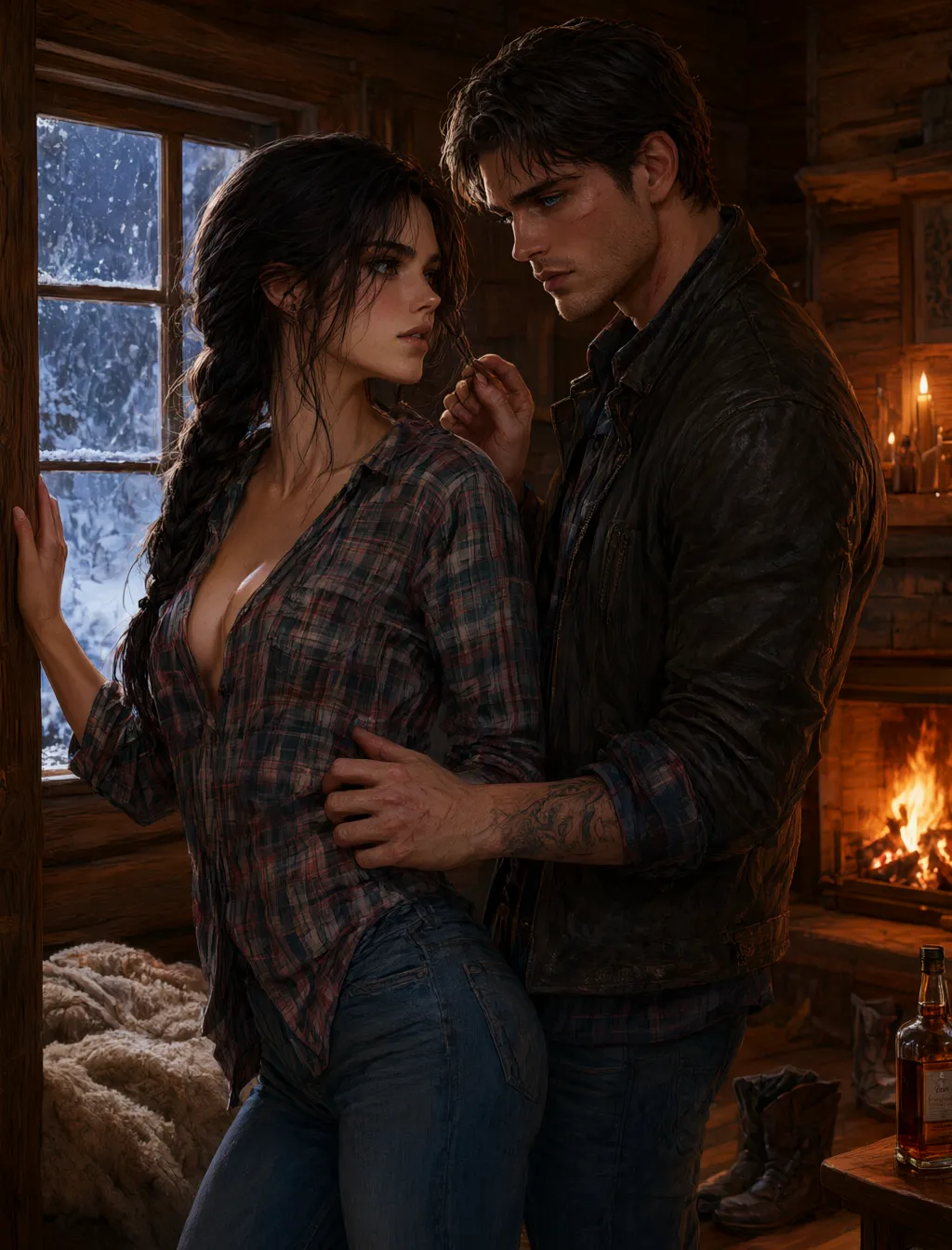
The door slammed into the frame with a sound that went through Maya's teeth. The whole cabin shuddered with it—logs complaining in their notches, dust sifting down from the rafters—and then the wind's howl cut off like a hand clamped over a mouth. The silence that followed was worse. It rang in her ears, a high thin note that made her want to swallow.
Snow spilled across the floorboards, a white tongue licking toward her boots. She watched it come, watched it melt at the edges where the fire's heat reached, watched it keep going anyway. The trek in had taken something out of her she hadn't realized she was carrying. Her scarf hung half-unwound, one end dragging against her chest. Her cheeks stung with the cold's memory, that deep burn that meant frost was already testing her skin.
Cole stood against the door like he'd grown there. Snow dusted his shoulders, clung to the dark wool of his coat, melted in dark patches where his body heat was winning. His chest heaved—once, twice—and then he got his breathing under control like it was a physical act of will. His hands came up and worked the knot of his scarf loose, and she watched the way his fingers moved, scarred and deliberate, and felt something in her stomach tighten that had nothing to do with the cold.
The fire crackled behind her. It threw long shadows across the rough-hewn logs, made the single windowpane rattle in its frame like something wanted in. The air smelled of pine sap and woodsmoke and damp wool, and underneath all of it, the sharper smell of him—snow and leather and something dark she couldn't name.
He turned.
His eyes found her across the room, and the look in them pinned her in place. It wasn't anger. It wasn't even warning. It was assessment, the cold calculation of a man measuring what he had to work with, and Maya felt herself stand straighter under it out of pure reflex. She'd been looked at by men her whole life—by soldiers and warlords and men who thought a woman with a camera was an easy mark. She knew the difference between wanting and weighing. This was weighing.
"You're alive," he said. His voice was low and clipped, scraped raw by the wind. "Good."
"Were you worried?" The words came out before she could stop them, sharp and defensive, the way she got when she felt small. She hated that about herself. Hated that she did it even now, with snow still melting on the floor between them and the wind still screaming outside like a thing with teeth.
Cole's mouth did something that wasn't quite a smile. "Worried about the weather. Not about you." He shrugged out of his coat, and she caught a glimpse of the flannel underneath, dark red against the broad stretch of his shoulders. "You're too stubborn to die."
"That's the nicest thing you've said to me all day."
"It's not a compliment." He hung the coat on a peg by the door, and the way he moved was economical, every gesture doing exactly what it needed to do. Nothing wasted. She'd noticed that about him on the trail, the way he never repeated a motion, never fumbled, never hesitated. A man who'd learned that hesitation got people killed.
The fire popped. A log shifted, sending up a shower of sparks that danced against the dark. Maya stepped closer to it, holding her hands out to the heat, and felt the sting as sensation returned to her fingers. Her boots were wet through. Her jeans were wet to the knee. She'd been so sure they'd make it before the storm broke, so sure the cabin was closer than it looked on the map.
She'd been wrong.
"You should get out of those boots." Cole's voice came from somewhere behind her. "The wet's going to freeze you faster than the cold."
She turned. He was crouched by the woodpile now, feeding split logs into his arms like they weighed nothing. The firelight caught the scars on his hands, pale lines that crossed his knuckles and disappeared into his sleeves. She wondered what had made them. Wondered if he'd ever tell her.
"I'm fine," she said.
"You're not." He straightened, the wood stacked against his chest, and his winter-sky eyes found hers again. "You're shaking."
She looked down at her hands and realized he was right. The tremor ran through her fingers in fine waves, the aftermath of the trek, the cold, the fear she hadn't let herself feel on the trail when the wind had tried to take her off her feet. She curled her fingers into fists and pressed them against her thighs, willing them still.
"It'll pass," she said.
Cole said nothing. He carried the wood to the hearth and dropped it into the iron rack with a clatter that filled the silence. Then he stood there, hands on his hips, watching the fire like it owed him something. The flames painted his face in moving light, made the hollows of his cheeks deeper, made his jaw look like it had been carved from something harder than bone.
"There's coffee," he said. "Kettle's on the stove. You want some?"
The question surprised her. It was the first thing he'd said that wasn't an order or an observation. She blinked at his back, at the broad line of his shoulders under the flannel, at the way the firelight caught the dark of his hair where the snow had melted.
"Yes," she said. "Please."
He moved toward the small kitchen at the back of the cabin, and she watched him go, watched the way his body filled the space, the way the cabin seemed to shrink around him. She'd known him for three days. Three days of sharing a trail, a fire, a tent when the first storm had caught them halfway up the mountain. Three days of his silence and her questions, his clipped answers and her growing frustration with a man who gave nothing away.
She'd come up here to write a story about the people who lived in these mountains, the ones who'd carved lives out of rock and snow and stubbornness. She hadn't expected to find one of them on the trail, hadn't expected to fall in step with a man who moved like he was born to the terrain, hadn't expected the storm that had forced them to take shelter together in a cabin that wasn't theirs.
The kettle began to hiss on the stove. Cole moved through the small kitchen with the same economy he did everything, finding mugs, finding the grounds, working the old hand-crank grinder with steady turns of his wrist. The smell of coffee began to layer over the woodsmoke, rich and dark, and Maya felt something in her chest loosen that she hadn't known was tight.
"I didn't think the storm would be this bad," she said, mostly to the fire. "The forecast said—"
"The forecast was wrong." Cole's voice came from the kitchen, flat and final. "They're always wrong up here. The mountains make their own weather."
"You could have told me that before we started."
"I did."
She turned to look at him. He was pouring the boiling water into the press, watching it darken, his face unreadable. She tried to remember if he had warned her, tried to recall the exact words he'd used when she'd first fallen in step beside him on the trail. She'd been so focused on her questions, on the angles of the story, on the way his answers kept slipping through her fingers like water.
"You said the pass could close," she said slowly. "You didn't say we'd get trapped."
"Trapped is a matter of perspective." He brought the press over, two mugs in his other hand, and set them on the low table in front of the fire. "We're warm. We have food. The storm will pass in a day or two." He lowered himself onto the worn fur blanket spread before the hearth, and the firelight caught the lines of his face, the stubble on his jaw, the way his eyes reflected the flames. "The question is what we do with the time."
Maya stood where she was, watching him. The way he said it made something go tight in her chest. Not fear. Not quite. Something sharper, more complicated. She'd spent her career walking into rooms where men wanted things from her, had learned to read the weight of a gaze, the set of a jaw, the subtle shift of power before it became a problem. She knew how to deflect, how to redirect, how to keep herself safe.
Cole didn't look at her like he wanted something. He looked at her like he'd already decided what she needed and was waiting for her to catch up.
She hated that look.
"I'll take that coffee," she said, and crossed the room to sit on the other end of the fur blanket, putting the fire between them.
He handed her the mug. His fingers brushed hers in the passing, and the contact sent a jolt up her arm that she didn't expect. She saw him notice—saw the slight narrowing of his eyes, the way his gaze dropped to her hand and then back up to her face—and she curled her fingers around the warm ceramic, refusing to acknowledge it.
"You're a long way from home," he said. It wasn't a question.
"I'm a journalist. Home is wherever the story is."
"And what's the story here?"
She took a sip of the coffee. It was strong, bitter, exactly what she needed. "The people who live in these mountains. The ones who stay when everyone else leaves. I wanted to understand—"
"Why they stay."
"Yes."
Cole was quiet for a moment. The fire popped between them. Outside, the wind threw itself against the cabin walls, testing the seams, looking for a way in. He took a drink of his own coffee, and she watched his throat move as he swallowed, watched the way his hand wrapped around the mug, scarred and steady.
"You're asking the wrong people," he said. "I'm not one of them."
"You live here."
"I pass through."
"You said you knew this cabin. You said the owner was a friend."
"Friend is a strong word." He set his mug down and leaned back on his hands, looking up at the smoke-darkened beams of the ceiling. "I've slept here before. That's all. The man who owns it is dead now."
The words landed flat, without weight, but Maya saw something move behind his eyes—a shadow, a flicker, something he shut down before it could surface. She filed it away, the way she filed everything, and took another sip of her coffee.
"How did he die?"
"The mountains." Cole's gaze dropped back to her. "They take what they want."
The wind screamed. The window rattled. Maya felt the cold bleed through the walls even with the fire blazing, felt the weight of the snow piling up outside, felt how small this cabin was, how far from anything that could help them. She'd been in tight spots before. She'd been in war zones, in refugee camps, in places where the danger was visible, measurable, known. This was different. This was a slow pressure, a quiet closing of doors, a man watching her from across the fire with eyes the color of a winter sky.
"We're going to be here a while," she said.
"Yes."
"A day or two, you said."
"Maybe longer."
She set her mug down. The movement was deliberate, a placing of a piece on a board. She looked at him across the fire, at the broad shoulders and the scarred hands and the stillness of a man who had learned to wait.
"And what are we supposed to do with the time?" she asked.
Cole's mouth curved. It wasn't a smile, not quite, but it was something—a shift in the landscape of his face that made her breath catch. He pushed himself up from the blanket in one smooth motion and crossed the space between them, and Maya felt the heat of him before he touched her, felt the way his body displaced the air, felt the sudden awareness of how small the cabin was, how close the walls, how unavoidable this moment had been since the door slammed shut.
His hand closed around her wrist.
Not hard. That was the thing. His grip was loose enough that she could have pulled away, could have twisted free, could have made him a liar with a single motion. But she didn't. She stood there, frozen by the warmth of his palm against her cold skin, by the way his thumb found her pulse point and pressed against it like he was reading something there.
"You want to survive this," he said, his voice low, "you do what I say."
The fire crackled behind them. The wind howled. His thumb traced her pulse, a possessive claim that made her stomach tighten, and Maya felt her breath go sharp, felt her heart drum against his grip, felt the heat of his body cut through the cold like it had been waiting for permission.
She didn't pull away.
She met his winter-sky eyes, and something passed between them that she couldn't name—a challenge, a recognition, a thread pulled taut that neither of them was willing to cut.
"And if I don't?" she asked.
Her voice was steady. She was proud of that. But the tremor underneath—the one that told him she was already considering the cost of defiance—that was real, and she knew he heard it.
The fire popped. The wind screamed. Cole's thumb pressed against her pulse, and the silence stretched between them, charged and waiting.
The silence stretched until Maya thought she might scream into it just to break the pressure of his thumb against her pulse. But she didn't scream. She'd learned long ago that screaming gave ground, and she'd spent her whole life refusing to give ground to men who thought they could take it.
"If you don't," Cole said finally, his voice low enough that she had to lean in to hear it, "you'll last the night. Maybe. But the storm's not going to care how stubborn you are. The cold doesn't negotiate."
"That's not an answer."
"It's the only answer I've got." He released her wrist, and the absence of his warmth was a shock she didn't expect. Her hand hung in the air between them, useless, and she had to consciously lower it to her side. "You want me to tell you I'll drag you through the snow if you don't listen? I will. I've done worse for less."
She believed him. That was the worst part. She believed him with a certainty that settled in her bones like cold water, and she hated how much she wanted to believe him.
"You don't even know me," she said. "Three days on a trail and you think you can decide what's best for me?"
"I know you didn't pack for this." His gaze dropped to her boots, her wet jeans, the thin jacket she'd shrugged off by the fire. "I know you thought the forecast would hold. I know you're the kind of woman who trusts her own judgment over everyone else's, and I know that's going to get you killed out here if you don't learn to bend."
The accuracy of it stung. She opened her mouth to argue, to throw something back at him, but he was already turning away, already moving toward the kitchen like the conversation was over because he'd decided it was.
"I'm not done talking to you."
"I am." He didn't look back. "There's a bedroom through that door. You should get out of those wet clothes. There's a dry set in the chest at the foot of the bed—belonged to the man who lived here. They'll be too big, but they'll be warm."
She stood in the middle of the room, fire crackling at her back, and watched him move through the kitchen like she wasn't there. He filled the kettle again, set it on the stove, began methodically checking the cabinets—counting cans, stacking supplies, taking stock of what the dead man had left behind. She should have been furious at the dismissal. Instead she felt something worse: the strange, unwanted relief of being told what to do.
She crushed it before it could take root.
"I can find my own clothes."
"I'm sure you can." He didn't turn around. "But you'll find the man's clothes in the chest, and they'll be dry, and you'll be warmer than you are now. The choice is yours. I'm just telling you where the warmth is."
The floorboards creaked under her boots as she crossed to the bedroom door. It was warped from years of moisture, and she had to throw her shoulder against it to get it open. The room beyond was small, dark, dominated by a bed with a frame of rough-hewn logs and a mattress that sagged in the middle. A chest sat at its foot, and she knelt before it, lifting the lid.
The smell hit her first—mothballs and cedar and something older, something that smelled like a life that had ended. She pushed past it, digging through the folded clothes until she found a pair of wool trousers and a thick flannel shirt, both far too large for her frame. They were warm when she pressed them to her face, or maybe that was just her imagination, maybe that was just the relief of knowing she wouldn't have to sleep in wet denim.
She changed quickly, the cold air raising goosebumps on her skin before the wool settled against her. The trousers bunched at her ankles. The shirt hung past her hips, the sleeves swallowing her hands. She rolled them up, once, twice, and stood there in the dead man's clothes, feeling like a child playing dress-up in a life that wasn't hers.
When she came back out, Cole was in the same place, but he'd moved the fur blanket closer to the fire and spread a second one over it. Two bedrolls lay side by side, close enough that she could feel the heat of him when she got near, far enough that she could pretend there was space between them.
"I made up the floor," he said, not looking at her. "The bed's yours if you want it. I don't sleep much anyway."
She stared at the two bedrolls, at the intimacy of them, at the way he'd arranged them like he'd done it a hundred times before. "You expect me to sleep next to you?"
"I expect you to sleep where you're warm." He finally turned, and his gaze caught on her—the oversized shirt, the bunched trousers, the way she was drowning in a dead man's clothes—and something moved in his eyes. Not amusement. Something softer, more dangerous. "The fire's the only heat we've got. You want to freeze on the other side of the room, that's your choice. But I'm not going to watch you shiver all night when there's warmth right here."
"Warmth," she repeated. "Is that what we're calling it?"
His mouth curved again, that almost-smile that did something to her stomach every time. "What else would we call it?"
She didn't have an answer for that. She crossed to the bedrolls and sat down on the one farthest from him, pulling her knees up to her chest, wrapping her arms around them. The fire crackled. The wind screamed. Cole watched her for a long moment, then turned back to the kitchen, and she heard him moving around, heard the clink of cans, the rustle of paper.
"There's stew," he said. "Canned. The man who lived here kept a good pantry. We won't starve."
"You keep talking about him like you knew him."
"I did."
"But you said he wasn't a friend."
Cole was quiet for a moment. Then he said, "He wasn't. But he was a man, and he lived alone in these mountains for forty years, and he knew how to prepare for a winter. I respected that."
"How did you meet him?"
"I found him." The words came out flat, careful. "At the bottom of a ravine. He'd been there a few days. I buried him where he fell, marked the spot, and took his keys so no one would break the door down looking for him."
Maya's breath caught. She stared at his back, at the broad line of his shoulders, at the way his hands moved as he opened the can of stew with a knife that appeared from somewhere on his belt. "You buried him."
"Someone had to."
"And you've been using his cabin since."
"He doesn't need it anymore." Cole poured the stew into a pot, set it over the fire, and finally turned to face her. The firelight caught the hollows of his face, made his eyes look darker, deeper. "You want to judge me for that? Go ahead. I've been judged by better."
"I'm not judging you." The words came out softer than she intended. "I'm just—" She stopped, trying to find the shape of what she wanted to say. "You found a stranger at the bottom of a ravine and you buried him. You didn't have to do that."
"Yeah, I did." He crouched by the fire, stirring the stew with a wooden spoon. "You don't leave a man to the animals. That's not what we do."
The firelight flickered across his face, and Maya watched him, this man she'd known for three days, this man who spoke in clipped sentences and gave nothing away, and she felt something shift in her chest. Not trust. Not yet. But the beginning of it, maybe. The possibility of it.
"You said the mountains take what they want," she said slowly. "Is that what happened to him?"
"He was old. He was tired. He went out in a storm and didn't come back." Cole's voice was flat, but she saw his jaw tighten, saw the way his hand stilled on the spoon. "The mountains don't care how long you've survived them. They just take."
"And you?" The question came before she could stop it. "How long have you been surviving them?"
Cole looked up at her, and for a moment, she thought he might actually answer. The firelight caught his winter-sky eyes, and she saw something there—a flicker of something raw, something he'd buried deep and didn't want to surface.
"Long enough," he said.
The stew bubbled. The wind howled. Maya pulled the dead man's shirt tighter around her and watched Cole's scarred hands work, and she realized she was no longer thinking about the story she'd come here to write. She was thinking about him.
And that was more dangerous than any storm.
Cole ladled the stew into two bowls and handed her one. The ceramic was warm against her palms, and she breathed in the steam, letting it thaw the last of the cold from her face. He sat down on his bedroll across from her, close enough that their knees almost touched, and ate in silence, watching the fire.
"You should eat," he said. "You'll need the strength."
"For what?"
"For surviving." He took another bite, chewed, swallowed. "The storm's not going to let up tomorrow. We'll have to ration the wood, keep the fire going, make sure the pipes don't freeze. It's work. You'll need to help."
"I can help."
"Good." He glanced at her, and the look in his eyes made her breath catch. "I'm not going to carry you through this, Maya. I'll keep you alive, but you have to do your part."
The use of her name—her actual name, not "you" or "woman" or the silent way he'd referred to her before—landed like a stone in still water. She felt it ripple through her, that small intimacy, and she hated how much she wanted to hear him say it again.
"I always do my part," she said.
"I know." He set his empty bowl aside and leaned back on his hands. "That's why I'm still here."
She finished her stew in silence, watching the fire, feeling the warmth of the wool against her skin, the weight of his gaze on her face. The wind had settled into a steady howl, a constant presence, a reminder that there was no leaving, no escape, no world beyond these walls until the storm decided to release them.
"How long were you in the mountains before you found me?" she asked.
Cole was quiet for a moment. "A few weeks. I'd been moving north, following the weather, staying ahead of the worst of it."
"And before that?"
"Before that, I was somewhere else."
"Where?"
He looked at her, and she saw the wall come down, the shutters close behind his eyes. "Somewhere I don't talk about."
"You don't talk about anything," she said, and there was no bite in it, just observation. "Three days on the trail with you and I know less about you now than I did when I started."
"That's the way I like it."
"Why?"
He didn't answer. He pushed himself to his feet, gathered the bowls, carried them to the kitchen. She watched him move, watched the economy of his gestures, the way he never wasted a motion, and she thought about the ravine, about the dead man he'd buried, about the way he'd said "that's not what we do" like there was a we, like he belonged to something bigger than himself.
She wanted to know what that was. She wanted to know what had made him.
The fire popped. A log shifted, sending up a shower of sparks. Cole came back and stood at the edge of the blanket, looking down at her, and the firelight caught the scars on his hands, the stubble on his jaw, the way his eyes reflected the flames.
"You should sleep," he said. "I'll keep watch."
"Watch for what?"
"The fire. The storm. Anything that needs watching." He lowered himself onto his bedroll, lying on his back, one arm behind his head, his eyes on the ceiling. "Sleep, Maya. You're safe here."
The words landed like a promise, and she wanted to believe them. She wanted to believe that she was safe, that this man with his scarred hands and his clipped sentences and his winter-sky eyes would keep her alive, that the storm outside couldn't touch her as long as she stayed close to the fire.
She lay down on her bedroll, pulling the fur blanket up to her chin, and stared at the ceiling beams. The fire crackled. Cole's breathing evened out, slow and steady, and she listened to it, let it anchor her, let it pull her toward sleep.
She was almost under when his voice came out of the dark, low and rough.
"The scar on my hand. The one that runs across my knuckles."
She opened her eyes. He was still on his back, still staring at the ceiling, but his hand had moved, held up where the firelight could catch it. The scar was pale against his skin, a thin line that crossed his knuckles and disappeared into his sleeve.
"What about it?" she asked.
"A man gave it to me. A long time ago." He turned his hand, examining it like it belonged to someone else. "I was young. Dumber than I am now. I thought I could save someone who didn't want to be saved."
"Did you?"
"No." He lowered his hand. "But I learned something that day. You can't help someone who won't help themselves. You can only be there when they're ready to reach out."
The fire crackled. The wind howled. Maya lay in the dark, in a dead man's clothes, beside a man who gave nothing away, and felt the weight of his words settle over her like a second blanket.
"Is that what you're doing with me?" she asked. "Being there until I'm ready to reach out?"
Cole was quiet for a long moment. Then he turned his head, and in the firelight, his eyes found hers across the space between them.
"I'm keeping you alive," he said. "What you do with that is up to you."
He turned back to the ceiling, and the silence stretched between them, filled with the sound of the fire and the wind and the beating of her own heart.
She didn't sleep for a long time.