
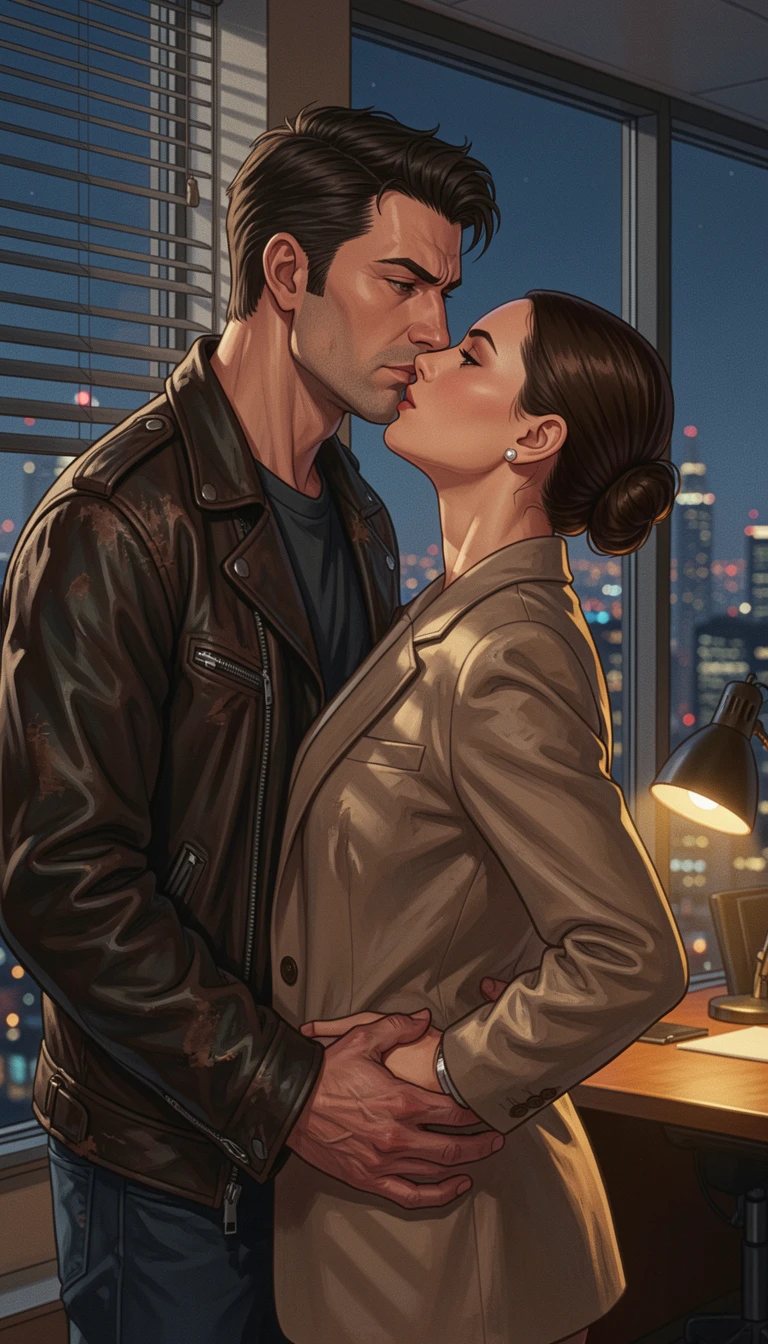
The fluorescent hum filled the silence between them, a low thrum that settled into his teeth. He watched her fingers curl tighter around the door's edge — the tendons standing, the knuckles blanching — and something in his chest unhooked itself, an anchor line cut loose. She was holding on. That was the choice. Not letting go, not yet, but she was holding on to the door like it was the only thing between her and a fall.
The tremor in her hand deepened, and he remembered the first time he'd seen it: through the Canon's zoom lens, three weeks ago, when she'd held a coffee cup with both hands in her kitchen and her father had been speaking on the phone in the background. Quick. Involuntary. A fault line running through the polished surface she'd learned to wear like armor. He'd noticed it then. He noticed everything. Noticed the way she'd set the mug down too carefully, the way her palm had pressed flat against the counter as if to steady herself against a wave only she could feel.
"You came." Her voice was different from the one she'd used when she opened the door — lower, less composed, as if the door between them had already begun to strip something away. "I wasn't sure you would."
He wanted to say something clever. Something that would put her at ease, crack the tension with a journalist's well-placed question. Instead he said, "You knew I would."
Her lips curved — not quite a smile, but close enough to shift the weight on his chest. "Yeah. I did." She pulled the door wider, an inch, maybe two. Behind her, the office was dark save for a desk lamp casting a pool of amber light across scattered papers. "You want to come in, or are you planning to stand in that hallway all night?"
The question hung between them, and he felt its weight in his throat. This was the threshold. The moment her invitation became a choice he'd have to live with. He could still walk away — tell her he'd misread the situation, that he'd come for a quote and nothing more, retreat to the safety of his leather jacket and the story he could still salvage. But the tremor in her hand was still there, and he knew, with the certainty of a man who'd spent his life reading people in the margins between their words, that if he walked away now, she'd close that door and never open it for anyone again.
He stepped forward. Not past her — not quite — but close enough that the warm air from her office brushed his face, carrying the scent of coffee and the faint floral note of something he couldn't name. Her perfume, maybe. Or the soap from her bathroom. He kept his hands at his sides, his eyes on hers. "I'm not going to hurt you," he said. "Whatever you're afraid of — I'm not it."
She held his gaze for a long beat, her dark eyes unreadable in the dim light from the corridor. Then she stepped back, pulling the door with her, and the gap widened into an invitation. "I know," she said, and there was something fragile in the way she said it, like she was testing the words to see if they'd hold. "That's what scares me."
The door swung open fully, and he crossed the threshold into the warmth of her office, the fluorescent hum of the corridor dying behind him as the door clicked shut. The sound was softer than he expected — less like a seal and more like a door closing on a room that had been waiting for someone to enter. He turned to face her, and in the amber pool of the desk lamp, he saw the tremor in her hand steady itself. Just for a moment. Just long enough for her to meet his eyes.
He watched her hand settle against her thigh, the fingers splaying wide as if to claim the fabric beneath them. The tremor was still there—he could see it in the way her knuckles moved, a subtle vibration like a string plucked and left to hum—but it was quieter now, a ghost of what it had been in the doorway. She didn't answer right away. Instead she crossed to the desk, her heels silent on the thin carpet, and picked up a half-empty mug. The coffee had gone cold, judging by the ring of oil floating on the surface.
"You notice things." She said it like a fact, not an accusation. She didn't look at him. "That's your job, I know. Noticing."
"It's not a job. It's what I am." He stayed where he was, near the door, giving her the space she hadn't asked for but clearly needed. "I've been doing it since I was a kid. Before I knew there was a word for it."
"And what do you notice about me? Right now." She set the mug down and finally turned, her dark eyes finding his across the amber-lit room. The challenge in her voice was practiced, but he caught the way her thumb pressed against the rim of the mug—a counterpressure against the tremor she was still fighting.
He could have given her the safe answer. The journalistic one—that she kept her shoulders squared even when her hands betrayed her, that she'd learned to hold a mug like armor, that she chose neutral colors to disappear into a room. But the safe answer was a lie, and they both knew it.
"You stopped shaking when you looked at me," he said. "Not when I walked in. Not when I mentioned your father. When I met your eyes." He took a step forward, close enough that the warmth from the desk lamp reached his hands. "You've been holding yourself together for so long you don't remember what it feels like to let go. But something in you—something you haven't named yet—wants to see if I can catch you."
Her breath caught. A small thing, barely audible, but in the silence of the office it rang like a bell. She pressed her lips together, and for a moment he thought she might shut down, retreat behind the polished composure he'd watched through his camera lens for weeks. But her hand—the one that had been gripping the mug—lifted to her collarbone, where the undone button of her blouse revealed a thin silver chain. Her fingers found the pendant, a small oval of dark stone, and held it.
"My mother gave me this," she said quietly. "Before she died. She said it was for protection." Her eyes met his again, and this time the tremor in her voice was softer than the one in her hands had ever been. "I've worn it every day for fifteen years. And I've never told anyone what it really means."
He didn't move. Didn't push. He let the silence open like a door, the same way she had for him when he'd stood in the fluorescent hum of the corridor. She closed her eyes—a long, deliberate blink—and when she opened them, the walls she'd built were thinner. He could see through them, just barely, to the girl who'd learned to armor herself in silence.
"It means I'm not alone," she said. "Even when I feel like I am." Her fingers tightened on the pendant, and the tremor in her hand—the one that had steadied when she looked at him—returned, soft and fragile, like a wing testing whether it could still lift. "I don't know if I'm ready to let you catch me, Ryan. But I think I want to find out."
The words settled in his chest, heavier than they should have been for their size. He watched her fingers curl around the dark oval of stone, watched the tremor run through her hand like water over a fault line, and he knew—with the same certainty that had carried him through a decade of chasing secrets—that she had just handed him something she'd never given anyone. Not the pendant. Not the story. The space between her words, the place where the real meaning lived.
"That's not what it really means." He said it softly, without accusation, the way he might address a confession that had been waiting too long to be spoken. "That's what you tell yourself when you need to believe it. But the pendant—what it really means—you haven't said that yet."
Her hand stilled on the stone. Not the tremor stopping—something deeper, a freezing in place, as if his words had touched a part of her she'd forgotten how to feel. She looked down at the pendant, at the silver chain pooled against her collarbone, and her breath came shallow, caught between the ribs she held so carefully still.
"My mother gave it to me the night before she died." The words came slower now, each one placed like a stone on a grave. "She said it was from her mother, and her mother before that. A line of women who wore it when they were afraid." Her eyes lifted to his, and he saw something raw behind them, something she'd never let the cameras see. "She said the stone would keep me safe because I would always know I wasn't the first one to carry a secret that heavy."
The fluorescent hum from the corridor had died completely, swallowed by the amber pool of the desk lamp. He heard her breathing, the faint shift of fabric as her hand dropped from the pendant to her side. She didn't look away. Neither did he.
"The secret," he said. It wasn't a question.
"The secret." Her voice cracked on the second word, barely a fissure, but he heard it. "The one I've been carrying since I was fourteen years old. The one my father told me would destroy us all if I ever spoke it out loud." She pressed her palm flat against her thigh, the fingers splaying wide, and the tremor in her hand was the only thing moving in the whole room. "I've worn this pendant every day for fifteen years, Ryan. And I've never told anyone what I'm actually afraid of."
He took a step closer. Not crowding her—just closing the distance between them by a measure that felt deliberate, a choice he wanted her to see him make. The warm air from the desk lamp brushed his jacket, and he smelled coffee and the faint floral note of her skin, and he kept his hands at his sides, open, visible.
"You don't have to tell me tonight," he said. "But I want you to know—whatever it is, I'm not going to write it. I'm not going to use it. I came here for a story, but that's not what this is anymore." He held her gaze, let her see the truth in his eyes before he said it. "This is me asking you to trust me with the thing you've never trusted anyone with."
Her breath caught again, the same small sound from earlier, and he watched her hand lift back to the pendant, the tremor quieter now, almost still. Her fingers closed around the dark oval, and she held it like a talisman, like a door she was deciding whether to open.
"My father didn't just build an empire," she said, her voice barely above a whisper. "He built a prison. And I've been inside it since the day I was born." She lifted her chin, and her dark eyes met his across the amber light, and the weight of fifteen years settled into the space between them. "The pendant means I'm not alone in that prison. But it doesn't mean I know how to leave."
He heard the weight of her words settle into the silence—the prison, the pendant, the fifteen years of not knowing how to leave—and he let them sit, let the truth of them fill the amber-lit space between them. Her hand was still pressed flat against her thigh, the fingers splayed wide, and he watched the tremor move through them like a current he could almost feel from where he stood. "Three weeks ago," he said, keeping his voice low, careful, the way he'd approach a threshold he wasn't sure would hold. "In your kitchen. You were holding a coffee mug with both hands. Your father was on the phone in the background, and I watched your hand—" he lifted his own, palm open, a gesture of demonstration—"start to shake."
Her breath caught, a sharp inhale that pulled her shoulders back. She didn't look away, but her fingers curled against her thigh, the nails pressing crescents into the wool of her skirt. "You saw that." Not a question.
"I saw everything." He took a half-step closer, the distance between them shrinking to the length of his arm. "The way you set the mug down too quickly. The way your palm flattened against the counter like you were bracing against a wave only you could feel. And then you looked at the phone—not at him, at the phone itself—and your hand stopped. You pressed your palm to your sternum, right here—" he touched his own chest, the hollow above his heartbeat—"and the tremor just... stopped."
She was very still now. Not frozen—poised, like a figure on the edge of a photograph waiting for the shutter to close. Her hand lifted from her thigh to her collarbone, found the pendant, and held it. "He was telling me about a land deal," she said, her voice flat, rehearsed. "A development in the northern district. Something about permits and zoning variances."
"That's not true." He said it gently, without judgment, the way he might correct a child who'd told a lie they didn't believe themselves. "Your eyes went somewhere else. Not into space—into memory. You were listening to something he said, and whatever it was, it made your hand pick up the tremor again. Briefly. Then you pressed it down."
She closed her eyes, and he watched her swallow, the column of her throat moving against the silver chain. When she opened them, the walls were thinner still—he could almost see through to the raw thing beneath. "He said the offshore accounts were clean now. That the audit was done, the paper trail burned, and that I needed to get my story straight for the press conference next week." Her voice cracked on the last word, and she pressed her lips together, hard. "He didn't tell me what story. He never does. He just tells me to be ready, and I am—always—and that's the part I hate most. That I'm always ready to lie for him."
The words hung in the air between them, raw and unwrapped. He watched her hand tighten on the pendant, the knuckles white, and he knew—with the certainty that had carried him through a decade of chasing secrets—that she had just handed him a thread. Not the whole rope, but a thread he could pull if he was careful.
"The press conference," he said. "Next week. What's it for?"
She shook her head, a small motion, almost involuntary. "I don't know yet. He'll tell me the night before. He always does." She let go of the pendant, and her hand dropped to her side, the tremor back—a soft, continuous vibration that moved through her fingers like a tuning fork struck and left to hum. "I've been standing in the wings of his stage for fifteen years, Ryan. I know my lines before he writes them. I know the blocking before he sets the lights. But I don't know how to walk off the stage without bringing the whole house down."