
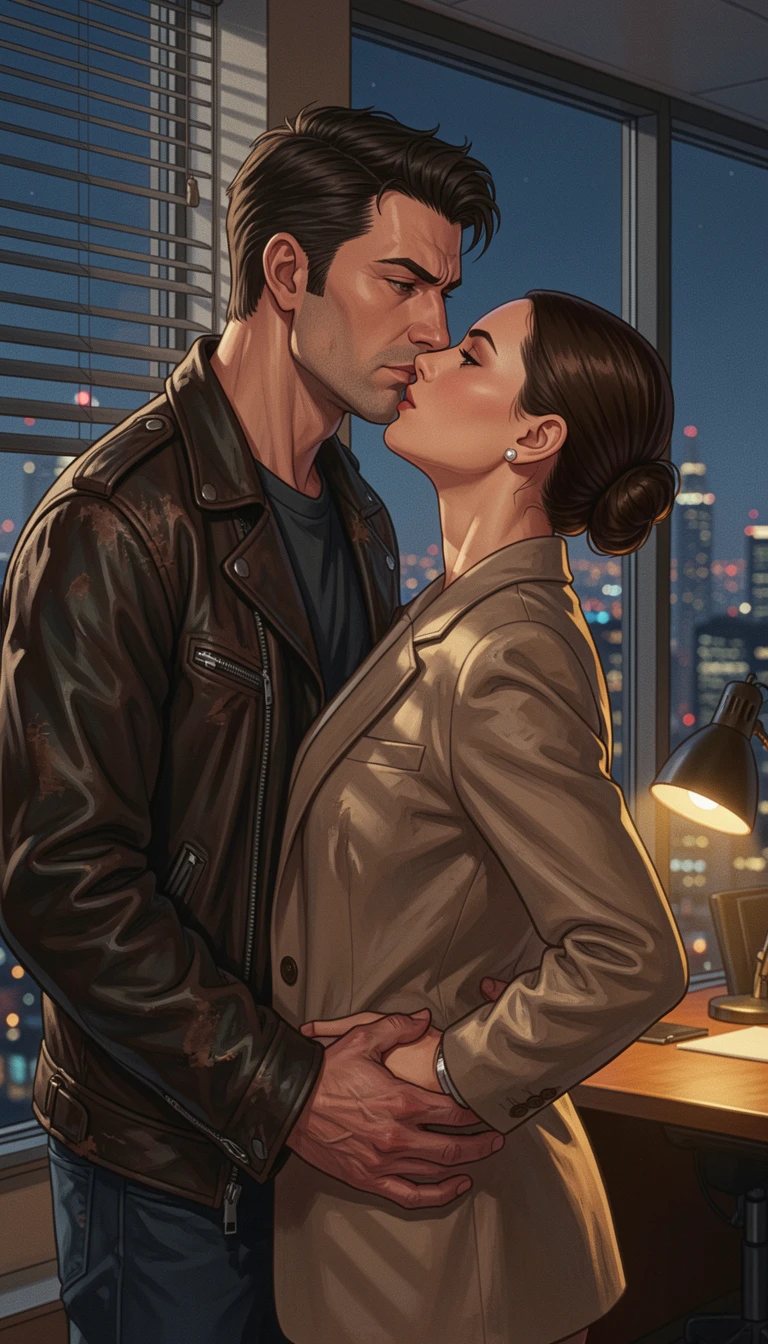
The third-floor office smelled of stale coffee and the burnt dust of an ancient radiator. Ryan Maddox settled the camera on its aluminum tripod, his callused fingers lingering on the focus ring, coaxing the image until Sophia Castellano's profile snapped into sharp relief against the glass of her 12th-floor window.
She was on the phone, her lips moving through the gap between her thumb and ear, the pace too fast for small talk. The hand not holding the phone pressed flat against the window—fingers splayed like a five-pointed plea. He watched her jaw work, the way her throat tightened before she forced it loose.
The espresso-dark hair was pulled back tight today, not a strand loose. She wore a neutral blazer, pearl earrings catching the overhead light. Everything about her said *contained*—except that hand against the glass, and the tremor he'd started noticing three weeks ago, in the way she'd turn from the window too fast.
He lifted a coffee cup from the dented desk, cold now, his eyes never leaving the viewfinder. Through the magnified frame, he watched her listen, then reply with a clipped nod. Her shoulders squared—not with defiance, with the practiced flex of someone preparing to take a blow.
A figure slid into the frame from the right. Marcus Castellano. Navy suit, silver-threaded hair slicked back, the gold signet ring catching light as he gestured once—a command, not a question. His daughter's hand dropped from the glass.
She didn't look at him. Her eyes stayed down, fixed on some point on her desk, and she reached into the top drawer with the economy of movement the hunted learn. A manila envelope, thick at the spine, emerged. She slid it across the surface without raising her gaze.
Marcus took it. No exchange of words that Ryan could read—a slight adjustment of the envelope in his grip, a final look around the room, and then he turned. His back was broad and unhurried. He vanished off frame the same way he'd entered.
Sophia stood very still. Her hand remained where the envelope had been, palm flat on the desk, as if she were feeling for heat left behind. Through the lens, Ryan saw her blink once, slowly. Her other hand came up and pressed against her sternum, just below the collarbone, holding something together that no one else could see.
Ryan's thumb hovered over the shutter release, the metal cool against his skin. The coffee in his other hand had gone forgotten. The story he'd come here for—the corruption scandal, the Senator's offshore accounts, the off-the-record sources who wouldn't speak above a whisper—it all felt like static in another room. What he'd just watched was something else. A trade. A ritual. A leash held taut.
He didn't press the button.
His thumb lifted. Then, deliberately, he pressed the shutter. The camera clicked, capturing the empty space where Marcus had stood—an absence framed in glass and reflected city light. The viewfinder held nothing but a polished floor and the edge of Sophia's desk.
He pulled his eye away, letting the camera hang from its strap against his chest. The coffee cup sat cold on the dented desk, untouched. He could still see the shape of her hand pressed flat on the surface where the envelope had been, the way her fingers had stayed there, searching for heat that was already gone.
He turned the camera over and hit the playback button. The image filled the small screen: the 12th floor, the desk, the empty air. Not a trace of Senator Castellano, his silver-threaded hair, his gold signet ring. Nothing but the aftermath of a transaction he'd watched but couldn't prove.
Ryan scrolled through the previous shots. Twenty-three frames of Sophia Castellano. The hand against the glass. The throat tightening. The blink of her eyes. He'd built a catalog of her tells without ever hearing her voice.
He looked back up through the window. She was still standing at her desk, her hand now gripping the edge, knuckles pale against the polished wood. Her shoulders rose and fell once—a breath, slow and deliberate. Then she turned away from the glass, walking out of frame.
The office across the street looked empty. Just furniture and light.
Ryan set the camera on the tripod, left it pointing at the window. The cold coffee stretched beside his hand. He could walk away. File the photos. Find another angle on the corruption story. That was the journalist's move—keep the distance, keep the lens between him and the truth.
But the tremor in her hand was still there, burned into his memory. The way she'd pressed her palm to her sternum, holding something in. He'd followed stories before. He'd never followed a person.
He grabbed his jacket from the back of the chair—worn leather, the collar turned up from years of city rain. He didn't bother with the camera. He'd come back for it later, if at all. His hand found the door handle, the metal cool and solid.
The door clicked shut behind him. The stairwell smelled of dust and old paint, and his footsteps echoed as he started down, cutting the distance between his third-floor office and the Castellano Tower's lobby with each measured beat of his soles.
The stairwell door swung open and the lobby hit him clean—marble floors, vaulted ceilings, the quiet hum of a building that had gone still for the evening. The elevator bank was thirty feet ahead, set into a wall of dark wood and brass. The doors were sliding shut, narrowing the gap between them until only a strip of light remained.
He saw her through that strip. Espresso-dark hair. The pale line of her neck as she stood facing forward, one hand gripping the leather strap of a bag. The doors met with a soft, oiled click.
The floor indicator above the elevator began to move. L. Then 2. Then 3.
Ryan's hand was still on the stairwell door. He could feel the cold metal of the push bar against his palm, the way his heart had not yet settled from the descent.
He could have run. His legs were longer, his reflexes still sharp from years of chasing leads down subway stairs and through rain-slicked alleys. He could have crossed the lobby in four seconds, shoved his hand between the doors, watched them pry open with a mechanical shudder. He could have stood in the elevator with her, breathing the same air, watching her dark eyes register the stranger who'd slipped through her father's building uninvited.
He didn't move.
The floor indicator ticked past 5. Then 6.
The lobby was empty. A security guard at the front desk glanced up from his phone, then back down. A janitor pushed a cart past a row of potted ferns, the wheels squeaking once before fading into the marble's echo. Nothing else moved.
Ryan let his hand fall from the door. He stood in the center of the lobby, the elevator now stopped at 9, and he imagined her stepping out onto the 12th floor, the office with the empty desk and the manila envelope's ghost still pressed into the wood.
The indicator stopped at 12. The doors opened up there, somewhere he couldn't see. He wondered if she'd turn and look back at the lobby through the glass of her window—if she'd notice the silhouette he'd left behind, the man with the camera he'd chosen not to bring.
His hand found the call button before he'd fully decided to press it—a pale oval of backlit plastic, warm under his thumb from the bank's ambient power. The button sank with a soft click, and the lobby's stillness seemed to sharpen around him, the marble floor reflecting the overhead lights in long, cold streaks. Above the elevator bank, the floor indicator glowed amber, still holding at 12, and he watched it as if the number might change on its own, as if waiting would undo the doors closing on the strip of her silhouette.
A long pause. Then the number changed. 11. The car was descending.
He counted the floors as they fell—10, 9—each tick of the indicator a small, irreversible decision. He had no plan. No words prepared. No explanation for why a man with a telephoto lens and a cold coffee and a camera full of her photographs was standing in her building's lobby, one hand still pressed to the button he'd already pushed, the leather of his jacket creaking with each shallow breath.
7. 6. The car was halfway down now, and he still hadn't moved. The security guard had looked up from his phone again, a faint furrow of curiosity deepening between his brows. Ryan met his gaze for a moment—neutral, unhurried, the practiced blankness of a man who belonged in a lobby—and the guard looked away first, back to the small blue glow of his screen.
4. 3. The numbers were dropping faster now, the old elevator mechanism humming through the walls. Ryan's hand fell from the call button, settling at his side. He could feel the weight of his own pulse in his throat, the fine tremor in his fingers that had nothing to do with cold or caffeine. He'd never crossed this line before. He'd never followed a person into their own building, their own territory, without knowing what he'd say when the doors opened.
2. The indicator flickered. A soft chime, muffled through the wood and brass, announced the car's arrival on the main floor. The doors slid open with a mechanical sigh, the interior empty—clean brass rail, mirrored wall, the faint chemical scent of the cleaning solution the janitor's cart still carried. A single receipt lay crumpled in the corner, a forgotten witness.
He stepped forward before the doors could close again, his weight settling inside the car. The doors hesitated, then began to slide shut, narrowing the gap between him and the lobby until the marble floor became a strip, then a seam, then nothing. The car was sealed. The panel offered him a row of numbered buttons, the 12 still warm from her finger.
He didn't press it. Not yet.
His hand hovered over the panel, palm open, the calluses on his fingers catching the faint light. He could still see her hand pressed flat against the desk where the envelope had been, the way her fingers had searched for heat that was already gone. He could still hear the click of the elevator doors meeting, the soft, oiled sound of a possibility closing.
The car waited. The numbers glowed. And Ryan Maddox stood in the space she'd just left, his finger inches from a button he couldn't unpress, the weight of the choice settling along his spine like a second spine, colder and sharper than the first.
His finger pressed down. The button sank with the same soft click as the call button had—a small, mechanical surrender that echoed through the sealed car. The 12 glowed amber, steady and patient, and the elevator hummed to life around him, the cables engaging somewhere above with a sound like a held breath releasing.
The car began to rise. The lobby fell away through the glass panel beside the doors—marble receding into a blur of light and shadow, the security guard's silhouette shrinking into the geometry of the floor. Ryan watched it go, his hand still hovering where the button had been, as if he could undo the ascent by keeping his palm open.
2. The indicator ticked overhead, a soft mechanical thud behind the panel. The car smelled of cleaning solution and the faint floral ghost of someone else's perfume. Not hers. Something older, trapped in the carpet fibers.
3. He pulled his hand back, let it fall to his side. The leather of his jacket creaked as he shifted his weight, and he caught his own reflection in the mirrored wall opposite—gray eyes, dark hair, the permanent furrow between his brows deepened into something he barely recognized. A man who had just pressed a button he couldn't unpress.
4. His reflection stared back at him, and he looked away first. The car was a box of polished brass and soft amber light, and he was sealed inside it, the distance between the lobby and the 12th floor narrowing with each tick of the indicator. The receipt crumpled in the corner was still there. A coffee stain on the carpet near his shoe. A scuff mark on the brass rail at hip height. Details. He catalogued them because it was easier than thinking about what came next.
6. The car slowed, then stopped. The doors slid open onto an empty hallway—carpet the color of slate, a row of frosted-glass doors, the distant hum of a vending machine. No one stood waiting. He watched the gap for a beat, the strip of hallway beyond, and then the doors slid shut again, the car resuming its climb with a soft lurch.
7. He had no words. No story, no alias, no prepared reason for why he was standing in an elevator in the Castellano Tower with a camera full of her photographs. The thought pressed against the inside of his skull—amateur, rookie, a man who'd traded his instincts for a thread he couldn't let go—but he didn't reach for the lobby button. His hand stayed at his side, palm open, fingers slightly spread.
9. The car rose through the building's spine, and he felt each floor pass through the soles of his shoes, a vibration he could almost mistake for his own heartbeat. The mirrored wall showed him the same furrowed stranger, the same worn leather jacket, the same hands that had pressed a shutter release and a call button and now this—the final number, the one he couldn't unpress.
11. The car slowed. The mechanism hummed, decelerating with a soft, practiced grace. Ryan's breath caught, held, didn't release. The amber number flickered, steadied, and then the car stopped with a gentle shudder, the cables settling above, the car swaying once before stilling.
The indicator held at 12. The doors did not open.
The door panel offered no click this time. His thumb found the 12 again—pressed it once, twice, three times, the button sinking with the same soft surrender each time. Nothing changed. The car held its position, a sealed capsule suspended in the building's spine, and through the mirrored wall he watched himself press the same button with the same desperate patience, as if repetition might convince the mechanism to obey.
His hand dropped to the lobby button. L. He pressed it, felt the cheap plastic yield under his callused finger, and waited for the hum of cables engaging, the lurch of descent. The car did not move. The amber 12 glowed above the door, steady and indifferent. He pushed the door-open button—the one shaped like two arrows parting—and heard nothing. No mechanical sigh. No click of released locks.
He stepped back, his shoulders meeting the brass rail, the metal cool through his leather jacket. The car was a box. A sealed box. And he had walked into it willingly. His reflection watched from the opposite wall—gray eyes wide, the furrow between his brows deeper than he remembered, the dark hair falling across his forehead from the stairwell descent. He looked like a man who had just realized the trap he'd set was also his own cage.
The silence in the car was absolute. No street noise filtered through the marble and steel. No distant hum of the vending machine from the 7th floor. Just the soft whir of the ventilation fan above, the subtle tremor of the car suspended in its shaft, and the sound of his own breathing—shallow, measured, the kind of breathing a man does when he's cataloguing exits and finding none.
He pushed off from the rail, his hands finding the panel again. He pressed every button in a row—B, L, 2, 3, all the way up to 15—his thumb moving with methodical precision, testing each one like a code he might crack. The buttons glowed amber, then faded. The doors did not open. The car did not move. The 12 remained lit, possessive, as if the floor itself had claimed him.
His head fell forward, his forehead pressing against the cool brushed steel of the door. He could smell the cleaning solution from the janitor's cart, the faint ghost of wax and ammonia. Behind his closed eyes, he saw her hand pressed flat against the desk, searching for heat that was already gone. He saw the envelope slide across the polished wood. He saw the elevator doors close on the strip of her silhouette, and he understood, with a clarity that settled cold in his chest, that he'd just followed a person into a building where he had no alibi and no exit.
A soft sound pulled his eyes open. Not from the panel. From behind him. He turned, his shoulder brushing the mirrored wall, and scanned the car's interior: the brass rail, the scuffed carpet, the crumpled receipt in the corner. Nothing moved. But the sound had been there—a whisper, almost, or the shift of fabric against a surface. He held still, his breath caught, and waited for it to come again.
The car was silent. The amber light held steady. And his reflection, trapped in the mirrored wall, watched him with the same wariness he felt pressing against his own ribs. The man in the glass wore a worn leather jacket, his hair dark and disheveled, his gray eyes fixed on something behind his own shoulder—a threat he could sense but not see. Ryan lifted his chin, and the reflection did the same, a slow, deliberate acknowledgment that there was no one else in the car.
He reached into his jacket, his fingers brushing the strap of the camera he'd left behind. The weight of its absence was heavier than the camera itself. He had no proof now. No record of her hand against the glass, her palm flat on the desk, the envelope sliding across the wood. Just the memory, burned into the space behind his eyes, and the strange certainty that he would need every detail of it soon.
The panel flickered. The amber 12 blinked once, twice, and then the car hummed—a low vibration rising through the floor, the cables engaging above with a sound like a held breath releasing. The doors did not open. But the car began to descend, the numbers ticking backward above the panel, 12 to 11 to 10, each floor falling away as if the building were exhaling him back toward the marble lobby, the security guard's curiosity, the cold coffee waiting in his third-floor office. He pressed his palm flat against the mirrored wall, steadying himself, and watched his reflection shrink into the glass as the car carried him down, the 12th floor receding into the sealed space he'd left behind.