
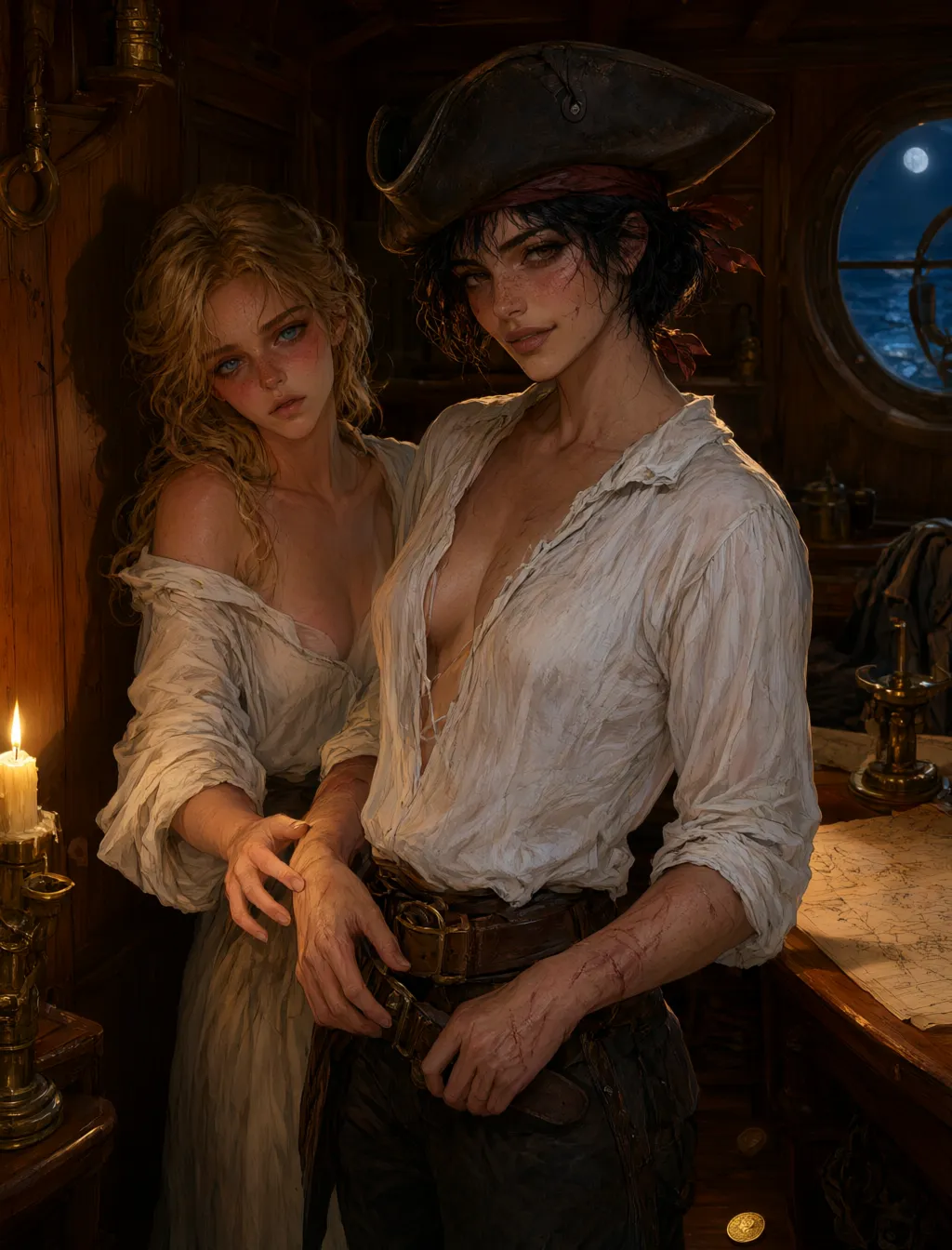
Amelia swung her lantern into the dark of the cargo hold, and the light caught something that didn't belong.
Not the barrels. Not the crates. Not the coils of rope she'd stored herself, three days ago, when they'd taken on supplies in Port Royal. Something softer. Something that breathed.
She held the lantern higher, and the shadows peeled back to reveal a woman pressed into the gap between two water barrels, her honey-blond hair half-spilled from its pins, her dress torn at the sleeve, her blue eyes wide and fixed on Amelia with the frozen alertness of a caught animal.
Amelia's cutlass stayed in its sheath. Her hand did not move toward it. The woman was unarmed — she could see that in the way her hands were pressed flat against her own thighs, empty, trying not to tremble. The dress was fine fabric, expensive, the kind of thing English ladies wore to garden parties and dinner tables where men decided their futures. It was also filthy, smudged with bilge and coal dust, the hem caked with whatever she'd crawled through to get here.
Amelia let the silence stretch. Let the woman feel the weight of being found.
"Well," Amelia said, her voice low. "That's not cargo."
The woman's chin lifted. Her jaw tightened. She said nothing.
Amelia took a step closer. The lantern swung, casting her shadow long across the stacked crates. The heat in the hold pressed in — humid, close, the air thick with salt and old sweat and the sharp smell of the woman's fear, cut with something floral. Lavender. Lavender soap, on a stowaway.
"You've got ten seconds," Amelia said, "to tell me why I shouldn't throw you overboard."
The woman's throat moved. A swallow. Her hands stayed pressed to her thighs, but Amelia saw the tremor in her fingers — fine, barely there, the kind of shake a person couldn't control.
Still, she held Amelia's gaze. Didn't look away. Didn't beg.
Amelia counted. "Eight."
The woman's hand moved — slow, deliberate, telegraphing every inch so Amelia could see she wasn't reaching for a weapon. Her fingers went to the small velvet pouch tucked into the waistband of her skirt, worked it free, and held it out.
Amelia looked at the pouch. Then at the woman's face. Then back at the pouch.
"That's not an answer."
The woman's lips pressed together. Her arm stayed extended, the pouch dangling from her fingers, catching the lantern light. The velvet was dark, almost black, and it was heavy with something that clinked — coins, by the sound, and one larger weight that shifted separate from the rest.
Amelia took it. Her fingers brushed the woman's — brief, accidental, and the woman's breath caught, sharp and quick, a sound she tried to hide and failed.
Amelia weighed the pouch in her palm. Good weight. Maybe thirty guineas, if the coins were gold. The larger shape was a locket — she could feel the outline of it through the velvet, oval, with a raised pattern on the front.
She didn't open it.
"A bribe," she said. "That's your answer."
"It's not a bribe." The woman's voice came out rough, cracking at the edges, but the diction was crisp — educated, English, the kind of voice that had been trained in drawing rooms. "It's payment. For passage."
Amelia raised an eyebrow. "Passage."
"To anywhere." The woman's blue eyes were bright in the lantern light, restless, cataloging Amelia's face the way Amelia was cataloging hers. "Anywhere that's not Jamaica."
The ship groaned around them. Water lapped against the hull. Somewhere above deck, Amelia could hear Swee's laugh — bright and unguarded — and the lower rumble of Kofi's response.
Amelia didn't look away from the woman.
"You're a long way from the governor's mansion," she said. "And that dress cost more than most of my crew will see in a year."
The woman's chin lifted higher. "You know who I am."
"I know the fabric. I know the cut. I know the lavender soap that only one shop in Port Royal carries, and it's the one the governor's wife uses." Amelia let the corner of her mouth lift — not quite a smile. "I'm a pirate, not a savage. I notice things."
The woman's throat moved again. Her hands, finally, dropped from her thighs. She sat back on her heels, the movement a small surrender — not of defiance, but of the pretense that she could run.
"My father is selling me," she said. "To a man I've met twice. A man who looks at me the way he looks at horses he's about to buy."
Amelia's fingers tightened on the velvet pouch. She said nothing.
"His name is Lord Thomas Whitmore." The woman's voice went flat, reciting the words like a script she'd memorized. "He's thirty-one. He has a country estate in Kent and a townhouse in London. He wants a wife who will look pretty on his arm and produce heirs and never speak out of turn." She paused. "He also has a mistress in Whitechapel that everyone knows about, and a gambling debt that would swallow my dowry whole within a year."
The hold was quiet. Amelia could hear the woman's breathing — steadier now, as if speaking had calmed her.
"So you ran," Amelia said.
"I ran."
"And chose a pirate ship."
"I chose the first ship leaving port that wasn't flying English colors." The woman's gaze flickered — a flash of something wry, almost humorous. "I didn't have time to be selective."
Amelia let out a breath that was almost a laugh. She crouched, bringing herself down to the woman's level, the lantern resting on the boards between them. The light caught the woman's face fully now — the porcelain skin smudged with dirt, the sunburn creeping across her cheeks, the fine lines of exhaustion around her eyes. She was beautiful. In the way a storm was beautiful. In the way a blade honed to its edge was beautiful.
"What's your name?" Amelia asked.
The woman hesitated. For a moment, Amelia thought she would lie. Then something in her face shifted — a decision, made in the space between one breath and the next.
"Josephine Ashworth." She paused. "But I'd prefer Jo."
"Jo." Amelia tested it. "And what exactly were you planning to do, Jo, once you reached wherever this ship was going? Assuming you survived the journey without being found."
Jo's lips pressed together. "I hadn't planned that far."
"No." Amelia's voice was dry. "I gathered."
She stood, the movement fluid, practiced. The velvet pouch was still in her hand. She looked down at it — then at Jo, still crouched between the barrels, her torn sleeve hanging loose, her pinned hair half-undone, her eyes tracking Amelia with the desperate focus of someone who knew her life was being decided in this moment.
"I could throw you overboard," Amelia said. "It would be practical. You're a liability. You're English nobility, which means your father will tear apart every port in the Caribbean looking for you. You don't know how to crew a ship. You don't know how to fight. You don't know how to survive a storm or a naval raid or a month without fresh provisions." She paused. "You're cargo I didn't ask for."
Jo's hands were fisted at her sides. Her jaw was tight. But she didn't argue. Didn't plead. She just watched, waiting.
Amelia looked at the pouch in her hand. Felt the weight of the coins. The shape of the locket beneath the velvet.
"But I'm not in the habit of returning women to men who think they own them," she said quietly. "And the money helps."
Jo's breath escaped in a rush — relief, held too long, now flooding out of her. She swayed, just slightly, and caught herself on the barrel beside her.
"Thank you," she said. The words came out thin. She cleared her throat and tried again. "Thank you. I—"
"Don't thank me yet." Amelia's voice was flat, practical. "You're not crew. You're a passenger, and passengers work. You'll scrub decks. You'll mend sails. You'll learn to tie knots and climb rigging and follow orders without question. You'll share a hammock with whoever has space. You'll eat the same slop we eat, drink the same watered rum, and you will not complain." She stepped closer, and Jo had to tilt her head back to hold her gaze. "And if you put this ship at risk — if you do anything that endangers my crew — I will throw you overboard. Not gently. Do you understand?"
Jo's eyes were bright. Her chest rose and fell in a long, steadying breath. "I understand."
"Good." Amelia turned toward the ladder. "Follow me. And bring your pouch — you'll need to pay for your own hammock."
She climbed, boots finding the worn rungs, the lantern swinging in her grip. Behind her, she heard the rustle of fabric, the scrape of shoes on wood, the soft sound of Josephine Ashworth rising from her hiding place to follow.
The night air hit Amelia's face as she emerged on deck — salt and wind and the vast dark of the Caribbean spread out under a scatter of stars. The crew was moving, adjusting lines, preparing for the turn toward open water. Swee was at the wheel, her red braid whipping in the breeze. Mara stood by the rail, her dark eyes finding Amelia the moment she appeared.
Mara's gaze slid past Amelia to the woman emerging behind her — dirty, disheveled, her torn sleeve flapping, her chin lifted like she was walking into a ballroom instead of onto a pirate deck.
Mara's expression didn't change. But one eyebrow rose, slow and meaningful.
Amelia ignored it.
"Swee," she called. "We've got a new hand. Show her where to stow her things and find her a hammock."
Jo stepped forward, the velvet pouch held tight in her fingers. She looked small against the vastness of the ship — the dark water stretching to the horizon, the rigging rising above her like a web of shadows, the crew watching her with open curiosity.
But she didn't shrink. She stood straight, her blue eyes sweeping the deck — the guns, the ropes, the stars, the faces of the women who would be her company for however long this journey lasted — and Amelia saw something kindle in her expression.
Not fear. Not hesitation.
Hunger.
Jo turned back to Amelia, and for a moment, they were the only two people on the deck. The wind pulled strands of honey-blond hair across her face. The lantern light caught the exhaustion in her eyes and the stubborn set of her mouth.
"Where are we headed?" Jo asked.
Amelia held her gaze. "West. Toward the open sea. Away from Jamaica." She paused. "After that, we'll see."
Jo nodded. A single, decisive movement. Then she turned and followed Swee across the deck, her steps uncertain on the shifting boards, her hand reaching out to catch the rail when the ship rolled.
Amelia watched her go. The velvet pouch was still in her own hand. She hadn't given it back.
She weighed it again. Felt the locket shift inside, heavy with whatever secrets it held.
"Well," Mara said, appearing at her side with the quiet she always carried. "You found something."
Amelia didn't look at her. "Found a problem."
"Found a pretty problem."
Amelia's jaw tightened. "She's a passenger. She pays. That's all."
Mara said nothing. But Amelia felt the weight of her gaze — knowing, patient, waiting for the truth Amelia wasn't ready to speak.
The ship crested a swell. The stars wheeled overhead. Somewhere below, Josephine Ashworth was being shown to a hammock, her first night of freedom settling around her like salt spray.
Amelia let her breath out slow. She tucked the velvet pouch into her coat pocket.
The locket pressed against her ribs.
She didn't open it. Not yet.
She leaned against the rail, letting the wind pull at her coat, watching the crew move through their familiar rhythms. The ship had settled into its heading now — southwest, riding the current, the sails full and straining. Above, the stars were emerging in their thousands, cold and bright, the same stars she'd navigated by for a decade.
Mara hadn't moved. She stood a few feet away, her back to the rail, her arms crossed, her face half in shadow. She wasn't looking at Amelia anymore. She was looking at the spot where Josephine had disappeared below deck.
"She's afraid," Mara said, quiet enough that only Amelia could hear.
"She should be."
"That's not what I mean." Mara's voice was patient, unhurried. "She's afraid of being sent back. Of being found. Of waking up tomorrow and realizing this was a dream." She paused. "She's not afraid of the sea. She's not afraid of the work. That's rare."
Amelia's fingers found the pouch in her pocket. She didn't pull it out — just pressed her palm against it, feeling the outline of the locket through the velvet.
"She's a governor's daughter," Amelia said. "She's been afraid of the wrong things her whole life. That doesn't make her useful."
"No," Mara agreed. "But it makes her interesting."
Amelia turned to look at her. Mara's face was unreadable in the dark, but there was a glint in her eye — the same glint she got when she spotted a ship on the horizon that might be worth chasing.
"You're enjoying this," Amelia said flatly.
"I'm enjoying watching you pretend you're not."
Amelia's jaw tightened. She opened her mouth to respond, but Swee's voice cut across the deck before she could.
"Cap'n! You'll want to see this."
Swee was at the stern, leaning over the rail, pointing back toward the dark line of land they'd left behind. Amelia crossed to her in a few long strides, Mara following.
"What is it?"
"Lights," Swee said. "On the horizon. Coming from Port Royal."
Amelia squinted into the dark. For a moment, she saw nothing — just the black water, the faint shimmer of moonlight on the waves. Then she caught it. A cluster of lights, small and distant, moving along the coast. Torches. Lanterns. A search party.
Her stomach tightened.
"They're already looking," she said.
"They found her room empty," Mara said. "Found her bed unslept in. Found the note she left, or didn't leave." She paused. "Her father won't wait until morning."
Amelia watched the lights crawl along the shore. They were still distant, still moving parallel to the coast, not yet putting out to sea. But it was only a matter of time before someone thought to check the harbor. Before someone remembered the pirate ship that had slipped anchor at dusk.
"How long until they launch boats?" she asked.
"If they're organized?" Swee's voice was uncharacteristically serious. "An hour. Maybe two."
Amelia turned and looked at the sails. They were full, riding a good wind, but the ship was heavy with cargo and the current was against them until they cleared the reef. They had speed, but they didn't have distance.
"Mara," she said. "Rouse the crew. Double the watch. I want every hand on deck and every light doused. We're running dark until we're past the Cayman Trench."
Mara nodded and moved, her voice low and steady as she passed the order along. The crew stirred into motion — quiet, practiced, the way people moved when they knew the stakes.
Amelia stayed at the rail, watching the lights. They were still there, still moving, still searching. Her hand found the velvet pouch again. She pulled it out, held it in her palm, and finally — after all the hours of not looking — she loosened the drawstring and tipped the contents into her hand.
Coins spilled across her fingers. Gold, mostly, a few silver. English mint, fresh and bright. Enough to buy passage on any ship in the Caribbean. Enough to buy a small farm, if she'd wanted one.
And the locket.
It was silver, tarnished at the edges, with an intricate rose engraved on the front. The clasp was stiff — she worked it open with her thumbnail, the metal catching in the salt-damp air.
Inside, two portraits. One was a woman, young, with honey-blond hair and a soft smile — Josephine's mother, by the resemblance. The other was a child, maybe eight years old, with the same blue eyes and a gap-toothed grin.
Amelia stared at the tiny painting. The child's face was open, unguarded, full of a joy that the woman in the cargo hold had clearly lost somewhere along the way.
She closed the locket. Slipped it back into the pouch with the coins. Tucked the whole thing into her coat pocket, close to her heart.
"You're keeping that," Mara said. She was back, standing at Amelia's shoulder, watching the same distant lights.
"I'm holding it for safekeeping."
"Mm." Mara's voice carried the weight of someone who knew exactly what safekeeping meant, and didn't believe it for a second. "And the girl?"
Amelia was quiet for a long moment. The wind pulled at her short hair. The ship crested another swell, and she adjusted her stance without thinking, the movement as natural as breathing.
"She's crew now," Amelia said. "Until she proves otherwise."
Mara said nothing. But when Amelia turned, she caught the ghost of a smile on the older woman's face — rare, fleeting, and gone before Amelia could be sure she'd seen it.