
T
Onkar's throat worked once. The word he hadn't spoken yet sat on his tongue like ash — bitter, final, the taste of something burning down. He looked at Shobha Bua's folded hands, at the white-knuckled grip she had on herself, and he thought of his brothers. Sagar's laugh. Sawan's terrible singing in the bathroom. Vikas teaching him to drive, patient even when he ground the gears. Madan, who always saved him the last piece of whatever he was eating.
'Yes,' he said.
The word hung in the veranda air, thin as the incense smoke still curling from the prayer room. Shobha Bua's hands did not unfold. Her face did not change. But something behind her eyes — a latch, a lock, a door he hadn't known he was watching — slid closed. She nodded once, sharp as a blade finding its sheath.
Urmila Bua let out a breath she had been holding since the funeral. Her round face crumpled, tears sliding down cheeks already mapped with old grief, and she pressed her pallu to her mouth to muffle a sound that might have been a sob or might have been relief.
Nirmala Bua lit another cigarette. The match flared in the dark, illuminating the hard lines of her face, the set of her jaw. She dragged once, twice, then let the smoke stream from her nostrils like a dragon cooling its forge. 'Good,' she said. 'Then it's settled.' But her eyes were not on Onkar. They were fixed on the empty chairs, on the ghost of her son still sitting in the one with the cracked armrest.
Anita Bua said nothing. She stood apart from the others, at the edge of the veranda where the light from the oil lamp didn't reach. Her sari was the color of dust, her face the color of old bone. She was watching him, he realized — not as a nephew, not as a solution, but as a stranger who had just walked into a room he did not belong in.
'Within the month,' Shobha Bua said again, as if testing the words against the night air. 'We'll have the priest come. Simple ceremony. No need for —' She stopped. For celebration, she had been about to say. 'No need for anything elaborate.'
Onkar nodded, though the motion felt borrowed, as if his body were performing agreements his mind hadn't caught up to. One month. Four weddings. Four women who had been his sisters-in-law, who had called him devar and teased him about finding a bride, who had served him tea and scolded him for not eating enough.
'The girls know,' Urmila Bua said, her voice a whisper that barely reached him. 'They've agreed.' She hesitated, her eyes darting to Shobha before continuing. 'Ritika's father — he's found a match for her. A widower in Solapur. Forty-seven. Two children.'
The silence that followed was a living thing. Onkar felt it press against his ears, against his chest. Ritika. Madan's wife. The dancer, the quiet one who always seemed to be watching from somewhere just outside the frame. He remembered her at the wedding, four years ago, barely nineteen, her eyes bright with a future she thought she understood.
'She stays,' Shobha Bua said flatly. 'I've spoken to her father. The arrangement is cancelled.'
'You spoke to him?' Onkar heard himself ask. 'When?'
'This morning.' She adjusted the fall of her sari, a small, precise motion. 'While you were at the temple.'
He had been at the temple. Lighting incense for his brothers. Praying for their souls, for their journey, for the mercy of whatever waited after the road and the metal and the blood. And while he prayed, his aunt had been on the phone, dismantling a marriage arrangement and building a new one around his unwilling neck.
Nirmala Bua's cigarette end glowed, dimmed. 'Don't look so pale, Onkar. It's not like we're asking you to marry strangers. You know these girls. You've lived with them under this roof for years.' She tapped ash onto the veranda floor. 'The only thing that changes is a few documents and which room you sleep in.'
The veranda floorboards creaked. Someone was standing in the doorway behind him — he felt the shift in the light, the shadow falling across his shoulder. He turned.
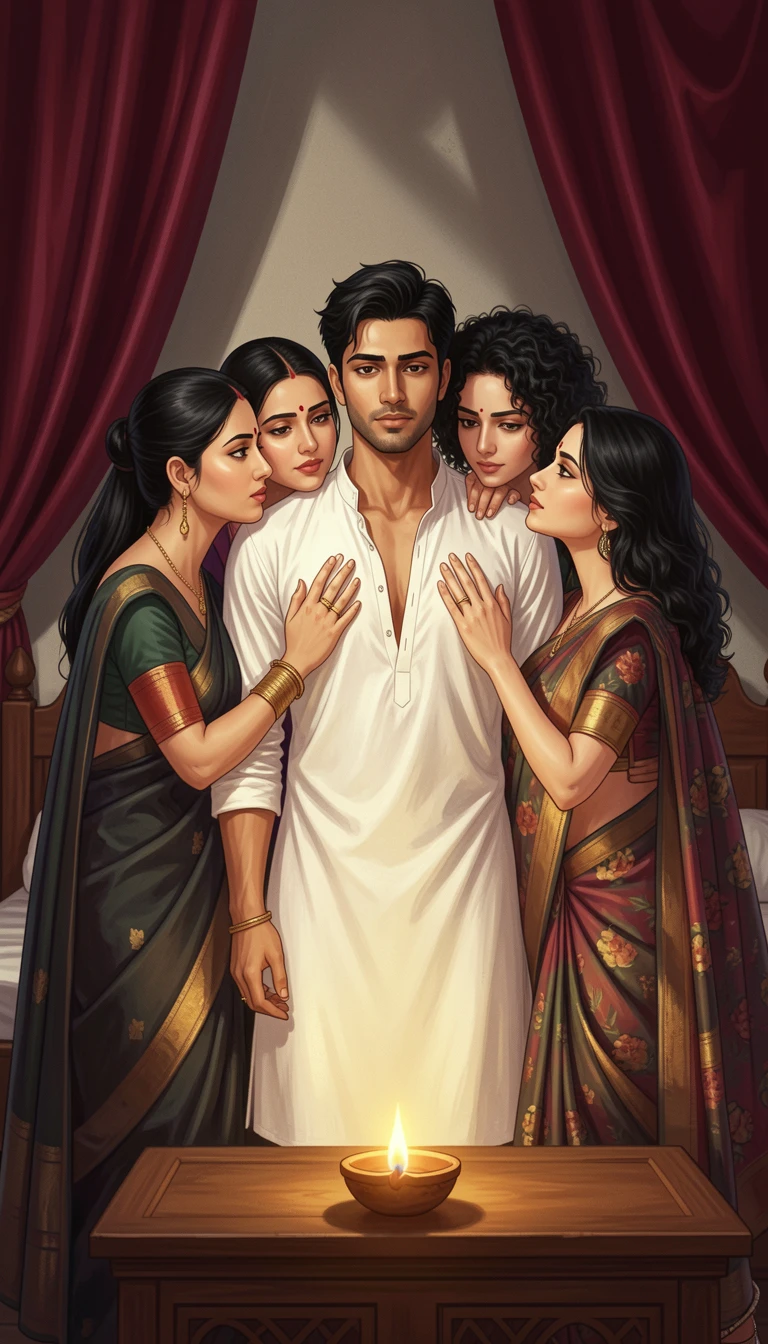
Shilpa stood in the frame, her hand resting on the doorjamb as if she needed it to hold herself upright. Her hair was loose, spilling over her shoulders, and she had changed out of the white she had worn for the funeral into a pale cream saree — the first color any of the widows had worn since the accident. Her eyes were red. She had been crying. But her voice, when she spoke, was steady.
'The tea is ready. I've kept it warm.'
She was looking at him. Directly. Without flinching. And he understood, with a clarity that felt like a blade sliding between his ribs, that she knew. Shobha Bua had told her. Or she had heard. Or she had simply known, the way women in this house knew everything before it was spoken aloud.
'I'll come inside,' he said. His voice sounded strange to his own ears. Distant. As if it belonged to someone else.
Shilpa did not move from the doorway. She held his gaze for a moment longer — just a moment, the space between two heartbeats — and then she stepped aside, her eyes dropping to the floor as he passed.
The kitchen smelled of ginger and cardamom and something sharper underneath, something like grief leaching into the steam. The kettle sat on the stove, its spout still breathing a thin column of vapor. Four cups waited on the counter, arranged in a neat row, as if she had known how many people would need them.
He stood in the middle of the kitchen and did not know what to do with his hands. He had stood in this kitchen a thousand times. He had watched his brothers crowd around the stove, stealing sips from each other's cups, their laughter filling the space until the walls seemed to bulge. Now the silence was so complete he could hear the refrigerator humming in the corner, could hear the clock in the hallway counting seconds like a heartbeat.
Shilpa followed him in. He heard the soft pad of her feet on the tiles, the rustle of her saree, the small sound she made as she lifted the kettle — a caught breath, almost a sob, swallowed before it could take shape.
'Shilpa.'
Her hand stilled. The kettle hovered over the cups, steam rising between them.
'I'm sorry,' he said. The words felt useless. Inadequate. But they were all he had.
She did not turn around. 'For what?'
'For —' He stopped. For being alive. For taking their place. For standing in this kitchen while your husband rots in the ground. 'For all of this.'
The kettle lowered. She poured the tea, steady, deliberate, the stream a perfect amber arc. 'Did you have a choice?'
'No.'
'Neither did I,' she said. She placed the kettle back on the stove. 'Neither did any of us. So stop apologizing for things that were never in your hands.'
She turned, a cup in each hand, and held one out to him. Her fingers brushed his — barely, a whisper of contact, a flutter of warmth that traveled up his arm and settled somewhere in his chest. She felt it too. He saw it in the way her eyes widened, the way her breath caught, the way she pulled her hand back as if she had touched a live wire.
'Thank you,' he said, and the words were for the tea and for everything else, for the courage it took to stand in this kitchen and pour tea for the man who was about to become her husband while her husband's body was still warm in its grave.
She nodded. Her jaw was tight, her lips pressed into a thin line. She picked up the other cups — for the buas, for the others — and walked past him, her shoulder brushing his arm as she passed, her scent trailing behind her like a question he did not know how to answer.
He stood alone in the kitchen, the cup warm in his hands, and he thought of Ritika in Solapur. Of Nisha touching the birthmark on her cheek. Of Veena's trapped-animal eyes. Of Shilpa's hair loose around her shoulders, the first color she had worn since the funeral.
One month, Shobha Bua had said. One month until he married four women who had loved his brothers first. One month until he became the answer to a question no one had asked him.
He lifted the cup to his lips. The tea was perfect — strong, sweet, with the faint bite of ginger at the back of the throat. Shilpa had made it the way he liked it. She knew. They all knew. They had been watching him his whole life, these women, and now they would be his in a way that felt less like ownership and more like being buried alive.
From the veranda, he heard the low murmur of voices. The buas, talking. Planning. Making lists. His aunts, who had raised him alongside their own sons, who had fed him and scolded him and loved him, now engineering a future he had never asked for.
He set the cup down. The kitchen was quiet. The refrigerator hummed. The clock ticked. Somewhere in the house, a door closed — soft, final, the sound of a room being sealed off.
He did not go inside. He did not go back to the veranda. He stood at the kitchen counter, his hand resting on the warm ceramic of the cup, and he let the silence settle around him like a shroud he would have to learn to wear.
The kitchen door swung open, a soft exhale of air against the tiles, and he looked up.
Ritika stood in the frame, one hand still on the handle, the other holding a thin laptop against her chest like a shield. She was wearing a deep red saree tonight, the fabric catching the dim light in ways that made her seem almost untouchable, like something from a different world. Her dark eyes, framed by those long lashes, swept over him once — quick, assessing — and then settled on the cup in his hand.
'The tea is cold now,' she said. Not a question. A statement of fact, delivered in the steady voice of someone who dealt in numbers and ledgers and things that added up.
He looked down at the cup. She was right. The warmth had leached out of the ceramic while he stood here, thinking of nothing and everything, letting the silence press against his ribs until he could barely breathe.
'I'll make more,' he said, and the words came out rough, unused.
'Don't.' She stepped inside, letting the door close behind her with a soft click. 'You'll wake the entire house boiling water at this hour. The buas are still on the veranda, and Shilpa is sitting with Nisha. She's been crying again.'
He set the cup down. 'I should —'
'No.' Her voice was firm, but not unkind. 'You should stand here and let me talk for a minute. That's what you should do.'
He stared at her. She set the laptop on the counter, opened it, and tapped a few keys. The screen glowed blue against her face, illuminating the sharp line of her jaw, the small nose ring catching the light. She looked up at him, and there was something almost amused in her eyes, a hint of the dancer's grace he remembered from before the accident, before the world had narrowed to grief and white sarees.
'I'm a chartered accountant,' she said. 'Did you know that?'
He blinked. 'I — yes. Madan told me. Once. When you first came to the house.'
Her eyebrows lifted slightly. 'He told you? I didn't think he talked about my work. He used to say it bored him.'
'He said you were the smartest person in the room. And that you'd probably end up running a firm someday.'
Something flickered across her face — surprise, or pain, or both. She looked down at the laptop, her fingers still resting on the keys. 'He said that?'
'Yes.'
She was silent for a long moment. The refrigerator hummed. The clock ticked. Somewhere in the house, a floorboard creaked under someone's weight, and then the sound faded into the night.
'I've been reviewing the family accounts,' she said finally, her voice quieter now. 'Since the accident. Someone has to. The buas don't know how, and Shilpa is too lost to focus on numbers. Veena doesn't care, and Nisha —' She stopped, shook her head. 'Nisha can barely get out of bed.'
'So you've been doing it alone?'
'Someone has to,' she repeated. She turned the laptop toward him. On the screen was a spreadsheet, columns of numbers, dates, transactions. 'There's life insurance. Savings. The house is paid off, but there are outstanding loans against Sagar's business and Vikas's shop. Madan had a mutual fund, but it's locked in a joint account that needs probate. And Sawan —' She tapped a cell. 'Sawan had credit card debt. Not a lot, but it's there.'
He stared at the numbers, but they blurred before his eyes. 'Why are you showing me this?'
'Because you're going to be the man of the house now.' Her voice was flat, not accusing, just stating a fact. 'And the man of the house should know what he's inheriting. It's not just four widows, Onkar. It's four widows and their dead husbands' debts.'
He felt something cold settle in his stomach. 'How bad is it?'
'Manageable. If we're careful. If we sell some assets. If the buas agree to cut back on certain expenses.' She closed the laptop, the screen going dark. 'I can handle the numbers. I've been handling them since I was twenty-one. But I need to know if you're going to let me.'
She was looking at him directly now, her dark eyes holding his, and he saw something in them he hadn't noticed before: not grief, not anger, but a kind of quiet determination. She had already started planning. Already started building a future out of the wreckage. And she was asking him if he would be part of it, or if he would stand in her way.
'You have a firm?' he asked.
'I had a firm. In Nagpur. Before I married Madan.' She touched the edge of the laptop, a small, possessive gesture. 'I put it on hold when I moved here. Told myself I'd restart after a few years, once we were settled, once he —' She stopped, her jaw tightening. 'Once he was ready to support me.'
'He didn't?'
'He wanted me to be a wife first. A mother. The firm could wait.' She let out a breath, something between a sigh and a laugh. 'It always could wait. And now there's no one left to wait for.'
The words hung in the air between them. He wanted to say something — something that would make it better, that would bridge the distance between what she had lost and what she was being asked to accept. But he had no words left. He had spent them all on Yes, on I'm sorry, on the silence that followed.
'The buas don't know about the accounts,' she said, her voice steady again. 'Not the details. They know the family has money, but they don't know how much or how little. I've been keeping it quiet because I didn't want them to panic.' She looked at him, and there was something almost like a challenge in her eyes. 'But now you know. So what are you going to do?'
He thought of Shobha Bua's folded hands, of her voice announcing the marriage as if it were a business transaction. He thought of Shilpa in the doorway, her hair loose, her fingers brushing his. He thought of the empty chairs on the veranda, the ghosts of his brothers laughing in the dark.
'Help me understand it,' he said. 'The accounts. All of it.' He met her eyes. 'If I'm going to be responsible for this family, I need to know what I'm carrying.'
She studied him for a long moment, her expression unreadable. Then she nodded, a small, precise movement, and opened the laptop again.
'Sit,' she said, gesturing to the chair across from her. 'I'll walk you through the basics.'
He pulled out the chair and sat. The wood creaked under his weight. The screen glowed between them, columns of numbers that felt like a language he didn't speak. But Ritika's voice was patient, her fingers moving through the spreadsheet with the ease of someone who had done this a thousand times, and he found himself listening, really listening, for the first time since the phone call that had torn his world apart.
'This is the household account,' she said, pointing to a column. 'Shobha Bua has access to it. She's been withdrawing for groceries, utilities, the funeral expenses. It's draining faster than it should.'
'How fast?'
'Another two months, at this rate. Maybe three if we're careful.' She looked up at him. 'After that, we'll need to liquidate some of the fixed deposits. Or start selling jewelry.'
He ran a hand through his hair. 'I didn't realize it was this bad.'
'Most people don't, until it's too late. That's why I'm telling you now.' She closed a file and opened another. 'Madan had a life insurance policy. Fifty lakhs. It's pending because the claim needs the nominee's signature, and the nominee —' She hesitated. 'The nominee was me. But without probate, the insurance company is holding it until the succession certificate is issued. That could take months.'
'Months.'
'At least.' She looked at him, her eyes steady. 'But I've already started the process. I know a lawyer in Nagpur who handles these cases. She's fast.'
'Does Shobha Bua know?'
'Not yet. She doesn't need to. Not until there's something to tell her.'
He leaned back in the chair, the wood creaking again. The kitchen felt smaller now, the walls pressing in, the numbers on the screen a map of a future he hadn't asked for but couldn't escape.
'You planned for this,' he said. 'Before the accident. You had a contingency.'
She didn't flinch. 'Everyone who marries into a family of drivers knows the risks. Madan drove like he was invincible. I had to be practical.' She closed the laptop. 'It's not betrayal to prepare for loss. It's survival.'
He looked at her — really looked, past the careful composure and the steady voice, to the woman underneath. She was twenty-three, the same age as him. She had been married to his brother for four years, had learned to love him, and had spent those same years preparing for the possibility that he might not come home one day. And now here she was, sitting in the dark kitchen with a laptop between them, showing him the ruins of her husband's legacy and asking him to help rebuild.
'Thank you,' he said, and the words felt small, inadequate, but they were all he had.
She tilted her head, a ghost of a smile crossing her lips. 'For what?'
'For being honest with me. For not treating me like a child who needs to be protected from the truth.'
The smile faded. 'You're not a child, Onkar. You're the only man left in this house. And I'm not going to pretend that everything is fine just to make you feel better.' She closed the laptop and stood, the red of her saree catching the light. 'I'll have a detailed report ready by tomorrow. You can look it over, ask questions, decide what you want to do. But tonight —' She paused, her hand resting on the edge of the counter. 'Tonight, you should get some sleep. You look like you haven't slept in days.'
'Neither have you.'
She didn't answer. She picked up the laptop, tucked it under her arm, and walked to the door. Her hand was on the handle when she stopped, not turning around.
'Onkar.'
'Yes?'
'Madan was a good man. He was reckless, and he drove too fast, and he never learned to save money, but he was good. He loved me. In his own way.' Her voice cracked, just slightly, on the last word. 'I want you to know that.'
He didn't know what to say. He watched her open the door, the light from the hallway spilling in, and then she was gone, the door clicking shut behind her, leaving him alone in the kitchen with the cold cup of tea and the hum of the refrigerator and the weight of everything she had just placed in his hands.
He sat there for a long time, staring at the empty space where the laptop had been, thinking about numbers and debts and futures he couldn't see. Then he stood, poured the cold tea down the sink, rinsed the cup, and left it on the counter to dry.
The house was quiet. The buas had gone to bed. The lights were off in the veranda, the oil lamp extinguished. He walked down the hallway, past the closed doors of his brothers' rooms, past the one that had been Madan and Ritika's, past the one where Shilpa had slept alone for the last ten nights. He stopped at his own door, his hand on the handle, and he thought of Ritika's steady voice in the kitchen, of her patience, of the way she had looked at him like he might actually be capable of carrying this weight.
He opened the door and stepped inside, closing it behind him. The room was dark. The bed was unmade. The window was open, letting in the cool night air and the distant sound of a dog barking somewhere in the neighbourhood.
He did not turn on the light. He lay down on the bed, still fully dressed, and stared at the ceiling, and he listened to the silence of the house that was no longer his brothers' but somehow, impossibly, his.
The silence pressed against his ears. He lay on the bed, still fully dressed, and stared at the ceiling, and he listened to the silence of the house that was no longer his brothers' but somehow, impossibly, his. The ceiling fan spun slowly, a faint wobble in its rhythm. He had fixed that wobble three years ago, tightening the mounting bracket while Sawan held the ladder and made jokes about his future as an electrician. Now the wobble was back, and there was no one to hold the ladder.
He closed his eyes. The darkness behind his lids was the same as the darkness in the room. His thoughts circled like the fan, a slow, hypnotic orbit: Shilpa in her mourning whites, Veena's sharp tongue, Nisha's hollow eyes, Ritika's steady hands on the laptop. Four women. Four lives. His now, if he had the strength to carry them.
A sound broke through the silence. A single metallic note, delicate and distant. He opened his eyes. It came again—something tapping against something else. A spoon against a cup, maybe. The kitchen, just down the hall.
He sat up slowly, the mattress springs groaning under his weight. His feet found the floor without looking. The door handle was cold in his palm, and he turned it with a click that seemed too loud in the stillness.
The hallway stretched before him, a tunnel of grey light from the window at the far end. The doors on either side were closed—Nisha's, Veena's, Shilpa's, the empty one that used to be Nidhi's. Behind them, the soft rhythm of breathing, the occasional shift of a body on a mattress. The house was alive with sleep, but somewhere, someone was awake.
He walked toward the kitchen. The tiles were cold under his bare feet, and the faint smell of old incense still lingered from the evening aarti. He reached the doorway and stopped.
Shilpa sat at the small table, a single oil lamp burning beside her. In front of her lay a stack of notebooks, a red pen uncapped and ready. She hadn't heard him. Her hair was loose, falling around her shoulders, and she wore a simple white cotton saree, no jewelry, no bindi. Her head was bent over a page, the tip of her tongue caught between her lips as she read. She looked younger like this, softer, despite the grief that clung to her like a second skin.
He should have turned back. He should have gone to his room and shut the door and pretended he hadn't seen her. But his feet wouldn't move. He stood in the doorway, watching, and something in his chest tightened.
She must have felt his presence. She looked up, and her hand stilled.
'Onkar.' Her voice was low, startled. 'I didn't hear you.'
'I couldn't sleep.' He gestured at the notebooks. 'You're grading exams.'
She glanced down at the papers, then back at him. 'The final exams for the term. I have to submit marks by Monday.' She paused. 'It helps. Keeping my hands busy.'
'Does it?' The question came out before he could stop it, and he regretted it immediately.
She looked at him for a long moment, her eyes unreadable in the lamplight. 'No. But it stops my mind from wandering to places I don't want it to go.' She set the pen down. 'Would you like some tea?'
'I don't want to trouble you.'
'It's no trouble. I was about to make another cup anyway.' She stood, and the saree pooled around her feet. She moved to the stove, her steps unhurried, and lit the burner. The flame caught, blue and steady, and she filled the kettle with water from the tap.
He watched her back as she worked. The curve of her spine. The way her fingers measured the tea leaves into the pot, precise and practiced. She had done this a thousand times—for Sagar, for the family, for herself in the quiet hours of the night. Now she was doing it for him, and he didn't know what to do with that.
'You teach at the army school,' he said, filling the silence.
'Yes.' She didn't turn around. 'Primary section. Class four. They're good children. Disciplined.'
'Sagar used to say you were the strictest teacher in the school.'
She went still, her hand hovering over the kettle. Then she said, very quietly, 'He used to say a lot of things.'
The kettle began to whistle. She poured the water over the leaves, and the steam rose, carrying the scent of cardamom and ginger. She let it steep, her eyes fixed on the darkening liquid, and then she poured two cups.
She brought one to him, holding it out with both hands. The cup was warm against his palms. The surface of the tea trembled slightly, and he realized his hands were shaking. He wrapped his fingers around the ceramic, steadying himself.
'Thank you.'
'You don't have to keep thanking me, Onkar.' She sat down, wrapping her own hands around her cup. 'We're going to be something to each other now. I don't know what word to use for it yet, but we're going to be something.'
He sat down across from her, the cool of the table seeping through the cotton of his kurta. The tea burned his tongue, but he welcomed the heat. It gave him something to feel besides the numbness.
She was watching him the way she must watch her students—patiently, expectantly, waiting for him to find the right answer.
'You're a teacher,' he said. 'You have a career. A life. This marriage—' He stopped. 'How do you feel about it?'
She didn't flinch. She took a sip of her tea, considering the question as if it were a problem on a worksheet. 'I feel like I don't have the luxury of feelings right now. The buas have decided. My parents have given their blessing. The society will accept it because it keeps the family name alive.' She set the cup down. 'What I feel doesn't matter.'
'It does matter.' His voice came out harsher than he intended. 'You matter.'
Her eyes met his. For a moment, the mask slipped—her grief, rawer and deeper than anything he had seen in daylight. Then she looked down at her cup, and the mask was back.
'You're kind to say that,' she said. 'But kindness doesn't change reality. I'm a widow in a house of widows. I have no children, no husband, no future that isn't written by someone else's hand. If this marriage can give me a roof, a purpose, a way to keep teaching and not be shamed—' She shrugged, a small, fragile motion. 'Then maybe that's enough.'
He wanted to reach across the table. He wanted to take her hand, to hold it, to tell her that she deserved more than enough. But he didn't. He stayed still, his hands wrapped around the warm cup, and he let the silence settle between them.
She drained her tea and stood. 'You should try to sleep. Tomorrow will be long.' She picked up her stack of notebooks and the lamp, and walked toward the door. At the threshold, she paused. 'I know this isn't what you wanted either. But we'll figure it out.'
Then she was gone, her footsteps fading down the hall, leaving him alone in the kitchen with the dying embers of the burner and the faint scent of her perfume—something floral, something that had belonged to her life before.
He finished his tea in the dark. He rinsed the cup and set it on the drying rack, and then he walked back to his room, past the closed doors, past the echoes of lives that had ended and the ones that were waiting to begin.
He lay down on the bed again, but he didn't close his eyes. He stared at the wobbling fan, and he listened to the house settle around him—the creak of old wood, the whisper of the wind through the window, the faint sound of a woman crying, muffled behind a door.
He didn't know which room it came from. He didn't know if it was one of them or all of them.
He let the sound fill the space inside him.