
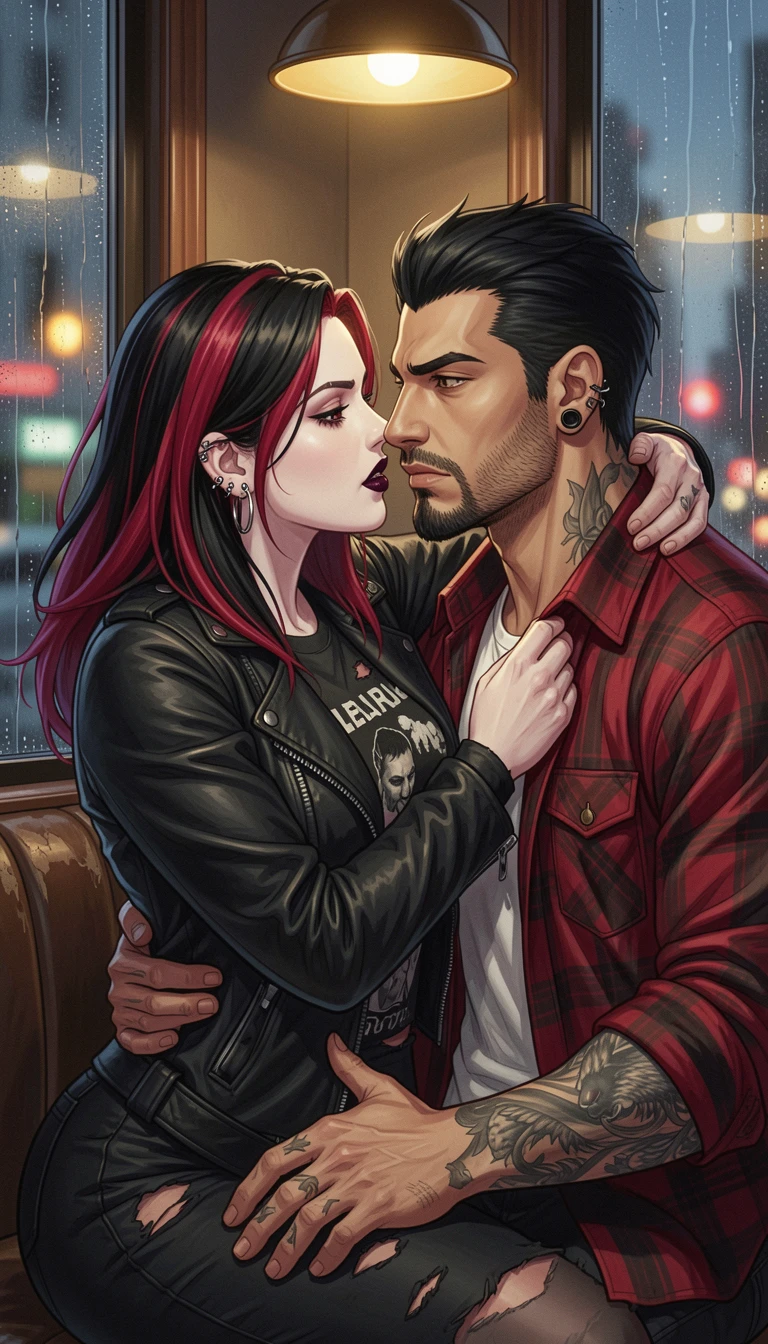
Her name hit the air like a stone dropped into still water. "Twenty-three—Lindsey." The barista's voice was bright, efficient, the usual sing-song of a working Saturday. The paper cup waited on the pickup counter, steam curling from the lid.
Lindsey didn't move.
Her fingers had locked around the edge of her chair, knuckles pale, because the man at the counter—the one whose hand had frozen around a paper cup of his own—was staring at her like she was the only thing in the room. Brown eyes, dark and warm, set in a face that looked like it had been carved from Tennessee fieldstone. Stubble traced the line of a strong jaw. Black gauges stretched his earlobes, and the sleeve of his flannel rode up just enough to show the edge of ink curling around his wrist.
He was big. Broad-shouldered, thick-necked, the kind of solid that came from years of swinging a hammer and hauling lumber. But it wasn't his size that pinned her to the chair. It was the way his nostrils flared. Once. Twice. A wolf catching a scent he couldn't place—or one he shouldn't want.
Lindsey stopped breathing.
She didn't need to breathe, not really. That was one of the advantages of being dead. But the habit persisted, and right now the habit had abandoned her entirely. Her chest was a hollow thing, and something inside it—something that had been quiet for a hundred and twelve years—was waking up. Stretching. Turning toward him like a flower toward a crack of light.
No. No, no, no.
He set his cup down. Slow, deliberate, like he was afraid the movement might shatter whatever spell held them both. His eyes never left hers. Not a blink. Not a flicker. Just that steady brown gaze, pulling her in, and she couldn't look away. She couldn't even try.
The coffee shop hummed around them—the hiss of the steam wand, the clatter of ceramic spoons against mugs, a woman laughing at something on her phone—but it all sounded underwater. Faint. Distant. The only real thing was the space between them, and it was shrinking.
He took a step.
One boot hit the worn floorboards, and the sound was a small earthquake. Lindsey's grip on the chair tightened. Her nails—painted matte black, chipped at the edges—bit into the wood. She could feel the grain pressing into her fingertips, grounding her, reminding her she had a body, that bodies were real and solid and didn't float away on the strength of a stranger's stare.
He took another step.
"Hey, miss? Your order's getting cold." The barista's voice cut through, sharp and friendly, and Lindsey flinched. The spell broke. Just for a second. She blinked, and the man was three feet closer, and now she could see the tattoo peeking above his collar—a thorny vine, maybe, or a crown of thorns—and the small white scar that split his left eyebrow.
"I—" Her voice came out thin. She cleared her throat, tried again. "Sorry. Yeah. Coming."
She pushed herself up from the chair, her legs steady despite the tremor in her chest. She was a vampire. She was a witch. She had walked through graveyards at midnight and spoken to things that had no names. She was not going to fall apart because a handsome werewolf was staring at her like she was the answer to a question he'd never known to ask.
But her heart—the dead, still thing in her chest—gave a single, heavy thump as she stepped toward the counter, and that had never happened before. Not in a hundred and twelve years.
She reached the pickup counter at the same moment he did. He'd moved, somehow, without her noticing, and now he was standing so close she could smell him—pine and sawdust and something warm underneath, like sun-heated stone. His chest was at her eye level. She had to tilt her chin up to meet his gaze, and when she did, she saw a muscle jump in his jaw.
"Sorry," he said, and his voice was low, rough, a Tennessee drawl that wrapped around the word like honey. "Didn't mean to stare."
Lindsey's lips curved before she could stop them. "Yes you did."
His eyes widened—just a fraction, just a crack—and then he laughed. A real laugh, warm and surprised, that crinkled the corners of his eyes. "Yeah. I guess I did." He stuck out his hand. "Austin."
She looked at his hand. Broad palm, callused fingers, a silver ring on his thumb. A working man's hand. An honest hand.
She took it.
His skin was hot. Burning. The contact sent a jolt up her arm, sharp and electric, and she felt the air leave her lungs in a rush. He felt it too—she saw it in the way his breath caught, the way his fingers tightened around hers, the way his dark eyes went a shade darker.
"Lindsey," she said, and her voice was barely a whisper.
He didn't let go. "Lindsey." He said it like he was tasting it, rolling it around on his tongue. "That's a beautiful name."
"It's my grandmother's." She didn't know why she said that. She didn't know why she was still holding his hand, either, but she couldn't seem to pull away. Her palm fit against his like it had been made for it.
The barista cleared her throat. "Uh, you two want to take your drinks somewhere? Or are we doing a meet-cute right here at the pickup counter?"
Lindsey flushed—actually flushed, heat crawling up her neck—and tugged her hand free. She grabbed her cup, a chai latte with oat milk, and clutched it like a shield. Austin picked up his own cup—black coffee, no sugar, by the look of it—and stepped aside, gesturing toward the seating area with a tilt of his head.
"Mind if I join you?" he asked. "Just for a minute."
Every instinct she had screamed yes. Every instinct also screamed run. He was a werewolf. A shifter. A creature of moon and pack and instinct, and she was a vampire, a thing of blood and shadow, and the two didn't mix. They never mixed. The old laws were clear: vampires and werewolves kept their distance. There was no treaty, no truce—just an unspoken agreement to stay out of each other's way.
But the thing in her chest—the thing that had been dead for over a century—was beating. Thumping. Pulling her toward him like a tide.
"I shouldn't," she said, and she meant it. But she didn't move toward the door. She didn't say goodbye. She just stood there, holding her drink, watching him watch her.
He smiled, slow and crooked. "You haven't said no yet."
"That's not a yes."
"It's not a no either."
She huffed a laugh, shaking her head. "You're persistent."
"I've been told that." He gestured again toward the table she'd been sitting at—the one with the wobbly leg and the view of the street. "Five minutes. That's all I'm asking. If you want me gone after that, I'll leave."
She should walk away. She should turn on her heel and march out the door and never come back to this coffee shop, never risk seeing him again. That was the smart thing. The safe thing. The thing a vampire witch who had survived a century by staying invisible would do.
Instead, she said, "Fine. Five minutes."
She led the way back to her table, her legs moving of their own accord. She sat down, and he slid into the chair across from her, his knees brushing the underside of the table. The contact made her jump, but he didn't notice—or pretended not to.
"So," he said, wrapping both hands around his coffee cup, "what brings a woman like you to a place like this?"
"A woman like me?" She arched an eyebrow, the black metal of her septum ring catching the light. "What kind of woman is that?"
He had the grace to look embarrassed. "I didn't mean—" He ran a hand over his jaw, scratching at the stubble. "I meant someone who looks like they've got places to be. Interesting places. Not a small-town coffee shop in East Tennessee."
The compliment slipped in sideways, unexpected, and she felt her cheeks warm again. "I live here. From here, actually. Born and raised." She left out the "died and reborn" part. "What about you?"
"Same." He took a sip of his coffee. "Grew up about twenty minutes outside town. My family runs a construction business, and I work with them when I'm not—" He stopped, a flicker of something crossing his face. Hesitation. Like he wasn't sure how much to share.
"When you're not what?" she prompted.
He set his cup down, turning it in his hands. "Studying. I'm working on a degree. Seminary." The word came out careful, watchful, like he was testing how she'd react.
Lindsey blinked. "Seminary. As in, you're studying to be a preacher."
"Pastor," he corrected, but there was no heat in it. "Yeah. Baptist."
A werewolf studying for the ministry. A shifter training to preach the gospel. She couldn't help it—she laughed. It wasn't a mean laugh, just surprised, just delighted, and it spilled out of her before she could catch it. "That's... that's not what I expected."
His shoulders relaxed a fraction. "What did you expect?"
"I don't know. Something with more teeth, maybe."
He grinned, and there was a flash of something sharp in it—not a threat, just a reminder that he was more than a big, soft-spoken man with a warm laugh. "I've got teeth. I just try not to use them on people."
The air between them shifted. The joke landed, but underneath it, something real had been named. Teeth. What they both had. What they both hid.
"You're a shifter," she said quietly. Not a question.
His smile faded. He studied her for a long moment, and she watched him decide—watched the calculation behind his eyes, the weighing of risk and trust. Finally, he nodded. "Yeah. And you're not human."
She didn't flinch. "No."
"What are you?"
The question hung in the air, heavy as the steam from their drinks. She could lie. She could deflect. She could tell him she was just a witch, which was true enough, and leave the rest buried. But the thing in her chest was still beating, still pulling, and lying to him felt like a betrayal of something she didn't yet understand.
"Vampire," she said.
He didn't flinch either. His eyes dropped to her cup—the chai latte—and then came back up. "You drink tea."
"I drink a lot of things." She lifted the cup, took a sip, watching him over the rim. "Blood's not always on the menu."
He let out a slow breath. "Huh."
"That all you've got? 'Huh'?"
"I'm a werewolf studying to be a Baptist pastor." He shrugged, a ghost of a smile tugging at his mouth. "I don't get to judge other people's weird."
She laughed again, and it felt good. Easy. "Fair point."
The silence that followed wasn't awkward. It was full—full of questions neither of them was ready to ask, full of the pull that hummed in the space between their bodies. She could feel it in her palms, in the base of her spine, in the hollow of her throat. A thread of something, invisible and unbreakable, tying her to him.
"Lindsey." He said her name like it mattered. "I don't know what this is. What's happening." He gestured between them, a vague motion. "But I felt it the second I saw you. Like I knew you. Like I've been waiting for you."
She wanted to tell him she felt it too. She wanted to say that her dead heart had started beating the moment he looked at her, that the world had rearranged itself around the shape of his voice. But the words stuck in her throat, too big, too dangerous.
"I should go," she said instead.
"You said five minutes."
"It's been five minutes."
He looked at his watch, then back at her, and his smile was soft, almost sad. "It's been three."
She stared at him. The pull in her chest was a physical thing now, a hand wrapped around her ribs, squeezing. She wanted to stay. She wanted to sit in this coffee shop for hours and let him talk, let him tell her about seminary and construction and the pack he was set to lead. She wanted to know everything about him, and that terrified her more than any hunter's stake or holy water ever had.
"Three minutes," she repeated. "Okay. One more."
He leaned back in his chair, and the motion stretched his shirt across his chest, and she did not look. She did not. "One more minute," he agreed. "What do you want to know?"
Everything. "Why seminary?"
He considered the question, turning it over. "Because I believe in something bigger than me. Bigger than the pack. And maybe that sounds stupid, coming from a guy who can turn into a wolf—"
"It doesn't," she said quickly. "It doesn't sound stupid."
He met her eyes, and something in his gaze softened. "Thanks."
The minute stretched. The coffee shop hummed. Somewhere, a timer dinged, and the barista called out another order. Lindsey's cup was growing cold in her hands.
"I should really go," she said, and this time she stood.
He stood too, a mirror of her movement, like they were already in sync. "Will you be here tomorrow?"
"I don't—" She shook her head. "I don't know."
"Same time," he said. "I'll be here. Just in case."
She wanted to tell him not to. She wanted to tell him that this was a bad idea, that what they were feeling was dangerous, that their worlds didn't touch for a reason. But the thing in her chest—the beat her heart had forgotten how to keep—was louder than her fear.
"I can't promise anything," she said.
"I'm not asking for a promise." He held her gaze, steady and warm. "Just asking you to show up."
She grabbed her bag, slung it over her shoulder, and walked toward the door. Every step felt like a betrayal of the tether that bound her to him, pulling taut, threatening to snap. She pushed the door open. The bell jangled. The afternoon air hit her face, humid and thick with exhaust.
And behind her, she heard his voice, low and certain: "See you tomorrow, Lindsey."
The door swung shut. She stood on the sidewalk, heart hammering in a chest that had no business beating, and she knew—she knew—that she would be back.
The sidewalk was solid under her boots, but Lindsey felt like she was floating. The door had barely clicked shut behind her, the bell still dying on the air, and her heart—her dead, useless heart—was hammering a rhythm she didn't have words for. She pressed a hand to her chest, feeling the thump through her ribs, and stared at the brick wall across the street without seeing it.
A hundred and twelve years. Not a single beat. Not a flutter. She'd stopped checking after the first decade, stopped hoping after the second, stopped even believing it had ever worked in the first place by the time she hit fifty. The heart was a muscle, and muscles needed blood, and her blood didn't move the way it used to. Simple biology. Dead girl walking.
But that man—that wolf with the warm eyes and the slow smile and the callused hand that had swallowed hers like it was made to hold it—had cracked something open. Something she'd sealed shut so long ago she'd forgotten it existed.
She pulled out her phone. The screen glowed against the gray afternoon, and her thumb moved on autopilot, opening a new contact. Austin. She typed the name, then stared at the empty number field.
She didn't have his number.
Of course she didn't have his number. They'd talked for three minutes. Three minutes that had rearranged the architecture of her chest, but still—three minutes. You didn't exchange digits in three minutes. You said nice to meet you and walked away and maybe, if the stars aligned, you ran into each other again someday.
But he'd said he'd be here tomorrow. Same time. And she'd said she'd come back.
Her thumb hovered over the screen. The cursor blinked in the empty field, patient and expectant.
She turned around.
The coffee shop window was a warm rectangle of gold light, fogged at the edges from the steam inside. And there he was—still standing by the table they'd shared, his coffee cup in one hand, his eyes fixed on the door. On her.
He hadn't moved. Hadn't sat down. He was just standing there, watching the door she'd walked through, and when their eyes met through the glass, his whole face softened.
Lindsey lifted her phone. She turned it toward him, screen out, the empty contact open. And she waved it—just a little, just enough for him to see.
His eyebrows went up. Then a grin spread across his face, slow and delighted, and he set his cup down and pulled out his own phone. She watched him tap at the screen, his thumbs moving with surprising speed for a man his size, and then he held it up to the glass.
A number. Ten digits. His name at the top.
She memorized it in a single glance—vampire memory had its uses—and typed it into the empty field. Austin. She hit save. Then she held the phone up again, the contact screen facing him, and gave it another wave.
He laughed. She could see it through the glass, the way his shoulders shook, the way his head tipped back for just a second. Then he raised his phone again, and she saw the screen change.
A new message. From him. To her.
She looked down at her phone as it buzzed in her hand.
The notification banner appeared at the top of her screen, a tiny preview of his name. Austin. Her thumb moved before she could think, swiping it open.
That was smooth. You practice that in a mirror?
A laugh burst out of her, sudden and bright, startling a woman walking past with a stroller. Lindsey pressed her hand to her mouth, shoulders shaking, and she didn't care. She didn't care that she was standing on a public sidewalk laughing at her phone like a teenager. She typed back: Been workshopping it for about thirty seconds. You like it?
Through the window, she watched him read the message. His grin widened, and he typed something, then paused, then typed again. The bubble appeared. Disappeared. Appeared again. She watched his brow furrow in concentration, and something in her chest—that same impossible thumping thing—went soft and warm.
Her phone buzzed. I like it. I also like that you turned around.
She read the message twice. Three times. The words were simple, but the weight behind them wasn't. He wasn't talking about the phone number. He was talking about the door. About the fact that she'd walked out and then walked back. About the fact that she was still standing here, on the other side of a pane of glass, instead of disappearing into the afternoon like any sensible creature would.
She looked up. He was watching her through the window, his phone held loosely in one hand, his expression open and unguarded in a way that made her throat tight. He wasn't hiding. He wasn't playing it cool. He was just there, waiting, hopeful, and the sight of it undid something in her chest.
She typed: I almost didn't.
His answer came fast. But you did.
Yeah. She bit her lip, then added: I don't know what that means.
She watched him read it. Watched his jaw work, the muscle jumping as he considered his response. He took his time, and she let him, standing there on the sidewalk with the evening cooling around her and the smell of coffee drifting through the door every time someone walked in or out.
His reply came through: Neither do I. But I'd like to find out. If you're open to that.
Lindsey stared at the screen. The cursor blinked at her, patient, waiting for a reply she didn't know how to form. The smart thing was to say no. To type something polite and final— I don't think that's a good idea —and walk away while she still could. The smart thing was to protect the careful, quiet life she'd built over a century of staying invisible.
But the thing in her chest—the thing that had woken up the moment he'd looked at her—was louder than her fear. It was a steady, insistent drumbeat, and it was telling her to stop running.
She typed: I'm open to that.
She hit send before she could change her mind.
Through the glass, she watched him read it. The tension in his shoulders dropped. He let out a breath she could almost see, and then he lifted his phone one more time. The message came through: Tomorrow. Same time. I'll buy you a drink. Something stronger than chai if you want.
She smiled at the screen. I don't drink.
Right. Sorry. I meant—
She cut him off before he could spiral: I know what you meant. And I don't need you to buy me anything. Just show up.
I'll be there.
She slipped her phone into her pocket and took a step back from the window. Austin raised his hand—a small wave, almost shy—and she returned it, her fingers curling in a gesture that felt too intimate for a stranger. Then she turned and started walking, her boots striking the pavement in a steady rhythm that matched the beat of her heart.
She made it half a block before her phone buzzed again.
Lindsey.
She stopped. Pulled it out. Read the single word, and felt the warmth of it spread through her chest like sunlight through a window.
She typed: Austin.
His reply came almost instantly: Just wanted to say your name.
She stood there on the sidewalk, surrounded by the ordinary sounds of a small town on a Saturday evening—a car engine turning over, a dog barking in a nearby yard, a child's laugh floating from an open window—and she felt something she hadn't felt in a hundred and twelve years.
She felt alive.
She typed: I like the way you say it.
I like the way you say mine.
She smiled down at the screen, then pocketed the phone and kept walking. The sun was starting to sink toward the treeline, painting the sky in shades of orange and pink, and the air was cooling, carrying the first hints of evening. She had a shop to open tomorrow, a dozen spell components to organize, and a century of careful solitude to reconsider.
But for now, she just walked. And her heart kept beating.
She walked six blocks before she finally stopped pretending she was heading anywhere in particular. Her feet had carried her past the hardware store, past the laundromat with the flickering sign, past the little park where a group of teenagers were kicking a soccer ball around in the fading light. None of it registered. The world was a blur of color and sound, and the only thing that felt real was the weight of her phone in her pocket and the phantom warmth of his hand still pressed against her palm.
She stopped at the corner of Elm and Fourth, under the sagging awning of a flower shop that had gone out of business three years ago. The windows were papered over, the door padlocked, and she leaned against the brick wall and pulled out her phone like it was a lifeline.
The message thread glowed on her screen. Seven messages. Seven small exchanges that had already rewired something fundamental in her brain. She scrolled through them, reading each one again, and her lips curved into a smile that she couldn't have stopped if she'd tried.
That was smooth. You practice that in a mirror?
She laughed again, a quiet huff of air, and shook her head. She couldn't remember the last time a man had made her laugh. Couldn't remember the last time she'd wanted one to.
Her thumb hovered over the keyboard. She should put the phone away. She should go home, light some sage, brew a cup of tea, and give herself a stern talking-to about the dangers of getting attached to a werewolf who studied the Bible for a living. That was the responsible thing. The smart thing.
Instead, she typed: You still standing at that table?
The response came in less than a minute. Sat down eventually. Didn't want to look like a creep.
She smiled. Too late. You already waved at me through a window like a lost puppy.
A lost puppy. That's a new one.
You prefer something else? Majestic wolf? Noble beast?
I'll take 'the guy who can't stop thinking about your eyes.'
Lindsey's breath caught. She stared at the message, her heart doing that impossible thumping thing again, and she didn't know how to respond. The words were simple. They were sweet. But they landed in her chest like a stone dropped into deep water, sending ripples through places she'd thought were permanently still.
She typed: You don't even know my last name.
I know enough.
That's not a lot.
It's a start.
She read that one twice. Then a third time. And she realized, with a clarity that felt almost physical, that she wanted it to be a start. She wanted to see where this went. She wanted to know what it felt like to let someone in, even if every instinct she'd honed over a century of survival was screaming at her to keep the door locked.
Her phone buzzed again. Lindsey.
Just her name. Just that. And she felt it in her chest—a pull, a warmth, a thread connecting her to him across the six blocks between them.
What?
Nothing. Just practicing.
She laughed out loud this time, startling a pigeon pecking at the curb. It flapped away in a burst of gray feathers, and she watched it go, still smiling, her phone warm in her hand.
She typed: You're ridiculous.
I've been told that too.
By who?
My mom. My pack. Pretty much everyone who's ever met me.
She bit her lip. The word pack sat there on the screen, a reminder of everything she was trying not to think about. He was a werewolf. A future alpha. He had a family, a community, a whole world of fur and fang and moonlit runs that she had no place in. And she was a vampire—a creature of shadow and stillness, of blood and silence, of a world that had learned long ago to keep its distance from his.
But she didn't want to think about that right now. She wanted to think about the way he'd said her name. The way his hand had felt around hers. The way his smile had crinkled the corners of his eyes when she'd called him ridiculous.
She typed: I should go. I have a shop to open in the morning.
What kind of shop?
The kind that sells herbs and candles and things that make people nervous.
His reply came fast: A witch shop.
Something like that.
Can I come see it sometime?
She stared at the question. The cursor blinked. The evening air was cooling against her skin, and somewhere in the distance, a church bell chimed the half-hour.
Maybe, she typed. If you're good.
I'm always good.
I doubt that.
You'll have to find out for yourself.
She smiled at the screen, then slipped the phone back into her pocket. The conversation could go on forever—she could feel it, the way it pulled at her, the way she wanted to keep talking, keep teasing, keep feeling the warmth of his attention like sunlight on her skin. But she had to stop somewhere. She had to leave something for tomorrow.
She pushed off from the wall and started walking again, her boots finding a steady rhythm on the pavement. The sun was lower now, the sky deepening to amber and rose, and the streetlights were beginning to flicker on, casting pools of orange light on the sidewalk. She had a mile to go before she reached her apartment, and she walked it slowly, savoring the feeling of the evening air on her face, the steady beat of her heart in her chest.
When she finally reached her door, she paused with her key in the lock. Her phone was silent in her pocket, but she could feel the weight of it, the promise of it. Tomorrow. Same time.
She turned the key and stepped inside, closing the door behind her. The apartment was dark and quiet, filled with the familiar scent of dried herbs and old wood. She didn't turn on the light. She just stood there in the dark, her back against the door, and let herself feel the thing that was growing in her chest.
It was terrifying. It was reckless. It was the most alive she'd felt in a hundred and twelve years.
She pulled out her phone one last time. The screen glowed in the darkness, and she typed a single message: Tomorrow.
His reply came before she could even set the phone down: Tomorrow.
She smiled in the dark, and her heart kept beating.