
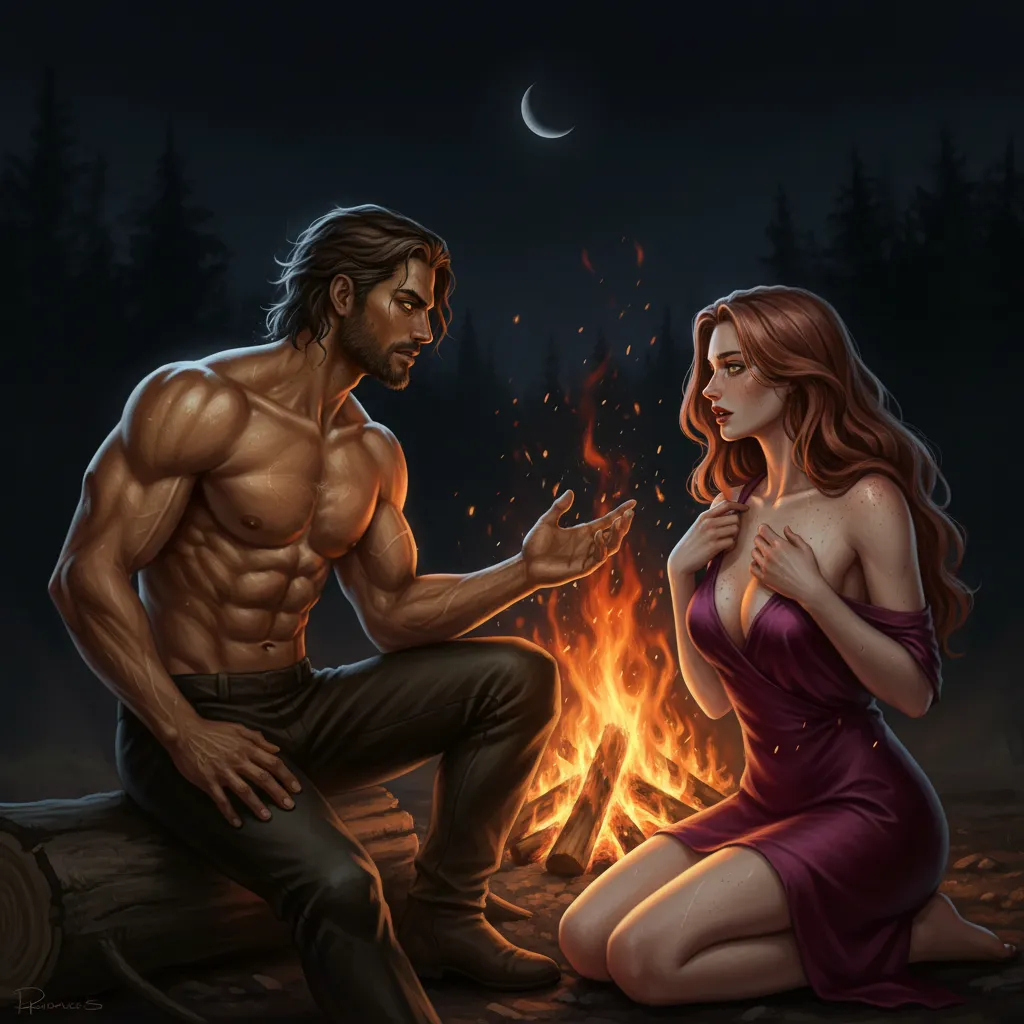
The first explosion bloomed against the lower east wall not as sound, but as a pressure in the teeth. A second later, the thunder arrived, shaking the stones under their feet and tearing Karthain’s mouth from Chesneir’s. The taste of her, salt and desperate hope, was replaced by the acrid promise of smoke.
He was moving before the echo died, his hand finding the hilt of the halberd leaning against the armory wall. His other hand found her arm, pulling her from the annex into the main chamber as dust sifted from the ceiling. “The east wall,” he said, his voice already stripped of everything but intent.
“The cultists,” Chesneir breathed, not a question. The Queen’s inaction. The lower plateau. It made a terrible, logical sense. Screams, real and nearby now, filtered through the high windows, weaving with the distant, rising chorus of alarm bells.
Karthain looked at her. In the chaotic gloom, her eyes were wide, but her chin was set. The healer. The noble’s daughter. The woman who bit her lip when she wanted something dirty and real. “Find your father. The wounded will be in the streets. Go.”
She caught his wrist as he turned. Her grip was firm, her smooth fingers a stark contrast to his corded skin. “You’re going to the wall.”
“I am the wall,” he said, and the words were not pride. They were geography. He pulled away and was gone, a streak of worn leather and determined shadow into the screaming night.
Chesneir found the streets of the upper district in panicked flux. Servants and nobles alike streamed westward, away from the orange glow staining the sky to the east. She moved against the current, her practiced healer’s mind compartmentalizing the fear, listening for the specific cries of pain. She found Stifven Preyce in a widened intersection, his fine robes hastily tied, directing a handful of household guards to form a makeshift aid station. His face, usually a mask of political calm, was pale with fury.
“They knew,” he spat as she reached him, not bothering with greeting. “The Queen’s spies had reports of Yellow Flame gatherings in the lower plateau for weeks. She deemed them ‘a local nuisance.’” He thrust a bundle of clean linens into her arms. “The ‘nuisance’ has siege ladders and blasting powder.”
She just nodded, already kneeling beside a guardsman clutching a seeping gash in his thigh from flying shrapnel. Her hands glowed with a soft, gold-tinged light, the familiar incantation rising to her lips. As she worked, she listened to the fragments of terror from the fleeing crowd. *They scaled the wall where the patrol was thinned… The lower gatehouse is overrun… It’s the Queen’s fault, she left us to burn…* The truth was spreading, a virus of revelation carried on the wind of disaster.
On the ramparts of the lower east wall, chaos was a living thing. Soldiers and knights of the Dawn’s Halberd milled, some trying to form lines, others staring in horror at the flood of fanatics pouring through a breached section. The cultists wore ragged saffron robes, their skin smeared with ash, their eyes wide with a mad, yellow fire. They fought with a terrifying disregard for their own lives, clutching crude axes and burning brands.
Karthain did not run. He walked into the heart of the panic, his halberd held loosely at his side. A young knight, his ceremonial plate spattered with blood, stumbled back from the fray, his breath coming in ragged sobs. Karthain’s free hand shot out, gripping the knight’s pauldron, stopping his retreat cold.
“Look at me.”
The knight’s terrified eyes focused on Karthain’s face. On the eyes that had seen too much horizon.
Karthain’s voice, when it came, did not shout. It cut through the din like a blade through silk, reaching every ear on that section of the wall. “You are Dawn’s Halberd. You took an oath. Not to a throne. Not to a queen who hides in silk.” He released the knight and turned, his gaze sweeping over the faltering men. “You swore it to the *light*. To the people who sleep behind these stones. They are not ‘local nuisances.’ They are your fathers. Your sisters. Your children.” He hefted his halberd, the simple, unadorned steel glinting in the firelight. “This wall is not stone. It is *you*. And you do not break.”
Something shifted in the air. A collective inhale. The panic didn’t vanish, but it crystallized, hardening into something else. Shoulders straightened. Grips tightened on weapons. The young knight wiped his face, nodded once, and turned back to the line, his sword held high.
Karthain moved to the front. He did not give another order. He simply began to kill.
His halberd moved with the brutal, efficient precision of a falling stone. It was not a dance. It was geometry. The first cultist lunged, a burning brand raised high. Karthain’s blade met the man’s collarbone, sheared through it, and exited below the ribs in a single, fluid pull. He did not watch the body fall. He was already turning, the haft of his weapon cracking into the temple of a second, dropping her like a sack of meal. A third came from the left; Karthain sidestepped the wild axe swing, drove his elbow into the cultist’s throat, and as the man gagged, brought the halberd’s butt-spike down through the top of his skull. It made a sound like a wet melon hitting stone.
He became a focal point. The rallied knights of the Dawn’s Halberd formed a wedge behind him, their discipline returning, their blades finding targets that were not already dead or dying. Karthain was the tip. He did not roar. He breathed, a steady, controlled rhythm. His world narrowed to the arc of his weapon, the shuffle of feet on bloody stone, the hot spray against his face. He saw every opening: a poorly guarded flank, a moment of hesitation, the shift of weight before a strike. He punished each one. A severed arm spun through the air. A cultist stumbled back, clutching at the ruin of his belly. Karthain stepped over him.
He was a man who had fought for fleeting happiness. This was the other side of that coin. This was the work that bought the quiet. The violence was not an expression of rage, but of economy. A waste of motion was a waste of life—his, or the men behind him. So he conserved. A short, sharp thrust to the gut, a twist, a withdrawal. A parry that redirected a blade into the path of another cultist. He moved through the saffron-robed fanatics like a scythe, and where he passed, the yellow flames guttered out in red.
Below, in the intersection, the air grew thick with the scent of blood and burning herbs. Chesneir’s hands moved from wound to wound, the gold light of her incantations stitching flesh and soothing shock. Her father’s voice was a constant, low drone, organizing the flow of the wounded. She heard a young woman weeping over a guard who would not wake. She heard her own voice, calm and firm, telling a boy with a burned arm to look at her, not at the bone. Her world was a tapestry of pain, and she was the needle, trying to sew it whole.
A thunderous *crack* echoed from the wall, distinct from the clamor of battle. Then another. Stone groaned. A section of the lower battlement, weakened by blasting powder, slumped inward in a cloud of dust and debris. Through the new, wider gap, a fresh wave of cultists poured, and among them lumbered hulking figures clad in crude, spiked iron—berserkers, their eyes wild with the same yellow fire, swinging massive, rusted cleavers.
The knightly wedge faltered. A cleaver sheared through a shield and the arm holding it. The line buckled. Karthain saw the fracture. He planted his halberd, dropped his shoulder, and charged into the nearest berserker. The impact drove the air from his own lungs, but he drove the larger man back three stumbling steps, breaking the momentum of the charge. He drew the dagger from his belt and drove it up under the berserker’s jaw, through the palate and into the brain. The giant stiffened, then collapsed.
“Reform!” Karthain’s command was a bark, raw now. “On me! They are just men!”
But the breach was widening. More cultists scrambled over the rubble. The tide was turning again, the defenders being pushed back step by bloody step. Karthain killed another berserker, taking a shallow gash across his ribs for the effort. He felt the warm seep of blood under his tunic. The heat of battle was a living thing around him, but inside, a cold calculus began. They could hold, perhaps. For a time. But the cost…
Then the screaming changed.
It was no longer the screams of battle. It was a deeper, collective wail of terror that rolled in from the direction of the sea, from the city’s lower docks. It was the sound of a horizon dying. Karthain risked a glance over his shoulder, past the city spires.
He risked a longer look, and the cold calculus in his gut froze solid. Beyond the city spires, where the sea met the sky, the horizon was wrong. It was rising. A wall of black water, taller than the highest tower, crowned with froth, moving with a terrible, slow certainty toward the shore. And before it, wading from the depths, was a shape of nightmare—a beast of scales and barnacles, its back a jagged mountain range, its single eye a pit of yellow flame that matched the cultists’ sigils. The wail of terror was the city seeing its death approach.
The cultists at the wall redoubled their efforts, shrieking with fervor. Their great beast had come. This breach was the distraction; the tidal wave was the end.
Karthain turned back to the buckling line of knights. Their faces, streaked with soot and blood, were etched with the same horrifying understanding. The fight went out of their postures. This was how Leyndell fell.
He planted his halberd in the cobbles with a crack that cut through the noise. He did not shout. His voice was a low, carrying rasp, the sound of stone grinding on stone. “Look at me.”
A few helmets turned. Then more. The man at their tip was bleeding, his armor dented, his expression not one of glorious defiance, but of utter, weary clarity.
“You know me,” Karthain said. “Some of you. Most of you have only heard the stories. The Champion. The Paladin.” He shook his head, a sharp, dismissive jerk. “A man who ran from this city because he could not bear the weight of its expectations.”
He took a step forward, his golden eyes holding theirs. “That man is gone. He died by a campfire, next to a woman who asked for nothing but a moment of his truth.” He gestured south, toward the healing square. “She is down there, right now, fighting a different war. Stitching your brothers back together. Your sisters. Your fathers. She is fighting for the *pieces* of this city. For the fleeting, fragile things that are actually worth saving.”
He yanked his halberd free. “That wall of water? That beast? They are not coming for the throne. They are not coming for the Queen’s treasury. They are coming for *her* work. They are coming to wash away the boy with the burned arm. The woman weeping over a guard. Every fleeting moment of happiness any of us have ever scraped from this damned, beautiful world.”
His voice hardened, final. “So I am not asking you to die for Leyndell. I am asking you to hold this breach. For ten minutes. For five. For as long as your arms can lift a sword. Buy time for the pieces. Buy time for me.”
He looked toward the monstrous tide, then back at them, and a grim, almost peaceful smile touched his bloodied lips. “I have a form I have not taken in years. A power I swore never to use again. It is… excessive. It will likely destroy me to wield it.” He shrugged, as if admitting a minor flaw. “But it can kill that thing. It can turn that wave. So you will hold this line. Not for a city. For the people in it. For the fleeting things.”
He raised his halberd, the blade catching the distant, sickly yellow light of the beast’s eye. “Who will stand with a broken paladin, for five more minutes?”
A silence. Then a knight, his shield arm hanging useless, raised his sword with a raw-throated cry. Another. A dozen. The wedge reformed, tighter, fiercer. The will to live had been crushed; in its place was the will to make a death matter. They closed ranks around the breach, a wall of scarred metal and desperate eyes.
Karthain nodded. It was enough. He turned and ran, not toward the sea, but into a nearby guard tower, taking the spiral stairs three at a time, up and up until he burst onto a windswept parapet overlooking the raging ocean and the oncoming mountain of water.
The scale was impossible. The beast’s head alone was the size of a cathedral. The wave’s peak blotted out the stars. The sound was a deafening roar of impending annihilation.
He closed his eyes. He sought the core of the holy light within him, the vast, searing reservoir he had kept locked away, buried under years of nomadic dust and campfire smoke. It answered, not with warmth, but with a painful, expanding brilliance that made his bones feel like glass. To use it as a paladin was to channel a river. To take the True Form was to become the ocean.
Chesneir’s face flashed behind his eyes. Her quiet concentration as she healed. The way she bit her lip. The feel of her pulse under his thumb. A fleeting thing. Worth everything.
He let the lock break.
Chesneir saw it from the rubble-strewn street below, her hands still glowing with the faint ember-light of a healing incantation she’d just poured into a sobbing child’s father.
A soundless detonation of light erupted from the high parapet, a silent, expanding sphere of white that swallowed the tower’s peak. It wasn’t fire. It was purity given form, a pressure that pushed the very air down upon the city, flattening the chaos for one breathless second.
Then he emerged from it.
The form was that of a giant, tall as the tower itself, a silhouette of sculpted, magnified muscle etched against the roiling wave. Wings of pure, incandescent white unfolded from his back with a sound like a thousand banners snapping in a gale, each feather a shard of captured moonlight. His body was exposed, a testament of raw power, but a veil of shimmering, solid light covered his loins, flowing like liquid platinum. His hair became a cascade of living flame, gold and white, and his eyes—his eyes were twin suns.
“Karthain,” she whispered, the name a prayer and a fracture in her chest.
The giant form raised a hand, and a blade of condensed dawn appeared in its grip, longer than a city street. He did not roar. He simply stepped off the parapet, and the air held him. The beat of his wings sent a gale through the lower districts, knocking cultists and defenders alike to their knees.
Chesneir could only watch, her healing forgotten, her world narrowed to the magnificent, terrifying figure gliding toward annihilation. This was the power he had buried. This was the god-killer he feared becoming. And he was doing it for the weeping woman, for the burned boy, for the fleeting things.
The mountain-beast saw him and loosed a roar that shattered the remaining glass in the city’s high windows. It swung a limb the size of a siege tower, claws dripping with brine and primordial slime. Karthain met it not with a dodge, but with a contemptuous backhand of his free hand. The impact was a thunderclap of force and light. The beast’s claw disintegrated into a shower of black ichor and shattered bone.
The wall of water was upon them. It towered over the outer walls, a cliff of black, starless ocean about to crash down and erase the city from the map.
Karthain turned his back on the shrieking beast. He faced the wave. He spread his wings to their fullest, impossible span, and plunged the blazing sword of light not into the water, but into the stone at the city’s edge, at the base of the wall where the soldiers held the breach.
The earth answered. A rampart of golden light erupted from the ground, not a wall, but a continent’s edge rising in seconds. It met the tidal wave with a cataclysm of steam and screaming energy. The water did not break; it was unmade. A corridor of dry, scorched seafloor opened before the city as the wave was parted, forced to either side in colossal, foaming shoulders that crashed harmlessly into the cliffs beyond.
The beast, stumbling in the sudden void of its own wave, shrieked in confusion. Karthain wrenched his blade free and was upon it. He moved with a speed that belied his size, a blur of white and gold. He did not hack. He carved. The greatsword passed through the beast’s neck in one clean, devastating arc.
There was no spray. The creature’s head simply separated, its dying cry cut short. The body teetered. The head, eyes still burning with yellow malice, began its long, tumbling fall toward the exposed seabed.
Karthain hovered for a moment, a stark, brilliant angel against the dark. Then the light began to fade. Not all at once, but like a guttering candle. The wings fragmented into drifting motes. The giant stature bled away, shrinking, diminishing. He fell from the sky, a dark speck against the lingering gold.
Chesneir was already running, shoving past stunned soldiers, her heart a frantic drum against her ribs. She found him in a crater of smoldering stone and broken masonry near the shattered gate, naked, steaming, curled on his side. The veil of light was gone. His skin was crisscrossed with fine, glowing cracks, as if the power had tried to break him apart from the inside.
She dropped to her knees, her hands hovering over him, afraid to touch. “Karthain.”
He shuddered. A raw, pained sound escaped his lips. His eyes opened, the sun-fire gone, replaced by the familiar, exhausted gold-brown. He focused on her face with immense effort. “Chesneir.”
Her skin was still singing from the blast of light, her new wings a faint, translucent weight upon her back, when his hand found her cheek. His touch was not the searing heat of divine power, but a desperate, fading warmth. Yet it was a conduit. She locked up, a sharp gasp trapped in her throat. Her eyes rolled back, not in pleasure, but in overwhelming reception. She felt it—not him, but the echo of the choice he’d made. The universe had offered him a new mantle, a station among the celestial, and he had shattered it. And this feeling, this cascading, golden clarity flooding her veins, was a piece of that shattered offering, given freely.
Her head lolled back towards the heavens. The first drops of rain hit her upturned face, cool and cleansing, mingling with the tears tracking through the grime on her cheeks. The sensation awakened something deep within her core. A second pulse of light erupted from her chest—softer than his, but radiant, majestic—washing over the crater in a wave of shimmering gold. It solidified the delicate wings at her back, made them gleam with soft, internal light.
She looked down, the divine awareness receding to a hum in her bones. He was dying. The fine, glowing cracks across his skin were darkening, leaking not blood but a fading, gold-tinged mist. His light was guttering out faster than she’d thought possible.
“Karthain.”
His lips moved, the sound barely a breath. “We must share our warmth, my love. Just like we did by the fire. Just like we did…”
Her father’s voice, ragged with panic, cut through from the crater’s edge. “Chesneir! By the Erdtree, what—?”
“Stay back!” she commanded, her voice ringing with an unfamiliar authority. She didn’t look away from Karthain. She understood. This wasn’t a healing incantation from her books. This was older. Primal. The first magic: the exchange of essence, of life, of heat.
Her hands, no longer hovering, went to his shoulders. She lowered herself over him, her golden wings draping around them both like a canopy, closing out the world, the rain, the distant cheers from the walls. Beneath the shelter of light and feather, she pressed her body along the length of his. His skin was cool, almost cold, against the feverish heat of her own.
“Take it back,” she whispered against his mouth. “Take what you gave me.”
She kissed him. It was not gentle. It was a conduit, a opening. She poured the warmth back into him, the golden energy humming in her chest flowing from her lips into his. She felt his mouth soften, respond. A shuddering breath filled his lungs. His hands, limp at his sides, twitched.
One hand rose slowly, trembling, to bury itself in the hair at the nape of her neck. The other found the curve of her waist, his callouses rough against the smooth skin under her torn tunic. He held her there, anchoring himself to her. The kiss deepened, turned hungry, a mutual devouring. She could taste the salt of his sweat, the ozone of spent power, and underneath it, him. Just him.
The glowing cracks on his skin began to seal, not with light, but with smooth, whole flesh. The cold receded, replaced by a growing, human heat. His hips shifted beneath her. She felt him, hard and insistent against her thigh, a stark, vital claim of life returning.
She broke the kiss, panting, her forehead resting against his. “You are not allowed to leave.”
A ghost of his old smile touched his lips. “Your command is my law.”
His hand at her waist slipped under the fabric of her tunic, skimming up her spine. The touch was electric, grounding. She arched into it, a soft moan escaping her. The wings at her back shivered, shedding motes of light that faded before they hit the ground. He explored the new contours of her shoulder blades, the place where wings met flesh, with a reverent curiosity.
“They’re beautiful,” he breathed.
“They’re yours,” she said, and kissed him again.
This time, the energy between them was purely mortal, purely theirs. The desperation turned to a slow, aching need. He rolled her beneath him with a strength that was returning second by second. The rain fell softly on the golden canopy of her wings, a private drumming for them alone. He looked down at her, his eyes clear, the gold-brown depths holding only her.
He peeled the ruined cloth from her body, his movements deliberate, unhurried. The cool air kissed her skin, followed immediately by the heat of his gaze. He did the same to his own remnants of clothing. Then skin met skin, the full, breathtaking length of him pressing her into the soft, rain-damp earth. The feeling was a homecoming. The solid weight of him, the thud of his heart against her chest, the coarse hair of his legs against her smooth thighs.
He entered her in one slow, inexorable push. She cried out, her nails biting into the hard muscle of his back. The stretch was perfect, a filling ache that drove the last of the cold and fear from her body. He was hers. He was here. He was alive inside her.
He stilled, buried to the hilt, letting her adjust, letting them both feel the totality of the connection. His breath was ragged in her ear. “Chesneir.”
It built between them, a coil winding tighter with every slow, deep stroke. His rhythm was a claiming, a reaffirmation of life, each thrust pushing a broken gasp from her lips. Her wings, draped around them like a sanctum of gold, trembled with the force of it. The world narrowed to the slap of skin, the wet, driving sound of the
ir joining, the heat of his breath against her neck.
“Look at me,” he gritted out, his voice raw.
Her eyes, clouded with pleasure, found his. The gold in them was molten. In that locked gaze, something vast and tectonic began to shift. She felt it first in her core—a gathering light, not hers, not his, but something born of their collision. It swelled with the friction, fed by his groans, her cries, the perfect ache of him filling her over and over.
“Karthain—” she warned, but it was too late.
His thrusts became punishing, desperate, driving them both toward the edge. Her back arched off the ground, her wings flaring wide for a searing instant before snapping shut around them again. The climax tore through him, through her, a mutual detonation.
And as they shattered together, a blinding nova of gold and white light exploded from the point where their bodies joined. It was silent and immense, a shockwave of pure power that filled the cocoon of her wings. Inside that private sun, she felt a torrent flood into her—an ocean of radiant, ancient strength—while a reciprocal, deeper wellspring surged back into him. The balance was met. The transaction, divine.
The light died, leaving them spent and gasping in the sudden dark. Sweat-slicked, trembling, he collapsed onto her, his face buried in her neck. Her wings glowed softly, their inner light now steadier, warmer. She felt different. The power inside her didn’t feel borrowed. It felt married.
Outside their golden shell, the world had taken notice. The crowd of soldiers and fleeing citizens had seen the winged shelter shudder. They had heard the raw, mounting sounds that were unmistakably not sounds of pain. A few nervous chuckles had rippled through the ranks. Then, as the movements within grew more fervent, the noises more abandonéd, the crowd, in a wave of collective, awkward hilarity, had dispersed. All but two.
Roland and another knight of the Dawn’s Halberd stood like statues ten paces from the glowing wings. They did not watch. Their eyes were fixed on the distant, burning eastern wall. They simply waited, hands on their sword hilts, guarding their master’s fate in the only way left to them.
Inside, Karthain rolled to his side, taking her with him, keeping them joined. He was still hard inside her. The divine energy that had just coursed through them was a potent tonic. His breath was coming back in slow, deep draughts. He brushed the damp hair from her forehead. “What have we done?” he whispered, awe and fear in his voice.
She touched his cheek. “We lived.” She flexed the muscles in her back, and her wings gave a resonant, chiming flutter. “And I feel… full.”
A hungry, disbelieving laugh escaped him. He kissed her, deep and slow, his hips beginning a gentle, rolling motion again. The sensitivity was a bright, almost painful fire, but neither pulled away. They moved into it, chasing the echo of the cataclysm, making it their own again.
This time was slower, sweeter, a rediscovery. He worshipped her with his mouth, tracing the lines of her new power where it shimmered just beneath her skin. She learned the shape of him anew, her hands mapping the corded strength of his arms, the scars on his back, the desperate clutch of his fingers in her hair. They spoke in gasps and sighs and broken words. His name. Hers. “More.” “Yes.” “Don’t stop.”
When the second peak took them, it was a deep, rolling tide, not a crashing wave. It left them boneless and intertwined, floating in the aftermath. For a long while, there was only the sound of their breathing and the distant, muted screams of the city.
Reality, cold and sharp, finally pierced the haze. The screams were not stopping. They were getting closer.
Karthain’s body went rigid. The languid heat in his eyes vanished, replaced by the hard focus of a commander. He gently withdrew from her and sat up. “They’re inside the walls.”
The screams outside their sanctuary did not grow louder. They coalesced, transformed, became a roar not of terror but of a single, thunderous voice. “Hark! Hark the golden king of wings! HARK! HARK THE GOLDEN KING OF WINGS!”
The sound was seismic, rolling through the stone of the armory, vibrating up through the floor into their bare skin. Karthain froze, half-crouched, his hand instinctively reaching for a sword that wasn’t there. Chesneir sat up, her wings flaring with a soft, chime-like rustle, casting a warm gold light over his stunned face.
“They’re… cheering,” she breathed, the words barely audible over the tidal wave of sound.
He stood, moving to the archway of their golden shelter. With a thought, he dissolved it. The wings of light shimmered and broke apart into a thousand fading motes. The scene that greeted them was not one of carnage, but of collective, delirious revelation. As far as they could see, from the shattered eastern wall to the highest spires of the city, people were on their knees, on rooftops, hanging from windows. Half a million faces, lit by torchlight and the Erdtree’s glow, were turned toward the armory annex. Their voices were a single, pounding chant. The golden king. The golden king of wings.
Chesneir came to stand beside him, her hand finding his. He was trembling. Not from fear, but from the sheer, overwhelming weight of the sound. It was a mantle being thrown over his shoulders, one he had cast off years ago. “They saw,” she murmured.
“They heard,” he corrected, his voice rough. A flush crept up his neck. The memory of their abandon, the sounds they’d made, now echoed back at them from the throats of a city. It was not shame he felt, but a profound, disorienting exposure.
Roland turned from his post, his face grim but his eyes shining with a fierce pride. “My lord. The beast is ash. The tidal wave was turned to mist by your light. The cultists… upon seeing it, their will broke. Most fell on their own blades. The rest are being rounded up by the Omen-cursed and taken to the catacombs.” He glanced at Chesneir, a flicker of something like approval in his gaze. “The city is yours.”
“It is not,” Karthain said, but the words were swallowed by another deafening wave of adulation. He looked out at the sea of hopeful, desperate faces. These were not subjects. They were people who had just been saved. The abstraction of a crowd became individuals: a child on a father’s shoulders, an old woman weeping, a soldier clutching a broken arm, his face alight with fervor.
The heat of the night, the smell of dust and sap and now, underlying it, the copper-tang of blood from the lower walls, pressed in on him. This was the reality. The horizon of his quiet life with her was already burning. He squeezed Chesneir’s hand. “They need a healer. They need order.”
She nodded, the softness of moments ago hardening into resolve. “I’ll find my father. The wounded will be in the lower squares.” She rose on her toes, kissed him—a quick, hard press of lips that was a promise and a farewell—then turned. Her wings, as if sensing purpose, gave a resonant pulse. She didn’t run, but walked with swift, certain grace into the chaotic tide of the celebrating crowd, which parted for her as if for a saint.
Karthain watched her go until the chestnut of her hair was lost in the multitude. Then he turned to Roland. “My armor. And a weapon. Any weapon.”
The knight gestured, and the second guardsman brought forth the polished plates of the Dawn’s Halberd regalia. Karthain dressed with mechanical efficiency. The cool metal was a familiar cage. Each buckle fastened, each strap pulled tight, was a step away from the man who had trembled against her skin and toward the legend the city was screaming for. He accepted a simple, heavy longsword, testing its weight. It was a tool. It would do.
He climbed the steps to a broken section of the armory’s upper rampart, overlooking a major thoroughfare now choked with people. The cheers redoubled at the sight of him in the gleaming paladin’s plate. He raised a hand. A hush fell, spreading outwards in a ripple until the only sound was the crackle of distant fires and the moan of the wounded.
He did not shout. His voice, carried by the strange acoustics of the night and the silence, reached them all. “You cheer for a shadow,” he began, his gaze sweeping over them. “You cheer for light that was spent years ago. Look around you.” He pointed to the smoking eastern wall. “The stones are broken. Your blood is on the cobbles. Your neighbors are missing. This is not victory. This is the aftermath of someone else’s failure.”
He saw the fervor in their faces waver, replaced by confusion, then by a dawning, weary understanding. Good. He needed them awake, not entranced.
“My good people, this is not victory,” Karthain continued, his voice carving through the silence. “This is death. This is pain. This is suffering. We should not hope for a savior in the night who would slay beasts at the wall. We should hope for a light bright enough to scare the beasts from ever approaching. I have been your slayer. I have been your beast-killer. I will be that no more.”
A wave of confused murmuring crested into cries, a sound of hearts breaking. He saw the hope drain from faces, replaced by the terror of being abandoned. He let it hang, let them feel the precipice.
“I will instead be your light. But no light can burn without a source of power. My power has a name. And you should all be as impressed with this power as you are with the light.” He paused, his eyes searching the crowd until he found a distant glimpse of chestnut hair, halted and watching. “And that name is Chesneir!”
The name echoed off the stone. “Together, we will make the night safe. We will empty the coffers of the palace and fill the ones in your homes. We will forge a new dawn that never ends, so the creatures in the night have nowhere to exist. Our love is the sun. And you, my dear people, are the land. Let us bring our light upon you. Together!”
The silence shattered into a roar that shook the very ramparts. It was not the mindless cheer from before. It was a vow, howled back at him. Mothers clutched children, brothers embraced, strangers gripped each other’s arms. The city, moments ago a tableau of shock and blood, was now a single, vibrating heart, lit from within by the idea of them.
Karthain descended the steps, the crowd parting before him like a tide. His gaze was fixed on her. Chesneir stood by a makeshift stretcher, her father Stifven beside her, both streaked with ash and blood. Her eyes were wide, her lips parted. He didn’t stop until he was before her. The noise of the city faded into a distant hum. Here, it was just the smell of her sweat and lavender soap under the grime, the quick rise and fall of her chest.
“You named me your power,” she said, her voice low, for him alone.
“You are,” he said. He reached out, his gauntleted hand cupping her cheek, the cool metal a stark contrast to her fevered skin. “The only power I’ve ever believed in.”
Stifven cleared his throat, a smile playing on his weary face. “I’ll… oversee the triage at the lower square. The speech was… adequate, Tomkrov.” He moved away, giving them a fragment of space in the chaos.
Chesneir leaned into his touch. “They need you to lead. They need orders.”
“They have them. Now they need to see it’s real.” His thumb stroked her cheekbone. “Come with me. Heal where I guard. Let them see the light and the source, inseparable.”
She nodded. The resolve was back, but now it was fused with a fierce, possessive pride. She took his offered hand, her smooth fingers threading through the gaps in his armored ones. They moved as one into the streaming flow of people toward the shattered eastern wall.
The lower plateau was a vision of hell given reprieve. Buildings smoldered. Cobbles were slick with blood and the strange, phosphorescent ichor of the cultists. The wounded lay in rows on the ground, their moans a terrible chorus. But where Karthain walked, a current of steadiness followed. Soldiers straightened. Panicked citizens stopped their wailing and began to help.
He issued commands with a quiet certainty that brooked no argument, directing soldiers to form firebreaks, civilians to carry water, stable hands to bring wagons for the dead. And beside him, Chesneir worked. Her hands glowed with a soft, gold-tinged light. She knelt in the muck, placing her palms on a soldier’s gut wound, the flesh knitting under her touch. She whispered assurances to a weeping child, her incantation a lullaby as she sealed a burn.
Karthain fought not at the wall, but in the street before it, a bulwark against any cultist stragglers. His longsword was a simple, brutal extension of his will. He moved with no flourish, only lethal efficiency. Each parry, each thrust, was made with the awareness of her at his back. The enemy that broke through the soldier’s line met not a paladin of legend, but a man protecting what was his. It was more terrifying.
During a lull, he turned. She was five paces away, bent over a fallen woman. The hem of her dress was soaked in blood and ichor. A strand of hair clung to her damp temple. She looked up, feeling his gaze. Their eyes locked. In the midst of the carnage, the connection was a physical pull, a cord of heat drawn taut between them. He saw the exhaustion in her, and the unbreakable will. She saw the violence in him, and the utter lack of pleasure he took in it. It was a confession more intimate than any touch.
The crowd around them saw it too. The whispered name became a chant. “Chesneir and Karthain. The Light and the Source.” It was a prayer.
As dawn’s first true light began to bleach the sky, the immediate work was done. The cultists were routed or dead. The fires were contained. The wounded were stabilized. A heavy, exhausted silence settled over the district. Karthain found her leaning against a soot-stained wall, her wings dim, her eyes closed. He stood before her, blocking her from the view of others. The pre-dawn chill was setting in, but the heat between their bodies was a living thing.