
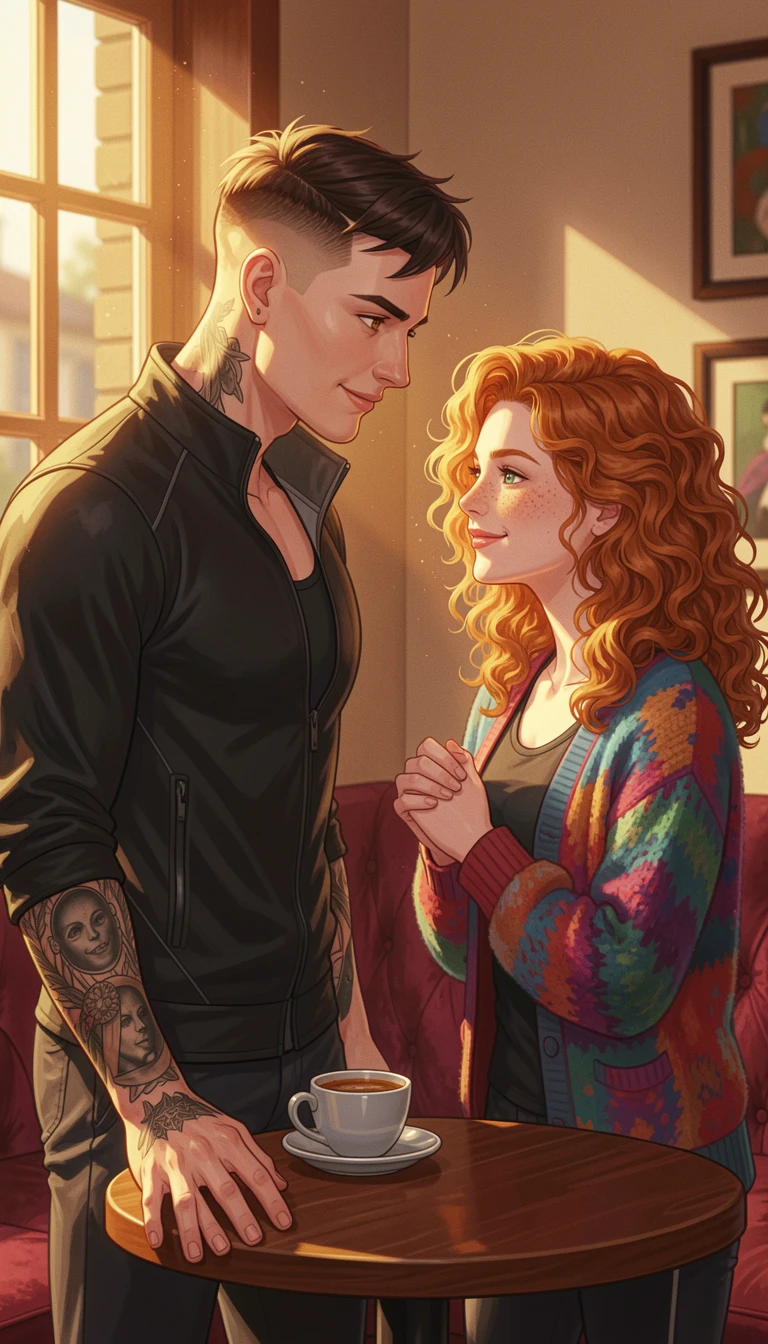
Hannah dried the same wine glass for the third time, her thumb tracing the rim in slow circles. The cloth in her hand had gone damp, and still she kept moving it across the crystal, watching the way the kitchen light caught the glass, splitting into thin rainbows against the whitewashed wall.
Behind her, Emily stirred something on the stove—a rich tomato sauce that had been simmering for an hour, filling the apartment with garlic and basil and the sharp sweetness of caramelized onion. She'd thrown herself into cooking the moment they'd disentangled, her curls escaping a messy bun, her cheeks still flushed from the kitchen counter and everything that had happened on it.
"You know that glass is clean." Emily didn't turn around. She was smiling, though, Hannah could hear it in her voice.
"I know."
"You've been drying it for ten minutes."
"I know."
Hannah set the glass down on the counter. Her hands felt empty now. She picked up a knife, checked the blade, set it down again. The apartment was too quiet, too full of the evening and what they'd said and what they hadn't said yet, the weight of three months compressed into three words— I love you —that still echoed in the small space between them.
The buzzer rang.
It was a sharp sound. Clean. Working. The first time in two months the buzzer had made a sound that wasn't static or silence.
Emily's head snapped up from the stove. The wooden spoon froze mid-stir. "That's—"
It rang again. Insistent. Real.
"That's not broken," Hannah said, and she heard her own voice go careful, the way it did when something unexpected happened and she didn't know yet which direction to move.
"No." Emily set the spoon down, wiped her hands on her jeans. She looked at Hannah, her sea-glass eyes wide, uncertainty flickering behind them. "My mother was supposed to call before she came. She always calls before she comes."
"Your mother?"
"She visits sometimes. Surprise visits. She likes to—" Emily gestured vaguely, her freckled hand circling the air. "Check on me. Make sure I'm eating. Make sure I'm not dating a serial killer."
"And you didn't mention this because…"
"Because she wasn't supposed to come this weekend." Emily crossed to the intercom, pressed the button. "Who is it?"
A voice crackled through the speaker. Warm. Female. The same Irish lilt that colored Emily's words. "It's your mother, love. Your buzzer's working now, did you know? I've been standing out here for five minutes pressing it out of habit."
Emily closed her eyes. She took a breath. She pressed the button again. "Come up."
She turned to Hannah, and her face was a complicated map of apology and warning and something else—pride, maybe, or hope. "She doesn't know about you. I was going to tell her this weekend, on the phone. I was going to call her tonight and say, Mam, I've met someone, and she would have cried and asked a thousand questions and I would have answered them in my own time." Emily's hands found Hannah's, squeezed. "But she's here. She's coming up. And I need you to know—she's going to ask you everything. She's going to look at you like she's already decided whether you're good enough. And she's going to be wrong, because she doesn't know you yet, but she's going to do it anyway."
Hannah's pulse had picked up. She could feel it in her throat, in the tips of her fingers where they pressed against Emily's palms. But she didn't pull away. "What does she know?"
"That I moved to Barcelona. That I teach. That I'm happy." Emily's smile flickered. "She knows I was with Ryan. She doesn't know the details, but she knows it was bad. She knows I left because I had to."
Hannah's jaw tightened. She hadn't asked about Ryan. She knew there was a before, a man in Ireland who had made Emily smaller than she was, and she knew Emily would tell her when she was ready. But now her mother was coming up the stairs, and the past was climbing with her.
A knock at the door. Three short raps, firm and polite.
Emily let go of Hannah's hands. She crossed to the door, unlocked it, pulled it open.
The woman in the doorway was shorter than Emily, with the same riot of ginger curls—gray streaking through them now—and the same sea-glass eyes, though hers were sharper, more weathered. She carried a small suitcase and wore a careful smile, the kind that measured before it warmed.
"Emily, love." She pulled Emily into a hug, held her for a long moment. "You look thin. Are you eating?"
"I'm eating, Mam."
"You don't look like you're eating."
"I am. Come in."
Siobhan stepped inside. Her eyes scanned the apartment—the monstera in the corner, the books stacked by color on the floor, the faded blue throw blanket rumpled on the couch. They landed on Hannah.
Hannah stood by the kitchen counter, her hands still, her shoulders straight. She was wearing one of Emily's cardigans—a soft, oversized thing in pale yellow that definitely didn't fit her shoulders but felt like a peace offering.
Siobhan's gaze traveled down Hannah's arms, where the cardigan ended at her elbows and the tattoos emerged—dark, intricate patterns coiling around her forearms. The leather bracelet on her wrist. The quiet steadiness in her stance.
"Mam," Emily said, her voice bright and careful, "this is Hannah. Hannah, this is my mother, Siobhan."
Hannah lifted a hand. Waved. Felt ridiculous. "Hi."
Siobhan's smile didn't waver. It didn't widen either. "Hannah." She said the name slowly, tasting it, filing it away. "Emily didn't mention she had company."
"It was a surprise," Hannah said. "For both of us."
"We were about to eat," Emily cut in, steering the moment with the practiced ease of someone who spent her days managing seven-year-olds. "There's plenty. Mam, sit down. I'll get you a plate."
Siobhan set her suitcase by the door. She didn't sit. Instead, she walked past the couch, past the books, past the monstera, and stopped at the kitchen island, directly across from Hannah. "You're not Spanish."
"No. Norwegian."
"But you live in Barcelona."
"I do."
"What do you do?"
Hannah felt the question land like a ball at her feet, clean and simple, and she chose to volley it back with the same directness. "I play football. Professionally."
Siobhan's eyebrows rose. Just a fraction. "Do you."
"For Barcelona." Hannah paused. "I'm the captain."
It still felt strange to say it out loud to someone who didn't already know. To watch the information settle into a face, to see the calculation behind the eyes— famous, busy, probably not serious. She'd seen that calculation a hundred times, in a hundred different faces, and she'd learned to read it before the person had finished forming the thought.
But Siobhan's face didn't settle into any of the familiar shapes. She just looked at Hannah, her sea-glass eyes steady, and said, "Emily doesn't watch football."
"No. She told me."
"She never has. When she was a girl, I tried to get her into it. Took her to a match once. She spent the whole time reading a book." The corner of Siobhan's mouth twitched. "She told me the grass was very green, though. That was her review."
Hannah smiled. "That sounds like her."
Something shifted in Siobhan's expression. It wasn't warmth, not yet, but it was a kind of acknowledgment— you know her. You really know her.
Emily appeared at her mother's elbow, pressing a glass of wine into her hand. "Sit. Please. The pasta is almost ready."
Siobhan took the wine. She sat. She didn't stop looking at Hannah.
Hannah held her ground under that gaze, the way she held it under floodlights in front of eighty thousand people. She didn't fidget. She didn't look away. She let Siobhan study her, let the silence stretch, because she'd learned long ago that rushing to fill a silence only made you say something you'd regret.
The pasta fork scraped against the pot. Steam rose. Emily moved between the stove and the cabinets with the efficiency of someone who'd cooked this meal a hundred times, but Hannah noticed the way her shoulders stayed tight, the way she kept glancing over her shoulder at the two of them like she was waiting for a fight to break out.
"So," Siobhan said, taking a sip of her wine, "how long have you two been together?"
"Three months," Hannah said.
"Three months." Siobhan repeated it like she was testing the weight of it. "And you're already keeping a cardigan here."
Hannah looked down at the pale yellow fabric. It smelled like Emily. Like lavender and the faint trace of the vanilla lotion she used after every shower. "I have more than a cardigan here," she said quietly. "I have a drawer. And a toothbrush. And a permanent indent on the left side of her couch."
Siobhan's eyebrows lifted again, but this time there was something else in her eyes. Curiosity, maybe. Or the beginning of approval. "A permanent indent."
"I sit in the same spot every time. She tells me I'm ruining the cushions. I tell her the cushions were already ruined when I met her."
"They were," Emily called from the stove. "The couch came with the apartment. It was already sagging."
"She's defending me," Hannah said, and she felt the corner of her mouth lift. "She does that."
Siobhan watched the exchange, her wine glass halfway to her lips. Something softened in her face. Just a crack. Just enough for Hannah to see the woman behind the careful smile—the mother who had flown across Europe to check on her daughter, who had stood outside a broken buzzer pressing it out of habit, who had walked up the stairs not knowing what she'd find.
"Emily," Siobhan said, not looking away from Hannah, "you didn't tell me she was handsome."
Emily's spoon clattered against the pot. "Mam."
"I'm just saying. You could have mentioned that part." Siobhan set her wine glass down. "All you said was that you'd met someone. You didn't say she looked at you like you hung the moon."
Hannah's chest tightened. She dropped her gaze to the counter, to the wine glass she'd dried three times, to her own hands resting on the marble. The leather bracelet pressed against her wrist, warm from her skin, a constant weight she'd worn for years.
"She does," Emily said softly. "She looks at me like that. And I don't know how I got this lucky, but I'm not going to question it."
The kitchen fell quiet. The sauce bubbled. The fridge hummed. Somewhere outside, a scooter whined past the balcony doors, the sound swallowed by the evening air.
Siobhan reached across the island and covered Hannah's hand with her own. Her palm was warm, the skin rough from years of work, the knuckles slightly swollen with age. "Thank you," she said, her voice low, "for looking at her like that."
Hannah looked up. Met the sea-glass eyes that were so like Emily's, and yet so different—older, wearier, carrying the weight of a daughter who had crossed an ocean to escape a man who had made her smaller.
"She's easy to look at," Hannah said. "She's easy to love."
Siobhan squeezed her hand once. Then she let go, picked up her wine, and took a long drink. "Right," she said, her voice brightening, "when do we eat? I'm starving."
Emily laughed—a real laugh, surprised and relieved—and turned back to the stove. "Two minutes. Sit down, both of you. I'll bring it over."
Hannah pulled out a chair for Siobhan at the small table by the balcony doors. The evening light slanted through the glass, painting the floor in gold, catching the dust motes that floated in the warm air. Siobhan sat, and Hannah sat across from her, the small table between them, the city humming below.
"You're quiet," Siobhan said.
"I'm usually quiet."
"Emily's not. She talks enough for two people."
"I know." Hannah's mouth curved. "I like it. She fills the silence so I don't have to."
Siobhan studied her again, but the sharpness was gone now, replaced by something softer. "You're good at this. The meeting-the-parent thing."
"I've never done it before."
"Really?"
"I don't have parents." Hannah said it simply, without weight, the way she'd learned to say it after years of practice. "They died when I was three. I grew up in foster homes."
Siobhan's face stilled. Her hand paused over her wine glass. "I didn't know."
"You weren't supposed to. Emily knows. That's enough."
Siobhan nodded slowly. She didn't offer sympathy or empty words, and Hannah was grateful for it. She just nodded, and then she picked up her wine, and she said, "Well. You've done fine tonight."
Emily appeared with three plates balanced on her arms, setting them down with the practiced ease of a woman who had spent years feeding herself and no one else. "Pasta. Garlic bread. The sauce is my grandmother's recipe, so if you don't like it, you're wrong."
"I'm sure it's perfect," Siobhan said.
"It is." Emily sat down, her knee brushing Hannah's under the table. She didn't pull away. She let the contact stay, a small anchor, a reminder that they were in this together.
Hannah picked up her fork. The pasta was perfect—al dente, the sauce rich and bright, the garlic bread crisp and buttery. She ate, and she listened, and she watched Emily light up as she told her mother about her students, about the girl who had drawn a rainbow on every single worksheet, about the boy who had cried because he lost his favorite pencil and then cried again when he found it.
Siobhan asked questions. Gentle ones, at first—how was work, was the apartment holding up, had she found a good doctor yet. Then sharper ones, the kind that circled back to Hannah without quite landing on her. "And what do you do on weekends? Do you go out much? Have you met her friends?"
Emily answered each one without flinching. "We go to the market. We walk along the beach. I've met her team. They're loud and they're nosy and they love her, which means they love me too, because she loves me."
Siobhan's fork paused mid-air. "She loves you?"
Emily looked at Hannah. Her sea-glass eyes were bright, unguarded, full of the same thing Hannah had felt swelling in her chest for three months. "She told me tonight. Before you called."
Siobhan set her fork down. She looked at Hannah, and her gaze was different now—not measuring, not wary, but searching. "Did you mean it?"
Hannah met her eyes. "Yes."
"And what are your intentions with my daughter?"
"Mam," Emily said, her voice sharp.
"I'm allowed to ask." Siobhan didn't look away from Hannah. "She's my only child. She moved across the sea to a country where she didn't know anyone. She spent two years with a man who—" She stopped. Her jaw tightened. "She deserves someone who stays."
The words hung in the air. Hannah felt them land in her chest, heavy and familiar, the same weight she carried every time she thought about the future, about the paparazzi, about the three million people who followed her every move.
"I know," Hannah said. "She does. And I will."
"How do I know that?"
Hannah thought about the phoenix on her shoulder, the compass on her forearm, the tree on her back covering the scar from a surgery she'd had alone at seventeen. She thought about the nine foster homes, the twelve schools, the years of never belonging until she found a team that became her family.
"Because I've never had a home before," she said quietly. "Not really. I had places I slept, people who were kind enough to feed me, teammates who became my family. But I've never had a home. A place where someone waited for me. A person who wanted me to come back." She looked at Emily, and her voice dropped. "Emily is my home. And I'm not going to leave it."
Siobhan was quiet for a long moment. Then she picked up her fork, and she took a bite of pasta, and she chewed slowly, deliberately, like she was tasting every syllable of what Hannah had said.
"Good," she said finally. "Because I'll fly back here if you break her heart. And I'll bring my sister's hurley."
Emily snorted. "Mam, you don't have a sister."
"I'll borrow one."
Hannah laughed. It came out surprised and warm, and she felt something loosen in her chest, a knot she hadn't realized she'd been carrying since the buzzer rang. "Understood."
They finished dinner. Emily cleared the plates, and Hannah helped, their shoulders brushing in the small kitchen, their hands finding each other in the soapy water. Siobhan moved to the balcony, her wine glass in hand, looking out at the city as the last light bled out of the sky.
Emily dried her hands on a towel. She turned to Hannah, her voice low. "You did good."
"She's terrifying."
"She's a mother. It's her job." Emily reached up, her fingers brushing the collar of the cardigan, straightening it. "You wore my cardigan. You called me your home. You told her you'd stay." She smiled, soft and bright. "You're good at this."
Hannah caught her hand, pressed a kiss to her knuckles. "I meant it. Every word."
"I know." Emily leaned in, her mouth brushing Hannah's, soft and quick, a promise. "I know."
From the balcony, Siobhan cleared her throat. "I can see you two from here."
"Then stop looking," Emily called back, and she kissed Hannah again, longer this time, until her mother laughed and turned back to the city.