
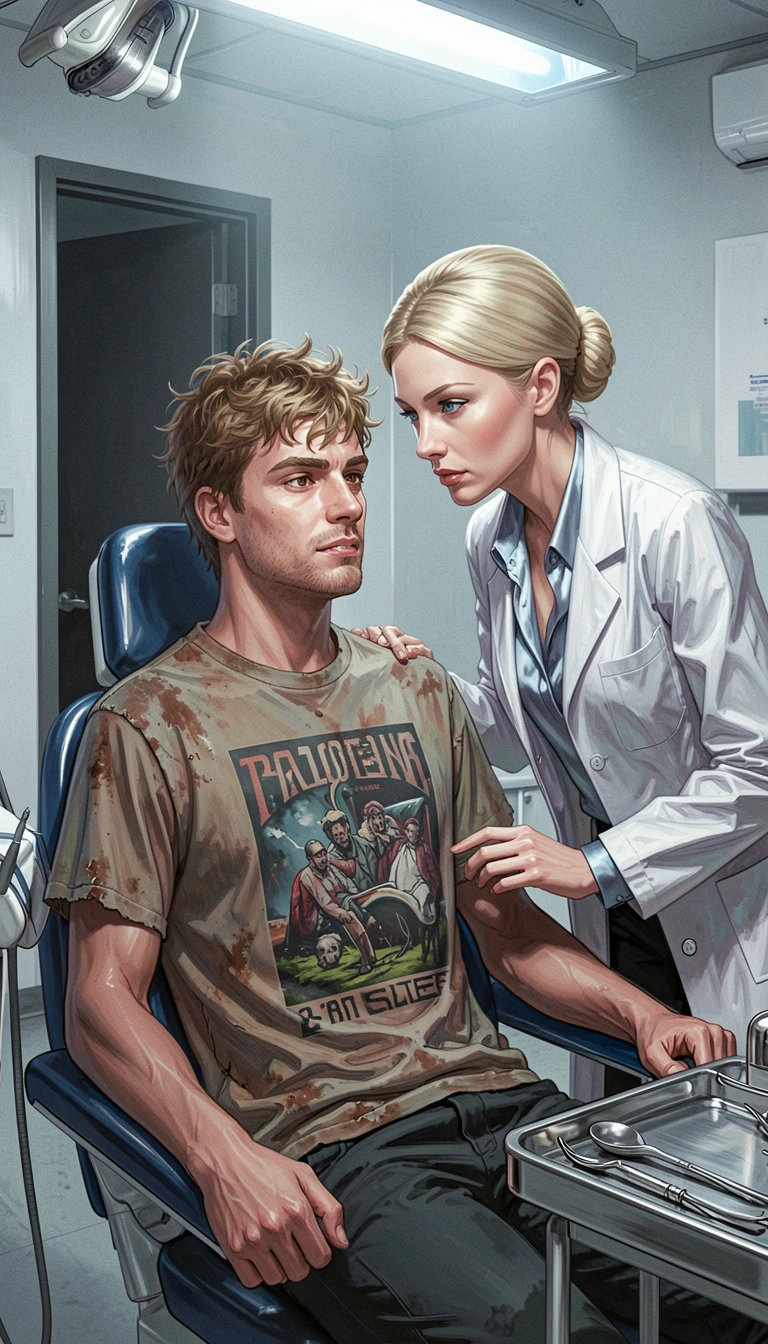
The light came back gray and thin, the way it comes through a window you forgot had blinds, and Tyler's first thought was that he was cold. Not the shivering kind. The kind where you notice the air on a strip of skin you didn't know was bare.
His back. His back was bare. The vinyl under him was cold and tacky, and it peeled a little when he shifted, and the sound of it was loud in the room. The chair was still tipped back. The lamp was still down over him, dead, a black circle of glass the size of a dinner plate.
He lay still and listened.
The fish tank. That hum, the one that had been there all night, low and steady, coming through the open door from the front office. Nothing else. No footsteps. No water in a pipe. No car out in the lot. He held his breath and waited for a door, a voice, the click of a lock, and got the hum and the hum and the hum.
His mouth tasted like metal and sugar. He worked his tongue along his teeth and found the molar, and it was smooth and strange and not his, a thing sitting in his jaw that he could feel but couldn't quite claim. No pain. That was the first good thing. He turned it over like a coin. No pain.
He sat up.
It took a long time. He did it in pieces, elbows first, then his back off the vinyl, then his legs swinging down over the side of the chair, and his feet found the floor and his knees did not want to hold. He sat there with his hands on his thighs and his head down and let the room stop moving. His jeans were on. Buttoned. No belt. The denim was loose at his waist and he could feel the whole waistband sitting low, and he put a hand there and pressed it flat against his stomach like he could hold himself in.
His shirt was gone. He looked around for it, the way you look for a thing you know is not there, checking the chair arm, the floor, the counter by the sink. Nothing. Just his own chest and the goosebumps and the cold.
The extraction set was still out.
He saw it on the lower shelf across the room, on the folded blue cloth, and it stopped him the way a snake stops you, before you know it's a snake. The instruments were laid in a row, biggest to smallest, the way you'd lay out silverware. They hadn't been used. He could see that from here. They were clean and still and in the same order somebody had put them in, and that was somehow worse than if they'd been scattered.
He stood up.
His legs were borrowed. That was the only word for it. They moved when he told them to, but late, like the message had to travel a long way, and his feet felt the floor through a layer of something. He took one step and then another and put his hand on the counter by the sink and stood there breathing.
The door to the exam room was open. He hadn't heard it open. It was just open now, and the hall beyond it was gray, and the fish tank hum came through it and filled the room like water.
He went out.
The hall was short. He remembered it being longer. There was the door to the room where they'd put his shirt, and it was shut, and he tried the knob and it turned and the room behind it was dark and small and had a sink and a cabinet and no shirt, no shirt anywhere, not on the chair, not on the floor, and he stood in the doorway and looked at the empty room for longer than it deserved.
He closed the door and kept going.
The front office was gray with morning. The blinds over the window were half open and the light came through in bars and lay across the carpet and across the reception desk and across the fish tank, and the fish were awake, drifting, orange and slow, and the hum was loud out here, and the waiting room chairs sat in their row with the magazines fanned on the table the way they'd been the day before, and it was all exactly the same, and that was the thing that made his stomach turn. Nothing had moved. The whole office was sitting there like a photograph of itself.
The front door was unlocked.
He knew because he walked to it and put his hand on the deadbolt and it turned under his thumb without any resistance at all, and the door swung in a half inch and the cold came in off the parking lot and touched his bare chest. He stood there with his hand on the door and looked out through the gap. The lot was empty. His Corolla was out there by itself, the only car, sitting under the light pole with the rust along the wheel well, and beyond it the road, and beyond that the fields, and the sky was the color of a nickel.
He closed the door. He didn't lock it. He didn't know why he didn't lock it. He just stood there with his hand on the door and then he turned around and looked at the counter.
His wallet was on it.
He crossed the room and picked it up and it was warm from the counter, or from the light, and he opened it and the cash was there, folded the way he folded it, the two hundreds and the two twenties, tucked in the billfold like nothing had happened. He stood there and counted it twice with his thumb and it was all there, every dollar, and he didn't know what to do with that. He had come in with two hundred and forty dollars and he was leaving with two hundred and forty dollars and a tooth he didn't pay for.
Under the wallet was a receipt.
It was a new one. Not the one from last night, not the one with the blank total line. This one was printed and the total line was filled in, and the number on it was 2,400.00, and it sat there on the counter in black ink like it had always been there, like the machine had printed it while he slept.
And under the total line, in blue ballpoint, in handwriting he knew, was a note.
Paid in full. See you Friday.
He read it three times. The same five words, the same blue ink, the same slant to the letters — the S in See with its little hook, the F in Friday pressed hard enough to ridge the paper. It was the same hand that had written 6:00 AM on the other receipt. It was the same hand that had folded his cash and slid it back into his wallet and set the wallet down on the counter like a tip.
His thumb found the edge of the receipt and he turned it over. The back was blank. He turned it again, front, and the number sat there in its box, 2,400.00, and under it the words that made the number mean nothing. Paid in full. He had two hundred and forty dollars in his wallet and a receipt that said he owed nothing, and both of those things were true at the same time, and neither of them was the thing that was actually happening.
His keys.
He looked at the counter the way he'd looked at the empty room down the hall — checking the places a thing should be, knowing it wasn't. The wallet. The receipt. A pen cup. A little tray of business cards with the clinic's name and a phone number that was probably real. The edge of the counter where the laminate had lifted. No keys. He lifted the wallet and looked under it. He ran his hand along the lip of the counter, felt the cold seam of it, the grit in the corner. Nothing.
He checked his pockets. Front left, front right, back. The denim was loose without the belt and his hands went in easy, and they came out empty, and he stood there with his palms open like he was showing them to somebody.
She had taken them. He remembered that much, the way you remember a thing that happened to somebody else — his hand going out with the keys on the ring, the little brass tag from the hardware store, the Corolla key worn smooth on one side. He had handed them over. He had stood in this room and given a woman his keys and she had put them in her coat pocket and he had watched her do it and had not said a word, and now the coat was gone and so were the keys and his car was out there under the light pole with the rust along the wheel well and he could not get into it.
He put the wallet in his back pocket. He folded the receipt along its creases and put it in the front, behind the cash, where the other one had been. His fingers knew that fold. They'd done it before.
The clock on the wall said 6:47.
He looked at it for a while. The second hand moved in little jumps, the way cheap clocks do, and he watched it go around twice and the minute hand didn't move and then it did, one tick, and it was 6:48. Somewhere in the building a compressor kicked on and the fish tank hum changed pitch, and he stood in the gray light with his bare chest and his loose jeans and the receipt in his pocket and did the arithmetic. He had come in at six the night before. He had been in this building for almost thirteen hours. He did not know how many of them he had been awake for.
His phone was in his other pocket, dead, and he took it out and pressed the button anyway, the way you press a light switch in a house with the power out. Nothing. The screen stayed black and gave him back a little smudge of his own thumb.
Then the drill started.
It came from down the hall, past the exam room, past the little dark room with the sink and the cabinet, from somewhere at the back of the building where he had never been. A high whine, thin and steady, the sound a dentist's drill makes when it's not touching anything yet — just spinning, just waiting. It went up half a step and held there. Then it stopped. Then it started again.
He had walked that hall. He had stood in the doorway of every room on it and looked inside and there had been nobody. The rooms had been dark and empty and the doors had been shut and he had opened them himself, one by one, and there had been a sink and a cabinet and a chair and no shirt and no people. That was ten minutes ago. That was a fact he had in his hands.
The drill ran. The hum of the tank ran under it. The clock ticked. He stood very still in the middle of the front office with his bare chest and his wallet in his pocket and listened to a machine running in a building he had just confirmed was empty, and the cold off the parking lot came in through the gap under the door and moved across the floor and found his feet.
He could go. The door was right there. It was unlocked — he'd felt it turn under his thumb, no resistance at all, like an invitation. He could walk out into the lot in his bare chest and his loose jeans and stand under the light pole next to his locked car, and he could wait there in the nickel-colored morning for somebody to come, and somebody would come, somebody always came down that road eventually. That was one thing he could do.
Or he could walk down the hall.
The drill stopped. In the silence the tank hum came back up and filled the room, and the clock ticked, and Tyler stood with his weight on the balls of his feet, one hand on the edge of the counter, and looked down the gray hall toward the back of the building where the sound had been. The exam room door stood open at the end of it. Past that, dark. Past that, whatever room the drill was in, and whoever was holding it, and whatever they were doing at 6:48 in the morning in a place that had been locked all night.
The note in his pocket said Friday. It was not Friday. He didn't know what day it was, but he knew it was not Friday, because he had come in on a Tuesday with his rent due in six days and his tooth cracked open like a bad egg, and six days from Tuesday was not Friday, and the woman who wrote in blue ballpoint had written a day that had not happened yet like it was already behind her.
He took his hand off the counter.
He walked to the door. He put his palm flat on it, the cold metal of it, the deadbolt still turned the way he'd left it, and he stood there with his forehead almost touching the glass and looked out at his Corolla sitting alone under the light pole with the rust along the wheel well and the driver's door he could not open. The fields beyond the road were the color of the sky. Nothing moved out there. No car, no truck, no farmer, no dog. Just his car and the road and the fields and the light coming up gray and thin the way it had come up in the room where he'd woken.
He turned the deadbolt. It clicked. He didn't know why he did that either. He just did it, and then he turned around, and he walked down the hall toward the sound.