
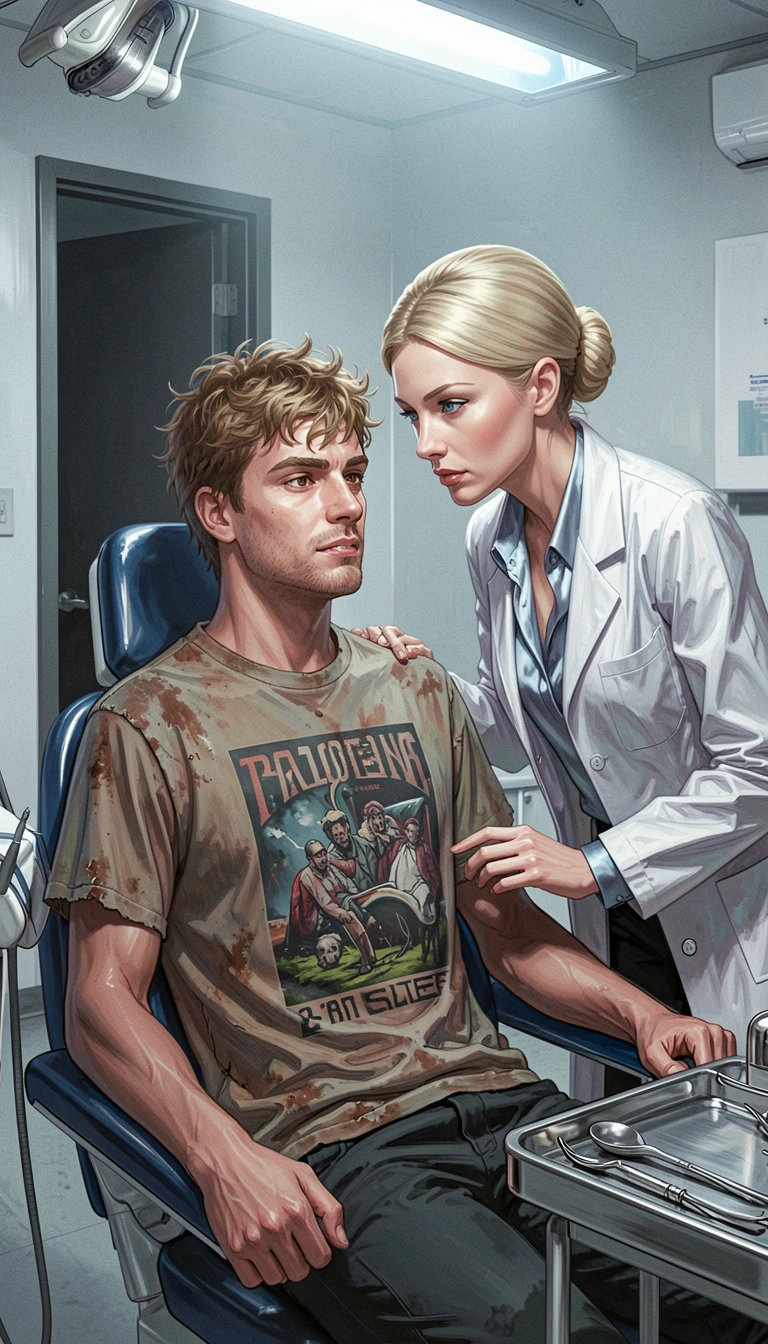
Friday came the way a bill comes. Tyler had spent the week working doubles at the warehouse because the alternative was lying in his rented room with the lights off, and lying in the dark made the phantom pressure worse — the straps that weren't there, the vinyl that wasn't under him, the yellow lamp that wasn't overhead. So he worked. He lifted and stacked and clocked out and clocked back in and ate gas-station sandwiches standing up, and by Friday afternoon his hands smelled like cardboard and his jaw had settled into a low, steady throb he'd stopped trying to place.
He showered at the laundromat on Fifth because his building's water ran cold after six. He scrubbed himself with the same bar of soap he'd used on his hands, twice, then a third time, and stood under the weak spray until it went tepid. Clean. She'd said clean. He didn't know why that mattered and he didn't ask himself.
He put on the jeans he'd worn to the clinic before, the ones with the buttonhole he'd finally learned, and a gray t-shirt that wasn't his band tee because his band tee was on Renata's back somewhere in that building and he'd stopped pretending that bothered him. No wallet. No phone. He left them on the mattress, and the mattress was the only thing in the room besides a milk crate and a lamp, and he looked at the wallet sitting there and closed the door on it.
The drive took an hour and eleven minutes. He knew because he watched the clock on the dash the whole way, and the number didn't change what he was doing. The county road unspooled under his tires, past the soybean fields and the one gas station with the sign missing letters, and the sun went low and orange behind him and threw his shadow down the road ahead of the car like something walking in front of him.
He pulled into the lot at five forty-eight. The Corolla's engine ticked as it cooled. The clinic's front window was dark, and the side door was dark, and the only light in the whole low building was a thin yellow line under the back door at the end of the building, the one he'd never used, the one that faced the dumpsters.
He sat in the car with his hands on the wheel and the keys in the ignition and the doors locked, all four of them, and he counted his own breaths the way he'd counted them all week, and then he turned the engine off and got out.
The gravel was loud under his boots. The air smelled like diesel and cut grass and, underneath it, faint, the mint. He walked to the front door because that was the door he knew, and he knocked on the glass, and the fish tank inside glowed blue and empty and nobody came.
So he walked around the building. Past the dumpster with its lid chained shut. Past the window with the blinds drawn and the little sign that said CLOSED. Past the side door, which was the door she'd held open for him the last time, and which was dark now, and which he stopped in front of and did not knock on. And then to the back door, the one under the yellow light, and he stood in front of it with his arms at his sides and did not knock, because he didn't know if he was supposed to.
The door opened before he decided.
Renata stood in the frame with the yellow light behind her and her red hair down, not in the ponytail, hanging past her shoulders in loose waves that caught the light at their edges. She wore black scrubs, the same black scrubs, and the silver necklace, and no shoes, just socks, and she looked at him the way you look at a package you've been expecting.
"There he is," she said. "Right on time."
"I said I'd come."
"You did." She stepped back and the doorway opened wider. "Come in out of the cold."
He stepped in. The back of the building was different from the front — no fish tank, no magazines, no carpet. Bare concrete under his boots, walls the color of old teeth, a corridor that ran straight ahead of him with doors on either side, most of them shut. The light came from a bare fluorescent tube overhead that hummed at the edge of hearing, and the hum got into his teeth and sat there.
Renata shut the door behind him. He heard the latch, and then he heard a second sound, lower, a bolt sliding home, and he didn't turn around to look at it.
"You look tired," she said.
"I worked doubles."
"All week?"
"Yeah."
"Did you sleep?"
He thought about the ceiling of his room and the phantom straps and the way his own hands had felt like somebody else's when he woke up. "Some."
She tilted her head. Her eyes crinkled at the corners the way they did, the way that had made him trust her the first day, and the crinkle was still there and it still worked, and he hated that it still worked, and he stood there in the humming corridor and let it work.
"You're a shell," she said, not unkindly. "You know that? You came in here in April all nervous, talking about your car and the weather, and now look at you. Standing in my hallway like you live here."
"I don't live here."
"No," she said. "Not yet."
She walked past him, close enough that he caught the mint and, under it, that sweeter thing, and she put her hand flat on his chest for half a second as she passed, not pushing, just there, just marking the spot, and then she was ahead of him in the corridor and he was following her because there was nothing else to do with his body.
The corridor ran deeper than he'd have guessed from outside. They passed a supply closet with a padlock on the hasp, and a door with a small square window he couldn't see through because the glass was frosted, and a bathroom with the light off, and the fluorescent tube buzzed overhead the whole way and he counted the doors to keep his mind from going where it wanted to go, which was the chair, which was the four brackets, which was the dark stain at the base of the seat.
"Where's Dr. Mack," he said. His voice came out flat. He hadn't meant it to.
"She's here," Renata said, ahead of him, not turning. "She's always here. She's getting things ready."
"Ready for what."
"For you." She said it like it was the most ordinary sentence in the world, and maybe to her it was. "You asked what happened to the last one. She didn't answer you. That was on purpose. You don't get the answer until you're in the room."
The corridor turned. He hadn't known it turned. He'd assumed the building was a rectangle and the back room with the chair was the end of it, but the corridor turned left and kept going, and the fluorescent tube ended at the turn and a different light picked up, warmer, from a doorway at the far end, and the air changed — less antiseptic, more dust, the smell of a room that doesn't get opened much.
Renata stopped in the middle of the corridor and turned to face him. She looked at him for a long moment, and her face did something he hadn't seen it do before — not the crinkle, not the warmth, but a flatness underneath, like a card turning over, showing its back.
"I want you to understand something," she said. "Before we go in."
"Okay."
"The front door is for people who leave. You came in the front door the first time. You came in the side door after that. Tonight you came in the back door, and the back door doesn't open from the inside." She let that sit. "I'm telling you because I like you. I've liked you since April. I want you to know what you're doing instead of finding out later."
Tyler stood in the corridor with his arms at his sides and his heart doing something slow and heavy in his chest, and he thought about the car in the lot with the keys in the ignition and the doors he'd locked, and how the keys were in the car and the car was behind a bolted door and the bolted door was behind him, and how none of that was the reason he wasn't running.
"I know what I'm doing," he said.
"Do you."
"I came back."
"Yeah," Renata said. "You did." And the flatness went out of her face and the warmth came back, and she smiled at him with her dimples and her crinkled eyes and reached out and took his hand, her fingers cool and dry around his, and led him the rest of the way down the corridor to the doorway at the end.
The room past the doorway was small and windowless and lit by one lamp on a metal stand, and the lamp had a shade that turned the light the color of weak tea. There was a chair in the middle of it. Not the dental chair — an older one, wood-framed, with a cracked leather seat and arms worn smooth at the ends, the kind of chair that had been in a waiting room once, a long time ago, before it got moved back here and forgotten. There was a steel tray on a rolling cart beside it, and a folded towel on the seat, and nothing else in the room at all except the lamp and the chair and the cart and, on the wall, a single electrical outlet with nothing plugged into it.
"Sit," Renata said.
He sat. The leather was cool through his jeans and the chair creaked under him and the arms were smooth under his palms and he put his hands there because there was nowhere else to put them, and the lamp threw his shadow up the wall behind him, huge and still.
Renata stood in front of him with her hands behind her back and looked down at him, and the tea-colored light made her freckles stand out across her nose, and she was quiet for a while, and the quiet had weight in it, and Tyler sat in the old chair and let the weight press down on him and did not say anything, because he'd learned that much.
"Good," she said finally. "You're learning."
She turned and walked to the doorway, and Tyler watched her go, and at the threshold she stopped and put her hand on the frame, and her fingers drummed there once, twice, light, the way they had on the counter the first day, the way they did when she was thinking about something she wasn't going to say.
"Dr. Mack will be in soon," she said. "She's finishing up. She likes to finish up."
"Renata."
"Mm."
"What's the towel for."
She looked back at him over her shoulder, and the tea-colored light caught one side of her face and left the other in shadow, and she smiled, and it was the same smile she'd given him through the window in April, warm and girl-next-door and absolutely certain of itself.
"You'll see," she said. "Don't move, Tyler. Not yet."
She stepped back into the hallway and pulled the door almost closed behind her, leaving a sliver of the humming fluorescent light down the edge, a thin bright line that fell across the concrete floor and stopped at the leg of the chair. The latch clicked. The room went dark except for that sliver and the tea-colored lamp, and the lamp hummed too, a lower hum than the tube in the hall, and the two hums beat against each other in the small room and made a third sound that wasn't either of them.
Tyler sat in the old chair with his hands on the worn arms and his shadow on the wall and did not move, because she'd told him not to, and because he'd already decided, somewhere in the hour of driving with the sun going down behind him, that he was going to do what they told him, and that the deciding had happened a long time ago and he was only now catching up to it.
He looked down at the floor beneath the chair. There was a stain on the concrete, dark and old, spread out from under the front leg in a shape that had no edges, the kind of stain that had been there long enough to stop being a stain and start being part of the floor. He looked at it for a while. He didn't ask about it, because there was no one in the room to ask, and because he already knew, in the flat place under his ribs where the answers lived now, that he wasn't going to like the answer.
So he sat. The towel was folded on the seat beside his thigh, clean and white and square. The cart held its tray and the tray held nothing he could see from this angle. The lamp hummed. The fluorescent tube hummed. Somewhere past the door, down the corridor, a drawer opened and closed, and then another, and then a third, and the sounds came in a slow deliberate rhythm, the way Dr. Mack did things, the way she'd written in his folder while he walked out of the room, the way she'd told him long charts are the ones that stay.
He was still sitting there with his hands on the arms of the chair when the sliver of light at the door widened, and a pair of soft-soled shoes appeared in it, and stopped, and the door swung open the rest of the way.